Deakin MAA310: Accounting and Society Climate Risk Report
VerifiedAdded on 2022/09/13
|13
|2996
|30
Report
AI Summary
This report provides an analysis of climate-related risks within the context of accounting and society, specifically focusing on the case of Yancoal. It begins with an executive summary highlighting the key findings and recommendations. The discussion delves into the implications of climate risk, examining it from the perspective of agency theory, particularly in the context of BlackRock's revised investment practices. It then evaluates Yancoal's climate-change-related risk disclosures through the lens of institutional theory, assessing the company's sustainability reporting. The report evaluates Yancoal's sustainability reports and provides recommendations for improving climate-related risk disclosures, emphasizing the importance of proactive strategies and stakeholder engagement. The report covers various aspects, including assessing business challenges, complying with regulatory requirements, meeting stakeholder expectations, providing risk management, developing a company strategy, raising finance for low-carbon projects, and reducing climate risk exposure.
Running Head: ACCOUNTING AND SOCIETY
ACCOUNTING AND SOCIETY
Name of the Student
Name of the University
Author Note
ACCOUNTING AND SOCIETY
Name of the Student
Name of the University
Author Note

Paraphrase This Document
Need a fresh take? Get an instant paraphrase of this document with our AI Paraphraser
1ACCOUNTING AND SOCIETY
Executive Summary
Climate change is accepted as present risk, which organizations in the different industries are
already facing around the world. This report aims to provide report to the board of directors
of Yancoal regarding climate-change related risk disclosures. Hence, it is recommended to
Yancoal to develop, implement and improve the climate risks strategies by following some
major steps, which are assessing challenges of business climate, complying with the
requirement of climate regulatory reporting, meeting stakeholders expectations, providing
opportunities and risk management, developing own strategy, raising finance for the low
carbon projects and reducing the climate risk exposure.
Executive Summary
Climate change is accepted as present risk, which organizations in the different industries are
already facing around the world. This report aims to provide report to the board of directors
of Yancoal regarding climate-change related risk disclosures. Hence, it is recommended to
Yancoal to develop, implement and improve the climate risks strategies by following some
major steps, which are assessing challenges of business climate, complying with the
requirement of climate regulatory reporting, meeting stakeholders expectations, providing
opportunities and risk management, developing own strategy, raising finance for the low
carbon projects and reducing the climate risk exposure.
2ACCOUNTING AND SOCIETY
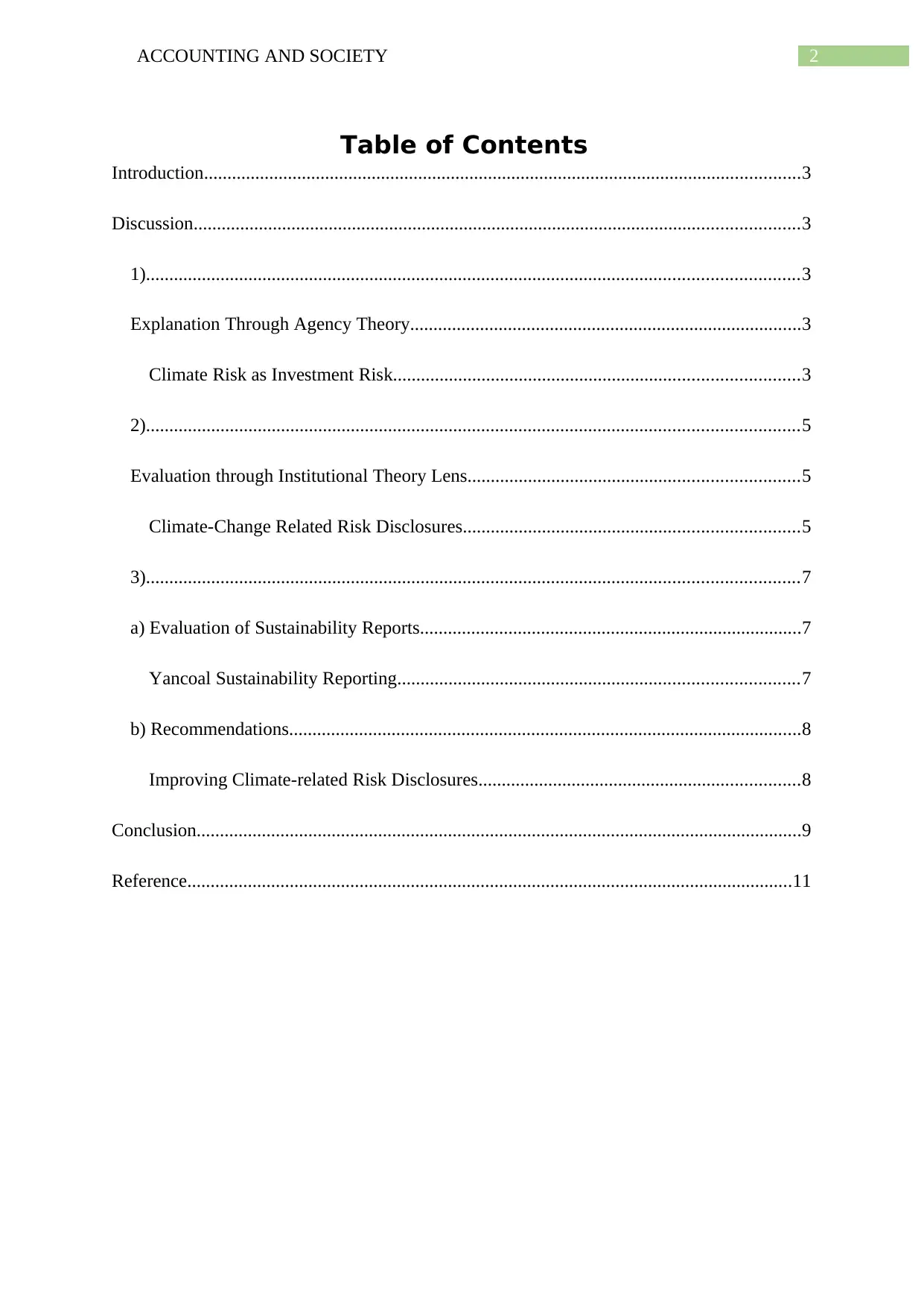
Table of Contents
Introduction................................................................................................................................3
Discussion..................................................................................................................................3
1)............................................................................................................................................3
Explanation Through Agency Theory....................................................................................3
Climate Risk as Investment Risk.......................................................................................3
2)............................................................................................................................................5
Evaluation through Institutional Theory Lens.......................................................................5
Climate-Change Related Risk Disclosures........................................................................5
3)............................................................................................................................................7
a) Evaluation of Sustainability Reports..................................................................................7
Yancoal Sustainability Reporting......................................................................................7
b) Recommendations..............................................................................................................8
Improving Climate-related Risk Disclosures.....................................................................8
Conclusion..................................................................................................................................9
Reference..................................................................................................................................11
Table of Contents
Introduction................................................................................................................................3
Discussion..................................................................................................................................3
1)............................................................................................................................................3
Explanation Through Agency Theory....................................................................................3
Climate Risk as Investment Risk.......................................................................................3
2)............................................................................................................................................5
Evaluation through Institutional Theory Lens.......................................................................5
Climate-Change Related Risk Disclosures........................................................................5
3)............................................................................................................................................7
a) Evaluation of Sustainability Reports..................................................................................7
Yancoal Sustainability Reporting......................................................................................7
b) Recommendations..............................................................................................................8
Improving Climate-related Risk Disclosures.....................................................................8
Conclusion..................................................................................................................................9
Reference..................................................................................................................................11
⊘ This is a preview!⊘
Do you want full access?
Subscribe today to unlock all pages.

Trusted by 1+ million students worldwide
3ACCOUNTING AND SOCIETY
Introduction
The financial report published by organization provides information about only
financial performance, but in order to understand about non-financial information,
sustainability report is published by organization. A sustainability report is key platform to
communicate sustainability impacts and performance is positive or negative (Haque, S.,
Deegan and Inglis 2016). Hence, this report aims to discuss from agency theory perspective,
the reason of revising investing practices by BlackRock for considering climate risk as the
investment risk. Further, evaluation will be done by considering institutional theory that
whether Yancoal has provided climate change related risk disclosures. Lastly, annual and
sustainability reports of Yancoal will be evaluated for finding whether adequate climate
change related risk disclosures have been made by company or not and based on this,
recommendations will be given to improve these disclosures for 2019.
Discussion
1)
Explanation Through Agency Theory
Climate Risk as Investment Risk
The largest asset management corporation of world, Blackrock announces various
initiatives of sustainability, recognized climate as the investment risk and have urged entities
for improving their financial disclosures to the shareholders relating to climate risks. The
concerns regarding climate change is invariably top issue raised by the clients of BlackRock
from all over the world, as they are asking for modifying their portfolios (Eleftheriadis and
Anagnostopoulou 2015). It has become the defining aspect in the long-term prospects of the
companies. The investors are compelled by the climate risk evidences for reassessing core
assumptions regarding modern finance. They constantly seek to understand regarding
Introduction
The financial report published by organization provides information about only
financial performance, but in order to understand about non-financial information,
sustainability report is published by organization. A sustainability report is key platform to
communicate sustainability impacts and performance is positive or negative (Haque, S.,
Deegan and Inglis 2016). Hence, this report aims to discuss from agency theory perspective,
the reason of revising investing practices by BlackRock for considering climate risk as the
investment risk. Further, evaluation will be done by considering institutional theory that
whether Yancoal has provided climate change related risk disclosures. Lastly, annual and
sustainability reports of Yancoal will be evaluated for finding whether adequate climate
change related risk disclosures have been made by company or not and based on this,
recommendations will be given to improve these disclosures for 2019.
Discussion
1)
Explanation Through Agency Theory
Climate Risk as Investment Risk
The largest asset management corporation of world, Blackrock announces various
initiatives of sustainability, recognized climate as the investment risk and have urged entities
for improving their financial disclosures to the shareholders relating to climate risks. The
concerns regarding climate change is invariably top issue raised by the clients of BlackRock
from all over the world, as they are asking for modifying their portfolios (Eleftheriadis and
Anagnostopoulou 2015). It has become the defining aspect in the long-term prospects of the
companies. The investors are compelled by the climate risk evidences for reassessing core
assumptions regarding modern finance. They constantly seek to understand regarding
Paraphrase This Document
Need a fresh take? Get an instant paraphrase of this document with our AI Paraphraser
4ACCOUNTING AND SOCIETY
physical risks linked with the climate change and ways by which climate policy impacts
costs, prices as well as demand all across economy (Hahn, Reimsbach and Schiemann 2015).
The impact of climate change is felt in the range of the ways all across different
sectors of investment, geographies as well as assets classes. For instance, entities with the
higher carbon emissions are usually more at the regulatory measures’ risks and agency
problems. The organizations owning the reserves of fossil fuel may see fall in value of these
assets, as policies are brought for reducing emissions (Freedman and Park 2014). Further,
energy sector is not only affected, but risk of climate change can indirectly or directly
influence the other sectors by revenues, expenses, operations, distributions and supply chains,
which ultimately affects the investors and other stakeholders of company (Lee, Park and
Klassen 2015).
Based on agency theory, it can be said that the significance to serve stakeholders as
well as embracing the purpose is now becoming gradually central to the way organizations
are understanding their role towards society. It is not possible for the organization to achieve
the long-term profits without embracing the purposes and thinking about broad stakeholders’
range (Zenghelis and Stern 2016). For instance, if company increases their prices of product,
fails to respect their clients and not focusses towards safety, may maximize their returns in
short-run, but in the long run, these actions tends to damage society and destroy the value of
their shareholders. In comparison to this, strong sense of commitment and purpose towards
stakeholders helps the company in connecting more deeply with its customers and adjust to
the changing society’s demand (Ben‐Amar and McIlkenny 2015).
The countries and organizations that does not responds to the stakeholders and do not
addresses the risks of sustainability and do not responds to the stakeholders, they will be
encountering growing skepticism from market that in turn results in higher cost of the capital.
physical risks linked with the climate change and ways by which climate policy impacts
costs, prices as well as demand all across economy (Hahn, Reimsbach and Schiemann 2015).
The impact of climate change is felt in the range of the ways all across different
sectors of investment, geographies as well as assets classes. For instance, entities with the
higher carbon emissions are usually more at the regulatory measures’ risks and agency
problems. The organizations owning the reserves of fossil fuel may see fall in value of these
assets, as policies are brought for reducing emissions (Freedman and Park 2014). Further,
energy sector is not only affected, but risk of climate change can indirectly or directly
influence the other sectors by revenues, expenses, operations, distributions and supply chains,
which ultimately affects the investors and other stakeholders of company (Lee, Park and
Klassen 2015).
Based on agency theory, it can be said that the significance to serve stakeholders as
well as embracing the purpose is now becoming gradually central to the way organizations
are understanding their role towards society. It is not possible for the organization to achieve
the long-term profits without embracing the purposes and thinking about broad stakeholders’
range (Zenghelis and Stern 2016). For instance, if company increases their prices of product,
fails to respect their clients and not focusses towards safety, may maximize their returns in
short-run, but in the long run, these actions tends to damage society and destroy the value of
their shareholders. In comparison to this, strong sense of commitment and purpose towards
stakeholders helps the company in connecting more deeply with its customers and adjust to
the changing society’s demand (Ben‐Amar and McIlkenny 2015).
The countries and organizations that does not responds to the stakeholders and do not
addresses the risks of sustainability and do not responds to the stakeholders, they will be
encountering growing skepticism from market that in turn results in higher cost of the capital.
5ACCOUNTING AND SOCIETY
In comparison to this, the countries and companies, which demonstrates transparency and
their responsiveness towards stakeholders, they will be attracting the investments more
effectively, which includes higher quality as well as more patient capital. The sustainability
disclosers made by the organizations helps in mitigating agency costs and are used by the
stakeholders for ascertaining that whether these risks are properly oversees and managed by
the entity within their business or not. In absence of the robust disclosures made by the
companies on these issues and risks, the investors and the other stakeholders will be
concluding that companies are not managing the risk adequately (BlackRock. 2020).
2)
Evaluation through Institutional Theory Lens
Climate-Change Related Risk Disclosures
Change in climate is gaining significant attention as the global dilemma of
environment. Given the growing significance of the climate change, various groups of
stakeholders have placed the climate change on the agenda of corporate and expecting the
business organizations for responding to their concerns and disclosing the relevant
information. There is increasing pressure from stakeholder regarding widespread disclosure
relating to corporate responsibility towards change in climate (Ben-Amar, Chang and
McIlkenny 2017).
Institutional theory posits that practices and policies of organization responds to the
institutional and social pressures exerted by the powerful groups of stakeholders for
conforming to the prevailing expectations of society for maintaining, repairing or gaining
legitimacy. The organizations conform to the institutional pressure for the change because
they get rewarded to do so by increasing resources, legitimacy and the survival capabilities.
The significant aspect of the institutional theory is the concept of isomorphic and
isomorphism (Woods, Linsley and Maffei 2016). The institutional isomorphic pressure is
In comparison to this, the countries and companies, which demonstrates transparency and
their responsiveness towards stakeholders, they will be attracting the investments more
effectively, which includes higher quality as well as more patient capital. The sustainability
disclosers made by the organizations helps in mitigating agency costs and are used by the
stakeholders for ascertaining that whether these risks are properly oversees and managed by
the entity within their business or not. In absence of the robust disclosures made by the
companies on these issues and risks, the investors and the other stakeholders will be
concluding that companies are not managing the risk adequately (BlackRock. 2020).
2)
Evaluation through Institutional Theory Lens
Climate-Change Related Risk Disclosures
Change in climate is gaining significant attention as the global dilemma of
environment. Given the growing significance of the climate change, various groups of
stakeholders have placed the climate change on the agenda of corporate and expecting the
business organizations for responding to their concerns and disclosing the relevant
information. There is increasing pressure from stakeholder regarding widespread disclosure
relating to corporate responsibility towards change in climate (Ben-Amar, Chang and
McIlkenny 2017).
Institutional theory posits that practices and policies of organization responds to the
institutional and social pressures exerted by the powerful groups of stakeholders for
conforming to the prevailing expectations of society for maintaining, repairing or gaining
legitimacy. The organizations conform to the institutional pressure for the change because
they get rewarded to do so by increasing resources, legitimacy and the survival capabilities.
The significant aspect of the institutional theory is the concept of isomorphic and
isomorphism (Woods, Linsley and Maffei 2016). The institutional isomorphic pressure is
⊘ This is a preview!⊘
Do you want full access?
Subscribe today to unlock all pages.
Trusted by 1+ million students worldwide
6ACCOUNTING AND SOCIETY
referred to institutional practices’ adaptation by the organization. There include three kinds of
the institutional isomorphic pressures, which includes normative pressures, mimetic pressure
and coercive pressures (Campiglio et al. 2018).
The reliance of companies on the funding of investor might results in significant
pressure on the companies for meeting demands of investors. There is increasing demand of
investor for the corporate information that pertains to change in climate and the companies,
which are better practices of disclosures are more capable to source funds from the investors.
For instance, one largest Australian investor’s group stated in their website that they are
expecting the entities to disclose their emission data of GHG, so that they can be able to
assess their strategies and performance to manage carbon emissions. This statement clearly
signifies that the entities that are having better strategies of climate and the reporting
practices, they are more likely to get the funding and support from the leading institutional
investors (Peters and Romi 2014).
Hence, various groups express their concerns regarding climate change issues and
they demand information and their demands and concerns appears for conforming top those
of stakeholders and community. The organizations are required to acknowledge the climate
change risks in their sustainability report and reflect on the priorities around the attitudes of
stakeholders, change in the policies of climate and potential opportunities of business, which
are consistent with the aspirational goals of not harming communities, employees and
environment. These entities should be more concerned regarding need to recognize climate
change issue in their policies of corporate, as the part to demonstrate good stewardship of the
resources as well as meeting various institutional expectations (Christophers 2017).
The pressures from the powerful stakeholders for the particular practices, especially
practices of disclosures will shape and influence the powerful stakeholders for the behavior
referred to institutional practices’ adaptation by the organization. There include three kinds of
the institutional isomorphic pressures, which includes normative pressures, mimetic pressure
and coercive pressures (Campiglio et al. 2018).
The reliance of companies on the funding of investor might results in significant
pressure on the companies for meeting demands of investors. There is increasing demand of
investor for the corporate information that pertains to change in climate and the companies,
which are better practices of disclosures are more capable to source funds from the investors.
For instance, one largest Australian investor’s group stated in their website that they are
expecting the entities to disclose their emission data of GHG, so that they can be able to
assess their strategies and performance to manage carbon emissions. This statement clearly
signifies that the entities that are having better strategies of climate and the reporting
practices, they are more likely to get the funding and support from the leading institutional
investors (Peters and Romi 2014).
Hence, various groups express their concerns regarding climate change issues and
they demand information and their demands and concerns appears for conforming top those
of stakeholders and community. The organizations are required to acknowledge the climate
change risks in their sustainability report and reflect on the priorities around the attitudes of
stakeholders, change in the policies of climate and potential opportunities of business, which
are consistent with the aspirational goals of not harming communities, employees and
environment. These entities should be more concerned regarding need to recognize climate
change issue in their policies of corporate, as the part to demonstrate good stewardship of the
resources as well as meeting various institutional expectations (Christophers 2017).
The pressures from the powerful stakeholders for the particular practices, especially
practices of disclosures will shape and influence the powerful stakeholders for the behavior
Paraphrase This Document
Need a fresh take? Get an instant paraphrase of this document with our AI Paraphraser
7ACCOUNTING AND SOCIETY
of organizations. It is not possible for the organization to survive without support of the
powerful groups of stakeholders. The companies that is fast in adapting changes in their
behavior of disclosure, they achieve competitive advantage. Hence, it is because of all above
reason, Yancoal should provide the disclosures relating to climate-change related risk (Ben-
Amar, Chang and McIlkenny 2017).
3)
a) Evaluation of Sustainability Reports
Yancoal Sustainability Reporting
Yancoal Australia Limited is the largest producer of pure coal in Australia. It is
operating five mines as well as managing five others all across Western Australia,
Queensland and South Wales. Yancoal understand its role of stewardship for safeguarding
itself and those who are involved with the business and it continues to achieve its ambitious
goal to achieve zero harm at the operations. The company continues looking for the new
ways of working for always protecting their people. Further, Yancoal acknowledge that it
plays major role in mitigating emissions that is generated by its operations and it supports
into the research for technology of low-emission in order to assists downstream emissions
reduction from coal products consumptions (Yancoal.com.au. 2020).
This company recognizes stakeholders’ growing interest relating to potential
opportunities and risks posed to the business and broader sector as the outcome of anticipated
global shift towards the lower-carbon economy. The board of Yancoal continues for
considering Taskforce on the “Climate-related Financial Disclosures Recommendations”,
which is established by Financial Stability Report of G20, as framework guiding company’s
climate-related disclosures. This consideration includes desires for the greater transparency in
way company identify and mitigates potential risks posed by any kind of changes in the
of organizations. It is not possible for the organization to survive without support of the
powerful groups of stakeholders. The companies that is fast in adapting changes in their
behavior of disclosure, they achieve competitive advantage. Hence, it is because of all above
reason, Yancoal should provide the disclosures relating to climate-change related risk (Ben-
Amar, Chang and McIlkenny 2017).
3)
a) Evaluation of Sustainability Reports
Yancoal Sustainability Reporting
Yancoal Australia Limited is the largest producer of pure coal in Australia. It is
operating five mines as well as managing five others all across Western Australia,
Queensland and South Wales. Yancoal understand its role of stewardship for safeguarding
itself and those who are involved with the business and it continues to achieve its ambitious
goal to achieve zero harm at the operations. The company continues looking for the new
ways of working for always protecting their people. Further, Yancoal acknowledge that it
plays major role in mitigating emissions that is generated by its operations and it supports
into the research for technology of low-emission in order to assists downstream emissions
reduction from coal products consumptions (Yancoal.com.au. 2020).
This company recognizes stakeholders’ growing interest relating to potential
opportunities and risks posed to the business and broader sector as the outcome of anticipated
global shift towards the lower-carbon economy. The board of Yancoal continues for
considering Taskforce on the “Climate-related Financial Disclosures Recommendations”,
which is established by Financial Stability Report of G20, as framework guiding company’s
climate-related disclosures. This consideration includes desires for the greater transparency in
way company identify and mitigates potential risks posed by any kind of changes in the

8ACCOUNTING AND SOCIETY
external environment, for instance market demand, legal, policy, technological and
reputational perspective (News.iguana2.com. 2020).
Yancoal reports its direct and indirect operational emissions and the consumptions
date of energy on annual basis in line with Australian NGER legislation and has implemented
the processes and system for calculation and collation of data required by Federal CER. The
majority of Scope 1 emissions of company relates to the fugitive emissions that is associated
with the combustion of fuel, decommissioned mines and open cut mines and operational
underground mining. The Scope 2 emissions of company stems from electricity consumption
purchased from grid (Linnenluecke, M.K., Birt, J. and Griffiths, A., 2015).
b) Recommendations
Improving Climate-related Risk Disclosures
The climate change is present risks to the business and now it is time to act. The
climate related change is giving rise to the various uncertainties and it should be the
responsibility of the management for considering these uncertainties and responding it in the
best possible way. The companies are expected for providing information to the investors
regarding the way climate-related risks should be considered to business and make the
relevant disclosures in the financial statements and sustainability reports. Further, they should
carefully identify these risks and assess whether it is material and requires judgement or not.
The company should develop the steps and implement their strategies of climate risk.
These are different steps to this particular process, which starts with the understanding of
risks and monitoring if the impacts through the development as well as financing these
strategies for expanding the opportunities. There include following steps to improve climate-
related risks disclosures:
Assessing strategies of business challenges.
external environment, for instance market demand, legal, policy, technological and
reputational perspective (News.iguana2.com. 2020).
Yancoal reports its direct and indirect operational emissions and the consumptions
date of energy on annual basis in line with Australian NGER legislation and has implemented
the processes and system for calculation and collation of data required by Federal CER. The
majority of Scope 1 emissions of company relates to the fugitive emissions that is associated
with the combustion of fuel, decommissioned mines and open cut mines and operational
underground mining. The Scope 2 emissions of company stems from electricity consumption
purchased from grid (Linnenluecke, M.K., Birt, J. and Griffiths, A., 2015).
b) Recommendations
Improving Climate-related Risk Disclosures
The climate change is present risks to the business and now it is time to act. The
climate related change is giving rise to the various uncertainties and it should be the
responsibility of the management for considering these uncertainties and responding it in the
best possible way. The companies are expected for providing information to the investors
regarding the way climate-related risks should be considered to business and make the
relevant disclosures in the financial statements and sustainability reports. Further, they should
carefully identify these risks and assess whether it is material and requires judgement or not.
The company should develop the steps and implement their strategies of climate risk.
These are different steps to this particular process, which starts with the understanding of
risks and monitoring if the impacts through the development as well as financing these
strategies for expanding the opportunities. There include following steps to improve climate-
related risks disclosures:
Assessing strategies of business challenges.
⊘ This is a preview!⊘
Do you want full access?
Subscribe today to unlock all pages.
Trusted by 1+ million students worldwide
9ACCOUNTING AND SOCIETY
Building forward-looking scenarios by complying with the requirements of the
climate regulatory requirements.
The third step is meeting extended expectations of the stakeholders by disclosing
requested information by the stakeholders.
The fourth step is providing opportunities and risks management by building future-
proof strategies in the operational countries.
The fifth step is developing company’s own strategy by setting priorities, targets and
benefit from the competitive advantages.
The sixth step is raising finance for low-carbon projects by accessing finance for low-
carbon projects.
The last step is reducing the exposure risks of climate by implementing actions of
climate reduction such as renewable energy, energy efficiency on full scope.
Although, the disclosures of climate related risk by Yancoal is quite effective and
meeting all expectations of stakeholders’ groups, but still if these recommendations are
adopted by the company, then it will make the climate-change-related risks disclosures much
more effective.
Conclusion
Therefore, the conclusion can be reached that climate risks are much more long-term
and complex in the nature compared to most of the traditional risks of business and there is
requirement to understand and measure its potential impacts. The more company makes
disclosures of climate-related risk, the better would be company positioned for engaging with
the investors and other stakeholders’ groups on impacts and the opportunities for the
organization. Moreover, there is growing pressures from the investors, continued social
pressure and emerging focus from the regulators for the companies to consider and provide
the useful and meaningful disclosures regarding climate-related risks, which could impact
Building forward-looking scenarios by complying with the requirements of the
climate regulatory requirements.
The third step is meeting extended expectations of the stakeholders by disclosing
requested information by the stakeholders.
The fourth step is providing opportunities and risks management by building future-
proof strategies in the operational countries.
The fifth step is developing company’s own strategy by setting priorities, targets and
benefit from the competitive advantages.
The sixth step is raising finance for low-carbon projects by accessing finance for low-
carbon projects.
The last step is reducing the exposure risks of climate by implementing actions of
climate reduction such as renewable energy, energy efficiency on full scope.
Although, the disclosures of climate related risk by Yancoal is quite effective and
meeting all expectations of stakeholders’ groups, but still if these recommendations are
adopted by the company, then it will make the climate-change-related risks disclosures much
more effective.
Conclusion
Therefore, the conclusion can be reached that climate risks are much more long-term
and complex in the nature compared to most of the traditional risks of business and there is
requirement to understand and measure its potential impacts. The more company makes
disclosures of climate-related risk, the better would be company positioned for engaging with
the investors and other stakeholders’ groups on impacts and the opportunities for the
organization. Moreover, there is growing pressures from the investors, continued social
pressure and emerging focus from the regulators for the companies to consider and provide
the useful and meaningful disclosures regarding climate-related risks, which could impact
Paraphrase This Document
Need a fresh take? Get an instant paraphrase of this document with our AI Paraphraser
10ACCOUNTING AND SOCIETY
entity and the way management responds to these risks. In addition, institutional theory in
disclosure context states that companies are driven by not only its aim to maximize profits,
but also by different institutions requirements such as government and institutional investors.
Further, Yancoal identifies and manages climate-related impacts on the business operations,
including monitoring of emissions and the energy operational footprint. Lastly, it is
recommended to Yancoal to develop and implement the climate risks strategies by taking
some important steps.
entity and the way management responds to these risks. In addition, institutional theory in
disclosure context states that companies are driven by not only its aim to maximize profits,
but also by different institutions requirements such as government and institutional investors.
Further, Yancoal identifies and manages climate-related impacts on the business operations,
including monitoring of emissions and the energy operational footprint. Lastly, it is
recommended to Yancoal to develop and implement the climate risks strategies by taking
some important steps.
11ACCOUNTING AND SOCIETY
Reference
Ben‐Amar, W. and McIlkenny, P., 2015. Board effectiveness and the voluntary disclosure of
climate change information. Business Strategy and the Environment, 24(8), pp.704-719.
Ben-Amar, W., Chang, M. and McIlkenny, P., 2017. Board gender diversity and corporate
response to sustainability initiatives: Evidence from the carbon disclosure project. Journal of
business ethics, 142(2), pp.369-383.
BlackRock. 2020. Larry Fink's Letter To Ceos | Blackrock. [online] Available at:
<https://www.blackrock.com/corporate/investor-relations/larry-fink-ceo-letter> [Accessed 4
April 2020].
Campiglio, E., Dafermos, Y., Monnin, P., Ryan-Collins, J., Schotten, G. and Tanaka, M.,
2018. Climate change challenges for central banks and financial regulators. Nature Climate
Change, 8(6), pp.462-468.
Christophers, B., 2017. Climate change and financial instability: Risk disclosure and the
problematics of neoliberal governance. Annals of the American Association of
Geographers, 107(5), pp.1108-1127.
Eleftheriadis, I.M. and Anagnostopoulou, E.G., 2015. Relationship between corporate climate
change disclosures and firm factors. Business Strategy and the Environment, 24(8), pp.780-
789.
Freedman, M. and Park, J.D., 2014. Mandated climate change disclosures by firms
participating in the regional greenhouse gas initiative. Social and Environmental
Accountability Journal, 34(1), pp.29-44.
Reference
Ben‐Amar, W. and McIlkenny, P., 2015. Board effectiveness and the voluntary disclosure of
climate change information. Business Strategy and the Environment, 24(8), pp.704-719.
Ben-Amar, W., Chang, M. and McIlkenny, P., 2017. Board gender diversity and corporate
response to sustainability initiatives: Evidence from the carbon disclosure project. Journal of
business ethics, 142(2), pp.369-383.
BlackRock. 2020. Larry Fink's Letter To Ceos | Blackrock. [online] Available at:
<https://www.blackrock.com/corporate/investor-relations/larry-fink-ceo-letter> [Accessed 4
April 2020].
Campiglio, E., Dafermos, Y., Monnin, P., Ryan-Collins, J., Schotten, G. and Tanaka, M.,
2018. Climate change challenges for central banks and financial regulators. Nature Climate
Change, 8(6), pp.462-468.
Christophers, B., 2017. Climate change and financial instability: Risk disclosure and the
problematics of neoliberal governance. Annals of the American Association of
Geographers, 107(5), pp.1108-1127.
Eleftheriadis, I.M. and Anagnostopoulou, E.G., 2015. Relationship between corporate climate
change disclosures and firm factors. Business Strategy and the Environment, 24(8), pp.780-
789.
Freedman, M. and Park, J.D., 2014. Mandated climate change disclosures by firms
participating in the regional greenhouse gas initiative. Social and Environmental
Accountability Journal, 34(1), pp.29-44.
⊘ This is a preview!⊘
Do you want full access?
Subscribe today to unlock all pages.
Trusted by 1+ million students worldwide

1 out of 13


Related Documents


Your All-in-One AI-Powered Toolkit for Academic Success.
+13062052269
info@desklib.com
Available 24*7 on WhatsApp / Email
![[object Object]](/_next/static/media/star-bottom.7253800d.svg)
Unlock your academic potential
Copyright © 2020–2026 A2Z Services. All Rights Reserved. Developed and managed by ZUCOL.