MAA310: Climate Change Risk Disclosure for Yancoal Analysis Report
VerifiedAdded on 2022/09/02
|12
|2891
|14
Report
AI Summary
This report analyzes the climate change-related risk disclosure of Yancoal, an Australian coal-producing company, using agency and institutional theories. The study examines how BlackRock, an asset management company, is revising its investment practices due to climate change risks and how this affects Yancoal. The report evaluates Yancoal's current climate change mitigation efforts, including its adherence to various legislations and recommendations. It also provides recommendations for Yancoal to further mitigate climate risks, such as implementing carbon taxes, investing in carbon capture technology, and adopting renewable energy sources. The report concludes by highlighting the importance of climate risk disclosures and the need for Yancoal to enhance its sustainability practices to meet stakeholder expectations and regulatory requirements. The analysis includes an evaluation of the company's environmental management system and its efforts to reduce emissions and energy consumption, while also considering the impacts of climate change on its operations and market demand.
Running head: ACCOUNTING AND SOCIETY
ACCOUNTING AND SOCIETY
Name of Student
Name of University
Author Notes
ACCOUNTING AND SOCIETY
Name of Student
Name of University
Author Notes

Paraphrase This Document
Need a fresh take? Get an instant paraphrase of this document with our AI Paraphraser
1CLIMATE CHANGE RELATED RISK DISCLOSURE
Abstract
The aim of this study is to observe the climate change affect in Yancoal. Agency and
instititonal theory has been used to evaluate the climate change in Yancoal and BlackRock.
From the study, it has been found that BlackRock is changing their investment strategy as
they found that climate is at risk. It has been perceived that Yancoal follows several
legislations and recommendations to reduce the climate change as far as possible however
further regulations should be implemented to mitigate the climate risk as low as possible.
Abstract
The aim of this study is to observe the climate change affect in Yancoal. Agency and
instititonal theory has been used to evaluate the climate change in Yancoal and BlackRock.
From the study, it has been found that BlackRock is changing their investment strategy as
they found that climate is at risk. It has been perceived that Yancoal follows several
legislations and recommendations to reduce the climate change as far as possible however
further regulations should be implemented to mitigate the climate risk as low as possible.
2CLIMATE CHANGE RELATED RISK DISCLOSURE
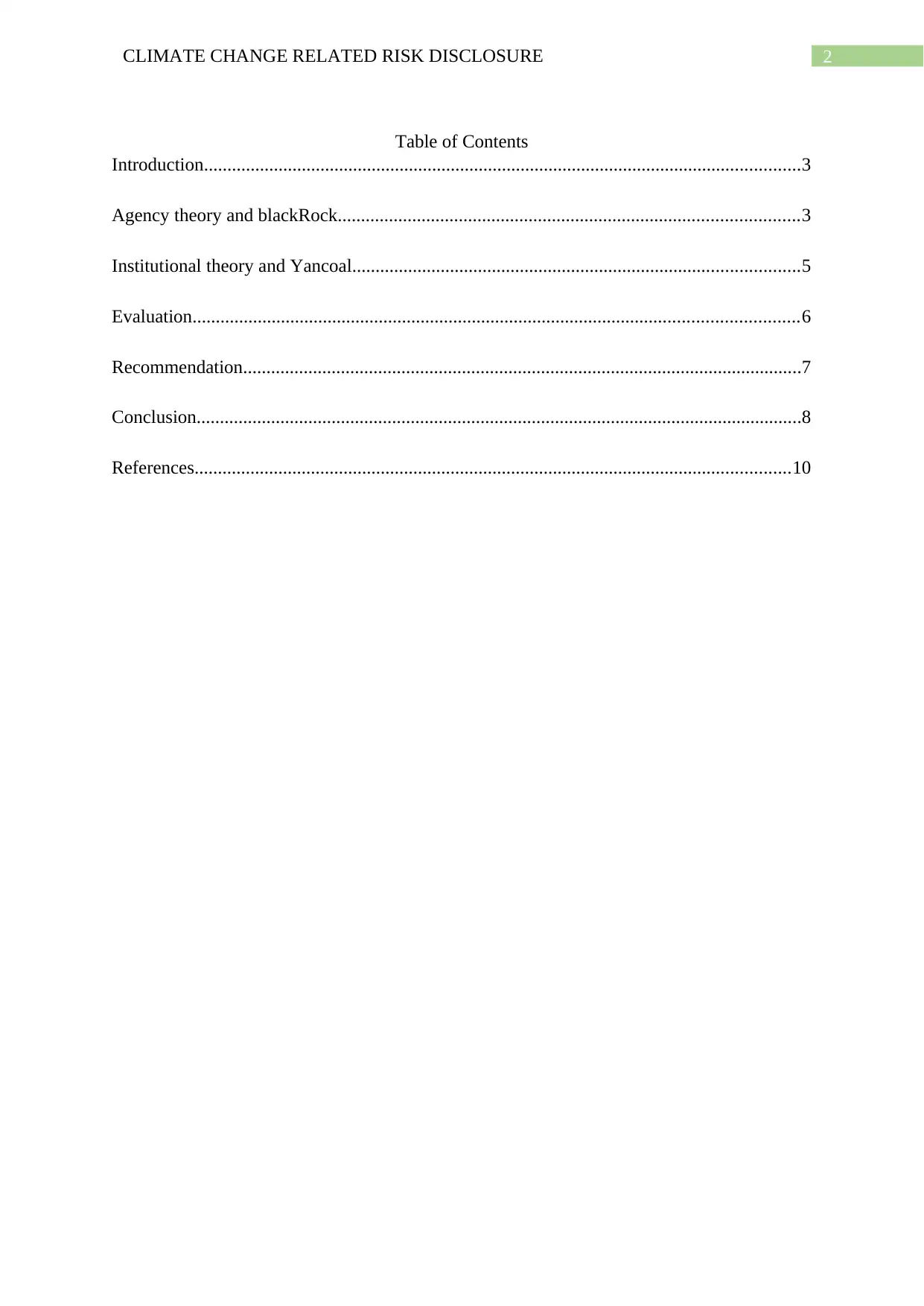
Table of Contents
Introduction................................................................................................................................3
Agency theory and blackRock...................................................................................................3
Institutional theory and Yancoal................................................................................................5
Evaluation..................................................................................................................................6
Recommendation........................................................................................................................7
Conclusion..................................................................................................................................8
References................................................................................................................................10
Table of Contents
Introduction................................................................................................................................3
Agency theory and blackRock...................................................................................................3
Institutional theory and Yancoal................................................................................................5
Evaluation..................................................................................................................................6
Recommendation........................................................................................................................7
Conclusion..................................................................................................................................8
References................................................................................................................................10
⊘ This is a preview!⊘
Do you want full access?
Subscribe today to unlock all pages.

Trusted by 1+ million students worldwide
3CLIMATE CHANGE RELATED RISK DISCLOSURE
Introduction
Yancoal is an Australian based coal producing company, which is operating
underground coal mines in New South Wales. BlackRock is the asset management company,
which is revising its investment practices at it perceived climate risk as an investment risk
(Gulati, Rivkin and Sesia 2017). These initiatives can affect the operation of Yancoal as it
can lead BlackRock to divest the shares of Yancoal. This report will be focusing on climate
change risks and disclosures by taking different theories to evaluate and recommend climate
change associated risk disclosure information to Yancoal, which will be used for its 2019
report.
Agency theory and blackRock
Agency theory is the principal that explains and resolve issues with relation between
business principals and its agents, which are related to business the agents are mainly
shareholders, CEO, managers of a company (Bosse and Phillips 2016). Agency theory
primarily addresses risks and disputes in two key areas: difference in goals and difference in
risk aversion. Agency theory attempts to tackle the problem related to shareholder’s interest
and profit maximization rather than self-interest of the organization (Shogren, Wehmeyer and
Palmer 2017). Climate change is already a concern on the US utility and hurricanes impacts
the operations of BlackRock massively as they pose to power and water supply. Climate
change creates uncertainty in evaluation. It impacts on the economy of the region as well as
impacts on the global economy (Thompson 2019). BlackRock observed that all US
metropolitan areas are suffering from mild to severe losses in GDP because of increasing
change to the climate since 1980. BlackRock has addressed that climate changes are affecting
their investment and therefore they are revising their investing practices. BlackRock, to put
effort on the sustainability will ditch the investments that considers an investment risk (Friel
Introduction
Yancoal is an Australian based coal producing company, which is operating
underground coal mines in New South Wales. BlackRock is the asset management company,
which is revising its investment practices at it perceived climate risk as an investment risk
(Gulati, Rivkin and Sesia 2017). These initiatives can affect the operation of Yancoal as it
can lead BlackRock to divest the shares of Yancoal. This report will be focusing on climate
change risks and disclosures by taking different theories to evaluate and recommend climate
change associated risk disclosure information to Yancoal, which will be used for its 2019
report.
Agency theory and blackRock
Agency theory is the principal that explains and resolve issues with relation between
business principals and its agents, which are related to business the agents are mainly
shareholders, CEO, managers of a company (Bosse and Phillips 2016). Agency theory
primarily addresses risks and disputes in two key areas: difference in goals and difference in
risk aversion. Agency theory attempts to tackle the problem related to shareholder’s interest
and profit maximization rather than self-interest of the organization (Shogren, Wehmeyer and
Palmer 2017). Climate change is already a concern on the US utility and hurricanes impacts
the operations of BlackRock massively as they pose to power and water supply. Climate
change creates uncertainty in evaluation. It impacts on the economy of the region as well as
impacts on the global economy (Thompson 2019). BlackRock observed that all US
metropolitan areas are suffering from mild to severe losses in GDP because of increasing
change to the climate since 1980. BlackRock has addressed that climate changes are affecting
their investment and therefore they are revising their investing practices. BlackRock, to put
effort on the sustainability will ditch the investments that considers an investment risk (Friel
Paraphrase This Document
Need a fresh take? Get an instant paraphrase of this document with our AI Paraphraser
4CLIMATE CHANGE RELATED RISK DISCLOSURE
2020). BlackRock believes that climate change is the top issue that their client is facing from
the agents. The CEO of BlackRock stated that investment strategy should be changed as the
climates are always changing. BlackRock is asking their client companies to disclose plans.
BlackRock is following this new standard for investing and the primary reason for this is high
sustainability related risk of investments such as fossil fuel and other fuels (Campiglio et.al
2017). CEO of BlackRock started to weigh on the shareholders votes on many sustainability
climate issues, which are arising in shareholders decision making. Fink, the CEO of
blackRock noted that climate change is getting a serious and crucial factor in company’s
long-term predictions and this is affecting the operation of BlackRock (Hicks 2017). As per
the sustainability report, Fink noted that climate change is getting more serious issue and high
impacting factor for the investment and claimed that the new approach will create new
market for them. Creating new market will bring new investment for the company. Climate
change also influences the long lifetime finance of the investment therefore; BlackRock has
taken this new approach to mitigate climate risk in the investments (Riding 2019). Climate
change also influences the inflation, interest rates negatively. Floods and drought can
massively affect the investment therefore BlackRock is expecting that the new standard will
aid them to mitigate climate risk related to investment. BlackRock is now focusing on three
key areas with long date investments that can be located with accuracy; U.S municipal bonds,
commercial mortgage-backed securities and electric utilities. New approach of investing
standard will be benefitted by outside board service, which aligns with the strategic and
environmental imperatives of the firm, and therefore the CEO of blackRock can scan the
environment and strategy effectively. The new investing practices will not only aid
BlackRock to mitigate the climate and environmental risk related to the environment but also
will look after the interest and profitability of the shareholders of the firm (Trabacchi and
Buchner 2019). To evaluate the impact of climate on investments, BlackRock said to its
2020). BlackRock believes that climate change is the top issue that their client is facing from
the agents. The CEO of BlackRock stated that investment strategy should be changed as the
climates are always changing. BlackRock is asking their client companies to disclose plans.
BlackRock is following this new standard for investing and the primary reason for this is high
sustainability related risk of investments such as fossil fuel and other fuels (Campiglio et.al
2017). CEO of BlackRock started to weigh on the shareholders votes on many sustainability
climate issues, which are arising in shareholders decision making. Fink, the CEO of
blackRock noted that climate change is getting a serious and crucial factor in company’s
long-term predictions and this is affecting the operation of BlackRock (Hicks 2017). As per
the sustainability report, Fink noted that climate change is getting more serious issue and high
impacting factor for the investment and claimed that the new approach will create new
market for them. Creating new market will bring new investment for the company. Climate
change also influences the long lifetime finance of the investment therefore; BlackRock has
taken this new approach to mitigate climate risk in the investments (Riding 2019). Climate
change also influences the inflation, interest rates negatively. Floods and drought can
massively affect the investment therefore BlackRock is expecting that the new standard will
aid them to mitigate climate risk related to investment. BlackRock is now focusing on three
key areas with long date investments that can be located with accuracy; U.S municipal bonds,
commercial mortgage-backed securities and electric utilities. New approach of investing
standard will be benefitted by outside board service, which aligns with the strategic and
environmental imperatives of the firm, and therefore the CEO of blackRock can scan the
environment and strategy effectively. The new investing practices will not only aid
BlackRock to mitigate the climate and environmental risk related to the environment but also
will look after the interest and profitability of the shareholders of the firm (Trabacchi and
Buchner 2019). To evaluate the impact of climate on investments, BlackRock said to its
5CLIMATE CHANGE RELATED RISK DISCLOSURE
investors that to mitigate loss from investments, Investors needs to assess issuer’s financial
ability to fund projects, which will mitigate the climate risk. Advanced data science aids
BlackRock to gauge the exact climate risk related to the investment of an organisation.
Institutional theory and Yancoal
Institutional theory is an method to comprehend organisation and management
practices as the product of social other than economic pressure. This theory is taken into
consideration as it has the ability to discuss organisational behaviour that defy the economic
rationality. Institutional theory provides an method to conceptualize and address climate
change in a organisation (Hwang and Colyvas 2019). The institutional isomorphic pressure
can influence the decisions of managers and it can impact the operations of Yancoal. The
social and institutional pressure of shareholder groups affects the practices and policies of
Yancoal as the shareholders groups remain concerned with their investments within the
organisation. Coercive pressure are the primary reason and driving force for adoption of
environmental management practices in a organisation. Coercive pressure may arise in
Yancoal if the fails to adopt any regulations related to the protection of the environment
(Askland 2018). Powerful stakeholders of Yancoal will force them to adopt climate change
related risk disclosures and other reporting practices. The adoption of climate change risk
disclosure not only will be helpful to protect Yancoal from government but also will improve
the legitimacy of the organisation related to the environment. Community expectation also
arises related to the issue of Yancoal not adopting risk disclosures. NGO’s and consumers
can demand better sustainability through the adoption of regulations. Yancoal produces coal
therefore climate risk should be a concerning factor for them. Coal mining generates heavy
pollution to the environment. Global climate change is a concerning factors and as Yancoal
operates within the coal industry, the intensity on the environmental pollution is massive
(Baer and Singer 2020). There are various risk for not implementing climate risk related
investors that to mitigate loss from investments, Investors needs to assess issuer’s financial
ability to fund projects, which will mitigate the climate risk. Advanced data science aids
BlackRock to gauge the exact climate risk related to the investment of an organisation.
Institutional theory and Yancoal
Institutional theory is an method to comprehend organisation and management
practices as the product of social other than economic pressure. This theory is taken into
consideration as it has the ability to discuss organisational behaviour that defy the economic
rationality. Institutional theory provides an method to conceptualize and address climate
change in a organisation (Hwang and Colyvas 2019). The institutional isomorphic pressure
can influence the decisions of managers and it can impact the operations of Yancoal. The
social and institutional pressure of shareholder groups affects the practices and policies of
Yancoal as the shareholders groups remain concerned with their investments within the
organisation. Coercive pressure are the primary reason and driving force for adoption of
environmental management practices in a organisation. Coercive pressure may arise in
Yancoal if the fails to adopt any regulations related to the protection of the environment
(Askland 2018). Powerful stakeholders of Yancoal will force them to adopt climate change
related risk disclosures and other reporting practices. The adoption of climate change risk
disclosure not only will be helpful to protect Yancoal from government but also will improve
the legitimacy of the organisation related to the environment. Community expectation also
arises related to the issue of Yancoal not adopting risk disclosures. NGO’s and consumers
can demand better sustainability through the adoption of regulations. Yancoal produces coal
therefore climate risk should be a concerning factor for them. Coal mining generates heavy
pollution to the environment. Global climate change is a concerning factors and as Yancoal
operates within the coal industry, the intensity on the environmental pollution is massive
(Baer and Singer 2020). There are various risk for not implementing climate risk related
⊘ This is a preview!⊘
Do you want full access?
Subscribe today to unlock all pages.
Trusted by 1+ million students worldwide
6CLIMATE CHANGE RELATED RISK DISCLOSURE
disclosures in the organisation. The weather condition significantly impacts on the ability of
Yancoal to manage transportation and production of materials. Climate change can reduce the
demand of the product in the market. Yancoal produces massive amount of waste from the
coal production, which is harmful for the environment. Other than these external
environmental affects, the stakeholders also can pressurize the firm to implement climate risk
related disclosure in their organisation if they does not implements it. Several factors affects
the implementation of climate related financial disclosure which evaluates that Yancoal
should provide climate related risk disclosures. Firstly, the investors needs to confirm that the
organisation is taking climate change seriously. The investors are less interested to invest in a
company that does to imply regulations and recommendations from government. Secondly, if
Yancoal complies with the standards, they will have better strategies to adapt climate change
in their organisation and will be better able to explain it to the investment committee. In
addition, these disclosures will aid Yancoal to identify, assess and manage climate related
risks. Evaluation of the risk will create new opportunities for the organisation. Through the
disclosure, analysts of Yancoal will be better equipped to analyse environmental change in
determining and valuating the firm. Further, Yancoal can use the climate risk related
disclosures to incorporate climate change, environmental and natural capital related
information in mainstream financial reports as well as disclosure will assists Yancoal to
achieve a holistic view of how climate change can affect their performance (Eccles and Krzus
2017).
In addition, consumers will not prefer any product that is not environment friendly
therefore Yancoal should implement climate risk related disclosure in their organisation.
Government can ban production and transportation of coal if Yancoal does not take sufficient
disclosures in their organisation.
disclosures in the organisation. The weather condition significantly impacts on the ability of
Yancoal to manage transportation and production of materials. Climate change can reduce the
demand of the product in the market. Yancoal produces massive amount of waste from the
coal production, which is harmful for the environment. Other than these external
environmental affects, the stakeholders also can pressurize the firm to implement climate risk
related disclosure in their organisation if they does not implements it. Several factors affects
the implementation of climate related financial disclosure which evaluates that Yancoal
should provide climate related risk disclosures. Firstly, the investors needs to confirm that the
organisation is taking climate change seriously. The investors are less interested to invest in a
company that does to imply regulations and recommendations from government. Secondly, if
Yancoal complies with the standards, they will have better strategies to adapt climate change
in their organisation and will be better able to explain it to the investment committee. In
addition, these disclosures will aid Yancoal to identify, assess and manage climate related
risks. Evaluation of the risk will create new opportunities for the organisation. Through the
disclosure, analysts of Yancoal will be better equipped to analyse environmental change in
determining and valuating the firm. Further, Yancoal can use the climate risk related
disclosures to incorporate climate change, environmental and natural capital related
information in mainstream financial reports as well as disclosure will assists Yancoal to
achieve a holistic view of how climate change can affect their performance (Eccles and Krzus
2017).
In addition, consumers will not prefer any product that is not environment friendly
therefore Yancoal should implement climate risk related disclosure in their organisation.
Government can ban production and transportation of coal if Yancoal does not take sufficient
disclosures in their organisation.
Paraphrase This Document
Need a fresh take? Get an instant paraphrase of this document with our AI Paraphraser
7CLIMATE CHANGE RELATED RISK DISCLOSURE
Evaluation
From the annual report of Yancoal, it has been found that Yancoal has adopted
several disclosures and regulations to mitigate impact of the product to the climate. Yancoal
works with the federal and state government departments and regulatory bodies ensuring full
limpidity in its environment and community and reporting. With acquisition of coal and other
assets, Yancoal has developed and implemented corporate Environmental Management
System to complement and support the environment and community. In addition, Yancoal
has adopted Environmental Assurance Audit program to identify and evaluate environmental
compliance, performance and assurance across its owned and managed coal mining
operations. Yancoal acknowledges that it has role to play in reducing the emission generated
by its operations therefore, they are continuously researching to lower the emission to assist
the reduction of downstream emission of coal products (McKay and Zheng 2017).
Recognising the potential interest of the shareholders related to the risk and opportunities,
Yancoal considers the Taskforce on Climate-related Financial Disclosures recommendations
the guide the shareholder about the climate related disclosure. This consideration includes
transparency in the way the firm is identifying and reducing risk posed to the environment
such as from policy, legal, market demand, reputation and technological perspective. Yancoal
is focused to reduce the greenhouse gas emissions and energy, which impacts in the climate
change massively. Yancoal follows and implemented Australian National Greenhouse and
Energy Reporting and Australian Government's Safeguard Mechanism legislation to reduce
the impact of greenhouse gas and lower the energy consumption (Jia 2017). The safeguard
mechanism aid Yancoal to reduce the carbon and greenhouse gas emission below the
threshold level. Air and noise emission is a concerning factors for Yancoal as their internal
and external shareholder are effected by it. Yancoal are minimise the emission of dust and
other pollutants by implementing Quality management plan in their organisation. The day to
Evaluation
From the annual report of Yancoal, it has been found that Yancoal has adopted
several disclosures and regulations to mitigate impact of the product to the climate. Yancoal
works with the federal and state government departments and regulatory bodies ensuring full
limpidity in its environment and community and reporting. With acquisition of coal and other
assets, Yancoal has developed and implemented corporate Environmental Management
System to complement and support the environment and community. In addition, Yancoal
has adopted Environmental Assurance Audit program to identify and evaluate environmental
compliance, performance and assurance across its owned and managed coal mining
operations. Yancoal acknowledges that it has role to play in reducing the emission generated
by its operations therefore, they are continuously researching to lower the emission to assist
the reduction of downstream emission of coal products (McKay and Zheng 2017).
Recognising the potential interest of the shareholders related to the risk and opportunities,
Yancoal considers the Taskforce on Climate-related Financial Disclosures recommendations
the guide the shareholder about the climate related disclosure. This consideration includes
transparency in the way the firm is identifying and reducing risk posed to the environment
such as from policy, legal, market demand, reputation and technological perspective. Yancoal
is focused to reduce the greenhouse gas emissions and energy, which impacts in the climate
change massively. Yancoal follows and implemented Australian National Greenhouse and
Energy Reporting and Australian Government's Safeguard Mechanism legislation to reduce
the impact of greenhouse gas and lower the energy consumption (Jia 2017). The safeguard
mechanism aid Yancoal to reduce the carbon and greenhouse gas emission below the
threshold level. Air and noise emission is a concerning factors for Yancoal as their internal
and external shareholder are effected by it. Yancoal are minimise the emission of dust and
other pollutants by implementing Quality management plan in their organisation. The day to
8CLIMATE CHANGE RELATED RISK DISCLOSURE
day management activity aid Yancoal to minimise emission which can impact the
environment negatively.
Recommendation
From the study, it has been observed that Yancoal has implemented several legislation
in their organisation to minimize the impact of coal and greenhouse gas in the environment.
They followed several legislations and recommendations to mitigate the harm of their
products in the climate. It is recommended that Yancoal should follow some additional
legislations to mitigate the impact of their product to the climate. They should implement
Carbon tax to reduce the carbon dioxide emission from their organisation. It is recommended
that Yancoal should maintain reliable energy supply as well as reduce emission like their
primary competitor Whitehaven Coal. Whitehaven Coal does this by combining low-ash, low
sulphur, high energy coal with advanced technology. Further, it is recommended that Yancoal
should invest in Carbon Capture Utilisation and Storage (CCUS) technology as White Haven
Coal did. The advanced technology and innovation will provide best solution to Yancoal to
mitigate the climate risk related to CHG emission. Without CCUS, Yancoal cannot be able to
achieve their climate goals (Zhang et.al 2018). In addition, it is recommended that Yancoal
should participate in range of industry forums and advocate for additional policies that will
aid them to address inequality, promote economic growth and most importantly, support
efficient environmental management. It is recommended that Yancoal should choose
renewable energy sources and avoid fossil fuels to reduce the climate footprint. Yancoal
should rise awareness among their employers, suppliers and stakeholders about the
sustainability issues that the organisation is facing. Additionally, Yancoal should encourage
its employees to use public transports with other employees in order to reduce carbon
emission to the environment. Yancoal should get sustainability and CSR certificates from the
government to review the climate impact of their organisation.
day management activity aid Yancoal to minimise emission which can impact the
environment negatively.
Recommendation
From the study, it has been observed that Yancoal has implemented several legislation
in their organisation to minimize the impact of coal and greenhouse gas in the environment.
They followed several legislations and recommendations to mitigate the harm of their
products in the climate. It is recommended that Yancoal should follow some additional
legislations to mitigate the impact of their product to the climate. They should implement
Carbon tax to reduce the carbon dioxide emission from their organisation. It is recommended
that Yancoal should maintain reliable energy supply as well as reduce emission like their
primary competitor Whitehaven Coal. Whitehaven Coal does this by combining low-ash, low
sulphur, high energy coal with advanced technology. Further, it is recommended that Yancoal
should invest in Carbon Capture Utilisation and Storage (CCUS) technology as White Haven
Coal did. The advanced technology and innovation will provide best solution to Yancoal to
mitigate the climate risk related to CHG emission. Without CCUS, Yancoal cannot be able to
achieve their climate goals (Zhang et.al 2018). In addition, it is recommended that Yancoal
should participate in range of industry forums and advocate for additional policies that will
aid them to address inequality, promote economic growth and most importantly, support
efficient environmental management. It is recommended that Yancoal should choose
renewable energy sources and avoid fossil fuels to reduce the climate footprint. Yancoal
should rise awareness among their employers, suppliers and stakeholders about the
sustainability issues that the organisation is facing. Additionally, Yancoal should encourage
its employees to use public transports with other employees in order to reduce carbon
emission to the environment. Yancoal should get sustainability and CSR certificates from the
government to review the climate impact of their organisation.
⊘ This is a preview!⊘
Do you want full access?
Subscribe today to unlock all pages.
Trusted by 1+ million students worldwide
9CLIMATE CHANGE RELATED RISK DISCLOSURE
Conclusion
On a concluding note, BlackRock has been changing its investment strategies as it
perceived that climate change is affecting all over the globe. They are changing the strategy
to mitigate the risks related to the climate. It has been found that advanced data sciences has
been aided blackRock to mitigate climate risk related to the investments. Further, from the
sustainability report of Yancoal, it has been found that Yancoal has implemented several
regulations and recommendations to mitigate the climate risk related to the investment and it
has been advised to Yancoal that they should mitigate the impact of CHG emission by
implementing Carbon Capture Utility Storage technology in their organisation. This will
assist them to reduce the climate risk in their organisation as well as will improve the
shareholders knowledge about the climate risk related disclosure.
Conclusion
On a concluding note, BlackRock has been changing its investment strategies as it
perceived that climate change is affecting all over the globe. They are changing the strategy
to mitigate the risks related to the climate. It has been found that advanced data sciences has
been aided blackRock to mitigate climate risk related to the investments. Further, from the
sustainability report of Yancoal, it has been found that Yancoal has implemented several
regulations and recommendations to mitigate the climate risk related to the investment and it
has been advised to Yancoal that they should mitigate the impact of CHG emission by
implementing Carbon Capture Utility Storage technology in their organisation. This will
assist them to reduce the climate risk in their organisation as well as will improve the
shareholders knowledge about the climate risk related disclosure.
Paraphrase This Document
Need a fresh take? Get an instant paraphrase of this document with our AI Paraphraser
10CLIMATE CHANGE RELATED RISK DISCLOSURE
References
Askland, H.H., 2018. A dying village: mining and the experiential condition of
displacement. The Extractive Industries and Society, 5(2), pp.230-236.
Baer, H.A. and Singer, M., 2020. The Anti-Coal and Anti-Coal Seam Gas Campaigns as
Components of the Climate Movement in Australia: Responses to Corporate
Hegemony. Capitalism Nature Socialism, pp.1-19.
Bosse, D.A. and Phillips, R.A., 2016. Agency theory and bounded self-interest. Academy of
Management Review, 41(2), pp.276-297.
Campiglio, E., Dafermos, Y., Monin, P., Ryan-Collins, J., Schotten, G. and Tanaka, M.,
2017. Finance and climate change: what role for central banks and financial regulators.
In CEP-DNB workshop on “Central Banking and Green Finance”, November (pp. 28-29).
Eccles, R.G. and Krzus, M.P., 2017. An analysis of oil & gas company disclosures from the
perspective of the task force on climate-related financial disclosures. Available at SSRN
3091232.
Friel, S., 2020. Climate change and the people's health: the need to exit the consumptagenic
system. The Lancet, 395(10225), pp.666-668.
Gulati, R., Rivkin, J.W. and Sesia, A., 2017. BlackRock (D): Organizing for the Future (with
video links).
Hicks, K., 2017. Insight: Heating up climate change disclosures. Company Director, 33(7),
p.52.
References
Askland, H.H., 2018. A dying village: mining and the experiential condition of
displacement. The Extractive Industries and Society, 5(2), pp.230-236.
Baer, H.A. and Singer, M., 2020. The Anti-Coal and Anti-Coal Seam Gas Campaigns as
Components of the Climate Movement in Australia: Responses to Corporate
Hegemony. Capitalism Nature Socialism, pp.1-19.
Bosse, D.A. and Phillips, R.A., 2016. Agency theory and bounded self-interest. Academy of
Management Review, 41(2), pp.276-297.
Campiglio, E., Dafermos, Y., Monin, P., Ryan-Collins, J., Schotten, G. and Tanaka, M.,
2017. Finance and climate change: what role for central banks and financial regulators.
In CEP-DNB workshop on “Central Banking and Green Finance”, November (pp. 28-29).
Eccles, R.G. and Krzus, M.P., 2017. An analysis of oil & gas company disclosures from the
perspective of the task force on climate-related financial disclosures. Available at SSRN
3091232.
Friel, S., 2020. Climate change and the people's health: the need to exit the consumptagenic
system. The Lancet, 395(10225), pp.666-668.
Gulati, R., Rivkin, J.W. and Sesia, A., 2017. BlackRock (D): Organizing for the Future (with
video links).
Hicks, K., 2017. Insight: Heating up climate change disclosures. Company Director, 33(7),
p.52.
11CLIMATE CHANGE RELATED RISK DISCLOSURE
Hwang, H. and Colyvas, J., 2019. Ontology, levels of society, and degrees of generality:
Theorizing actors as abstractions in institutional theory. Academy of Management Review,
(ja).
Jia, X., 2017. Extractive Governance, Environmental Management and Community
Engagement: China Versus Global. In Resource Security and Governance (pp. 75-100).
Routledge.
McKay, J. and Zheng, J., 2017. Water Security, Governance and Sustainable Development
Goals in China—Radical Laws, Institutions and Courts. In Resource Security and
Governance (pp. 165-187). Routledge.
Riding, S., 2019. BlackRock analysis helps define climate-change risk. Financial Times.
Available at https://www. ft. com/content/2350de58-7236-3593-ad79-16bfa6ecea8d.
Shogren, K.A., Wehmeyer, M.L. and Palmer, S.B., 2017. Causal agency theory.
In Development of self-determination through the life-course (pp. 55-67). Springer,
Dordrecht.
Thompson, J., 2019. Larry Fink Urged to Make BlackRock Tougher on Climate
Change. Financial Times.
Trabacchi, C. and Buchner, B., 2019. Unlocking Global Investments for SDGs and Tackling
Climate Change. In Achieving the Sustainable Development Goals Through Sustainable
Food Systems (pp. 157-170). Springer, Cham.
Zhang, S., Liu, L., Zhang, L., Zhuang, Y. and Du, J., 2018. An optimization model for carbon
capture utilization and storage supply chain: A case study in Northeastern China. Applied
Energy, 231, pp.194-206.
Hwang, H. and Colyvas, J., 2019. Ontology, levels of society, and degrees of generality:
Theorizing actors as abstractions in institutional theory. Academy of Management Review,
(ja).
Jia, X., 2017. Extractive Governance, Environmental Management and Community
Engagement: China Versus Global. In Resource Security and Governance (pp. 75-100).
Routledge.
McKay, J. and Zheng, J., 2017. Water Security, Governance and Sustainable Development
Goals in China—Radical Laws, Institutions and Courts. In Resource Security and
Governance (pp. 165-187). Routledge.
Riding, S., 2019. BlackRock analysis helps define climate-change risk. Financial Times.
Available at https://www. ft. com/content/2350de58-7236-3593-ad79-16bfa6ecea8d.
Shogren, K.A., Wehmeyer, M.L. and Palmer, S.B., 2017. Causal agency theory.
In Development of self-determination through the life-course (pp. 55-67). Springer,
Dordrecht.
Thompson, J., 2019. Larry Fink Urged to Make BlackRock Tougher on Climate
Change. Financial Times.
Trabacchi, C. and Buchner, B., 2019. Unlocking Global Investments for SDGs and Tackling
Climate Change. In Achieving the Sustainable Development Goals Through Sustainable
Food Systems (pp. 157-170). Springer, Cham.
Zhang, S., Liu, L., Zhang, L., Zhuang, Y. and Du, J., 2018. An optimization model for carbon
capture utilization and storage supply chain: A case study in Northeastern China. Applied
Energy, 231, pp.194-206.
⊘ This is a preview!⊘
Do you want full access?
Subscribe today to unlock all pages.
Trusted by 1+ million students worldwide

1 out of 12


Related Documents


Your All-in-One AI-Powered Toolkit for Academic Success.
+13062052269
info@desklib.com
Available 24*7 on WhatsApp / Email
![[object Object]](/_next/static/media/star-bottom.7253800d.svg)
Unlock your academic potential
Copyright © 2020–2026 A2Z Services. All Rights Reserved. Developed and managed by ZUCOL.