Advanced Research Methods Report
VerifiedAdded on 2019/12/03
|27
|10566
|371
Report
AI Summary
This report provides a comprehensive overview of advanced research methods within the context of the tourism and hospitality industry. It covers various learning objectives, including evaluating research processes, assessing research philosophies (positivism and interpretivism), analyzing different research approaches (qualitative, quantitative, deductive, and inductive), and evaluating primary and secondary data sources. The report also delves into issues of reliability and validity in data, the development and planning of a research project, and the creation of a research proposal. A case study focusing on consumer buying behavior in the UK eco-tourism industry is presented, demonstrating the application of these methods. The report includes a detailed methodology section outlining the research approach, philosophy, data collection techniques (questionnaires, interviews), sampling methods, and data analysis procedures. The inclusion of numerous illustrations and tables enhances the understanding of the concepts discussed. The report concludes by summarizing the key findings and emphasizing the importance of robust research methodologies in the tourism and hospitality sector.

Advanced Research Methods for Tourism
and Hospitality
and Hospitality

Paraphrase This Document
Need a fresh take? Get an instant paraphrase of this document with our AI Paraphraser
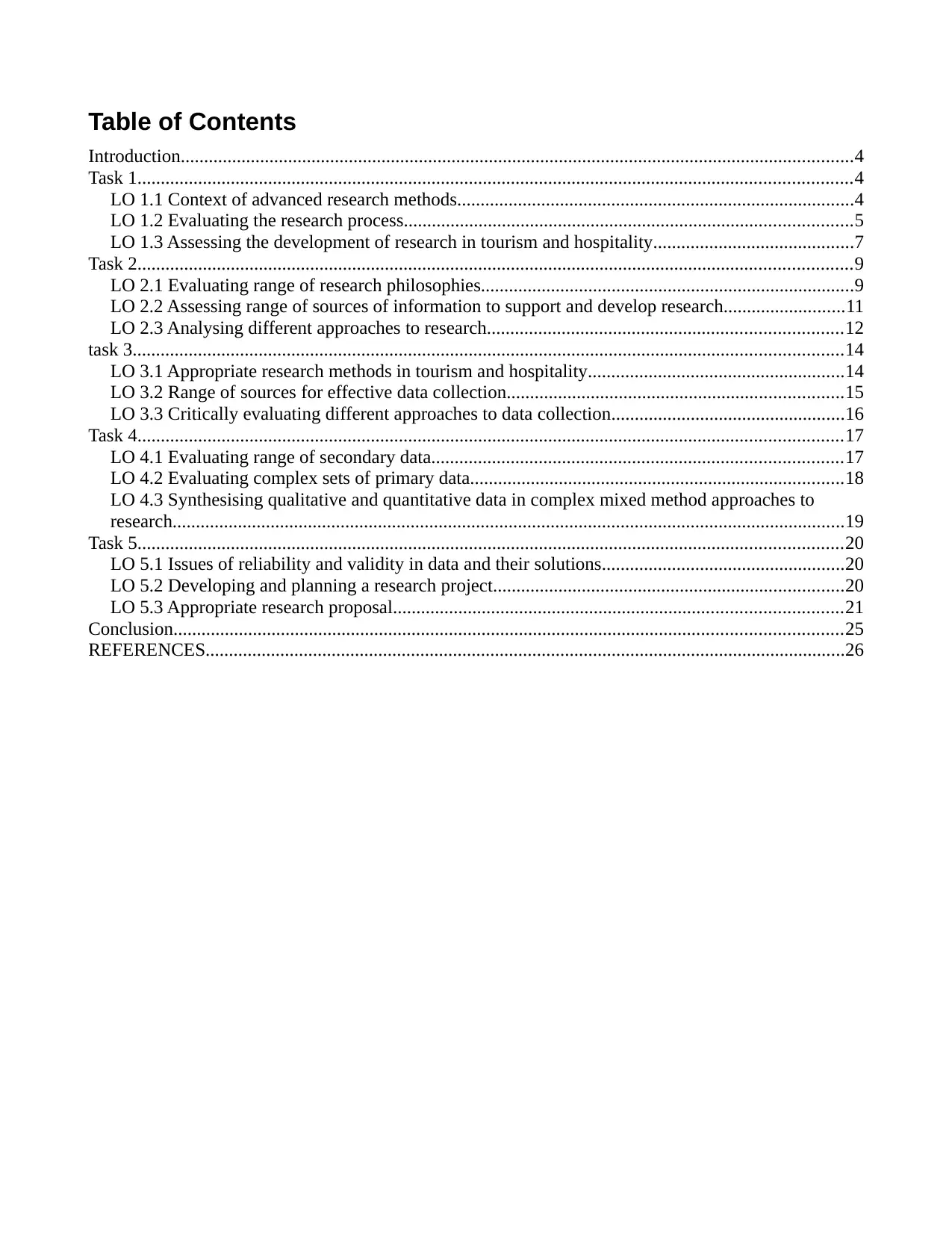
Table of Contents
Introduction................................................................................................................................................4
Task 1.........................................................................................................................................................4
LO 1.1 Context of advanced research methods.....................................................................................4
LO 1.2 Evaluating the research process................................................................................................5
LO 1.3 Assessing the development of research in tourism and hospitality...........................................7
Task 2.........................................................................................................................................................9
LO 2.1 Evaluating range of research philosophies................................................................................9
LO 2.2 Assessing range of sources of information to support and develop research..........................11
LO 2.3 Analysing different approaches to research............................................................................12
task 3........................................................................................................................................................14
LO 3.1 Appropriate research methods in tourism and hospitality.......................................................14
LO 3.2 Range of sources for effective data collection........................................................................15
LO 3.3 Critically evaluating different approaches to data collection..................................................16
Task 4.......................................................................................................................................................17
LO 4.1 Evaluating range of secondary data........................................................................................17
LO 4.2 Evaluating complex sets of primary data................................................................................18
LO 4.3 Synthesising qualitative and quantitative data in complex mixed method approaches to
research................................................................................................................................................19
Task 5.......................................................................................................................................................20
LO 5.1 Issues of reliability and validity in data and their solutions....................................................20
LO 5.2 Developing and planning a research project...........................................................................20
LO 5.3 Appropriate research proposal................................................................................................21
Conclusion...............................................................................................................................................25
REFERENCES.........................................................................................................................................26
Introduction................................................................................................................................................4
Task 1.........................................................................................................................................................4
LO 1.1 Context of advanced research methods.....................................................................................4
LO 1.2 Evaluating the research process................................................................................................5
LO 1.3 Assessing the development of research in tourism and hospitality...........................................7
Task 2.........................................................................................................................................................9
LO 2.1 Evaluating range of research philosophies................................................................................9
LO 2.2 Assessing range of sources of information to support and develop research..........................11
LO 2.3 Analysing different approaches to research............................................................................12
task 3........................................................................................................................................................14
LO 3.1 Appropriate research methods in tourism and hospitality.......................................................14
LO 3.2 Range of sources for effective data collection........................................................................15
LO 3.3 Critically evaluating different approaches to data collection..................................................16
Task 4.......................................................................................................................................................17
LO 4.1 Evaluating range of secondary data........................................................................................17
LO 4.2 Evaluating complex sets of primary data................................................................................18
LO 4.3 Synthesising qualitative and quantitative data in complex mixed method approaches to
research................................................................................................................................................19
Task 5.......................................................................................................................................................20
LO 5.1 Issues of reliability and validity in data and their solutions....................................................20
LO 5.2 Developing and planning a research project...........................................................................20
LO 5.3 Appropriate research proposal................................................................................................21
Conclusion...............................................................................................................................................25
REFERENCES.........................................................................................................................................26
Illustration Index
Illustration 1: Research Triangle................................................................................................................7
Illustration 2: Inter-disciplinary framework...............................................................................................9
Illustration 3: Sources of information......................................................................................................11
Illustration 4: Deductive Vs. Inductive Research Approach....................................................................14
Index of Tables
Table 1: Timetable....................................................................................................................................25
Illustration 1: Research Triangle................................................................................................................7
Illustration 2: Inter-disciplinary framework...............................................................................................9
Illustration 3: Sources of information......................................................................................................11
Illustration 4: Deductive Vs. Inductive Research Approach....................................................................14
Index of Tables
Table 1: Timetable....................................................................................................................................25
⊘ This is a preview!⊘
Do you want full access?
Subscribe today to unlock all pages.

Trusted by 1+ million students worldwide
INTRODUCTION
Travel and tourism industry is considered to be one of the highly competitive landscapes in the
UK, due to which it is very important for companies operating in this sector to research the market in a
bid to identify new trends and make necessary changes in its working (Cavusgil and Das, 2007). The
tourism industry today is evolving at rather a very rapid pace, due to which it is of utmost importance
for such companies to thoroughly assess the market. Research essentially is a process through which
different facts and figures related to a topic can be determined. This way new dimensions can be added
to the subject matter. There are various benefits that can be obtained by conducting an intensive study
of a topic. For instance it helps in resolving various problems related to the subject matter; as well as to
form and investigate various theories in terms of their suitability pertaining to the topic
(Krishnaswamy, Sivakumar and Mathirajan, 2009).
The present research is a testimony to provide a comprehensive understanding of aspects related
to research within the travel and tourism industry. Here various research methods, approaches,
processes, etc. are presented with a view point of Whitbread PLC, a UK based multinational hotel,
coffee shop and restaurant. In addition to it, various research philosophies also have been evaluated in
the present report (Weller and Gulick, 2014). Different sources of information that may be used to
conduct a research investigation also are presented and discussed in this research. Through this report
an attempt has been made so as to assess different sources of information that may be considered for
taking effective decisions in relation to the research investigation. On this basis, this research would
shed light over different tools and methods that may be used to conduct a research investigation in the
tourism and hospitality industry, so as to improve organizational functions of firms such as Whitbread.
This way suggestions can be made that would help the firm to prolong its existence in the market and
provide effective services to the customers.
TASK 1
LO 1.1 Context of advanced research methods
Research is a process through which either new facts are unveiled or an addition is made to the
existing ones (Babbie, 2010). Today conducting research into different areas and aspects of business
operations has become crucial for companies, as it is a way through which their overall functioning can
be improved, as well as take decisions to prolong the firm's existence in market. Research is important
from a variety of view points. For instance it provides insights into determining solutions through
which a problem can be resolved. Furthermore it helped in developing abilities through which different
issues can be evaluated. Various theories related to subject matter can be developed and tested by using
Travel and tourism industry is considered to be one of the highly competitive landscapes in the
UK, due to which it is very important for companies operating in this sector to research the market in a
bid to identify new trends and make necessary changes in its working (Cavusgil and Das, 2007). The
tourism industry today is evolving at rather a very rapid pace, due to which it is of utmost importance
for such companies to thoroughly assess the market. Research essentially is a process through which
different facts and figures related to a topic can be determined. This way new dimensions can be added
to the subject matter. There are various benefits that can be obtained by conducting an intensive study
of a topic. For instance it helps in resolving various problems related to the subject matter; as well as to
form and investigate various theories in terms of their suitability pertaining to the topic
(Krishnaswamy, Sivakumar and Mathirajan, 2009).
The present research is a testimony to provide a comprehensive understanding of aspects related
to research within the travel and tourism industry. Here various research methods, approaches,
processes, etc. are presented with a view point of Whitbread PLC, a UK based multinational hotel,
coffee shop and restaurant. In addition to it, various research philosophies also have been evaluated in
the present report (Weller and Gulick, 2014). Different sources of information that may be used to
conduct a research investigation also are presented and discussed in this research. Through this report
an attempt has been made so as to assess different sources of information that may be considered for
taking effective decisions in relation to the research investigation. On this basis, this research would
shed light over different tools and methods that may be used to conduct a research investigation in the
tourism and hospitality industry, so as to improve organizational functions of firms such as Whitbread.
This way suggestions can be made that would help the firm to prolong its existence in the market and
provide effective services to the customers.
TASK 1
LO 1.1 Context of advanced research methods
Research is a process through which either new facts are unveiled or an addition is made to the
existing ones (Babbie, 2010). Today conducting research into different areas and aspects of business
operations has become crucial for companies, as it is a way through which their overall functioning can
be improved, as well as take decisions to prolong the firm's existence in market. Research is important
from a variety of view points. For instance it provides insights into determining solutions through
which a problem can be resolved. Furthermore it helped in developing abilities through which different
issues can be evaluated. Various theories related to subject matter can be developed and tested by using
Paraphrase This Document
Need a fresh take? Get an instant paraphrase of this document with our AI Paraphraser
different tools and methods of research (Whiteley and Whiteley, 2006). Today the context of research
has changed by great margins. It can be supported through fact that in earlier times carrying out a
research investigation was a very time consuming and complicated process, as there were a lot many
areas and aspects that had to be considered. But today major changes have happened in this regard. It
now is a much simplified process, as new methods and tools have been developed (Love, 2005).
Essentially there are two kinds of research – applied and pure. As the name suggests, pure
research is related to conducting an analysis into different subject matter, just for the sake of adding
new dimensions to existing studies; while on the other hand applied research is used in context to
investigate or study a phenomenon (Noble and Smith, 2015). In short it can be said that the latter form
of research helps in determining cause and effect relationships. These research methods are explained
in the following points: Applied research: Main purpose of using this type of research is to be able to conduct an
investigation into different phenomena and real life problems. By following this method, a
researcher can attempt to provide solution for practical issues and also resolve them with ease
and effectiveness (Bradford, 2015). It is conducted so as to be able to test different theories and
develop new ones. Through it, results gained from pure research can be put to practical use.
Pure research: It is that type of research which is conducted so as to enhance the knowledge
base of an individual and thus add to existing base of data and information pertaining to the
topic. It is exploratory in nature and is carried out with a practical 'end use' in mind.
There are various concepts and contexts related to advanced research methods. One of them is
the philosophies considered to conduct such an investigation (Marshall, 2007). Over the years
numerous research philosophies have been developed, but two of them are very famous and are used
extensively – positivism and interpretivisim. Through such kind of philosophies, a researcher can easily
and effectively conduct the investigation and thus attain desired results.
LO 1.2 Evaluating the research process
Conducting any research investigation is a very complicated process largely because there are a
variety of aspects that have to be considered in this regard (Fillis, 2007). Over the years, scholars,
academicians and experts on the topic of research have developed different processes and systems. It is
very important to evaluate different research processes because it would help the scholar to understand
elements that have to be paid a lot of attention so as to conduct the study in an efficient and effective
manner. Several research processes with variety of stages have been developed over the years. For
instance the one developed by Veal in 1992 consists of four steps – preparation and planning;
has changed by great margins. It can be supported through fact that in earlier times carrying out a
research investigation was a very time consuming and complicated process, as there were a lot many
areas and aspects that had to be considered. But today major changes have happened in this regard. It
now is a much simplified process, as new methods and tools have been developed (Love, 2005).
Essentially there are two kinds of research – applied and pure. As the name suggests, pure
research is related to conducting an analysis into different subject matter, just for the sake of adding
new dimensions to existing studies; while on the other hand applied research is used in context to
investigate or study a phenomenon (Noble and Smith, 2015). In short it can be said that the latter form
of research helps in determining cause and effect relationships. These research methods are explained
in the following points: Applied research: Main purpose of using this type of research is to be able to conduct an
investigation into different phenomena and real life problems. By following this method, a
researcher can attempt to provide solution for practical issues and also resolve them with ease
and effectiveness (Bradford, 2015). It is conducted so as to be able to test different theories and
develop new ones. Through it, results gained from pure research can be put to practical use.
Pure research: It is that type of research which is conducted so as to enhance the knowledge
base of an individual and thus add to existing base of data and information pertaining to the
topic. It is exploratory in nature and is carried out with a practical 'end use' in mind.
There are various concepts and contexts related to advanced research methods. One of them is
the philosophies considered to conduct such an investigation (Marshall, 2007). Over the years
numerous research philosophies have been developed, but two of them are very famous and are used
extensively – positivism and interpretivisim. Through such kind of philosophies, a researcher can easily
and effectively conduct the investigation and thus attain desired results.
LO 1.2 Evaluating the research process
Conducting any research investigation is a very complicated process largely because there are a
variety of aspects that have to be considered in this regard (Fillis, 2007). Over the years, scholars,
academicians and experts on the topic of research have developed different processes and systems. It is
very important to evaluate different research processes because it would help the scholar to understand
elements that have to be paid a lot of attention so as to conduct the study in an efficient and effective
manner. Several research processes with variety of stages have been developed over the years. For
instance the one developed by Veal in 1992 consists of four steps – preparation and planning;
investigation; analysis and writing up/presentation of results (Garland and Garland, 2012). But on the
other hand, process developed by Polonsky & Waller (2005) contains six stages – problem definition;
research objectives; research design; data gathering; data analysis & interpretation; and presenting
the results. A scholar needs to ensure that he/she has thorough understanding of the process and several
stages involved in it. If it is not clear then the research cannot be carried out in an efficient and effective
manner.
Research process developed by Veal (1992) consists of four stages. According to Bradford
(2015) this is a very simplified process of conducting any research investigation (Goddard and
Melville, 2004). Further, the author also states that Veal had involved only four stages in the process,
there are a variety of aspects which essentially should have been involved here, but rather have been
omitted. Due to this effectiveness of the overall process is reduced dramatically. Vaivio (2008) states
that carrying out any research is a very complicated procedure, and simplifying it to this extent is not
right, because it reduces the overall effectiveness of conducting a research study (Wakins, 2010). Thus
here it is very important for the researcher to stay focused on the subject matter, as there is very limited
scope of discussing and evaluating other topics, though may indirectly be related to the topic. From the
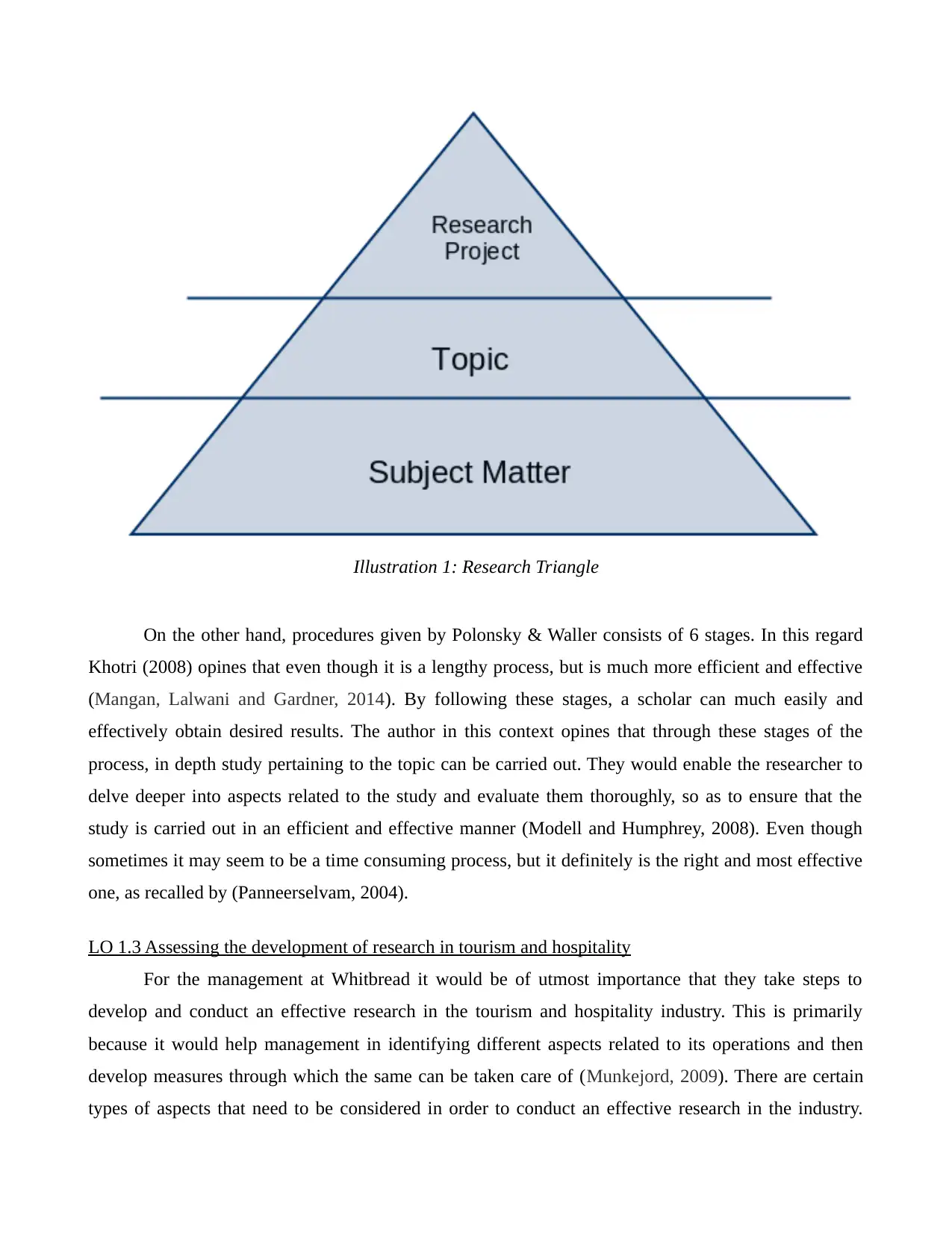
following diagram, this research process can be explained and evaluated in a much better manner. Here
the researcher first would need to define subject area for the study. This means that first area which is
to be investigated (Sobh and Perry, 2006). Once a general idea about the investigation is obtained by
deciding on subject matter, the researcher will have to decide and develop a specific topic related to the
area that has been decided earlier. Finally the research project is to be undertaken by performing
different steps and procedures.
other hand, process developed by Polonsky & Waller (2005) contains six stages – problem definition;
research objectives; research design; data gathering; data analysis & interpretation; and presenting
the results. A scholar needs to ensure that he/she has thorough understanding of the process and several
stages involved in it. If it is not clear then the research cannot be carried out in an efficient and effective
manner.
Research process developed by Veal (1992) consists of four stages. According to Bradford
(2015) this is a very simplified process of conducting any research investigation (Goddard and
Melville, 2004). Further, the author also states that Veal had involved only four stages in the process,
there are a variety of aspects which essentially should have been involved here, but rather have been
omitted. Due to this effectiveness of the overall process is reduced dramatically. Vaivio (2008) states
that carrying out any research is a very complicated procedure, and simplifying it to this extent is not
right, because it reduces the overall effectiveness of conducting a research study (Wakins, 2010). Thus
here it is very important for the researcher to stay focused on the subject matter, as there is very limited
scope of discussing and evaluating other topics, though may indirectly be related to the topic. From the
following diagram, this research process can be explained and evaluated in a much better manner. Here
the researcher first would need to define subject area for the study. This means that first area which is
to be investigated (Sobh and Perry, 2006). Once a general idea about the investigation is obtained by
deciding on subject matter, the researcher will have to decide and develop a specific topic related to the
area that has been decided earlier. Finally the research project is to be undertaken by performing
different steps and procedures.
⊘ This is a preview!⊘
Do you want full access?
Subscribe today to unlock all pages.
Trusted by 1+ million students worldwide
On the other hand, procedures given by Polonsky & Waller consists of 6 stages. In this regard
Khotri (2008) opines that even though it is a lengthy process, but is much more efficient and effective
(Mangan, Lalwani and Gardner, 2014). By following these stages, a scholar can much easily and
effectively obtain desired results. The author in this context opines that through these stages of the
process, in depth study pertaining to the topic can be carried out. They would enable the researcher to
delve deeper into aspects related to the study and evaluate them thoroughly, so as to ensure that the
study is carried out in an efficient and effective manner (Modell and Humphrey, 2008). Even though
sometimes it may seem to be a time consuming process, but it definitely is the right and most effective
one, as recalled by (Panneerselvam, 2004).
LO 1.3 Assessing the development of research in tourism and hospitality
For the management at Whitbread it would be of utmost importance that they take steps to
develop and conduct an effective research in the tourism and hospitality industry. This is primarily
because it would help management in identifying different aspects related to its operations and then
develop measures through which the same can be taken care of (Munkejord, 2009). There are certain
types of aspects that need to be considered in order to conduct an effective research in the industry.
Illustration 1: Research Triangle
Khotri (2008) opines that even though it is a lengthy process, but is much more efficient and effective
(Mangan, Lalwani and Gardner, 2014). By following these stages, a scholar can much easily and
effectively obtain desired results. The author in this context opines that through these stages of the
process, in depth study pertaining to the topic can be carried out. They would enable the researcher to
delve deeper into aspects related to the study and evaluate them thoroughly, so as to ensure that the
study is carried out in an efficient and effective manner (Modell and Humphrey, 2008). Even though
sometimes it may seem to be a time consuming process, but it definitely is the right and most effective
one, as recalled by (Panneerselvam, 2004).
LO 1.3 Assessing the development of research in tourism and hospitality
For the management at Whitbread it would be of utmost importance that they take steps to
develop and conduct an effective research in the tourism and hospitality industry. This is primarily
because it would help management in identifying different aspects related to its operations and then
develop measures through which the same can be taken care of (Munkejord, 2009). There are certain
types of aspects that need to be considered in order to conduct an effective research in the industry.
Illustration 1: Research Triangle
Paraphrase This Document
Need a fresh take? Get an instant paraphrase of this document with our AI Paraphraser
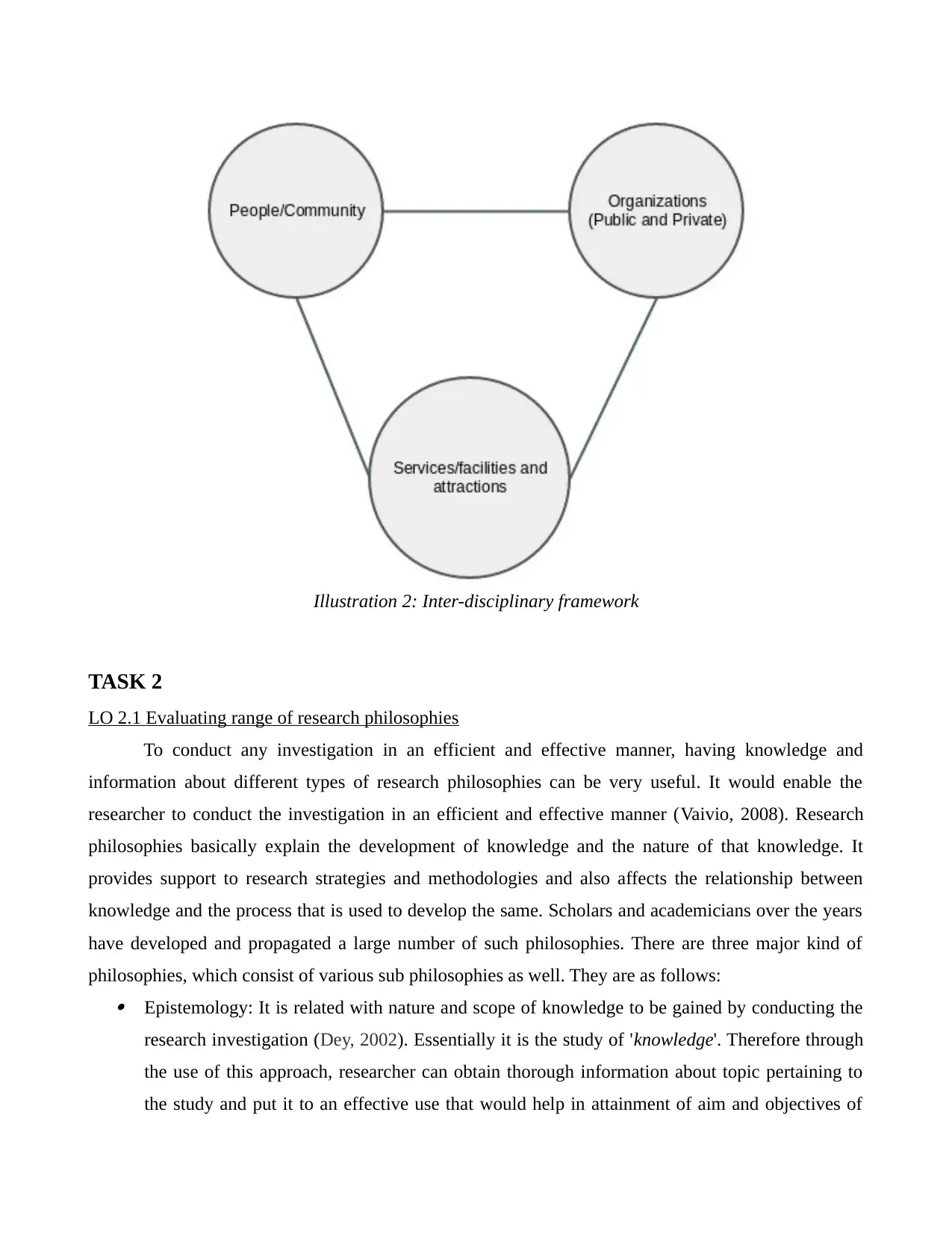
They are people/community; organizations (both public and private); and services/facilities &
attractions. It is related to the inter-disciplinary framework developed by Veal (2004). On this basis, it
can be said that management at Whitbread would need to pay a lot of attention to the environment that
it is a part of (Vicky, 2013).
Herein it can be observed that all these elements are linked with one another and wield their
influence on each other. For instance, people or the community have an influence over organizations in
the tourism and hospitality industry; and vice versa as well. It largely is related with macro
environment, meaning that both these elements cannot control the factors and eventually would get
affected by it (Bertrand and Fransoo, 2002). Companies such as Whitbread would affect the customers,
i.e. the community in terms of their lifestyle. Similarly, organizations also have an impact over
services/facilities and attractions in the tourism and hospitality industry. Furthermore, firms such as
Whitbread get affected by products and/or services as management of the firm would attempt to ensure
that customer demands in terms of such facilities is fulfilled to great extents (Guercini, 2014).
On this basis, it can be said that while researching the tourism and hospitality industry, these
three environmental factors and forces would have to be given a lot of attention. Therefore, a researcher
would have to ensure that thorough understanding about these factors is obtained, because it would
help in making the research efficient and effective. Without such kind of knowledge, researcher will not
be able to study different aspects related to functioning of the tourism and hospitality industry (Healy
and Perry, 2000). While conducting such a study, researcher will have to pay attention towards aspects
such as different micro and macro environmental factors and develop thorough understanding about
them. By having information about such areas, an study into different topics related to field of tourism
and hospitality can be conducted in an effective manner (Jamieson, 2004). This would mean that
desired results can be obtained with ease and comfort.
attractions. It is related to the inter-disciplinary framework developed by Veal (2004). On this basis, it
can be said that management at Whitbread would need to pay a lot of attention to the environment that
it is a part of (Vicky, 2013).
Herein it can be observed that all these elements are linked with one another and wield their
influence on each other. For instance, people or the community have an influence over organizations in
the tourism and hospitality industry; and vice versa as well. It largely is related with macro
environment, meaning that both these elements cannot control the factors and eventually would get
affected by it (Bertrand and Fransoo, 2002). Companies such as Whitbread would affect the customers,
i.e. the community in terms of their lifestyle. Similarly, organizations also have an impact over
services/facilities and attractions in the tourism and hospitality industry. Furthermore, firms such as
Whitbread get affected by products and/or services as management of the firm would attempt to ensure
that customer demands in terms of such facilities is fulfilled to great extents (Guercini, 2014).
On this basis, it can be said that while researching the tourism and hospitality industry, these
three environmental factors and forces would have to be given a lot of attention. Therefore, a researcher
would have to ensure that thorough understanding about these factors is obtained, because it would
help in making the research efficient and effective. Without such kind of knowledge, researcher will not
be able to study different aspects related to functioning of the tourism and hospitality industry (Healy
and Perry, 2000). While conducting such a study, researcher will have to pay attention towards aspects
such as different micro and macro environmental factors and develop thorough understanding about
them. By having information about such areas, an study into different topics related to field of tourism
and hospitality can be conducted in an effective manner (Jamieson, 2004). This would mean that
desired results can be obtained with ease and comfort.
TASK 2
LO 2.1 Evaluating range of research philosophies
To conduct any investigation in an efficient and effective manner, having knowledge and
information about different types of research philosophies can be very useful. It would enable the
researcher to conduct the investigation in an efficient and effective manner (Vaivio, 2008). Research
philosophies basically explain the development of knowledge and the nature of that knowledge. It
provides support to research strategies and methodologies and also affects the relationship between
knowledge and the process that is used to develop the same. Scholars and academicians over the years
have developed and propagated a large number of such philosophies. There are three major kind of
philosophies, which consist of various sub philosophies as well. They are as follows: Epistemology: It is related with nature and scope of knowledge to be gained by conducting the
research investigation (Dey, 2002). Essentially it is the study of 'knowledge'. Therefore through
the use of this approach, researcher can obtain thorough information about topic pertaining to
the study and put it to an effective use that would help in attainment of aim and objectives of
Illustration 2: Inter-disciplinary framework
LO 2.1 Evaluating range of research philosophies
To conduct any investigation in an efficient and effective manner, having knowledge and
information about different types of research philosophies can be very useful. It would enable the
researcher to conduct the investigation in an efficient and effective manner (Vaivio, 2008). Research
philosophies basically explain the development of knowledge and the nature of that knowledge. It
provides support to research strategies and methodologies and also affects the relationship between
knowledge and the process that is used to develop the same. Scholars and academicians over the years
have developed and propagated a large number of such philosophies. There are three major kind of
philosophies, which consist of various sub philosophies as well. They are as follows: Epistemology: It is related with nature and scope of knowledge to be gained by conducting the
research investigation (Dey, 2002). Essentially it is the study of 'knowledge'. Therefore through
the use of this approach, researcher can obtain thorough information about topic pertaining to
the study and put it to an effective use that would help in attainment of aim and objectives of
Illustration 2: Inter-disciplinary framework
⊘ This is a preview!⊘
Do you want full access?
Subscribe today to unlock all pages.
Trusted by 1+ million students worldwide
the investigation. Therefore, the philosophy of epistemology works as a tool that helps in
enhancement of knowledge (Khotri, 2008). Here it may not be wrong to say that by using this
philosophy the researcher can contribute to existing facts associated with the topic. It consists of
two types of sub philosophies:◦ Positivism: It is a scientific approach to conducting any research investigation. It provides
an explanation, predicts and controls different aspects of the study by dividing and isolating
them from one another. Herein highly organized methods that can be easily measured are
used (Panneerselvam, 2004). The researcher does not have a direct interaction while using
this philosophy. This means that the scholar would have no control over outcome(s) of the
study. It is a type of social research used to discover patterns and regularities in different
societal aspects associated with a research topic in some or the other way (Downey,
Hamilton and Catterall, 2007).
◦ Phenomenology/interpretivisim: According to various authors and experts on the subject of
research methodologies, philosophy of interpretivisim leans towards collection and use of
qualitative data. Herein methods such as unstructured interviews, observations, etc. are
taken into consideration to conduct any research investigation (Ireland, Webb and Coombs,
2005). According to this philosophy, it is not possible to reduce the complexity of the world
and break it down into different series of laws and generalisations. The researcher has a
critical role to play here. Ontology: It can be defined as a process that studies the form and nature of reality. Therefore it
may not be wrong to say that it helps understanding different aspects related to functioning of
various societal aspects and concepts in an efficient and effective manner (Johnson and
Christensen, 2010). It again consists of two:◦ Objectivism: It evaluates different social phenomenon and also meaning of their existence
as socially independent facets.
◦ Subjectivism/Constructivism: According to this philosophy, social phenomena are as a result
of perceptions and actions of various social actors.
Axiology: It essentially takes into consideration judgements about values, ethics and aesthetics
(Hansen, 2011). Herein a lot of attention is paid towards role played by different values in
different stages and phases of conducting a research investigation. It questions the very
objectivity or purpose of a research study.
LO 2.2 Assessing range of sources of information to support and develop research
For conducting any research study, it is of utmost importance that information and knowledge
enhancement of knowledge (Khotri, 2008). Here it may not be wrong to say that by using this
philosophy the researcher can contribute to existing facts associated with the topic. It consists of
two types of sub philosophies:◦ Positivism: It is a scientific approach to conducting any research investigation. It provides
an explanation, predicts and controls different aspects of the study by dividing and isolating
them from one another. Herein highly organized methods that can be easily measured are
used (Panneerselvam, 2004). The researcher does not have a direct interaction while using
this philosophy. This means that the scholar would have no control over outcome(s) of the
study. It is a type of social research used to discover patterns and regularities in different
societal aspects associated with a research topic in some or the other way (Downey,
Hamilton and Catterall, 2007).
◦ Phenomenology/interpretivisim: According to various authors and experts on the subject of
research methodologies, philosophy of interpretivisim leans towards collection and use of
qualitative data. Herein methods such as unstructured interviews, observations, etc. are
taken into consideration to conduct any research investigation (Ireland, Webb and Coombs,
2005). According to this philosophy, it is not possible to reduce the complexity of the world
and break it down into different series of laws and generalisations. The researcher has a
critical role to play here. Ontology: It can be defined as a process that studies the form and nature of reality. Therefore it
may not be wrong to say that it helps understanding different aspects related to functioning of
various societal aspects and concepts in an efficient and effective manner (Johnson and
Christensen, 2010). It again consists of two:◦ Objectivism: It evaluates different social phenomenon and also meaning of their existence
as socially independent facets.
◦ Subjectivism/Constructivism: According to this philosophy, social phenomena are as a result
of perceptions and actions of various social actors.
Axiology: It essentially takes into consideration judgements about values, ethics and aesthetics
(Hansen, 2011). Herein a lot of attention is paid towards role played by different values in
different stages and phases of conducting a research investigation. It questions the very
objectivity or purpose of a research study.
LO 2.2 Assessing range of sources of information to support and develop research
For conducting any research study, it is of utmost importance that information and knowledge
Paraphrase This Document
Need a fresh take? Get an instant paraphrase of this document with our AI Paraphraser
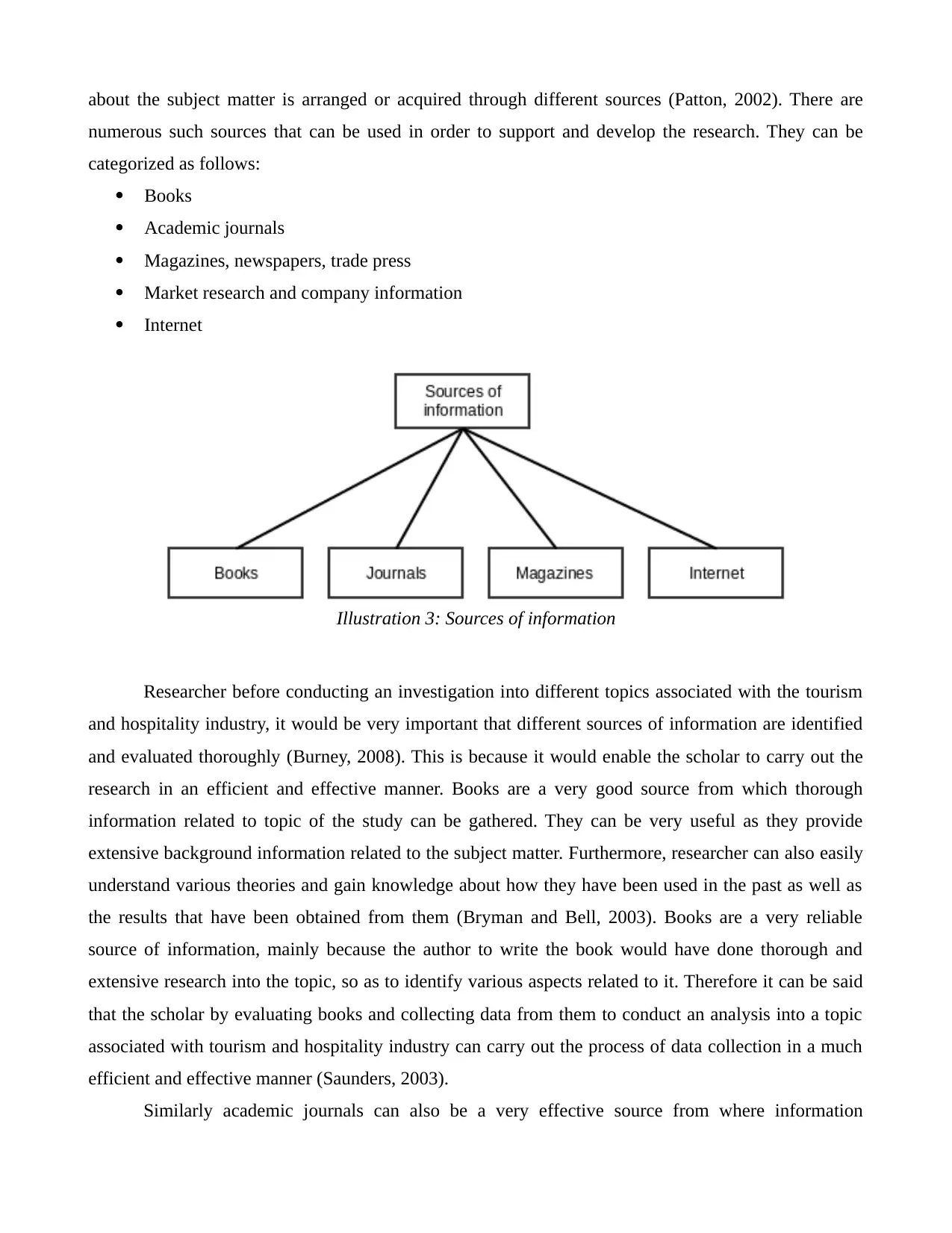
about the subject matter is arranged or acquired through different sources (Patton, 2002). There are
numerous such sources that can be used in order to support and develop the research. They can be
categorized as follows:
Books
Academic journals
Magazines, newspapers, trade press
Market research and company information
Internet
Researcher before conducting an investigation into different topics associated with the tourism
and hospitality industry, it would be very important that different sources of information are identified
and evaluated thoroughly (Burney, 2008). This is because it would enable the scholar to carry out the
research in an efficient and effective manner. Books are a very good source from which thorough
information related to topic of the study can be gathered. They can be very useful as they provide
extensive background information related to the subject matter. Furthermore, researcher can also easily
understand various theories and gain knowledge about how they have been used in the past as well as
the results that have been obtained from them (Bryman and Bell, 2003). Books are a very reliable
source of information, mainly because the author to write the book would have done thorough and
extensive research into the topic, so as to identify various aspects related to it. Therefore it can be said
that the scholar by evaluating books and collecting data from them to conduct an analysis into a topic
associated with tourism and hospitality industry can carry out the process of data collection in a much
efficient and effective manner (Saunders, 2003).
Similarly academic journals can also be a very effective source from where information
Illustration 3: Sources of information
numerous such sources that can be used in order to support and develop the research. They can be
categorized as follows:
Books
Academic journals
Magazines, newspapers, trade press
Market research and company information
Internet
Researcher before conducting an investigation into different topics associated with the tourism
and hospitality industry, it would be very important that different sources of information are identified
and evaluated thoroughly (Burney, 2008). This is because it would enable the scholar to carry out the
research in an efficient and effective manner. Books are a very good source from which thorough
information related to topic of the study can be gathered. They can be very useful as they provide
extensive background information related to the subject matter. Furthermore, researcher can also easily
understand various theories and gain knowledge about how they have been used in the past as well as
the results that have been obtained from them (Bryman and Bell, 2003). Books are a very reliable
source of information, mainly because the author to write the book would have done thorough and
extensive research into the topic, so as to identify various aspects related to it. Therefore it can be said
that the scholar by evaluating books and collecting data from them to conduct an analysis into a topic
associated with tourism and hospitality industry can carry out the process of data collection in a much
efficient and effective manner (Saunders, 2003).
Similarly academic journals can also be a very effective source from where information
Illustration 3: Sources of information
pertaining to research topic can be gathered easily and effectively. It consists of data and findings of
various past primary research study topics. By gaining access to these journals the scholar would be
able to obtain authentic and relevant data related with the study and use it in a proper manner in the
current research study (Dona, 2006). Since these journals are peer-reviewed, it can be said that
information gained through these would be of highest quality standards that would help in ensuring
efficiency and effectiveness of the present study on different topics related to tourism and hospitality
industry in UK. Newspapers, magazines, trade press, etc. are also very effective source of information
through which numerous amount of data pertaining to the topic under purview can be gathered easily
and effectively. Not only are they authentic, but they are also very easy to be accessed (Jackson, 2010).
But here the researcher would have to ensure that the whole study is not dependent upon this source of
information.
By reviewing information from past market research data would help in process for conducting
a research study in a much efficient and effective manner. It can be supported through fact that these
provides fresh and highly authentic data with the help of which current study eventually can be made
more effective and its chances of succeeding can be enhanced by great margins (Merriam, 2009). These
are very reliable source of information, unlike the internet, on which a scholar though can depend, but
it is always advisable not to depend on it. Various academicians have hailed the internet as a very
valued source of information, as it can be accessed by anyone at any point of time. But it is not very
reliable, meaning that a scholar cannot heavily depend on it. A researcher can obtain authentic as well
as false information from the internet, meaning that there is a 50-50 probability of acquiring high
quality, effective and authentic information from this source (Johnson and Christensen, 2008). But
since it is easy and almost free to use, scholar for the present study on tourism and hospitality industry
can rely on this source, as there are chances that it would provide a good amount of very useful
information on the topic.
LO 2.3 Analysing different approaches to research
For conducting any research investigation it is very important to identify and use different kinds
of research approaches. They can be divided into four – qualitative, quantitative, deductive and
inductive. Qualitative research approach can be linked with social constructivist paradigm wherein
socially constructed nature of reality is taken into consideration (Shuttleworth, 2014). In this kind of
research design the scholar pays attention towards evaluating the literal meaning of different words and
aspects included in conducting a research investigation. It is a more interactive and personal kind of
approach that would enable a researcher to consider a large number of areas related to the topic in
various past primary research study topics. By gaining access to these journals the scholar would be
able to obtain authentic and relevant data related with the study and use it in a proper manner in the
current research study (Dona, 2006). Since these journals are peer-reviewed, it can be said that
information gained through these would be of highest quality standards that would help in ensuring
efficiency and effectiveness of the present study on different topics related to tourism and hospitality
industry in UK. Newspapers, magazines, trade press, etc. are also very effective source of information
through which numerous amount of data pertaining to the topic under purview can be gathered easily
and effectively. Not only are they authentic, but they are also very easy to be accessed (Jackson, 2010).
But here the researcher would have to ensure that the whole study is not dependent upon this source of
information.
By reviewing information from past market research data would help in process for conducting
a research study in a much efficient and effective manner. It can be supported through fact that these
provides fresh and highly authentic data with the help of which current study eventually can be made
more effective and its chances of succeeding can be enhanced by great margins (Merriam, 2009). These
are very reliable source of information, unlike the internet, on which a scholar though can depend, but
it is always advisable not to depend on it. Various academicians have hailed the internet as a very
valued source of information, as it can be accessed by anyone at any point of time. But it is not very
reliable, meaning that a scholar cannot heavily depend on it. A researcher can obtain authentic as well
as false information from the internet, meaning that there is a 50-50 probability of acquiring high
quality, effective and authentic information from this source (Johnson and Christensen, 2008). But
since it is easy and almost free to use, scholar for the present study on tourism and hospitality industry
can rely on this source, as there are chances that it would provide a good amount of very useful
information on the topic.
LO 2.3 Analysing different approaches to research
For conducting any research investigation it is very important to identify and use different kinds
of research approaches. They can be divided into four – qualitative, quantitative, deductive and
inductive. Qualitative research approach can be linked with social constructivist paradigm wherein
socially constructed nature of reality is taken into consideration (Shuttleworth, 2014). In this kind of
research design the scholar pays attention towards evaluating the literal meaning of different words and
aspects included in conducting a research investigation. It is a more interactive and personal kind of
approach that would enable a researcher to consider a large number of areas related to the topic in
⊘ This is a preview!⊘
Do you want full access?
Subscribe today to unlock all pages.
Trusted by 1+ million students worldwide

1 out of 27


Related Documents


Your All-in-One AI-Powered Toolkit for Academic Success.
+13062052269
info@desklib.com
Available 24*7 on WhatsApp / Email
![[object Object]](/_next/static/media/star-bottom.7253800d.svg)
Unlock your academic potential
Copyright © 2020–2026 A2Z Services. All Rights Reserved. Developed and managed by ZUCOL.