ATM and IP Network Comparison: Control, Cost, Adaptability

Verified

Added on  2020/12/09

|5
|838
|401
Report
AI Summary
This report provides a comparative analysis of Asynchronous Transfer Mode (ATM) and Internet Protocol (IP) networks, focusing on several key aspects: control, flexibility, adaptability, cost, and manageability. The comparison highlights ATM's high-speed switching capabilities and its use of small unit cells for data transmission, contrasting this with IP's connectionless service and routing functions. The report evaluates the cost-effectiveness of both networks, noting ATM's higher cost compared to the more affordable IP network. It also examines the manageability, adaptability, and flexibility of each technology, emphasizing ATM's reliability and efficient control versus IP's error recovery and data transmission capabilities. The report references the data link layer in both ATM and IP networks, highlighting its role in data transfer. The report is based on research from various journals and books, which are referenced at the end of the document.

Document Page
DQ5-Part2
tabler-icon-diamond-filled.svg

Paraphrase This Document

Need a fresh take? Get an instant paraphrase of this document with our AI Paraphraser
Document Page
Table of Contents
How may such an ATM solution be compared to an IP network over Ethernet, in terms of
control, flexibility, adaptability, cost and manageability? .........................................................3
REFERENCES................................................................................................................................5
Document Page
How may such an ATM solution be compared to an IP network over Ethernet, in terms of
control, flexibility, adaptability, cost and manageability?
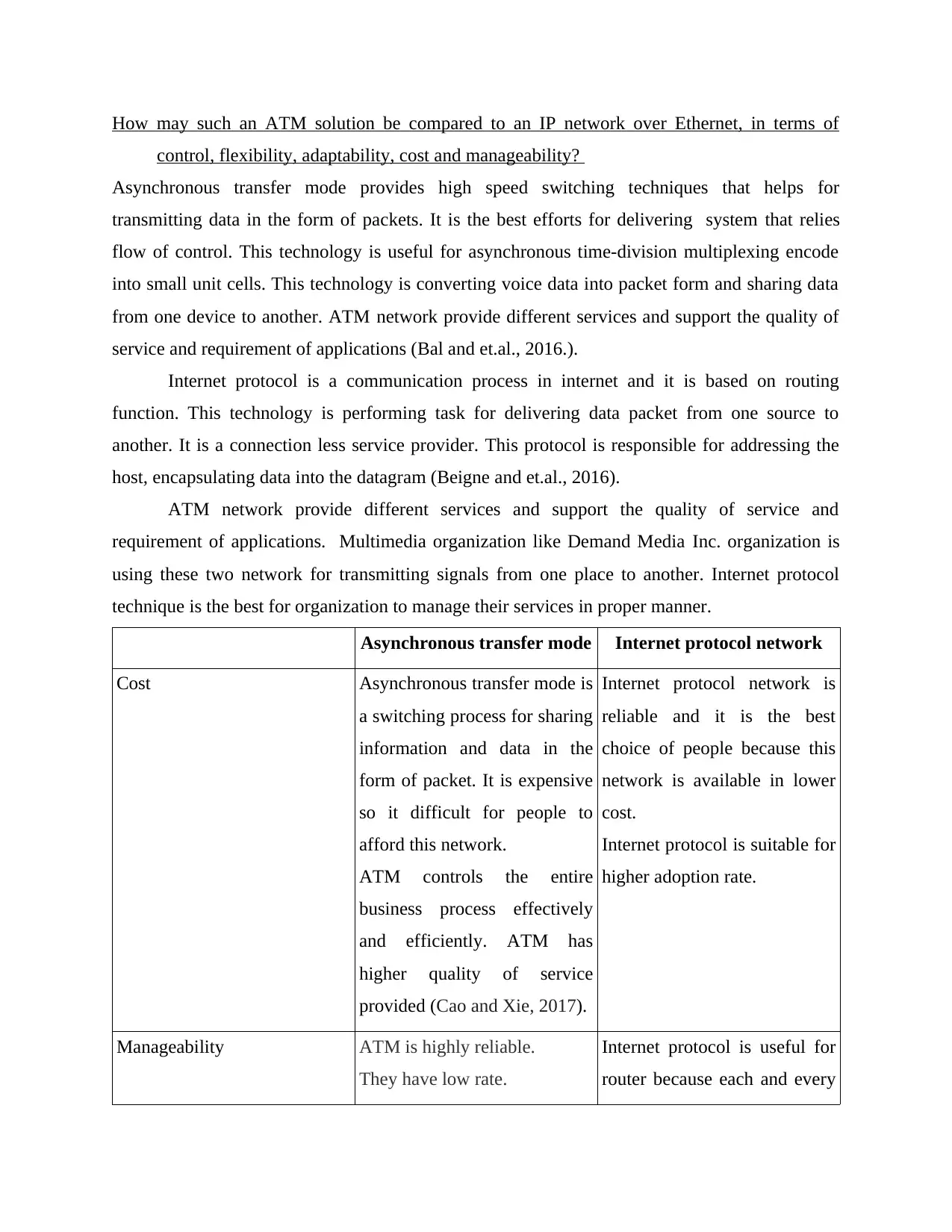
Asynchronous transfer mode provides high speed switching techniques that helps for
transmitting data in the form of packets. It is the best efforts for delivering system that relies
flow of control. This technology is useful for asynchronous time-division multiplexing encode
into small unit cells. This technology is converting voice data into packet form and sharing data
from one device to another. ATM network provide different services and support the quality of
service and requirement of applications (Bal and et.al., 2016.).
Internet protocol is a communication process in internet and it is based on routing
function. This technology is performing task for delivering data packet from one source to
another. It is a connection less service provider. This protocol is responsible for addressing the
host, encapsulating data into the datagram (Beigne and et.al., 2016).
ATM network provide different services and support the quality of service and
requirement of applications. Multimedia organization like Demand Media Inc. organization is
using these two network for transmitting signals from one place to another. Internet protocol
technique is the best for organization to manage their services in proper manner.
Asynchronous transfer mode Internet protocol network
Cost Asynchronous transfer mode is
a switching process for sharing
information and data in the
form of packet. It is expensive
so it difficult for people to
afford this network.
ATM controls the entire
business process effectively
and efficiently. ATM has
higher quality of service
provided (Cao and Xie, 2017).
Internet protocol network is
reliable and it is the best
choice of people because this
network is available in lower
cost.
Internet protocol is suitable for
higher adoption rate.
Manageability ATM is highly reliable.
They have low rate.
Internet protocol is useful for
router because each and every
Document Page
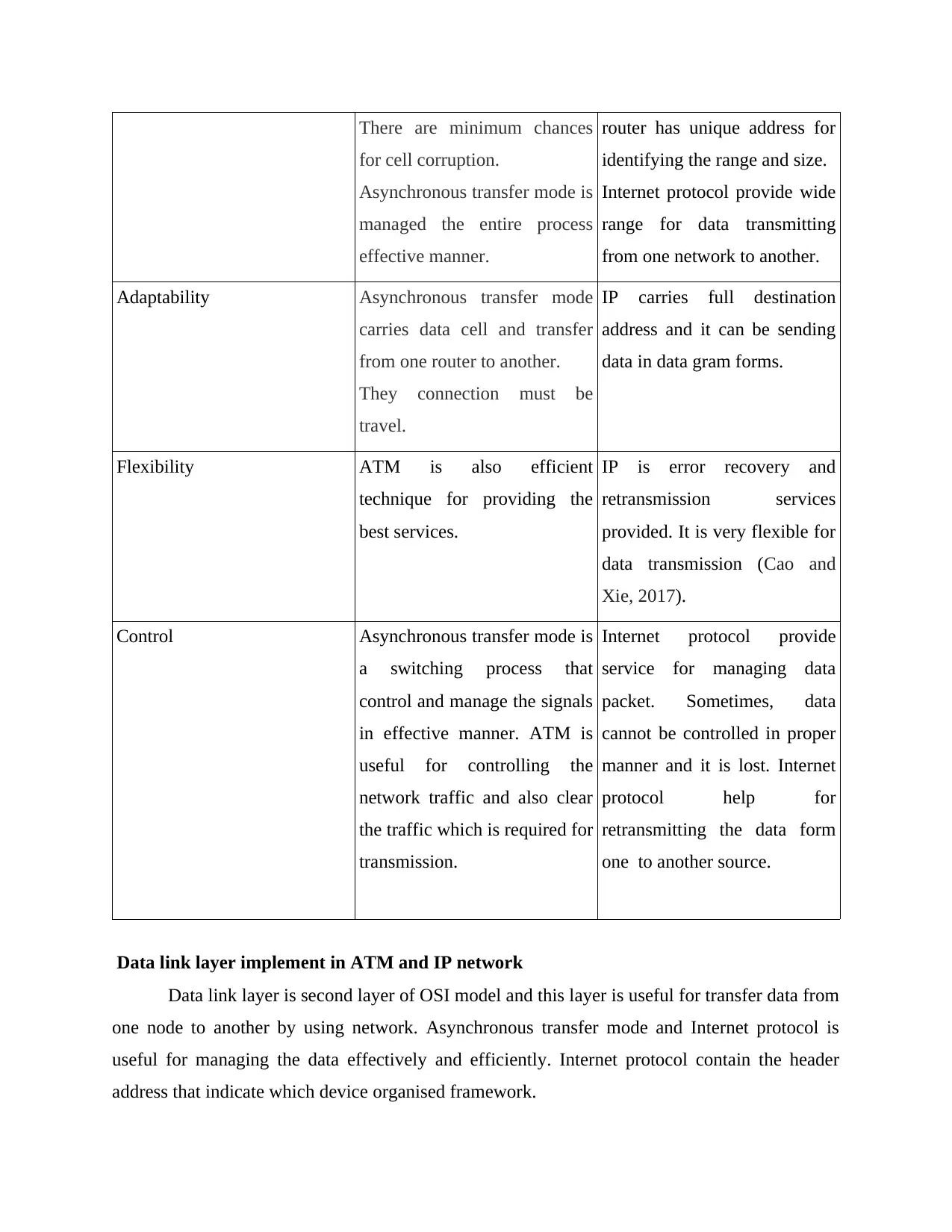
There are minimum chances
for cell corruption.
Asynchronous transfer mode is
managed the entire process
effective manner.
router has unique address for
identifying the range and size.
Internet protocol provide wide
range for data transmitting
from one network to another.
Adaptability Asynchronous transfer mode
carries data cell and transfer
from one router to another.
They connection must be
travel.
IP carries full destination
address and it can be sending
data in data gram forms.
Flexibility ATM is also efficient
technique for providing the
best services.
IP is error recovery and
retransmission services
provided. It is very flexible for
data transmission (Cao and
Xie, 2017).
Control Asynchronous transfer mode is
a switching process that
control and manage the signals
in effective manner. ATM is
useful for controlling the
network traffic and also clear
the traffic which is required for
transmission.
Internet protocol provide
service for managing data
packet. Sometimes, data
cannot be controlled in proper
manner and it is lost. Internet
protocol help for
retransmitting the data form
one to another source.
Data link layer implement in ATM and IP network
Data link layer is second layer of OSI model and this layer is useful for transfer data from
one node to another by using network. Asynchronous transfer mode and Internet protocol is
useful for managing the data effectively and efficiently. Internet protocol contain the header
address that indicate which device organised framework.
tabler-icon-diamond-filled.svg

Paraphrase This Document

Need a fresh take? Get an instant paraphrase of this document with our AI Paraphraser
Document Page
REFERENCES
Books and Journals:
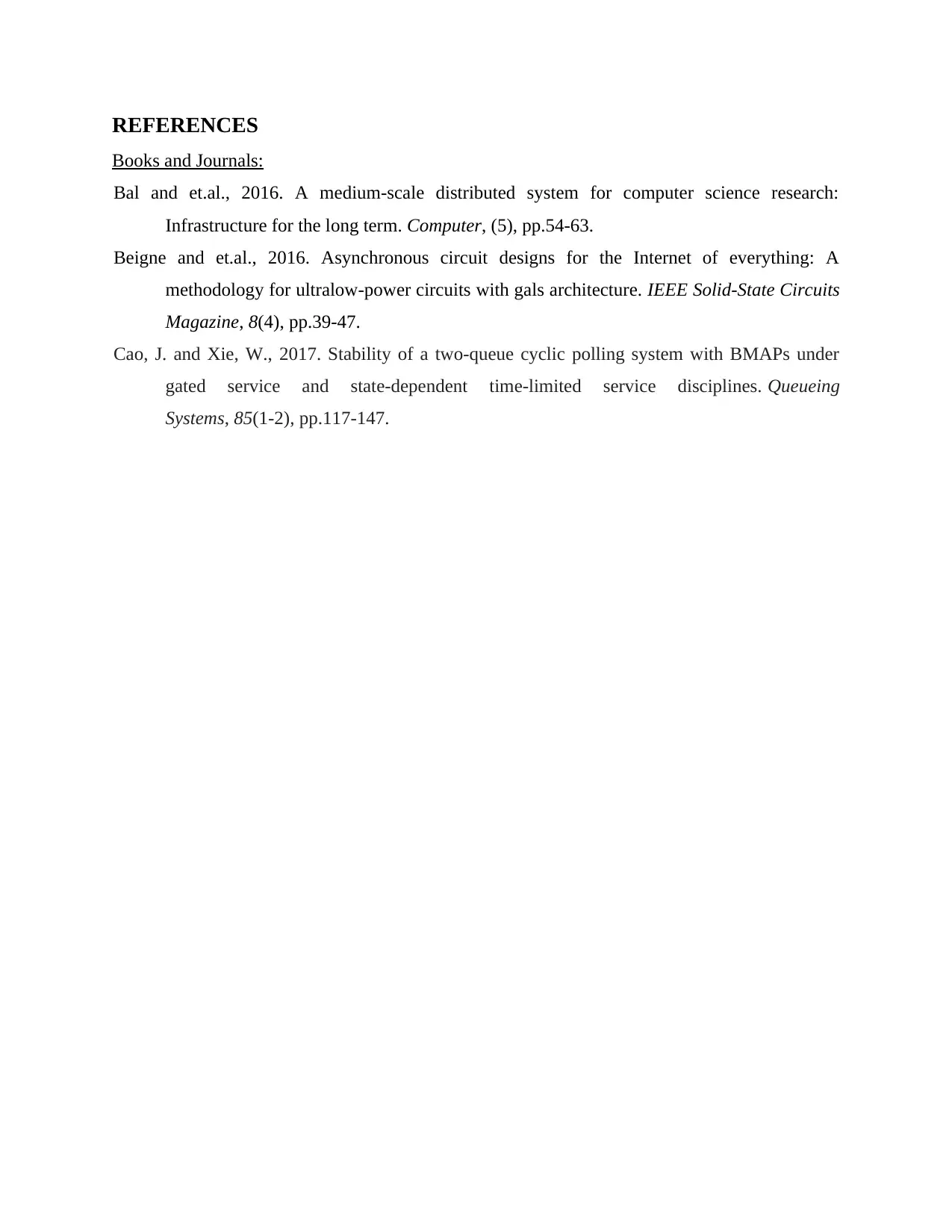
Bal and et.al., 2016. A medium-scale distributed system for computer science research:
Infrastructure for the long term. Computer, (5), pp.54-63.
Beigne and et.al., 2016. Asynchronous circuit designs for the Internet of everything: A
methodology for ultralow-power circuits with gals architecture. IEEE Solid-State Circuits
Magazine, 8(4), pp.39-47.
Cao, J. and Xie, W., 2017. Stability of a two-queue cyclic polling system with BMAPs under
gated service and state-dependent time-limited service disciplines. Queueing
Systems, 85(1-2), pp.117-147.
chevron_up_icon
1 out of 5
circle_padding
hide_on_mobile
zoom_out_icon
[object Object]