Regulation of Australian Banks: Past, Present and Future Analysis
VerifiedAdded on 2020/03/23
|12
|3307
|89
Report
AI Summary
This report provides a comprehensive analysis of the Australian banking industry, examining its historical development, current regulatory environment, and potential future trends. It begins with a historical overview, tracing the evolution of banking in Australia from the 19th century to the present day, highlighting key milestones such as the establishment of the first banks, the impact of economic depressions, and the introduction of technological advancements. The report then delves into the current state of the banking sector, focusing on the dominance of the 'big four' banks, the role of regulatory bodies like APRA and RBA, and the impact of the 'four pillars policy'. It also explores the presence of regional and foreign-owned banks and their contributions to the economy. Furthermore, the report anticipates future changes in the banking system, including the integration of cultural aspects, technological innovations, value chain optimization, and enhanced customer management. The analysis emphasizes the importance of adapting to these changes to maintain a strong and efficient banking system. The report concludes with recommendations for enhancing the Australian banking industry, based on the historical context, current practices, and future prospects. This report is a student contribution published on Desklib, a platform offering AI-powered study tools and resources.
REGULATION OF
AUSTRALIAN
BANKS-PAST,
PRESENT AND
FUTURE.
AUSTRALIAN
BANKS-PAST,
PRESENT AND
FUTURE.

Paraphrase This Document
Need a fresh take? Get an instant paraphrase of this document with our AI Paraphraser

1
By student name
Professor
Date: 16 September, 2017.
1 | P a g e
By student name
Professor
Date: 16 September, 2017.
1 | P a g e
2
Executive Summary
The banking industry began in Australia in the 19th century when the first bank was set up. Since
then there has been a lot of changes in the overall banking operations and structure. There are
large numbers of banks today that are making effective utilizations of the technology today and
making the difference. The banking industry is very stable and sophisticated, and operated on the
various laws and regulations that has been framed to control the same. In this report we will
study the overall banking industry in Australia. We will analyze the past present and future of the
banking industry and state certain recommendation with which it can be enhanced. It is a
research report which includes a lot of in depth analysis of the overall topic and brief facts from
the same are stated here under in details.
2 | P a g e
Executive Summary
The banking industry began in Australia in the 19th century when the first bank was set up. Since
then there has been a lot of changes in the overall banking operations and structure. There are
large numbers of banks today that are making effective utilizations of the technology today and
making the difference. The banking industry is very stable and sophisticated, and operated on the
various laws and regulations that has been framed to control the same. In this report we will
study the overall banking industry in Australia. We will analyze the past present and future of the
banking industry and state certain recommendation with which it can be enhanced. It is a
research report which includes a lot of in depth analysis of the overall topic and brief facts from
the same are stated here under in details.
2 | P a g e
⊘ This is a preview!⊘
Do you want full access?
Subscribe today to unlock all pages.

Trusted by 1+ million students worldwide
3
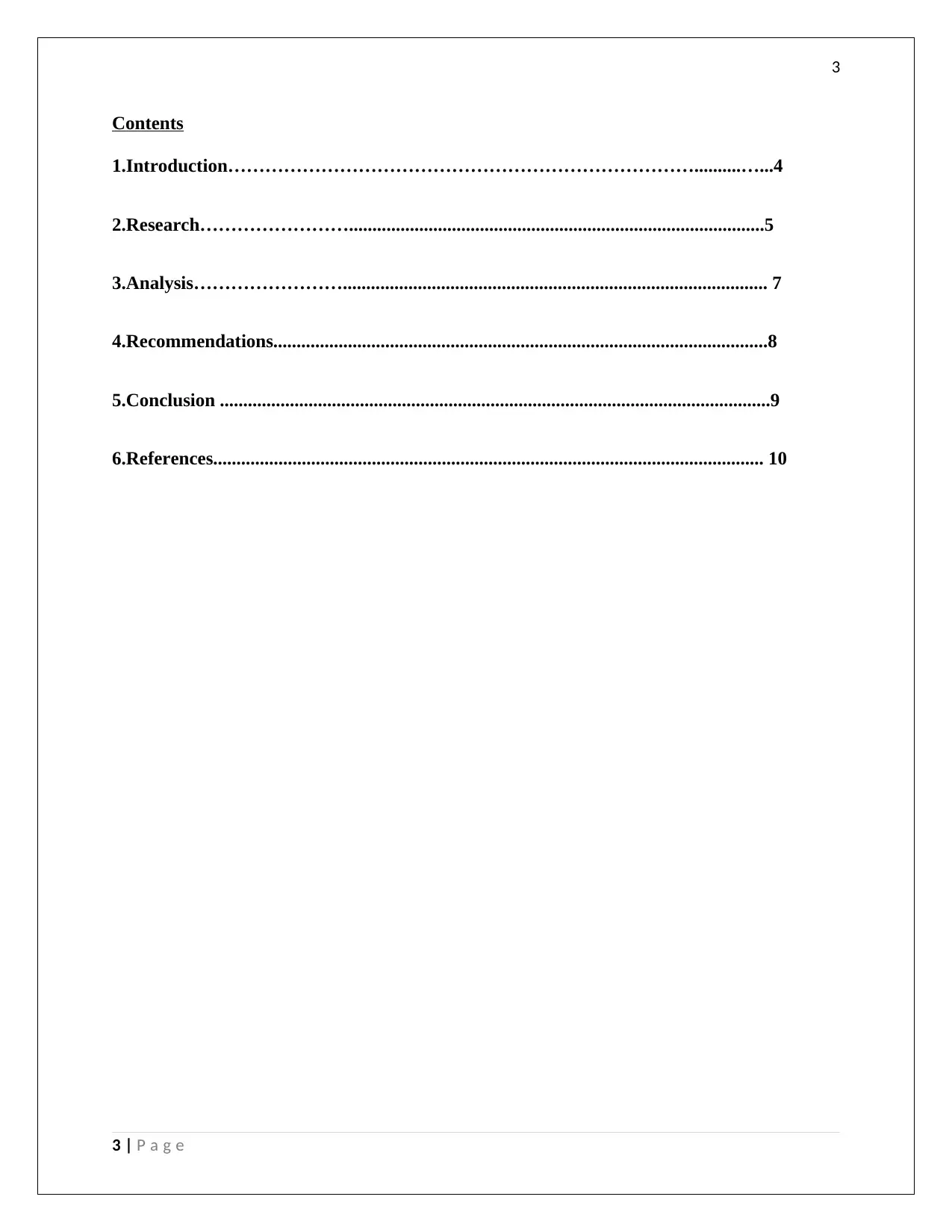
Contents
1.Introduction…………………………………………………………………..........…...4
2.Research…………………….........................................................................................5
3.Analysis……………………........................................................................................... 7
4.Recommendations..........................................................................................................8
5.Conclusion ......................................................................................................................9
6.References...................................................................................................................... 10
3 | P a g e
Contents
1.Introduction…………………………………………………………………..........…...4
2.Research…………………….........................................................................................5
3.Analysis……………………........................................................................................... 7
4.Recommendations..........................................................................................................8
5.Conclusion ......................................................................................................................9
6.References...................................................................................................................... 10
3 | P a g e
Paraphrase This Document
Need a fresh take? Get an instant paraphrase of this document with our AI Paraphraser
4
1. Introduction
In the starting of the 19th century the first bank was set up in Australia. From then till today
there has been large number of reforms in this regard. In this 21st century technology has taken
the reigns in its hands and all the operations are managed on the technical line. There are four big
banks in Australia today on which the four pillar policy was framed that prevents merger of these
banks with each other. These banks are Australia and New Zealand Banking Group Limited,
Commonwealth Bank of Australia, National Australia Bank Limited and Westpac Banking
Corporation. These are the top banks in Australia nd dominates the overall banking sector. The
importance of the banks over the past years has increase and baks today are contributing more
than half of the total assets of the economy. Apart from providing basic services to the
consumers that is lending of money, and management of deposits, they provide large number of
other services also today that ranges from fund management to asset management. They also
provide insurance related services to the consumers and also big companies. These banks are
required to follow the rules and regulations that have been set up by the law framing body of the
country and all the actions must be in line with the same. The strong financial position that the
banks hold today reflects the changes that has occurred in the overall banking sector from the
time when the first bank was set up in the 19th century. Today there are as many as 53 banks
operating in the Australian financial sector (Adapa & Roy, 2017). None of these banks are held
by the government, few of them are owned by foreign parties and 14 banks are owned by the
Australian. The government is not allowed to hold any bank to prevent them from controlling the
economy. The banks are forced to follow the regulations that have been set up the Australian
Prudential Regulation Authority (APRA). These banks holds a large amount of market share and
that is thus controlling the overall economy in some way or the other. The overall analysis of
these bank, from the past to their future presence is discussed in this report briefly. The key
regulating parties of the banking sector includes the RBA, the APRA and the ASIC. They frame
rules and regulations on which the banking system works. They issue guidelines which is
mandatory for all the banks to follow. Any company who wants to function in Australia needs to
have the permission of the APRA and then only they can begin their overall operations. These
standards that are set by these institutions follows a large number of topics that relates to capital
adequacy, management of the funds, securitization, maintain proper quality credits and many
other. They set down limitations that the banks have to follow, and in case the consumers are not
4 | P a g e
1. Introduction
In the starting of the 19th century the first bank was set up in Australia. From then till today
there has been large number of reforms in this regard. In this 21st century technology has taken
the reigns in its hands and all the operations are managed on the technical line. There are four big
banks in Australia today on which the four pillar policy was framed that prevents merger of these
banks with each other. These banks are Australia and New Zealand Banking Group Limited,
Commonwealth Bank of Australia, National Australia Bank Limited and Westpac Banking
Corporation. These are the top banks in Australia nd dominates the overall banking sector. The
importance of the banks over the past years has increase and baks today are contributing more
than half of the total assets of the economy. Apart from providing basic services to the
consumers that is lending of money, and management of deposits, they provide large number of
other services also today that ranges from fund management to asset management. They also
provide insurance related services to the consumers and also big companies. These banks are
required to follow the rules and regulations that have been set up by the law framing body of the
country and all the actions must be in line with the same. The strong financial position that the
banks hold today reflects the changes that has occurred in the overall banking sector from the
time when the first bank was set up in the 19th century. Today there are as many as 53 banks
operating in the Australian financial sector (Adapa & Roy, 2017). None of these banks are held
by the government, few of them are owned by foreign parties and 14 banks are owned by the
Australian. The government is not allowed to hold any bank to prevent them from controlling the
economy. The banks are forced to follow the regulations that have been set up the Australian
Prudential Regulation Authority (APRA). These banks holds a large amount of market share and
that is thus controlling the overall economy in some way or the other. The overall analysis of
these bank, from the past to their future presence is discussed in this report briefly. The key
regulating parties of the banking sector includes the RBA, the APRA and the ASIC. They frame
rules and regulations on which the banking system works. They issue guidelines which is
mandatory for all the banks to follow. Any company who wants to function in Australia needs to
have the permission of the APRA and then only they can begin their overall operations. These
standards that are set by these institutions follows a large number of topics that relates to capital
adequacy, management of the funds, securitization, maintain proper quality credits and many
other. They set down limitations that the banks have to follow, and in case the consumers are not
4 | P a g e
5
happy they can launch their complaints to the respective authorities. If the banks do not comply
with these provisions, then their license can also be cancelled. So in order to avoid the same,
these rules must be strictly followed and all the decisions of the banks should be taken keeping
them in view. This helps in effective management of the accounts and make sure that there are
very less amount of errors involved in the same. The inter-governmental cooperation from other
parts of the world has also improved a lot. The Australian government has a very friendly
attitude towards its counter parties in other parts of the world. All these countries believe in
forwarding a helping hand as and when needed. The Australian government stands for better
harmonization of relationship in the Asian pacific region.This helps in better development of the
world relationship and also open new business opportunities for these companies and also the
economy is also benefited. It opens the option of third party funding which the banks can secure
from other companies that are operating in foreign land and in times of recession it is of great
help.
2. Research
. The first bank was framed in the early 19th century. By the end of the late nineteenth
century during the Victorian era, when there was a situation of huge depression, a large number
of colonial banks failed. This was a huge blow to the banking sector. A new legislation was
framed in 1901, to supervise these banks and protect them, and manage their overall operations.
New rules and regulations were framed after the Second World War. The government was not
allowed to own any of these banks. People assumed that if government had the power to control
the banks than they might be able to control the overall economy also. In order to fight the same,
strict guidelines were framed to control the overall banking sector and provide the people a basis
on which they can judge the performances of these banks. However as there were many changes
in the overall scenario of the world banking sector, deregulation became the order of the day and
5 | P a g e
happy they can launch their complaints to the respective authorities. If the banks do not comply
with these provisions, then their license can also be cancelled. So in order to avoid the same,
these rules must be strictly followed and all the decisions of the banks should be taken keeping
them in view. This helps in effective management of the accounts and make sure that there are
very less amount of errors involved in the same. The inter-governmental cooperation from other
parts of the world has also improved a lot. The Australian government has a very friendly
attitude towards its counter parties in other parts of the world. All these countries believe in
forwarding a helping hand as and when needed. The Australian government stands for better
harmonization of relationship in the Asian pacific region.This helps in better development of the
world relationship and also open new business opportunities for these companies and also the
economy is also benefited. It opens the option of third party funding which the banks can secure
from other companies that are operating in foreign land and in times of recession it is of great
help.
2. Research
. The first bank was framed in the early 19th century. By the end of the late nineteenth
century during the Victorian era, when there was a situation of huge depression, a large number
of colonial banks failed. This was a huge blow to the banking sector. A new legislation was
framed in 1901, to supervise these banks and protect them, and manage their overall operations.
New rules and regulations were framed after the Second World War. The government was not
allowed to own any of these banks. People assumed that if government had the power to control
the banks than they might be able to control the overall economy also. In order to fight the same,
strict guidelines were framed to control the overall banking sector and provide the people a basis
on which they can judge the performances of these banks. However as there were many changes
in the overall scenario of the world banking sector, deregulation became the order of the day and
5 | P a g e
⊘ This is a preview!⊘
Do you want full access?
Subscribe today to unlock all pages.
Trusted by 1+ million students worldwide
6
many changes were brought in. It made the need of stronger norms more evident and clear for
these banks (Anginer & Kunt, 2014).The overall banking balance sheet has grown at an average
rate of 13 percent since 1985. It is a reflection of the strong effect of the banking regulation on
the economy and the presence of the strong demand and supply effect of the economy. The
overall banking scenario was very badly hit because of the great depression that occurred in the
late 1990s. There was a huge decrease in the overall banking home loan demands and that
caused a lot of loss to these banking companies. But since the companies have got over
depression, they are trying to make more profit and generate more revenue by getting third party
funding for their banks and its management. There has been huge growth since the time common
wealth banking norms were issued on the basis of world banking rules. The growth has been
spread over a time line and is visible in the strong market position that these banks hold in
today’s time and the overall effect that they have on the economy of the company (Arnott, et al.,
2017). There was no influence from the government also, as they were not allowed to control
these banks and hence the overall function was dynamic and stable. This was the past of the
banking industry in Australia and since then a lot of it has changed and the same is stated below.
There has been huge growth and development in the Australian banks since 1990. There has
been introduction of Automatic Teller machines and other devices that helped in infusing the
technology with the everyday banking services. This was very helpful for the customers.
Deregulation became the order of the day in 1960, and affected a large number of banks very
badly. In 1980, new banks were established and there was fresh innovation and development.
There were a lot of reward that were associated with the overall deregulation as it allowed many
credit unions and budding societies to become banks without going into mutation. The
government of Australia had launched the four pillars policy as per which the top four banks
were not allowed to merge with each other and had to maintain their individual status. This was
extremely helpful in the long run and made sure that the power was not transferred to a single
banking company. The government was not given any power and was not allowed to control
these banks in anyways. The last government owned bank was old out in 2011, and after that
these banks were privatized. Strict guidelines were issued for the same to be followed by these
banks.
6 | P a g e
many changes were brought in. It made the need of stronger norms more evident and clear for
these banks (Anginer & Kunt, 2014).The overall banking balance sheet has grown at an average
rate of 13 percent since 1985. It is a reflection of the strong effect of the banking regulation on
the economy and the presence of the strong demand and supply effect of the economy. The
overall banking scenario was very badly hit because of the great depression that occurred in the
late 1990s. There was a huge decrease in the overall banking home loan demands and that
caused a lot of loss to these banking companies. But since the companies have got over
depression, they are trying to make more profit and generate more revenue by getting third party
funding for their banks and its management. There has been huge growth since the time common
wealth banking norms were issued on the basis of world banking rules. The growth has been
spread over a time line and is visible in the strong market position that these banks hold in
today’s time and the overall effect that they have on the economy of the company (Arnott, et al.,
2017). There was no influence from the government also, as they were not allowed to control
these banks and hence the overall function was dynamic and stable. This was the past of the
banking industry in Australia and since then a lot of it has changed and the same is stated below.
There has been huge growth and development in the Australian banks since 1990. There has
been introduction of Automatic Teller machines and other devices that helped in infusing the
technology with the everyday banking services. This was very helpful for the customers.
Deregulation became the order of the day in 1960, and affected a large number of banks very
badly. In 1980, new banks were established and there was fresh innovation and development.
There were a lot of reward that were associated with the overall deregulation as it allowed many
credit unions and budding societies to become banks without going into mutation. The
government of Australia had launched the four pillars policy as per which the top four banks
were not allowed to merge with each other and had to maintain their individual status. This was
extremely helpful in the long run and made sure that the power was not transferred to a single
banking company. The government was not given any power and was not allowed to control
these banks in anyways. The last government owned bank was old out in 2011, and after that
these banks were privatized. Strict guidelines were issued for the same to be followed by these
banks.
6 | P a g e
Paraphrase This Document
Need a fresh take? Get an instant paraphrase of this document with our AI Paraphraser
7
3. Analysis
The present banking sector is dominated by the top four banks that hold most of the market share
and contribute the most to the economy. They are guided by the four pillar policy by which they
are not allowed to merge with each other but they can merge with other banks and small
institutions. These acquisitions and mergers have helped in the growth of these banks all over
and also in improving their overall market share. They are extremely huge and as per the world
banking ranks, they are together ranked at 80th position and in case of the market share they
have a 50 rank. They contribute 100 percent to the total share of the GDP and have around
$960billion of assets that are reflected in their books in combination. Their pre-tax income is
around 21 percent and over the years they have been extremely profitable. Apart from providing
normal banking services, the major source of income of this bank comes from non routine
activities like asset management and fund management. There is few other banks also there apart
from these top banks whose main area of focus is the management of the retail sector and hence
are often known as regional banks (Bakir, 2017).These regional banks are a group of five banks
that are owned by the Australian. Over the years they have tried to bring a large amount of
changes in their functioning by providing better services to the customers at discount. They
together contribute to around 8 percent of the total Australian GDP.
Apart from all these, there are few banks that are owned by foreigners, they contribute to around
20 percent of the total GDP. Previously these banks tried to focus on the sale of services and
failed very badly. But now apart from focusing on the whole sale market, they are trying to
indulge in providing better retail oriented services to the consumers at very low prices. The
largest owned foreign banks makes a contribution of around 2.5 percent to the total economy and
is also the eight largest domestic bank in Australia. The major activities of these banks include
fund management and insurance but they also indulge in other type of activities also that will
help them in generating funds. Till today, there are around 53 banks that are functioning in the
Australian economy and none of these banks are owned by government officials. This makes the
overall banking system very strong and reliable (Dowding, 2017).
7 | P a g e
3. Analysis
The present banking sector is dominated by the top four banks that hold most of the market share
and contribute the most to the economy. They are guided by the four pillar policy by which they
are not allowed to merge with each other but they can merge with other banks and small
institutions. These acquisitions and mergers have helped in the growth of these banks all over
and also in improving their overall market share. They are extremely huge and as per the world
banking ranks, they are together ranked at 80th position and in case of the market share they
have a 50 rank. They contribute 100 percent to the total share of the GDP and have around
$960billion of assets that are reflected in their books in combination. Their pre-tax income is
around 21 percent and over the years they have been extremely profitable. Apart from providing
normal banking services, the major source of income of this bank comes from non routine
activities like asset management and fund management. There is few other banks also there apart
from these top banks whose main area of focus is the management of the retail sector and hence
are often known as regional banks (Bakir, 2017).These regional banks are a group of five banks
that are owned by the Australian. Over the years they have tried to bring a large amount of
changes in their functioning by providing better services to the customers at discount. They
together contribute to around 8 percent of the total Australian GDP.
Apart from all these, there are few banks that are owned by foreigners, they contribute to around
20 percent of the total GDP. Previously these banks tried to focus on the sale of services and
failed very badly. But now apart from focusing on the whole sale market, they are trying to
indulge in providing better retail oriented services to the consumers at very low prices. The
largest owned foreign banks makes a contribution of around 2.5 percent to the total economy and
is also the eight largest domestic bank in Australia. The major activities of these banks include
fund management and insurance but they also indulge in other type of activities also that will
help them in generating funds. Till today, there are around 53 banks that are functioning in the
Australian economy and none of these banks are owned by government officials. This makes the
overall banking system very strong and reliable (Dowding, 2017).
7 | P a g e
8
Now if we go for the future banking system, there are several changes that are anticipated to
occur that will make the overall system more strong and efficient. These few changes are
• To infuse the overall work done with the cultural aspects of the economy
• To bring more changes with regard to new innovations and development
• To optimize the overall chain value so that more revenue is generated
• To make the overall customer management system more efficient and less erroneous
It is important for the banks to introduce all these changes in their system because in the long
run it will become very important to do the same. These changes are needed so that the bugs
from the banking system are removed and the entire system becomes more stable. It will be
helpful to the company and also to the customers (Kohtamäki, 2017). It is important that these
companies are able to able to survive this transition phase form the traditional banking system to
more technological advance one. If the companies are not able to survive this phase they won’t
be able to perform good. In the long run it is important that new updates should take place every
now and then. These will be necessary to keep the companies in par with the other world banks
and make the entire system top notch to the global level. It is important to develop better relation
with the customers that will help in better management of the resources overall. It is also
necessary that these banks are able to escape the future of commodity traps and don’t sell their
service as they are selling some products to the people (Mayntz, 2017).These services are there
to help the customers, hence commercialization is important but the overall essence of banking
must always be there. This is the most important thing that the banks must keep in mind. The
companies also need to improve their overall management by effectively combining their needs
demands and the needs of the consumer with their resources, culture and other attributes. These
are few of the basic changes that might be required in the future. As of now the banking sector is
a growing economy and with changes in technology and overall procedures better changes will
occur, that will make the system more efficient.
4. Recommendations
So on the basis of the above analysis it can be said that the main need of these companies is
to not commercialize the services and provide quality services to the consumers. The consumers
8 | P a g e
Now if we go for the future banking system, there are several changes that are anticipated to
occur that will make the overall system more strong and efficient. These few changes are
• To infuse the overall work done with the cultural aspects of the economy
• To bring more changes with regard to new innovations and development
• To optimize the overall chain value so that more revenue is generated
• To make the overall customer management system more efficient and less erroneous
It is important for the banks to introduce all these changes in their system because in the long
run it will become very important to do the same. These changes are needed so that the bugs
from the banking system are removed and the entire system becomes more stable. It will be
helpful to the company and also to the customers (Kohtamäki, 2017). It is important that these
companies are able to able to survive this transition phase form the traditional banking system to
more technological advance one. If the companies are not able to survive this phase they won’t
be able to perform good. In the long run it is important that new updates should take place every
now and then. These will be necessary to keep the companies in par with the other world banks
and make the entire system top notch to the global level. It is important to develop better relation
with the customers that will help in better management of the resources overall. It is also
necessary that these banks are able to escape the future of commodity traps and don’t sell their
service as they are selling some products to the people (Mayntz, 2017).These services are there
to help the customers, hence commercialization is important but the overall essence of banking
must always be there. This is the most important thing that the banks must keep in mind. The
companies also need to improve their overall management by effectively combining their needs
demands and the needs of the consumer with their resources, culture and other attributes. These
are few of the basic changes that might be required in the future. As of now the banking sector is
a growing economy and with changes in technology and overall procedures better changes will
occur, that will make the system more efficient.
4. Recommendations
So on the basis of the above analysis it can be said that the main need of these companies is
to not commercialize the services and provide quality services to the consumers. The consumers
8 | P a g e
⊘ This is a preview!⊘
Do you want full access?
Subscribe today to unlock all pages.
Trusted by 1+ million students worldwide
9
must be given their dues accordingly and must be provided the best service that will help in their
growth and development. It is important that these companies are able to able to survive this
transition phase form the traditional banking system to more technological advance one. It is
important to develop better relation with the customers that will help in better management of the
resources overal (Trieu, 2017). New technological advances must be done to make the entire
process more easy. It is also important to see that there must be simplification of the banking
processes so that the customers are able to understand it easily and deal with the same without
issues. Proper audit of the banking companies must be done as per the stated rules and
regulations so that people are aware of the true picture of the financials of the company. They
can take their important decisions on the basis of the same.
5. Conclusion
After the entire analysis it can be concluded that the banking system in Australia ahs
improved a lot over the years. There has been huge growth from the first bank that was
formed in 19th century till today. It will be ok for the banking companies to make sure that
retain their current position and bring it new changes so that the future is better. The banking
companies must be operated independently and the government should also see to it that the
overall norms that it has framed for the same must be free from all kind of errors. The
customers instill their faith in these banking companies and thus it is their responsibility to
provide them the best services (Yates, 2017). The present scenario in respect to these banking
companies is bright and with few changes the companies will be able to improve a lot and
will be to inculcate more changes in the system. The government should see to it that there is
more growth of domestic banks rather than foreign owned banks and that there are steps
taken for the betterment of the same. Overall the banking system is effective and strong and
free from errors.
9 | P a g e
must be given their dues accordingly and must be provided the best service that will help in their
growth and development. It is important that these companies are able to able to survive this
transition phase form the traditional banking system to more technological advance one. It is
important to develop better relation with the customers that will help in better management of the
resources overal (Trieu, 2017). New technological advances must be done to make the entire
process more easy. It is also important to see that there must be simplification of the banking
processes so that the customers are able to understand it easily and deal with the same without
issues. Proper audit of the banking companies must be done as per the stated rules and
regulations so that people are aware of the true picture of the financials of the company. They
can take their important decisions on the basis of the same.
5. Conclusion
After the entire analysis it can be concluded that the banking system in Australia ahs
improved a lot over the years. There has been huge growth from the first bank that was
formed in 19th century till today. It will be ok for the banking companies to make sure that
retain their current position and bring it new changes so that the future is better. The banking
companies must be operated independently and the government should also see to it that the
overall norms that it has framed for the same must be free from all kind of errors. The
customers instill their faith in these banking companies and thus it is their responsibility to
provide them the best services (Yates, 2017). The present scenario in respect to these banking
companies is bright and with few changes the companies will be able to improve a lot and
will be to inculcate more changes in the system. The government should see to it that there is
more growth of domestic banks rather than foreign owned banks and that there are steps
taken for the betterment of the same. Overall the banking system is effective and strong and
free from errors.
9 | P a g e
Paraphrase This Document
Need a fresh take? Get an instant paraphrase of this document with our AI Paraphraser
10
Refrences
Adapa, S. & Roy, S., 2017. Consumers’ post-adoption behaviour towards Internet banking: empirical
evidence from Australia. Behaviour & Informtaion Technology, 36(9), pp. 970-983.
Anginer, D. & Kunt, A., 2014. Has the global banking system become more fragile over time?. Journal of
Financial Stability, Volume 13, pp. 202-213.
Arnott, D., Lizama, F. & Song, Y., 2017. Patterns of business intelligence systems use in organizations.
Decision Support Systems, Volume 97, pp. 58-68.
Bakir, c., 2017. How do mega-bank merger policy and regulations contribute to financial stability?
Evidence from Australia and Canada. Journal of Economic Policy Reform, pp. 1-15.
Dowding, K., 2017. Australian exceptionalism reconsidered. Australian journal of Political Science, 52(2),
pp. 165-182.
Kohtamäki, M., 2017. Real-time Strategy and Business Intelligence: Digitizing Practices and Systems.
Finland: Palgrave Macmillan.
Mayntz, R., 2017. Networked Governance. s.l.:Springer.
Trieu, V., 2017. Getting value from Business Intelligence systems: A review and research agenda.
Decision Support Systems, Volume 93, pp. 111-124.
Yates, J., 2017. Protecting housing and mortgage markets in times of crisis: a view from Australia.
Journal of Housing and the Built Environment, 29(2), pp. 361-382.
10 | P a g e
Refrences
Adapa, S. & Roy, S., 2017. Consumers’ post-adoption behaviour towards Internet banking: empirical
evidence from Australia. Behaviour & Informtaion Technology, 36(9), pp. 970-983.
Anginer, D. & Kunt, A., 2014. Has the global banking system become more fragile over time?. Journal of
Financial Stability, Volume 13, pp. 202-213.
Arnott, D., Lizama, F. & Song, Y., 2017. Patterns of business intelligence systems use in organizations.
Decision Support Systems, Volume 97, pp. 58-68.
Bakir, c., 2017. How do mega-bank merger policy and regulations contribute to financial stability?
Evidence from Australia and Canada. Journal of Economic Policy Reform, pp. 1-15.
Dowding, K., 2017. Australian exceptionalism reconsidered. Australian journal of Political Science, 52(2),
pp. 165-182.
Kohtamäki, M., 2017. Real-time Strategy and Business Intelligence: Digitizing Practices and Systems.
Finland: Palgrave Macmillan.
Mayntz, R., 2017. Networked Governance. s.l.:Springer.
Trieu, V., 2017. Getting value from Business Intelligence systems: A review and research agenda.
Decision Support Systems, Volume 93, pp. 111-124.
Yates, J., 2017. Protecting housing and mortgage markets in times of crisis: a view from Australia.
Journal of Housing and the Built Environment, 29(2), pp. 361-382.
10 | P a g e

11
11 | P a g e
11 | P a g e
⊘ This is a preview!⊘
Do you want full access?
Subscribe today to unlock all pages.
Trusted by 1+ million students worldwide

1 out of 12


Related Documents


Your All-in-One AI-Powered Toolkit for Academic Success.
+13062052269
info@desklib.com
Available 24*7 on WhatsApp / Email
![[object Object]](/_next/static/media/star-bottom.7253800d.svg)
Unlock your academic potential
Copyright © 2020–2026 A2Z Services. All Rights Reserved. Developed and managed by ZUCOL.