BTEC Level 2 IT Diploma - Unit 10 Assignment 1: Database Use Analysis
VerifiedAdded on 2019/09/13
|5
|967
|450
Report
AI Summary
This assignment report, developed for a BTEC Level 2 Diploma in Information Technology, Unit 10 (Database Development), focuses on the practical application and analysis of databases within a healthcare context. The report begins by exploring the uses and features of databases in two different organizations, specifically a health authority and doctors' surgeries. It then explains how database tools and techniques enhance productivity, accuracy, and usability. The report further delves into a detailed analysis of each database, considering their strengths and weaknesses. The assignment aims to provide a comprehensive understanding of database applications and their impact on information management. The report follows the guidelines provided, including submission requirements and assessment criteria, ensuring a professional standard of work. This solution is available on Desklib, a platform offering study tools for students.
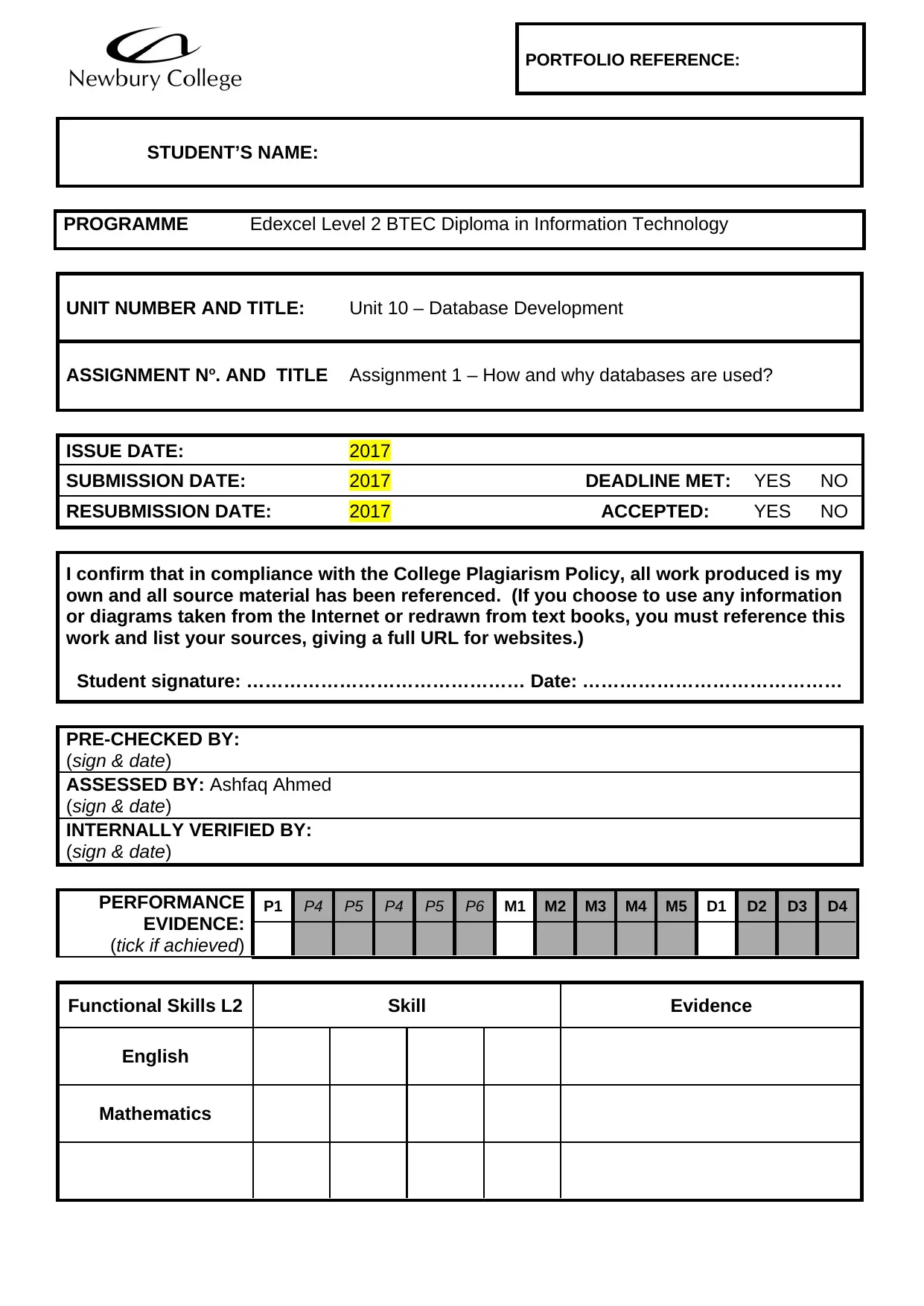
PORTFOLIO REFERENCE:
STUDENT’S NAME:
PROGRAMME Edexcel Level 2 BTEC Diploma in Information Technology
UNIT NUMBER AND TITLE: Unit 10 – Database Development
ASSIGNMENT No. AND TITLE Assignment 1 – How and why databases are used?
ISSUE DATE: 2017
SUBMISSION DATE: 2017 DEADLINE MET: YES NO
RESUBMISSION DATE: 2017 ACCEPTED: YES NO
I confirm that in compliance with the College Plagiarism Policy, all work produced is my
own and all source material has been referenced. (If you choose to use any information
or diagrams taken from the Internet or redrawn from text books, you must reference this
work and list your sources, giving a full URL for websites.)
Student signature: ……………………………………… Date: ……………………………………
PRE-CHECKED BY:
(sign & date)
ASSESSED BY: Ashfaq Ahmed
(sign & date)
INTERNALLY VERIFIED BY:
(sign & date)
PERFORMANCE
EVIDENCE:
(tick if achieved)
P1 P4 P5 P4 P5 P6 M1 M2 M3 M4 M5 D1 D2 D3 D4
Functional Skills L2 Skill Evidence
English
Mathematics
STUDENT’S NAME:
PROGRAMME Edexcel Level 2 BTEC Diploma in Information Technology
UNIT NUMBER AND TITLE: Unit 10 – Database Development
ASSIGNMENT No. AND TITLE Assignment 1 – How and why databases are used?
ISSUE DATE: 2017
SUBMISSION DATE: 2017 DEADLINE MET: YES NO
RESUBMISSION DATE: 2017 ACCEPTED: YES NO
I confirm that in compliance with the College Plagiarism Policy, all work produced is my
own and all source material has been referenced. (If you choose to use any information
or diagrams taken from the Internet or redrawn from text books, you must reference this
work and list your sources, giving a full URL for websites.)
Student signature: ……………………………………… Date: ……………………………………
PRE-CHECKED BY:
(sign & date)
ASSESSED BY: Ashfaq Ahmed
(sign & date)
INTERNALLY VERIFIED BY:
(sign & date)
PERFORMANCE
EVIDENCE:
(tick if achieved)
P1 P4 P5 P4 P5 P6 M1 M2 M3 M4 M5 D1 D2 D3 D4
Functional Skills L2 Skill Evidence
English
Mathematics
Paraphrase This Document
Need a fresh take? Get an instant paraphrase of this document with our AI Paraphraser

Unit 4 - Impact of use of IT on business systems
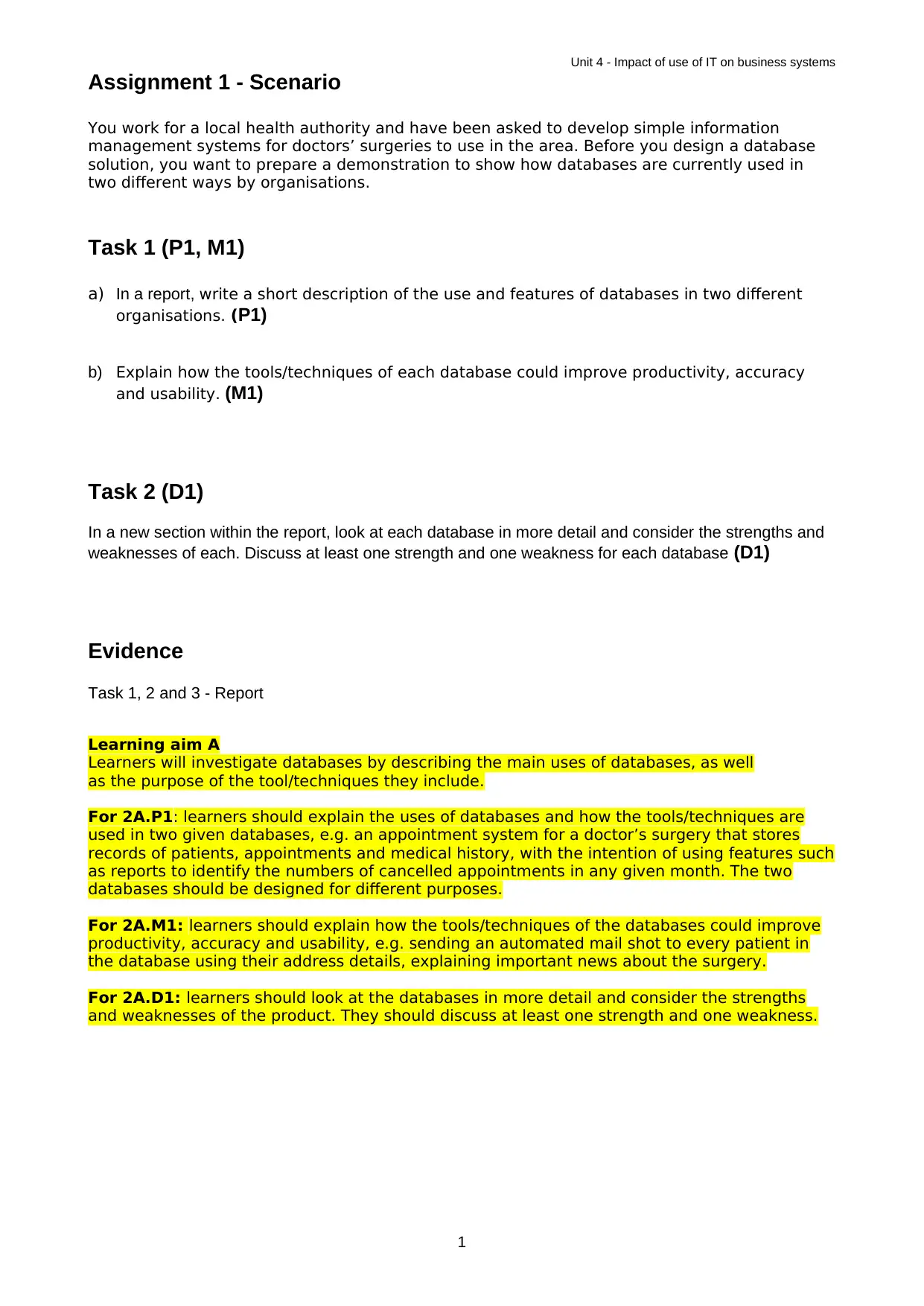
Assignment 1 - Scenario
You work for a local health authority and have been asked to develop simple information
management systems for doctors’ surgeries to use in the area. Before you design a database
solution, you want to prepare a demonstration to show how databases are currently used in
two different ways by organisations.
Task 1 (P1, M1)
a) In a report, write a short description of the use and features of databases in two different
organisations. (P1)
b) Explain how the tools/techniques of each database could improve productivity, accuracy
and usability. (M1)
Task 2 (D1)
In a new section within the report, look at each database in more detail and consider the strengths and
weaknesses of each. Discuss at least one strength and one weakness for each database (D1)
Evidence
Task 1, 2 and 3 - Report
Learning aim A
Learners will investigate databases by describing the main uses of databases, as well
as the purpose of the tool/techniques they include.
For 2A.P1: learners should explain the uses of databases and how the tools/techniques are
used in two given databases, e.g. an appointment system for a doctor’s surgery that stores
records of patients, appointments and medical history, with the intention of using features such
as reports to identify the numbers of cancelled appointments in any given month. The two
databases should be designed for different purposes.
For 2A.M1: learners should explain how the tools/techniques of the databases could improve
productivity, accuracy and usability, e.g. sending an automated mail shot to every patient in
the database using their address details, explaining important news about the surgery.
For 2A.D1: learners should look at the databases in more detail and consider the strengths
and weaknesses of the product. They should discuss at least one strength and one weakness.
1
Assignment 1 - Scenario
You work for a local health authority and have been asked to develop simple information
management systems for doctors’ surgeries to use in the area. Before you design a database
solution, you want to prepare a demonstration to show how databases are currently used in
two different ways by organisations.
Task 1 (P1, M1)
a) In a report, write a short description of the use and features of databases in two different
organisations. (P1)
b) Explain how the tools/techniques of each database could improve productivity, accuracy
and usability. (M1)
Task 2 (D1)
In a new section within the report, look at each database in more detail and consider the strengths and
weaknesses of each. Discuss at least one strength and one weakness for each database (D1)
Evidence
Task 1, 2 and 3 - Report
Learning aim A
Learners will investigate databases by describing the main uses of databases, as well
as the purpose of the tool/techniques they include.
For 2A.P1: learners should explain the uses of databases and how the tools/techniques are
used in two given databases, e.g. an appointment system for a doctor’s surgery that stores
records of patients, appointments and medical history, with the intention of using features such
as reports to identify the numbers of cancelled appointments in any given month. The two
databases should be designed for different purposes.
For 2A.M1: learners should explain how the tools/techniques of the databases could improve
productivity, accuracy and usability, e.g. sending an automated mail shot to every patient in
the database using their address details, explaining important news about the surgery.
For 2A.D1: learners should look at the databases in more detail and consider the strengths
and weaknesses of the product. They should discuss at least one strength and one weakness.
1

Unit 4 - Impact of use of IT on business systems
Guidance
Work through each task, making copies of your work as you complete them. These will be
required in your submission. Any diagrams should be produced using appropriate tools.
Take regular backups of your work. This will enable you to recover quickly should the
system fail and also allow you to backtrack if you decide to add to, delete from or edit your
work.
Discuss your recommendations, giving the reasons for the choices you are making, with
your tutor, who may give advice. Document your choices as you progress. Update all your
documentation as changes are made.
Submission Requirements
A PowerPoint presentation covering tasks 1 – 3 and a Word-processed report of
professional standard covering task 4, submitted electronically via Moodle.
Warning: All media must be virus free!
Media containing viruses, or media which cannot be run directly, will result in a FAIL grade
being awarded for this module.
Your responses to every task, including clear and full workings, which have been
proofread, checked and corrected. Do not incorporate your answers within the task sheet.
Instead, produce a separate document for these - you may copy and paste diagrams and
tables from the task sheet into your answers document if you wish.
All work must be submitted via Moodle on the link provided by your tutor
2
Guidance
Work through each task, making copies of your work as you complete them. These will be
required in your submission. Any diagrams should be produced using appropriate tools.
Take regular backups of your work. This will enable you to recover quickly should the
system fail and also allow you to backtrack if you decide to add to, delete from or edit your
work.
Discuss your recommendations, giving the reasons for the choices you are making, with
your tutor, who may give advice. Document your choices as you progress. Update all your
documentation as changes are made.
Submission Requirements
A PowerPoint presentation covering tasks 1 – 3 and a Word-processed report of
professional standard covering task 4, submitted electronically via Moodle.
Warning: All media must be virus free!
Media containing viruses, or media which cannot be run directly, will result in a FAIL grade
being awarded for this module.
Your responses to every task, including clear and full workings, which have been
proofread, checked and corrected. Do not incorporate your answers within the task sheet.
Instead, produce a separate document for these - you may copy and paste diagrams and
tables from the task sheet into your answers document if you wish.
All work must be submitted via Moodle on the link provided by your tutor
2
⊘ This is a preview!⊘
Do you want full access?
Subscribe today to unlock all pages.

Trusted by 1+ million students worldwide

Unit 4 - Impact of use of IT on business systems
ASSIGNMENT SUBMISSIONS
If your assignment is formally submitted by the deadline, but your evidence does not
meet the standard required, you will be given one more opportunity to resubmit on a new
date agreed with the lecturer but you will be given only Pass grade upon resubmission of
appropriate work (if resubmitted work meets the required criteria).
If your assignment is submitted after the deadline, you may not be entitled to Merit or
Distinction grades. Therefore you must be sure that the evidence submitted is of at least
Pass standard (within the agreed date).
If you are resubmitting work, the original submission including accompanying assignment
documentation must be resubmitted along with a completed Resubmission Sheet
(available on Moodle) followed by the revised work.
3
ASSIGNMENT SUBMISSIONS
If your assignment is formally submitted by the deadline, but your evidence does not
meet the standard required, you will be given one more opportunity to resubmit on a new
date agreed with the lecturer but you will be given only Pass grade upon resubmission of
appropriate work (if resubmitted work meets the required criteria).
If your assignment is submitted after the deadline, you may not be entitled to Merit or
Distinction grades. Therefore you must be sure that the evidence submitted is of at least
Pass standard (within the agreed date).
If you are resubmitting work, the original submission including accompanying assignment
documentation must be resubmitted along with a completed Resubmission Sheet
(available on Moodle) followed by the revised work.
3
Paraphrase This Document
Need a fresh take? Get an instant paraphrase of this document with our AI Paraphraser

Unit 4 - Impact of use of IT on business systems
ASSESSMENT EVIDENCE
All documents related to the assignment must be submitted via link on Moodle.
4
ASSESSMENT EVIDENCE
All documents related to the assignment must be submitted via link on Moodle.
4
1 out of 5
Related Documents
Your All-in-One AI-Powered Toolkit for Academic Success.
+13062052269
info@desklib.com
Available 24*7 on WhatsApp / Email
Unlock your academic potential
Copyright © 2020–2026 A2Z Services. All Rights Reserved. Developed and managed by ZUCOL.