Business Analysis Report: Osmidium Employee Data Insights

Verified

Added on  2023/05/30

|9
|979
|405
Report
AI Summary
This report presents a detailed analysis of employee data, focusing on various aspects such as work hours, salary, and employee relationships within Osmidium. The analysis begins with an overview of weekly work hours, highlighting the mean, median, range, and skewness of the distribution, as well as the presence of outliers. It then examines employee retention likelihood and provides a gender-based comparison of work hours. The report also assesses employee relationships with management and explores the correlation between age, work hours, education, work experience, promotions, tenure at Osmidium, and salary. The findings reveal insights into the factors influencing employee satisfaction and performance, providing valuable information for business decision-making.

Document Page
BUSINESS ANALYSIS
STUDENT ID:
[Pick the date]
tabler-icon-diamond-filled.svg

Paraphrase This Document

Need a fresh take? Get an instant paraphrase of this document with our AI Paraphraser
Document Page
PART 1: Data Analysis
Task 1
Task 2
Document Page
Task 3
Document Page
Task 4
tabler-icon-diamond-filled.svg

Paraphrase This Document

Need a fresh take? Get an instant paraphrase of this document with our AI Paraphraser
Document Page
Task 5
Document Page
Document Page
tabler-icon-diamond-filled.svg

Paraphrase This Document

Need a fresh take? Get an instant paraphrase of this document with our AI Paraphraser
Document Page
Part 2: Report
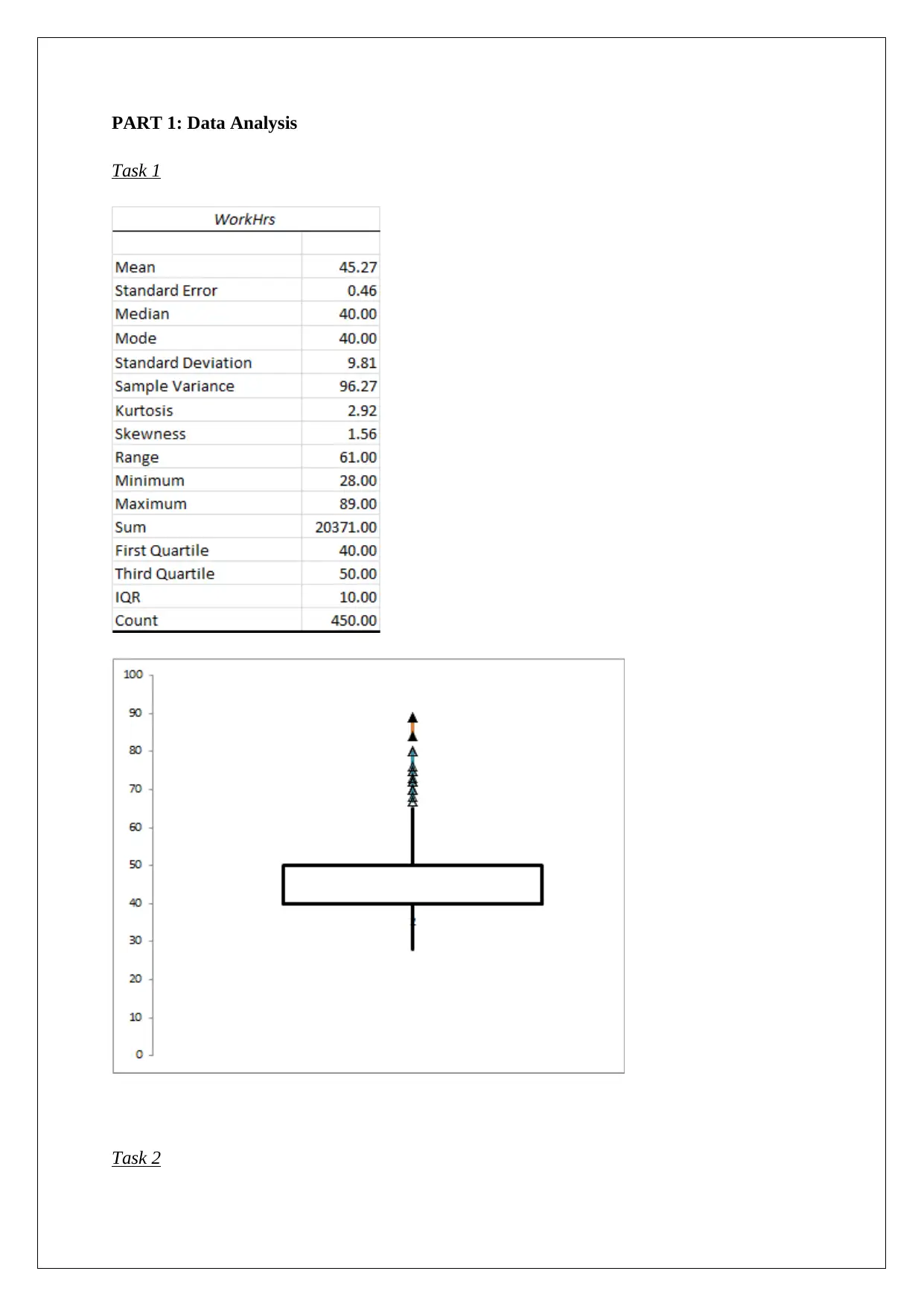
1) The mean weekly work hours for employees based on the given sample data is 45.27
hours. However, the median weekly work hours for employees are only 40 hours. This
implies that 50% of the sample employees tend to work for 40 hours or less per week. The
minimum weekly hours for an employee is 28 hours while the corresponding maximum
weekly hours observed for the sample employees is 89 hours. This clearly reflects that there
is a high range in which the weekly work hours of employees vary. However, IQR is 10
hours which implies that the middle 50% of the employees have their weekly work hours
lying in a range of 10 hours which indicates high variation at the two extreme ends. Also, the
shape of the weekly work hours distribution is asymmetric as high positive skew is present
thereby implying that are a lot of employees who are working for significantly high hours per
week. There is presence of more than 10 outliers in the data and most of these are on the
higher end.
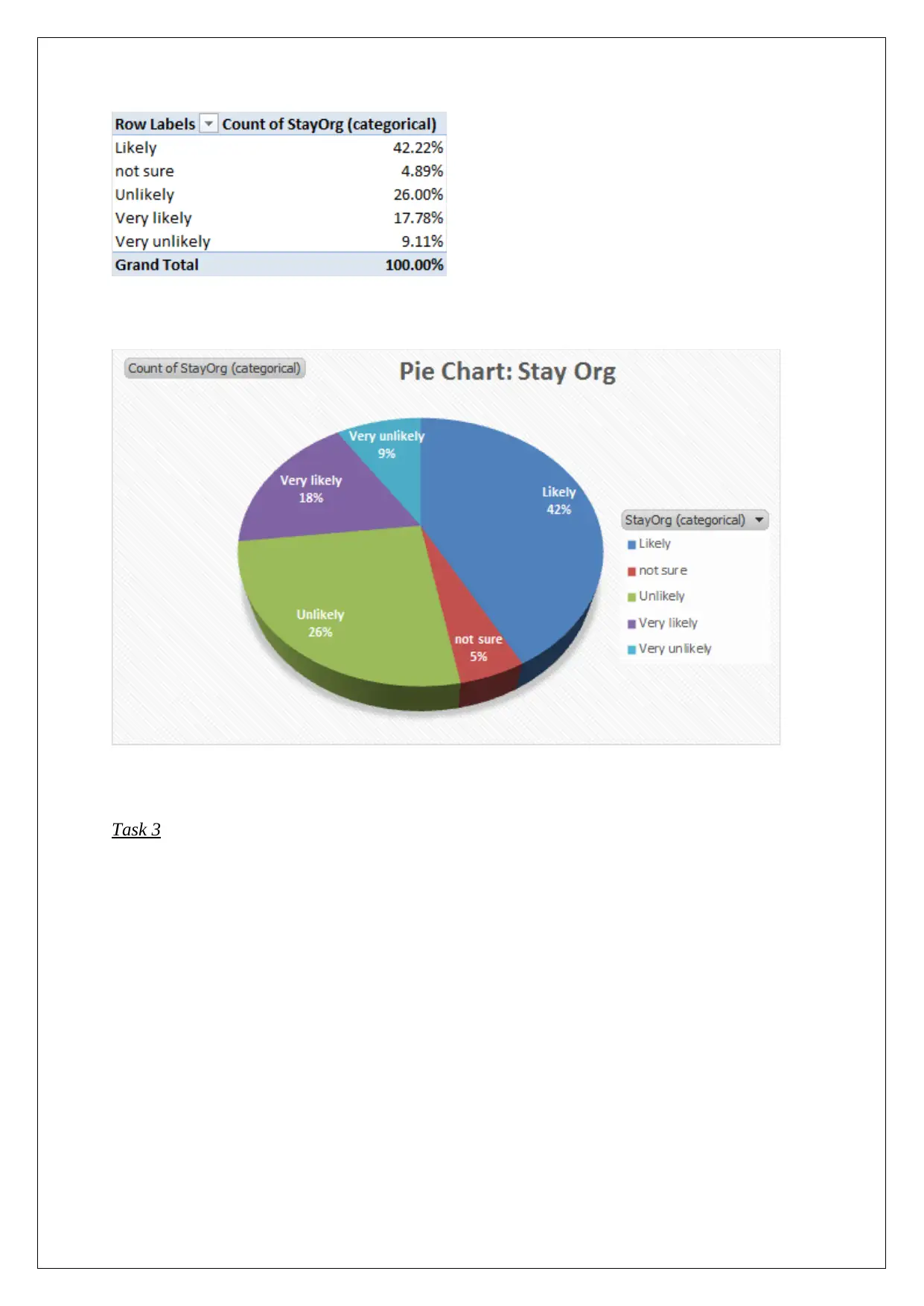
2) The number of employees that have been included in the survey correspond to 450. Out of
these, 80 employees are very likely to stay in their job. This implies that 17.78% of the
employees are very likely to stay in their job.
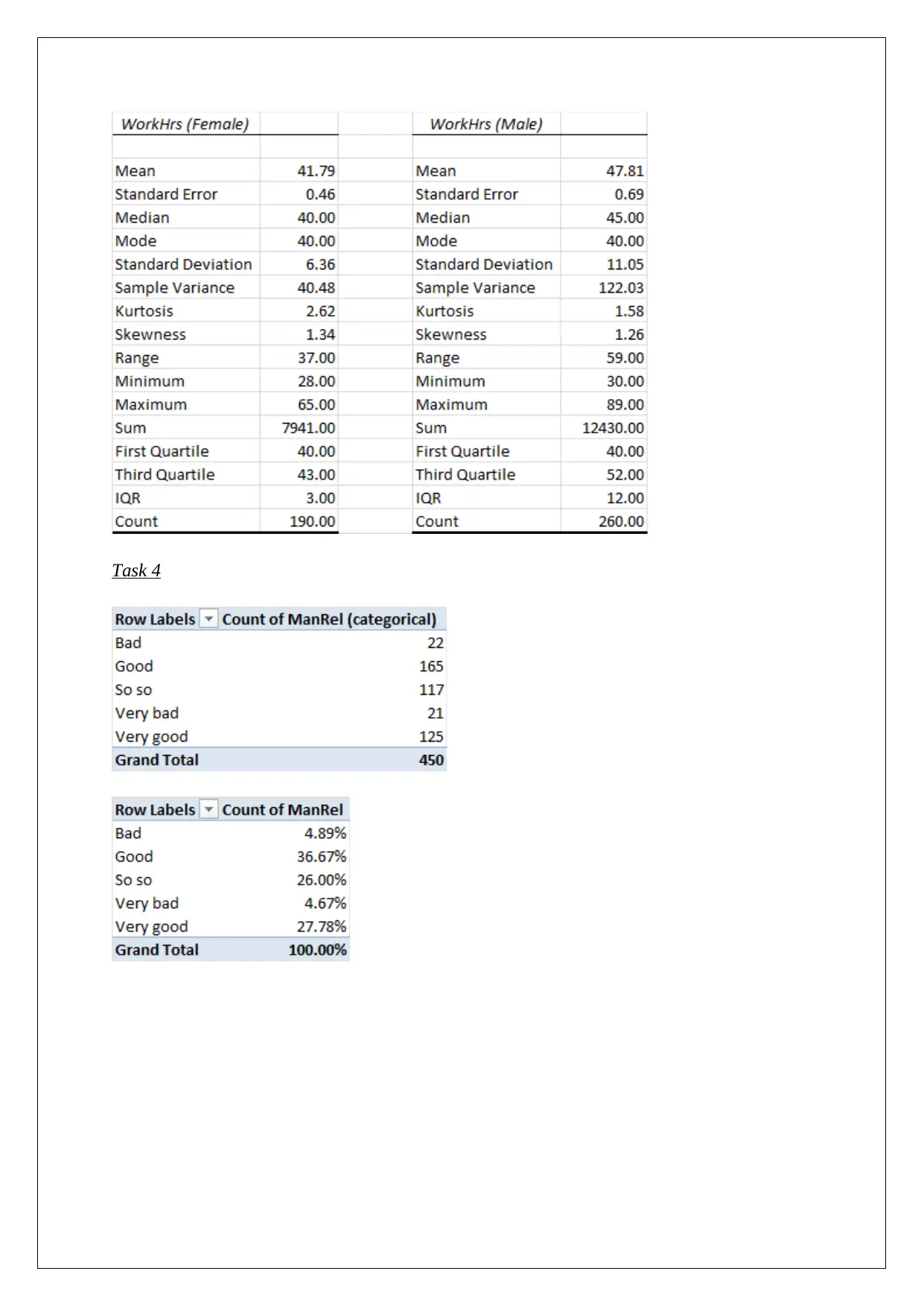
3) Based on the summary of the weekly work hours of the two genders (i.e. male and female),
it can be concluded that there does seem to be significant difference between the work hours
of the two genders. The average weekly work hours of female employees are 41.79 hours in
comparison to 47.81 hours for their male counterparts. Additionally, the median weekly work
hours for females are 40 hours as compared to 45 hours for their male counterparts. The
variation in weekly work hours also seem to be higher for male employees in comparison
with female employees which is apparent from the higher value of range, IQR, variance for
male employees. Also, it is evident that representation of males tends to be higher than
females as about 58% of the employees are males and remaining are females.
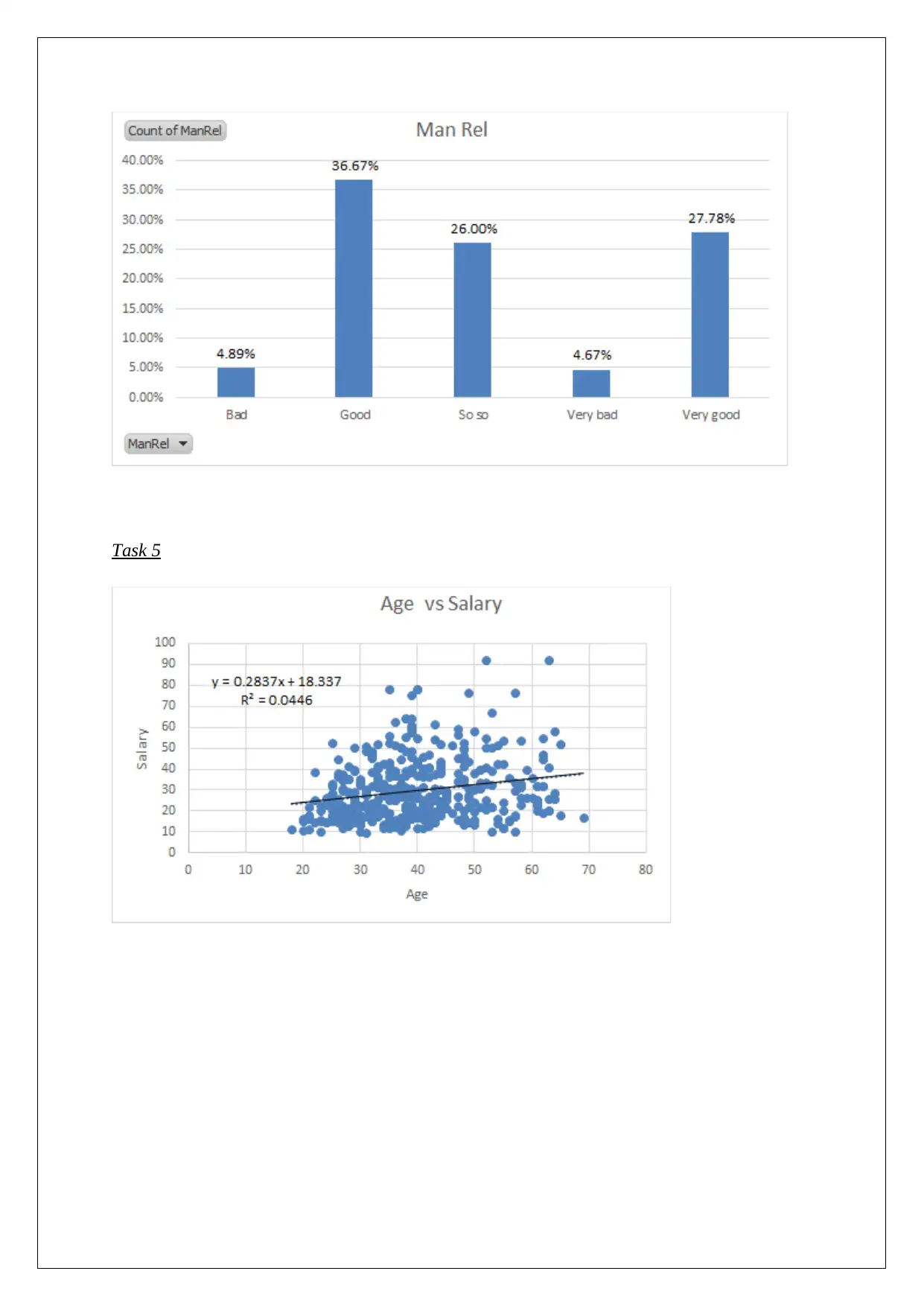
4) Most of the Osmidium employees have good relationships with the management as this is
true for 36.67% of the employees. Further, there are 27.78% of the employees who tend to
have very good relations with the management. Then, there are those employees who tend to
have so-so relationship with the management and these comprise 26% of the employees. The
employees who tend to have bad and very bad relationship with the management comprise
only 4.89% and 4.67% respectively. Thus, it is apparent that more than 90% of the
Osmidium employees tend to have good or so-so relationship with the management.
Document Page
5) Owing to the positive slope of the best fit line, there is positive relationship between age
and salary. But considering the large amount of deviation of the scatter points from the line of
best fit and also abysmally low value of R2(0.0446), it is apparent that the strength of
relationship is weak. Hence, age does not seem to be a significant determinant of salary.
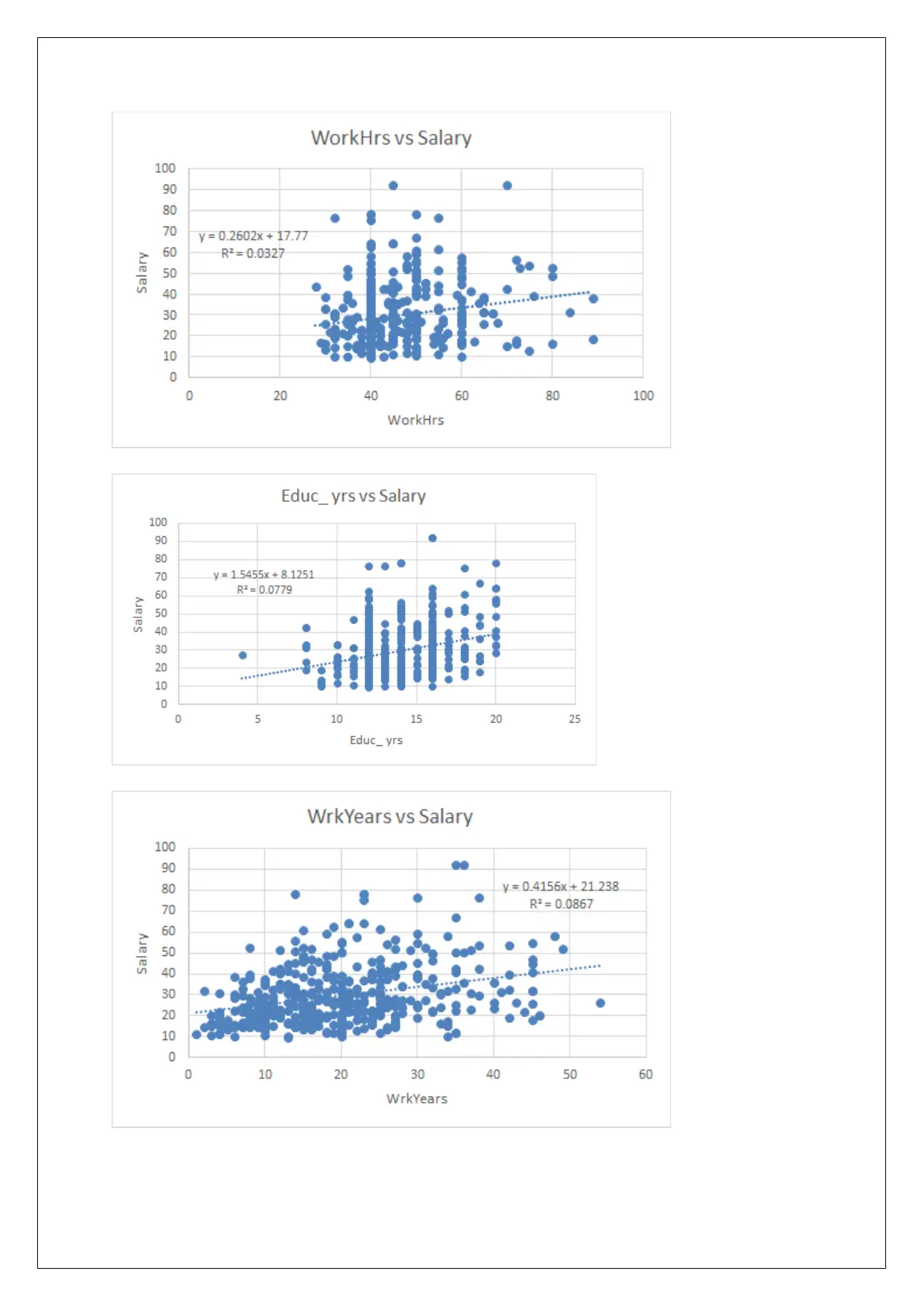
Owing to the positive slope of the best fit line, there is positive relationship between workhrs
and salary. But considering the large amount of deviation of the scatter points from the line of
best fit and also abysmally low value of R2(0.0327), it is apparent that the strength of
relationship is weak. Hence, workhrsdoes not seem to be a significant determinant of salary.
Owing to the positive slope of the best fit line, there is positive relationship between Educ-yrs
and salary. But considering the large amount of deviation of the scatter points from the line of
best fit and also low value of R2(0.0779), it is apparent that the strength of relationship is
weak. Hence, Educ_yrs not seem to be a significant determinant of salary.
Owing to the positive slope of the best fit line, there is positive relationship between
workyears and salary. But considering the large amount of deviation of the scatter points
from the line of best fit and also low value of R2(0.0867), it is apparent that the strength of
relationship is moderate. Hence, workyear does seem to be a significant determinant of
salary.
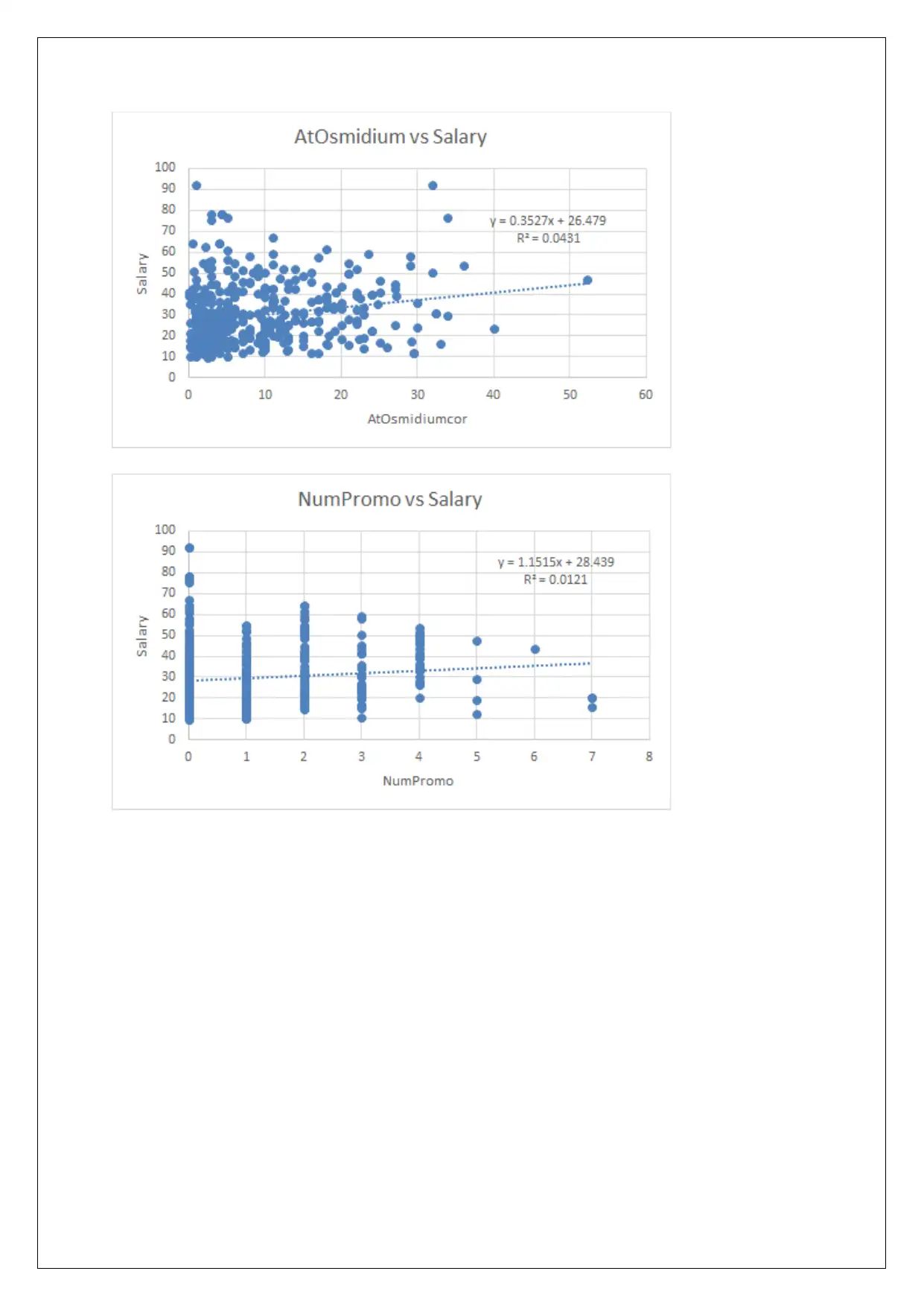
Owing to the positive slope of the best fit line, there is positive relationship between
NumPromo and salary. But considering the large amount of deviation of the scatter points
from the line of best fit and also abysmally low value of R2(0.0121), it is apparent that the
strength of relationship is weak. Hence, NumPromo not seem to be a significant determinant
of salary.
Owing to the positive slope of the best fit line, there is positive relationship between years at
Osmidium and salary. But considering the large amount of deviation of the scatter points
from the line of best fit and also low value of R2(0.0431), it is apparent that the strength of
relationship is weak. Hence, year at Osmidium does not seem to be a significant determinant
of salary.
chevron_up_icon
1 out of 9
circle_padding
hide_on_mobile
zoom_out_icon
[object Object]