Report on Social Media and Professional Skills in the Digital Age
VerifiedAdded on 2023/01/13
|9
|3140
|53
Report
AI Summary
This report delves into the multifaceted impact of social media on professional skills within the digital age. It begins by outlining the positive and negative aspects of social media's influence, examining its role in communication, information sharing, and business operations, while also addressing challenges such as spam, malware, and privacy concerns. The report then explores the critical issues of security and privacy, categorizing threats as classical (malware, spam attacks) and modern (fake profiles, inference attacks, surveillance), and proposing measures like privacy settings, antivirus software, and third-party applications to mitigate these risks. A comparative analysis of Facebook and Twitter highlights their features and applications, emphasizing their roles in business, communication, and marketing. The report underscores the evolving landscape of professional skills in the digital era, emphasizing the importance of adapting to new technologies and navigating the complexities of social media platforms. The report provides a comprehensive overview of how professional skills are evolving in the digital age.
Integrated Profession Skills in
the Digital Age
the Digital Age

Paraphrase This Document
Need a fresh take? Get an instant paraphrase of this document with our AI Paraphraser
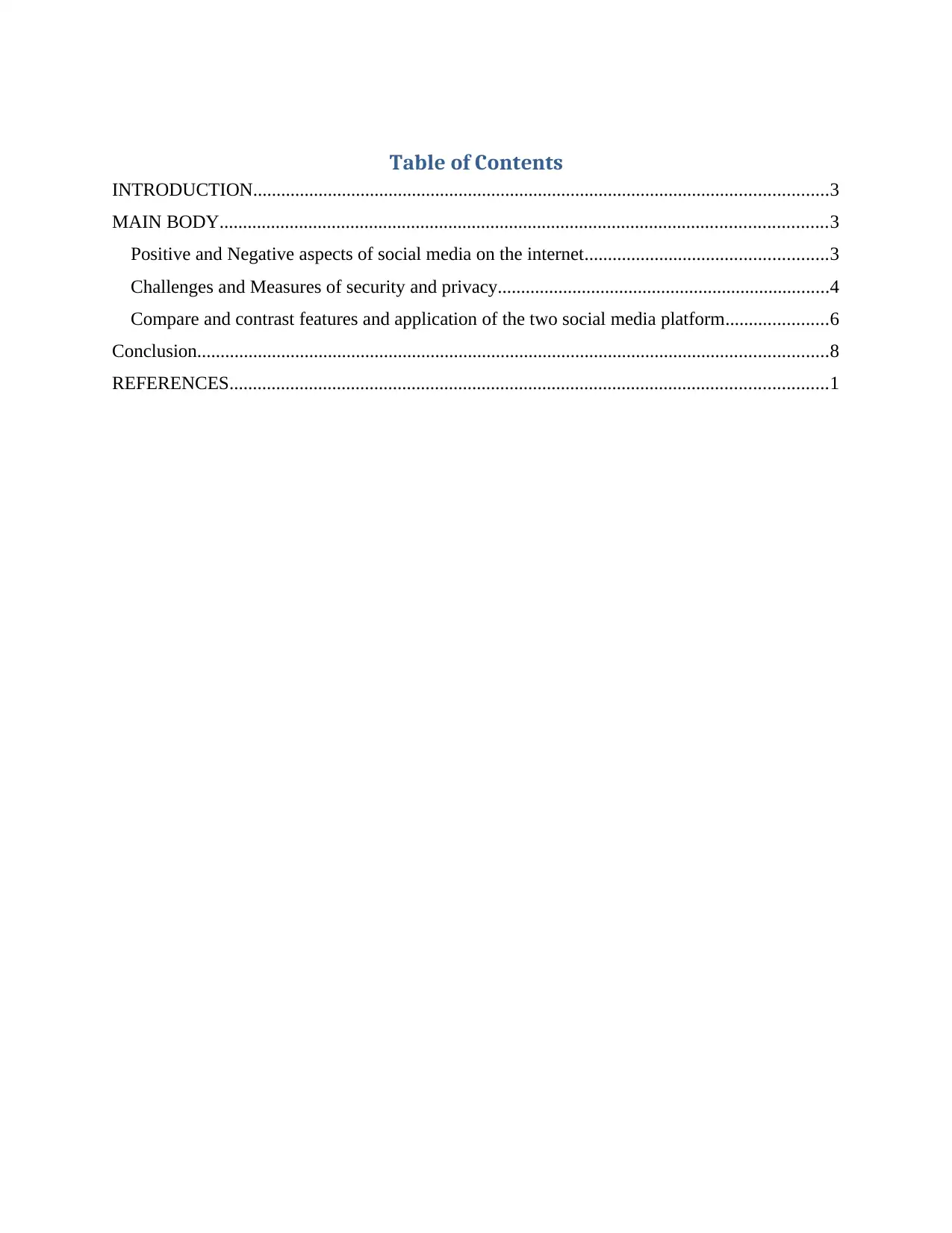
Table of Contents
INTRODUCTION...........................................................................................................................3
MAIN BODY..................................................................................................................................3
Positive and Negative aspects of social media on the internet....................................................3
Challenges and Measures of security and privacy.......................................................................4
Compare and contrast features and application of the two social media platform......................6
Conclusion.......................................................................................................................................8
REFERENCES................................................................................................................................1
INTRODUCTION...........................................................................................................................3
MAIN BODY..................................................................................................................................3
Positive and Negative aspects of social media on the internet....................................................3
Challenges and Measures of security and privacy.......................................................................4
Compare and contrast features and application of the two social media platform......................6
Conclusion.......................................................................................................................................8
REFERENCES................................................................................................................................1
INTRODUCTION
Professional skills are those skills which are not taught but are acquired by the individual
which help them in adding value to the performance. It includes the skills of leadership,
management of the project, mentoring, conflict management etc. With the introduction of the
computer system and emerging technology the transfers of the information became quick and
free . (Dai, 2015) But due to this the individuals need to acquire various skills with the help of
which they can efficiently deal with the challenges. In the digital age the internet plays crucial
role as it facilitates communication, sharing of the information, data and the resources for the
businesses as well as individual. In this report the positive and negative aspect of social media
and challenges related to the security and privacy are taken into considered. Apart from this the
features, application and suitability of various social media platform are also discussed.
MAIN BODY
Positive and Negative aspects of social media on the internet
The social media has changed the way in which the people communicate, interact and
share the information. It is quite influential as it has various positive and negative impacts on the
users as well as on the internet. With the help of this the people can connect themselves with
others, share various resources, market the activities etc (Greenwood, Perrin and Duggan, 2016)
The social media has various positive and negative impacts on the internet which are given
below:
Positive aspects: The social media has various benefits with the help of which the
individuals can interact with others, the businesses can target their audiences effectively. The
businesses by way of various attractive advertising and promotional campaigns, branding models
over such platform help them in managing the customers. With such platforms the businesses
develops the insights about their customers and the market intelligence. This increase the scope
of internet as it can be used for undertaking various activities. In addition to this various learning
programs are available on the social media platform with which the users can improve their skills
due to which the importance of the internet has increased in the life of the students. Various
surveys are organised by the companies for gathering the data and the information about the taste
and preference of the customers and because of this the consumption of the data is increasing and
with this the prices for the internet gradually increased. Also the use of various platform such as
Professional skills are those skills which are not taught but are acquired by the individual
which help them in adding value to the performance. It includes the skills of leadership,
management of the project, mentoring, conflict management etc. With the introduction of the
computer system and emerging technology the transfers of the information became quick and
free . (Dai, 2015) But due to this the individuals need to acquire various skills with the help of
which they can efficiently deal with the challenges. In the digital age the internet plays crucial
role as it facilitates communication, sharing of the information, data and the resources for the
businesses as well as individual. In this report the positive and negative aspect of social media
and challenges related to the security and privacy are taken into considered. Apart from this the
features, application and suitability of various social media platform are also discussed.
MAIN BODY
Positive and Negative aspects of social media on the internet
The social media has changed the way in which the people communicate, interact and
share the information. It is quite influential as it has various positive and negative impacts on the
users as well as on the internet. With the help of this the people can connect themselves with
others, share various resources, market the activities etc (Greenwood, Perrin and Duggan, 2016)
The social media has various positive and negative impacts on the internet which are given
below:
Positive aspects: The social media has various benefits with the help of which the
individuals can interact with others, the businesses can target their audiences effectively. The
businesses by way of various attractive advertising and promotional campaigns, branding models
over such platform help them in managing the customers. With such platforms the businesses
develops the insights about their customers and the market intelligence. This increase the scope
of internet as it can be used for undertaking various activities. In addition to this various learning
programs are available on the social media platform with which the users can improve their skills
due to which the importance of the internet has increased in the life of the students. Various
surveys are organised by the companies for gathering the data and the information about the taste
and preference of the customers and because of this the consumption of the data is increasing and
with this the prices for the internet gradually increased. Also the use of various platform such as
⊘ This is a preview!⊘
Do you want full access?
Subscribe today to unlock all pages.

Trusted by 1+ million students worldwide
Facebook, Watsapp etc. helps in educating the user and with that the focus has increased towards
the social media (Mammadova, Jabrayilova. and Mammadzada, 2016).
Negative aspects: The social media has various negative impacts as the internet as the use
of the social media leads to or exposes the user towards various types of challenges such as spam
messages, malware etc. Due to these the users are more exposed to the risk of safety and privacy.
This has direct impact on the users as their personal information can be accessed by the hackers.
This leads to loss of trust on the internet of the users and it affects the business operations. Most
of the millennial do not have trust on the social media sites due to which the requirement of the
data reduces. Also the issues which is related with the problems of the privacy and security at
personal level has adverse impact on the internet. Along with this the increasing use of the
internet causes various heath related issues such as depression, anxiety etc. that affects the image
of the internet. This is because of the fact that doctor suggest to avoid the use of the social media
which will ultimately affect the sales of the internet service providing companies (Ngai, Tao.
and Moon, 2015).
Challenges and Measures of security and privacy
The online social networks are gaining popularity these days as the people are adopting
such platform because they offers a space for effective communication, sharing of the resources
etc. The content which is being shared by the users includes their experiences, locations,
opinions, their knowledge, private and personal information, photos etc. The users at online
social network faces the issues and challenges related to the management of the social identity as
they compromise with their social privacy. With the use of the social networking tools the way
of communication has changed both at personal level as well as at professional level. Due to this
the users of such platforms are more exposed to various threats related to their privacy and
security (Głód, 2016). The challenges which are faced by them can be categorised as classical
and modern threats. Such threats are:
Classical threats are related to the extraction of the personal information about the users
which they have shared through online sharing network. Also it targets the information of the
peers by adjusting and correlating various private attributes (Solanke, 2020). Some of the such
threats are:
Malware: It stands for malicious software that aims to log into the system of the user and
accessing their private information. It can be done easily as the structure of the online
the social media (Mammadova, Jabrayilova. and Mammadzada, 2016).
Negative aspects: The social media has various negative impacts as the internet as the use
of the social media leads to or exposes the user towards various types of challenges such as spam
messages, malware etc. Due to these the users are more exposed to the risk of safety and privacy.
This has direct impact on the users as their personal information can be accessed by the hackers.
This leads to loss of trust on the internet of the users and it affects the business operations. Most
of the millennial do not have trust on the social media sites due to which the requirement of the
data reduces. Also the issues which is related with the problems of the privacy and security at
personal level has adverse impact on the internet. Along with this the increasing use of the
internet causes various heath related issues such as depression, anxiety etc. that affects the image
of the internet. This is because of the fact that doctor suggest to avoid the use of the social media
which will ultimately affect the sales of the internet service providing companies (Ngai, Tao.
and Moon, 2015).
Challenges and Measures of security and privacy
The online social networks are gaining popularity these days as the people are adopting
such platform because they offers a space for effective communication, sharing of the resources
etc. The content which is being shared by the users includes their experiences, locations,
opinions, their knowledge, private and personal information, photos etc. The users at online
social network faces the issues and challenges related to the management of the social identity as
they compromise with their social privacy. With the use of the social networking tools the way
of communication has changed both at personal level as well as at professional level. Due to this
the users of such platforms are more exposed to various threats related to their privacy and
security (Głód, 2016). The challenges which are faced by them can be categorised as classical
and modern threats. Such threats are:
Classical threats are related to the extraction of the personal information about the users
which they have shared through online sharing network. Also it targets the information of the
peers by adjusting and correlating various private attributes (Solanke, 2020). Some of the such
threats are:
Malware: It stands for malicious software that aims to log into the system of the user and
accessing their private information. It can be done easily as the structure of the online
Paraphrase This Document
Need a fresh take? Get an instant paraphrase of this document with our AI Paraphraser
social networks are easy to understand in comparison to other online services. The worst
malware attack on social media platform is considered to be the one in which the
credentials of the users are accessed and the messages are send to their connections by
impersonating them. For example, the Koobface malware is the one that get spread on
various platform such as Facebook, Twitter, MySpace etc. with the aim to gather the
login credentials of the users (Tewari, 2016).
Spam Attacks: Span messages are the unwanted messages which appears on the wall of
the account of the social media as a wall post or a spam message. The spam messages
contains various advertisements or links which can connect the user to the malware sites.
They generally comes from the fake profiles and applications. Various filtration
approaches for spam messages are used so that they can be detected before they reach to
the targeted system (Fuchs, 2017).
Modern Threats: The Modern threats focusses upon gathering the private information and data
about the user and the people connected to them. Some of the modern attacks are:
Fake profiles: This is most common attack as in this the attacker creates a fake profile
with fake credentials and sends request to the people. Upon acceptance of the request the
information can easily be accessed by them as their aim is to gather the private
information through an online social network that can be used for sending the spam. It
creates a problem for service providers as well because it leads to the misuse of their
bandwidth (Thorpe, 2016).
Inference attacks: These attacks are related with accessing sensitive information of the
user which can be related to their age, gender, political affiliations etc. For such attacks
the machine learning algorithms are used which is then combined with the publicly
available data. The mutual friend based attack are also used for collecting the sensitive
data of the user and their peer.
Surveillance: Social media surveillance is related with monitoring the activities of an
individual on various social media platform. In this the social roles of the individual are
analysed on the basis of their relationships with other and their profile.
Such threats need to be managed effectively so that the privacy and the security of the
users can be ensured. The challenges can be managed with the help of precautionary measures
and with the help of various front-line defence that is developed and managed by the online
malware attack on social media platform is considered to be the one in which the
credentials of the users are accessed and the messages are send to their connections by
impersonating them. For example, the Koobface malware is the one that get spread on
various platform such as Facebook, Twitter, MySpace etc. with the aim to gather the
login credentials of the users (Tewari, 2016).
Spam Attacks: Span messages are the unwanted messages which appears on the wall of
the account of the social media as a wall post or a spam message. The spam messages
contains various advertisements or links which can connect the user to the malware sites.
They generally comes from the fake profiles and applications. Various filtration
approaches for spam messages are used so that they can be detected before they reach to
the targeted system (Fuchs, 2017).
Modern Threats: The Modern threats focusses upon gathering the private information and data
about the user and the people connected to them. Some of the modern attacks are:
Fake profiles: This is most common attack as in this the attacker creates a fake profile
with fake credentials and sends request to the people. Upon acceptance of the request the
information can easily be accessed by them as their aim is to gather the private
information through an online social network that can be used for sending the spam. It
creates a problem for service providers as well because it leads to the misuse of their
bandwidth (Thorpe, 2016).
Inference attacks: These attacks are related with accessing sensitive information of the
user which can be related to their age, gender, political affiliations etc. For such attacks
the machine learning algorithms are used which is then combined with the publicly
available data. The mutual friend based attack are also used for collecting the sensitive
data of the user and their peer.
Surveillance: Social media surveillance is related with monitoring the activities of an
individual on various social media platform. In this the social roles of the individual are
analysed on the basis of their relationships with other and their profile.
Such threats need to be managed effectively so that the privacy and the security of the
users can be ensured. The challenges can be managed with the help of precautionary measures
and with the help of various front-line defence that is developed and managed by the online
social network (Carr and Hayes, 2015). The measures that can be taken to ensure the privacy and
the safety of the users are:
Privacy settings: To ensure the safety of the personal information the individual need to
consider the privacy setting. The individuals have to adjust their private settings so that
they can reduce the chances of unauthorised access to the information of the user. The
user keep on operating the account on the basis of the default setting which is why they
are recommended to operate with customised private settings.
Antivirus and Anti spyware: The antivirus helps in detecting the viruses from the
computer system and protecting the data which is stored in the system. With the help of
these two software the unauthorised access can be protected by way of countering them.
Third party applications: With the help of third party applications various privacy and
security measures can be taken easily as they have different which are hosted outside the
online social network and the user controls (Boulianne, 2015).
Compare and contrast features and application of the two social media platform
Social media platforms are being increasingly used by businesses as they provide many
benefits to business owners like they help in attracting customers through advertisement on
social media sites, attracting candidates who can be recruited in company, building brand image
of company, increasing customer base etc. social media help businesses to get exposure, traffic
and also it help in gaining market insights so that the potential threats and opportunities that
prevail in market can be evaluated. The social media sites that are increasingly being used are
Facebook and Twitter which help them in achieving their objectives of using social media
(Ashley and Tuten, 2015).
Facebook is an American online social media and social networking service which was
founded by Mark Zuckerberg and can be easily accessed by devices which have internet
connectivity like phones, computers, tablets etc. There are many features which can be
efficiently used by companies like businesses can make their company profile on Facebook and
upload information regarding the company like number of employees, types of jobs available,
the people who can view company's profile etc. The best feature of Facebook is that it is being
increasingly used by all the people all over the world which help in connecting them to other
people. This feature can also be used by companies so that they can reach to a large number of
customers and candidates which help in enhancing company's image in market. Other features of
the safety of the users are:
Privacy settings: To ensure the safety of the personal information the individual need to
consider the privacy setting. The individuals have to adjust their private settings so that
they can reduce the chances of unauthorised access to the information of the user. The
user keep on operating the account on the basis of the default setting which is why they
are recommended to operate with customised private settings.
Antivirus and Anti spyware: The antivirus helps in detecting the viruses from the
computer system and protecting the data which is stored in the system. With the help of
these two software the unauthorised access can be protected by way of countering them.
Third party applications: With the help of third party applications various privacy and
security measures can be taken easily as they have different which are hosted outside the
online social network and the user controls (Boulianne, 2015).
Compare and contrast features and application of the two social media platform
Social media platforms are being increasingly used by businesses as they provide many
benefits to business owners like they help in attracting customers through advertisement on
social media sites, attracting candidates who can be recruited in company, building brand image
of company, increasing customer base etc. social media help businesses to get exposure, traffic
and also it help in gaining market insights so that the potential threats and opportunities that
prevail in market can be evaluated. The social media sites that are increasingly being used are
Facebook and Twitter which help them in achieving their objectives of using social media
(Ashley and Tuten, 2015).
Facebook is an American online social media and social networking service which was
founded by Mark Zuckerberg and can be easily accessed by devices which have internet
connectivity like phones, computers, tablets etc. There are many features which can be
efficiently used by companies like businesses can make their company profile on Facebook and
upload information regarding the company like number of employees, types of jobs available,
the people who can view company's profile etc. The best feature of Facebook is that it is being
increasingly used by all the people all over the world which help in connecting them to other
people. This feature can also be used by companies so that they can reach to a large number of
customers and candidates which help in enhancing company's image in market. Other features of
⊘ This is a preview!⊘
Do you want full access?
Subscribe today to unlock all pages.
Trusted by 1+ million students worldwide
Facebook includes that the list can be organised by managing the settings, groups can be created
in which various additional features are added such as watch party etc.
Twitter is an American micro-blogging and social networking service which is used by
users to interact with each other through messages known as tweets. Companies can use Twitter
platform to create successful social media campaigns, boost their sales and brand recognition and
also enhance customer service. It enables the people to create groups so that the user can reduce
the rush in their Twitter feed. At Twitter the user are allowed to tweet the hyperlinked text so
that nothing is to written in detail but people can access to the source for details. In addition to
this, the right sidebar is efficiently be used as it display various data and statistics (Allcott and
Gentzkow, 2017).
Comparison Between the two: Facebook is a common platform for the businesses,
universities, individuals that helps them in effectively interacting, learning, teaching, promoting
things. While the Twitter is used rarely for performing such activities. Very often these two
platform are treated to be synonyms as both are based upon the same baseline concept that is to
provide communication, flexible, easily accessible etc. The Facebook is comparatively more
famous among people as the features are quite simple such the pictures can easily be uploaded,
also animations, various related apps and gaming videos are the additional features of the
Facebook. On the other hand limited features are provided by the Twitter which can attract
people such as it allows adding text along with hyperlinks. While comparing the two most
common social media platform it can be analysed that if Twitter offers micro blogging service
the Facebook offers various services in addition to micro blogging.
Contrast Between the two: Differentiating among the two is significantly a difficult task as
their exist a huge versatility among the two. Twitter has becoming more advanced day by day as
they are adding on various features like with various apps of Twitter such as Twitpic enables the
users to upload their pictures on Twitter account. It is important to compare and contrast among
these two as they both are most recognisable and are quite popular. The newly emerging
platform such as MySpace and LinkedIn has resemblance with the Facebook while the Tumbler
is considered to be quite similar to Twitter. The main difference among them are on the basis of
the method of communication such as on Facebook people interact with those who are known to
them while on Twitter people tries to linked them self to more and more people even those
whom they don’t even know. These two social media platform are different from each other but
in which various additional features are added such as watch party etc.
Twitter is an American micro-blogging and social networking service which is used by
users to interact with each other through messages known as tweets. Companies can use Twitter
platform to create successful social media campaigns, boost their sales and brand recognition and
also enhance customer service. It enables the people to create groups so that the user can reduce
the rush in their Twitter feed. At Twitter the user are allowed to tweet the hyperlinked text so
that nothing is to written in detail but people can access to the source for details. In addition to
this, the right sidebar is efficiently be used as it display various data and statistics (Allcott and
Gentzkow, 2017).
Comparison Between the two: Facebook is a common platform for the businesses,
universities, individuals that helps them in effectively interacting, learning, teaching, promoting
things. While the Twitter is used rarely for performing such activities. Very often these two
platform are treated to be synonyms as both are based upon the same baseline concept that is to
provide communication, flexible, easily accessible etc. The Facebook is comparatively more
famous among people as the features are quite simple such the pictures can easily be uploaded,
also animations, various related apps and gaming videos are the additional features of the
Facebook. On the other hand limited features are provided by the Twitter which can attract
people such as it allows adding text along with hyperlinks. While comparing the two most
common social media platform it can be analysed that if Twitter offers micro blogging service
the Facebook offers various services in addition to micro blogging.
Contrast Between the two: Differentiating among the two is significantly a difficult task as
their exist a huge versatility among the two. Twitter has becoming more advanced day by day as
they are adding on various features like with various apps of Twitter such as Twitpic enables the
users to upload their pictures on Twitter account. It is important to compare and contrast among
these two as they both are most recognisable and are quite popular. The newly emerging
platform such as MySpace and LinkedIn has resemblance with the Facebook while the Tumbler
is considered to be quite similar to Twitter. The main difference among them are on the basis of
the method of communication such as on Facebook people interact with those who are known to
them while on Twitter people tries to linked them self to more and more people even those
whom they don’t even know. These two social media platform are different from each other but
Paraphrase This Document
Need a fresh take? Get an instant paraphrase of this document with our AI Paraphraser
are used by the users simultaneously. They do not alter each other it is the choice of the users
which they chose on daily basis (Zapalska, Jackson and Zelmanowitz, 2016).
Yes, social media plays a crucial role in effectively communicating and interacting with
each other. It is more than marketing and branding as with its increasing use it is becoming the
part of the life of the individuals. The businesses are utilising such platform for making their
customers aware about their products and services by publishing various advertisings. It has
transformed the way in which the organisations use to communicate as it is cost effective in
comparison to various other techniques such as advertising online, emails etc. Also with the help
of various blogs and tweets the businesses tries to make the business efficient as they can take
immediate feedbacks and assistance and many more. On the basis of various researches it is
identified that they social media sites are becoming an effective platform for communication.
Conclusion
It is concluded from the above report that the use of social media has increased overtime due
to which the dependency on such online platform has been increased. It is used by each and
every person in the society with some or the other purpose such as the businesses uses them to
promote their businesses, individual uses it for the purpose of interacting with each other. further
it is also concluded that with the use of such platform various threats need to be faced by the
individual which are related to the loss of private information etc. and to deal with such
challenges the users need to consider the various measures such as installation of the antivirus,
anti-spyware and many more.
which they chose on daily basis (Zapalska, Jackson and Zelmanowitz, 2016).
Yes, social media plays a crucial role in effectively communicating and interacting with
each other. It is more than marketing and branding as with its increasing use it is becoming the
part of the life of the individuals. The businesses are utilising such platform for making their
customers aware about their products and services by publishing various advertisings. It has
transformed the way in which the organisations use to communicate as it is cost effective in
comparison to various other techniques such as advertising online, emails etc. Also with the help
of various blogs and tweets the businesses tries to make the business efficient as they can take
immediate feedbacks and assistance and many more. On the basis of various researches it is
identified that they social media sites are becoming an effective platform for communication.
Conclusion
It is concluded from the above report that the use of social media has increased overtime due
to which the dependency on such online platform has been increased. It is used by each and
every person in the society with some or the other purpose such as the businesses uses them to
promote their businesses, individual uses it for the purpose of interacting with each other. further
it is also concluded that with the use of such platform various threats need to be faced by the
individual which are related to the loss of private information etc. and to deal with such
challenges the users need to consider the various measures such as installation of the antivirus,
anti-spyware and many more.
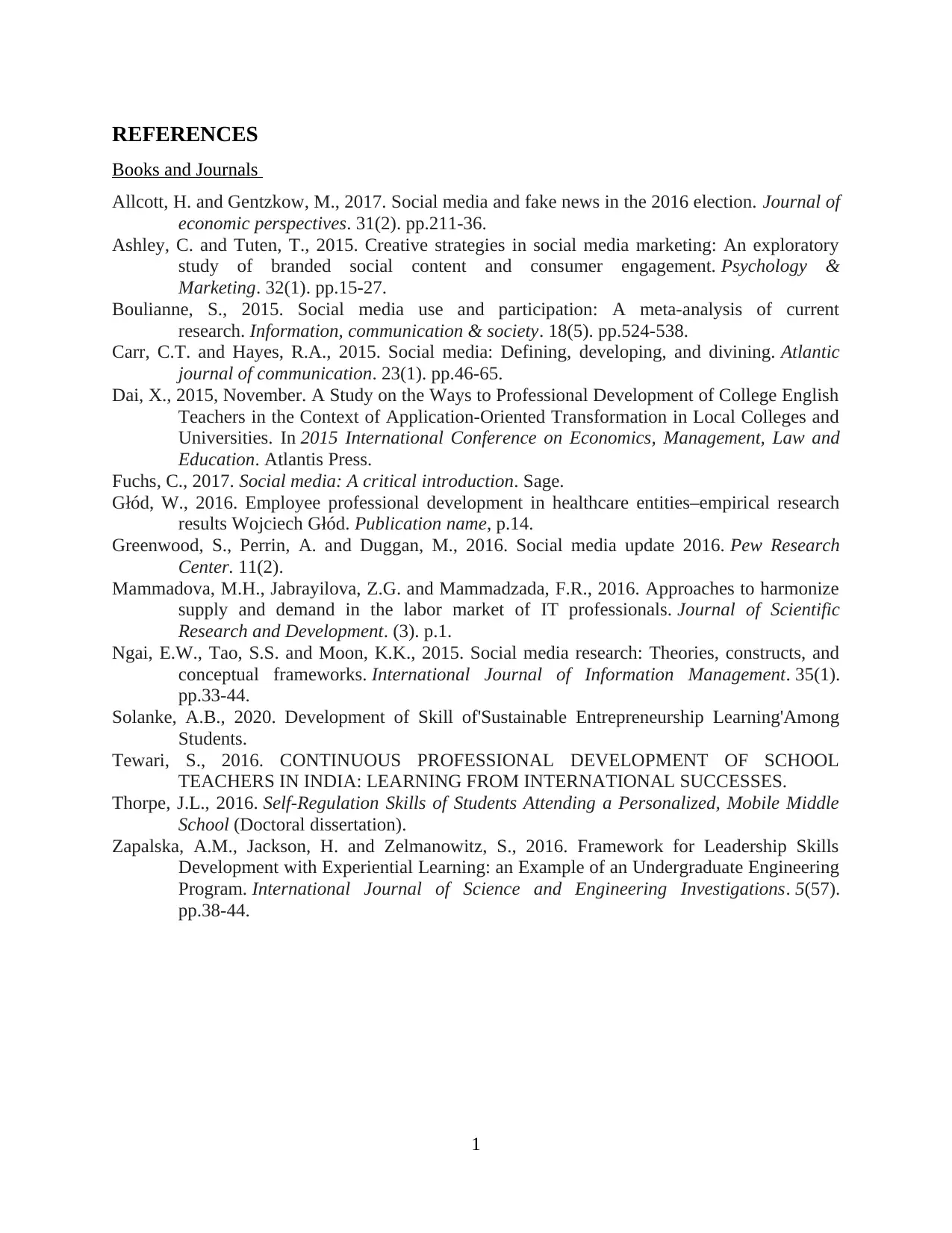
REFERENCES
Books and Journals
Allcott, H. and Gentzkow, M., 2017. Social media and fake news in the 2016 election. Journal of
economic perspectives. 31(2). pp.211-36.
Ashley, C. and Tuten, T., 2015. Creative strategies in social media marketing: An exploratory
study of branded social content and consumer engagement. Psychology &
Marketing. 32(1). pp.15-27.
Boulianne, S., 2015. Social media use and participation: A meta-analysis of current
research. Information, communication & society. 18(5). pp.524-538.
Carr, C.T. and Hayes, R.A., 2015. Social media: Defining, developing, and divining. Atlantic
journal of communication. 23(1). pp.46-65.
Dai, X., 2015, November. A Study on the Ways to Professional Development of College English
Teachers in the Context of Application-Oriented Transformation in Local Colleges and
Universities. In 2015 International Conference on Economics, Management, Law and
Education. Atlantis Press.
Fuchs, C., 2017. Social media: A critical introduction. Sage.
Głód, W., 2016. Employee professional development in healthcare entities–empirical research
results Wojciech Głód. Publication name, p.14.
Greenwood, S., Perrin, A. and Duggan, M., 2016. Social media update 2016. Pew Research
Center. 11(2).
Mammadova, M.H., Jabrayilova, Z.G. and Mammadzada, F.R., 2016. Approaches to harmonize
supply and demand in the labor market of IT professionals. Journal of Scientific
Research and Development. (3). p.1.
Ngai, E.W., Tao, S.S. and Moon, K.K., 2015. Social media research: Theories, constructs, and
conceptual frameworks. International Journal of Information Management. 35(1).
pp.33-44.
Solanke, A.B., 2020. Development of Skill of'Sustainable Entrepreneurship Learning'Among
Students.
Tewari, S., 2016. CONTINUOUS PROFESSIONAL DEVELOPMENT OF SCHOOL
TEACHERS IN INDIA: LEARNING FROM INTERNATIONAL SUCCESSES.
Thorpe, J.L., 2016. Self-Regulation Skills of Students Attending a Personalized, Mobile Middle
School (Doctoral dissertation).
Zapalska, A.M., Jackson, H. and Zelmanowitz, S., 2016. Framework for Leadership Skills
Development with Experiential Learning: an Example of an Undergraduate Engineering
Program. International Journal of Science and Engineering Investigations. 5(57).
pp.38-44.
1
Books and Journals
Allcott, H. and Gentzkow, M., 2017. Social media and fake news in the 2016 election. Journal of
economic perspectives. 31(2). pp.211-36.
Ashley, C. and Tuten, T., 2015. Creative strategies in social media marketing: An exploratory
study of branded social content and consumer engagement. Psychology &
Marketing. 32(1). pp.15-27.
Boulianne, S., 2015. Social media use and participation: A meta-analysis of current
research. Information, communication & society. 18(5). pp.524-538.
Carr, C.T. and Hayes, R.A., 2015. Social media: Defining, developing, and divining. Atlantic
journal of communication. 23(1). pp.46-65.
Dai, X., 2015, November. A Study on the Ways to Professional Development of College English
Teachers in the Context of Application-Oriented Transformation in Local Colleges and
Universities. In 2015 International Conference on Economics, Management, Law and
Education. Atlantis Press.
Fuchs, C., 2017. Social media: A critical introduction. Sage.
Głód, W., 2016. Employee professional development in healthcare entities–empirical research
results Wojciech Głód. Publication name, p.14.
Greenwood, S., Perrin, A. and Duggan, M., 2016. Social media update 2016. Pew Research
Center. 11(2).
Mammadova, M.H., Jabrayilova, Z.G. and Mammadzada, F.R., 2016. Approaches to harmonize
supply and demand in the labor market of IT professionals. Journal of Scientific
Research and Development. (3). p.1.
Ngai, E.W., Tao, S.S. and Moon, K.K., 2015. Social media research: Theories, constructs, and
conceptual frameworks. International Journal of Information Management. 35(1).
pp.33-44.
Solanke, A.B., 2020. Development of Skill of'Sustainable Entrepreneurship Learning'Among
Students.
Tewari, S., 2016. CONTINUOUS PROFESSIONAL DEVELOPMENT OF SCHOOL
TEACHERS IN INDIA: LEARNING FROM INTERNATIONAL SUCCESSES.
Thorpe, J.L., 2016. Self-Regulation Skills of Students Attending a Personalized, Mobile Middle
School (Doctoral dissertation).
Zapalska, A.M., Jackson, H. and Zelmanowitz, S., 2016. Framework for Leadership Skills
Development with Experiential Learning: an Example of an Undergraduate Engineering
Program. International Journal of Science and Engineering Investigations. 5(57).
pp.38-44.
1
⊘ This is a preview!⊘
Do you want full access?
Subscribe today to unlock all pages.
Trusted by 1+ million students worldwide

1 out of 9


Related Documents


Your All-in-One AI-Powered Toolkit for Academic Success.
+13062052269
info@desklib.com
Available 24*7 on WhatsApp / Email
![[object Object]](/_next/static/media/star-bottom.7253800d.svg)
Unlock your academic potential
Copyright © 2020–2026 A2Z Services. All Rights Reserved. Developed and managed by ZUCOL.