Smart Dublin City Project: Data-Driven Solutions for Dublin
VerifiedAdded on 2022/08/12
|12
|2802
|10
Report
AI Summary
This report analyzes the Smart Dublin City Project, focusing on data collection methodologies, data analysis techniques, and the integration of online services and digital communication to improve city livability and competitiveness. The project emphasizes the importance of primary and secondary data sources, including questionnaires, books, journals, and online resources. The report details the conversion of collected data into useful information using analytical tools like Excel and SPSS, and explores the analysis of structured, unstructured, numeric, nominal, and ordinal data. It highlights methods to integrate online services and digital communication with citizens through IT support, creative data sourcing, and predictive modeling. The report also discusses improving marketing decisions and reducing city council expenses using data analytics methods such as text analysis, statistical analysis, diagnostic analysis, predictive analysis, and prescriptive analysis to provide better services and make the city more efficient.

Smart Dublin Project 1
Smart Dublin City Project
Professor
Institution
Name
Course
Date
Smart Dublin City Project
Professor
Institution
Name
Course
Date

Paraphrase This Document
Need a fresh take? Get an instant paraphrase of this document with our AI Paraphraser
Smart Dublin Project 2
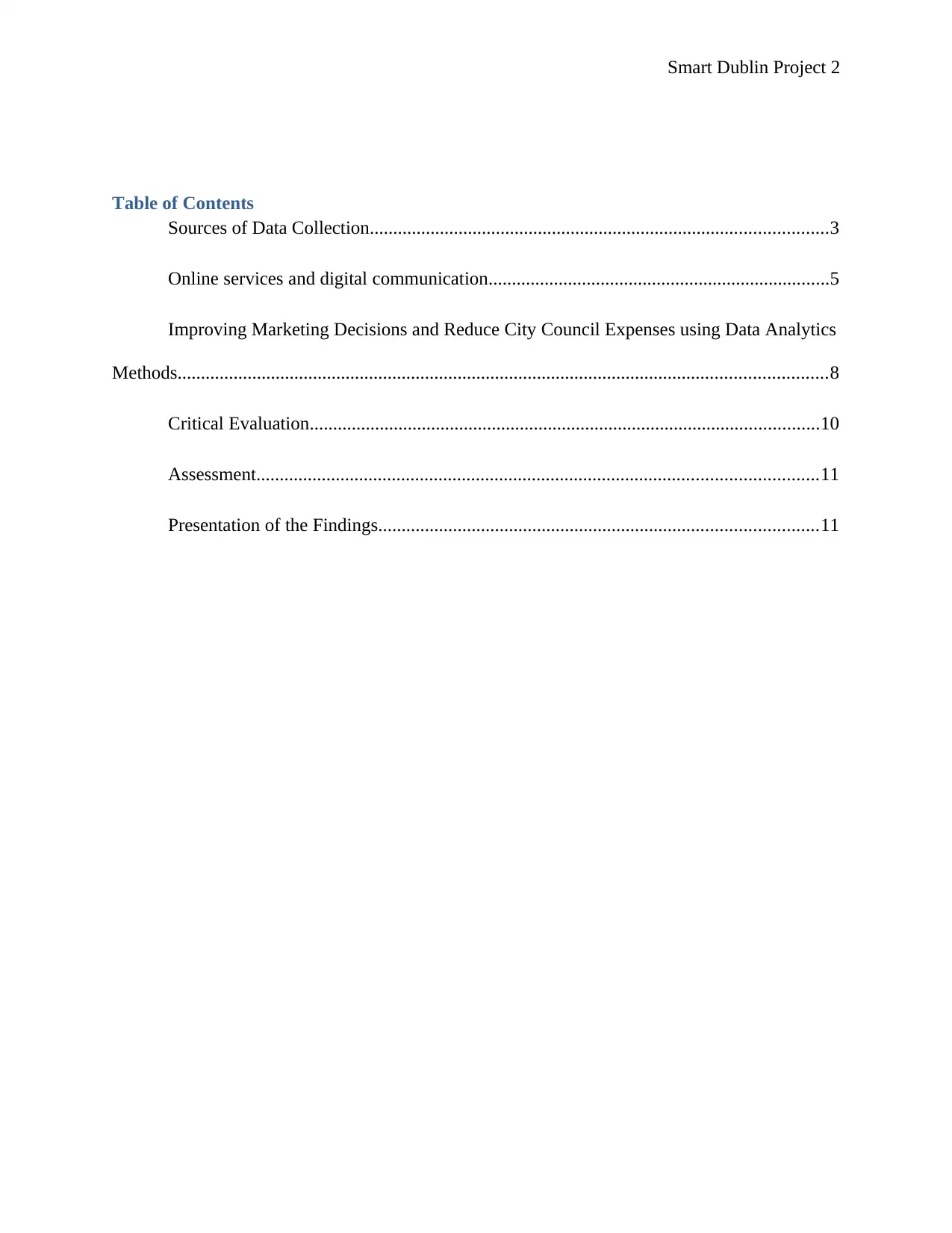
Table of Contents
Sources of Data Collection..................................................................................................3
Online services and digital communication.........................................................................5
Improving Marketing Decisions and Reduce City Council Expenses using Data Analytics
Methods...........................................................................................................................................8
Critical Evaluation.............................................................................................................10
Assessment........................................................................................................................11
Presentation of the Findings..............................................................................................11
Table of Contents
Sources of Data Collection..................................................................................................3
Online services and digital communication.........................................................................5
Improving Marketing Decisions and Reduce City Council Expenses using Data Analytics
Methods...........................................................................................................................................8
Critical Evaluation.............................................................................................................10
Assessment........................................................................................................................11
Presentation of the Findings..............................................................................................11
Smart Dublin Project 3
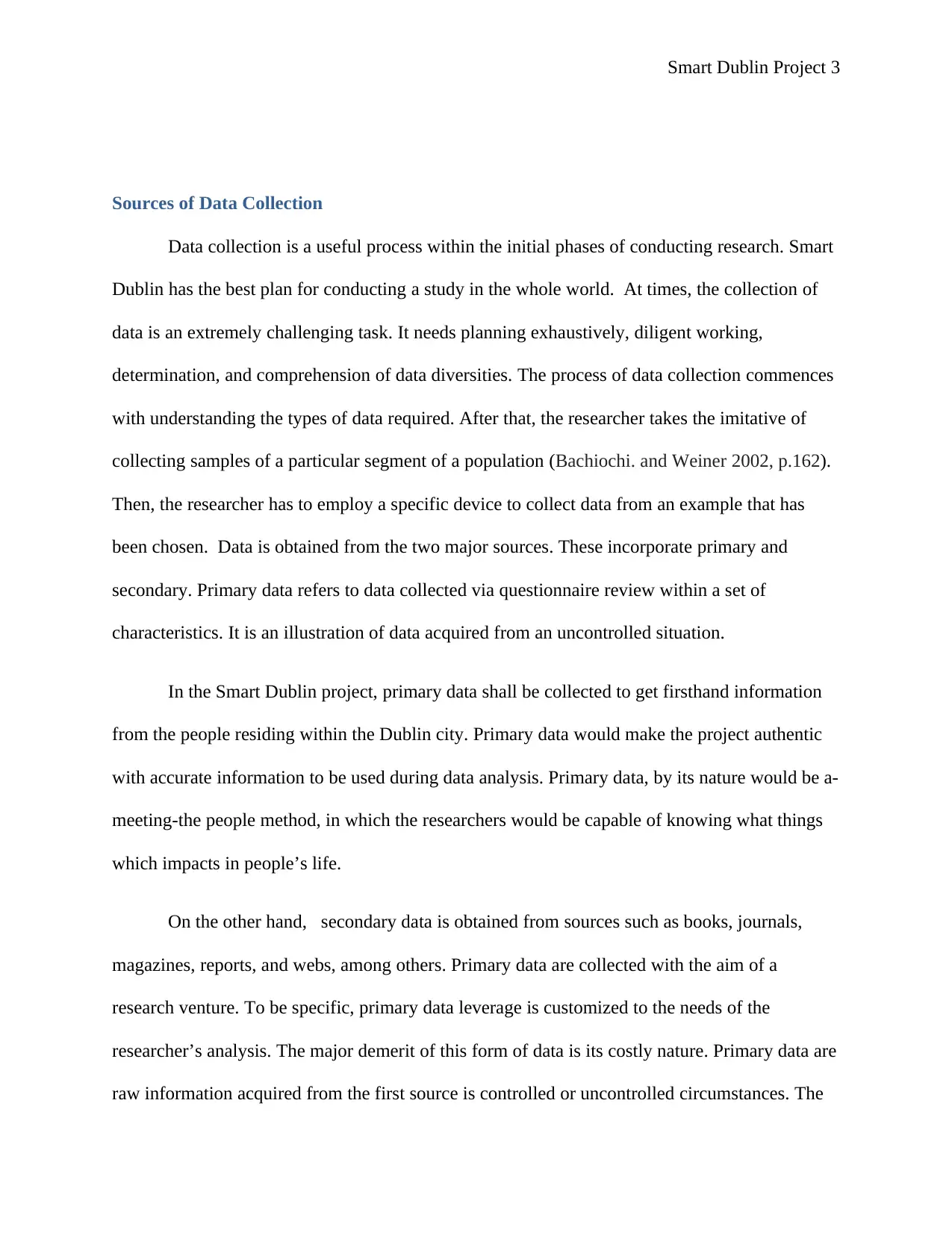
Sources of Data Collection
Data collection is a useful process within the initial phases of conducting research. Smart
Dublin has the best plan for conducting a study in the whole world. At times, the collection of
data is an extremely challenging task. It needs planning exhaustively, diligent working,
determination, and comprehension of data diversities. The process of data collection commences
with understanding the types of data required. After that, the researcher takes the imitative of
collecting samples of a particular segment of a population (Bachiochi. and Weiner 2002, p.162).
Then, the researcher has to employ a specific device to collect data from an example that has
been chosen. Data is obtained from the two major sources. These incorporate primary and
secondary. Primary data refers to data collected via questionnaire review within a set of
characteristics. It is an illustration of data acquired from an uncontrolled situation.
In the Smart Dublin project, primary data shall be collected to get firsthand information
from the people residing within the Dublin city. Primary data would make the project authentic
with accurate information to be used during data analysis. Primary data, by its nature would be a-
meeting-the people method, in which the researchers would be capable of knowing what things
which impacts in people’s life.
On the other hand, secondary data is obtained from sources such as books, journals,
magazines, reports, and webs, among others. Primary data are collected with the aim of a
research venture. To be specific, primary data leverage is customized to the needs of the
researcher’s analysis. The major demerit of this form of data is its costly nature. Primary data are
raw information acquired from the first source is controlled or uncontrolled circumstances. The
Sources of Data Collection
Data collection is a useful process within the initial phases of conducting research. Smart
Dublin has the best plan for conducting a study in the whole world. At times, the collection of
data is an extremely challenging task. It needs planning exhaustively, diligent working,
determination, and comprehension of data diversities. The process of data collection commences
with understanding the types of data required. After that, the researcher takes the imitative of
collecting samples of a particular segment of a population (Bachiochi. and Weiner 2002, p.162).
Then, the researcher has to employ a specific device to collect data from an example that has
been chosen. Data is obtained from the two major sources. These incorporate primary and
secondary. Primary data refers to data collected via questionnaire review within a set of
characteristics. It is an illustration of data acquired from an uncontrolled situation.
In the Smart Dublin project, primary data shall be collected to get firsthand information
from the people residing within the Dublin city. Primary data would make the project authentic
with accurate information to be used during data analysis. Primary data, by its nature would be a-
meeting-the people method, in which the researchers would be capable of knowing what things
which impacts in people’s life.
On the other hand, secondary data is obtained from sources such as books, journals,
magazines, reports, and webs, among others. Primary data are collected with the aim of a
research venture. To be specific, primary data leverage is customized to the needs of the
researcher’s analysis. The major demerit of this form of data is its costly nature. Primary data are
raw information acquired from the first source is controlled or uncontrolled circumstances. The
⊘ This is a preview!⊘
Do you want full access?
Subscribe today to unlock all pages.

Trusted by 1+ million students worldwide
Smart Dublin Project 4
primary data sources are populace tests from where information is collected. The early stage of
the process is selecting the targeted populace. The origins of primary data include accounts of
eyewitnesses, interviews, drawings, autobiographies, statistical data, as well as journals reporting
original studies.
The secondary source of data describes, summarizes reviews, interprets, and analyses
primary sources. Secondary data can be categorized into internal and external sources.
Associations or individuals collect external secondary data from outer environments. Internal
data include sources that exist and are kept within an organization. Internal data sources are
attained from balance sheets, sales figures, past marketing studies, and profits and loss
statements. Similarly, some of the external data can be collected from foundations, government
sources, corporate filings, and media incorporating both telecasts and prints.
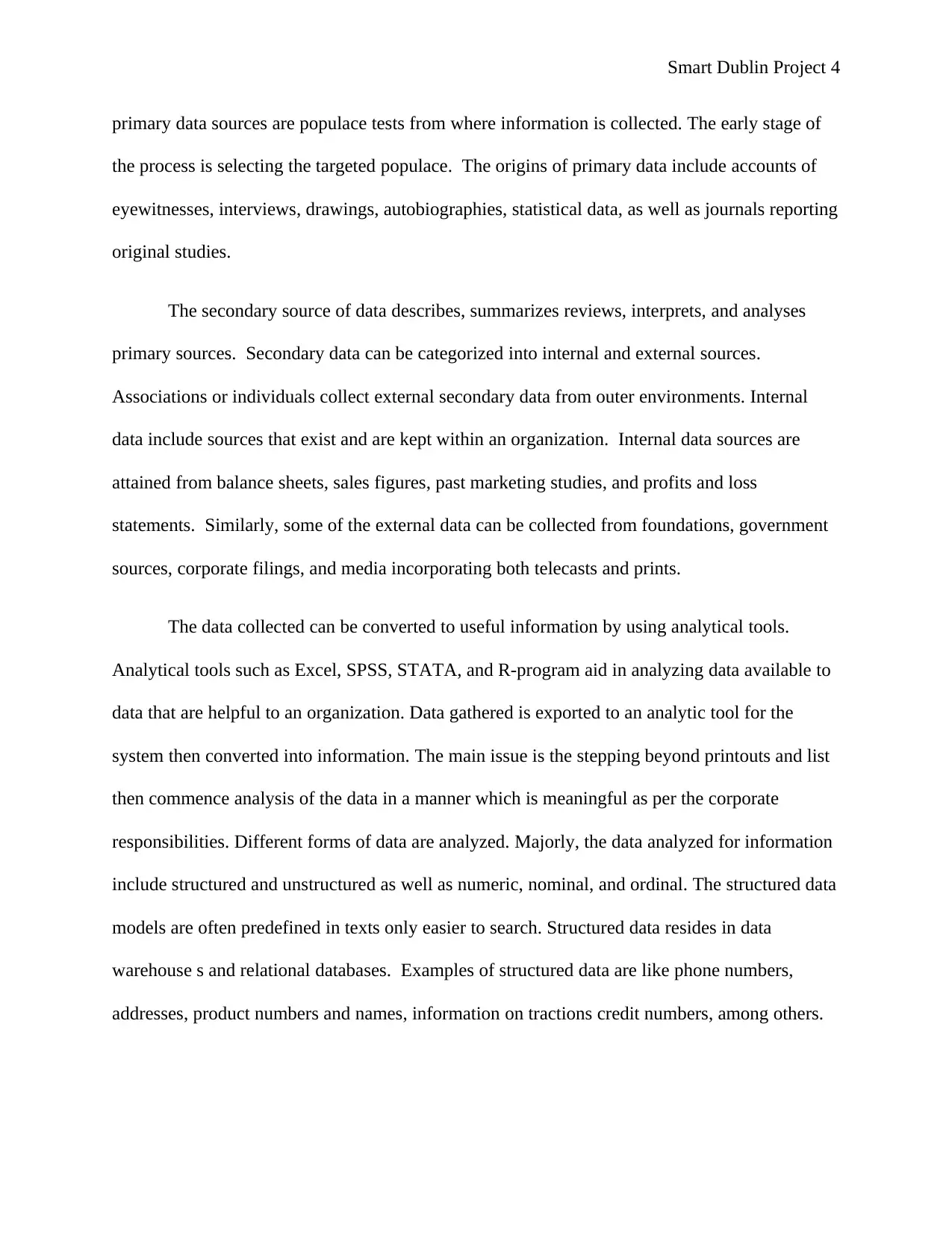
The data collected can be converted to useful information by using analytical tools.
Analytical tools such as Excel, SPSS, STATA, and R-program aid in analyzing data available to
data that are helpful to an organization. Data gathered is exported to an analytic tool for the
system then converted into information. The main issue is the stepping beyond printouts and list
then commence analysis of the data in a manner which is meaningful as per the corporate
responsibilities. Different forms of data are analyzed. Majorly, the data analyzed for information
include structured and unstructured as well as numeric, nominal, and ordinal. The structured data
models are often predefined in texts only easier to search. Structured data resides in data
warehouse s and relational databases. Examples of structured data are like phone numbers,
addresses, product numbers and names, information on tractions credit numbers, among others.
primary data sources are populace tests from where information is collected. The early stage of
the process is selecting the targeted populace. The origins of primary data include accounts of
eyewitnesses, interviews, drawings, autobiographies, statistical data, as well as journals reporting
original studies.
The secondary source of data describes, summarizes reviews, interprets, and analyses
primary sources. Secondary data can be categorized into internal and external sources.
Associations or individuals collect external secondary data from outer environments. Internal
data include sources that exist and are kept within an organization. Internal data sources are
attained from balance sheets, sales figures, past marketing studies, and profits and loss
statements. Similarly, some of the external data can be collected from foundations, government
sources, corporate filings, and media incorporating both telecasts and prints.
The data collected can be converted to useful information by using analytical tools.
Analytical tools such as Excel, SPSS, STATA, and R-program aid in analyzing data available to
data that are helpful to an organization. Data gathered is exported to an analytic tool for the
system then converted into information. The main issue is the stepping beyond printouts and list
then commence analysis of the data in a manner which is meaningful as per the corporate
responsibilities. Different forms of data are analyzed. Majorly, the data analyzed for information
include structured and unstructured as well as numeric, nominal, and ordinal. The structured data
models are often predefined in texts only easier to search. Structured data resides in data
warehouse s and relational databases. Examples of structured data are like phone numbers,
addresses, product numbers and names, information on tractions credit numbers, among others.
Paraphrase This Document
Need a fresh take? Get an instant paraphrase of this document with our AI Paraphraser
Smart Dublin Project 5
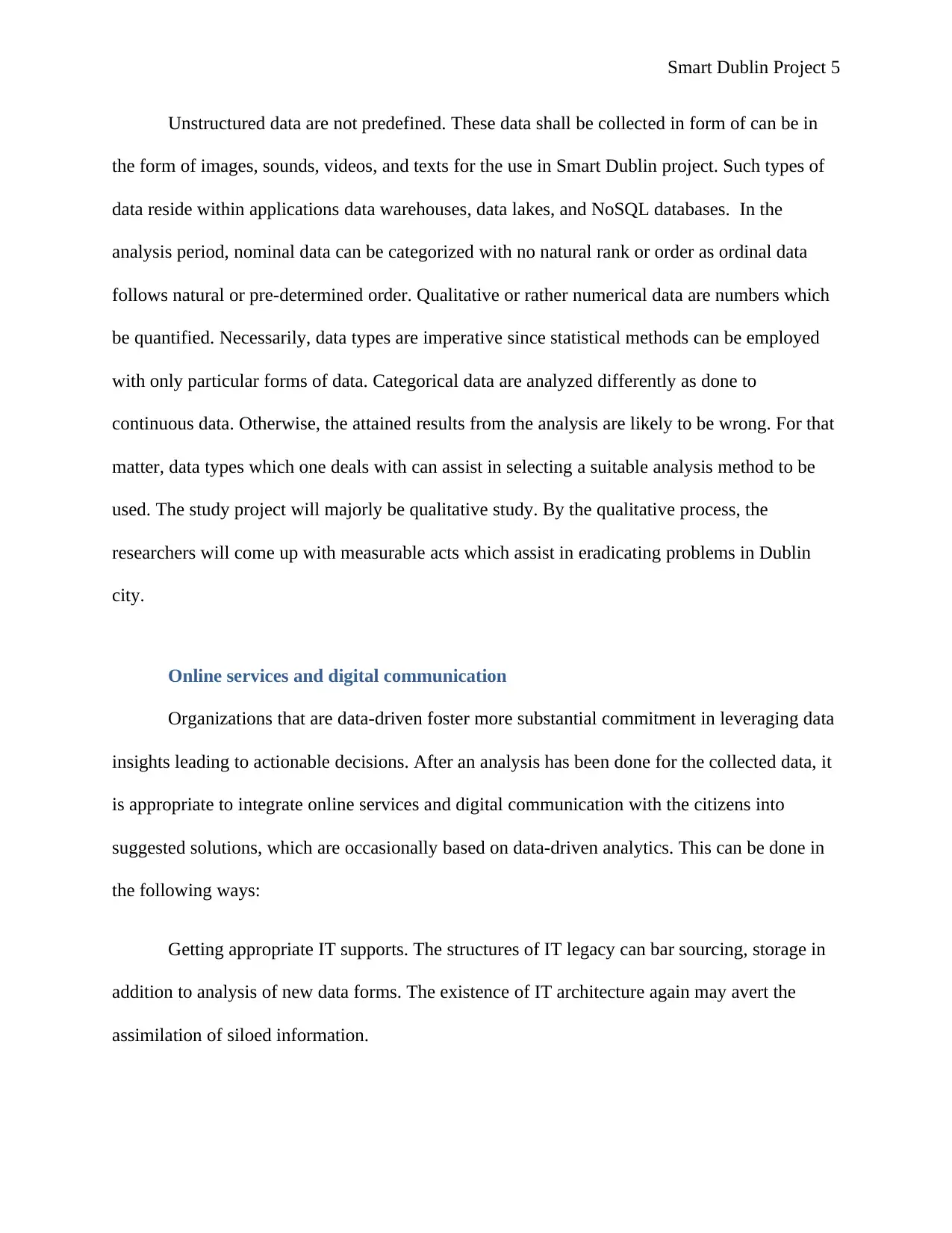
Unstructured data are not predefined. These data shall be collected in form of can be in
the form of images, sounds, videos, and texts for the use in Smart Dublin project. Such types of
data reside within applications data warehouses, data lakes, and NoSQL databases. In the
analysis period, nominal data can be categorized with no natural rank or order as ordinal data
follows natural or pre-determined order. Qualitative or rather numerical data are numbers which
be quantified. Necessarily, data types are imperative since statistical methods can be employed
with only particular forms of data. Categorical data are analyzed differently as done to
continuous data. Otherwise, the attained results from the analysis are likely to be wrong. For that
matter, data types which one deals with can assist in selecting a suitable analysis method to be
used. The study project will majorly be qualitative study. By the qualitative process, the
researchers will come up with measurable acts which assist in eradicating problems in Dublin
city.
Online services and digital communication
Organizations that are data-driven foster more substantial commitment in leveraging data
insights leading to actionable decisions. After an analysis has been done for the collected data, it
is appropriate to integrate online services and digital communication with the citizens into
suggested solutions, which are occasionally based on data-driven analytics. This can be done in
the following ways:
Getting appropriate IT supports. The structures of IT legacy can bar sourcing, storage in
addition to analysis of new data forms. The existence of IT architecture again may avert the
assimilation of siloed information.
Unstructured data are not predefined. These data shall be collected in form of can be in
the form of images, sounds, videos, and texts for the use in Smart Dublin project. Such types of
data reside within applications data warehouses, data lakes, and NoSQL databases. In the
analysis period, nominal data can be categorized with no natural rank or order as ordinal data
follows natural or pre-determined order. Qualitative or rather numerical data are numbers which
be quantified. Necessarily, data types are imperative since statistical methods can be employed
with only particular forms of data. Categorical data are analyzed differently as done to
continuous data. Otherwise, the attained results from the analysis are likely to be wrong. For that
matter, data types which one deals with can assist in selecting a suitable analysis method to be
used. The study project will majorly be qualitative study. By the qualitative process, the
researchers will come up with measurable acts which assist in eradicating problems in Dublin
city.
Online services and digital communication
Organizations that are data-driven foster more substantial commitment in leveraging data
insights leading to actionable decisions. After an analysis has been done for the collected data, it
is appropriate to integrate online services and digital communication with the citizens into
suggested solutions, which are occasionally based on data-driven analytics. This can be done in
the following ways:
Getting appropriate IT supports. The structures of IT legacy can bar sourcing, storage in
addition to analysis of new data forms. The existence of IT architecture again may avert the
assimilation of siloed information.
Smart Dublin Project 6
What is more, the management of unstructured data has passed the capabilities of
traditional IT. Completely resolving these cases usually take many years for implementation.
However, the corporate head can address the needs of short-term big-data through closely
working with chief information officers in prioritizing the requirements. It indicates that there
would be swift identification and connectivity for essential data to be employed in analytics.
Subsequently, cleanup operations are mounted to synchronize as well as merge overlapping data
then work around the information missing (Robertson and Perera 2002).
Creativity on data sourcing processes. Always, firms are having ready data needed to
handle various problems in business. However, managers are not aware of how they can utilize
such information in significant decision making processes in a company. For instance, operation
executives may not understand the prospective value of hourly or daily processes that take place
within an organization. Organizations can promote comprehensive scrutiny of the data through
being specific about business predicament as well as opportunities that are required to be
addressed. In such an instance, managers should be creative concerning possible internal and
external data sources.
Construct models that forecast and optimize the outcomes of a business. Data are
essential; however, competitive edge and improvements on performance come from models of
data analytics. These permit business managers in predicting as well as optimizing the results.
More importantly, the appropriate method of constructing an analytic data model begins with
recognizing business opportunities then establishing how models can assist in improving the
performance. Modeling that is led by hypothesis creates faster results and model roots within
practical data associations, which are widely comprehended by the managers. Statistical models
What is more, the management of unstructured data has passed the capabilities of
traditional IT. Completely resolving these cases usually take many years for implementation.
However, the corporate head can address the needs of short-term big-data through closely
working with chief information officers in prioritizing the requirements. It indicates that there
would be swift identification and connectivity for essential data to be employed in analytics.
Subsequently, cleanup operations are mounted to synchronize as well as merge overlapping data
then work around the information missing (Robertson and Perera 2002).
Creativity on data sourcing processes. Always, firms are having ready data needed to
handle various problems in business. However, managers are not aware of how they can utilize
such information in significant decision making processes in a company. For instance, operation
executives may not understand the prospective value of hourly or daily processes that take place
within an organization. Organizations can promote comprehensive scrutiny of the data through
being specific about business predicament as well as opportunities that are required to be
addressed. In such an instance, managers should be creative concerning possible internal and
external data sources.
Construct models that forecast and optimize the outcomes of a business. Data are
essential; however, competitive edge and improvements on performance come from models of
data analytics. These permit business managers in predicting as well as optimizing the results.
More importantly, the appropriate method of constructing an analytic data model begins with
recognizing business opportunities then establishing how models can assist in improving the
performance. Modeling that is led by hypothesis creates faster results and model roots within
practical data associations, which are widely comprehended by the managers. Statistical models
⊘ This is a preview!⊘
Do you want full access?
Subscribe today to unlock all pages.
Trusted by 1+ million students worldwide
Smart Dublin Project 7
make excellent models indisputably. Sometimes, professionals in the statistic field design models
that are too multifaceted to be practical, thus exhausting the capabilities of an organization.
Transform the capabilities of the business. Digital communications can be integrated with
the citizens into suggested solutions developing pertinent business analytics that can be used by
many people quickly. Data model designers should comprehend forms of business judgments
which managers are required to make in all their action while running an organization.
Conversations with the line managers shall make sure that tools and analytics are complements
with the existing process of decision making. This enables firms to manage effectively various
trade-offs. Again, embedded analytical tools should be simple to use. Citizens require transparent
methods for using fresh models alongside algorithms every day. Sophisticated data models need
sharp marketing skills to operate and comprehend. Intuitive interfaces and tools should be
provided to assist managers in executing their duties.
Furthermore, the integration can be enabled through the development of capacities in
exploiting big data. Companies must upgrade their literacy and skills of analysis. To make data
analytics to be a component of everyday operation, managers need to view such as key in solving
problems and recognizing opportunities. The effort of everyone varies concerning organizational
goals and timelines. Culture adjustments call for metrics of reinforcing behaviors. For instance,
adult learners usually benefit from approaches related to forums and field works. In these areas,
they take part in real-world cases, thus get to comprehend multiple problems. Therefore, data-
driven analytics should be based on pronouncements made at workplaces permitting workers to
learn through doing.
make excellent models indisputably. Sometimes, professionals in the statistic field design models
that are too multifaceted to be practical, thus exhausting the capabilities of an organization.
Transform the capabilities of the business. Digital communications can be integrated with
the citizens into suggested solutions developing pertinent business analytics that can be used by
many people quickly. Data model designers should comprehend forms of business judgments
which managers are required to make in all their action while running an organization.
Conversations with the line managers shall make sure that tools and analytics are complements
with the existing process of decision making. This enables firms to manage effectively various
trade-offs. Again, embedded analytical tools should be simple to use. Citizens require transparent
methods for using fresh models alongside algorithms every day. Sophisticated data models need
sharp marketing skills to operate and comprehend. Intuitive interfaces and tools should be
provided to assist managers in executing their duties.
Furthermore, the integration can be enabled through the development of capacities in
exploiting big data. Companies must upgrade their literacy and skills of analysis. To make data
analytics to be a component of everyday operation, managers need to view such as key in solving
problems and recognizing opportunities. The effort of everyone varies concerning organizational
goals and timelines. Culture adjustments call for metrics of reinforcing behaviors. For instance,
adult learners usually benefit from approaches related to forums and field works. In these areas,
they take part in real-world cases, thus get to comprehend multiple problems. Therefore, data-
driven analytics should be based on pronouncements made at workplaces permitting workers to
learn through doing.
Paraphrase This Document
Need a fresh take? Get an instant paraphrase of this document with our AI Paraphraser
Smart Dublin Project 8
Improving Marketing Decisions and Reduce City Council Expenses using Data
Analytics Methods
To improve the data marketing decisions of the Dublin city, a more advanced level of
technology should be deployed. To this end, data analytics methods would play an integral role
in providing citizens with relevant services, enhancing energy efficiency through creating
greener environments while keen on reducing city council expenses. Data analytics allows the
management to discover several market dynamics, take risks, and still anticipate possible market
shifts. While making marketing decisions, the following data analytics methods will be
embedded in my planning:
Text analysis: This is a method that uses a database to discover large data patterns. It is
also known as the data mining method. I will employ this method to break down raw data that
has been collected into marketing information. The market I will be operating in will presumably
have business intelligence tools, which will, therefore, help in strategic decision making. I
believe this discovery will create not only better governance of the city but also better health
services. Generally, the method will help with the qualitative data examination, such as
interviews and observations hence enhancing marketing decisions. Furthermore, it will eliminate
too much guesswork emanating from marketing planning advertisements, development of
products and services, and choosing the right content (Gandomi, and Haider 2015, p.137).
Statistical Analysis: The method will address the question that will arise from the past
data retrieved from the dashboard. It will, therefore, involve collection, interpretation, analyzing,
and presentation of data collected previously in the city council. There exist two categories of
this type of data analysis- inferential and descriptive analysis. The statistical analysis technique
will ensure that the city's expense is reduced through offering services to the people with a better
Improving Marketing Decisions and Reduce City Council Expenses using Data
Analytics Methods
To improve the data marketing decisions of the Dublin city, a more advanced level of
technology should be deployed. To this end, data analytics methods would play an integral role
in providing citizens with relevant services, enhancing energy efficiency through creating
greener environments while keen on reducing city council expenses. Data analytics allows the
management to discover several market dynamics, take risks, and still anticipate possible market
shifts. While making marketing decisions, the following data analytics methods will be
embedded in my planning:
Text analysis: This is a method that uses a database to discover large data patterns. It is
also known as the data mining method. I will employ this method to break down raw data that
has been collected into marketing information. The market I will be operating in will presumably
have business intelligence tools, which will, therefore, help in strategic decision making. I
believe this discovery will create not only better governance of the city but also better health
services. Generally, the method will help with the qualitative data examination, such as
interviews and observations hence enhancing marketing decisions. Furthermore, it will eliminate
too much guesswork emanating from marketing planning advertisements, development of
products and services, and choosing the right content (Gandomi, and Haider 2015, p.137).
Statistical Analysis: The method will address the question that will arise from the past
data retrieved from the dashboard. It will, therefore, involve collection, interpretation, analyzing,
and presentation of data collected previously in the city council. There exist two categories of
this type of data analysis- inferential and descriptive analysis. The statistical analysis technique
will ensure that the city's expense is reduced through offering services to the people with a better
Smart Dublin Project 9
understanding of their exact needs. Moreover, I believe the method will give me an overall view
of the people's change in requirements since they are bound to change with time.
Diagnostics Analysis: the technique in question resolves the issue of what happened from
the statistical analysis. It will be useful to identify data with different patterns. The city council
requires better answers on what happened to the previous management in terms of good
governance. The decisions made therein with unearth unhealthy behaviors that might have been
propagated hence coming up with relevant marketing decisions.
Predictive Analysis: They anticipate what is likely to happen while keen to benchmark
with the previously collected data. The analysis will concentrate on predicting future market
trends based on the past and present database information. If, for example, garbage collection or
inadequate health care services were reluctant, the method will enable the marketers to hatch
new ways of solving the menace. It will also help anticipate future occurrences in terms of
furnishing citizens with relevant information as regards to marketing dynamics and to make
appropriate adjustment (Elgendy and Elragal 2016, p.1071). Predictive analysis will also give me
a roadmap and an array of options to pick from to tradeoff some services I consider time-
consuming. Indeed, duplication of work and malpractices do flourish in an environment devoid
of accountability and transparency. Together with my administration, such practices will seize to
happen as the method will give us useful views about how the city council is performing—hence
reduction in expenses.
Prescriptive Analysis: This is a combination of all other data analysis to determine which
appropriate decision should be deployed. Therefore, the council will thoroughly examine a
variety of problems affecting the community and address them appropriately. Issues such as
understanding of their exact needs. Moreover, I believe the method will give me an overall view
of the people's change in requirements since they are bound to change with time.
Diagnostics Analysis: the technique in question resolves the issue of what happened from
the statistical analysis. It will be useful to identify data with different patterns. The city council
requires better answers on what happened to the previous management in terms of good
governance. The decisions made therein with unearth unhealthy behaviors that might have been
propagated hence coming up with relevant marketing decisions.
Predictive Analysis: They anticipate what is likely to happen while keen to benchmark
with the previously collected data. The analysis will concentrate on predicting future market
trends based on the past and present database information. If, for example, garbage collection or
inadequate health care services were reluctant, the method will enable the marketers to hatch
new ways of solving the menace. It will also help anticipate future occurrences in terms of
furnishing citizens with relevant information as regards to marketing dynamics and to make
appropriate adjustment (Elgendy and Elragal 2016, p.1071). Predictive analysis will also give me
a roadmap and an array of options to pick from to tradeoff some services I consider time-
consuming. Indeed, duplication of work and malpractices do flourish in an environment devoid
of accountability and transparency. Together with my administration, such practices will seize to
happen as the method will give us useful views about how the city council is performing—hence
reduction in expenses.
Prescriptive Analysis: This is a combination of all other data analysis to determine which
appropriate decision should be deployed. Therefore, the council will thoroughly examine a
variety of problems affecting the community and address them appropriately. Issues such as
⊘ This is a preview!⊘
Do you want full access?
Subscribe today to unlock all pages.
Trusted by 1+ million students worldwide
Smart Dublin Project 10
health care, citizen empowerment, better governance, and public services will be analyzed
through these methods.
Critical Evaluation
Service delivery in Smart Dublin is essential to every citizen. Efficient city services and
engagement with the citizens can be promoted at all times. This can be done through
development of a comprehensive strategy of communication by the city residents. Essentially,
citizen engagement and efficient service delivery truly work. The communication strategy should
reach out people through broadcasts provided to citizens via advertisements, social media,
emails, SMSs and sessions for hosting information. Likewise, improvement of city life quality
and promoting innovative solutions using data analytics ideas are paramount. To be enable this
to be a success, it is significant to offer sufficient resources, staffing together with metrics for
success meant for innovation. Clear measurements and goals ought to be identified with the
intention of tracking initiatives of engagement by the citizens. What is more, it is significant to
maintain fairness on technological resource allocations.
Assessment
After the analysis has been done, it is essential to decide the information attained from
the data. Assessment is done on whatever matters in a decision. The management then solidifies
on the business case. The trustworthy information, which supports the arguments and stories are
approved. Online platforms like social media generated nontraditional unstructured data in
terabytes used for the project analysis. The generated data were attained in the form of photos,
conversations, and vides. It was suitable to add such data into a stream of information flowing
health care, citizen empowerment, better governance, and public services will be analyzed
through these methods.
Critical Evaluation
Service delivery in Smart Dublin is essential to every citizen. Efficient city services and
engagement with the citizens can be promoted at all times. This can be done through
development of a comprehensive strategy of communication by the city residents. Essentially,
citizen engagement and efficient service delivery truly work. The communication strategy should
reach out people through broadcasts provided to citizens via advertisements, social media,
emails, SMSs and sessions for hosting information. Likewise, improvement of city life quality
and promoting innovative solutions using data analytics ideas are paramount. To be enable this
to be a success, it is significant to offer sufficient resources, staffing together with metrics for
success meant for innovation. Clear measurements and goals ought to be identified with the
intention of tracking initiatives of engagement by the citizens. What is more, it is significant to
maintain fairness on technological resource allocations.
Assessment
After the analysis has been done, it is essential to decide the information attained from
the data. Assessment is done on whatever matters in a decision. The management then solidifies
on the business case. The trustworthy information, which supports the arguments and stories are
approved. Online platforms like social media generated nontraditional unstructured data in
terabytes used for the project analysis. The generated data were attained in the form of photos,
conversations, and vides. It was suitable to add such data into a stream of information flowing
Paraphrase This Document
Need a fresh take? Get an instant paraphrase of this document with our AI Paraphraser
Smart Dublin Project 11
into the sensors, external sources, monitored processes as of local demographics up to weather
forecasts.
Presentation of the Findings
The use of technology determines economy of an area. Also, the decision made with the use of
technology forms a landmark on how the business in the city council operates. Thus, technology
provides more business opportunities for public companies, small business enterprises, and
private firms within the Smart Dublin city.
With strategic application of data analytics methods, the city council enhanced
development in terms of infrastructure to its citizens. Hence, they could be able to access
services with ease. Again with centralized marketing and decision-making centers, people were
at liberty to air out their grievances whenever they feel mistreated. Subsequently, the existed tax
collection method was consistent due to the use of technology. This enabled daily running of
businesses within the city with minimal disturbances.
into the sensors, external sources, monitored processes as of local demographics up to weather
forecasts.
Presentation of the Findings
The use of technology determines economy of an area. Also, the decision made with the use of
technology forms a landmark on how the business in the city council operates. Thus, technology
provides more business opportunities for public companies, small business enterprises, and
private firms within the Smart Dublin city.
With strategic application of data analytics methods, the city council enhanced
development in terms of infrastructure to its citizens. Hence, they could be able to access
services with ease. Again with centralized marketing and decision-making centers, people were
at liberty to air out their grievances whenever they feel mistreated. Subsequently, the existed tax
collection method was consistent due to the use of technology. This enabled daily running of
businesses within the city with minimal disturbances.
Smart Dublin Project 12
References
Bachiochi, P.D. and Weiner, S.P., 2002. Qualitative data collection and analysis. Handbook of
research methods in industrial and organizational psychology, pp.161-183.
Elgendy, N., and Elragal, A., 2016. Big data analytics in support of the decision making
process. Procedia Computer Science, 100, pp.1071-1084.
Gandomi, A., and Haider, M., 2015. Beyond the hype: Big data concepts, methods, and
analytics. International journal of information management, 35(2), pp.137-144.
Robertson, N. and Perera, T., 2002. Automated data collection for simulation?. Simulation
Practice and Theory, 9(6-8), pp.349-364.
References
Bachiochi, P.D. and Weiner, S.P., 2002. Qualitative data collection and analysis. Handbook of
research methods in industrial and organizational psychology, pp.161-183.
Elgendy, N., and Elragal, A., 2016. Big data analytics in support of the decision making
process. Procedia Computer Science, 100, pp.1071-1084.
Gandomi, A., and Haider, M., 2015. Beyond the hype: Big data concepts, methods, and
analytics. International journal of information management, 35(2), pp.137-144.
Robertson, N. and Perera, T., 2002. Automated data collection for simulation?. Simulation
Practice and Theory, 9(6-8), pp.349-364.
⊘ This is a preview!⊘
Do you want full access?
Subscribe today to unlock all pages.
Trusted by 1+ million students worldwide

1 out of 12


Related Documents


Your All-in-One AI-Powered Toolkit for Academic Success.
+13062052269
info@desklib.com
Available 24*7 on WhatsApp / Email
![[object Object]](/_next/static/media/star-bottom.7253800d.svg)
Unlock your academic potential
Copyright © 2020–2026 A2Z Services. All Rights Reserved. Developed and managed by ZUCOL.