Employee Engagement Analysis: Factors, Types and Recommendations
VerifiedAdded on 2019/09/25
|11
|2962
|176
Report
AI Summary
This report delves into the critical aspect of employee engagement within organizations. It begins by defining employee engagement and highlighting its significance in achieving organizational goals, emphasizing the psychological connection between employees and the company. The report outlines the various types of employee engagement, including engaged, not engaged, and actively disengaged, as defined by Gallup. It then explores key factors that influence employee engagement, such as career development, leadership, ethical standards, and job satisfaction. The literature review synthesizes findings from prominent researchers and organizations, including Kahn, Gallup, and Towers Perrin, to provide a comprehensive understanding of the subject. The report concludes with inferences drawn from the research and offers recommendations for enhancing employee engagement, such as counseling and incentive strategies. The research adopted a descriptive approach, relying on secondary data to analyze and provide recommendations for fostering a more engaged workforce.

0
employee engagement
Student name
submission date
employee engagement
Student name
submission date

Paraphrase This Document
Need a fresh take? Get an instant paraphrase of this document with our AI Paraphraser

Employee engagement in organizations
Executive Summary
Employees are the most important resource of an organization as it helps to achieve the
objectives of the organization. The positive engagement of employees in their workplace helps in
creating not just employees but valued individuals. The engaged employees who are more
positive and effective help in forming a psychological connection between the employees with
the organization which helps in providing more committed employees. The reason for choosing
the employee engagement concern is that the engagement of employees in an organization
affects the clients of the company and the staff members reflecting on their performance. In this
paper, I have studied the importance of Employee Engagement in organizations and various
factors which can affect employee engagement. The research adopted is descriptive research, and
the data is used from secondary sources. The data then was studied, and the recommendations
were given in the reference. Some of the suggestions which can be given by conducting this
research are that as some employees in the organization cannot manage their personal and
professional life, the organizations must arrange to counsel based on the problems of the
employees. The organizations must devise some strategies to satisfy the low-income employees
by providing them with additional incentives if targets are achieved so that the commitment and
attitude of the employees can be improved towards the company.
1
Executive Summary
Employees are the most important resource of an organization as it helps to achieve the
objectives of the organization. The positive engagement of employees in their workplace helps in
creating not just employees but valued individuals. The engaged employees who are more
positive and effective help in forming a psychological connection between the employees with
the organization which helps in providing more committed employees. The reason for choosing
the employee engagement concern is that the engagement of employees in an organization
affects the clients of the company and the staff members reflecting on their performance. In this
paper, I have studied the importance of Employee Engagement in organizations and various
factors which can affect employee engagement. The research adopted is descriptive research, and
the data is used from secondary sources. The data then was studied, and the recommendations
were given in the reference. Some of the suggestions which can be given by conducting this
research are that as some employees in the organization cannot manage their personal and
professional life, the organizations must arrange to counsel based on the problems of the
employees. The organizations must devise some strategies to satisfy the low-income employees
by providing them with additional incentives if targets are achieved so that the commitment and
attitude of the employees can be improved towards the company.
1

Employee engagement in organizations
Table of Contents
Executive Summary.........................................................................................................................2
Introduction......................................................................................................................................4
Employee engagement.................................................................................................................4
Aspects of Employee Engagement..............................................................................................4
Types of Employee Engagement.................................................................................................4
Factors Leading to Employee Engagement.................................................................................5
Literature review..............................................................................................................................7
Hyman and Mason.......................................................................................................................7
Gallup Organisation.....................................................................................................................7
The conference board New York,................................................................................................7
The Towers Perrin.......................................................................................................................7
Kahn.............................................................................................................................................8
Sanford.........................................................................................................................................8
Purcell et Al’s..............................................................................................................................8
Inferences, Recommendations and Conclusion...............................................................................9
Inferences.....................................................................................................................................9
Recommendations........................................................................................................................9
Conclusion.................................................................................................................................10
Reference.......................................................................................................................................11
2
Table of Contents
Executive Summary.........................................................................................................................2
Introduction......................................................................................................................................4
Employee engagement.................................................................................................................4
Aspects of Employee Engagement..............................................................................................4
Types of Employee Engagement.................................................................................................4
Factors Leading to Employee Engagement.................................................................................5
Literature review..............................................................................................................................7
Hyman and Mason.......................................................................................................................7
Gallup Organisation.....................................................................................................................7
The conference board New York,................................................................................................7
The Towers Perrin.......................................................................................................................7
Kahn.............................................................................................................................................8
Sanford.........................................................................................................................................8
Purcell et Al’s..............................................................................................................................8
Inferences, Recommendations and Conclusion...............................................................................9
Inferences.....................................................................................................................................9
Recommendations........................................................................................................................9
Conclusion.................................................................................................................................10
Reference.......................................................................................................................................11
2
⊘ This is a preview!⊘
Do you want full access?
Subscribe today to unlock all pages.

Trusted by 1+ million students worldwide

Employee engagement in organizations
Introduction
Employee engagement
Employee engagement is the relationship of the employees with the organization they work in.
An engaged employee is the one who is committed and enthusiastic towards its work and
performs every day to achieve the organizational goals and objectives. (Wikipedia, 2016)
Engagement of employees is the level of involvement and commitment of an employee to attain
the organizational value. An engaged employee works for the improvement in the performance
and helps the company to grow. The organization must work for developing and nurturing the
relationship between employees and employer. (Success, 2016)
Engagement has the closest association with the flow and involvement of an employee in his job.
It is different from a job as it focuses on how the employees are considered about their
performance in a job. It also concerns the emotional state of employees. It can be thought as
before job involvement where individuals experience deep engagement in their jobs.
HR professionals believe that the challenge of engagement of employees is concerned more
about the feelings of employees towards the work experience and the way they are treated. The
majority of the employees want to remain committed towards their organization as it fulfills the
need of connecting with and contributing to something important.
Aspects of Employee Engagement
The aspects of employee engagement are as follows:
The experience and psychological feelings of an employee
The ability of an employer to create engagement of employees
Communication at all levels among all
Personal and professional progress
Performance and accountability
Rewards and recognition based on performance
Leadership ability for one's job ([engage]- The Employee Success and
Engagement Blog by Achievers, 2015)
Types of Employee Engagement
As per Gallup, there are various types of employees in engagement perspective:
3
Introduction
Employee engagement
Employee engagement is the relationship of the employees with the organization they work in.
An engaged employee is the one who is committed and enthusiastic towards its work and
performs every day to achieve the organizational goals and objectives. (Wikipedia, 2016)
Engagement of employees is the level of involvement and commitment of an employee to attain
the organizational value. An engaged employee works for the improvement in the performance
and helps the company to grow. The organization must work for developing and nurturing the
relationship between employees and employer. (Success, 2016)
Engagement has the closest association with the flow and involvement of an employee in his job.
It is different from a job as it focuses on how the employees are considered about their
performance in a job. It also concerns the emotional state of employees. It can be thought as
before job involvement where individuals experience deep engagement in their jobs.
HR professionals believe that the challenge of engagement of employees is concerned more
about the feelings of employees towards the work experience and the way they are treated. The
majority of the employees want to remain committed towards their organization as it fulfills the
need of connecting with and contributing to something important.
Aspects of Employee Engagement
The aspects of employee engagement are as follows:
The experience and psychological feelings of an employee
The ability of an employer to create engagement of employees
Communication at all levels among all
Personal and professional progress
Performance and accountability
Rewards and recognition based on performance
Leadership ability for one's job ([engage]- The Employee Success and
Engagement Blog by Achievers, 2015)
Types of Employee Engagement
As per Gallup, there are various types of employees in engagement perspective:
3
Paraphrase This Document
Need a fresh take? Get an instant paraphrase of this document with our AI Paraphraser

Employee engagement in organizations
Engaged- these are the builders for the success of the organization. They are always keen to
know the expected result so that they can fulfill those expectations. They are always concerned
about the growth of their organization and their place in it. They always perform at high levels.
They try and use their skills and abilities daily for their work as they work with passion to
making the company move forward
Not Engaged- these type of employees are focused more towards the tasks rather than the goals
of the organization. They want the high authority to tell them what to do so that they can perform
that task and finish it. Their focus is just the accomplishment of a task and not the achievement
of the outcome. These employees feel that their contributions are overlooked, and their abilities
are not utilized. The reason for this is their unproductive relationship with the managers and co-
workers.
Actively Disengaged- these type of employees are against everything. They always feel unhappy
at a workplace and are busy with their unhappiness. They are always negative towards new
opportunities. Each day, these employees feel uncomfortable if the co-workers accomplish
something. The workers working in a company always rely on each other for generating products
and services so that these disengaged workers can cause a lot of damage to the functioning of the
organization. (Goulddesigninc.wordpress.com, 2016)
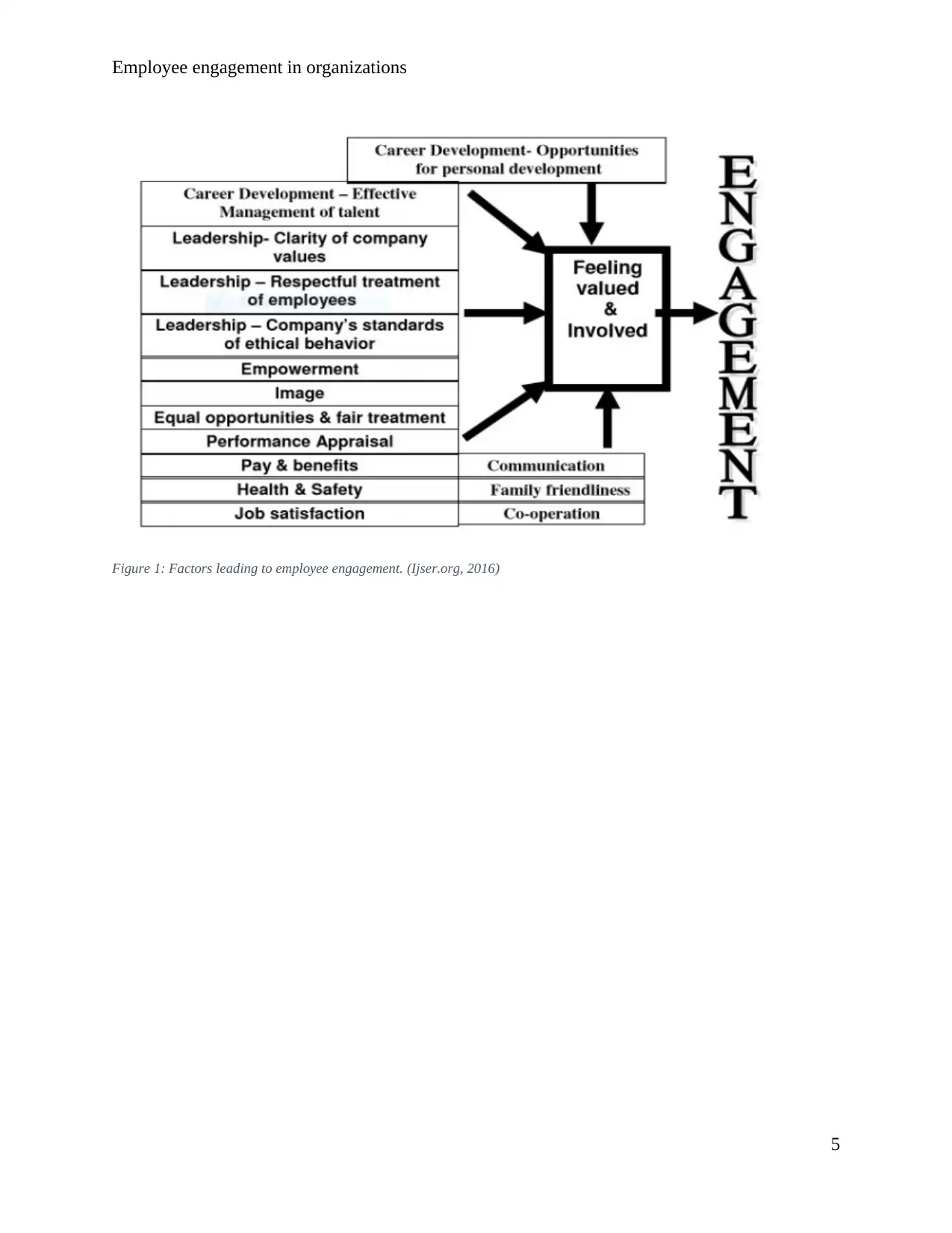
Factors Leading to Employee Engagement
There are various critical factors which lead to employee engagement. Some of them are career
development including opportunities for personal development and effective management of
talent, leadership involving clarity of company values and respectful treatment of employees,
company’s standards of ethical pay and benefits, health and safety, job satisfaction,
communication, family friendliness, co-operation, empowerment, and image. Other factors
include equal opportunities and fair treatment to all the employees, performance appraisal for
high levels of employee engagement and, pay benefits to boost the employee engagement.
(Work.chron.com, 2016)
4
Engaged- these are the builders for the success of the organization. They are always keen to
know the expected result so that they can fulfill those expectations. They are always concerned
about the growth of their organization and their place in it. They always perform at high levels.
They try and use their skills and abilities daily for their work as they work with passion to
making the company move forward
Not Engaged- these type of employees are focused more towards the tasks rather than the goals
of the organization. They want the high authority to tell them what to do so that they can perform
that task and finish it. Their focus is just the accomplishment of a task and not the achievement
of the outcome. These employees feel that their contributions are overlooked, and their abilities
are not utilized. The reason for this is their unproductive relationship with the managers and co-
workers.
Actively Disengaged- these type of employees are against everything. They always feel unhappy
at a workplace and are busy with their unhappiness. They are always negative towards new
opportunities. Each day, these employees feel uncomfortable if the co-workers accomplish
something. The workers working in a company always rely on each other for generating products
and services so that these disengaged workers can cause a lot of damage to the functioning of the
organization. (Goulddesigninc.wordpress.com, 2016)
Factors Leading to Employee Engagement
There are various critical factors which lead to employee engagement. Some of them are career
development including opportunities for personal development and effective management of
talent, leadership involving clarity of company values and respectful treatment of employees,
company’s standards of ethical pay and benefits, health and safety, job satisfaction,
communication, family friendliness, co-operation, empowerment, and image. Other factors
include equal opportunities and fair treatment to all the employees, performance appraisal for
high levels of employee engagement and, pay benefits to boost the employee engagement.
(Work.chron.com, 2016)
4
Employee engagement in organizations
Figure 1: Factors leading to employee engagement. (Ijser.org, 2016)
5
Figure 1: Factors leading to employee engagement. (Ijser.org, 2016)
5
⊘ This is a preview!⊘
Do you want full access?
Subscribe today to unlock all pages.
Trusted by 1+ million students worldwide

Employee engagement in organizations
Literature review
Very often employee engagement is described as an intellectual and emotional commitment to
the company or the effort of the employees in doing their jobs. As suggested by Kahn, it is a
multi-faceted aspect of the organization. But Truss et al. (2006) describe employee engagement
as the passion of employees for work, a mental state which bounds the engagement dimensions
by Kahn (1990) and also captures the common theme from all the definitions.(Ang, n.d.)
Hyman and Mason (1995) argued that the schemes of involvement of employees create less
or no input in high-level decision making. And also does not involve any important sharing of
authority or power. Similarly, Blyton and Turnbull (2004:272) argued that the involvement of
employees is soft on power. Whereas, the study done by Purcell et al.'s (2003) found that the
levels of employee engagement are affected by the decisions regarding the involvement
decisions. The study conducted was a descriptive study. (Hyman and Mason, 1995)
Gallup Organisation (2004) found the links to be critical between the loyalty of the customer,
profitability and growth of the business, and engagement of employees. The comparison of the
scores of these variables was made in various stores which come under top 25 percent of
customer loyalty and employee engagement with the bottom 25percent. The bottom 25 percent
stores are underperformed in the productivity measures like customer complaints, sales, and
turnover. The study was conducted from a survey. Thus, it was a quantitative study. This
research summarized that engaged employees result in satisfied customers and thus, improve the
profits of the company. The HR professionals must work for engaging the disengaged employees
by launching special initiatives.
The conference board New York, this is a qualitative study which summarizes the already
known facts of engagement of the employees towards their work. It also focuses on the concern
of feelings of employees towards their job as if the employees are psychologically and
emotionally attached to their jobs; then they are more willing to contribute to the success of their
company.
The Towers Perrin (2003), this study identifies the rationality and emotions as the core
components of employee engagement. It was found that the emotions of an individual are linked
to their satisfaction and the inspiration they achieve from their job by being a part of the
company. It was seen that the scores for emotional engagement are lower than the scores of
rational engagement.
6
Literature review
Very often employee engagement is described as an intellectual and emotional commitment to
the company or the effort of the employees in doing their jobs. As suggested by Kahn, it is a
multi-faceted aspect of the organization. But Truss et al. (2006) describe employee engagement
as the passion of employees for work, a mental state which bounds the engagement dimensions
by Kahn (1990) and also captures the common theme from all the definitions.(Ang, n.d.)
Hyman and Mason (1995) argued that the schemes of involvement of employees create less
or no input in high-level decision making. And also does not involve any important sharing of
authority or power. Similarly, Blyton and Turnbull (2004:272) argued that the involvement of
employees is soft on power. Whereas, the study done by Purcell et al.'s (2003) found that the
levels of employee engagement are affected by the decisions regarding the involvement
decisions. The study conducted was a descriptive study. (Hyman and Mason, 1995)
Gallup Organisation (2004) found the links to be critical between the loyalty of the customer,
profitability and growth of the business, and engagement of employees. The comparison of the
scores of these variables was made in various stores which come under top 25 percent of
customer loyalty and employee engagement with the bottom 25percent. The bottom 25 percent
stores are underperformed in the productivity measures like customer complaints, sales, and
turnover. The study was conducted from a survey. Thus, it was a quantitative study. This
research summarized that engaged employees result in satisfied customers and thus, improve the
profits of the company. The HR professionals must work for engaging the disengaged employees
by launching special initiatives.
The conference board New York, this is a qualitative study which summarizes the already
known facts of engagement of the employees towards their work. It also focuses on the concern
of feelings of employees towards their job as if the employees are psychologically and
emotionally attached to their jobs; then they are more willing to contribute to the success of their
company.
The Towers Perrin (2003), this study identifies the rationality and emotions as the core
components of employee engagement. It was found that the emotions of an individual are linked
to their satisfaction and the inspiration they achieve from their job by being a part of the
company. It was seen that the scores for emotional engagement are lower than the scores of
rational engagement.
6
Paraphrase This Document
Need a fresh take? Get an instant paraphrase of this document with our AI Paraphraser

Employee engagement in organizations
This study was a quantitative study as the survey of respondents was done. Only less than 2/3rd of
the sample size agreed that they are satisfied with their company's workplace and even lesser
agreed to the fact that they get inspiration from their companies to do better work. (Towers
Perrin 2003). It shows the importance of the actions of management to determine the level of
engagement of employees in a company.
Kahn carried out a study of engagement(1990). Initially, his work was based on the work of
Goffman (1961) who explained the concept of the attachment and detachment of employees with
their role varies. Although Kahn claims that Goffman’s study concentrated on short-term one-on-
one encounters, a distinctive concept was required to fit the organizational life; that is
“continuous, emotionally fraught, and rationally complex” (Diamond and Allcorn 1985).
It was seen that group theorists, psychologists, and sociologists recognize that individuals are
naturally hesitant of being members of already operating systems. A qualitative study was
conducted by Kahn on the mental conditions of personal engagement and disengagement through
interviews taken from the staff and counselors about their engagement and disengagement at
work. It was found that three mental conditions are related to the engagement or disengagement
at work which are availability, safety, and meaningfulness. It was also found that the employees
were engaged more in the work which gave them safety and meaningfulness mentally and when
they were more psychologically available.
Sanford (2003) reported that the study conducted by Gallup poll on the engagement of
employees includes 29% of the U.S. workforce whereas 55% are not engaged, and 16% are
disengaged. Seigts et al. (2006) summarize the employee engagement literature stating the
factors of engagement deals with communication clarity, expectation conveyance, advancement
of career, connection with others, contribution, recognition, and authority of one's job, leaders
credibility, the relationship of employees and the confidence within the company. These factors
of employee engagement make the employees and employers get focused, attracted and retain
the talent. The study conducted was quantitative study as the research was based on the factors of
employee engagement.
Purcell et Al’s (2003) study found that there are various factors connected with high level of
engagement of employees in the organizations. One thing that was found similar was that the
engagement of employees is connected with the involvement of the employees in the activities
related to their jobs. For, e.g., effective communication is a factor that affects the engagement
levels of the employees as the engagement was affected when the employees received the
information about their place in the company, the growth of the company and their contribution
towards this growth. Hence, it is important to keep the flow of communication among all the
levels. It is a research based on the quantitative study of the existing researches.
7
This study was a quantitative study as the survey of respondents was done. Only less than 2/3rd of
the sample size agreed that they are satisfied with their company's workplace and even lesser
agreed to the fact that they get inspiration from their companies to do better work. (Towers
Perrin 2003). It shows the importance of the actions of management to determine the level of
engagement of employees in a company.
Kahn carried out a study of engagement(1990). Initially, his work was based on the work of
Goffman (1961) who explained the concept of the attachment and detachment of employees with
their role varies. Although Kahn claims that Goffman’s study concentrated on short-term one-on-
one encounters, a distinctive concept was required to fit the organizational life; that is
“continuous, emotionally fraught, and rationally complex” (Diamond and Allcorn 1985).
It was seen that group theorists, psychologists, and sociologists recognize that individuals are
naturally hesitant of being members of already operating systems. A qualitative study was
conducted by Kahn on the mental conditions of personal engagement and disengagement through
interviews taken from the staff and counselors about their engagement and disengagement at
work. It was found that three mental conditions are related to the engagement or disengagement
at work which are availability, safety, and meaningfulness. It was also found that the employees
were engaged more in the work which gave them safety and meaningfulness mentally and when
they were more psychologically available.
Sanford (2003) reported that the study conducted by Gallup poll on the engagement of
employees includes 29% of the U.S. workforce whereas 55% are not engaged, and 16% are
disengaged. Seigts et al. (2006) summarize the employee engagement literature stating the
factors of engagement deals with communication clarity, expectation conveyance, advancement
of career, connection with others, contribution, recognition, and authority of one's job, leaders
credibility, the relationship of employees and the confidence within the company. These factors
of employee engagement make the employees and employers get focused, attracted and retain
the talent. The study conducted was quantitative study as the research was based on the factors of
employee engagement.
Purcell et Al’s (2003) study found that there are various factors connected with high level of
engagement of employees in the organizations. One thing that was found similar was that the
engagement of employees is connected with the involvement of the employees in the activities
related to their jobs. For, e.g., effective communication is a factor that affects the engagement
levels of the employees as the engagement was affected when the employees received the
information about their place in the company, the growth of the company and their contribution
towards this growth. Hence, it is important to keep the flow of communication among all the
levels. It is a research based on the quantitative study of the existing researches.
7

Employee engagement in organizations
Briefly, the above-conducted researches and literature state that the cause of disengagement of
employees is poor management. However, the employees do not have the positive relationship
with their employers and co-workers. So, they have to face denial in the opportunities of
communication and having power for decision-making processes. Employees need managers
who understand, care and are committed towards their company so that they can work in a
positive environment.
Inferences, Recommendations and Conclusion
Inferences
The research shows that the relationships of employees among themselves and the behavior they
deal with in the organization is a significant factor which affects the engagement of an employee
in an organization. A majority of them think that their ability and skills are not optimally utilized,
and they have to face denial in the opportunity of getting engaged in the voluntary activities. The
organizations are most concerned in acknowledging the positive behavior and fostering it rather
than focusing on the negative emotions and providing solutions for them. The organizations must
focus on solving the problem of a great number of employees being not engaged or disengaged.
The fluctuating job designs make the employees lose interest in their job as they don't have the
stability, which results in high employee turnover.
Recommendations
This paper suggests that employee engagement is a vital concept which is considerably worthy
for future research. Various practices such as training programs for new or untrained employees,
flexible work arrangements, and incentive rewards are very important aspects to encourage
employee engagement in the company. Future research must focus on other factors as well which
are significant for engagement in various groups, organizations, roles, and jobs.
(Wickramasinghe and Perera, 2012) The organizations should also consider the perception of
employees based on the support they get from the company to improve the engagement of
employees. The employer or managers must develop a feeling of community and positive
behavior in the company. The management must concentrate more towards the job design and
build more opportunities for people to get involved. By paying attention to the happiness of
employees at the place of work, the company can initiate better functioning of workers and
optimum utilization of resources in future. According to the research on individual differences,
the employees must be treated as valued individuals rather than just employees by going beyond
vertical communication.
8
Briefly, the above-conducted researches and literature state that the cause of disengagement of
employees is poor management. However, the employees do not have the positive relationship
with their employers and co-workers. So, they have to face denial in the opportunities of
communication and having power for decision-making processes. Employees need managers
who understand, care and are committed towards their company so that they can work in a
positive environment.
Inferences, Recommendations and Conclusion
Inferences
The research shows that the relationships of employees among themselves and the behavior they
deal with in the organization is a significant factor which affects the engagement of an employee
in an organization. A majority of them think that their ability and skills are not optimally utilized,
and they have to face denial in the opportunity of getting engaged in the voluntary activities. The
organizations are most concerned in acknowledging the positive behavior and fostering it rather
than focusing on the negative emotions and providing solutions for them. The organizations must
focus on solving the problem of a great number of employees being not engaged or disengaged.
The fluctuating job designs make the employees lose interest in their job as they don't have the
stability, which results in high employee turnover.
Recommendations
This paper suggests that employee engagement is a vital concept which is considerably worthy
for future research. Various practices such as training programs for new or untrained employees,
flexible work arrangements, and incentive rewards are very important aspects to encourage
employee engagement in the company. Future research must focus on other factors as well which
are significant for engagement in various groups, organizations, roles, and jobs.
(Wickramasinghe and Perera, 2012) The organizations should also consider the perception of
employees based on the support they get from the company to improve the engagement of
employees. The employer or managers must develop a feeling of community and positive
behavior in the company. The management must concentrate more towards the job design and
build more opportunities for people to get involved. By paying attention to the happiness of
employees at the place of work, the company can initiate better functioning of workers and
optimum utilization of resources in future. According to the research on individual differences,
the employees must be treated as valued individuals rather than just employees by going beyond
vertical communication.
8
⊘ This is a preview!⊘
Do you want full access?
Subscribe today to unlock all pages.
Trusted by 1+ million students worldwide

Employee engagement in organizations
Conclusion
Employee engagement is a significant factor in increasing the effectiveness and efficiency of an
organization. This research paper was conducted to determine the importance of employee
engagement in the organizations and to know the factors which affect the employee engagement.
By conducting this paper, we can conclude that employee engagement plays a vital role in an
organization as it gives the organization employees willing to work and perform for building a
better organization. Most of the organizations are realizing that an engaged employee is better
than a satisfied employee for an organization for providing improved productivity and loyalty as
an engaged employee is psychologically bound with the organization and is more committed
towards its job. The various concepts studied through various studies makes it difficult to
determine the concept of employee engagement as every research is conducted under different
situations using different measures. Despite this, there was one similarity among all that the
majority were in the category of ‘not engaged'. This finding was very disappointing but not very
surprising as not many people enjoy to work when they are getting a little meaning from what
they do. As per the research, there is a link between the business outcomes and the engagement
of employees in their jobs. Moreover, the personality and perception of individuals influence
their responses which shape and direct their engagement in the organization.
9
Conclusion
Employee engagement is a significant factor in increasing the effectiveness and efficiency of an
organization. This research paper was conducted to determine the importance of employee
engagement in the organizations and to know the factors which affect the employee engagement.
By conducting this paper, we can conclude that employee engagement plays a vital role in an
organization as it gives the organization employees willing to work and perform for building a
better organization. Most of the organizations are realizing that an engaged employee is better
than a satisfied employee for an organization for providing improved productivity and loyalty as
an engaged employee is psychologically bound with the organization and is more committed
towards its job. The various concepts studied through various studies makes it difficult to
determine the concept of employee engagement as every research is conducted under different
situations using different measures. Despite this, there was one similarity among all that the
majority were in the category of ‘not engaged'. This finding was very disappointing but not very
surprising as not many people enjoy to work when they are getting a little meaning from what
they do. As per the research, there is a link between the business outcomes and the engagement
of employees in their jobs. Moreover, the personality and perception of individuals influence
their responses which shape and direct their engagement in the organization.
9
Paraphrase This Document
Need a fresh take? Get an instant paraphrase of this document with our AI Paraphraser

Employee engagement in organizations
Reference
[engage]- The Employee Success and Engagement Blog by Achievers. (2015). The 8 elements of
employee engagement. [online] Available at: http://blog.achievers.com/2015/09/8-elements-
employee-engagement/ [Accessed 17 Aug. 2016].
Ang, E. (n.d.). Employee Engagement. SSRN Electronic Journal.
Goulddesigninc.wordpress.com. (2016). 3 Types Of Employee Engagement And Its Result.
[online] Available at: https://goulddesigninc.wordpress.com/2013/06/20/3-types-of-employee-
engagement-and-its-result/ [Accessed 17 Aug. 2016].
Hyman, J. and Mason, B. (1995). Managing employee involvement and participation. London:
Sage Publications.
Ijser.org. (2016). [online] Available at: http://www.ijser.org/paper/To-study-the-Employee-
Engagement-practices-and-its-effect-on-employee-performance-with-special-reference-to-ICICI-
and-HDFC-Bank-in-Lucknow/Image_001.jpg [Accessed 17 Aug. 2016].
Purcell, J. and Undy, R. (1986). 3. Research into the Management of Employee Relations at
Templeton College, Oxford. Employee Relations, 8(5), pp.15-22.
Success, W. (2016). What is Employee Engagement - Engage for Success. [online] Engage for
Success. Available at: http://engageforsuccess.org/what-is-employee-engagement [Accessed 17
Aug. 2016].
Wickramasinghe, V. and Perera, S. (2012). Effects of perceived organisation support, employee
engagement and organisation citizenship behaviour on quality performance. Total Quality
Management & Business Excellence, 25(11-12), pp.1280-1294
Wikipedia. (2016). Employee engagement. [online] Available at:
https://en.wikipedia.org/wiki/Employee_engagement [Accessed 17 Aug. 2016].
Work.chron.com. (2016). [online] Available at: http://work.chron.com/internal-external-factors-
affecting-employee-engagement-31069.html [Accessed 17 Aug. 2016].
10
Reference
[engage]- The Employee Success and Engagement Blog by Achievers. (2015). The 8 elements of
employee engagement. [online] Available at: http://blog.achievers.com/2015/09/8-elements-
employee-engagement/ [Accessed 17 Aug. 2016].
Ang, E. (n.d.). Employee Engagement. SSRN Electronic Journal.
Goulddesigninc.wordpress.com. (2016). 3 Types Of Employee Engagement And Its Result.
[online] Available at: https://goulddesigninc.wordpress.com/2013/06/20/3-types-of-employee-
engagement-and-its-result/ [Accessed 17 Aug. 2016].
Hyman, J. and Mason, B. (1995). Managing employee involvement and participation. London:
Sage Publications.
Ijser.org. (2016). [online] Available at: http://www.ijser.org/paper/To-study-the-Employee-
Engagement-practices-and-its-effect-on-employee-performance-with-special-reference-to-ICICI-
and-HDFC-Bank-in-Lucknow/Image_001.jpg [Accessed 17 Aug. 2016].
Purcell, J. and Undy, R. (1986). 3. Research into the Management of Employee Relations at
Templeton College, Oxford. Employee Relations, 8(5), pp.15-22.
Success, W. (2016). What is Employee Engagement - Engage for Success. [online] Engage for
Success. Available at: http://engageforsuccess.org/what-is-employee-engagement [Accessed 17
Aug. 2016].
Wickramasinghe, V. and Perera, S. (2012). Effects of perceived organisation support, employee
engagement and organisation citizenship behaviour on quality performance. Total Quality
Management & Business Excellence, 25(11-12), pp.1280-1294
Wikipedia. (2016). Employee engagement. [online] Available at:
https://en.wikipedia.org/wiki/Employee_engagement [Accessed 17 Aug. 2016].
Work.chron.com. (2016). [online] Available at: http://work.chron.com/internal-external-factors-
affecting-employee-engagement-31069.html [Accessed 17 Aug. 2016].
10

1 out of 11


Related Documents


Your All-in-One AI-Powered Toolkit for Academic Success.
+13062052269
info@desklib.com
Available 24*7 on WhatsApp / Email
![[object Object]](/_next/static/media/star-bottom.7253800d.svg)
Unlock your academic potential
Copyright © 2020–2026 A2Z Services. All Rights Reserved. Developed and managed by ZUCOL.