Managing Financial Resources Report
VerifiedAdded on 2019/12/03
|19
|4535
|150
Report
AI Summary
This report comprehensively explores managing financial resources and decisions within a business context. It covers various sources of finance (retained earnings, issuing shares, bank loans), their implications, and associated costs. The report emphasizes the importance of financial planning and its role in decision-making. It delves into the financial information requirements for different stakeholders and how costs are reflected in financial statements (income statement, cash flow statement, balance sheet). Investment appraisal methods (payback period, ARR, NPV, IRR) are applied to evaluate investment proposals. The report also includes calculations of contribution, break-even point, and profitability, analyzing the impact of varying costs and sales discounts. Finally, it examines the purpose and use of different accounting records and analyzes financial statements using profitability, liquidity, and efficiency ratios to assess the overall financial health of a business.
MANAGING FINANCIAL RESOURCES
AND DECISIONS
AND DECISIONS

Paraphrase This Document
Need a fresh take? Get an instant paraphrase of this document with our AI Paraphraser
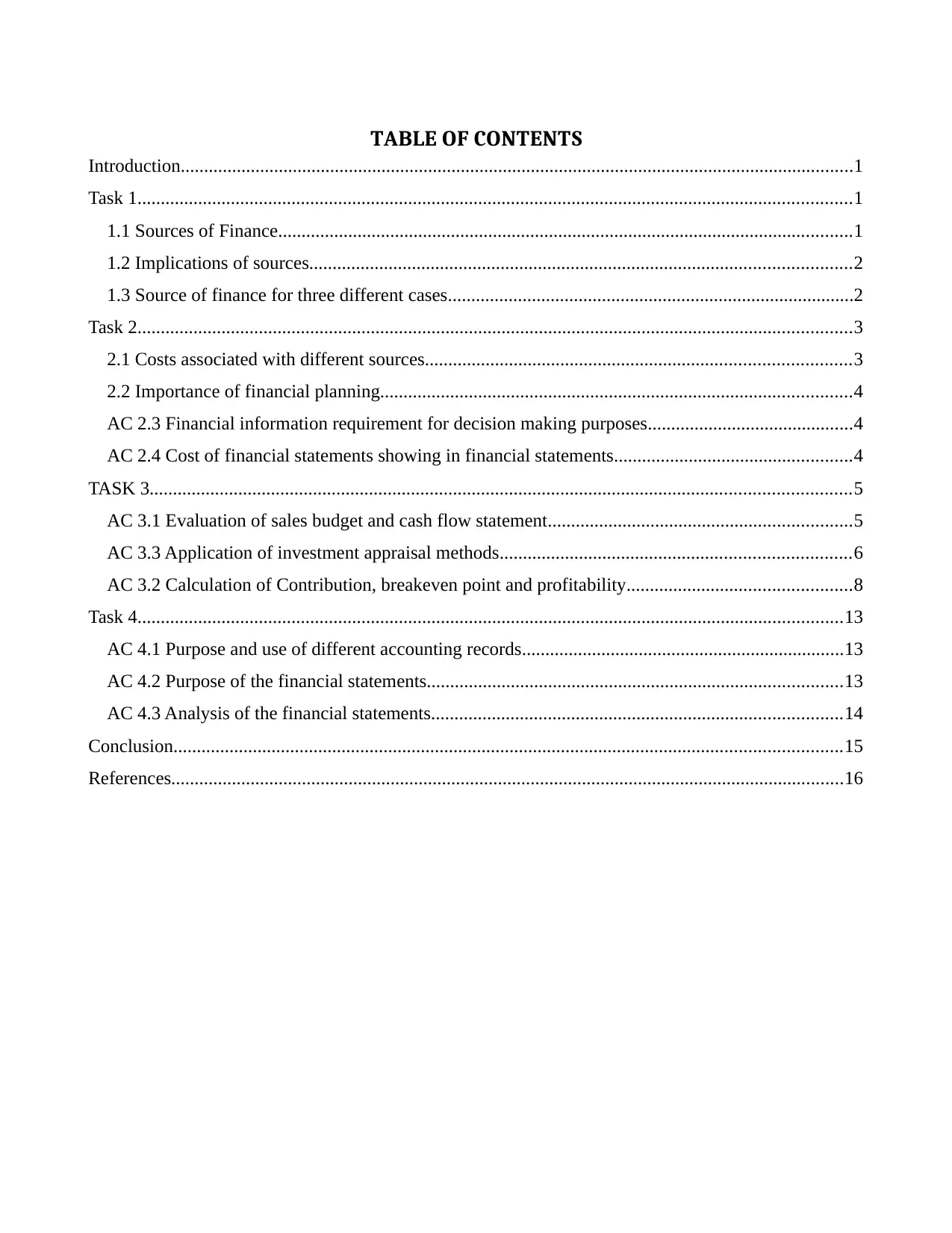
TABLE OF CONTENTS
Introduction................................................................................................................................................1
Task 1.........................................................................................................................................................1
1.1 Sources of Finance...........................................................................................................................1
1.2 Implications of sources....................................................................................................................2
1.3 Source of finance for three different cases.......................................................................................2
Task 2.........................................................................................................................................................3
2.1 Costs associated with different sources...........................................................................................3
2.2 Importance of financial planning.....................................................................................................4
AC 2.3 Financial information requirement for decision making purposes............................................4
AC 2.4 Cost of financial statements showing in financial statements...................................................4
TASK 3......................................................................................................................................................5
AC 3.1 Evaluation of sales budget and cash flow statement.................................................................5
AC 3.3 Application of investment appraisal methods...........................................................................6
AC 3.2 Calculation of Contribution, breakeven point and profitability................................................8
Task 4.......................................................................................................................................................13
AC 4.1 Purpose and use of different accounting records.....................................................................13
AC 4.2 Purpose of the financial statements.........................................................................................13
AC 4.3 Analysis of the financial statements........................................................................................14
Conclusion...............................................................................................................................................15
References................................................................................................................................................16
Introduction................................................................................................................................................1
Task 1.........................................................................................................................................................1
1.1 Sources of Finance...........................................................................................................................1
1.2 Implications of sources....................................................................................................................2
1.3 Source of finance for three different cases.......................................................................................2
Task 2.........................................................................................................................................................3
2.1 Costs associated with different sources...........................................................................................3
2.2 Importance of financial planning.....................................................................................................4
AC 2.3 Financial information requirement for decision making purposes............................................4
AC 2.4 Cost of financial statements showing in financial statements...................................................4
TASK 3......................................................................................................................................................5
AC 3.1 Evaluation of sales budget and cash flow statement.................................................................5
AC 3.3 Application of investment appraisal methods...........................................................................6
AC 3.2 Calculation of Contribution, breakeven point and profitability................................................8
Task 4.......................................................................................................................................................13
AC 4.1 Purpose and use of different accounting records.....................................................................13
AC 4.2 Purpose of the financial statements.........................................................................................13
AC 4.3 Analysis of the financial statements........................................................................................14
Conclusion...............................................................................................................................................15
References................................................................................................................................................16
INTRODUCTION
Looking at the present condition of corporate market and economic conditions of UK, it is
essential for the companies operating in it to manage and control their financial resources in effective
and efficient manner so that they can attain long term growth and sustainability (Drake and Fabozzi,
2012). In the present study, researcher focuses on evaluating varied sources of finance and their
implications so that smart decision can be made regarding selection of appropriate source. Furthermore,
various financial tools and techniques have been used to evaluate actual position of the company and
accordingly recommending the suitable strategies and tactics for the future growth and success.
TASK 1
1.1 Sources of Finance
There are several sources of finance available to the businesses of different level which can be
used for the expansion of business operations. Furthermore, in order to buy up an organisation or
establishing business in new market it is important for the management to ensure adequate amount of
funding. Following are the sources of funds available to the business: Retained earnings: These are the funds that are kept reserved after distributing the profits to
investors, shareholders etc. The main purpose of using this source is that by the means of this
company does not raise any liabilities (Gibson, 2008). But contrary to this, management has to
make sure that company make optimum utilisation these funds otherwise it may be considered
as loss for the firm. Issue of share: Through the means of issuing shares company may generate large amount of
money. However, these are considered as the most common method of financing. There are two
methods through the help of firm can generate funds IPO and FPO (Mao, 2012). The main
advantage of this source is that company does not have to repay the principle amount. While
management has to make sure that dividend is given to each shareholder for the long term
relationship.
Bank loan: Bank borrowing is considered as the most common method of raising the funds
from external sources. However, the main aim of this source is that company can raise large
amount by completing few legal formalities. The major drawback of this source is that, firm has
to pay monthly instalment of interest which can affect the working capital of business.
1
Looking at the present condition of corporate market and economic conditions of UK, it is
essential for the companies operating in it to manage and control their financial resources in effective
and efficient manner so that they can attain long term growth and sustainability (Drake and Fabozzi,
2012). In the present study, researcher focuses on evaluating varied sources of finance and their
implications so that smart decision can be made regarding selection of appropriate source. Furthermore,
various financial tools and techniques have been used to evaluate actual position of the company and
accordingly recommending the suitable strategies and tactics for the future growth and success.
TASK 1
1.1 Sources of Finance
There are several sources of finance available to the businesses of different level which can be
used for the expansion of business operations. Furthermore, in order to buy up an organisation or
establishing business in new market it is important for the management to ensure adequate amount of
funding. Following are the sources of funds available to the business: Retained earnings: These are the funds that are kept reserved after distributing the profits to
investors, shareholders etc. The main purpose of using this source is that by the means of this
company does not raise any liabilities (Gibson, 2008). But contrary to this, management has to
make sure that company make optimum utilisation these funds otherwise it may be considered
as loss for the firm. Issue of share: Through the means of issuing shares company may generate large amount of
money. However, these are considered as the most common method of financing. There are two
methods through the help of firm can generate funds IPO and FPO (Mao, 2012). The main
advantage of this source is that company does not have to repay the principle amount. While
management has to make sure that dividend is given to each shareholder for the long term
relationship.
Bank loan: Bank borrowing is considered as the most common method of raising the funds
from external sources. However, the main aim of this source is that company can raise large
amount by completing few legal formalities. The major drawback of this source is that, firm has
to pay monthly instalment of interest which can affect the working capital of business.
1
⊘ This is a preview!⊘
Do you want full access?
Subscribe today to unlock all pages.

Trusted by 1+ million students worldwide
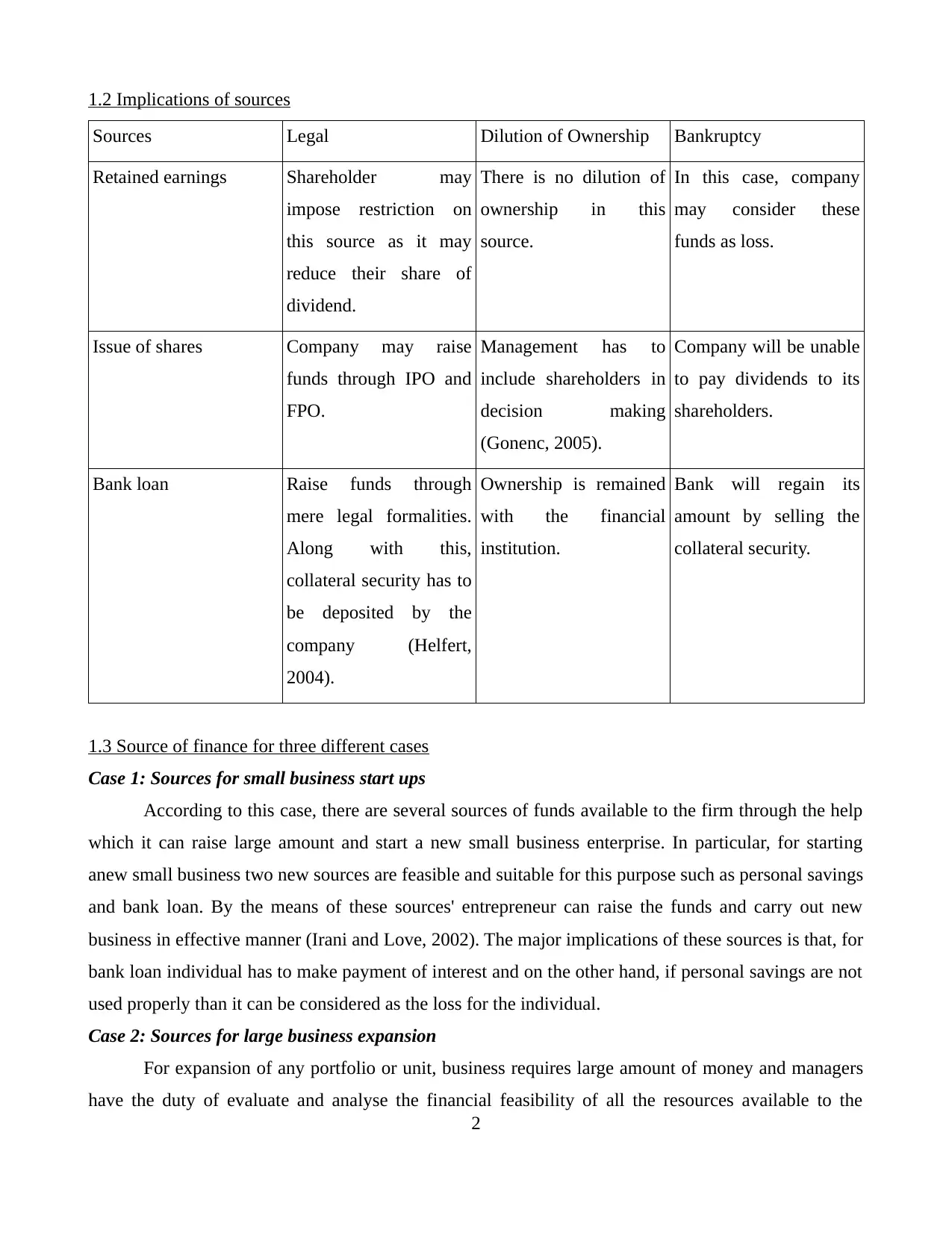
1.2 Implications of sources
Sources Legal Dilution of Ownership Bankruptcy
Retained earnings Shareholder may
impose restriction on
this source as it may
reduce their share of
dividend.
There is no dilution of
ownership in this
source.
In this case, company
may consider these
funds as loss.
Issue of shares Company may raise
funds through IPO and
FPO.
Management has to
include shareholders in
decision making
(Gonenc, 2005).
Company will be unable
to pay dividends to its
shareholders.
Bank loan Raise funds through
mere legal formalities.
Along with this,
collateral security has to
be deposited by the
company (Helfert,
2004).
Ownership is remained
with the financial
institution.
Bank will regain its
amount by selling the
collateral security.
1.3 Source of finance for three different cases
Case 1: Sources for small business start ups
According to this case, there are several sources of funds available to the firm through the help
which it can raise large amount and start a new small business enterprise. In particular, for starting
anew small business two new sources are feasible and suitable for this purpose such as personal savings
and bank loan. By the means of these sources' entrepreneur can raise the funds and carry out new
business in effective manner (Irani and Love, 2002). The major implications of these sources is that, for
bank loan individual has to make payment of interest and on the other hand, if personal savings are not
used properly than it can be considered as the loss for the individual.
Case 2: Sources for large business expansion
For expansion of any portfolio or unit, business requires large amount of money and managers
have the duty of evaluate and analyse the financial feasibility of all the resources available to the
2
Sources Legal Dilution of Ownership Bankruptcy
Retained earnings Shareholder may
impose restriction on
this source as it may
reduce their share of
dividend.
There is no dilution of
ownership in this
source.
In this case, company
may consider these
funds as loss.
Issue of shares Company may raise
funds through IPO and
FPO.
Management has to
include shareholders in
decision making
(Gonenc, 2005).
Company will be unable
to pay dividends to its
shareholders.
Bank loan Raise funds through
mere legal formalities.
Along with this,
collateral security has to
be deposited by the
company (Helfert,
2004).
Ownership is remained
with the financial
institution.
Bank will regain its
amount by selling the
collateral security.
1.3 Source of finance for three different cases
Case 1: Sources for small business start ups
According to this case, there are several sources of funds available to the firm through the help
which it can raise large amount and start a new small business enterprise. In particular, for starting
anew small business two new sources are feasible and suitable for this purpose such as personal savings
and bank loan. By the means of these sources' entrepreneur can raise the funds and carry out new
business in effective manner (Irani and Love, 2002). The major implications of these sources is that, for
bank loan individual has to make payment of interest and on the other hand, if personal savings are not
used properly than it can be considered as the loss for the individual.
Case 2: Sources for large business expansion
For expansion of any portfolio or unit, business requires large amount of money and managers
have the duty of evaluate and analyse the financial feasibility of all the resources available to the
2
Paraphrase This Document
Need a fresh take? Get an instant paraphrase of this document with our AI Paraphraser
company. In this context, large corporation is recommended to use issue of share for raising the funds
as it is the most feasible method for generating money for a large business enterprise. The main benefit
of this source is that, company is liable to pay principle amount to its shareholders. But in return of
invested amount, company has to pay dividends to its shareholders so that they can continue with the
business in the future. Along with this, retained earnings can be used because they are kept reserved for
expansion and other related purpose only as well as retained earnings will not raise liability of business.
Case 3: Sources for small group of people for buying up existing venture
According to this case, small group of people in order to enhance their existing business
operations are planning to buy existing venture thus requires large amount of money. Therefore, it has
been recommended to these people is that they should use government grants and venture capitalist as
the major source of finance (Leung, 2011). However, the rationale behind government grants is that
they are easy to acquire and government of UK promotes such investment so that small business can
grow effectively. On the other hand, venture capitalists are the investors who can invest in the potential
proposal of business and carry out the operations effectively.
TASK 2
2.1 Costs associated with different sources
In order to raise funds there are several costs that company has to incur. However, each source
has its own cost associated that manager has to evaluate and avoid the risks and uncertainties associated
with it. Retained earnings: These are the funds that are kept reserved after paying all the interest,
dividends, and share of profits to the different stakeholders (Pavlatos and Paggios, 2009).
Retained earnings consist of opportunity costs that company have in investing for future
potential business. Issue of shares: In this source, company is going to bear the costs of dividend as well as the cost
of issuing the shares within the market. It is important for the firm to pay dividends to its
shareholders so that their needs and wants can be satisfied in effective and efficient manner.
Bank loan: This source consists of interest cost and it is essential for the management of
business enterprise to pay interest instalment every month despite having adverse financial
position (Lewellen, 2004).
These are some of the costs associated with different sources of finance available to the business
enterprise.
3
as it is the most feasible method for generating money for a large business enterprise. The main benefit
of this source is that, company is liable to pay principle amount to its shareholders. But in return of
invested amount, company has to pay dividends to its shareholders so that they can continue with the
business in the future. Along with this, retained earnings can be used because they are kept reserved for
expansion and other related purpose only as well as retained earnings will not raise liability of business.
Case 3: Sources for small group of people for buying up existing venture
According to this case, small group of people in order to enhance their existing business
operations are planning to buy existing venture thus requires large amount of money. Therefore, it has
been recommended to these people is that they should use government grants and venture capitalist as
the major source of finance (Leung, 2011). However, the rationale behind government grants is that
they are easy to acquire and government of UK promotes such investment so that small business can
grow effectively. On the other hand, venture capitalists are the investors who can invest in the potential
proposal of business and carry out the operations effectively.
TASK 2
2.1 Costs associated with different sources
In order to raise funds there are several costs that company has to incur. However, each source
has its own cost associated that manager has to evaluate and avoid the risks and uncertainties associated
with it. Retained earnings: These are the funds that are kept reserved after paying all the interest,
dividends, and share of profits to the different stakeholders (Pavlatos and Paggios, 2009).
Retained earnings consist of opportunity costs that company have in investing for future
potential business. Issue of shares: In this source, company is going to bear the costs of dividend as well as the cost
of issuing the shares within the market. It is important for the firm to pay dividends to its
shareholders so that their needs and wants can be satisfied in effective and efficient manner.
Bank loan: This source consists of interest cost and it is essential for the management of
business enterprise to pay interest instalment every month despite having adverse financial
position (Lewellen, 2004).
These are some of the costs associated with different sources of finance available to the business
enterprise.
3
2.2 Importance of financial planning
Financial planning or forecasting can be defined as the process of managing and making
optimum utilisation of available resources. However, the main purpose behind having financial
planning is that it assists in avoiding risks and uncertainties associated with the financial position of
business enterprise. Further, it also plays important role in the success of business enterprise. By the
means of proper financial forecasting, manager can easily identify future income and expenditure that
company's functioning may possess during the course of accounting period (Prorokowski, 2011). In
addition to this, through the help economic management senior authority can make effective and
profitable investment decisions. Lastly, it helps in maintaining balance between company's cash
outflow and inflow.
AC 2.3 Financial information requirement for decision making purposes
There are several stakeholders associated with the firm which requires wide range of information
so that they can make smart and effective decisions regarding future contingency. However, these users
gather information from varied sources such as budgets, financial statements, and annual report of the
desired company. Further, budgets help internal stakeholders such as managers, management and other
crucial managerial people in identifying and understanding variance by comparing the actual outcome
and budgeted value (Lapsley, Miller and Panozzo, 2010). By the means of this, managers can make
suitable and reliable strategies and tactics so that negative variances can be converted into fruitful
results for the company. Along with this, suppliers uses the financial statements to evaluate the
capability of firm in paying the debt amount so that they can make decisions regarding future supply of
goods and services as well as determine the credit period given to the corporation. In case of
employees, they are the stakeholders who are interested in evaluating the actual financial position of
the business so that they can analyse their future within the company and other benefits such as bonus,
incentives etc. Lastly, shareholders investigate the net profit of the company in order to make decision
related to their dividend as well as the policy framed by the company regarding dividends. By the
means of this they can easily make decision on future investments.
4
Financial planning or forecasting can be defined as the process of managing and making
optimum utilisation of available resources. However, the main purpose behind having financial
planning is that it assists in avoiding risks and uncertainties associated with the financial position of
business enterprise. Further, it also plays important role in the success of business enterprise. By the
means of proper financial forecasting, manager can easily identify future income and expenditure that
company's functioning may possess during the course of accounting period (Prorokowski, 2011). In
addition to this, through the help economic management senior authority can make effective and
profitable investment decisions. Lastly, it helps in maintaining balance between company's cash
outflow and inflow.
AC 2.3 Financial information requirement for decision making purposes
There are several stakeholders associated with the firm which requires wide range of information
so that they can make smart and effective decisions regarding future contingency. However, these users
gather information from varied sources such as budgets, financial statements, and annual report of the
desired company. Further, budgets help internal stakeholders such as managers, management and other
crucial managerial people in identifying and understanding variance by comparing the actual outcome
and budgeted value (Lapsley, Miller and Panozzo, 2010). By the means of this, managers can make
suitable and reliable strategies and tactics so that negative variances can be converted into fruitful
results for the company. Along with this, suppliers uses the financial statements to evaluate the
capability of firm in paying the debt amount so that they can make decisions regarding future supply of
goods and services as well as determine the credit period given to the corporation. In case of
employees, they are the stakeholders who are interested in evaluating the actual financial position of
the business so that they can analyse their future within the company and other benefits such as bonus,
incentives etc. Lastly, shareholders investigate the net profit of the company in order to make decision
related to their dividend as well as the policy framed by the company regarding dividends. By the
means of this they can easily make decision on future investments.
4
⊘ This is a preview!⊘
Do you want full access?
Subscribe today to unlock all pages.
Trusted by 1+ million students worldwide
AC 2.4 Cost of financial statements showing in financial statements
Every organisation operating in the corporate market has to prepare different types of statements so
that they can record their transaction taken place during the course of accounting period. There are
three major financial statements of the company that are: income statement, cash flow statement and
balance sheet. Following are the effects of selected sources on the financial statements:
Issue of shares: Under this source cost of dividend is shown under the debit side of the profit and
loss account (Income statement). While on the other hand, the amount raised through issuing
shares is headed under the liability side of share capital in the balance sheet (Dayananda, 2002).
Bank loan: The amount generated through loan will be considered as the long term liability of the
company. Thus, it is headed to the liability side of balance sheet. As well as the amount changed
by financial institution on monthly basis in terms of interest will be shown in debit side of profit
and loss account.
Retained earnings: These are the funds that are kept reserved by the management for the future
contingency. Thus, the amount raised through this source will reduce the retained profit in the
income statement of the company (Neale and McElroy, 2004).
TASK 3
AC 3.1 Evaluation of sales budget and cash flow statement
According to the present given case there are two statements of the company that has been
analysed to evaluate the variances and loopholes within the financial position of the firm.
Sales budget: In the given sales budget it has been evaluated that, negative variance within the
sales performance of the company is constantly increasing from month of July to December. However,
it clearly states that actual sales of company are less than the anticipated sales value. In addition to this,
this can be due to the reason of lower quality of product leads to lower demand of the products (Shim,
Siegel and Shim, 2011). Thus, it is important for the management to focus on maintaining the quality
aspect at each level so that products reliability and suitability can be increased as per the expectations
of the customers and hence, leads to higher demand in the market.
Cash flow statement: The total cash is showing fluctuating results and it because of the sales
volatile during the months of July to December. Further, expenditure like wages, rent and rates,
insurance and directors salaries are volatile in nature. In addition to it, the available balance of cash has
shown decreasing figures till the month of April. While better sales strategy helps in generating higher
cash balance in the next month of 43000 but again due to lack of management showed decreasing
5
Every organisation operating in the corporate market has to prepare different types of statements so
that they can record their transaction taken place during the course of accounting period. There are
three major financial statements of the company that are: income statement, cash flow statement and
balance sheet. Following are the effects of selected sources on the financial statements:
Issue of shares: Under this source cost of dividend is shown under the debit side of the profit and
loss account (Income statement). While on the other hand, the amount raised through issuing
shares is headed under the liability side of share capital in the balance sheet (Dayananda, 2002).
Bank loan: The amount generated through loan will be considered as the long term liability of the
company. Thus, it is headed to the liability side of balance sheet. As well as the amount changed
by financial institution on monthly basis in terms of interest will be shown in debit side of profit
and loss account.
Retained earnings: These are the funds that are kept reserved by the management for the future
contingency. Thus, the amount raised through this source will reduce the retained profit in the
income statement of the company (Neale and McElroy, 2004).
TASK 3
AC 3.1 Evaluation of sales budget and cash flow statement
According to the present given case there are two statements of the company that has been
analysed to evaluate the variances and loopholes within the financial position of the firm.
Sales budget: In the given sales budget it has been evaluated that, negative variance within the
sales performance of the company is constantly increasing from month of July to December. However,
it clearly states that actual sales of company are less than the anticipated sales value. In addition to this,
this can be due to the reason of lower quality of product leads to lower demand of the products (Shim,
Siegel and Shim, 2011). Thus, it is important for the management to focus on maintaining the quality
aspect at each level so that products reliability and suitability can be increased as per the expectations
of the customers and hence, leads to higher demand in the market.
Cash flow statement: The total cash is showing fluctuating results and it because of the sales
volatile during the months of July to December. Further, expenditure like wages, rent and rates,
insurance and directors salaries are volatile in nature. In addition to it, the available balance of cash has
shown decreasing figures till the month of April. While better sales strategy helps in generating higher
cash balance in the next month of 43000 but again due to lack of management showed decreasing
5
Paraphrase This Document
Need a fresh take? Get an instant paraphrase of this document with our AI Paraphraser
results in the month of November. Thus, it can be recommended that, senior authority should focus on
increasing company’s sales so that it can generate higher profitability.
To,
The Director of ABC Ltd
Date _____
Subject: Current financial position of the business enterprise
Looking at the present condition of firm’s expenditure and revenues it has been evaluated
that; management should indulge better and effective strategies so that desired results can be
obtained. Along with this, negative sales volume affecting the cash balance and less
profitability. Henceforth, it is recommended to top level management that they should
undertake new strategies so that sales of the offerings can be increased as well as manager
should use effective marketing planning to market and promote the products so that desired
audience can be reached in the best possible manner.
AC 3.3 Application of investment appraisal methods
In general investment appraisal techniques can be defined as the methods or approaches through
the help of which managers can easily evaluate the reliability and validity of investment proposals
(Dostov and Shust, 2014). In the present given scenario, ABC Engineering Ltd has two investment
proposals with the similar initial investment of 450000. However, project A is associated with Hi-Tech
Machinery and on the other hand, project B is linked within enhancing the marketing activities of the
company.
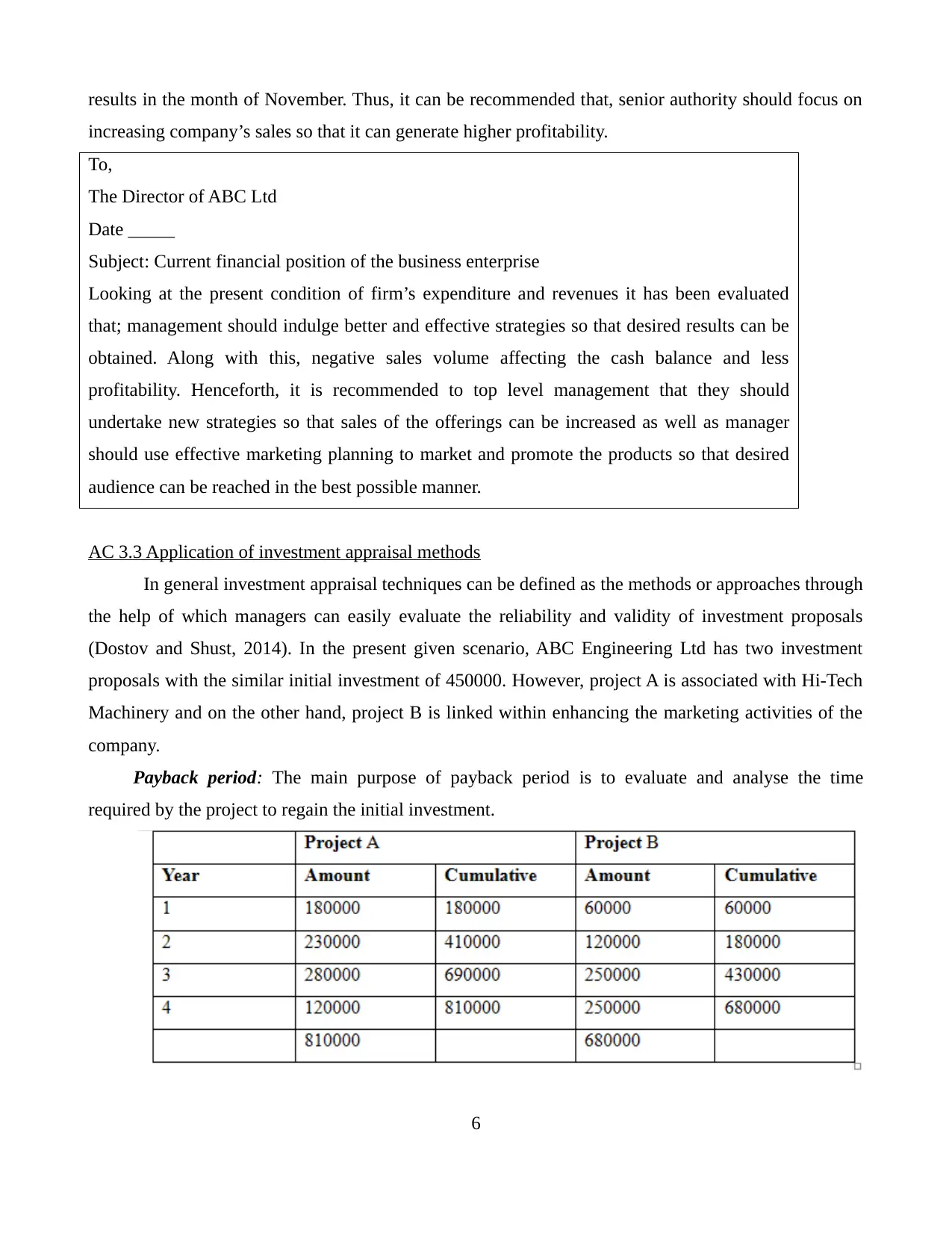
Payback period: The main purpose of payback period is to evaluate and analyse the time
required by the project to regain the initial investment.
6
increasing company’s sales so that it can generate higher profitability.
To,
The Director of ABC Ltd
Date _____
Subject: Current financial position of the business enterprise
Looking at the present condition of firm’s expenditure and revenues it has been evaluated
that; management should indulge better and effective strategies so that desired results can be
obtained. Along with this, negative sales volume affecting the cash balance and less
profitability. Henceforth, it is recommended to top level management that they should
undertake new strategies so that sales of the offerings can be increased as well as manager
should use effective marketing planning to market and promote the products so that desired
audience can be reached in the best possible manner.
AC 3.3 Application of investment appraisal methods
In general investment appraisal techniques can be defined as the methods or approaches through
the help of which managers can easily evaluate the reliability and validity of investment proposals
(Dostov and Shust, 2014). In the present given scenario, ABC Engineering Ltd has two investment
proposals with the similar initial investment of 450000. However, project A is associated with Hi-Tech
Machinery and on the other hand, project B is linked within enhancing the marketing activities of the
company.
Payback period: The main purpose of payback period is to evaluate and analyse the time
required by the project to regain the initial investment.
6
Payback period of project A = 2 year + £40000/£280000
= 2 year + 0.143 year
= 2.143 year
Payback period for project B = 3 year + £20000/£250000
= 3 year + 0.08 year
= 3.08 year
Accounting rate of return (ARR) = Average profit/Initial Investment*100
Project A Average Profit = Total Profit/number of year
= £810000/4
= £202500
ARR = £202500/£450000*100
= 45%
Project B Average Profit = 680000£/4
= £170000
ARR = £170000/£450000*100
= 37.78%
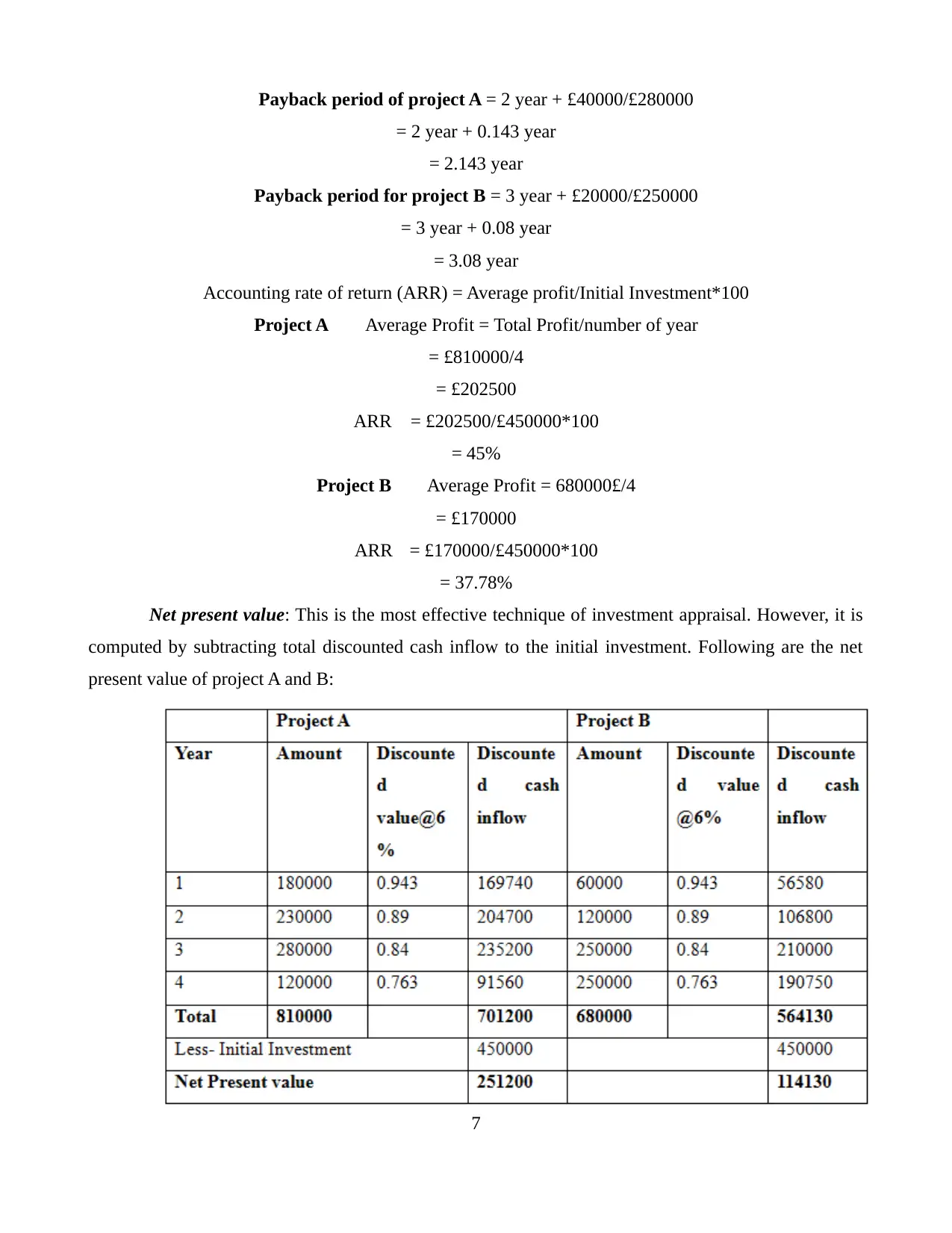
Net present value: This is the most effective technique of investment appraisal. However, it is
computed by subtracting total discounted cash inflow to the initial investment. Following are the net
present value of project A and B:
7
= 2 year + 0.143 year
= 2.143 year
Payback period for project B = 3 year + £20000/£250000
= 3 year + 0.08 year
= 3.08 year
Accounting rate of return (ARR) = Average profit/Initial Investment*100
Project A Average Profit = Total Profit/number of year
= £810000/4
= £202500
ARR = £202500/£450000*100
= 45%
Project B Average Profit = 680000£/4
= £170000
ARR = £170000/£450000*100
= 37.78%
Net present value: This is the most effective technique of investment appraisal. However, it is
computed by subtracting total discounted cash inflow to the initial investment. Following are the net
present value of project A and B:
7
⊘ This is a preview!⊘
Do you want full access?
Subscribe today to unlock all pages.
Trusted by 1+ million students worldwide
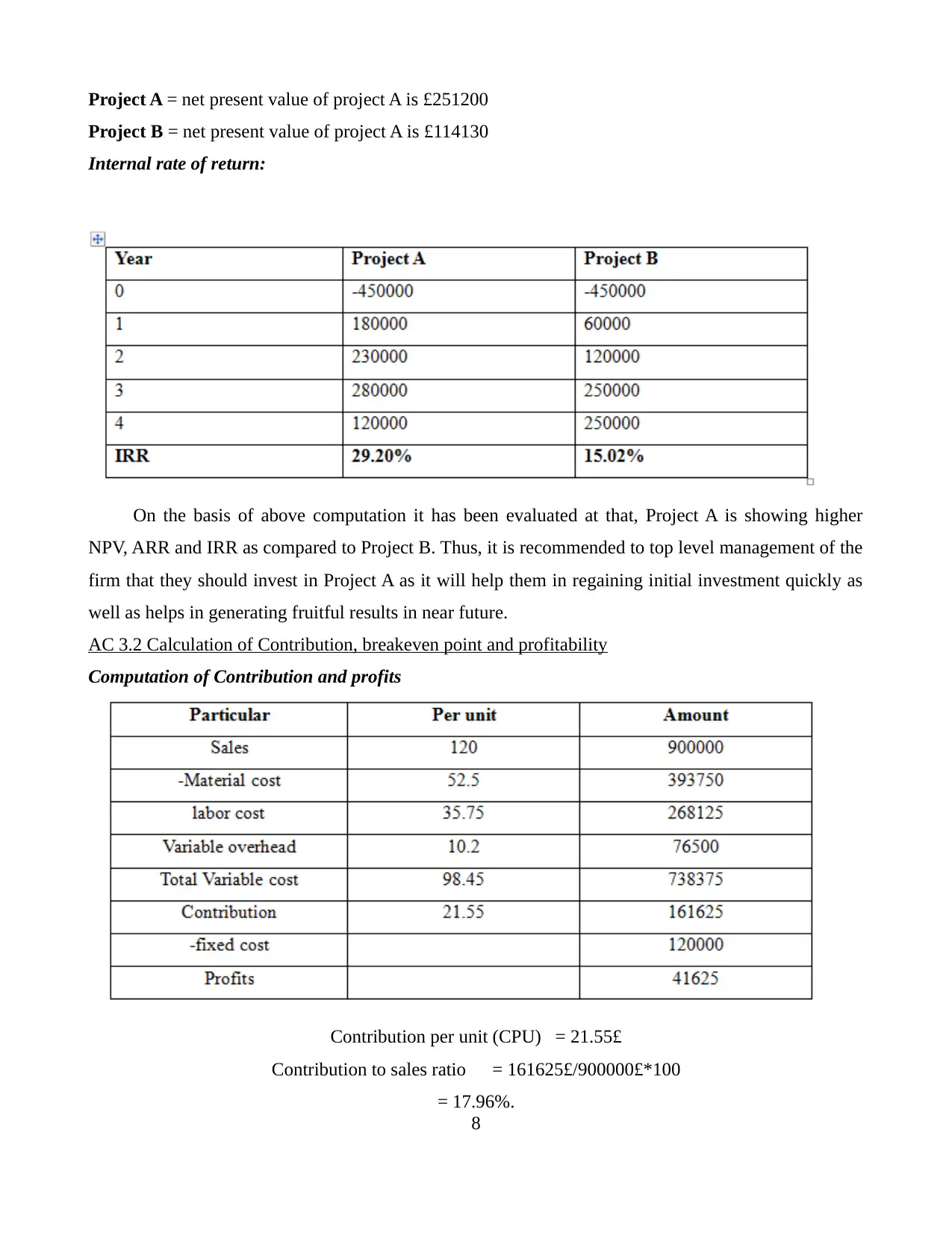
Project A = net present value of project A is £251200
Project B = net present value of project A is £114130
Internal rate of return:
On the basis of above computation it has been evaluated at that, Project A is showing higher
NPV, ARR and IRR as compared to Project B. Thus, it is recommended to top level management of the
firm that they should invest in Project A as it will help them in regaining initial investment quickly as
well as helps in generating fruitful results in near future.
AC 3.2 Calculation of Contribution, breakeven point and profitability
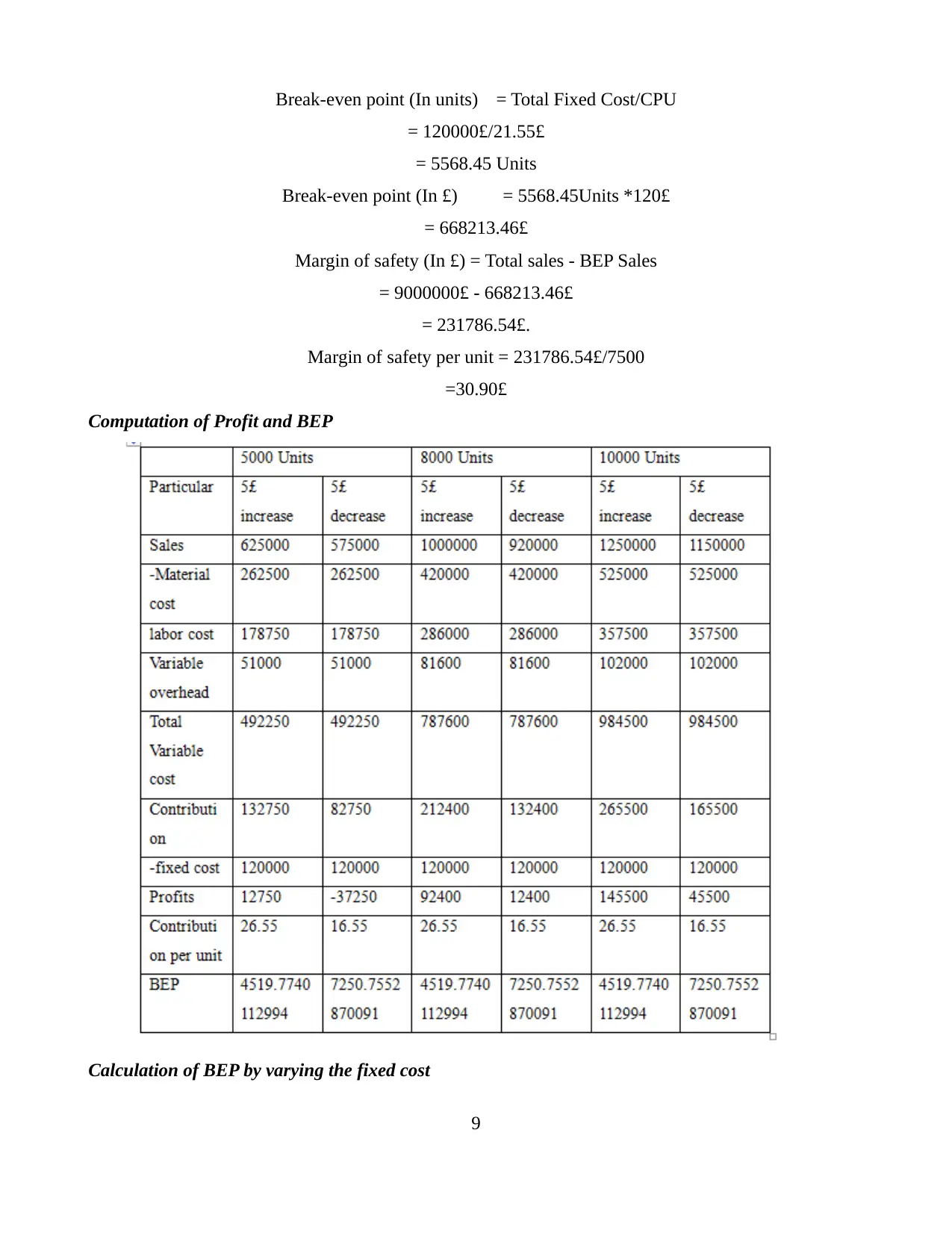
Computation of Contribution and profits
Contribution per unit (CPU) = 21.55£
Contribution to sales ratio = 161625£/900000£*100
= 17.96%.
8
Project B = net present value of project A is £114130
Internal rate of return:
On the basis of above computation it has been evaluated at that, Project A is showing higher
NPV, ARR and IRR as compared to Project B. Thus, it is recommended to top level management of the
firm that they should invest in Project A as it will help them in regaining initial investment quickly as
well as helps in generating fruitful results in near future.
AC 3.2 Calculation of Contribution, breakeven point and profitability
Computation of Contribution and profits
Contribution per unit (CPU) = 21.55£
Contribution to sales ratio = 161625£/900000£*100
= 17.96%.
8
Paraphrase This Document
Need a fresh take? Get an instant paraphrase of this document with our AI Paraphraser
Break-even point (In units) = Total Fixed Cost/CPU
= 120000£/21.55£
= 5568.45 Units
Break-even point (In £) = 5568.45Units *120£
= 668213.46£
Margin of safety (In £) = Total sales - BEP Sales
= 9000000£ - 668213.46£
= 231786.54£.
Margin of safety per unit = 231786.54£/7500
=30.90£
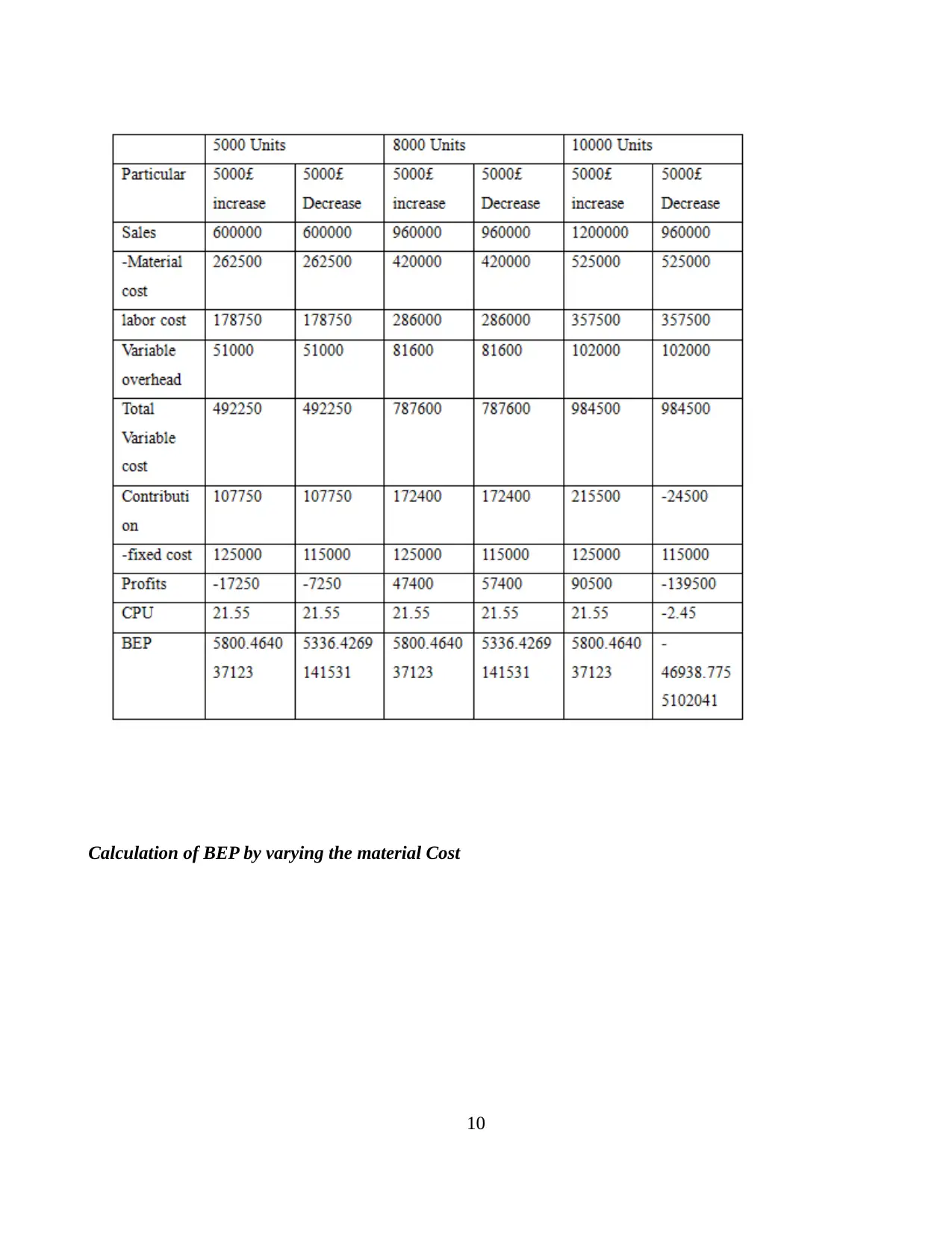
Computation of Profit and BEP
Calculation of BEP by varying the fixed cost
9
= 120000£/21.55£
= 5568.45 Units
Break-even point (In £) = 5568.45Units *120£
= 668213.46£
Margin of safety (In £) = Total sales - BEP Sales
= 9000000£ - 668213.46£
= 231786.54£.
Margin of safety per unit = 231786.54£/7500
=30.90£
Computation of Profit and BEP
Calculation of BEP by varying the fixed cost
9
Calculation of BEP by varying the material Cost
10
10
⊘ This is a preview!⊘
Do you want full access?
Subscribe today to unlock all pages.
Trusted by 1+ million students worldwide

1 out of 19


Related Documents


Your All-in-One AI-Powered Toolkit for Academic Success.
+13062052269
info@desklib.com
Available 24*7 on WhatsApp / Email
![[object Object]](/_next/static/media/star-bottom.7253800d.svg)
Unlock your academic potential
Copyright © 2020–2026 A2Z Services. All Rights Reserved. Developed and managed by ZUCOL.