RBP020L024S: Performance Measurement at Great Persons, Inc. Case Study
VerifiedAdded on 2023/01/19
|25
|5337
|49
Case Study
AI Summary
This case study analyzes the application of a balanced scorecard at Great Persons, Inc. (GPI), a non-profit organization. The study explores the challenges GPI faces in performance measurement, given its diverse range of services and operational structure. The case outlines the strategic management tools, including mission, vision, values, and competitive advantages. It then focuses on the balanced scorecard as a tool for implementing strategy, detailing its advantages, disadvantages, and the process of its implementation, including translating vision into strategic goals, communication, and transformation into plans. The assignment also proposes a balanced scorecard and a strategy map, integrating various perspectives like client/community, financial, internal process, and workforce. It highlights the importance of key performance indicators (KPIs) and strategic goals to ensure the effectiveness of GPI's operations and achieve its objectives within its budget of $19 million and 80 cost centers. The study concludes by emphasizing the balanced scorecard's role in linking operational and strategic objectives, enabling better assessment of organizational effectiveness.

1
Name:
Course
Professor’s name
University name
City, State
Date of submission
Name:
Course
Professor’s name
University name
City, State
Date of submission

Paraphrase This Document
Need a fresh take? Get an instant paraphrase of this document with our AI Paraphraser
2
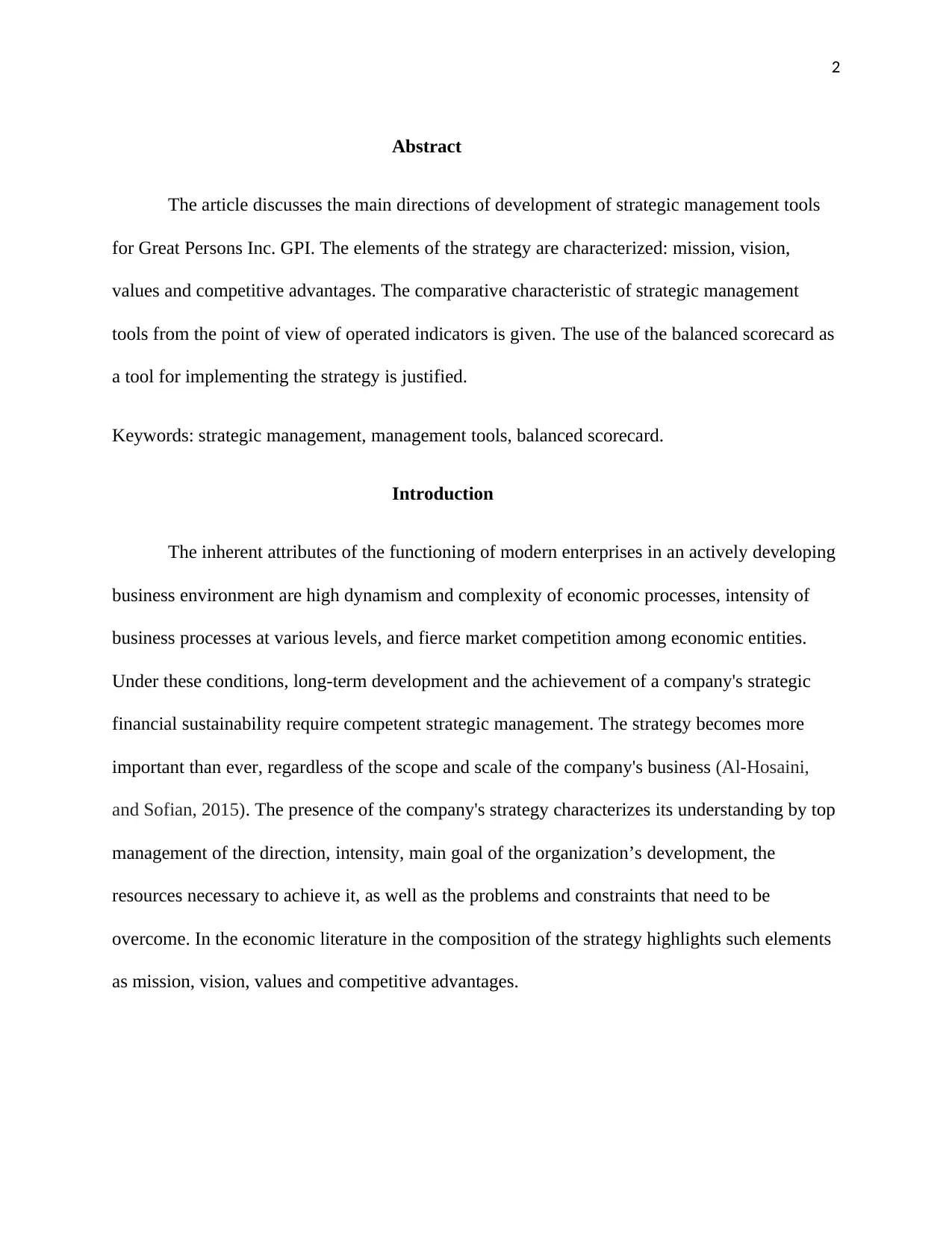
Abstract
The article discusses the main directions of development of strategic management tools
for Great Persons Inc. GPI. The elements of the strategy are characterized: mission, vision,
values and competitive advantages. The comparative characteristic of strategic management
tools from the point of view of operated indicators is given. The use of the balanced scorecard as
a tool for implementing the strategy is justified.
Keywords: strategic management, management tools, balanced scorecard.
Introduction
The inherent attributes of the functioning of modern enterprises in an actively developing
business environment are high dynamism and complexity of economic processes, intensity of
business processes at various levels, and fierce market competition among economic entities.
Under these conditions, long-term development and the achievement of a company's strategic
financial sustainability require competent strategic management. The strategy becomes more
important than ever, regardless of the scope and scale of the company's business (Al-Hosaini,
and Sofian, 2015). The presence of the company's strategy characterizes its understanding by top
management of the direction, intensity, main goal of the organization’s development, the
resources necessary to achieve it, as well as the problems and constraints that need to be
overcome. In the economic literature in the composition of the strategy highlights such elements
as mission, vision, values and competitive advantages.
Abstract
The article discusses the main directions of development of strategic management tools
for Great Persons Inc. GPI. The elements of the strategy are characterized: mission, vision,
values and competitive advantages. The comparative characteristic of strategic management
tools from the point of view of operated indicators is given. The use of the balanced scorecard as
a tool for implementing the strategy is justified.
Keywords: strategic management, management tools, balanced scorecard.
Introduction
The inherent attributes of the functioning of modern enterprises in an actively developing
business environment are high dynamism and complexity of economic processes, intensity of
business processes at various levels, and fierce market competition among economic entities.
Under these conditions, long-term development and the achievement of a company's strategic
financial sustainability require competent strategic management. The strategy becomes more
important than ever, regardless of the scope and scale of the company's business (Al-Hosaini,
and Sofian, 2015). The presence of the company's strategy characterizes its understanding by top
management of the direction, intensity, main goal of the organization’s development, the
resources necessary to achieve it, as well as the problems and constraints that need to be
overcome. In the economic literature in the composition of the strategy highlights such elements
as mission, vision, values and competitive advantages.
3
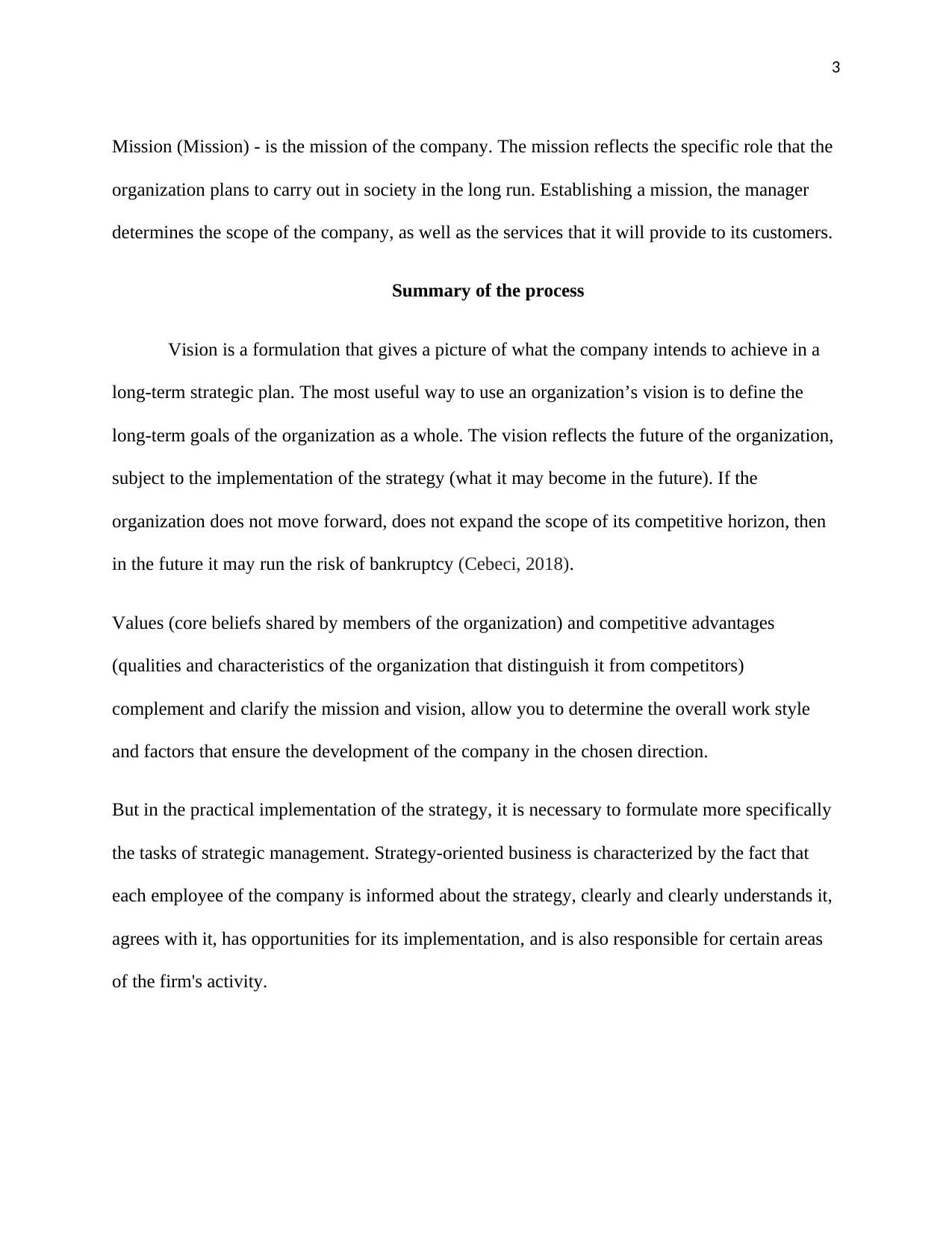
Mission (Mission) - is the mission of the company. The mission reflects the specific role that the
organization plans to carry out in society in the long run. Establishing a mission, the manager
determines the scope of the company, as well as the services that it will provide to its customers.
Summary of the process
Vision is a formulation that gives a picture of what the company intends to achieve in a
long-term strategic plan. The most useful way to use an organization’s vision is to define the
long-term goals of the organization as a whole. The vision reflects the future of the organization,
subject to the implementation of the strategy (what it may become in the future). If the
organization does not move forward, does not expand the scope of its competitive horizon, then
in the future it may run the risk of bankruptcy (Cebeci, 2018).
Values (core beliefs shared by members of the organization) and competitive advantages
(qualities and characteristics of the organization that distinguish it from competitors)
complement and clarify the mission and vision, allow you to determine the overall work style
and factors that ensure the development of the company in the chosen direction.
But in the practical implementation of the strategy, it is necessary to formulate more specifically
the tasks of strategic management. Strategy-oriented business is characterized by the fact that
each employee of the company is informed about the strategy, clearly and clearly understands it,
agrees with it, has opportunities for its implementation, and is also responsible for certain areas
of the firm's activity.
Mission (Mission) - is the mission of the company. The mission reflects the specific role that the
organization plans to carry out in society in the long run. Establishing a mission, the manager
determines the scope of the company, as well as the services that it will provide to its customers.
Summary of the process
Vision is a formulation that gives a picture of what the company intends to achieve in a
long-term strategic plan. The most useful way to use an organization’s vision is to define the
long-term goals of the organization as a whole. The vision reflects the future of the organization,
subject to the implementation of the strategy (what it may become in the future). If the
organization does not move forward, does not expand the scope of its competitive horizon, then
in the future it may run the risk of bankruptcy (Cebeci, 2018).
Values (core beliefs shared by members of the organization) and competitive advantages
(qualities and characteristics of the organization that distinguish it from competitors)
complement and clarify the mission and vision, allow you to determine the overall work style
and factors that ensure the development of the company in the chosen direction.
But in the practical implementation of the strategy, it is necessary to formulate more specifically
the tasks of strategic management. Strategy-oriented business is characterized by the fact that
each employee of the company is informed about the strategy, clearly and clearly understands it,
agrees with it, has opportunities for its implementation, and is also responsible for certain areas
of the firm's activity.
⊘ This is a preview!⊘
Do you want full access?
Subscribe today to unlock all pages.

Trusted by 1+ million students worldwide
4
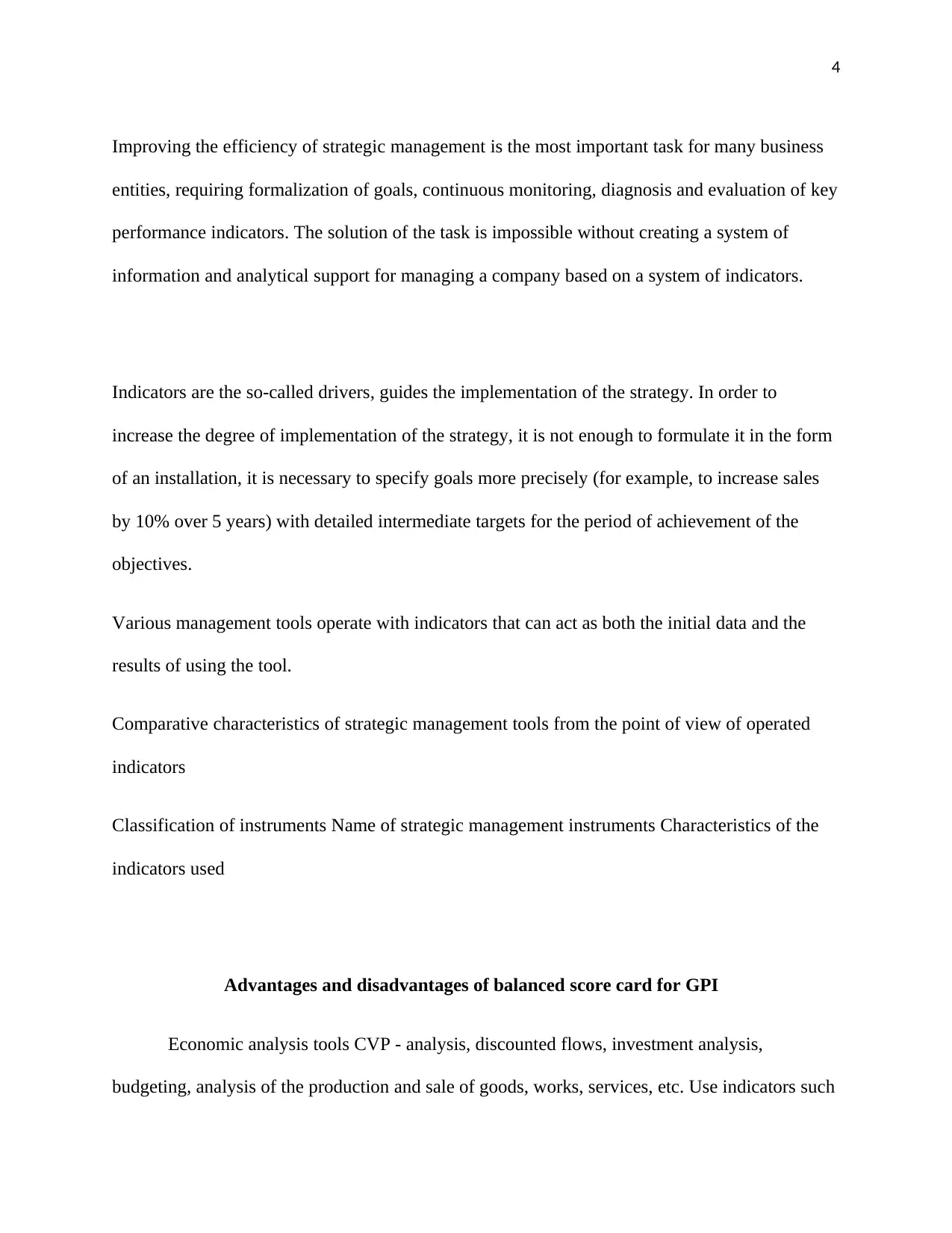
Improving the efficiency of strategic management is the most important task for many business
entities, requiring formalization of goals, continuous monitoring, diagnosis and evaluation of key
performance indicators. The solution of the task is impossible without creating a system of
information and analytical support for managing a company based on a system of indicators.
Indicators are the so-called drivers, guides the implementation of the strategy. In order to
increase the degree of implementation of the strategy, it is not enough to formulate it in the form
of an installation, it is necessary to specify goals more precisely (for example, to increase sales
by 10% over 5 years) with detailed intermediate targets for the period of achievement of the
objectives.
Various management tools operate with indicators that can act as both the initial data and the
results of using the tool.
Comparative characteristics of strategic management tools from the point of view of operated
indicators
Classification of instruments Name of strategic management instruments Characteristics of the
indicators used
Advantages and disadvantages of balanced score card for GPI
Economic analysis tools CVP - analysis, discounted flows, investment analysis,
budgeting, analysis of the production and sale of goods, works, services, etc. Use indicators such
Improving the efficiency of strategic management is the most important task for many business
entities, requiring formalization of goals, continuous monitoring, diagnosis and evaluation of key
performance indicators. The solution of the task is impossible without creating a system of
information and analytical support for managing a company based on a system of indicators.
Indicators are the so-called drivers, guides the implementation of the strategy. In order to
increase the degree of implementation of the strategy, it is not enough to formulate it in the form
of an installation, it is necessary to specify goals more precisely (for example, to increase sales
by 10% over 5 years) with detailed intermediate targets for the period of achievement of the
objectives.
Various management tools operate with indicators that can act as both the initial data and the
results of using the tool.
Comparative characteristics of strategic management tools from the point of view of operated
indicators
Classification of instruments Name of strategic management instruments Characteristics of the
indicators used
Advantages and disadvantages of balanced score card for GPI
Economic analysis tools CVP - analysis, discounted flows, investment analysis,
budgeting, analysis of the production and sale of goods, works, services, etc. Use indicators such
Paraphrase This Document
Need a fresh take? Get an instant paraphrase of this document with our AI Paraphraser
5
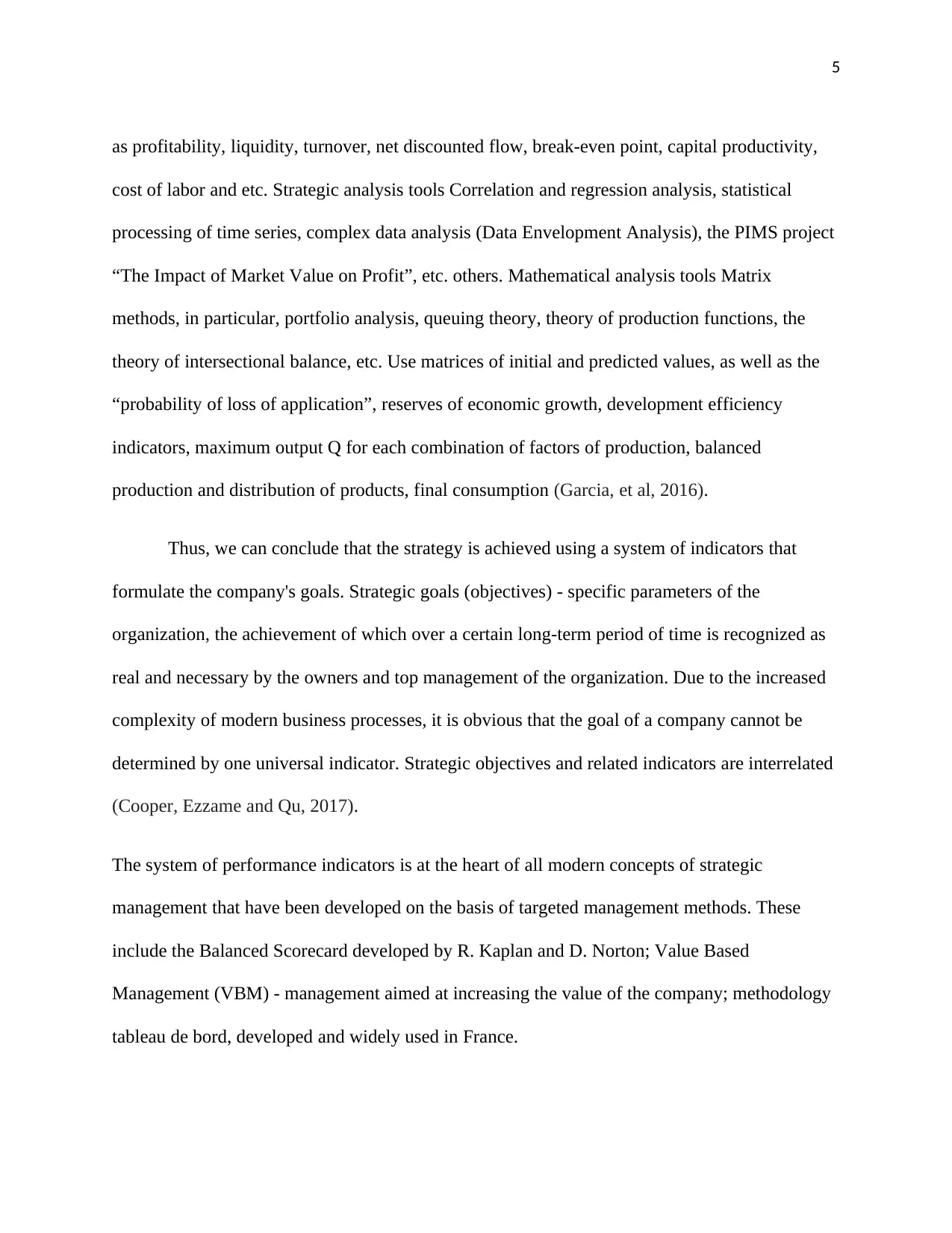
as profitability, liquidity, turnover, net discounted flow, break-even point, capital productivity,
cost of labor and etc. Strategic analysis tools Correlation and regression analysis, statistical
processing of time series, complex data analysis (Data Envelopment Analysis), the PIMS project
“The Impact of Market Value on Profit”, etc. others. Mathematical analysis tools Matrix
methods, in particular, portfolio analysis, queuing theory, theory of production functions, the
theory of intersectional balance, etc. Use matrices of initial and predicted values, as well as the
“probability of loss of application”, reserves of economic growth, development efficiency
indicators, maximum output Q for each combination of factors of production, balanced
production and distribution of products, final consumption (Garcia, et al, 2016).
Thus, we can conclude that the strategy is achieved using a system of indicators that
formulate the company's goals. Strategic goals (objectives) - specific parameters of the
organization, the achievement of which over a certain long-term period of time is recognized as
real and necessary by the owners and top management of the organization. Due to the increased
complexity of modern business processes, it is obvious that the goal of a company cannot be
determined by one universal indicator. Strategic objectives and related indicators are interrelated
(Cooper, Ezzame and Qu, 2017).
The system of performance indicators is at the heart of all modern concepts of strategic
management that have been developed on the basis of targeted management methods. These
include the Balanced Scorecard developed by R. Kaplan and D. Norton; Value Based
Management (VBM) - management aimed at increasing the value of the company; methodology
tableau de bord, developed and widely used in France.
as profitability, liquidity, turnover, net discounted flow, break-even point, capital productivity,
cost of labor and etc. Strategic analysis tools Correlation and regression analysis, statistical
processing of time series, complex data analysis (Data Envelopment Analysis), the PIMS project
“The Impact of Market Value on Profit”, etc. others. Mathematical analysis tools Matrix
methods, in particular, portfolio analysis, queuing theory, theory of production functions, the
theory of intersectional balance, etc. Use matrices of initial and predicted values, as well as the
“probability of loss of application”, reserves of economic growth, development efficiency
indicators, maximum output Q for each combination of factors of production, balanced
production and distribution of products, final consumption (Garcia, et al, 2016).
Thus, we can conclude that the strategy is achieved using a system of indicators that
formulate the company's goals. Strategic goals (objectives) - specific parameters of the
organization, the achievement of which over a certain long-term period of time is recognized as
real and necessary by the owners and top management of the organization. Due to the increased
complexity of modern business processes, it is obvious that the goal of a company cannot be
determined by one universal indicator. Strategic objectives and related indicators are interrelated
(Cooper, Ezzame and Qu, 2017).
The system of performance indicators is at the heart of all modern concepts of strategic
management that have been developed on the basis of targeted management methods. These
include the Balanced Scorecard developed by R. Kaplan and D. Norton; Value Based
Management (VBM) - management aimed at increasing the value of the company; methodology
tableau de bord, developed and widely used in France.
6
In the past few years, a balanced scorecard has become very popular in enterprises in various
business areas (mainly abroad). According to a survey of two hundred successful companies in
more than 20 countries around the world, conducted in 2001 by the British company Business
Intelligence, 57% of surveyed firms use a balanced scorecard (Balanced Scorecard) to manage.
And according to the company Balanced Scorecard Collaborative (founded by D. Norton and R.
Kaplan), at the end of 2002, more than half of the firms in the list of the five hundred largest
firms in the world, which is compiled by the reputable magazine Fortune (Falle, Rauter, Engert,
and Baumgartner, 2016).
The balanced scorecard is a technology of integrated enterprise management, which allows not
only to assess the effectiveness of the organization, but also, according to the author, is one of
the main tools of strategic management. The balanced scorecard helps clarify strategic goals and
defines critical parameters for their achievement.
The process of introducing a balanced scorecard includes the following stages
- Balanced scorecard as a strategic management system
1. Translating the vision of a strategy into a balanced set of strategic goals for an organization —
it is designed to help management formulate a strategy and clarify the strategic goals of an
organization with the identification of critical factors affecting strategic goals.
In the past few years, a balanced scorecard has become very popular in enterprises in various
business areas (mainly abroad). According to a survey of two hundred successful companies in
more than 20 countries around the world, conducted in 2001 by the British company Business
Intelligence, 57% of surveyed firms use a balanced scorecard (Balanced Scorecard) to manage.
And according to the company Balanced Scorecard Collaborative (founded by D. Norton and R.
Kaplan), at the end of 2002, more than half of the firms in the list of the five hundred largest
firms in the world, which is compiled by the reputable magazine Fortune (Falle, Rauter, Engert,
and Baumgartner, 2016).
The balanced scorecard is a technology of integrated enterprise management, which allows not
only to assess the effectiveness of the organization, but also, according to the author, is one of
the main tools of strategic management. The balanced scorecard helps clarify strategic goals and
defines critical parameters for their achievement.
The process of introducing a balanced scorecard includes the following stages
- Balanced scorecard as a strategic management system
1. Translating the vision of a strategy into a balanced set of strategic goals for an organization —
it is designed to help management formulate a strategy and clarify the strategic goals of an
organization with the identification of critical factors affecting strategic goals.
⊘ This is a preview!⊘
Do you want full access?
Subscribe today to unlock all pages.
Trusted by 1+ million students worldwide
7
2. Communication and the further establishment of conformity between strategic goals and
indicators of their achievement (specification of the strategy). Building a strategic map.
3. Transformation of strategy into plans - involves the development of strategic measures, the
preparation of business plans. At this stage, with the help of a balanced scorecard, organizational
resources are allocated, with a focus on the strategy developed.
4. Strategic learning and adaptation.
The concept of a balanced scorecard offers a form of presentation of the strategy, which
increases the likelihood of achieving the desired strategic goals.
When developing a balanced scorecard, the strategy covers the following areas (prospects):
- finance (financial position and financial performance);
- clients (company image from the point of view of its clients);
2. Communication and the further establishment of conformity between strategic goals and
indicators of their achievement (specification of the strategy). Building a strategic map.
3. Transformation of strategy into plans - involves the development of strategic measures, the
preparation of business plans. At this stage, with the help of a balanced scorecard, organizational
resources are allocated, with a focus on the strategy developed.
4. Strategic learning and adaptation.
The concept of a balanced scorecard offers a form of presentation of the strategy, which
increases the likelihood of achieving the desired strategic goals.
When developing a balanced scorecard, the strategy covers the following areas (prospects):
- finance (financial position and financial performance);
- clients (company image from the point of view of its clients);
Paraphrase This Document
Need a fresh take? Get an instant paraphrase of this document with our AI Paraphraser
8
- internal business processes (key processes that largely determine the effectiveness of the
company);
- training and growth (the most important elements of culture, technology and skills of the
enterprise staff).
Each direction is formalized in the form of strategic maps (strategy map), containing information
about the objectives, indicators, targets and how to achieve them. The term "Strategic Map"
Kaplan and Norton proposed to call the causal relationships between the individual elements of
the organization's strategy. Causal chains graphically reflect the logic of the strategy - how the
implementation of one strategic goal will contribute to the achievement of other strategic goals in
a balanced system of goals. The translation of the strategy into the language of logical
regularities reflected in the strategic map allows each business unit and the employee of the
organization to get a clear explanation of the essence of the strategy and the tasks for its
implementation. Thus, the construction of strategic maps makes the strategy More
understandable and “transparent” for employees of the enterprise (Gibbons, and Kaplan, 2015).
In addition to the undoubted advantages, a balanced scorecard has several disadvantages:
- MTP can be built only after all employees have adopted and understood the strategy;
- internal business processes (key processes that largely determine the effectiveness of the
company);
- training and growth (the most important elements of culture, technology and skills of the
enterprise staff).
Each direction is formalized in the form of strategic maps (strategy map), containing information
about the objectives, indicators, targets and how to achieve them. The term "Strategic Map"
Kaplan and Norton proposed to call the causal relationships between the individual elements of
the organization's strategy. Causal chains graphically reflect the logic of the strategy - how the
implementation of one strategic goal will contribute to the achievement of other strategic goals in
a balanced system of goals. The translation of the strategy into the language of logical
regularities reflected in the strategic map allows each business unit and the employee of the
organization to get a clear explanation of the essence of the strategy and the tasks for its
implementation. Thus, the construction of strategic maps makes the strategy More
understandable and “transparent” for employees of the enterprise (Gibbons, and Kaplan, 2015).
In addition to the undoubted advantages, a balanced scorecard has several disadvantages:
- MTP can be built only after all employees have adopted and understood the strategy;
9
- there is no responsibility for the overall result;
- more focused on the management of assets and resources, rather than on their financing;
- there is practically no final reference point in it, i.e. baseline for which
measures the success of the implementation of the strategy and the efficiency of the company.
More optimistic about the results of the introduction of a balanced scorecard look at the creators
of this system - Kaplan and Norton. The main objectives of the balanced scorecard (BSC) Robert
Kaplan and David Norton see the creation of an organization focused on the implementation of
the strategy:
Can't find what you need? Try our literature selection service.
- translation strategy into action. MTP allows you to quickly translate the strategy to the level of
specific activities, which allows you to maximize the focus of action on the achievement of the
strategy;
- there is no responsibility for the overall result;
- more focused on the management of assets and resources, rather than on their financing;
- there is practically no final reference point in it, i.e. baseline for which
measures the success of the implementation of the strategy and the efficiency of the company.
More optimistic about the results of the introduction of a balanced scorecard look at the creators
of this system - Kaplan and Norton. The main objectives of the balanced scorecard (BSC) Robert
Kaplan and David Norton see the creation of an organization focused on the implementation of
the strategy:
Can't find what you need? Try our literature selection service.
- translation strategy into action. MTP allows you to quickly translate the strategy to the level of
specific activities, which allows you to maximize the focus of action on the achievement of the
strategy;
⊘ This is a preview!⊘
Do you want full access?
Subscribe today to unlock all pages.
Trusted by 1+ million students worldwide
10
- connection of the organization with the strategy. BSC allows to achieve a synergy effect
through directing the efforts of all departments of the company to achieve a strategy;
- implementation of the strategy by all employees. The system of indicators allows you to direct
the efforts of all employees to the implementation of the strategy with the help of a
communication system, motivation;
- strategic management in real time. MTP allows you to link the budget and strategy, with the
help of information and analytical systems to constantly manage the process, to conduct strategic
training;
- mobilization. MTP creates motives for the effective work of all employees, which is supported
by senior management through the creation of a strategic management system and direct
leadership.
Thus, the introduction of a balanced scorecard in enterprises allows us to link operational
objectives with strategic ones. Information obtained in the framework of a balanced scorecard (in
particular, the values of individual indicators) can be reflected in the internal reporting of the
- connection of the organization with the strategy. BSC allows to achieve a synergy effect
through directing the efforts of all departments of the company to achieve a strategy;
- implementation of the strategy by all employees. The system of indicators allows you to direct
the efforts of all employees to the implementation of the strategy with the help of a
communication system, motivation;
- strategic management in real time. MTP allows you to link the budget and strategy, with the
help of information and analytical systems to constantly manage the process, to conduct strategic
training;
- mobilization. MTP creates motives for the effective work of all employees, which is supported
by senior management through the creation of a strategic management system and direct
leadership.
Thus, the introduction of a balanced scorecard in enterprises allows us to link operational
objectives with strategic ones. Information obtained in the framework of a balanced scorecard (in
particular, the values of individual indicators) can be reflected in the internal reporting of the
Paraphrase This Document
Need a fresh take? Get an instant paraphrase of this document with our AI Paraphraser
11
enterprise, thanks to which the effectiveness of organizations can be assessed more objectively
(Hahn, and Figge, 2018).
In the article, the basic directions of development of the toolkit of strategic management are
considered. Strategy elements are characterized by: mission, vision, values and competitive
advantages. Signal indicators from a given one of the following indicators: The program of the
balanced scorecard as a tool of peace of mind strategy proved.
Currently, the management is the most widely known balanced scorecard - Balanced Scorecard
(BSC). (A similar system of Key Performance Indicators - Key Performance Indicator (KPI) is
also common, the MSP is even referred to as particular cases of KPI.
However, the practical implementation of SSP, according to different sources , does not provide
the expected increase in the efficiency of the enterprise. And many are looking for the
shortcomings of a balanced scorecard, the elimination of which should give an increase in its
efficiency, create its various modifications Hakkak, and Ghodsi, 2015). Is it a drawback?
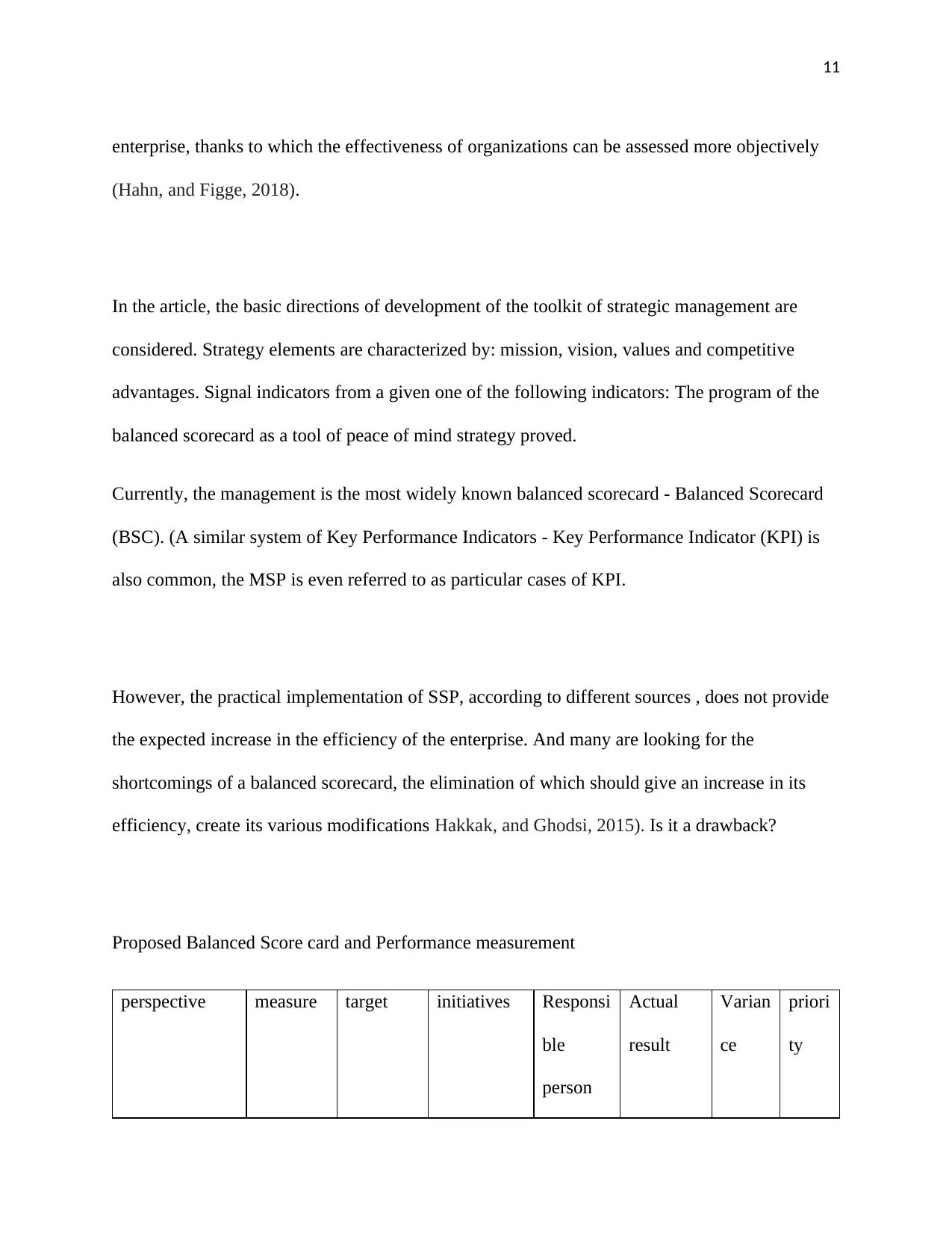
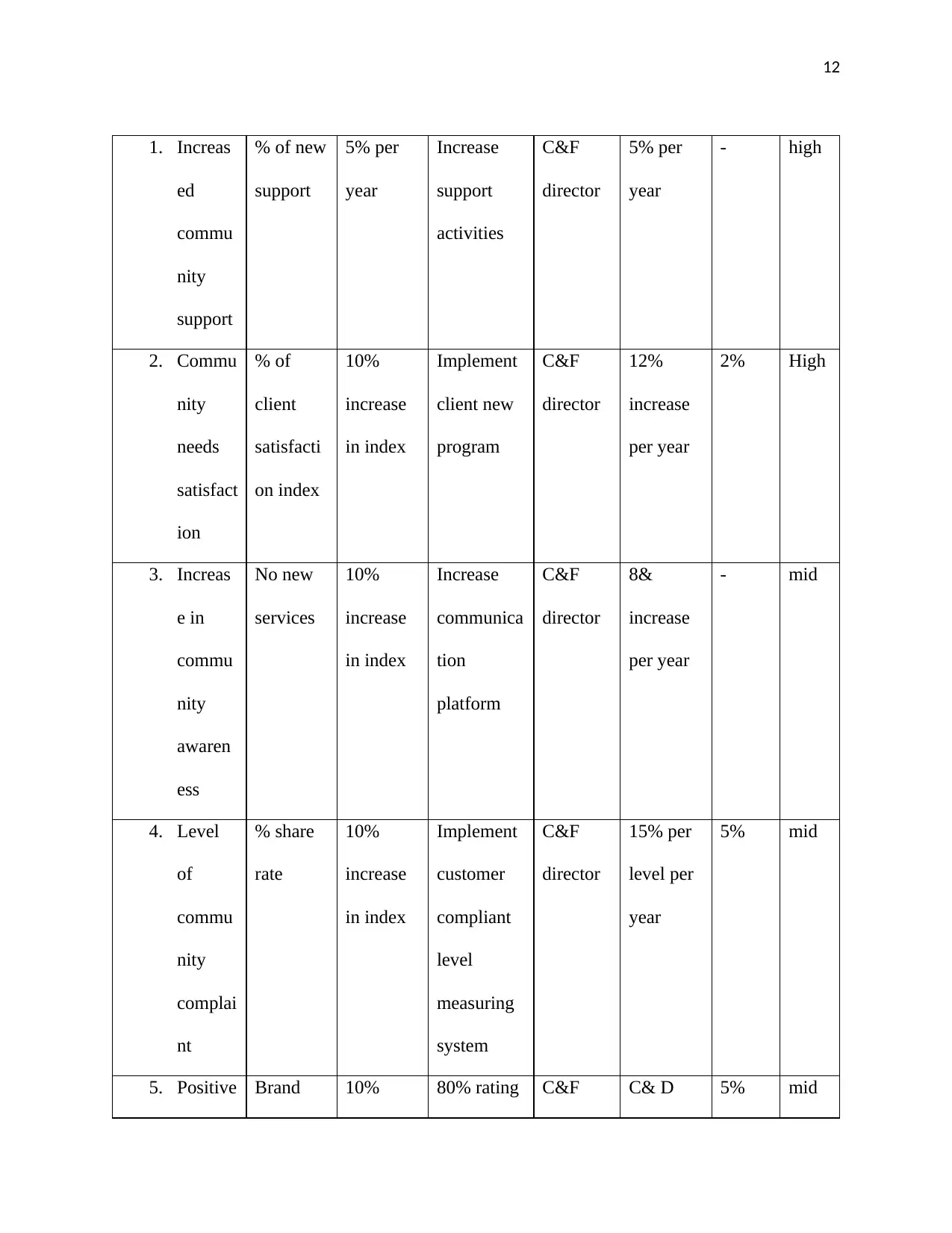
Proposed Balanced Score card and Performance measurement
perspective measure target initiatives Responsi
ble
person
Actual
result
Varian
ce
priori
ty
enterprise, thanks to which the effectiveness of organizations can be assessed more objectively
(Hahn, and Figge, 2018).
In the article, the basic directions of development of the toolkit of strategic management are
considered. Strategy elements are characterized by: mission, vision, values and competitive
advantages. Signal indicators from a given one of the following indicators: The program of the
balanced scorecard as a tool of peace of mind strategy proved.
Currently, the management is the most widely known balanced scorecard - Balanced Scorecard
(BSC). (A similar system of Key Performance Indicators - Key Performance Indicator (KPI) is
also common, the MSP is even referred to as particular cases of KPI.
However, the practical implementation of SSP, according to different sources , does not provide
the expected increase in the efficiency of the enterprise. And many are looking for the
shortcomings of a balanced scorecard, the elimination of which should give an increase in its
efficiency, create its various modifications Hakkak, and Ghodsi, 2015). Is it a drawback?
Proposed Balanced Score card and Performance measurement
perspective measure target initiatives Responsi
ble
person
Actual
result
Varian
ce
priori
ty
12
1. Increas
ed
commu
nity
support
% of new
support
5% per
year
Increase
support
activities
C&F
director
5% per
year
- high
2. Commu
nity
needs
satisfact
ion
% of
client
satisfacti
on index
10%
increase
in index
Implement
client new
program
C&F
director
12%
increase
per year
2% High
3. Increas
e in
commu
nity
awaren
ess
No new
services
10%
increase
in index
Increase
communica
tion
platform
C&F
director
8&
increase
per year
- mid
4. Level
of
commu
nity
complai
nt
% share
rate
10%
increase
in index
Implement
customer
compliant
level
measuring
system
C&F
director
15% per
level per
year
5% mid
5. Positive Brand 10% 80% rating C&F C& D 5% mid
1. Increas
ed
commu
nity
support
% of new
support
5% per
year
Increase
support
activities
C&F
director
5% per
year
- high
2. Commu
nity
needs
satisfact
ion
% of
client
satisfacti
on index
10%
increase
in index
Implement
client new
program
C&F
director
12%
increase
per year
2% High
3. Increas
e in
commu
nity
awaren
ess
No new
services
10%
increase
in index
Increase
communica
tion
platform
C&F
director
8&
increase
per year
- mid
4. Level
of
commu
nity
complai
nt
% share
rate
10%
increase
in index
Implement
customer
compliant
level
measuring
system
C&F
director
15% per
level per
year
5% mid
5. Positive Brand 10% 80% rating C&F C& D 5% mid
⊘ This is a preview!⊘
Do you want full access?
Subscribe today to unlock all pages.
Trusted by 1+ million students worldwide

1 out of 25


Related Documents


Your All-in-One AI-Powered Toolkit for Academic Success.
+13062052269
info@desklib.com
Available 24*7 on WhatsApp / Email
![[object Object]](/_next/static/media/star-bottom.7253800d.svg)
Unlock your academic potential
Copyright © 2020–2026 A2Z Services. All Rights Reserved. Developed and managed by ZUCOL.