Heavenly Chocolate: Research Proposal for Business Decision Making
VerifiedAdded on 2023/04/20
|12
|3065
|77
Report
AI Summary
This report analyzes the Heavenly Chocolate case study, which focuses on the company's challenges related to increased sales demand exceeding production capacity. It begins with an introduction to the problem and identifies the need for strategies to ensure sustainable business growth. The report then outlines the management decisions that need to be made, focusing on production and capacity planning, marketing projections, and financial management. Three main research objectives are established: organizational capabilities, performance management, and strategic leadership. The report identifies relevant secondary data sources, discussing their advantages and disadvantages. Finally, it proposes an interview with the management of Heavenly Chocolate as the primary data collection method, outlining its advantages and disadvantages. The research aims to provide a framework for Heavenly Chocolate to make informed decisions regarding its growth and sustainability.

Running head: ASSIGNMENT 1 1
Assignment 1
Name
Institution
Assignment 1
Name
Institution

Paraphrase This Document
Need a fresh take? Get an instant paraphrase of this document with our AI Paraphraser
ASSIGNMENT 1 2
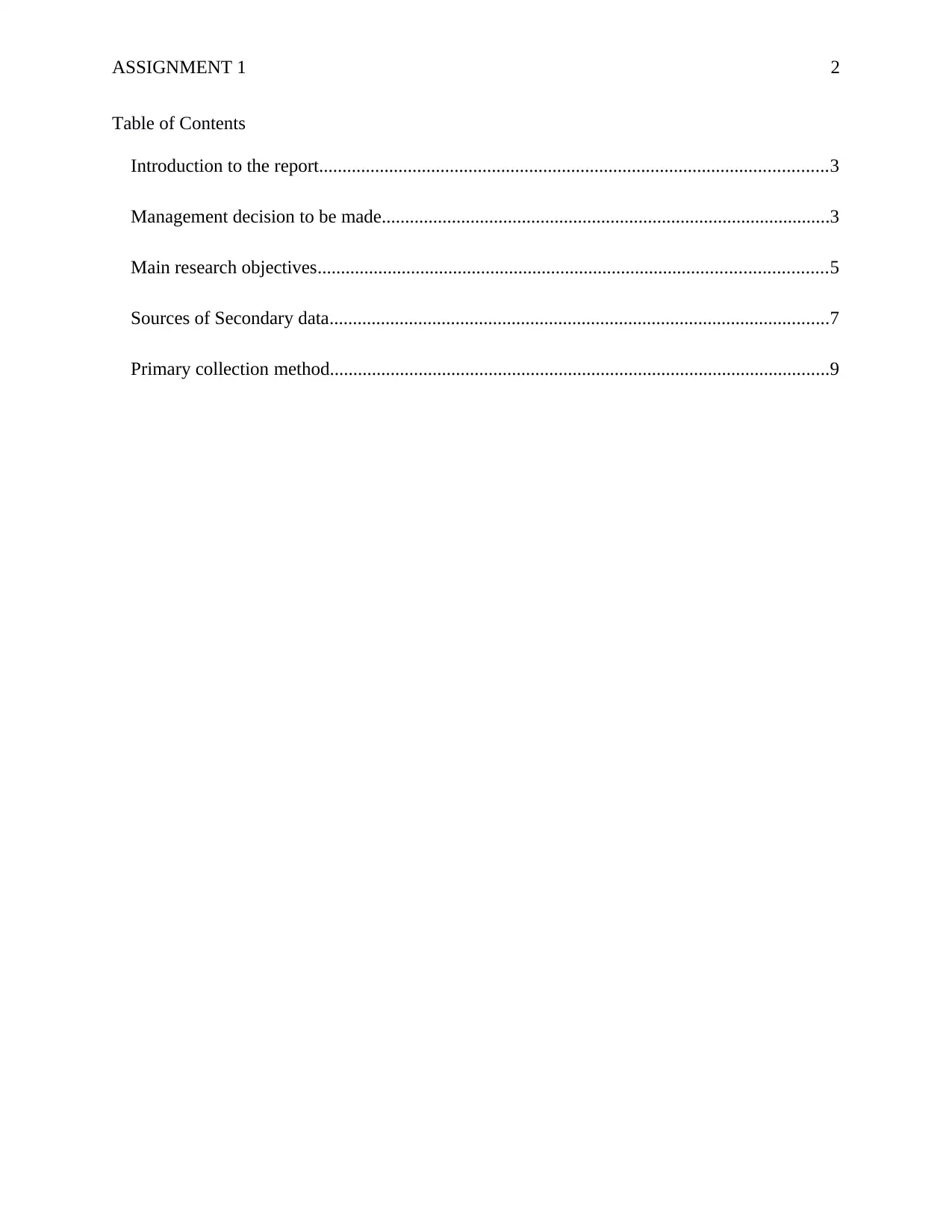
Table of Contents
Introduction to the report.............................................................................................................3
Management decision to be made................................................................................................3
Main research objectives.............................................................................................................5
Sources of Secondary data...........................................................................................................7
Primary collection method...........................................................................................................9
Table of Contents
Introduction to the report.............................................................................................................3
Management decision to be made................................................................................................3
Main research objectives.............................................................................................................5
Sources of Secondary data...........................................................................................................7
Primary collection method...........................................................................................................9
ASSIGNMENT 1 3
Introduction to the report
This report will be centered on reading the case study for purposes of getting the context
and finding the problems that are currently facing Heavenly Chocolate Company. Once the
issues have been identified, the report will concentrate on finding relevant secondary sources that
has information to put the issue into context. Further, the research will focus on the objectives
which will be significant in highlighting the causes of the issues that Heavenly Chocolate is
currently facing in order to know how the issues can be addressed. Nonetheless, the research will
involve secondary sources and the report will identify the sources as well as discuss the
advantages and disadvantages of the sources with respect to the case study. Lastly, the report will
focus on the primary collection method that will be used by discussing its advantages and
disadvantages in order to justify the method as appropriate for the study.
Management decision to be made
The issue at hand with Heavenly Chocolates case study relates to the need to come up
with strategies to increase sales demand and create a sustainable business. The company is
currently losing its online clients as a result of lack of production capacity to meet the demands
for their products. The company has been in existent for over 20 years selling quality chocolate
from its retail store. The issues surrounding this company began when it launched its business to
the international market which consequently led to unexpected demand that the company could
no longer provide.
Production and capacity planning is an integral part of a company to ensure that it is able
to meet demand for the products (Cheng, Fu, & Lai, 2018). Effectively production planning is
significant because it influences the profitability of the company. Therefore, production capacity
is dependent on how many products are required to be sold, planning appropriate capacity and
Introduction to the report
This report will be centered on reading the case study for purposes of getting the context
and finding the problems that are currently facing Heavenly Chocolate Company. Once the
issues have been identified, the report will concentrate on finding relevant secondary sources that
has information to put the issue into context. Further, the research will focus on the objectives
which will be significant in highlighting the causes of the issues that Heavenly Chocolate is
currently facing in order to know how the issues can be addressed. Nonetheless, the research will
involve secondary sources and the report will identify the sources as well as discuss the
advantages and disadvantages of the sources with respect to the case study. Lastly, the report will
focus on the primary collection method that will be used by discussing its advantages and
disadvantages in order to justify the method as appropriate for the study.
Management decision to be made
The issue at hand with Heavenly Chocolates case study relates to the need to come up
with strategies to increase sales demand and create a sustainable business. The company is
currently losing its online clients as a result of lack of production capacity to meet the demands
for their products. The company has been in existent for over 20 years selling quality chocolate
from its retail store. The issues surrounding this company began when it launched its business to
the international market which consequently led to unexpected demand that the company could
no longer provide.
Production and capacity planning is an integral part of a company to ensure that it is able
to meet demand for the products (Cheng, Fu, & Lai, 2018). Effectively production planning is
significant because it influences the profitability of the company. Therefore, production capacity
is dependent on how many products are required to be sold, planning appropriate capacity and
⊘ This is a preview!⊘
Do you want full access?
Subscribe today to unlock all pages.

Trusted by 1+ million students worldwide
ASSIGNMENT 1 4
develop production timelines that will eliminate unnecessary costs. However, production and
capacity planning requires sources of information and reliable data in order to forecast the level
of production. For instance, past performance of a company is significant in providing reliable
data that can be used in making accurate predictions (Sagaert et al, 2018). Depending on the
nature of the production a company can assess whether to increase or reduce production
capacity.
Another issue that is important in planning production and capacity is marketing
projections. Marketing strategy plays a crucial role in developing production and capacity plans
because it helps to predict increased sales and production through lowering costs and competing
price (Mariel & Minner, 2015). Besides, the orders received are significant to assist a company
in making strategic decisions with regards to production capacity. Also, advance sales from a
company sales records is equally important in making the right forecasting for increasing
production capacity (Hedenstierna & Disney, 2018).
Majority of businesses often face various challenges. When businesses begin to grow,
they require various solutions to challenges and opportunities (Chauhan, Nagi & Proth, 2004).
The ability to recognize and overcome an impending challenge is essential for the growth and
sustainability of a business. However, it is important to ensure that the steps taken are not likely
to create additional problem like the case with Heavenly Chocolate. This is because the company
was experiencing the challenge of expansion and increasing sales which brought another
problem that involves capacity production and planning (Bunn & Oliveira, 2016).
In this regard, there are several strategies that can play a significant role in addressing the
growth and sustainability (Nguyen & Wang, 2019). The business has to ensure that it is able to
keep up with the market by understanding the various aspects such as market share and
develop production timelines that will eliminate unnecessary costs. However, production and
capacity planning requires sources of information and reliable data in order to forecast the level
of production. For instance, past performance of a company is significant in providing reliable
data that can be used in making accurate predictions (Sagaert et al, 2018). Depending on the
nature of the production a company can assess whether to increase or reduce production
capacity.
Another issue that is important in planning production and capacity is marketing
projections. Marketing strategy plays a crucial role in developing production and capacity plans
because it helps to predict increased sales and production through lowering costs and competing
price (Mariel & Minner, 2015). Besides, the orders received are significant to assist a company
in making strategic decisions with regards to production capacity. Also, advance sales from a
company sales records is equally important in making the right forecasting for increasing
production capacity (Hedenstierna & Disney, 2018).
Majority of businesses often face various challenges. When businesses begin to grow,
they require various solutions to challenges and opportunities (Chauhan, Nagi & Proth, 2004).
The ability to recognize and overcome an impending challenge is essential for the growth and
sustainability of a business. However, it is important to ensure that the steps taken are not likely
to create additional problem like the case with Heavenly Chocolate. This is because the company
was experiencing the challenge of expansion and increasing sales which brought another
problem that involves capacity production and planning (Bunn & Oliveira, 2016).
In this regard, there are several strategies that can play a significant role in addressing the
growth and sustainability (Nguyen & Wang, 2019). The business has to ensure that it is able to
keep up with the market by understanding the various aspects such as market share and
Paraphrase This Document
Need a fresh take? Get an instant paraphrase of this document with our AI Paraphraser
ASSIGNMENT 1 5
competition in order to develop a reliable strategy to maximize growth and sustainability.
Business environment is subject to change and requires planning ahead (Cokins, 2017). It is clear
that Heavenly Chocolates failed to plan ahead and as a result, it was not able to predict the
growing demand. Moreover, cash flow and financial management of a business is significant to
predict growth and sustainability of a company. Among other significant strategies for growth
and sustainability involves the ability to solve problems, have the right skills and attitude and
welcoming change (Vogel, Almada-lobo & Almeder, 2017).
Main research objectives
There are three objectives that will enable the management of the company to make the
correct decision. This includes organization capabilities, performance management and strategic
leadership.
Organization capabilities involves all the processes that are strategic and are expected to
deliver high level of value to the consumers. Among some of these processes include successful
entering new markets, creating products that appeal to the consumers and offering exemplary
customer service (Charles, Schmidheiny & Watts, 2017). These issues are part and parcel of an
organization strategy and require expertise and commitment. Further, a significant market share
is dependent on a business competitive edge and organizational capabilities. As a result,
managers in organizations are challenged to clarify objectives and goals, assess performance and
continually strengthen the organization. Consequently, the capabilities of an organization should
be highly visible to the customer organization in order to acknowledge that the business offers
exceptional value to their customers. Lastly, organization capabilities should be robust such that
it makes it difficult for competitors to copy hence securing a significant market share.
competition in order to develop a reliable strategy to maximize growth and sustainability.
Business environment is subject to change and requires planning ahead (Cokins, 2017). It is clear
that Heavenly Chocolates failed to plan ahead and as a result, it was not able to predict the
growing demand. Moreover, cash flow and financial management of a business is significant to
predict growth and sustainability of a company. Among other significant strategies for growth
and sustainability involves the ability to solve problems, have the right skills and attitude and
welcoming change (Vogel, Almada-lobo & Almeder, 2017).
Main research objectives
There are three objectives that will enable the management of the company to make the
correct decision. This includes organization capabilities, performance management and strategic
leadership.
Organization capabilities involves all the processes that are strategic and are expected to
deliver high level of value to the consumers. Among some of these processes include successful
entering new markets, creating products that appeal to the consumers and offering exemplary
customer service (Charles, Schmidheiny & Watts, 2017). These issues are part and parcel of an
organization strategy and require expertise and commitment. Further, a significant market share
is dependent on a business competitive edge and organizational capabilities. As a result,
managers in organizations are challenged to clarify objectives and goals, assess performance and
continually strengthen the organization. Consequently, the capabilities of an organization should
be highly visible to the customer organization in order to acknowledge that the business offers
exceptional value to their customers. Lastly, organization capabilities should be robust such that
it makes it difficult for competitors to copy hence securing a significant market share.
ASSIGNMENT 1 6
The second objective for the management is to develop an elaborate performance
management system (Bleischwitz, Welfens & Zhang, 2017). The system will be crucial because
it will clearly show the strategic relationship between the desired performance outcomes such as
growth and sustainability and drivers of performance such as new market entry, service quality
and customer loyalty. More so, the performance of various department in an organization is
directly linked to the growth strategy and sustainability.
The third element that will ensure the management is able to make the required decision
with respect to Heavenly Chocolate is supportive leadership. Leadership plays an integral role in
in influencing the attitudes and actions of other employees. For this reason, leadership must
ensure that the organization must perform at high level amidst increasing competition and
changing business environment (Ortiz‐de‐Mandojana, & Bansal, 2016). Further, the leadership
of the company should evaluate why various collaborations hinder the ability of the company to
adopt to new changes. In addition, the leadership of the organization should ensure that it
strengthens the execution of infrastructure through investing in strategies that support successful
execution of its objectives. Nonetheless, the organization leadership should ensure that it initiates
a process that is aimed at identifying strategies that have high probability of success
(Sewchurran, Dekker & McDonogh, 2018).
With the above objectives, Heavenly Chocolate management will be better placed to
foresee the increased sales demand and structure the company to ensure that it is able to meet its
objectives with ease. Therefore, the management should ensure that it hires and train its
employees based on the needs of the business. This is because the department that was tasked to
take the company internationally through their website failed to foresee the increase in demand.
As a result, the incompetency of the employees subjected the company to competitive situation
The second objective for the management is to develop an elaborate performance
management system (Bleischwitz, Welfens & Zhang, 2017). The system will be crucial because
it will clearly show the strategic relationship between the desired performance outcomes such as
growth and sustainability and drivers of performance such as new market entry, service quality
and customer loyalty. More so, the performance of various department in an organization is
directly linked to the growth strategy and sustainability.
The third element that will ensure the management is able to make the required decision
with respect to Heavenly Chocolate is supportive leadership. Leadership plays an integral role in
in influencing the attitudes and actions of other employees. For this reason, leadership must
ensure that the organization must perform at high level amidst increasing competition and
changing business environment (Ortiz‐de‐Mandojana, & Bansal, 2016). Further, the leadership
of the company should evaluate why various collaborations hinder the ability of the company to
adopt to new changes. In addition, the leadership of the organization should ensure that it
strengthens the execution of infrastructure through investing in strategies that support successful
execution of its objectives. Nonetheless, the organization leadership should ensure that it initiates
a process that is aimed at identifying strategies that have high probability of success
(Sewchurran, Dekker & McDonogh, 2018).
With the above objectives, Heavenly Chocolate management will be better placed to
foresee the increased sales demand and structure the company to ensure that it is able to meet its
objectives with ease. Therefore, the management should ensure that it hires and train its
employees based on the needs of the business. This is because the department that was tasked to
take the company internationally through their website failed to foresee the increase in demand.
As a result, the incompetency of the employees subjected the company to competitive situation
⊘ This is a preview!⊘
Do you want full access?
Subscribe today to unlock all pages.
Trusted by 1+ million students worldwide
ASSIGNMENT 1 7
that might result in the company losing a significant market share based on its poor reputation for
the consumers who cannot get the products they want.
Sources of Secondary data
Poláček, T., & Žákovská, M. (2018). Decision in implementation of production
capacity planning determinated by usage of sensitive analysis. Trendy Ekonomiky a
Managementu, 12(31), 57-69. doi:http://dx.doi.org/10.13164/trends.2018.31.57
This article plays a significant role when it comes to understanding how to effectively
plan and manage material flow and production resources. The article aims to provide insight on
the success factors attributed to manufacturing companies. The advantage of this article is that it
is centered on all aspects of management, material management, planning and scheduling and
human resource and coordination of suppliers. There is no limiting factor with respect to this
source because it has significant insight into how Heavenly Chocolate will improve its
production capacity.
Vogel, T., Almada-lobo, B., & Almeder, C. (2017). Integrated versus hierarchical
approach to aggregate production planning and master production scheduling.OR
Spectrum, 39(1), 193-229. doi:http://dx.doi.org/10.1007/s00291-016-0450-2
This source discusses the hierarchical planning concept that is commonly used for
production planning purposes. The advantage of this source is that it provides insight into
production by suggesting that planning process should be divided into sub- processes for
purposes of reducing complexity. Besides, this source is particularly significant because it
alludes that through optimizing sub-problems, an organization will be able to make better
decision for overall problem. There is no disadvantage related to this source in context to
Heavenly Chocolate issue.
that might result in the company losing a significant market share based on its poor reputation for
the consumers who cannot get the products they want.
Sources of Secondary data
Poláček, T., & Žákovská, M. (2018). Decision in implementation of production
capacity planning determinated by usage of sensitive analysis. Trendy Ekonomiky a
Managementu, 12(31), 57-69. doi:http://dx.doi.org/10.13164/trends.2018.31.57
This article plays a significant role when it comes to understanding how to effectively
plan and manage material flow and production resources. The article aims to provide insight on
the success factors attributed to manufacturing companies. The advantage of this article is that it
is centered on all aspects of management, material management, planning and scheduling and
human resource and coordination of suppliers. There is no limiting factor with respect to this
source because it has significant insight into how Heavenly Chocolate will improve its
production capacity.
Vogel, T., Almada-lobo, B., & Almeder, C. (2017). Integrated versus hierarchical
approach to aggregate production planning and master production scheduling.OR
Spectrum, 39(1), 193-229. doi:http://dx.doi.org/10.1007/s00291-016-0450-2
This source discusses the hierarchical planning concept that is commonly used for
production planning purposes. The advantage of this source is that it provides insight into
production by suggesting that planning process should be divided into sub- processes for
purposes of reducing complexity. Besides, this source is particularly significant because it
alludes that through optimizing sub-problems, an organization will be able to make better
decision for overall problem. There is no disadvantage related to this source in context to
Heavenly Chocolate issue.
Paraphrase This Document
Need a fresh take? Get an instant paraphrase of this document with our AI Paraphraser
ASSIGNMENT 1 8
Li, S., & Tirupati, D. (1994). Dynamic capacity expansion problem with multiple
products: Technology selection and timing of capacity additions. Operations
Research, 42(5), 958. Retrieved from
This source plays a significant role for this research as it examines multiproduct dynamic
investment model for making technology choices and expansion decision. The advantages of this
source is that it considers technology selection, timing and capacity addition. This source is
significant for addressing Heavenly Chocolate problem because it emphasizes on the need for
complex considerations such as demand patterns, economies of scale and mix flexibility. There
are no disadvantages that are associated with this source in regards to the case study.
Schwab, L., Gold, S., Kunz, N., & Reiner, G. (2017). Sustainable business growth:
Exploring operations decision-making. Journal of Global Responsibility, 8(1), 83-95.
doi:http://dx.doi.org/10.1108/JGR-11-2016-0031
This source is also important for providing insight into the issues surrounding Heavenly
Chocolate. The source explores how operations decision making may keep the growing firms
with boundaries of corporate and societal sustainability. The advantage of this source is pegged
on the findings of this research which suggests that operation decision made by managers during
growth period follow specific patterns. Therefore, the findings of this research will be essential
for providing a framework for decision making by Heavenly Chocolate Company.
Katavic, I., PhD. (2011). CREATING A POSITIVE CHANGE TO ACHIEVE
SUSTAINABLE GROWTH. Ekonomska Istrazivanja, 24(1), 38-50. Retrieved from
This source is crucial as it offers knowledge on how to achieve sustainable growth. The
source postulates that that organizations ought to create positive change which is essential for
Li, S., & Tirupati, D. (1994). Dynamic capacity expansion problem with multiple
products: Technology selection and timing of capacity additions. Operations
Research, 42(5), 958. Retrieved from
This source plays a significant role for this research as it examines multiproduct dynamic
investment model for making technology choices and expansion decision. The advantages of this
source is that it considers technology selection, timing and capacity addition. This source is
significant for addressing Heavenly Chocolate problem because it emphasizes on the need for
complex considerations such as demand patterns, economies of scale and mix flexibility. There
are no disadvantages that are associated with this source in regards to the case study.
Schwab, L., Gold, S., Kunz, N., & Reiner, G. (2017). Sustainable business growth:
Exploring operations decision-making. Journal of Global Responsibility, 8(1), 83-95.
doi:http://dx.doi.org/10.1108/JGR-11-2016-0031
This source is also important for providing insight into the issues surrounding Heavenly
Chocolate. The source explores how operations decision making may keep the growing firms
with boundaries of corporate and societal sustainability. The advantage of this source is pegged
on the findings of this research which suggests that operation decision made by managers during
growth period follow specific patterns. Therefore, the findings of this research will be essential
for providing a framework for decision making by Heavenly Chocolate Company.
Katavic, I., PhD. (2011). CREATING A POSITIVE CHANGE TO ACHIEVE
SUSTAINABLE GROWTH. Ekonomska Istrazivanja, 24(1), 38-50. Retrieved from
This source is crucial as it offers knowledge on how to achieve sustainable growth. The
source postulates that that organizations ought to create positive change which is essential for
ASSIGNMENT 1 9
making clear strategy, effective communication and utilization of resources. The advantages of
this sources is that it introduces all aspects related to creating positive change in an organization.
Primary collection method
The primary collection method that will be used for this purpose is an interview with the
management of the Heavenly Chocolate Company. The managers will be interviewed in relation
to their decision making with regards to the approval of launching global business without the
capacity to sustain the demand from their consumers. Also, the questions in the interview will
focus on management skills and leadership qualities needed to run the company. The mangers
will also be interviewed on growth and sustainable strategies that they have put in place to ensure
the business has a competitive edge in the chocolate business. Moreover, the interview will
consider other growing companies and their managers with regards to production capacity
planning and growth and sustainability.
The findings of the interviews will then be used to make reasonable conclusion on how
the company will make decisions regarding their problem. There are both advantages and
disadvantages of collecting data through interviews. Among the advantage include, it is easy to
correct the speech whenever the interviewee does not understand the angle of a particular
question (Poláček & Žákovská, 2018). The relationship between an interviewer and interviewee
is significant in providing truths about the information that is being sought. Besides, interviews
play a significant role as it gives the interviewer the chance to select the candidate. Among other
advantages of interviews include collecting of sufficient information, time saving, less costly, in
depth analysis and flexibility with which the interviewer can carry out the interview.
On the other hand, there are also disadvantages that are associated with collecting data
through interviews. For instance, interviews is not a complete process as some of the questions
making clear strategy, effective communication and utilization of resources. The advantages of
this sources is that it introduces all aspects related to creating positive change in an organization.
Primary collection method
The primary collection method that will be used for this purpose is an interview with the
management of the Heavenly Chocolate Company. The managers will be interviewed in relation
to their decision making with regards to the approval of launching global business without the
capacity to sustain the demand from their consumers. Also, the questions in the interview will
focus on management skills and leadership qualities needed to run the company. The mangers
will also be interviewed on growth and sustainable strategies that they have put in place to ensure
the business has a competitive edge in the chocolate business. Moreover, the interview will
consider other growing companies and their managers with regards to production capacity
planning and growth and sustainability.
The findings of the interviews will then be used to make reasonable conclusion on how
the company will make decisions regarding their problem. There are both advantages and
disadvantages of collecting data through interviews. Among the advantage include, it is easy to
correct the speech whenever the interviewee does not understand the angle of a particular
question (Poláček & Žákovská, 2018). The relationship between an interviewer and interviewee
is significant in providing truths about the information that is being sought. Besides, interviews
play a significant role as it gives the interviewer the chance to select the candidate. Among other
advantages of interviews include collecting of sufficient information, time saving, less costly, in
depth analysis and flexibility with which the interviewer can carry out the interview.
On the other hand, there are also disadvantages that are associated with collecting data
through interviews. For instance, interviews is not a complete process as some of the questions
⊘ This is a preview!⊘
Do you want full access?
Subscribe today to unlock all pages.
Trusted by 1+ million students worldwide
ASSIGNMENT 1 10
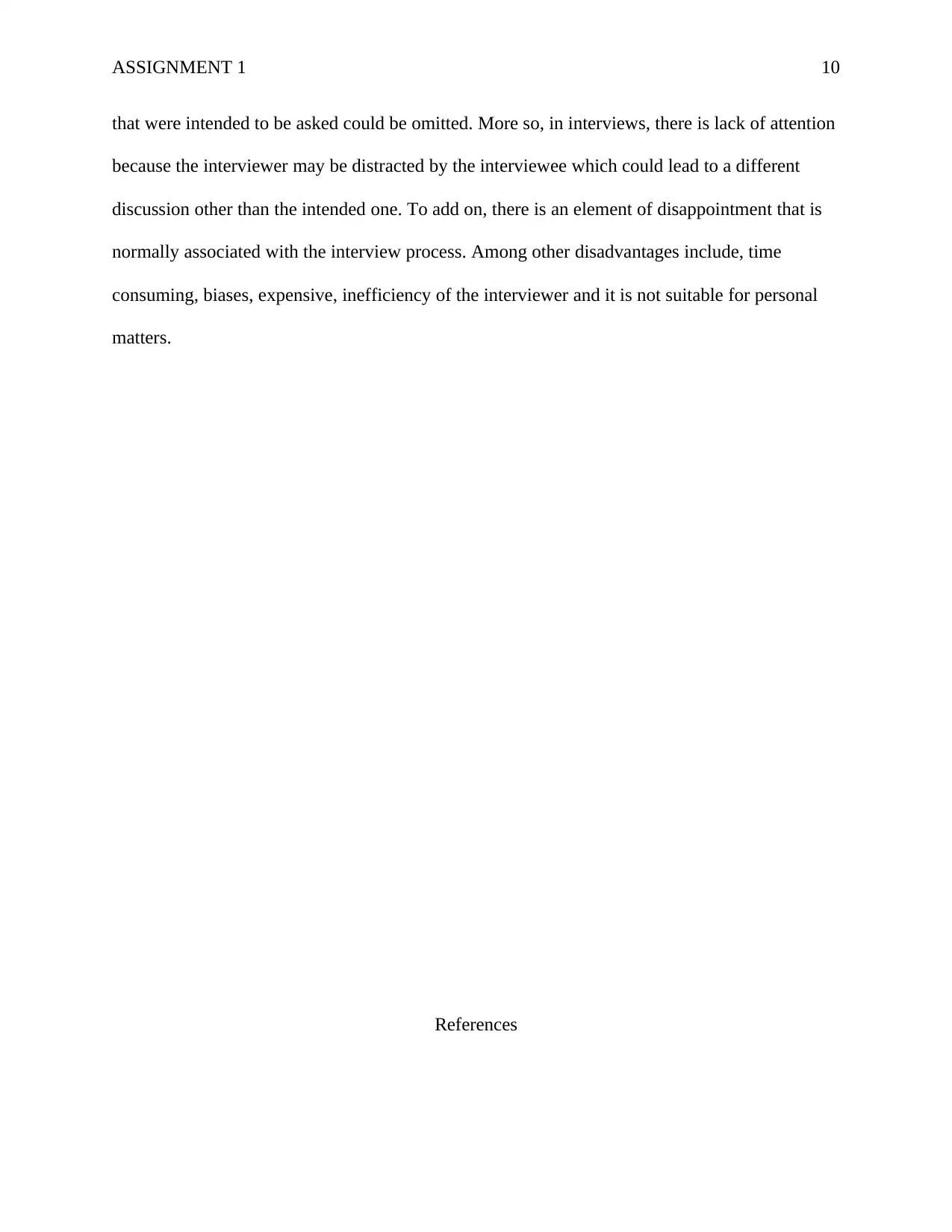
that were intended to be asked could be omitted. More so, in interviews, there is lack of attention
because the interviewer may be distracted by the interviewee which could lead to a different
discussion other than the intended one. To add on, there is an element of disappointment that is
normally associated with the interview process. Among other disadvantages include, time
consuming, biases, expensive, inefficiency of the interviewer and it is not suitable for personal
matters.
References
that were intended to be asked could be omitted. More so, in interviews, there is lack of attention
because the interviewer may be distracted by the interviewee which could lead to a different
discussion other than the intended one. To add on, there is an element of disappointment that is
normally associated with the interview process. Among other disadvantages include, time
consuming, biases, expensive, inefficiency of the interviewer and it is not suitable for personal
matters.
References
Paraphrase This Document
Need a fresh take? Get an instant paraphrase of this document with our AI Paraphraser
ASSIGNMENT 1 11
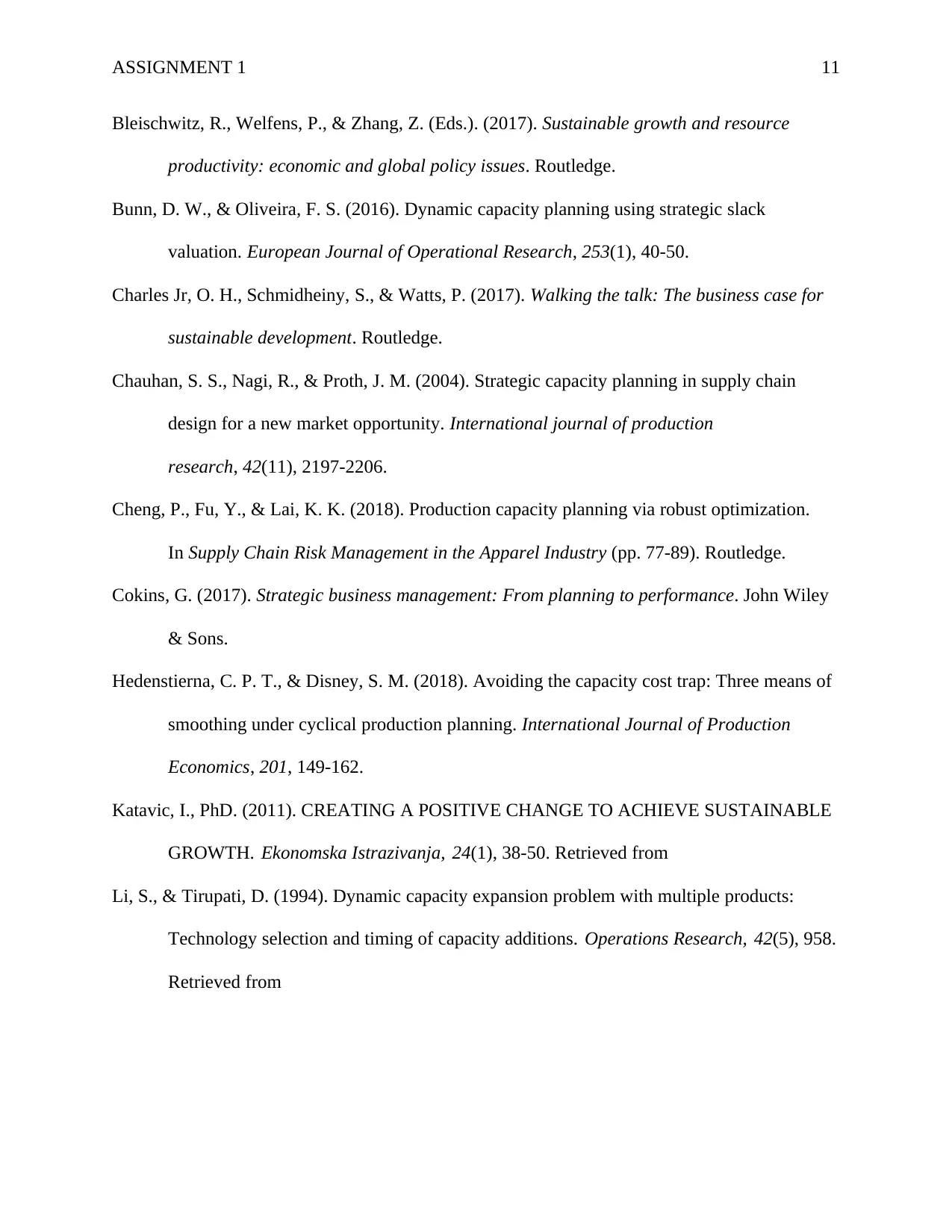
Bleischwitz, R., Welfens, P., & Zhang, Z. (Eds.). (2017). Sustainable growth and resource
productivity: economic and global policy issues. Routledge.
Bunn, D. W., & Oliveira, F. S. (2016). Dynamic capacity planning using strategic slack
valuation. European Journal of Operational Research, 253(1), 40-50.
Charles Jr, O. H., Schmidheiny, S., & Watts, P. (2017). Walking the talk: The business case for
sustainable development. Routledge.
Chauhan, S. S., Nagi, R., & Proth, J. M. (2004). Strategic capacity planning in supply chain
design for a new market opportunity. International journal of production
research, 42(11), 2197-2206.
Cheng, P., Fu, Y., & Lai, K. K. (2018). Production capacity planning via robust optimization.
In Supply Chain Risk Management in the Apparel Industry (pp. 77-89). Routledge.
Cokins, G. (2017). Strategic business management: From planning to performance. John Wiley
& Sons.
Hedenstierna, C. P. T., & Disney, S. M. (2018). Avoiding the capacity cost trap: Three means of
smoothing under cyclical production planning. International Journal of Production
Economics, 201, 149-162.
Katavic, I., PhD. (2011). CREATING A POSITIVE CHANGE TO ACHIEVE SUSTAINABLE
GROWTH. Ekonomska Istrazivanja, 24(1), 38-50. Retrieved from
Li, S., & Tirupati, D. (1994). Dynamic capacity expansion problem with multiple products:
Technology selection and timing of capacity additions. Operations Research, 42(5), 958.
Retrieved from
Bleischwitz, R., Welfens, P., & Zhang, Z. (Eds.). (2017). Sustainable growth and resource
productivity: economic and global policy issues. Routledge.
Bunn, D. W., & Oliveira, F. S. (2016). Dynamic capacity planning using strategic slack
valuation. European Journal of Operational Research, 253(1), 40-50.
Charles Jr, O. H., Schmidheiny, S., & Watts, P. (2017). Walking the talk: The business case for
sustainable development. Routledge.
Chauhan, S. S., Nagi, R., & Proth, J. M. (2004). Strategic capacity planning in supply chain
design for a new market opportunity. International journal of production
research, 42(11), 2197-2206.
Cheng, P., Fu, Y., & Lai, K. K. (2018). Production capacity planning via robust optimization.
In Supply Chain Risk Management in the Apparel Industry (pp. 77-89). Routledge.
Cokins, G. (2017). Strategic business management: From planning to performance. John Wiley
& Sons.
Hedenstierna, C. P. T., & Disney, S. M. (2018). Avoiding the capacity cost trap: Three means of
smoothing under cyclical production planning. International Journal of Production
Economics, 201, 149-162.
Katavic, I., PhD. (2011). CREATING A POSITIVE CHANGE TO ACHIEVE SUSTAINABLE
GROWTH. Ekonomska Istrazivanja, 24(1), 38-50. Retrieved from
Li, S., & Tirupati, D. (1994). Dynamic capacity expansion problem with multiple products:
Technology selection and timing of capacity additions. Operations Research, 42(5), 958.
Retrieved from
ASSIGNMENT 1 12
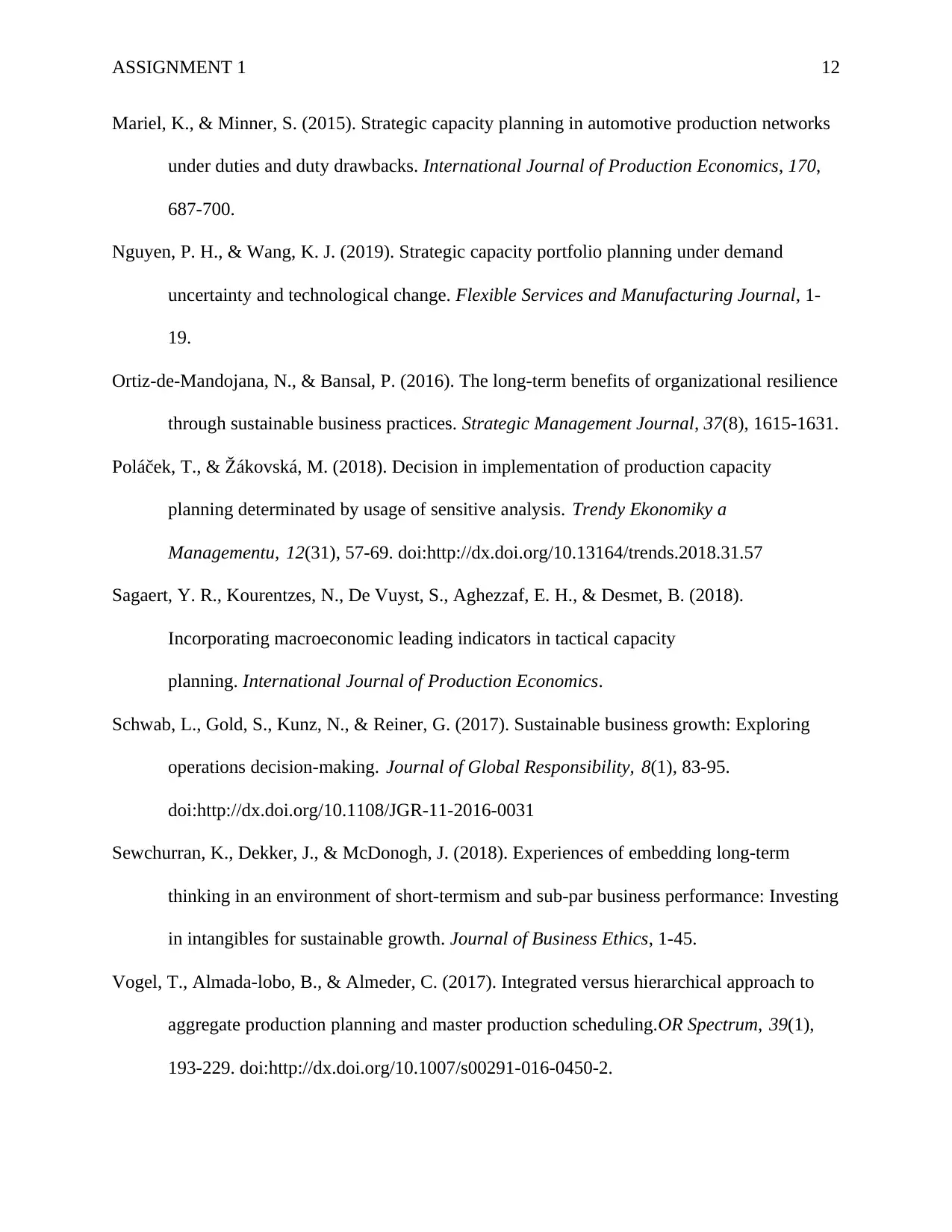
Mariel, K., & Minner, S. (2015). Strategic capacity planning in automotive production networks
under duties and duty drawbacks. International Journal of Production Economics, 170,
687-700.
Nguyen, P. H., & Wang, K. J. (2019). Strategic capacity portfolio planning under demand
uncertainty and technological change. Flexible Services and Manufacturing Journal, 1-
19.
Ortiz‐de‐Mandojana, N., & Bansal, P. (2016). The long‐term benefits of organizational resilience
through sustainable business practices. Strategic Management Journal, 37(8), 1615-1631.
Poláček, T., & Žákovská, M. (2018). Decision in implementation of production capacity
planning determinated by usage of sensitive analysis. Trendy Ekonomiky a
Managementu, 12(31), 57-69. doi:http://dx.doi.org/10.13164/trends.2018.31.57
Sagaert, Y. R., Kourentzes, N., De Vuyst, S., Aghezzaf, E. H., & Desmet, B. (2018).
Incorporating macroeconomic leading indicators in tactical capacity
planning. International Journal of Production Economics.
Schwab, L., Gold, S., Kunz, N., & Reiner, G. (2017). Sustainable business growth: Exploring
operations decision-making. Journal of Global Responsibility, 8(1), 83-95.
doi:http://dx.doi.org/10.1108/JGR-11-2016-0031
Sewchurran, K., Dekker, J., & McDonogh, J. (2018). Experiences of embedding long-term
thinking in an environment of short-termism and sub-par business performance: Investing
in intangibles for sustainable growth. Journal of Business Ethics, 1-45.
Vogel, T., Almada-lobo, B., & Almeder, C. (2017). Integrated versus hierarchical approach to
aggregate production planning and master production scheduling.OR Spectrum, 39(1),
193-229. doi:http://dx.doi.org/10.1007/s00291-016-0450-2.
Mariel, K., & Minner, S. (2015). Strategic capacity planning in automotive production networks
under duties and duty drawbacks. International Journal of Production Economics, 170,
687-700.
Nguyen, P. H., & Wang, K. J. (2019). Strategic capacity portfolio planning under demand
uncertainty and technological change. Flexible Services and Manufacturing Journal, 1-
19.
Ortiz‐de‐Mandojana, N., & Bansal, P. (2016). The long‐term benefits of organizational resilience
through sustainable business practices. Strategic Management Journal, 37(8), 1615-1631.
Poláček, T., & Žákovská, M. (2018). Decision in implementation of production capacity
planning determinated by usage of sensitive analysis. Trendy Ekonomiky a
Managementu, 12(31), 57-69. doi:http://dx.doi.org/10.13164/trends.2018.31.57
Sagaert, Y. R., Kourentzes, N., De Vuyst, S., Aghezzaf, E. H., & Desmet, B. (2018).
Incorporating macroeconomic leading indicators in tactical capacity
planning. International Journal of Production Economics.
Schwab, L., Gold, S., Kunz, N., & Reiner, G. (2017). Sustainable business growth: Exploring
operations decision-making. Journal of Global Responsibility, 8(1), 83-95.
doi:http://dx.doi.org/10.1108/JGR-11-2016-0031
Sewchurran, K., Dekker, J., & McDonogh, J. (2018). Experiences of embedding long-term
thinking in an environment of short-termism and sub-par business performance: Investing
in intangibles for sustainable growth. Journal of Business Ethics, 1-45.
Vogel, T., Almada-lobo, B., & Almeder, C. (2017). Integrated versus hierarchical approach to
aggregate production planning and master production scheduling.OR Spectrum, 39(1),
193-229. doi:http://dx.doi.org/10.1007/s00291-016-0450-2.
⊘ This is a preview!⊘
Do you want full access?
Subscribe today to unlock all pages.
Trusted by 1+ million students worldwide

1 out of 12


Related Documents


Your All-in-One AI-Powered Toolkit for Academic Success.
+13062052269
info@desklib.com
Available 24*7 on WhatsApp / Email
![[object Object]](/_next/static/media/star-bottom.7253800d.svg)
Unlock your academic potential
Copyright © 2020–2025 A2Z Services. All Rights Reserved. Developed and managed by ZUCOL.