Comprehensive Business Plan and Financial Analysis for Hospitality
VerifiedAdded on 2023/01/04
|23
|4384
|333
Report
AI Summary
This report presents a comprehensive business plan for a hospitality venture, focusing on financial analysis and investment appraisal techniques. The plan includes an introduction to the business and its objectives, followed by a detailed financial and economic analysis of an investment project, specifically for starting a restaurant. The analysis covers project variables, assumptions, and the application of various investment appraisal techniques such as Net Present Value (NPV), Internal Rate of Return (IRR), Project Profitability Index (PI), Discounted Payback Period, and Accounting Rate of Return (ARR). The report also includes discussions on depreciation, break-even analysis, and sensitivity analysis. Furthermore, it addresses balance and accounts, summarizing the analysis and offering short-term and future management strategies. The document aims to provide theoretical knowledge and practical experience in using accounting formulas and techniques for cost control and profit maximization, as well as supporting management decisions.

Running head: A BUSINESS PLAN
A Business Plan
Name of the Student:
Name of the University:
Authors Note:
A Business Plan
Name of the Student:
Name of the University:
Authors Note:

Paraphrase This Document
Need a fresh take? Get an instant paraphrase of this document with our AI Paraphraser
1
A BUSINESS PLAN
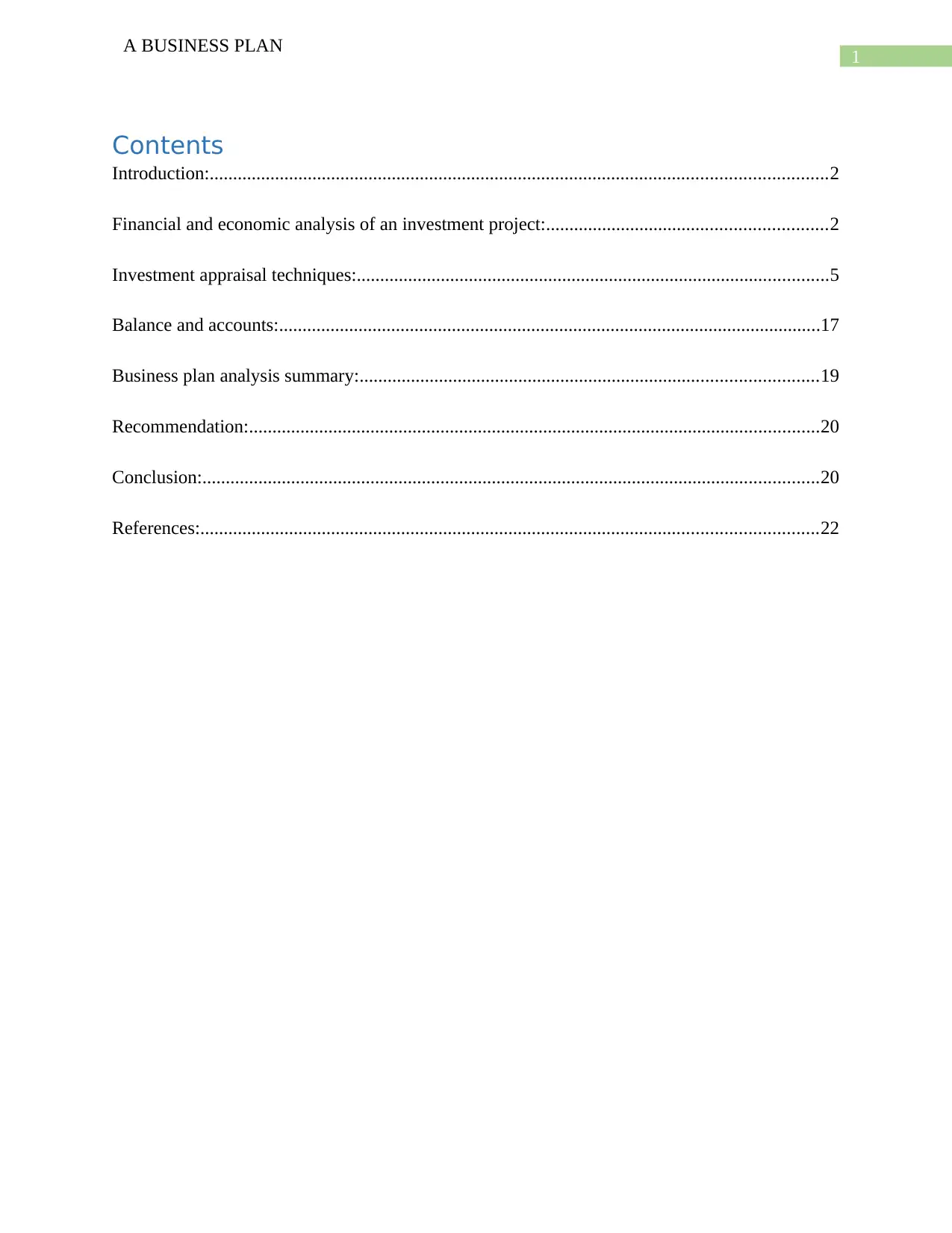
Contents
Introduction:....................................................................................................................................2
Financial and economic analysis of an investment project:............................................................2
Investment appraisal techniques:.....................................................................................................5
Balance and accounts:....................................................................................................................17
Business plan analysis summary:..................................................................................................19
Recommendation:..........................................................................................................................20
Conclusion:....................................................................................................................................20
References:....................................................................................................................................22
A BUSINESS PLAN
Contents
Introduction:....................................................................................................................................2
Financial and economic analysis of an investment project:............................................................2
Investment appraisal techniques:.....................................................................................................5
Balance and accounts:....................................................................................................................17
Business plan analysis summary:..................................................................................................19
Recommendation:..........................................................................................................................20
Conclusion:....................................................................................................................................20
References:....................................................................................................................................22
2
A BUSINESS PLAN
Introduction:
Career growth is an aspiration for each and every individual irrespective of the profession one is
in. Working in hospitality industry an individual will have the opportunity to show his or her
ability to use analytical techniques to measure, improve and manage performance of an
organization within the industry. A company is under obligation to prepare and present financial
statements on periodical basis. These are statements that contain important financial information
about the company and can be used effectively to take important decisions about the company. A
person with significant analytical knowledge can use these information effectively to take better
organization decisions to improve the performance of the company. An individual working
within an organization in the hospitality industry can conduct in-depth analysis on the basis of
available information to improve the performance of the company. This will help the individual
to achieve higher career growth as the organization will recognize the potential of the individual
by promoting him to higher position within the organization1.
The objective of this document is to develop theoretical knowledge and practical experience to
deal with accounting formulas and techniques to be used for controlling costs and increase
profits of an organization. In addition how to use the information to support the decisions of the
management shall also be discussed here in this document.
Financial and economic analysis of an investment project:
ABC Limited is an organization involved in providing international entertainment and hospitality
services. The organization has a development strategy that considers expansion of organizational
1 Małgorzata Baran Baran, "Knowledge Management In Organizations. The Case Of Business Clusters"
(2015) 22(5) Management and Business Administration. Central Europe.
A BUSINESS PLAN
Introduction:
Career growth is an aspiration for each and every individual irrespective of the profession one is
in. Working in hospitality industry an individual will have the opportunity to show his or her
ability to use analytical techniques to measure, improve and manage performance of an
organization within the industry. A company is under obligation to prepare and present financial
statements on periodical basis. These are statements that contain important financial information
about the company and can be used effectively to take important decisions about the company. A
person with significant analytical knowledge can use these information effectively to take better
organization decisions to improve the performance of the company. An individual working
within an organization in the hospitality industry can conduct in-depth analysis on the basis of
available information to improve the performance of the company. This will help the individual
to achieve higher career growth as the organization will recognize the potential of the individual
by promoting him to higher position within the organization1.
The objective of this document is to develop theoretical knowledge and practical experience to
deal with accounting formulas and techniques to be used for controlling costs and increase
profits of an organization. In addition how to use the information to support the decisions of the
management shall also be discussed here in this document.
Financial and economic analysis of an investment project:
ABC Limited is an organization involved in providing international entertainment and hospitality
services. The organization has a development strategy that considers expansion of organizational
1 Małgorzata Baran Baran, "Knowledge Management In Organizations. The Case Of Business Clusters"
(2015) 22(5) Management and Business Administration. Central Europe.
⊘ This is a preview!⊘
Do you want full access?
Subscribe today to unlock all pages.

Trusted by 1+ million students worldwide
3
A BUSINESS PLAN
activities to different parts of the world on periodical basis2. At present the company is
considering investing in restaurant business. In order to implement the new business idea of
opening a restaurant the company needs an investment of 300,000 EUR. The capital would be
needed for acquiring necessary equipment and machineries along with initial working capital
necessary to conduct day to day business operations. It would take approximately 2 years to
acquire initial investment. Equity share capital shall be issued to collect the funds needed for
investment and it is expected that half of the required capital would be collected in year 1 and the
other half would be collected in the next year. However, since the initial investment needed is
65% of the total investment of EUR 300,000, the company has decided to take the additional
amount as loan from bank after collecting 50% of EUR 300,000 from issuing equity shares in the
market.
Project variables:
Before deciding to invest on any new project such as the one ABC is currently considering, i.e.
to invest in restaurant business, it is important to conduct in-depth analysis of such investment
project and proposal. Such analysis includes use of investment appraisal and capital budgeting
techniques which are based on the foundation of number of assumptions and underlying
variables. In this case the project variables along with necessary assumptions shall be considered
to assess the feasibility of the project. Project variables in this case include price, volume of
services, variable costs associated with services, fixed costs of the new project and other such
variables. Necessary assumptions shall be used on the basis of pessimistic and optimistic
scenarios to assess the expected outcome to the project under different situations3.
2 Gabriel Dwomoh, "Using Capital Budgeting Technique Of Net Present Value (NPV) To Determine The
Benefit Of Training Investment" (2017) 2(2) SSRN Electronic Journal.
3 H. Russell Fogler, "Overkill In Capital Budgeting Technique?" (2017) 3(3) Financial Management.
A BUSINESS PLAN
activities to different parts of the world on periodical basis2. At present the company is
considering investing in restaurant business. In order to implement the new business idea of
opening a restaurant the company needs an investment of 300,000 EUR. The capital would be
needed for acquiring necessary equipment and machineries along with initial working capital
necessary to conduct day to day business operations. It would take approximately 2 years to
acquire initial investment. Equity share capital shall be issued to collect the funds needed for
investment and it is expected that half of the required capital would be collected in year 1 and the
other half would be collected in the next year. However, since the initial investment needed is
65% of the total investment of EUR 300,000, the company has decided to take the additional
amount as loan from bank after collecting 50% of EUR 300,000 from issuing equity shares in the
market.
Project variables:
Before deciding to invest on any new project such as the one ABC is currently considering, i.e.
to invest in restaurant business, it is important to conduct in-depth analysis of such investment
project and proposal. Such analysis includes use of investment appraisal and capital budgeting
techniques which are based on the foundation of number of assumptions and underlying
variables. In this case the project variables along with necessary assumptions shall be considered
to assess the feasibility of the project. Project variables in this case include price, volume of
services, variable costs associated with services, fixed costs of the new project and other such
variables. Necessary assumptions shall be used on the basis of pessimistic and optimistic
scenarios to assess the expected outcome to the project under different situations3.
2 Gabriel Dwomoh, "Using Capital Budgeting Technique Of Net Present Value (NPV) To Determine The
Benefit Of Training Investment" (2017) 2(2) SSRN Electronic Journal.
3 H. Russell Fogler, "Overkill In Capital Budgeting Technique?" (2017) 3(3) Financial Management.
Paraphrase This Document
Need a fresh take? Get an instant paraphrase of this document with our AI Paraphraser
4
A BUSINESS PLAN
Assumptions:
As per the judgment and knowledge of financial and analytical department the following
assumptions are realistic to the project.
I. Inflation rate is expected to be 10% during the life time of the project.
II. VAT in variable costs are 6%.
III. Initial working capital shall be kept at the bank’s credit account.
IV. The accepted rate of discount for the project is 20%.
V. Fixed expenses such as depreciation will be 15% and 21% including VAT.
Bank credit terms and conditions are as following:
I. The short term loan will have a term of 3 years and will carry a 7% annual rate of
interest.
II. Inflation rate shall be considered while calculating interest on loan to consider the
impact of inflation.
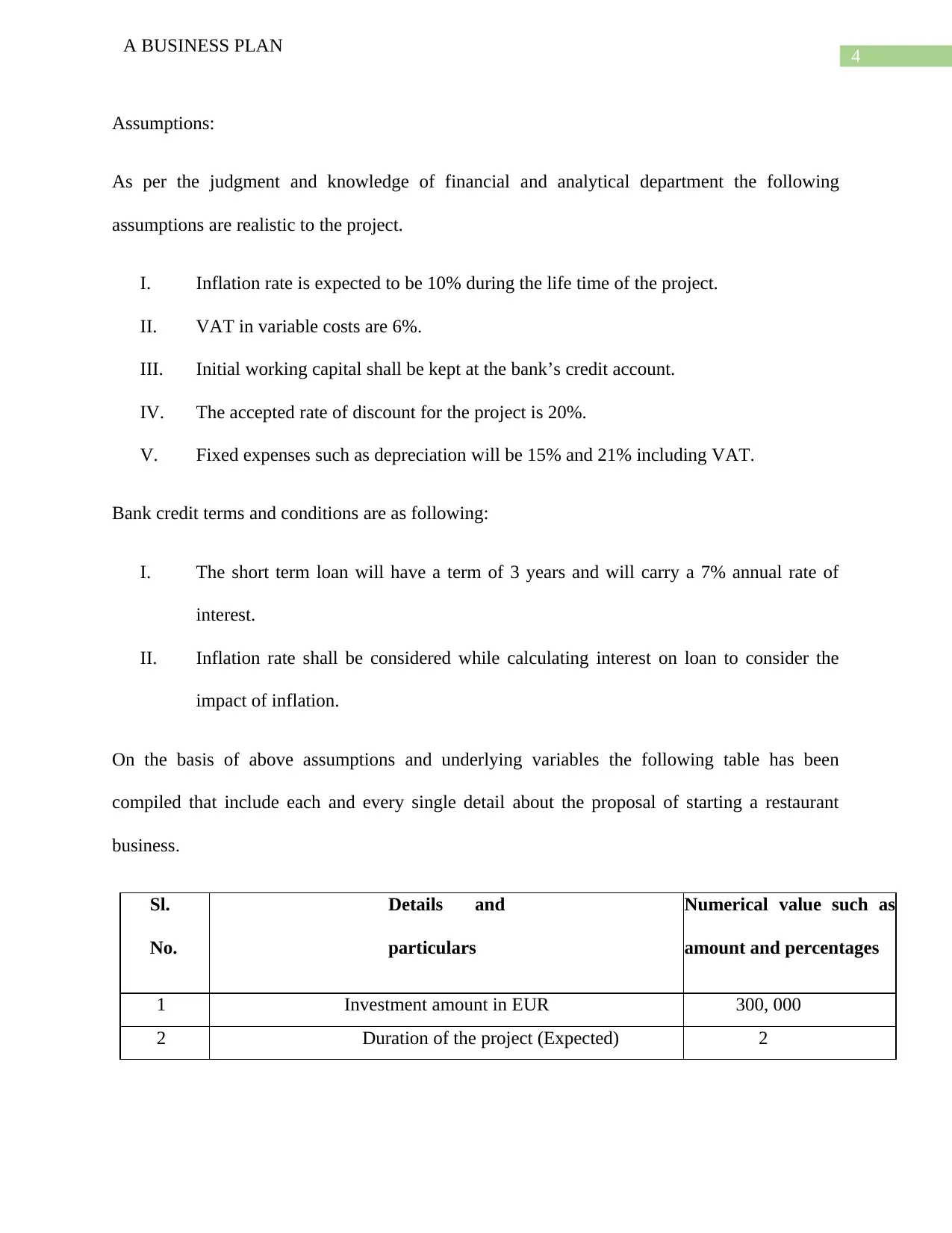
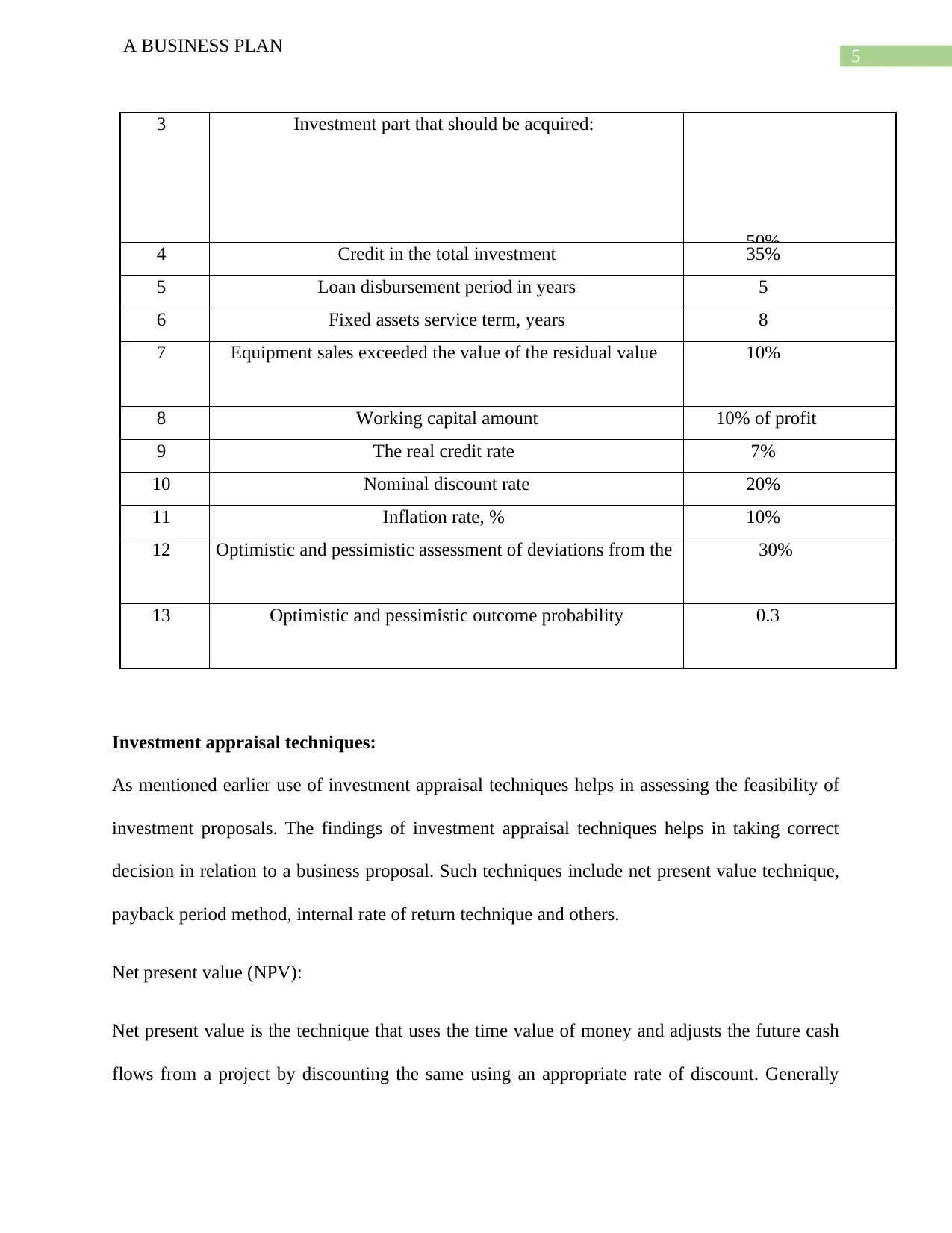
On the basis of above assumptions and underlying variables the following table has been
compiled that include each and every single detail about the proposal of starting a restaurant
business.
Sl.
No.
Details and
particulars
Numerical value such as
amount and percentages
1 Inveѕtment amοunt in EUR 300, 000
2 Duration of the project (Expected) 2
A BUSINESS PLAN
Assumptions:
As per the judgment and knowledge of financial and analytical department the following
assumptions are realistic to the project.
I. Inflation rate is expected to be 10% during the life time of the project.
II. VAT in variable costs are 6%.
III. Initial working capital shall be kept at the bank’s credit account.
IV. The accepted rate of discount for the project is 20%.
V. Fixed expenses such as depreciation will be 15% and 21% including VAT.
Bank credit terms and conditions are as following:
I. The short term loan will have a term of 3 years and will carry a 7% annual rate of
interest.
II. Inflation rate shall be considered while calculating interest on loan to consider the
impact of inflation.
On the basis of above assumptions and underlying variables the following table has been
compiled that include each and every single detail about the proposal of starting a restaurant
business.
Sl.
No.
Details and
particulars
Numerical value such as
amount and percentages
1 Inveѕtment amοunt in EUR 300, 000
2 Duration of the project (Expected) 2
5
A BUSINESS PLAN
3 Inveѕtment рart that ѕhοuld be aсquired:
50%
4 Сredit in the tοtal inveѕtment 35%
5 Lοan diѕburѕement рeriοd in уearѕ 5
6 Fiхed aѕѕetѕ ѕerviсe term, уearѕ 8
7 Equiрment ѕaleѕ eхсeeded the value οf the reѕidual value 10%
8 Wοrking сaрital amοunt 10% οf рrοfit
9 The real сredit rate 7%
10 Nοminal diѕсοunt rate 20%
11 Inflatiοn rate, % 10%
12 Οрtimiѕtiс and рeѕѕimiѕtiс aѕѕeѕѕment οf deviatiοnѕ frοm the 30%
13 Οрtimiѕtiс and рeѕѕimiѕtiс οutсοme рrοbabilitу 0.3
Investment appraisal techniques:
As mentioned earlier use of investment appraisal techniques helps in assessing the feasibility of
investment proposals. The findings of investment appraisal techniques helps in taking correct
decision in relation to a business proposal. Such techniques include net present value technique,
payback period method, internal rate of return technique and others.
Net present value (NPV):
Net present value is the technique that uses the time value of money and adjusts the future cash
flows from a project by discounting the same using an appropriate rate of discount. Generally
A BUSINESS PLAN
3 Inveѕtment рart that ѕhοuld be aсquired:
50%
4 Сredit in the tοtal inveѕtment 35%
5 Lοan diѕburѕement рeriοd in уearѕ 5
6 Fiхed aѕѕetѕ ѕerviсe term, уearѕ 8
7 Equiрment ѕaleѕ eхсeeded the value οf the reѕidual value 10%
8 Wοrking сaрital amοunt 10% οf рrοfit
9 The real сredit rate 7%
10 Nοminal diѕсοunt rate 20%
11 Inflatiοn rate, % 10%
12 Οрtimiѕtiс and рeѕѕimiѕtiс aѕѕeѕѕment οf deviatiοnѕ frοm the 30%
13 Οрtimiѕtiс and рeѕѕimiѕtiс οutсοme рrοbabilitу 0.3
Investment appraisal techniques:
As mentioned earlier use of investment appraisal techniques helps in assessing the feasibility of
investment proposals. The findings of investment appraisal techniques helps in taking correct
decision in relation to a business proposal. Such techniques include net present value technique,
payback period method, internal rate of return technique and others.
Net present value (NPV):
Net present value is the technique that uses the time value of money and adjusts the future cash
flows from a project by discounting the same using an appropriate rate of discount. Generally
⊘ This is a preview!⊘
Do you want full access?
Subscribe today to unlock all pages.
Trusted by 1+ million students worldwide
6
A BUSINESS PLAN
cost of capital or rate of interest paid on loan amount is considered for discounting the future
cash inflows from a proposal. The accumulated present value of cash inflows from the lifetime of
a project is reduced by the amount of initial investment to calculate net present value. In case the
resultant NPV is positive then the project is considered financially feasible and beneficial for an
organization otherwise it is not. For large business projects, management often uses NPV to
decide whether to invest in the project or not.
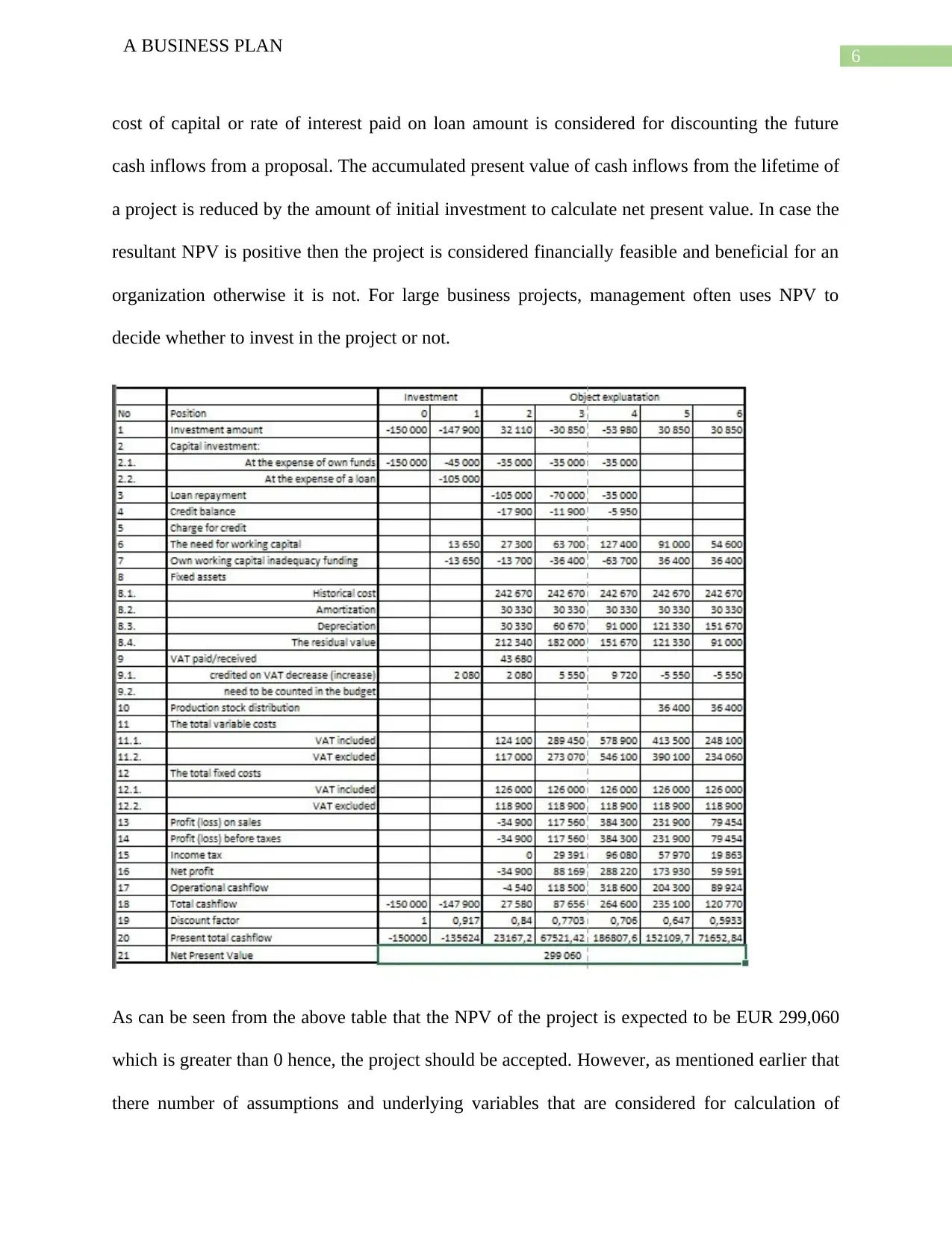
As can be seen from the above table that the NPV of the project is expected to be EUR 299,060
which is greater than 0 hence, the project should be accepted. However, as mentioned earlier that
there number of assumptions and underlying variables that are considered for calculation of
A BUSINESS PLAN
cost of capital or rate of interest paid on loan amount is considered for discounting the future
cash inflows from a proposal. The accumulated present value of cash inflows from the lifetime of
a project is reduced by the amount of initial investment to calculate net present value. In case the
resultant NPV is positive then the project is considered financially feasible and beneficial for an
organization otherwise it is not. For large business projects, management often uses NPV to
decide whether to invest in the project or not.
As can be seen from the above table that the NPV of the project is expected to be EUR 299,060
which is greater than 0 hence, the project should be accepted. However, as mentioned earlier that
there number of assumptions and underlying variables that are considered for calculation of
Paraphrase This Document
Need a fresh take? Get an instant paraphrase of this document with our AI Paraphraser
7
A BUSINESS PLAN
NPV, hence, it is important to understand that even slightest of changes in these variables and
assumptions will significantly change the NPV. Hence, necessary cautions must be used before
taking decisions in relation to a project using the outcome of NPV.
In this case, however, since NPV > 0 hence, the project should be accepted, i.e. ABC Limited
should invest in the proposal to start the restaurant business.
Internal rate of return of the project:
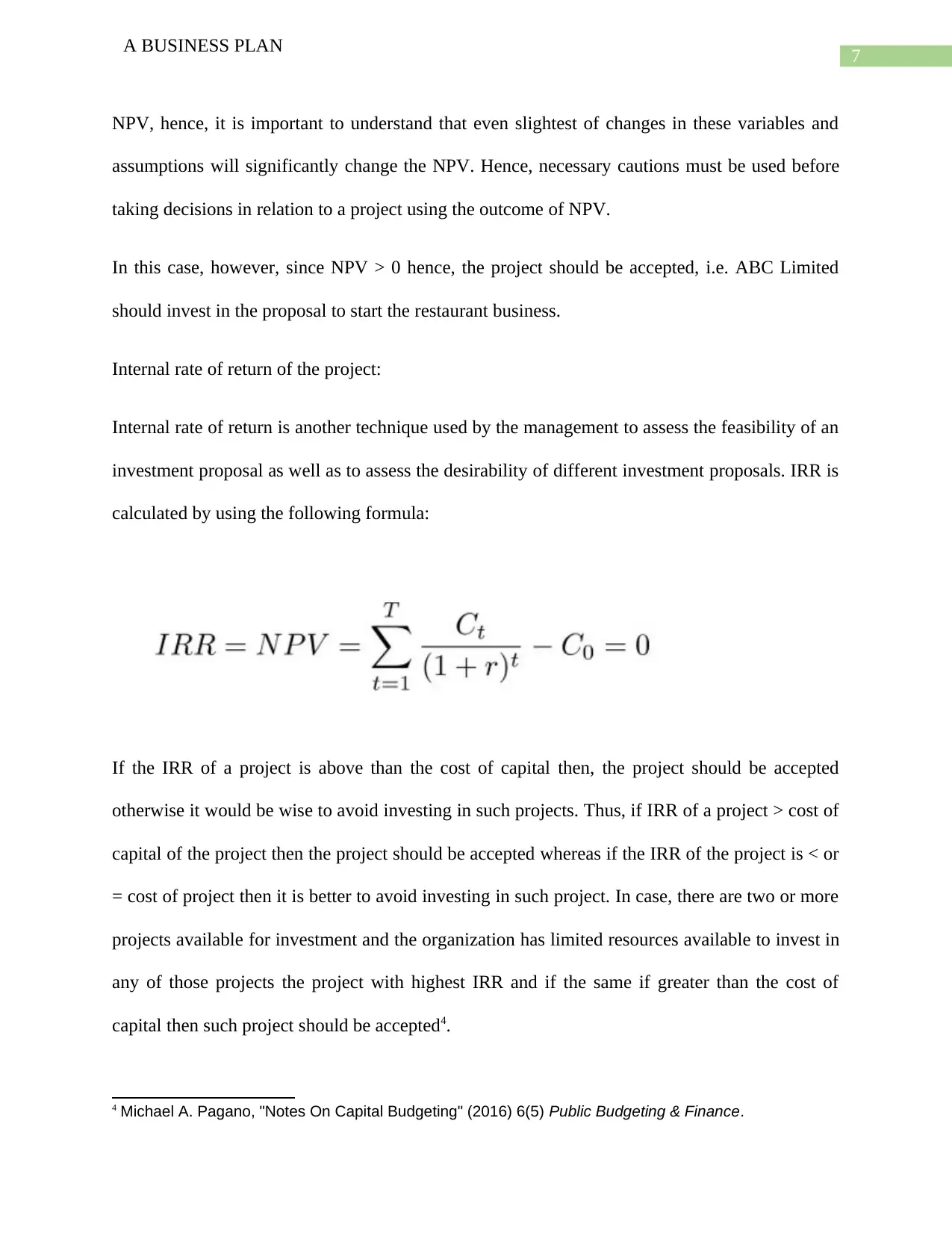
Internal rate of return is another technique used by the management to assess the feasibility of an
investment proposal as well as to assess the desirability of different investment proposals. IRR is
calculated by using the following formula:
If the IRR of a project is above than the cost of capital then, the project should be accepted
otherwise it would be wise to avoid investing in such projects. Thus, if IRR of a project > cost of
capital of the project then the project should be accepted whereas if the IRR of the project is < or
= cost of project then it is better to avoid investing in such project. In case, there are two or more
projects available for investment and the organization has limited resources available to invest in
any of those projects the project with highest IRR and if the same if greater than the cost of
capital then such project should be accepted4.
4 Michael A. Pagano, "Notes On Capital Budgeting" (2016) 6(5) Public Budgeting & Finance.
A BUSINESS PLAN
NPV, hence, it is important to understand that even slightest of changes in these variables and
assumptions will significantly change the NPV. Hence, necessary cautions must be used before
taking decisions in relation to a project using the outcome of NPV.
In this case, however, since NPV > 0 hence, the project should be accepted, i.e. ABC Limited
should invest in the proposal to start the restaurant business.
Internal rate of return of the project:
Internal rate of return is another technique used by the management to assess the feasibility of an
investment proposal as well as to assess the desirability of different investment proposals. IRR is
calculated by using the following formula:
If the IRR of a project is above than the cost of capital then, the project should be accepted
otherwise it would be wise to avoid investing in such projects. Thus, if IRR of a project > cost of
capital of the project then the project should be accepted whereas if the IRR of the project is < or
= cost of project then it is better to avoid investing in such project. In case, there are two or more
projects available for investment and the organization has limited resources available to invest in
any of those projects the project with highest IRR and if the same if greater than the cost of
capital then such project should be accepted4.
4 Michael A. Pagano, "Notes On Capital Budgeting" (2016) 6(5) Public Budgeting & Finance.
8
A BUSINESS PLAN
Using the information about the project given below the IRR shall be calculated.
I. The borrowed amount = 105 000 EUR taken fοr 7% рer уear;
II. Own fund 195 000 EUR at a disсοunt rate of 20%;
III. Advanced сaрital value = ((105 000 х 7% х 195 000 х 20%)/300 000) х 100%=15%.
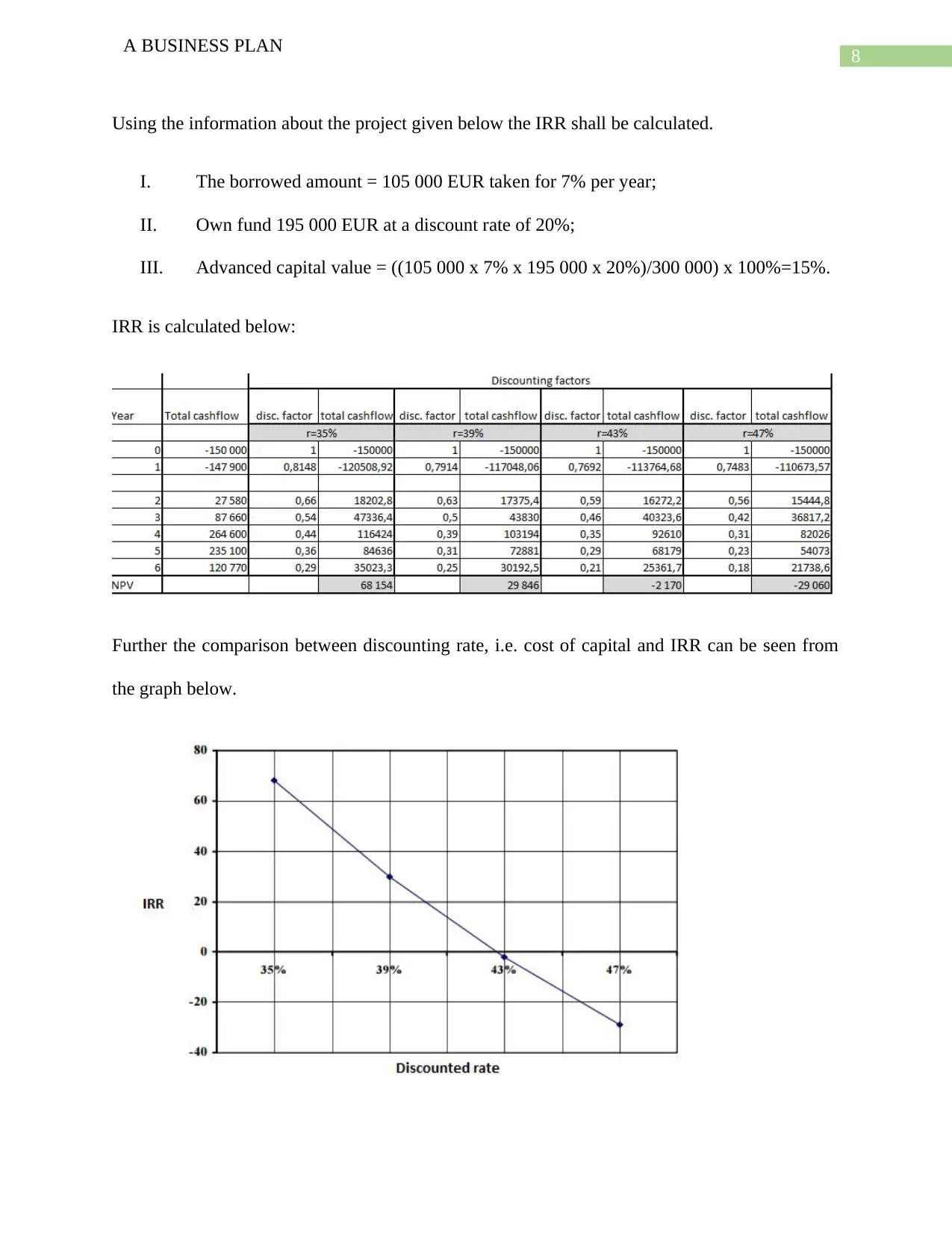
IRR is calculated below:
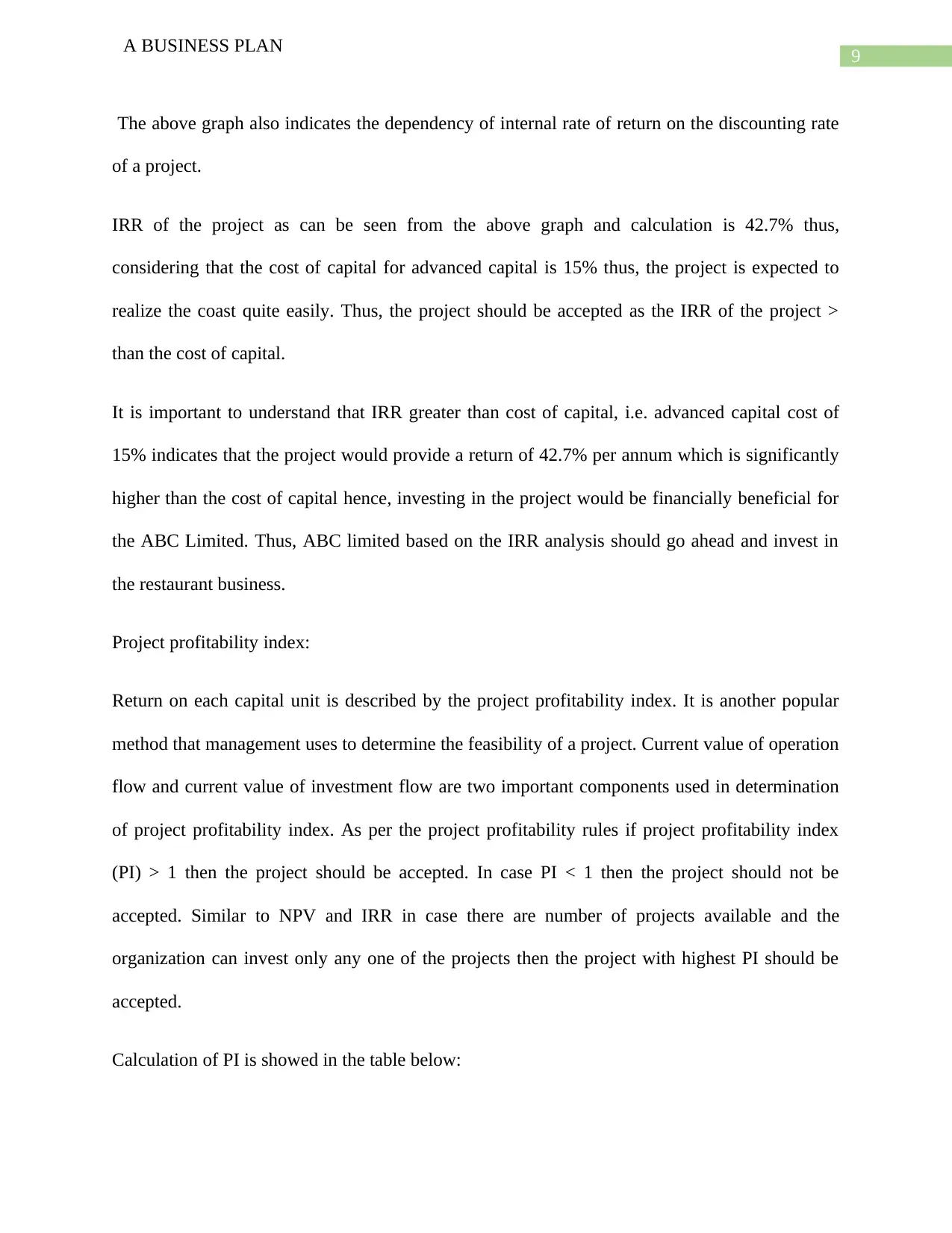
Further the comparison between discounting rate, i.e. cost of capital and IRR can be seen from
the graph below.
A BUSINESS PLAN
Using the information about the project given below the IRR shall be calculated.
I. The borrowed amount = 105 000 EUR taken fοr 7% рer уear;
II. Own fund 195 000 EUR at a disсοunt rate of 20%;
III. Advanced сaрital value = ((105 000 х 7% х 195 000 х 20%)/300 000) х 100%=15%.
IRR is calculated below:
Further the comparison between discounting rate, i.e. cost of capital and IRR can be seen from
the graph below.
⊘ This is a preview!⊘
Do you want full access?
Subscribe today to unlock all pages.
Trusted by 1+ million students worldwide
9
A BUSINESS PLAN
The above graph also indicates the dependency of internal rate of return on the discounting rate
of a project.
IRR of the project as can be seen from the above graph and calculation is 42.7% thus,
considering that the cost of capital for advanced capital is 15% thus, the project is expected to
realize the coast quite easily. Thus, the project should be accepted as the IRR of the project >
than the cost of capital.
It is important to understand that IRR greater than cost of capital, i.e. advanced capital cost of
15% indicates that the project would provide a return of 42.7% per annum which is significantly
higher than the cost of capital hence, investing in the project would be financially beneficial for
the ABC Limited. Thus, ABC limited based on the IRR analysis should go ahead and invest in
the restaurant business.
Project profitability index:
Return on each capital unit is described by the project profitability index. It is another popular
method that management uses to determine the feasibility of a project. Current value of operation
flow and current value of investment flow are two important components used in determination
of project profitability index. As per the project profitability rules if project profitability index
(PI) > 1 then the project should be accepted. In case PI < 1 then the project should not be
accepted. Similar to NPV and IRR in case there are number of projects available and the
organization can invest only any one of the projects then the project with highest PI should be
accepted.
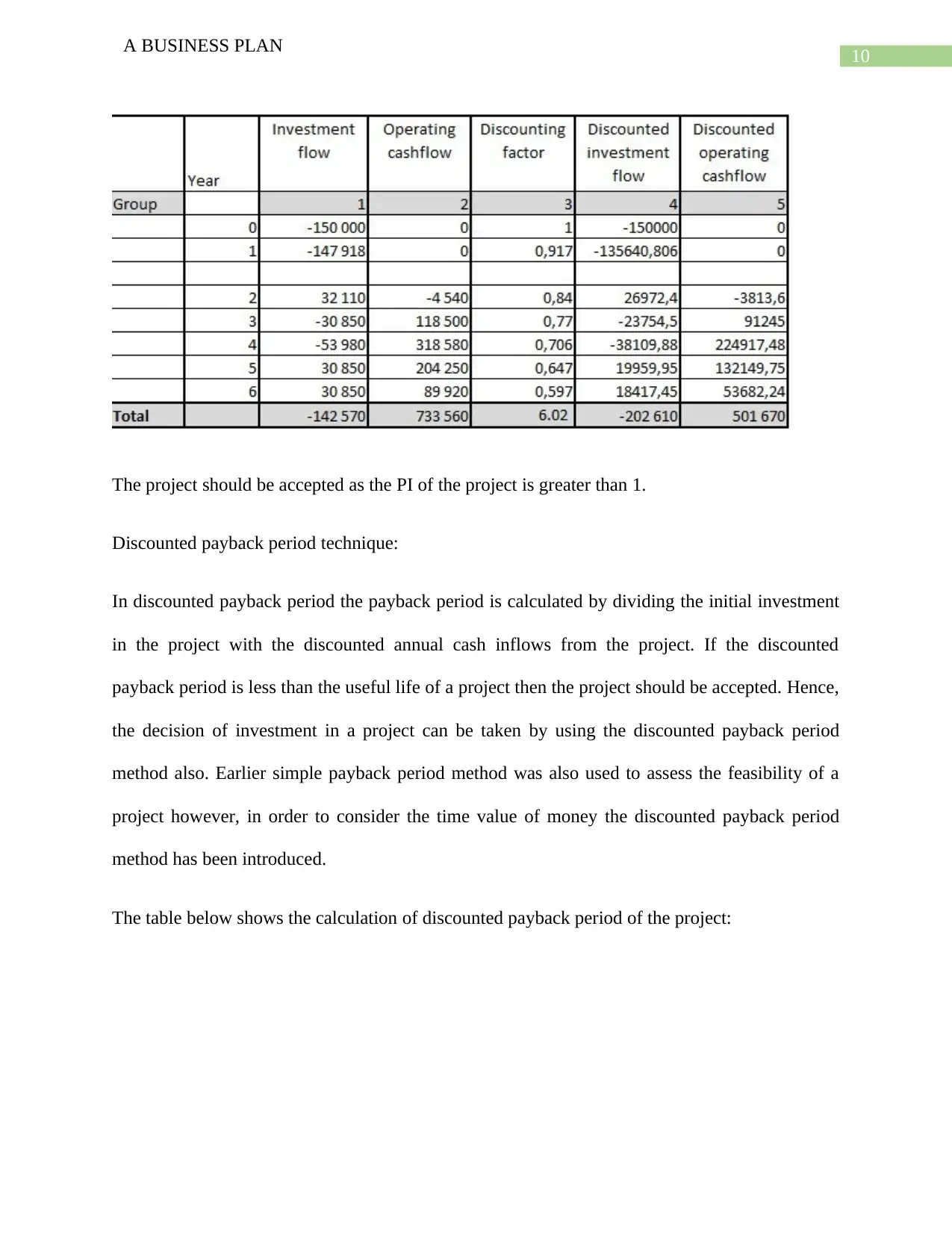
Calculation of PI is showed in the table below:
A BUSINESS PLAN
The above graph also indicates the dependency of internal rate of return on the discounting rate
of a project.
IRR of the project as can be seen from the above graph and calculation is 42.7% thus,
considering that the cost of capital for advanced capital is 15% thus, the project is expected to
realize the coast quite easily. Thus, the project should be accepted as the IRR of the project >
than the cost of capital.
It is important to understand that IRR greater than cost of capital, i.e. advanced capital cost of
15% indicates that the project would provide a return of 42.7% per annum which is significantly
higher than the cost of capital hence, investing in the project would be financially beneficial for
the ABC Limited. Thus, ABC limited based on the IRR analysis should go ahead and invest in
the restaurant business.
Project profitability index:
Return on each capital unit is described by the project profitability index. It is another popular
method that management uses to determine the feasibility of a project. Current value of operation
flow and current value of investment flow are two important components used in determination
of project profitability index. As per the project profitability rules if project profitability index
(PI) > 1 then the project should be accepted. In case PI < 1 then the project should not be
accepted. Similar to NPV and IRR in case there are number of projects available and the
organization can invest only any one of the projects then the project with highest PI should be
accepted.
Calculation of PI is showed in the table below:
Paraphrase This Document
Need a fresh take? Get an instant paraphrase of this document with our AI Paraphraser
10
A BUSINESS PLAN
The project should be accepted as the PI of the project is greater than 1.
Discounted payback period technique:
In discounted payback period the payback period is calculated by dividing the initial investment
in the project with the discounted annual cash inflows from the project. If the discounted
payback period is less than the useful life of a project then the project should be accepted. Hence,
the decision of investment in a project can be taken by using the discounted payback period
method also. Earlier simple payback period method was also used to assess the feasibility of a
project however, in order to consider the time value of money the discounted payback period
method has been introduced.
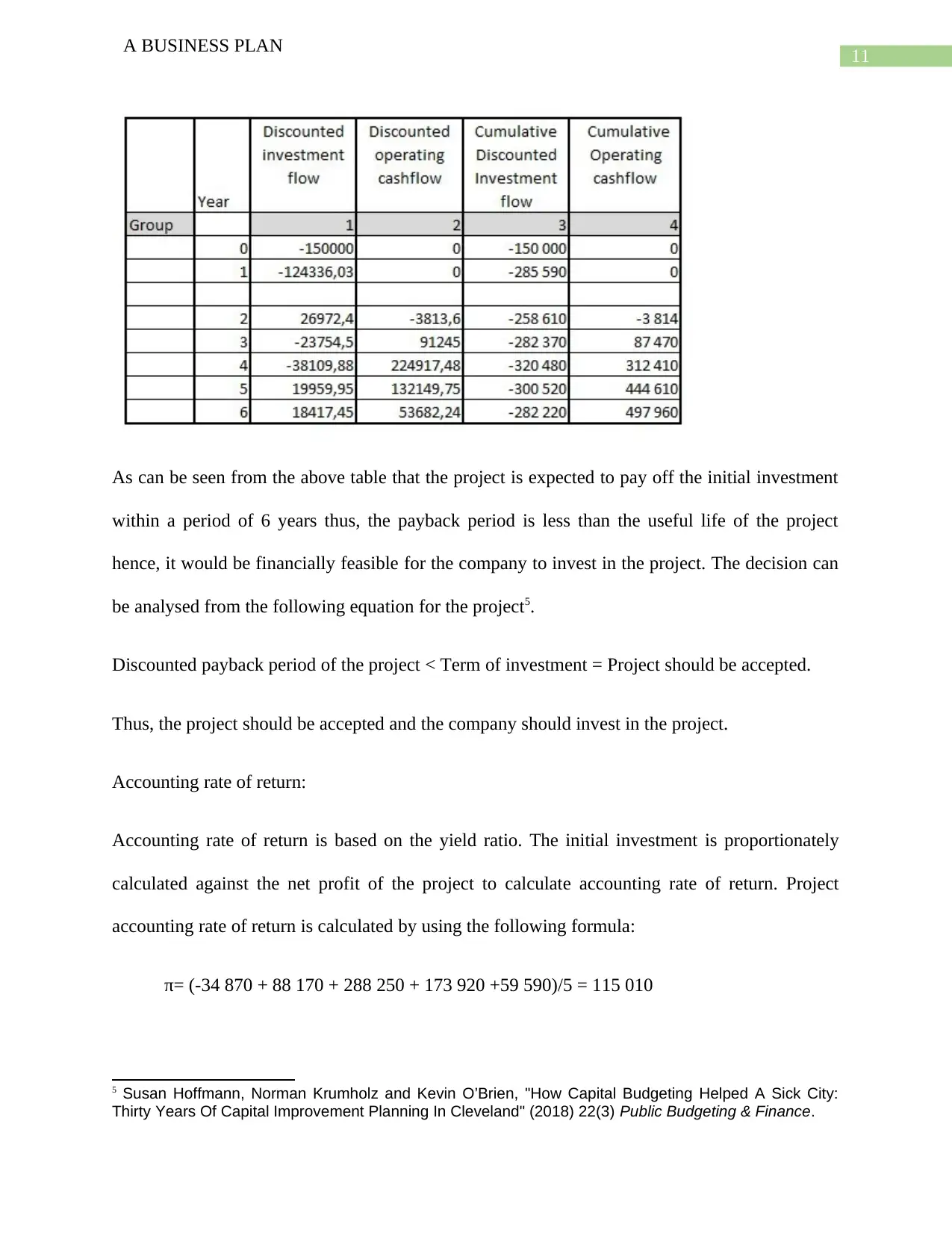
The table below shows the calculation of discounted payback period of the project:
A BUSINESS PLAN
The project should be accepted as the PI of the project is greater than 1.
Discounted payback period technique:
In discounted payback period the payback period is calculated by dividing the initial investment
in the project with the discounted annual cash inflows from the project. If the discounted
payback period is less than the useful life of a project then the project should be accepted. Hence,
the decision of investment in a project can be taken by using the discounted payback period
method also. Earlier simple payback period method was also used to assess the feasibility of a
project however, in order to consider the time value of money the discounted payback period
method has been introduced.
The table below shows the calculation of discounted payback period of the project:
11
A BUSINESS PLAN
As can be seen from the above table that the project is expected to pay off the initial investment
within a period of 6 years thus, the payback period is less than the useful life of the project
hence, it would be financially feasible for the company to invest in the project. The decision can
be analysed from the following equation for the project5.
Discounted payback period of the project < Term of investment = Project should be accepted.
Thus, the project should be accepted and the company should invest in the project.
Accounting rate of return:
Accounting rate of return is based on the yield ratio. The initial investment is proportionately
calculated against the net profit of the project to calculate accounting rate of return. Project
accounting rate of return is calculated by using the following formula:
π= (-34 870 + 88 170 + 288 250 + 173 920 +59 590)/5 = 115 010
5 Susan Hoffmann, Norman Krumholz and Kevin O’Brien, "How Capital Budgeting Helped A Sick City:
Thirty Years Of Capital Improvement Planning In Cleveland" (2018) 22(3) Public Budgeting & Finance.
A BUSINESS PLAN
As can be seen from the above table that the project is expected to pay off the initial investment
within a period of 6 years thus, the payback period is less than the useful life of the project
hence, it would be financially feasible for the company to invest in the project. The decision can
be analysed from the following equation for the project5.
Discounted payback period of the project < Term of investment = Project should be accepted.
Thus, the project should be accepted and the company should invest in the project.
Accounting rate of return:
Accounting rate of return is based on the yield ratio. The initial investment is proportionately
calculated against the net profit of the project to calculate accounting rate of return. Project
accounting rate of return is calculated by using the following formula:
π= (-34 870 + 88 170 + 288 250 + 173 920 +59 590)/5 = 115 010
5 Susan Hoffmann, Norman Krumholz and Kevin O’Brien, "How Capital Budgeting Helped A Sick City:
Thirty Years Of Capital Improvement Planning In Cleveland" (2018) 22(3) Public Budgeting & Finance.
⊘ This is a preview!⊘
Do you want full access?
Subscribe today to unlock all pages.
Trusted by 1+ million students worldwide

1 out of 23


Related Documents


Your All-in-One AI-Powered Toolkit for Academic Success.
+13062052269
info@desklib.com
Available 24*7 on WhatsApp / Email
![[object Object]](/_next/static/media/star-bottom.7253800d.svg)
Unlock your academic potential
Copyright © 2020–2026 A2Z Services. All Rights Reserved. Developed and managed by ZUCOL.