Managing Human Resources: Training, Performance, & Employment Law
VerifiedAdded on 2023/06/14
|11
|3448
|85
Report
AI Summary
This report provides an overview of managing human resources, emphasizing the importance of training and learning methods, performance management, and employment-related legislation. It explores various learning styles such as VARK and Kolb's theory, highlighting their advantages and disadvantages in different contexts. The report delves into performance management practices, including SMART goal setting and the use of Key Performance Indicators (KPIs) to evaluate employee and organizational performance. Furthermore, it discusses employment legislation like the Employment Contract Act, Data Protection Act, and Disciplinary Processes Act, underscoring their role in protecting employee rights and ensuring fair labor practices. The analysis aims to provide insights into effective human resource management strategies for organizational success. Desklib provides access to this and many other solved assignments.

MANAGING HUMAN RESOURCES

Paraphrase This Document
Need a fresh take? Get an instant paraphrase of this document with our AI Paraphraser
EXECUTIVE SUMMARY
Managing human relation most likely provides many benefits to the industry in identifying,
observing and analysis of operations. As, with the proper usage of that businesses being able to
assess about the environment and also, improve their working efficiency. By this also helps in
monitoring about various aspects of working persons in accordance of their performance. With
the help of human resources firm not being able to achieve their targeted goals. The report
basically based on telling about different types of training and learning techniques utilized by
industry. Furthermore, it also, provides information about the performance management and its
purpose in organization. Lastly, the analysis provides details regarding different types of
legislative laws in regard to working employee under managing human resource.
Managing human relation most likely provides many benefits to the industry in identifying,
observing and analysis of operations. As, with the proper usage of that businesses being able to
assess about the environment and also, improve their working efficiency. By this also helps in
monitoring about various aspects of working persons in accordance of their performance. With
the help of human resources firm not being able to achieve their targeted goals. The report
basically based on telling about different types of training and learning techniques utilized by
industry. Furthermore, it also, provides information about the performance management and its
purpose in organization. Lastly, the analysis provides details regarding different types of
legislative laws in regard to working employee under managing human resource.
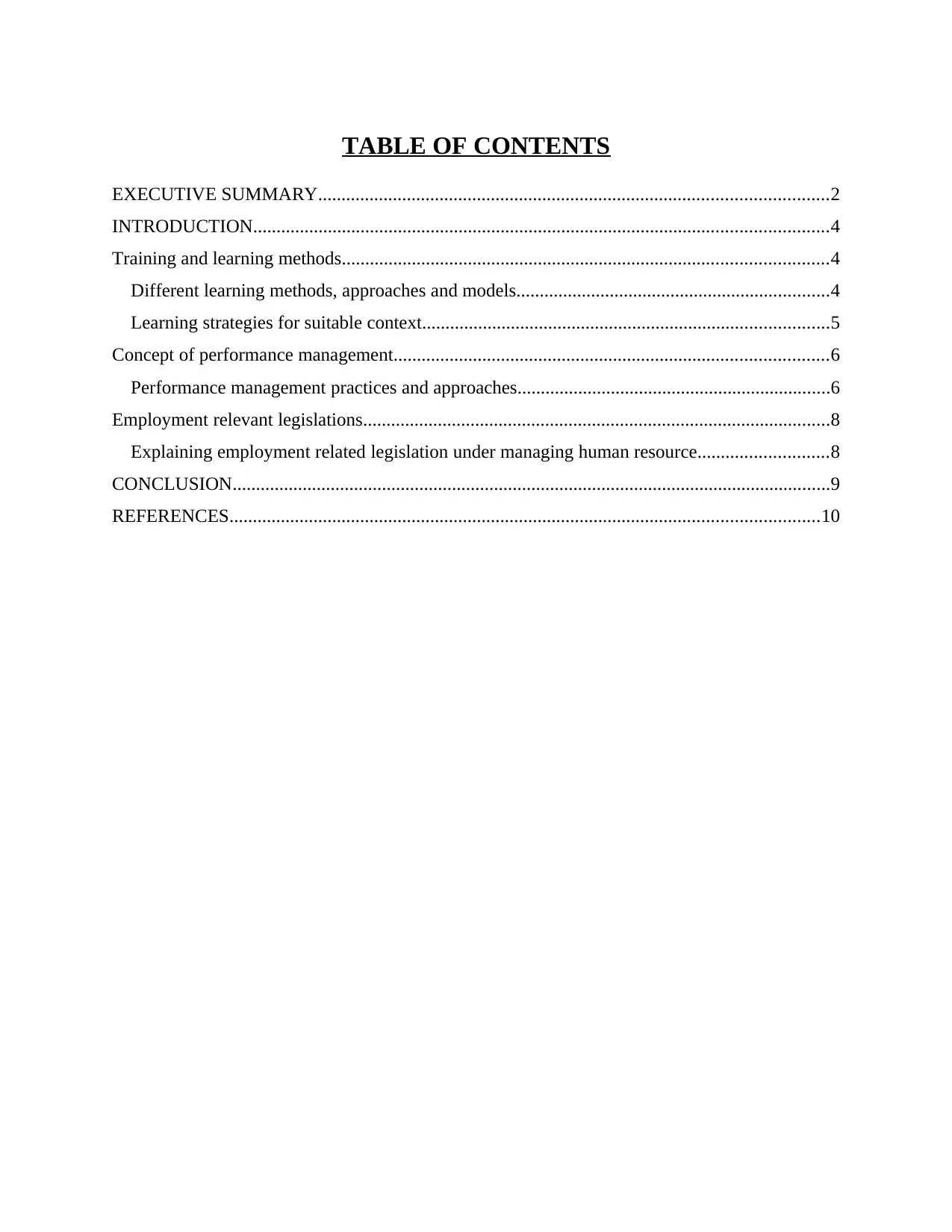
TABLE OF CONTENTS
EXECUTIVE SUMMARY.............................................................................................................2
INTRODUCTION...........................................................................................................................4
Training and learning methods........................................................................................................4
Different learning methods, approaches and models...................................................................4
Learning strategies for suitable context.......................................................................................5
Concept of performance management.............................................................................................6
Performance management practices and approaches...................................................................6
Employment relevant legislations....................................................................................................8
Explaining employment related legislation under managing human resource............................8
CONCLUSION................................................................................................................................9
REFERENCES..............................................................................................................................10
EXECUTIVE SUMMARY.............................................................................................................2
INTRODUCTION...........................................................................................................................4
Training and learning methods........................................................................................................4
Different learning methods, approaches and models...................................................................4
Learning strategies for suitable context.......................................................................................5
Concept of performance management.............................................................................................6
Performance management practices and approaches...................................................................6
Employment relevant legislations....................................................................................................8
Explaining employment related legislation under managing human resource............................8
CONCLUSION................................................................................................................................9
REFERENCES..............................................................................................................................10
⊘ This is a preview!⊘
Do you want full access?
Subscribe today to unlock all pages.

Trusted by 1+ million students worldwide
INTRODUCTION
Managing Human Resource is basically defined as the method which, being used by any
firm for the effectively hiring, selecting, recruiting and managing the work force. This plays a
very important role in any organization for meeting the requirements so that, they may being able
to increase the productivity for gaining profits. As, it is required at different level so that brand
became capable enough to increase market share, improves the efficiency in working and gain
competitive advantage over others firms. In addition, also provides assistance in effectively
working operation so that, company being able to match the demand and supply of customers.
The reports show about the various training and learning methods as well as, techniques
required. Furthermore, it provides details regarding the concept and purpose of performance
management. Lastly, analysis shows about the employment related legislation in managing
human resource.
Training and learning methods
Different learning methods, approaches and models
These are generally described as the various methods or ways which firm may utilize for
providing their working employees with appropriate knowledge and skills. As, these plays very
vital role in any organization to effectively and efficiently working for the betterment. This
includes:
VARK Learning Style: The model most likely aims to provide the details regarding about
managers in developing several strategies for promoting employees learning, in accordance to
their style of learning things (What are VARK Learning Styles, 2022). With the help of
identifying different types of learners leaders may utilize different learning style which includes:
Visual Learning: The people who majorly get to know or learn about various skills and
knowledge with the help of pictures, comes under this method (Tampuu and et.al., 2020). As, the
individuals learns best by looking or seeing various diagrams, illustrations, charts and many
more.
Auditory Learning: Under this method aims to share details about the employee who
gets the learning with hearing about the information. As, these working people tend to get high
acceptable knowledge about the topic with the help of hearing the lectures as well as, also being
good at remembering.
Managing Human Resource is basically defined as the method which, being used by any
firm for the effectively hiring, selecting, recruiting and managing the work force. This plays a
very important role in any organization for meeting the requirements so that, they may being able
to increase the productivity for gaining profits. As, it is required at different level so that brand
became capable enough to increase market share, improves the efficiency in working and gain
competitive advantage over others firms. In addition, also provides assistance in effectively
working operation so that, company being able to match the demand and supply of customers.
The reports show about the various training and learning methods as well as, techniques
required. Furthermore, it provides details regarding the concept and purpose of performance
management. Lastly, analysis shows about the employment related legislation in managing
human resource.
Training and learning methods
Different learning methods, approaches and models
These are generally described as the various methods or ways which firm may utilize for
providing their working employees with appropriate knowledge and skills. As, these plays very
vital role in any organization to effectively and efficiently working for the betterment. This
includes:
VARK Learning Style: The model most likely aims to provide the details regarding about
managers in developing several strategies for promoting employees learning, in accordance to
their style of learning things (What are VARK Learning Styles, 2022). With the help of
identifying different types of learners leaders may utilize different learning style which includes:
Visual Learning: The people who majorly get to know or learn about various skills and
knowledge with the help of pictures, comes under this method (Tampuu and et.al., 2020). As, the
individuals learns best by looking or seeing various diagrams, illustrations, charts and many
more.
Auditory Learning: Under this method aims to share details about the employee who
gets the learning with hearing about the information. As, these working people tend to get high
acceptable knowledge about the topic with the help of hearing the lectures as well as, also being
good at remembering.
Paraphrase This Document
Need a fresh take? Get an instant paraphrase of this document with our AI Paraphraser
Reading and Writing: Employees who most likely to learn from taking several
information which being displayed in the form of as text or words (Yakubova, 2021). The
working force majorly gets the skills and knowledge with the help of writing and reading out the
given information.
Kinaesthetic Learning: Also, known as tactile learners which aims to get the
information and skills by touching and doing stuff on their own. People get to develop their
learning with doing the things on their own way.
Kolb's Theory of Learning Styles: As, just like the above tourism industry may tend to utilize
this style as well (Kolb's Learning Styles and Experiential Learning Cycle, 2022). Under this
majorly aims at providing details about employees learning preferences is based on four modes.
With the acquiring of concepts which may be applied flexibly in accordance to situations. This
includes:
Concrete Experience: Under this mainly focusing on providing the details regarding that
while working employees encounters new experiences. With the help of this people get to know
about the task and also being able to develop the knowledge with the situation occurred.
Reflective Observation: The next stage which most likely to provides details about
having and gaining the learning with the help of reflective observations (Leder and et.al., 2019).
Under this the working force tends to reflect on the experiences on several personal basis. This
also, help them in developing and learning about experiences.
Abstract Conceptualisation: This basically provides details regarding the employees
generating various new ideas or coming up with different strategies. As the worker after
observing their reflection learns about and utilizes new techniques in accordance to situation.
This helps them in effectively learning and efficiency increase.
Active Experimentation: The last stage which most likely to get provide information
about application of the new ideas and methods (Keegan, Ringhofer and Huemann, 2018). With
the help of actively experimenting employees may get to develop more of their learning by
getting information about the implemented ideas.
Learning strategies for suitable context
As, with the help as well as, proper utilization of all the employees being able to
effectively improve their learning. Not just that, but the help of this working personal may also
being able to adapt towards the situations and overcome them. Along with that, by the assistance
information which being displayed in the form of as text or words (Yakubova, 2021). The
working force majorly gets the skills and knowledge with the help of writing and reading out the
given information.
Kinaesthetic Learning: Also, known as tactile learners which aims to get the
information and skills by touching and doing stuff on their own. People get to develop their
learning with doing the things on their own way.
Kolb's Theory of Learning Styles: As, just like the above tourism industry may tend to utilize
this style as well (Kolb's Learning Styles and Experiential Learning Cycle, 2022). Under this
majorly aims at providing details about employees learning preferences is based on four modes.
With the acquiring of concepts which may be applied flexibly in accordance to situations. This
includes:
Concrete Experience: Under this mainly focusing on providing the details regarding that
while working employees encounters new experiences. With the help of this people get to know
about the task and also being able to develop the knowledge with the situation occurred.
Reflective Observation: The next stage which most likely to provides details about
having and gaining the learning with the help of reflective observations (Leder and et.al., 2019).
Under this the working force tends to reflect on the experiences on several personal basis. This
also, help them in developing and learning about experiences.
Abstract Conceptualisation: This basically provides details regarding the employees
generating various new ideas or coming up with different strategies. As the worker after
observing their reflection learns about and utilizes new techniques in accordance to situation.
This helps them in effectively learning and efficiency increase.
Active Experimentation: The last stage which most likely to get provide information
about application of the new ideas and methods (Keegan, Ringhofer and Huemann, 2018). With
the help of actively experimenting employees may get to develop more of their learning by
getting information about the implemented ideas.
Learning strategies for suitable context
As, with the help as well as, proper utilization of all the employees being able to
effectively improve their learning. Not just that, but the help of this working personal may also
being able to adapt towards the situations and overcome them. Along with that, by the assistance
of different styles, various approaches and models the tourism industry may being able to
provide their working people the accurate and appropriate learning (Ghiasi and et.al., 2021).
Bases VARK Learning Style Kolb's Theory of Learning
Styles
Advantage It helps in identifying
various preferences
Provides assistance in
effective learning
Flexible
Helps in learning
growth
Helps in gaining self-
knowledge more
effectively
Also, provides
information of areas of
improvement
(Abdollahi, Tomita and
Hassanpour, 2020).
Enhance study skills
Disadvantage Very time-consuming
Have restrictive
working
May causes hinder in
learning
Requires higher level
of preparation
Also, time taking
method
Concept of performance management
Performance management practices and approaches
Performance management is generally described as the various strategies, methods or
ways which firm may utilize for managing the performance of working personal. With the help
of this one may also being able to develop different skills and knowledge which provides them
the assistance in organizational and group goal achievement (Sriharana and Tseb, 2019). Not just
that, but with the aid of this employees also being able to proactive in an enterprise.
Pro-active Performance Management: Under this team of leader and his/her sub
ordinates majorly involves and helps in establishing goals. Not just that, but working force
proactively aims at improving performance and also to overcome any of the upcoming obstacle.
Apart from this industry also use approach:Adams, Z., and et.al., 2019
provide their working people the accurate and appropriate learning (Ghiasi and et.al., 2021).
Bases VARK Learning Style Kolb's Theory of Learning
Styles
Advantage It helps in identifying
various preferences
Provides assistance in
effective learning
Flexible
Helps in learning
growth
Helps in gaining self-
knowledge more
effectively
Also, provides
information of areas of
improvement
(Abdollahi, Tomita and
Hassanpour, 2020).
Enhance study skills
Disadvantage Very time-consuming
Have restrictive
working
May causes hinder in
learning
Requires higher level
of preparation
Also, time taking
method
Concept of performance management
Performance management practices and approaches
Performance management is generally described as the various strategies, methods or
ways which firm may utilize for managing the performance of working personal. With the help
of this one may also being able to develop different skills and knowledge which provides them
the assistance in organizational and group goal achievement (Sriharana and Tseb, 2019). Not just
that, but with the aid of this employees also being able to proactive in an enterprise.
Pro-active Performance Management: Under this team of leader and his/her sub
ordinates majorly involves and helps in establishing goals. Not just that, but working force
proactively aims at improving performance and also to overcome any of the upcoming obstacle.
Apart from this industry also use approach:Adams, Z., and et.al., 2019
⊘ This is a preview!⊘
Do you want full access?
Subscribe today to unlock all pages.
Trusted by 1+ million students worldwide
SMART Goal Setting: It is basically defined as the setting of various parameters which
provides assistance in analysing and comparison (SMART Goals, 2022). This may results in
improving the performance by getting to know about different areas which required focus. Under
this:
Specific: Under this majorly focus on creation of clear and specific goals. As, various
goals being made which may be achieved by the industry for increasing their working efficiency.
These goals required to be made so that working force being able to excel them and increase
their knowledge and performance.
Measurable: This aims to provide the details that measuring about how the goals being
achieved. In addition, this may also help in easily tracking of the performance so that employees
being able to get to know about their work (Presti, 2021).
Achievable: Sets information about setting various achievable goals. As, making and
creation of such targets which may being achieved by the working people. The goals setted
means to be realistic and also meaningful so that employees work hard for achieve that.
Relevant: The performance objectives required to be relevant about what industry may
putting efforts to achieve (Toshov, 2021). As, every target made must require aligning with
values as well as, long term goals. With the help of this industry may improve the performance
of people.
Time Bounded: Last step majorly focus on providing information related to know about
setting up time frame for the setted objective. Any kind of end date to goal achievement results
in providing motivation along with prioritizing the goal.
Key Performance Indicators: Along with above industry may also try to utilize various types
of KPI's which most likely to provides assistance in effectively managing performance (Ali and
Haliah, 2021). As, these are some, of the measurable values which is used for evaluation of
performance of employees or industry in achieving their targets. This consists:
Profit margin: This most likely to provide help in getting to know about profit being
earned by industry. With identifying and analysing about hoe effectively business is generating
profits and performance.
CRR: Customer Retention Rate aims to focus on getting to know about the number of
customers being with industry (Varouchas, Sicilia and Sánchez-Alonso, 2018). Being one of the
provides assistance in analysing and comparison (SMART Goals, 2022). This may results in
improving the performance by getting to know about different areas which required focus. Under
this:
Specific: Under this majorly focus on creation of clear and specific goals. As, various
goals being made which may be achieved by the industry for increasing their working efficiency.
These goals required to be made so that working force being able to excel them and increase
their knowledge and performance.
Measurable: This aims to provide the details that measuring about how the goals being
achieved. In addition, this may also help in easily tracking of the performance so that employees
being able to get to know about their work (Presti, 2021).
Achievable: Sets information about setting various achievable goals. As, making and
creation of such targets which may being achieved by the working people. The goals setted
means to be realistic and also meaningful so that employees work hard for achieve that.
Relevant: The performance objectives required to be relevant about what industry may
putting efforts to achieve (Toshov, 2021). As, every target made must require aligning with
values as well as, long term goals. With the help of this industry may improve the performance
of people.
Time Bounded: Last step majorly focus on providing information related to know about
setting up time frame for the setted objective. Any kind of end date to goal achievement results
in providing motivation along with prioritizing the goal.
Key Performance Indicators: Along with above industry may also try to utilize various types
of KPI's which most likely to provides assistance in effectively managing performance (Ali and
Haliah, 2021). As, these are some, of the measurable values which is used for evaluation of
performance of employees or industry in achieving their targets. This consists:
Profit margin: This most likely to provide help in getting to know about profit being
earned by industry. With identifying and analysing about hoe effectively business is generating
profits and performance.
CRR: Customer Retention Rate aims to focus on getting to know about the number of
customers being with industry (Varouchas, Sicilia and Sánchez-Alonso, 2018). Being one of the
Paraphrase This Document
Need a fresh take? Get an instant paraphrase of this document with our AI Paraphraser
most important metrics for determining about loyalty of consumers and getting high performance
from least one or not.
Customer Satisfaction: Metrics majorly revels about knowing how many people being
satisfied with the performance of industry (Meričková and et.al., 2020). This KPI require to align
with the business goals so that industry being able to improve their effectiveness as well as,
performance.
RPC: Also known as Revenue Per Client is which focus on providing details about the
revenue being generated by the tourism industry per click (Hannila and et.al., 2020). If the
business being able to generate amount of profits with customers results in high performance.
Employment relevant legislations
Explaining employment related legislation under managing human resource
The legislation related to employment basically shares information about various types of
labour laws made for protecting the rights of workers. Apart from that, it plays very crucial role
in managing labours so that they, feel secured while doing their work. Various acts includes:
Employment Contract Act: The Act was established in 1963 under the Parliament of
UK which provides details about providing the prior notice before dismissal of any labour. The
tourism industry require for follow the act. As, with the incorporation of this business being able
to effectively manage the working labours (Liebregts and Stam, 2019). Not just that, but with the
proper utilization of this law results in industry to retain their employees. Along with that, it also
helps in maintaining the reputation of business with appropriate policies. In addition, also having
control over the staff when there is very availability. This most likely to helps in protecting the
interest of workers (Jimeno, Martínez-Matute and Mora-Sanguinetti, 2018).
Data Protection Act: UK protection Data Act of 2018 aims to share details about the
proper control of personal information by any of the enterprise or industry (Amo Filvá and et.al.,
2018). As, it is required to provide the privacy to every working personal. By adapting this
legislation tourism industry being able to gives security to every information of working persons.
Along with that, incorporating such law helps in setting out about various targets and re-
checking data being used fairly. Not just that, but having such act under the operation of industry
helps them in maintaining the trust of employees working there. This also, aids in improving
performance as well.
from least one or not.
Customer Satisfaction: Metrics majorly revels about knowing how many people being
satisfied with the performance of industry (Meričková and et.al., 2020). This KPI require to align
with the business goals so that industry being able to improve their effectiveness as well as,
performance.
RPC: Also known as Revenue Per Client is which focus on providing details about the
revenue being generated by the tourism industry per click (Hannila and et.al., 2020). If the
business being able to generate amount of profits with customers results in high performance.
Employment relevant legislations
Explaining employment related legislation under managing human resource
The legislation related to employment basically shares information about various types of
labour laws made for protecting the rights of workers. Apart from that, it plays very crucial role
in managing labours so that they, feel secured while doing their work. Various acts includes:
Employment Contract Act: The Act was established in 1963 under the Parliament of
UK which provides details about providing the prior notice before dismissal of any labour. The
tourism industry require for follow the act. As, with the incorporation of this business being able
to effectively manage the working labours (Liebregts and Stam, 2019). Not just that, but with the
proper utilization of this law results in industry to retain their employees. Along with that, it also
helps in maintaining the reputation of business with appropriate policies. In addition, also having
control over the staff when there is very availability. This most likely to helps in protecting the
interest of workers (Jimeno, Martínez-Matute and Mora-Sanguinetti, 2018).
Data Protection Act: UK protection Data Act of 2018 aims to share details about the
proper control of personal information by any of the enterprise or industry (Amo Filvá and et.al.,
2018). As, it is required to provide the privacy to every working personal. By adapting this
legislation tourism industry being able to gives security to every information of working persons.
Along with that, incorporating such law helps in setting out about various targets and re-
checking data being used fairly. Not just that, but having such act under the operation of industry
helps them in maintaining the trust of employees working there. This also, aids in improving
performance as well.
Disciplinary Processes Act: Procedure law which aims to focus on information with the
various ways for employers in dealing with every disciplinary issues occurred. As, being a part
of Employment Rights Act from 1996, allegations made in against of any working people for
misconducting or doing anything not legal. By incorporating such legislation majorly provides
assistance to industry in having an equal rights between all (De Rooij and et.al., 2019). By the
proper utilization of this law business being able to work effectively. Not just that, but also gives
out an equal opportunity or chances to operate the business without hurting the sentiments of any
task force.
Equality and Diversity Act: Law basically provides the details for protecting the rights
and people themselves from any kind of discrimination at the working place. The Equality Act
2010 also helps in effectively saving both the working people and industry in getting any of the
partiality while performing their activities (Adams and et.al., 2019). The business require to
adapt the legislation so that, it may help them in managing the task force along with operations.
In addition, with accommodating such law also, provides the assistance in making and keeping
the working personal motivated towards their work. Apart from that, it also provides the
assessment in lowering down or even preventing any of the legal issue which may arise in the
future.
Termination of Employment Act: Law majorly shares the information regarding the
ending of working employee after the breach or broken of contracts (Pohorelova, 2019). As
under this legislation after the agreement or any sort of contract is over, one week of notice
period being provided to both industry and working personal. With the adaption of this law
business may be able to provide an equal opportunity for both the parties to solve out the ending
process. Apart from that, but with incorporation of this travel agencies also, gets the chances to
improve their working (Pryazhennikov, 2020). Not just that, but having such gives another
benefit in effectively managing the human resources by using such rules and regulations.
CONCLUSION
From the above report it has been concluded that, managing human resource does plays a
very crucial role in success to any organization. It contributes in effectively utilizing all the
working personal to their fullest capacity. In addition, this also provides assistance to industry in
executing their operations without any problems, increase profits and gain competitive advantage
over other firms. Furthermore, the report provides details regarding various types of training and
various ways for employers in dealing with every disciplinary issues occurred. As, being a part
of Employment Rights Act from 1996, allegations made in against of any working people for
misconducting or doing anything not legal. By incorporating such legislation majorly provides
assistance to industry in having an equal rights between all (De Rooij and et.al., 2019). By the
proper utilization of this law business being able to work effectively. Not just that, but also gives
out an equal opportunity or chances to operate the business without hurting the sentiments of any
task force.
Equality and Diversity Act: Law basically provides the details for protecting the rights
and people themselves from any kind of discrimination at the working place. The Equality Act
2010 also helps in effectively saving both the working people and industry in getting any of the
partiality while performing their activities (Adams and et.al., 2019). The business require to
adapt the legislation so that, it may help them in managing the task force along with operations.
In addition, with accommodating such law also, provides the assistance in making and keeping
the working personal motivated towards their work. Apart from that, it also provides the
assessment in lowering down or even preventing any of the legal issue which may arise in the
future.
Termination of Employment Act: Law majorly shares the information regarding the
ending of working employee after the breach or broken of contracts (Pohorelova, 2019). As
under this legislation after the agreement or any sort of contract is over, one week of notice
period being provided to both industry and working personal. With the adaption of this law
business may be able to provide an equal opportunity for both the parties to solve out the ending
process. Apart from that, but with incorporation of this travel agencies also, gets the chances to
improve their working (Pryazhennikov, 2020). Not just that, but having such gives another
benefit in effectively managing the human resources by using such rules and regulations.
CONCLUSION
From the above report it has been concluded that, managing human resource does plays a
very crucial role in success to any organization. It contributes in effectively utilizing all the
working personal to their fullest capacity. In addition, this also provides assistance to industry in
executing their operations without any problems, increase profits and gain competitive advantage
over other firms. Furthermore, the report provides details regarding various types of training and
⊘ This is a preview!⊘
Do you want full access?
Subscribe today to unlock all pages.
Trusted by 1+ million students worldwide
learning methods along with techniques. Moreover, it shows about the concept and also purpose
of performance management. Lastly, analysis provides details about different types of
employment related legislation under managing HR.
REFERENCES
Books and Journals
Abdollahi, B., Tomita, N. and Hassanpour, S., 2020. Data augmentation in training deep learning
models for medical image analysis. In Deep learners and deep learner descriptors for
medical applications (pp. 167-180). Springer, Cham.
Adams, Z., and et.al., 2019. The economic significance of laws relating to employment
protection and different forms of employment: analysis of a panel of 117 countries,
1990–2013. International Labour Review. 158(1). pp.1-35.
Ali, Y. and Haliah, H., 2021. Implementation of New Public Management Concept in Budget
Preparation in Indonesia. International Journal of Social Science Research and Review.
4(3). pp.28-36.
Amo Filvá, D. and et.al., 2018. The student’s progress snapshot a hybrid text and visual learning
analytics dashboard. International journal of engineering education. 34(3). pp.990-
1000.
De Rooij, M. M. and et.al., 2019. A configurational explanation for performance management
systems' design in project-based organizations. International Journal of Project
Management. 37(5). pp.616-630.
Ghiasi, G., and et.al., 2021. Multi-task self-training for learning general representations. In
Proceedings of the IEEE/CVF International Conference on Computer Vision (pp. 8856-
8865).
Hannila, H., and et.al., 2020. Digitalisation of a company decision-making system: a concept for
data-driven and fact-based product portfolio management. Journal of Decision Systems,
pp.1-22.
Jimeno, J.F., Martínez-Matute, M. and Mora-Sanguinetti, J.S., 2018. Employment protection
legislation, labor courts, and effective firing costs. IZA Journal of Labor Economics,
9(1).
Keegan, A., Ringhofer, C. and Huemann, M., 2018. Human resource management and project
based organizing: Fertile ground, missed opportunities and prospects for closer
connections. International Journal of Project Management.36(1). pp.121-133.
of performance management. Lastly, analysis provides details about different types of
employment related legislation under managing HR.
REFERENCES
Books and Journals
Abdollahi, B., Tomita, N. and Hassanpour, S., 2020. Data augmentation in training deep learning
models for medical image analysis. In Deep learners and deep learner descriptors for
medical applications (pp. 167-180). Springer, Cham.
Adams, Z., and et.al., 2019. The economic significance of laws relating to employment
protection and different forms of employment: analysis of a panel of 117 countries,
1990–2013. International Labour Review. 158(1). pp.1-35.
Ali, Y. and Haliah, H., 2021. Implementation of New Public Management Concept in Budget
Preparation in Indonesia. International Journal of Social Science Research and Review.
4(3). pp.28-36.
Amo Filvá, D. and et.al., 2018. The student’s progress snapshot a hybrid text and visual learning
analytics dashboard. International journal of engineering education. 34(3). pp.990-
1000.
De Rooij, M. M. and et.al., 2019. A configurational explanation for performance management
systems' design in project-based organizations. International Journal of Project
Management. 37(5). pp.616-630.
Ghiasi, G., and et.al., 2021. Multi-task self-training for learning general representations. In
Proceedings of the IEEE/CVF International Conference on Computer Vision (pp. 8856-
8865).
Hannila, H., and et.al., 2020. Digitalisation of a company decision-making system: a concept for
data-driven and fact-based product portfolio management. Journal of Decision Systems,
pp.1-22.
Jimeno, J.F., Martínez-Matute, M. and Mora-Sanguinetti, J.S., 2018. Employment protection
legislation, labor courts, and effective firing costs. IZA Journal of Labor Economics,
9(1).
Keegan, A., Ringhofer, C. and Huemann, M., 2018. Human resource management and project
based organizing: Fertile ground, missed opportunities and prospects for closer
connections. International Journal of Project Management.36(1). pp.121-133.
Paraphrase This Document
Need a fresh take? Get an instant paraphrase of this document with our AI Paraphraser
Leder, J., and et.al., 2019. Comparing immersive virtual reality and powerpoint as methods for
delivering safety training: Impacts on risk perception, learning, and decision making.
Safety science. 111. pp.271-286.
Liebregts, W. and Stam, E., 2019. Employment protection legislation and entrepreneurial
activity. International Small Business Journal. 37(6). pp.581-603.
Meričková, B.M., and et.al., 2020. Performance Measurement in Education Public Services
Based on the Value for Money Concept. Scientific Papers of the University of
Pardubice. Series D, Faculty of Economics & Administration. 28(3).
Pohorelova, О., 2019. Towards Improvement Of Legislation In The Field Of Private
Employment Agencies. Social Law. (1).
Presti, C., 2021. Toward a Contemporary Concept of Management Control. In Integrating
Performance and Risk in a Management Control System (pp. 9-41). Springer, Cham.
Pryazhennikov, M., 2020. Project Employment in International Labour Standards and Labour
Legislation of the EAEU Countries. Russ. Jurid. J., p.136.
Sriharana, V.G. and Tseb, M.S., 2019. Only a Three-Legged Stool? A Review of the Concept of
Alignment in the Economics of Performance Management. Management Accounting. 2.
pp.1-12.
Tampuu, A., and et.al., 2020. A survey of end-to-end driving: Architectures and training
methods. IEEE Transactions on Neural Networks and Learning Systems.
Toshov, M. R., 2021. Termination of the employment contract due to changes in the number of
employees (staff table) and the nature of the work. Asian Journal of Multidimensional
Research. 10(10). pp.1572-1577.
Varouchas, E., Sicilia, M.Á. and Sánchez-Alonso, S., 2018. Academics’ perceptions on quality
in higher education shaping key performance indicators. Sustainability. 10(12). p.4752.
Yakubova, Y., 2021. MANAGING WELL-BEING VALUES OF EMPLOYEES-KEYS TO
SUCCESSFUL HUMAN RESOURCE MANAGEMENT. Economics and Innovative
Technologies. 2021(6). p.12.
Online
Kolb's Learning Styles and Experiential Learning Cycle. 2022. [Online]. Available Through:
<https://www.simplypsychology.org/learning-kolb.html>
SMART Goals. 2022. [Online]. Available Through:
<https://corporatefinanceinstitute.com/resources/knowledge/other/smart-goal/>
What are VARK Learning Styles. 2022. [Online]. Available Through:
<https://blog.definedlearning.com/blog/what-are-vark-learning-styles>
delivering safety training: Impacts on risk perception, learning, and decision making.
Safety science. 111. pp.271-286.
Liebregts, W. and Stam, E., 2019. Employment protection legislation and entrepreneurial
activity. International Small Business Journal. 37(6). pp.581-603.
Meričková, B.M., and et.al., 2020. Performance Measurement in Education Public Services
Based on the Value for Money Concept. Scientific Papers of the University of
Pardubice. Series D, Faculty of Economics & Administration. 28(3).
Pohorelova, О., 2019. Towards Improvement Of Legislation In The Field Of Private
Employment Agencies. Social Law. (1).
Presti, C., 2021. Toward a Contemporary Concept of Management Control. In Integrating
Performance and Risk in a Management Control System (pp. 9-41). Springer, Cham.
Pryazhennikov, M., 2020. Project Employment in International Labour Standards and Labour
Legislation of the EAEU Countries. Russ. Jurid. J., p.136.
Sriharana, V.G. and Tseb, M.S., 2019. Only a Three-Legged Stool? A Review of the Concept of
Alignment in the Economics of Performance Management. Management Accounting. 2.
pp.1-12.
Tampuu, A., and et.al., 2020. A survey of end-to-end driving: Architectures and training
methods. IEEE Transactions on Neural Networks and Learning Systems.
Toshov, M. R., 2021. Termination of the employment contract due to changes in the number of
employees (staff table) and the nature of the work. Asian Journal of Multidimensional
Research. 10(10). pp.1572-1577.
Varouchas, E., Sicilia, M.Á. and Sánchez-Alonso, S., 2018. Academics’ perceptions on quality
in higher education shaping key performance indicators. Sustainability. 10(12). p.4752.
Yakubova, Y., 2021. MANAGING WELL-BEING VALUES OF EMPLOYEES-KEYS TO
SUCCESSFUL HUMAN RESOURCE MANAGEMENT. Economics and Innovative
Technologies. 2021(6). p.12.
Online
Kolb's Learning Styles and Experiential Learning Cycle. 2022. [Online]. Available Through:
<https://www.simplypsychology.org/learning-kolb.html>
SMART Goals. 2022. [Online]. Available Through:
<https://corporatefinanceinstitute.com/resources/knowledge/other/smart-goal/>
What are VARK Learning Styles. 2022. [Online]. Available Through:
<https://blog.definedlearning.com/blog/what-are-vark-learning-styles>

1 out of 11


Related Documents


Your All-in-One AI-Powered Toolkit for Academic Success.
+13062052269
info@desklib.com
Available 24*7 on WhatsApp / Email
![[object Object]](/_next/static/media/star-bottom.7253800d.svg)
Unlock your academic potential
Copyright © 2020–2026 A2Z Services. All Rights Reserved. Developed and managed by ZUCOL.