Holmes Institute: IT's Transformative Impact on Healthcare Sector
VerifiedAdded on 2022/10/09
|11
|2569
|57
Report
AI Summary
This report provides a comprehensive analysis of the impact of information technology (IT) on the healthcare sector. It explores various applications of IT, including hospital management systems, patient record management, diagnostic tools, and communication platforms. The report highlights the benefits of IT in healthcare, such as improved efficiency, enhanced patient care, better decision-making, and advancements in medical research. It also addresses the challenges and drawbacks, including the high costs of implementation, data security concerns, and the potential for job displacement. The report further examines the merits of IT in healthcare, such as improved healthcare services, enhanced communication between patients and doctors, and better treatment outcomes. Conversely, the demerits of IT in healthcare, like the high cost of implementation, data breaches, and job losses, are also discussed. The report concludes with recommendations for healthcare providers to effectively implement and manage IT infrastructure, ensuring both cost-effectiveness and data security, ultimately improving patient outcomes.
IMPACT OF INFORMATION TECHNOLOGY ON HEALTHCARE 1
IMPACT OF INFORMATION TECHNOLOGY ON HEALTHCARE
By
Author’s Name
Institution’s Affiliation
Date of Submission
Course
IMPACT OF INFORMATION TECHNOLOGY ON HEALTHCARE
By
Author’s Name
Institution’s Affiliation
Date of Submission
Course

Paraphrase This Document
Need a fresh take? Get an instant paraphrase of this document with our AI Paraphraser
IMPACT OF INFORMATION TECHNOLOGY ON HEALTHCARE 2
Table of Contents
Introduction...................................................................................................................3
Body..............................................................................................................................3
Conclusion and Recommendation...............................................................................8
Bibliography
Table of Contents
Introduction...................................................................................................................3
Body..............................................................................................................................3
Conclusion and Recommendation...............................................................................8
Bibliography
IMPACT OF INFORMATION TECHNOLOGY ON HEALTHCARE 3
Introduction
Health care is one of the sector in the economy that requires to incorporate
Information technology in its operation since, through IT many businesses have been
able to grow steadily over the years. Technology is creating many business
opportunities and also innovations that enhance the growth of the business (Devaraj,
2013). IT has also made it easier in the running of the business in the economy
hence enhance healthy competitions.
Importance of IT in Business Survival
IT increases the efficiency of the business; if the computers are properly
programmed they can monitor the data collection processes very efficiency, while
also checking for human errors and also providing help and guidance to the users. IT
help in the increase of customer for the business product or services. Through the
use of social media, websites, blogs and also TV, many customers have outreach
through the adverts (Bardhan, 2013). Therefore, advertisement has created public
relation and also market business operations. Technology has also enabled the
security of business records. Most of the company important operational records,
agreement, licenses are stored in a computer which is safe compared to the
traditional method where they used physical papers which can be lost easily. Data
stored in a computer is sometimes encrypted with a strong password and stored
later back up in clouds (Bainbridge, 2013).
Through business using technology especially in the research, it's able to
learn more about the current and also the emerging issues in entrepreneurship. The
business is able to be updated on what is happening currently and this will increase
healthy competition among businesses that have adopted the use of technology in
Introduction
Health care is one of the sector in the economy that requires to incorporate
Information technology in its operation since, through IT many businesses have been
able to grow steadily over the years. Technology is creating many business
opportunities and also innovations that enhance the growth of the business (Devaraj,
2013). IT has also made it easier in the running of the business in the economy
hence enhance healthy competitions.
Importance of IT in Business Survival
IT increases the efficiency of the business; if the computers are properly
programmed they can monitor the data collection processes very efficiency, while
also checking for human errors and also providing help and guidance to the users. IT
help in the increase of customer for the business product or services. Through the
use of social media, websites, blogs and also TV, many customers have outreach
through the adverts (Bardhan, 2013). Therefore, advertisement has created public
relation and also market business operations. Technology has also enabled the
security of business records. Most of the company important operational records,
agreement, licenses are stored in a computer which is safe compared to the
traditional method where they used physical papers which can be lost easily. Data
stored in a computer is sometimes encrypted with a strong password and stored
later back up in clouds (Bainbridge, 2013).
Through business using technology especially in the research, it's able to
learn more about the current and also the emerging issues in entrepreneurship. The
business is able to be updated on what is happening currently and this will increase
healthy competition among businesses that have adopted the use of technology in
⊘ This is a preview!⊘
Do you want full access?
Subscribe today to unlock all pages.

Trusted by 1+ million students worldwide
IMPACT OF INFORMATION TECHNOLOGY ON HEALTHCARE 4
research (Buntin, et al. 2011). Technology has increased the production of many
businesses; due to the emergence of new technology many business practices have
been automated. Business using robots and also artificial intelligence software has
enabled it to be more effective and also speed up productions compared to the
human being who is unpredictable and unreliable.
Considerations while Implementing Information Technology in Business
Operations
When the business chooses to use IT in its operations it should consider the
cost incurred in the installation of the IT operations since it should be effective so
that the business does not incur a lot of money in the installation of the IT system
(Ingebrigtsen, et al. 2014). The business should consider the amount of money they
have and are willing to spend. The systems should also be economical such that
they do not occupy much space in the business which could be used for other
purpose. It should be usable by the user since some complex system tend to pose a
threat to users who don’t understand its complexity. Therefore, users should be able
to learn and be able to operate it.
Moreover, the business should consider if it’s productive and adds value to
the business. As the business's main reason for integrating IT is to improve its
operations and also provide effective services. Therefore, if it’s not for any benefit,
the business should consider doing away with it. Another reason to consider in the
implementation of IT infrastructures is the process that will be taken during planning,
implementation and also execution. Due to limited time, the business should ensure
the implementation does not take a long time and procedure. It should take minimal
time as possible; Implementation and execution of software should involve the use of
research (Buntin, et al. 2011). Technology has increased the production of many
businesses; due to the emergence of new technology many business practices have
been automated. Business using robots and also artificial intelligence software has
enabled it to be more effective and also speed up productions compared to the
human being who is unpredictable and unreliable.
Considerations while Implementing Information Technology in Business
Operations
When the business chooses to use IT in its operations it should consider the
cost incurred in the installation of the IT operations since it should be effective so
that the business does not incur a lot of money in the installation of the IT system
(Ingebrigtsen, et al. 2014). The business should consider the amount of money they
have and are willing to spend. The systems should also be economical such that
they do not occupy much space in the business which could be used for other
purpose. It should be usable by the user since some complex system tend to pose a
threat to users who don’t understand its complexity. Therefore, users should be able
to learn and be able to operate it.
Moreover, the business should consider if it’s productive and adds value to
the business. As the business's main reason for integrating IT is to improve its
operations and also provide effective services. Therefore, if it’s not for any benefit,
the business should consider doing away with it. Another reason to consider in the
implementation of IT infrastructures is the process that will be taken during planning,
implementation and also execution. Due to limited time, the business should ensure
the implementation does not take a long time and procedure. It should take minimal
time as possible; Implementation and execution of software should involve the use of
Paraphrase This Document
Need a fresh take? Get an instant paraphrase of this document with our AI Paraphraser
IMPACT OF INFORMATION TECHNOLOGY ON HEALTHCARE 5
less manpower and also resources. The IT infrastructure should also give room for
expansion, updating and also upgrading because technology keeps on changing
(Ingebrigtsen, et al. 2014). Upgrading the system can keep up with technology.
Finally, it should also provide for security, the system being installed should not
affect the environment and also the surrounding people in a negative way.
Uses of Information Technology in Health Care Sector
Health care uses Information technology through the use of enterprise
resource planning software (ERP) which is able to control all its operations. Most
hospitals have highly adopted the use of a hospital management system which is an
application software for managing activities within various departments within the
hospital (Sittig, 2015). Hospital management system assists in keeping records of
the patient admitted in the hospital, medicine the hospital has, number of empty
hospital beds, number of doctors in the hospital, the total stock of medicine in the
hospital pharmacy, hospital bills to be paid and also doctors and nurses on leave. It
gives real-time information on what is happening around the hospital.
Healthcare has also adopted the use of various scans to be able to screen
people to identify the disease they might be suffering from. A good example is the
CT scan which is used to screen patients to find out whether they have any traces of
cancer growth in their body (Sittig, 2015). Through this many have been identified
they have cancer but at an early stage where the condition is manageable and also
curable. Hospital has as used IT devices to screen persons entering the country
during the outbreak of dangerous diseases like Ebola. Hospital uses technology in
the storage of the blood in the blood banks which is regulated through the use of
computers at a certain temperature so that it can be preserved for long. When one
less manpower and also resources. The IT infrastructure should also give room for
expansion, updating and also upgrading because technology keeps on changing
(Ingebrigtsen, et al. 2014). Upgrading the system can keep up with technology.
Finally, it should also provide for security, the system being installed should not
affect the environment and also the surrounding people in a negative way.
Uses of Information Technology in Health Care Sector
Health care uses Information technology through the use of enterprise
resource planning software (ERP) which is able to control all its operations. Most
hospitals have highly adopted the use of a hospital management system which is an
application software for managing activities within various departments within the
hospital (Sittig, 2015). Hospital management system assists in keeping records of
the patient admitted in the hospital, medicine the hospital has, number of empty
hospital beds, number of doctors in the hospital, the total stock of medicine in the
hospital pharmacy, hospital bills to be paid and also doctors and nurses on leave. It
gives real-time information on what is happening around the hospital.
Healthcare has also adopted the use of various scans to be able to screen
people to identify the disease they might be suffering from. A good example is the
CT scan which is used to screen patients to find out whether they have any traces of
cancer growth in their body (Sittig, 2015). Through this many have been identified
they have cancer but at an early stage where the condition is manageable and also
curable. Hospital has as used IT devices to screen persons entering the country
during the outbreak of dangerous diseases like Ebola. Hospital uses technology in
the storage of the blood in the blood banks which is regulated through the use of
computers at a certain temperature so that it can be preserved for long. When one
IMPACT OF INFORMATION TECHNOLOGY ON HEALTHCARE 6
donated blood to the hospital the blood is kept in a safe blood bank for years till
when its need arises (Siau, 2002).
Sick people admitted to the hospital in the Intensive care unit and also high
dependency care unit is kept in a life support machine. This life support machines
are controlled by the use of the computers where incase one is in a comma his or
her functions can continue working. More so, when a woman is giving birth to a child
before nine months the child is kept in the hospital incubators (Huryk, 2010). The
incubators are fitted with IT sensors gadgets which regulate the temperatures in the
incubators room. The hospital also has highly appreciated IT as it has enabled the
researchers and also doctors to find thecure for various diseases. Through the use
of IT devices like computers, microscope doctors have found it easier for them to
conduct research (Pai, 20111). The research has enabled them to find medicine for
various diseases in existence.
Merits of Information Technology in Healthcare Sector
Information technology has various merits in Health care such as the
improvement of health care services in the hospital. The medical practitioner can be
able to get an accurate record of the patient and also understand his or her medical
history (Kohli, 2012). Hence patient can be treated easily. IT has enhanced easier
communication between the patient and the doctor. Patients don’t have necessarily
have to go to the hospital (Huryk, 2010). They can communicate to the doctor at the
comfort of their homes through the use of telephones and also mobile apps. They
use IT they can also book for an appointment with the doctor to the hospital during
their free time.
donated blood to the hospital the blood is kept in a safe blood bank for years till
when its need arises (Siau, 2002).
Sick people admitted to the hospital in the Intensive care unit and also high
dependency care unit is kept in a life support machine. This life support machines
are controlled by the use of the computers where incase one is in a comma his or
her functions can continue working. More so, when a woman is giving birth to a child
before nine months the child is kept in the hospital incubators (Huryk, 2010). The
incubators are fitted with IT sensors gadgets which regulate the temperatures in the
incubators room. The hospital also has highly appreciated IT as it has enabled the
researchers and also doctors to find thecure for various diseases. Through the use
of IT devices like computers, microscope doctors have found it easier for them to
conduct research (Pai, 20111). The research has enabled them to find medicine for
various diseases in existence.
Merits of Information Technology in Healthcare Sector
Information technology has various merits in Health care such as the
improvement of health care services in the hospital. The medical practitioner can be
able to get an accurate record of the patient and also understand his or her medical
history (Kohli, 2012). Hence patient can be treated easily. IT has enhanced easier
communication between the patient and the doctor. Patients don’t have necessarily
have to go to the hospital (Huryk, 2010). They can communicate to the doctor at the
comfort of their homes through the use of telephones and also mobile apps. They
use IT they can also book for an appointment with the doctor to the hospital during
their free time.
⊘ This is a preview!⊘
Do you want full access?
Subscribe today to unlock all pages.
Trusted by 1+ million students worldwide
IMPACT OF INFORMATION TECHNOLOGY ON HEALTHCARE 7
Through the use of technology, patients have been able to get better
treatment without pain. Through operation which has been invented with the use of
anesthesia made people have been operating and hence saving their lives.
Technology has also made the doctors to become better at the service they offer.
There have been doctors training through the use of the VR tools and this has
enabled the medical practitioner and also the doctors to practices without the chance
of harming any patient under their care (Ancker, 2011). Through the use of the
hospital management system in various hospital, resources have been able to be
properly utilized. Unlike in the past where the hospital used manual physical paper,
there were many instances where resources like medicine were burgled out of the
hospital (Phichitchaisopa, 2013). But through the use of hospital management
computer software, one is able to be accountable for anything in his or her
department. Hence, the operational cost has been reducing with an increase in
revenue.
Demerits of Information Technology in Health Care Sector
Despite the benefits the IT bring to the health care it doesn’t go without the
demerits. IT is Expensive, for instance, acquiring specialized IT gadgets in the
hospital tends to require a lot of costs that small hospital cannot be able to rise
(Ancker, 2011). It’s also expensive to maintain them in case of any breakage to the
system the spare parts are difficult to find in the market and one has to order them
from abroad which is very expensive (Cresswell, 2010). It is also expensive to
training people on how to use the system as some are too complex for one to
understand this force hospital to employ and external special who demand to be paid
very much.
Through the use of technology, patients have been able to get better
treatment without pain. Through operation which has been invented with the use of
anesthesia made people have been operating and hence saving their lives.
Technology has also made the doctors to become better at the service they offer.
There have been doctors training through the use of the VR tools and this has
enabled the medical practitioner and also the doctors to practices without the chance
of harming any patient under their care (Ancker, 2011). Through the use of the
hospital management system in various hospital, resources have been able to be
properly utilized. Unlike in the past where the hospital used manual physical paper,
there were many instances where resources like medicine were burgled out of the
hospital (Phichitchaisopa, 2013). But through the use of hospital management
computer software, one is able to be accountable for anything in his or her
department. Hence, the operational cost has been reducing with an increase in
revenue.
Demerits of Information Technology in Health Care Sector
Despite the benefits the IT bring to the health care it doesn’t go without the
demerits. IT is Expensive, for instance, acquiring specialized IT gadgets in the
hospital tends to require a lot of costs that small hospital cannot be able to rise
(Ancker, 2011). It’s also expensive to maintain them in case of any breakage to the
system the spare parts are difficult to find in the market and one has to order them
from abroad which is very expensive (Cresswell, 2010). It is also expensive to
training people on how to use the system as some are too complex for one to
understand this force hospital to employ and external special who demand to be paid
very much.
Paraphrase This Document
Need a fresh take? Get an instant paraphrase of this document with our AI Paraphraser
IMPACT OF INFORMATION TECHNOLOGY ON HEALTHCARE 8
Information might be accessed to the unwanted people especially the
hackers. Hackers have day by day been a major threat in information technology
where they maliciously damage the health care database (Goh, 2011). Hence, the
hospital as it relies on the database to paralyze its operation this brings suffering to
patient who needs attention and cannot get it. As a result of hospital records being
accessed by unauthorized persons, it makes it impossible to have data
confidentiality and integrity. Many have been rendered jobless with the evolution of
technology (Cresswell, 2013). Unlike in the past through the use of computers, many
people have lost their jobs as one doctor can attend to many patients in a day.
Additionally, there is the use of Artificial Itelligence robotics that has come to replace
human beings as they are more efficient and effective.
Conclusion and Recommendation
For health care to maintain and also control IT infrastructures they must be
willing and also able to incur more cost in purchasing the specialized equipment.
They must also employ a specialist to each and every IT equipment’s purchases so
that he or she can monitor its operations and alert when it requires maintenance.
The specialist should also train others on how to properly use IT infrastructures so
that it can be able to last for a longer period.
Information might be accessed to the unwanted people especially the
hackers. Hackers have day by day been a major threat in information technology
where they maliciously damage the health care database (Goh, 2011). Hence, the
hospital as it relies on the database to paralyze its operation this brings suffering to
patient who needs attention and cannot get it. As a result of hospital records being
accessed by unauthorized persons, it makes it impossible to have data
confidentiality and integrity. Many have been rendered jobless with the evolution of
technology (Cresswell, 2013). Unlike in the past through the use of computers, many
people have lost their jobs as one doctor can attend to many patients in a day.
Additionally, there is the use of Artificial Itelligence robotics that has come to replace
human beings as they are more efficient and effective.
Conclusion and Recommendation
For health care to maintain and also control IT infrastructures they must be
willing and also able to incur more cost in purchasing the specialized equipment.
They must also employ a specialist to each and every IT equipment’s purchases so
that he or she can monitor its operations and alert when it requires maintenance.
The specialist should also train others on how to properly use IT infrastructures so
that it can be able to last for a longer period.
IMPACT OF INFORMATION TECHNOLOGY ON HEALTHCARE 9
References
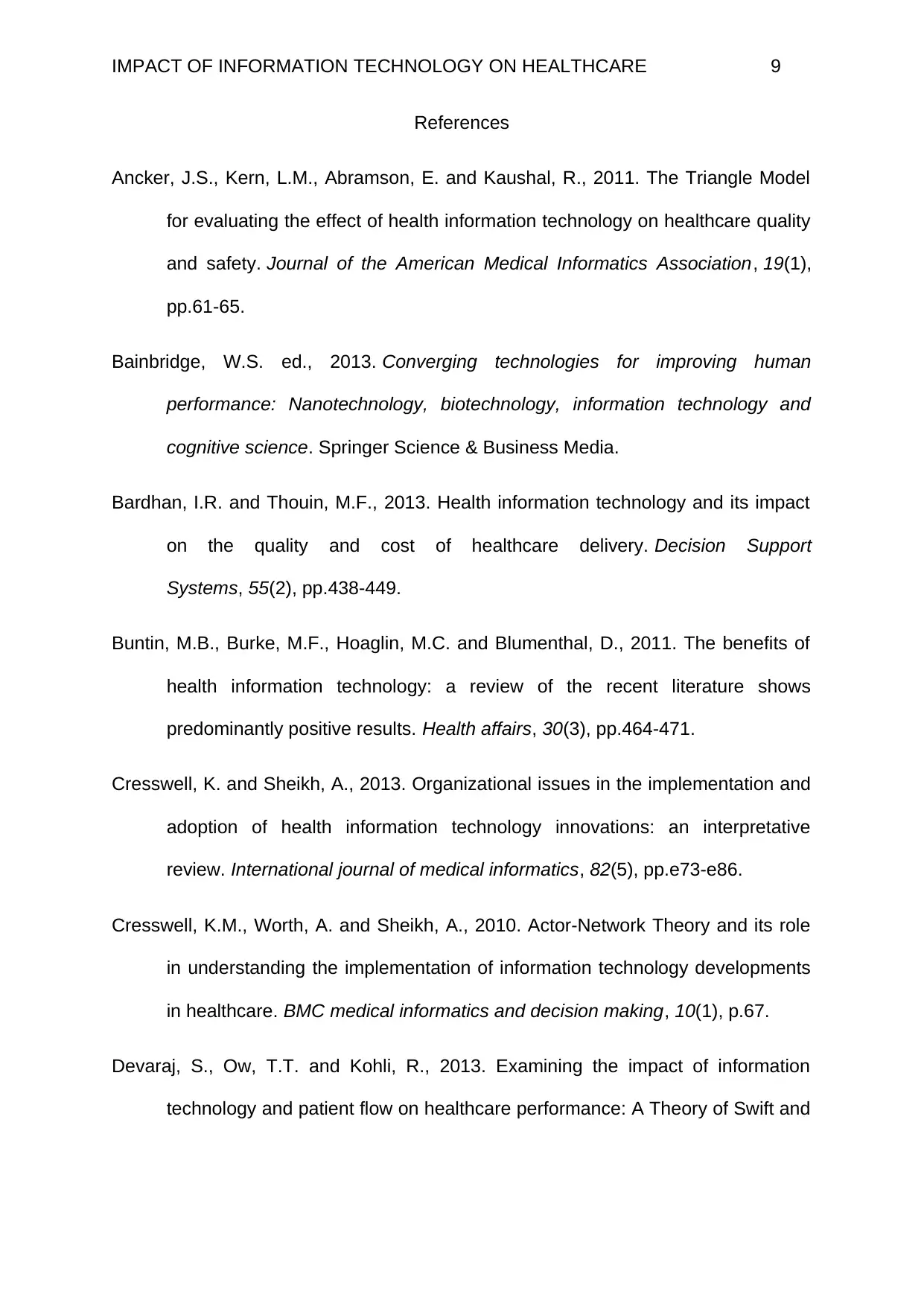
Ancker, J.S., Kern, L.M., Abramson, E. and Kaushal, R., 2011. The Triangle Model
for evaluating the effect of health information technology on healthcare quality
and safety. Journal of the American Medical Informatics Association, 19(1),
pp.61-65.
Bainbridge, W.S. ed., 2013. Converging technologies for improving human
performance: Nanotechnology, biotechnology, information technology and
cognitive science. Springer Science & Business Media.
Bardhan, I.R. and Thouin, M.F., 2013. Health information technology and its impact
on the quality and cost of healthcare delivery. Decision Support
Systems, 55(2), pp.438-449.
Buntin, M.B., Burke, M.F., Hoaglin, M.C. and Blumenthal, D., 2011. The benefits of
health information technology: a review of the recent literature shows
predominantly positive results. Health affairs, 30(3), pp.464-471.
Cresswell, K. and Sheikh, A., 2013. Organizational issues in the implementation and
adoption of health information technology innovations: an interpretative
review. International journal of medical informatics, 82(5), pp.e73-e86.
Cresswell, K.M., Worth, A. and Sheikh, A., 2010. Actor-Network Theory and its role
in understanding the implementation of information technology developments
in healthcare. BMC medical informatics and decision making, 10(1), p.67.
Devaraj, S., Ow, T.T. and Kohli, R., 2013. Examining the impact of information
technology and patient flow on healthcare performance: A Theory of Swift and
References
Ancker, J.S., Kern, L.M., Abramson, E. and Kaushal, R., 2011. The Triangle Model
for evaluating the effect of health information technology on healthcare quality
and safety. Journal of the American Medical Informatics Association, 19(1),
pp.61-65.
Bainbridge, W.S. ed., 2013. Converging technologies for improving human
performance: Nanotechnology, biotechnology, information technology and
cognitive science. Springer Science & Business Media.
Bardhan, I.R. and Thouin, M.F., 2013. Health information technology and its impact
on the quality and cost of healthcare delivery. Decision Support
Systems, 55(2), pp.438-449.
Buntin, M.B., Burke, M.F., Hoaglin, M.C. and Blumenthal, D., 2011. The benefits of
health information technology: a review of the recent literature shows
predominantly positive results. Health affairs, 30(3), pp.464-471.
Cresswell, K. and Sheikh, A., 2013. Organizational issues in the implementation and
adoption of health information technology innovations: an interpretative
review. International journal of medical informatics, 82(5), pp.e73-e86.
Cresswell, K.M., Worth, A. and Sheikh, A., 2010. Actor-Network Theory and its role
in understanding the implementation of information technology developments
in healthcare. BMC medical informatics and decision making, 10(1), p.67.
Devaraj, S., Ow, T.T. and Kohli, R., 2013. Examining the impact of information
technology and patient flow on healthcare performance: A Theory of Swift and
⊘ This is a preview!⊘
Do you want full access?
Subscribe today to unlock all pages.
Trusted by 1+ million students worldwide
IMPACT OF INFORMATION TECHNOLOGY ON HEALTHCARE 10
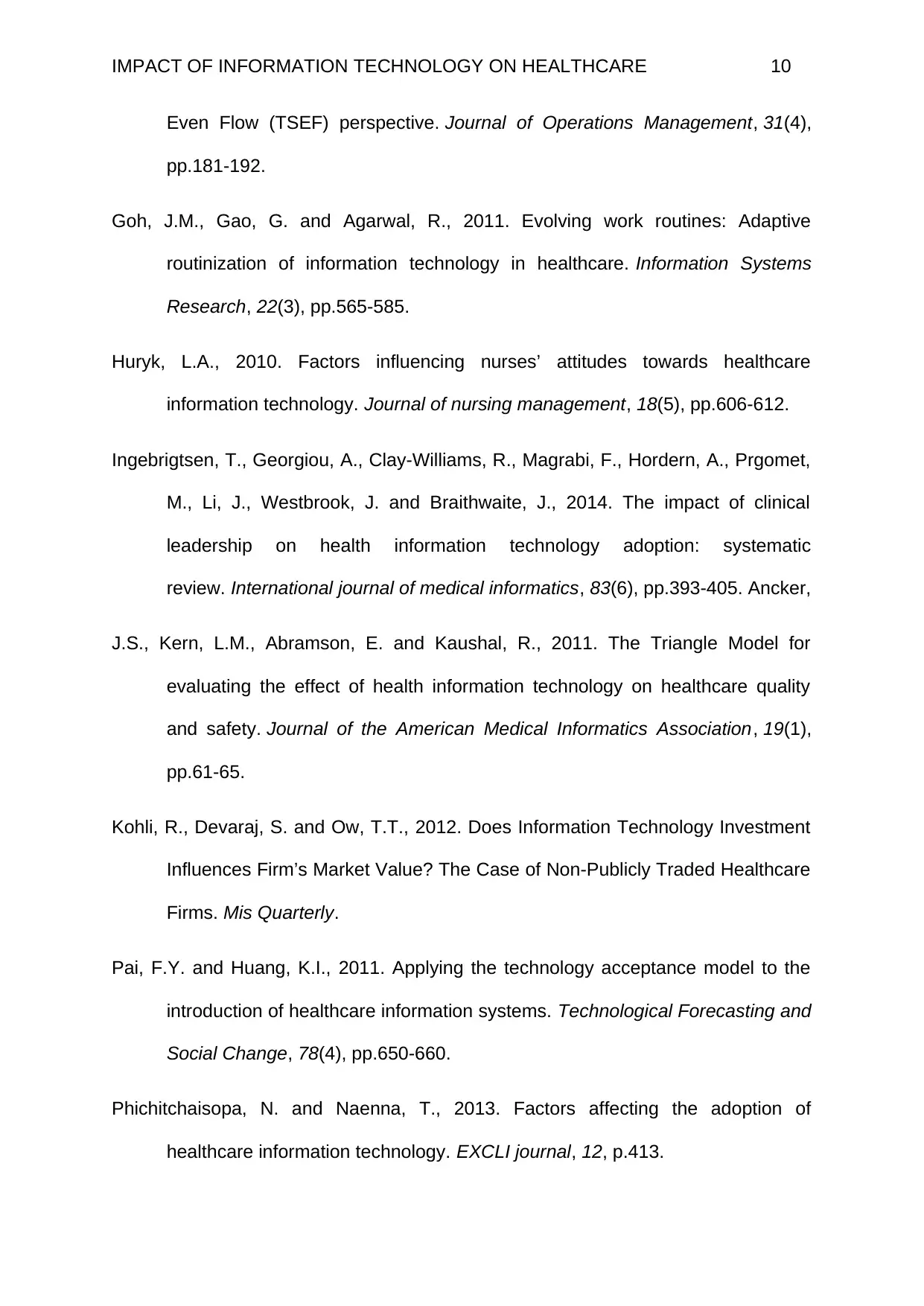
Even Flow (TSEF) perspective. Journal of Operations Management, 31(4),
pp.181-192.
Goh, J.M., Gao, G. and Agarwal, R., 2011. Evolving work routines: Adaptive
routinization of information technology in healthcare. Information Systems
Research, 22(3), pp.565-585.
Huryk, L.A., 2010. Factors influencing nurses’ attitudes towards healthcare
information technology. Journal of nursing management, 18(5), pp.606-612.
Ingebrigtsen, T., Georgiou, A., Clay-Williams, R., Magrabi, F., Hordern, A., Prgomet,
M., Li, J., Westbrook, J. and Braithwaite, J., 2014. The impact of clinical
leadership on health information technology adoption: systematic
review. International journal of medical informatics, 83(6), pp.393-405. Ancker,
J.S., Kern, L.M., Abramson, E. and Kaushal, R., 2011. The Triangle Model for
evaluating the effect of health information technology on healthcare quality
and safety. Journal of the American Medical Informatics Association, 19(1),
pp.61-65.
Kohli, R., Devaraj, S. and Ow, T.T., 2012. Does Information Technology Investment
Influences Firm’s Market Value? The Case of Non-Publicly Traded Healthcare
Firms. Mis Quarterly.
Pai, F.Y. and Huang, K.I., 2011. Applying the technology acceptance model to the
introduction of healthcare information systems. Technological Forecasting and
Social Change, 78(4), pp.650-660.
Phichitchaisopa, N. and Naenna, T., 2013. Factors affecting the adoption of
healthcare information technology. EXCLI journal, 12, p.413.
Even Flow (TSEF) perspective. Journal of Operations Management, 31(4),
pp.181-192.
Goh, J.M., Gao, G. and Agarwal, R., 2011. Evolving work routines: Adaptive
routinization of information technology in healthcare. Information Systems
Research, 22(3), pp.565-585.
Huryk, L.A., 2010. Factors influencing nurses’ attitudes towards healthcare
information technology. Journal of nursing management, 18(5), pp.606-612.
Ingebrigtsen, T., Georgiou, A., Clay-Williams, R., Magrabi, F., Hordern, A., Prgomet,
M., Li, J., Westbrook, J. and Braithwaite, J., 2014. The impact of clinical
leadership on health information technology adoption: systematic
review. International journal of medical informatics, 83(6), pp.393-405. Ancker,
J.S., Kern, L.M., Abramson, E. and Kaushal, R., 2011. The Triangle Model for
evaluating the effect of health information technology on healthcare quality
and safety. Journal of the American Medical Informatics Association, 19(1),
pp.61-65.
Kohli, R., Devaraj, S. and Ow, T.T., 2012. Does Information Technology Investment
Influences Firm’s Market Value? The Case of Non-Publicly Traded Healthcare
Firms. Mis Quarterly.
Pai, F.Y. and Huang, K.I., 2011. Applying the technology acceptance model to the
introduction of healthcare information systems. Technological Forecasting and
Social Change, 78(4), pp.650-660.
Phichitchaisopa, N. and Naenna, T., 2013. Factors affecting the adoption of
healthcare information technology. EXCLI journal, 12, p.413.
Paraphrase This Document
Need a fresh take? Get an instant paraphrase of this document with our AI Paraphraser
IMPACT OF INFORMATION TECHNOLOGY ON HEALTHCARE 11
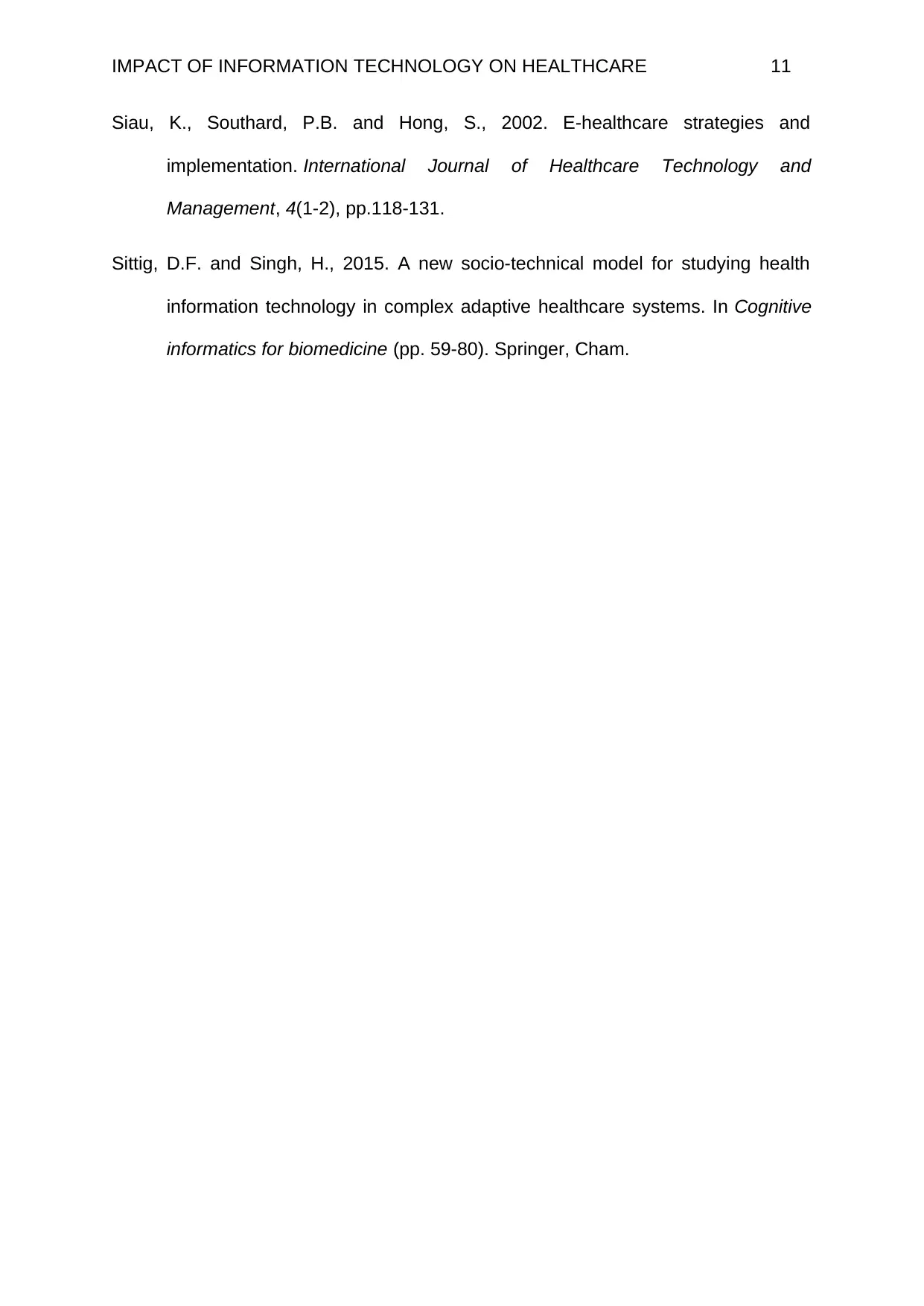
Siau, K., Southard, P.B. and Hong, S., 2002. E-healthcare strategies and
implementation. International Journal of Healthcare Technology and
Management, 4(1-2), pp.118-131.
Sittig, D.F. and Singh, H., 2015. A new socio-technical model for studying health
information technology in complex adaptive healthcare systems. In Cognitive
informatics for biomedicine (pp. 59-80). Springer, Cham.
Siau, K., Southard, P.B. and Hong, S., 2002. E-healthcare strategies and
implementation. International Journal of Healthcare Technology and
Management, 4(1-2), pp.118-131.
Sittig, D.F. and Singh, H., 2015. A new socio-technical model for studying health
information technology in complex adaptive healthcare systems. In Cognitive
informatics for biomedicine (pp. 59-80). Springer, Cham.

1 out of 11


Related Documents


Your All-in-One AI-Powered Toolkit for Academic Success.
+13062052269
info@desklib.com
Available 24*7 on WhatsApp / Email
![[object Object]](/_next/static/media/star-bottom.7253800d.svg)
Unlock your academic potential
Copyright © 2020–2025 A2Z Services. All Rights Reserved. Developed and managed by ZUCOL.