Case Study: IOT in Nissan Smart Cars for UK Road Safety
VerifiedAdded on 2022/10/01
|49
|14217
|8
Case Study
AI Summary
This report presents a case study focusing on the implementation of IOT (Internet of Things) in Nissan cars to enhance road safety in the UK. It investigates the potential of transforming ordinary cars into smart cars to reduce accidents. The research, conducted at the University of Lincoln, explores the benefits and risks associated with IOT integration, considering both driver and pedestrian perspectives. The study analyzes primary and secondary data, including descriptive and inferential statistics, and utilizes the PRISMA framework for secondary data analysis. The report also addresses research limitations, ethical considerations, and provides recommendations for future research, highlighting the impact of smart car technology on UK road safety and customer perception. The study concludes by linking the objectives with the conclusion and providing recommendations for future research scope.
Utilisation of IOT (IOT ) based smart cars to make travelling road safer - Case study of
Nissan UK
Name of the student: Razvan Hopet
Name of the University: University of Lincoln
Reference: Harvard
Nissan UK
Name of the student: Razvan Hopet
Name of the University: University of Lincoln
Reference: Harvard

Paraphrase This Document
Need a fresh take? Get an instant paraphrase of this document with our AI Paraphraser

Acknowledgment:
I would like to thank all staff from University of Lincoln that I collaborated with for the past
two years. Besides this, I would like to thank my juniors as well as senior for their support to
toward completion of the research paper. I would like to extend my gratitude towards the
Module leader Phil for his appreciation and guidance that has helped me to complete my
paper. Lastly, I would like to thank Dr. Ion Gabriel Tudorache without whom I would not been
able to complete my educational journey in engineering for the past five years. I believe his
support and guidance will continue to inspire me in my future career. Their continuous
mental, moral and enthusiastic support helped me complete this final report.
I would like to thank all staff from University of Lincoln that I collaborated with for the past
two years. Besides this, I would like to thank my juniors as well as senior for their support to
toward completion of the research paper. I would like to extend my gratitude towards the
Module leader Phil for his appreciation and guidance that has helped me to complete my
paper. Lastly, I would like to thank Dr. Ion Gabriel Tudorache without whom I would not been
able to complete my educational journey in engineering for the past five years. I believe his
support and guidance will continue to inspire me in my future career. Their continuous
mental, moral and enthusiastic support helped me complete this final report.
Abstract:
This report investigates and focuses on how the implementation of IOT (IOT ) in cars can
potentially reduce the amount of accidents on the roads. The cars are expected to be
transformed into smart cars from the ordinary ones. Thus, it will be observed in the study
how roads of UK can be made safer with the use of IOT in the cars and transforming them
into smart cars. The primary limitation of the researcher was the time limitation and hence,
the researcher was bound to conduct the research on the limited number of respondents. In
addition, due to the shortages of time, the researcher would not get time to conduct the
research on the other country apart from the UK. As a recommendation, researcher has
found using of SAS software is more relevant and it provides the accurate result on the given
data set compared to the other statistical tools. Study has found that the installation of IOT
in smart cars is not only essential for the drivers but is also important for pedestrians.
Therefore, it was required to the researcher to collect the information from the pedestrians
apart from the experienced and qualified drivers for finding out the more accurate result on
the effectiveness of the using of these cars over the ordinary cars.
Keywords:
UK road safety with IOT , IOT based smart cars in UK, Nissan smart car, Nissan IOT to
make UK road safe
This report investigates and focuses on how the implementation of IOT (IOT ) in cars can
potentially reduce the amount of accidents on the roads. The cars are expected to be
transformed into smart cars from the ordinary ones. Thus, it will be observed in the study
how roads of UK can be made safer with the use of IOT in the cars and transforming them
into smart cars. The primary limitation of the researcher was the time limitation and hence,
the researcher was bound to conduct the research on the limited number of respondents. In
addition, due to the shortages of time, the researcher would not get time to conduct the
research on the other country apart from the UK. As a recommendation, researcher has
found using of SAS software is more relevant and it provides the accurate result on the given
data set compared to the other statistical tools. Study has found that the installation of IOT
in smart cars is not only essential for the drivers but is also important for pedestrians.
Therefore, it was required to the researcher to collect the information from the pedestrians
apart from the experienced and qualified drivers for finding out the more accurate result on
the effectiveness of the using of these cars over the ordinary cars.
Keywords:
UK road safety with IOT , IOT based smart cars in UK, Nissan smart car, Nissan IOT to
make UK road safe
⊘ This is a preview!⊘
Do you want full access?
Subscribe today to unlock all pages.

Trusted by 1+ million students worldwide
Table of Contents
CHAPTER ONE: INTRODUCTION......................................................................................6
1.1 Introduction:...................................................................................................................6
1.2 Background of the research:.......................................................................................6
1.3 Research question:.......................................................................................................7
1.4 Research aim and objective:.......................................................................................7
1.4.1 Research aim:........................................................................................................7
1.4.2 Research objective................................................................................................7
1.5 Research justification:..................................................................................................8
1.6 Research structure:......................................................................................................9
1.7 Ethical consideration:...................................................................................................9
1.8 Chapter summary:........................................................................................................9
CHAPTER TWO: LITERATURE REVIEW........................................................................10
2.1 IOT (IOT ).....................................................................................................................10
2.2 Development of Internet of Things...........................................................................10
2.3 Application of IOT in Consumer sector....................................................................11
2.4 Application of IOT in Commercial sector.................................................................12
2.5 Application of IOT in Automotive sector..................................................................13
2.6 IOT in UK......................................................................................................................14
2.7 IOT Application by Nissan.........................................................................................14
CHAPTER THREE: METHODOLOGY..............................................................................16
3.1 Introduction..................................................................................................................16
3.2 Research onion...........................................................................................................16
3.3 Research philosophy..................................................................................................17
3.4 Research approaches................................................................................................17
3.5 Research design.........................................................................................................18
3.6 Research strategies....................................................................................................18
CHAPTER ONE: INTRODUCTION......................................................................................6
1.1 Introduction:...................................................................................................................6
1.2 Background of the research:.......................................................................................6
1.3 Research question:.......................................................................................................7
1.4 Research aim and objective:.......................................................................................7
1.4.1 Research aim:........................................................................................................7
1.4.2 Research objective................................................................................................7
1.5 Research justification:..................................................................................................8
1.6 Research structure:......................................................................................................9
1.7 Ethical consideration:...................................................................................................9
1.8 Chapter summary:........................................................................................................9
CHAPTER TWO: LITERATURE REVIEW........................................................................10
2.1 IOT (IOT ).....................................................................................................................10
2.2 Development of Internet of Things...........................................................................10
2.3 Application of IOT in Consumer sector....................................................................11
2.4 Application of IOT in Commercial sector.................................................................12
2.5 Application of IOT in Automotive sector..................................................................13
2.6 IOT in UK......................................................................................................................14
2.7 IOT Application by Nissan.........................................................................................14
CHAPTER THREE: METHODOLOGY..............................................................................16
3.1 Introduction..................................................................................................................16
3.2 Research onion...........................................................................................................16
3.3 Research philosophy..................................................................................................17
3.4 Research approaches................................................................................................17
3.5 Research design.........................................................................................................18
3.6 Research strategies....................................................................................................18
Paraphrase This Document
Need a fresh take? Get an instant paraphrase of this document with our AI Paraphraser
3.7 Time horizons..............................................................................................................18
3.8 Data collection process..............................................................................................19
3.9 Data sampling..............................................................................................................19
3.10 Data analysis.............................................................................................................20
3.11 Research Hypothesis:..............................................................................................20
3.12 Ethical consideration................................................................................................20
3.13 Accessibility issues...................................................................................................20
3.14 Time schedule...........................................................................................................20
CHAPTER FOUR: DATA ANALYSIS.................................................................................22
4.1 Introduction:.................................................................................................................22
4.2 Primary data analysis:................................................................................................22
4.2.1 Descriptive Analysis:...........................................................................................22
4.2.2 Regression: .......................................................................................................32
4.2.3 Inferential Statistics:............................................................................................35
4.3 Secondary data analysis:..........................................................................................36
4.3.1: PRISMA Framework:.........................................................................................36
4.3.2 Secondary Data Analysis:..................................................................................36
4.4 Research Limitation:...................................................................................................37
CHAPTER FIVE: CONCLUSION AND RECOMMENDATION......................................38
5.1 Conclusion...................................................................................................................38
5.2 Linking the objectives with the conclusion ...........................................................38
5.2.1 Linking the first objective with the conclusion.................................................38
5.2.2 Linking the second objective with the conclusion...........................................38
5.2.3 Linking the third objective with the conclusion................................................39
5.2.4 Linking the fourth objective with the conclusion.............................................39
5.3 Recommendations and limitations of the research ............................................40
5.4 Scope of the research in future................................................................................41
3.8 Data collection process..............................................................................................19
3.9 Data sampling..............................................................................................................19
3.10 Data analysis.............................................................................................................20
3.11 Research Hypothesis:..............................................................................................20
3.12 Ethical consideration................................................................................................20
3.13 Accessibility issues...................................................................................................20
3.14 Time schedule...........................................................................................................20
CHAPTER FOUR: DATA ANALYSIS.................................................................................22
4.1 Introduction:.................................................................................................................22
4.2 Primary data analysis:................................................................................................22
4.2.1 Descriptive Analysis:...........................................................................................22
4.2.2 Regression: .......................................................................................................32
4.2.3 Inferential Statistics:............................................................................................35
4.3 Secondary data analysis:..........................................................................................36
4.3.1: PRISMA Framework:.........................................................................................36
4.3.2 Secondary Data Analysis:..................................................................................36
4.4 Research Limitation:...................................................................................................37
CHAPTER FIVE: CONCLUSION AND RECOMMENDATION......................................38
5.1 Conclusion...................................................................................................................38
5.2 Linking the objectives with the conclusion ...........................................................38
5.2.1 Linking the first objective with the conclusion.................................................38
5.2.2 Linking the second objective with the conclusion...........................................38
5.2.3 Linking the third objective with the conclusion................................................39
5.2.4 Linking the fourth objective with the conclusion.............................................39
5.3 Recommendations and limitations of the research ............................................40
5.4 Scope of the research in future................................................................................41

Reference list: .....................................................................................................................42
Appendix:................................................................................................................................47
Appendix:................................................................................................................................47
⊘ This is a preview!⊘
Do you want full access?
Subscribe today to unlock all pages.
Trusted by 1+ million students worldwide
CHAPTER ONE: INTRODUCTION
1.1 Introduction:
The highly developed economy of the United Kingdom leads the country’s per capita income
to increase significantly. The people of the country are getting more developed and
consequently they are getting more ways to earn money. As their earning capacity is rising,
they are having more money for leisurely expenditure. This means they are having more
disposable income and higher purchasing power. This leads them to spend more on luxury
products. As a consequence, the number of cars is increasing drastically on road. This thus
leads to a rise in the number of road accidents increased at an alarming rate (Rolison et al.
2018). This report investigates and focuses on how the implementation of IOT (IOT) in cars
can potentially reduce the amount of accidents on the roads. The cars are expected to be
transformed into smart cars from the standard model available today. Thus, it will be
observed in the study how roads of UK can be made safer with the use of IOT in the cars
and transforming them into smart cars.
1.2 Background of the research:
In United Kingdom, recently it has been observed that there has been a rise in the number of
road accidents. The main reason behind this may be that the citizens are investing more on
luxury items. They are more into buying such things. This has increased the investment in
cars to a much higher level thereby increasing the number of cars on roads (Scholes et al.
2018). The roads have not been sufficiently broadened to make space for the increased
number of cars. This is leading to an increase in the number of accidents on the roads of
UK. It has been expected that if the cars can be transformed into smart cars, it may result in
the reduction in the number of road accidents. This can be done with the help of installation
the advanced technology of Internet of Things. In this study research is done to find out how
much it is effective to reduce the threat of road accidents when these advanced mechanisms
are installed. It has been observed that the road accidents mainly occur due to the presence
of blind spots on the roads (Sundfør,Sagberg and Høye 2019). This can prove detrimental
on the number of accidents occurred. There have been incidents of over speeding as well. In
some casescases, the drivers are not able to detect or sense the potential for an accident to
happen. This may lead to certain fatal accidents at times. At times speeding cars may run
over pedestrians as well. So, research is being continuously done to find out if the road
safety can be increased to a considerable level with the use of Internet of Things. The study
is mainly based on the context of the Nissan UK and analysed in its regard how far the use
of IOT helps in bringing about more safety on the roads of UK.
1.1 Introduction:
The highly developed economy of the United Kingdom leads the country’s per capita income
to increase significantly. The people of the country are getting more developed and
consequently they are getting more ways to earn money. As their earning capacity is rising,
they are having more money for leisurely expenditure. This means they are having more
disposable income and higher purchasing power. This leads them to spend more on luxury
products. As a consequence, the number of cars is increasing drastically on road. This thus
leads to a rise in the number of road accidents increased at an alarming rate (Rolison et al.
2018). This report investigates and focuses on how the implementation of IOT (IOT) in cars
can potentially reduce the amount of accidents on the roads. The cars are expected to be
transformed into smart cars from the standard model available today. Thus, it will be
observed in the study how roads of UK can be made safer with the use of IOT in the cars
and transforming them into smart cars.
1.2 Background of the research:
In United Kingdom, recently it has been observed that there has been a rise in the number of
road accidents. The main reason behind this may be that the citizens are investing more on
luxury items. They are more into buying such things. This has increased the investment in
cars to a much higher level thereby increasing the number of cars on roads (Scholes et al.
2018). The roads have not been sufficiently broadened to make space for the increased
number of cars. This is leading to an increase in the number of accidents on the roads of
UK. It has been expected that if the cars can be transformed into smart cars, it may result in
the reduction in the number of road accidents. This can be done with the help of installation
the advanced technology of Internet of Things. In this study research is done to find out how
much it is effective to reduce the threat of road accidents when these advanced mechanisms
are installed. It has been observed that the road accidents mainly occur due to the presence
of blind spots on the roads (Sundfør,Sagberg and Høye 2019). This can prove detrimental
on the number of accidents occurred. There have been incidents of over speeding as well. In
some casescases, the drivers are not able to detect or sense the potential for an accident to
happen. This may lead to certain fatal accidents at times. At times speeding cars may run
over pedestrians as well. So, research is being continuously done to find out if the road
safety can be increased to a considerable level with the use of Internet of Things. The study
is mainly based on the context of the Nissan UK and analysed in its regard how far the use
of IOT helps in bringing about more safety on the roads of UK.
Paraphrase This Document
Need a fresh take? Get an instant paraphrase of this document with our AI Paraphraser
1.3 Research question:
The overall report is done in the backdrop of UK’s present scenario. The report is a case
study completed in context of Nissan UK. The research question to be analysed and the
necessity to finding a solution to be is:
How IOT can be used in cars to make road safer? (case study of Nissan UK)
This is the basic question that is taken care of in the research. There are various other
secondary questions that are also expected to be answered in this study.
How the uses of IOT convert the ordinary cars into smart cars?
Whether the use of IOT makes the infrastructure of road of UK potentially safer?
Finding out the possible risks associated with the installation of IOT in the cars.
To find out the possible risks of plying smart cars on the roads of UK.
How Nissan will take the initiative to make use of IOT and introduce it to make the
things safer on roads?
1.4 Research aim and objective:
The present study is based on the above-mentioned research question. The main aim is to
find out how far the utilisation of IOT in cars will increase the safety on roads of UK.
1.4.1 Research aim:
The aims with which the study is done are:
To understand how Nissan utilises the technology of IOT in the making of smart cars
safer to drive.
To find out how smart cars are different from the ordinary cars to drive.
To analyse how the introduction of smart cars will reduce the accidents on road.
To determine the reaction of qualified drivers about the road accidents come across
by Nissan cars which have got the new technology implemented.
1.4.2 Research objective
The objective of this study is to identify and detect the potential positive impact the impact of
the use of Internet of Things’ installation in the vehicles of Nissan UK. The idea with which
this study is done is to find out the how the use of IOT will help to reduce the number of
accidents on the roads of UK. The advanced technology of the use of IOT help the cars to
have certain sensors installed which will help them to detect things and help the drivers take
action to avoid collision. This will help in bringing down the frequency of road accidents.
Thus, in this study, analysis is done to find the benefits as well as the risks associated with
the idea of installation of IOT in the cars. The analysis is done based on the context of
number of vehicles that has been come across by Nissan UK vehicles. The objective is to
find answers to the primary question that how the implementation of IOT will help in making
the roads of UK a safer place to travel on (Brookhuis, De Waard and Janssen 2019). By the
end of the study if the answers to the secondary questions are also answered, it will help to
The overall report is done in the backdrop of UK’s present scenario. The report is a case
study completed in context of Nissan UK. The research question to be analysed and the
necessity to finding a solution to be is:
How IOT can be used in cars to make road safer? (case study of Nissan UK)
This is the basic question that is taken care of in the research. There are various other
secondary questions that are also expected to be answered in this study.
How the uses of IOT convert the ordinary cars into smart cars?
Whether the use of IOT makes the infrastructure of road of UK potentially safer?
Finding out the possible risks associated with the installation of IOT in the cars.
To find out the possible risks of plying smart cars on the roads of UK.
How Nissan will take the initiative to make use of IOT and introduce it to make the
things safer on roads?
1.4 Research aim and objective:
The present study is based on the above-mentioned research question. The main aim is to
find out how far the utilisation of IOT in cars will increase the safety on roads of UK.
1.4.1 Research aim:
The aims with which the study is done are:
To understand how Nissan utilises the technology of IOT in the making of smart cars
safer to drive.
To find out how smart cars are different from the ordinary cars to drive.
To analyse how the introduction of smart cars will reduce the accidents on road.
To determine the reaction of qualified drivers about the road accidents come across
by Nissan cars which have got the new technology implemented.
1.4.2 Research objective
The objective of this study is to identify and detect the potential positive impact the impact of
the use of Internet of Things’ installation in the vehicles of Nissan UK. The idea with which
this study is done is to find out the how the use of IOT will help to reduce the number of
accidents on the roads of UK. The advanced technology of the use of IOT help the cars to
have certain sensors installed which will help them to detect things and help the drivers take
action to avoid collision. This will help in bringing down the frequency of road accidents.
Thus, in this study, analysis is done to find the benefits as well as the risks associated with
the idea of installation of IOT in the cars. The analysis is done based on the context of
number of vehicles that has been come across by Nissan UK vehicles. The objective is to
find answers to the primary question that how the implementation of IOT will help in making
the roads of UK a safer place to travel on (Brookhuis, De Waard and Janssen 2019). By the
end of the study if the answers to the secondary questions are also answered, it will help to
get hold of the fact how Nissan UK makes use of IOT to develop the smart cars. It is also
analysed how these cars are different from the ordinary cars and how much potential these
cars have to make the frequency of accidents low (Noy, Shinar and Horrey 2018). The
problems of running the smart cars on road are also discussed in detail. How this initiative of
Nissan of introducing this modern technology has impacted the road accident level in UK is
thoroughly analysed. The impact caused on the customers mind about the use of IOT in cars
or the use of smart cars is also discussed in this study. The results are made dependent on
the number of accidents come across by Nissan vehicles.
1.5 Research justification:
This research is done in the backdrop of the road accident frequency on UK roads. Road
accidents are not only harmful for any particular individual but also it causes a setback for
the whole nation as well. If the roads of a country are not safe, it is nowhere safe in the
country. Thus, it is a very positive initiative for the company Nissan UK to develop and
introduce this modern technology to install IOT in cars. The sensors are put inside the cars
which can detect other cars in close proximity and take automated action to avoid collisions.
The study is done to make an analysis about the benefits and risks associated with the use
of IOT in the cars. Findings are done to see whether the implementation of this advanced
technology is actually having a positive impact in reducing the number of road accidents.
The study is based on the case study of the concerned company Nissan UK which is
introducing these smart cars on the roads of UK. This research will follow applied research
method as the basic objective of is to find solution of a large number of car accident in the
UK.
analysed how these cars are different from the ordinary cars and how much potential these
cars have to make the frequency of accidents low (Noy, Shinar and Horrey 2018). The
problems of running the smart cars on road are also discussed in detail. How this initiative of
Nissan of introducing this modern technology has impacted the road accident level in UK is
thoroughly analysed. The impact caused on the customers mind about the use of IOT in cars
or the use of smart cars is also discussed in this study. The results are made dependent on
the number of accidents come across by Nissan vehicles.
1.5 Research justification:
This research is done in the backdrop of the road accident frequency on UK roads. Road
accidents are not only harmful for any particular individual but also it causes a setback for
the whole nation as well. If the roads of a country are not safe, it is nowhere safe in the
country. Thus, it is a very positive initiative for the company Nissan UK to develop and
introduce this modern technology to install IOT in cars. The sensors are put inside the cars
which can detect other cars in close proximity and take automated action to avoid collisions.
The study is done to make an analysis about the benefits and risks associated with the use
of IOT in the cars. Findings are done to see whether the implementation of this advanced
technology is actually having a positive impact in reducing the number of road accidents.
The study is based on the case study of the concerned company Nissan UK which is
introducing these smart cars on the roads of UK. This research will follow applied research
method as the basic objective of is to find solution of a large number of car accident in the
UK.
⊘ This is a preview!⊘
Do you want full access?
Subscribe today to unlock all pages.
Trusted by 1+ million students worldwide
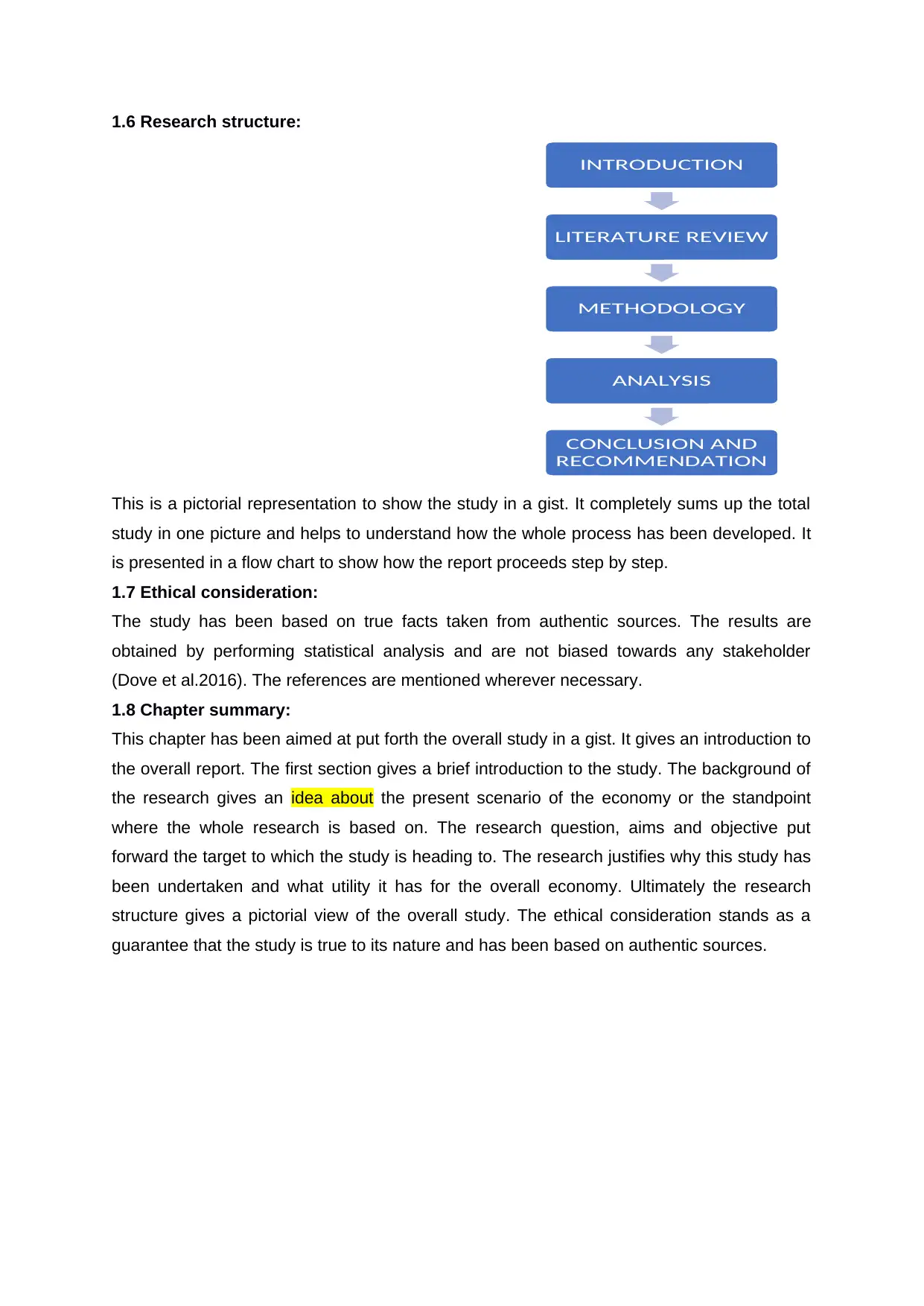
1.6 Research structure:
This is a pictorial representation to show the study in a gist. It completely sums up the total
study in one picture and helps to understand how the whole process has been developed. It
is presented in a flow chart to show how the report proceeds step by step.
1.7 Ethical consideration:
The study has been based on true facts taken from authentic sources. The results are
obtained by performing statistical analysis and are not biased towards any stakeholder
(Dove et al.2016). The references are mentioned wherever necessary.
1.8 Chapter summary:
This chapter has been aimed at put forth the overall study in a gist. It gives an introduction to
the overall report. The first section gives a brief introduction to the study. The background of
the research gives an idea about the present scenario of the economy or the standpoint
where the whole research is based on. The research question, aims and objective put
forward the target to which the study is heading to. The research justifies why this study has
been undertaken and what utility it has for the overall economy. Ultimately the research
structure gives a pictorial view of the overall study. The ethical consideration stands as a
guarantee that the study is true to its nature and has been based on authentic sources.
INTRODUCTION
LITERATURE REVIEW
METHODOLOGY
ANALYSIS
CONCLUSION AND
RECOMMENDATION
This is a pictorial representation to show the study in a gist. It completely sums up the total
study in one picture and helps to understand how the whole process has been developed. It
is presented in a flow chart to show how the report proceeds step by step.
1.7 Ethical consideration:
The study has been based on true facts taken from authentic sources. The results are
obtained by performing statistical analysis and are not biased towards any stakeholder
(Dove et al.2016). The references are mentioned wherever necessary.
1.8 Chapter summary:
This chapter has been aimed at put forth the overall study in a gist. It gives an introduction to
the overall report. The first section gives a brief introduction to the study. The background of
the research gives an idea about the present scenario of the economy or the standpoint
where the whole research is based on. The research question, aims and objective put
forward the target to which the study is heading to. The research justifies why this study has
been undertaken and what utility it has for the overall economy. Ultimately the research
structure gives a pictorial view of the overall study. The ethical consideration stands as a
guarantee that the study is true to its nature and has been based on authentic sources.
INTRODUCTION
LITERATURE REVIEW
METHODOLOGY
ANALYSIS
CONCLUSION AND
RECOMMENDATION
Paraphrase This Document
Need a fresh take? Get an instant paraphrase of this document with our AI Paraphraser
CHAPTER TWO: LITERATURE REVIEW
2.1 IOT (IOT)
IOT is an evolution from the convergence and association of different technologies. It is like
a system of interrelated devices which are having unique identifiers embedded within them.
According to Conti et al. 2018 the advanced technology involves real time analytics with the
help of sensor installed in them. Machine learning is an important part of this technology of
IOT implication. There are also certain traditional embedded systems which are useful
contributions for enabling this system of modern form of technology (Mowbray 2017). The
traditional or conventional forms of system mostly include automation, wireless sensor
networks and other in-built control systems. Ge et al. 2017 puts forward the newer concept
of automotive IOT which is coming up. It is making use of the technology to create smarter
cars. These vehicles with embedded IOT technologies are more intelligent and have
advanced technology in built. This facilitates safe, comfortable and efficient driving of those
vehicles. According to Lin 2016 this technology is providing the automotive sector with
innovative ideas and advanced solutions which include connected car solutions. This
technology provides smarter navigation systems along with telematics solutions. Even the
cars have in-vehicle infotainment systems. The application of this technology has been
widespread. The various devices are connected on the platform of IOT to build in sensors
which can collaborate and integrate the data and analytically study it to reach to the most
important or valuable information to find solution to the specific requirement. The more the
use of this technology is increasing the more the world heading toward the concept of
automated devices. Considering the observation of Sun and Ansari 2016 it can be said that
the powerful devices on the platform of IOT can exactly find the piece of information that is
required and very safely ignore the other unnecessary stuff. The application of such devices
will guide the users to answer regular question by studying things and making analysis to
extract information and find solution (Krasniqi and Hajrizi 2016).
2.2 Development of Internet of Things
IOT in transportation can be considered as revolutionary but an accepted concept in terms of
safety. The discussion of this technology can be dated back to the time as early as 1982. Its
application was in the form of a modified Coke Vending Machine at Carnegie Mellon
University. It was probably the first appliance which was using the concept of IOT
application. This device used the technology to make an inventory report to analyse whether
the newly loaded drinks were cold or not. There were various presentations done on the
academic and contemporary visions of concept of Internet of Things. Definitions were
shifting to the modern versions of the concept. Not only in factories, was the idea also
shifting to the application of IOT in home appliances as well. This field received a great
momentum when the idea of device to device communication was envisioned. The term IOT
2.1 IOT (IOT)
IOT is an evolution from the convergence and association of different technologies. It is like
a system of interrelated devices which are having unique identifiers embedded within them.
According to Conti et al. 2018 the advanced technology involves real time analytics with the
help of sensor installed in them. Machine learning is an important part of this technology of
IOT implication. There are also certain traditional embedded systems which are useful
contributions for enabling this system of modern form of technology (Mowbray 2017). The
traditional or conventional forms of system mostly include automation, wireless sensor
networks and other in-built control systems. Ge et al. 2017 puts forward the newer concept
of automotive IOT which is coming up. It is making use of the technology to create smarter
cars. These vehicles with embedded IOT technologies are more intelligent and have
advanced technology in built. This facilitates safe, comfortable and efficient driving of those
vehicles. According to Lin 2016 this technology is providing the automotive sector with
innovative ideas and advanced solutions which include connected car solutions. This
technology provides smarter navigation systems along with telematics solutions. Even the
cars have in-vehicle infotainment systems. The application of this technology has been
widespread. The various devices are connected on the platform of IOT to build in sensors
which can collaborate and integrate the data and analytically study it to reach to the most
important or valuable information to find solution to the specific requirement. The more the
use of this technology is increasing the more the world heading toward the concept of
automated devices. Considering the observation of Sun and Ansari 2016 it can be said that
the powerful devices on the platform of IOT can exactly find the piece of information that is
required and very safely ignore the other unnecessary stuff. The application of such devices
will guide the users to answer regular question by studying things and making analysis to
extract information and find solution (Krasniqi and Hajrizi 2016).
2.2 Development of Internet of Things
IOT in transportation can be considered as revolutionary but an accepted concept in terms of
safety. The discussion of this technology can be dated back to the time as early as 1982. Its
application was in the form of a modified Coke Vending Machine at Carnegie Mellon
University. It was probably the first appliance which was using the concept of IOT
application. This device used the technology to make an inventory report to analyse whether
the newly loaded drinks were cold or not. There were various presentations done on the
academic and contemporary visions of concept of Internet of Things. Definitions were
shifting to the modern versions of the concept. Not only in factories, was the idea also
shifting to the application of IOT in home appliances as well. This field received a great
momentum when the idea of device to device communication was envisioned. The term IOT
was coined by Kevin Ashton in the year 1999. He although preferred the term to be used as
“Internet for Things”. The use Radio Frequency Identification was another important concept
essential for the application of Internet of things. Extensively the use of this technology was
spreading in other fields as well. The use of the IOT was spreading into other spaces like
commercial, industrial, infrastructural and consumer bases. The use of IOT will make things
or objects connected more to the internet rather than people. Cisco systems estimated that
the beginning of the concept of IOT was in between the year 2008 and 2009 (Sahaet al.
2017). More this concept was shifting things from ordinary gadgets to the use of automated
devices.
2.3 Application of IOT in Consumer sector
Utilisation of IOT can be initially observed in the industrial sector like manufacturing or
inventory management sector. When the utility of the technology was perceived, it spread to
other sectors as well. It moved really fast to other segments grabbing popularity in the
consumer application sector. It has a diverse use in the consumer application (Zhuet al.
2015). The use of IOT technology was growing in the field of home automation, connected
vehicles, connected health and wearable technology.
Satyanarayanan et al. 2015 said that there developed the concept of smart home. IOT
devices are a part of the larger concept of home automation. Supporting to that Feng et al.
2017 said that home automation includes lighting, heating, air conditioning and security
systems. The automated homes or smart homes use the platform of internet as a hub to
keep a control on the smart devices and other appliances. According to Lane et al. 2015 the
smart home devices are used on the iOS platforms or the Android platform. It can also be
certain native app on the iOS platform. Thus, these are easily handled and can be used to
connect different devices through just one click. There are also various applications of
certain non-commercial systems which can be considered as open source ecosystems such
as Home Assistant.
Sreekanth and Nitha (2016) said that another key application of the smart home technology
is that it can be used to provide elderly care and assistance to the ageing people. The old
and elderly people can be properly taken care of if this advanced technology is used. Palet
al. 2018 suggested in support of the view that additionally people who are having certain
disabilities can also be provided with assistance. The home systems can be customised
accordingly to provide assistance according to the need of the owner’s disability. This
concept can be explained as the facts the people who are visually impaired are in need of
different treatment than that of them those who have hearing impairment. The user may also
use certain wearable device which may help him accordingly to make way and provide him
assistance according to his need. People with mobility limitations can also be guided
accordingly. The elderly people can enjoy much freedom and move about independently.
“Internet for Things”. The use Radio Frequency Identification was another important concept
essential for the application of Internet of things. Extensively the use of this technology was
spreading in other fields as well. The use of the IOT was spreading into other spaces like
commercial, industrial, infrastructural and consumer bases. The use of IOT will make things
or objects connected more to the internet rather than people. Cisco systems estimated that
the beginning of the concept of IOT was in between the year 2008 and 2009 (Sahaet al.
2017). More this concept was shifting things from ordinary gadgets to the use of automated
devices.
2.3 Application of IOT in Consumer sector
Utilisation of IOT can be initially observed in the industrial sector like manufacturing or
inventory management sector. When the utility of the technology was perceived, it spread to
other sectors as well. It moved really fast to other segments grabbing popularity in the
consumer application sector. It has a diverse use in the consumer application (Zhuet al.
2015). The use of IOT technology was growing in the field of home automation, connected
vehicles, connected health and wearable technology.
Satyanarayanan et al. 2015 said that there developed the concept of smart home. IOT
devices are a part of the larger concept of home automation. Supporting to that Feng et al.
2017 said that home automation includes lighting, heating, air conditioning and security
systems. The automated homes or smart homes use the platform of internet as a hub to
keep a control on the smart devices and other appliances. According to Lane et al. 2015 the
smart home devices are used on the iOS platforms or the Android platform. It can also be
certain native app on the iOS platform. Thus, these are easily handled and can be used to
connect different devices through just one click. There are also various applications of
certain non-commercial systems which can be considered as open source ecosystems such
as Home Assistant.
Sreekanth and Nitha (2016) said that another key application of the smart home technology
is that it can be used to provide elderly care and assistance to the ageing people. The old
and elderly people can be properly taken care of if this advanced technology is used. Palet
al. 2018 suggested in support of the view that additionally people who are having certain
disabilities can also be provided with assistance. The home systems can be customised
accordingly to provide assistance according to the need of the owner’s disability. This
concept can be explained as the facts the people who are visually impaired are in need of
different treatment than that of them those who have hearing impairment. The user may also
use certain wearable device which may help him accordingly to make way and provide him
assistance according to his need. People with mobility limitations can also be guided
accordingly. The elderly people can enjoy much freedom and move about independently.
⊘ This is a preview!⊘
Do you want full access?
Subscribe today to unlock all pages.
Trusted by 1+ million students worldwide

1 out of 49


Related Documents


Your All-in-One AI-Powered Toolkit for Academic Success.
+13062052269
info@desklib.com
Available 24*7 on WhatsApp / Email
![[object Object]](/_next/static/media/star-bottom.7253800d.svg)
Unlock your academic potential
Copyright © 2020–2026 A2Z Services. All Rights Reserved. Developed and managed by ZUCOL.