Assessment of Continuous Improvement Systems in Business Operations
VerifiedAdded on 2021/02/20
|10
|2785
|22
Report
AI Summary
This report comprehensively addresses various aspects of business operations and continuous improvement. It begins by defining quality management systems and their crucial role in enhancing customer satisfaction and optimizing resource utilization, followed by an explanation of how knowledge management systems facilitate organizational learning and support employee performance. The report then evaluates the benefits of regular performance assessments, introduces the Six Sigma model, and emphasizes the importance of capturing information regarding continuous improvement processes and integrating it into knowledge management systems. Furthermore, it discusses the significance of lateral and analytical thinking in planning improvements and explores the relationships between continuous improvement systems and other organizational systems. The report concludes with an analysis of offshore manufacturing, staff layoffs, and product diversification, using brainstorming, mind mapping, and stepladder techniques to evaluate these strategies. Finally, it emphasizes the positive impact of training and mentoring on skilled staff for improved productivity.

ASSESSMENT

Paraphrase This Document
Need a fresh take? Get an instant paraphrase of this document with our AI Paraphraser
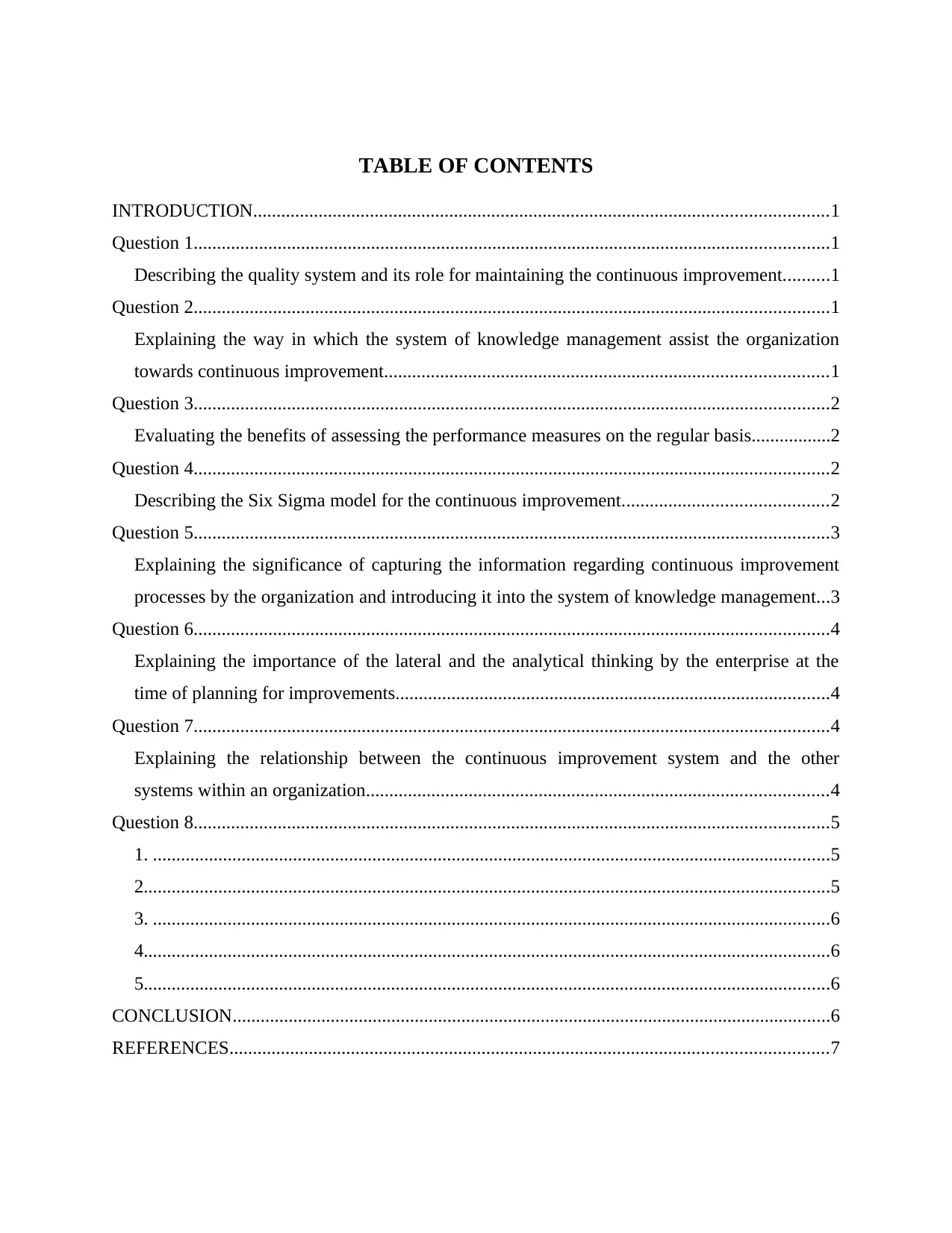
TABLE OF CONTENTS
INTRODUCTION...........................................................................................................................1
Question 1........................................................................................................................................1
Describing the quality system and its role for maintaining the continuous improvement..........1
Question 2........................................................................................................................................1
Explaining the way in which the system of knowledge management assist the organization
towards continuous improvement...............................................................................................1
Question 3........................................................................................................................................2
Evaluating the benefits of assessing the performance measures on the regular basis.................2
Question 4........................................................................................................................................2
Describing the Six Sigma model for the continuous improvement............................................2
Question 5........................................................................................................................................3
Explaining the significance of capturing the information regarding continuous improvement
processes by the organization and introducing it into the system of knowledge management...3
Question 6........................................................................................................................................4
Explaining the importance of the lateral and the analytical thinking by the enterprise at the
time of planning for improvements.............................................................................................4
Question 7........................................................................................................................................4
Explaining the relationship between the continuous improvement system and the other
systems within an organization...................................................................................................4
Question 8........................................................................................................................................5
1. .................................................................................................................................................5
2...................................................................................................................................................5
3. .................................................................................................................................................6
4...................................................................................................................................................6
5...................................................................................................................................................6
CONCLUSION................................................................................................................................6
REFERENCES................................................................................................................................7
INTRODUCTION...........................................................................................................................1
Question 1........................................................................................................................................1
Describing the quality system and its role for maintaining the continuous improvement..........1
Question 2........................................................................................................................................1
Explaining the way in which the system of knowledge management assist the organization
towards continuous improvement...............................................................................................1
Question 3........................................................................................................................................2
Evaluating the benefits of assessing the performance measures on the regular basis.................2
Question 4........................................................................................................................................2
Describing the Six Sigma model for the continuous improvement............................................2
Question 5........................................................................................................................................3
Explaining the significance of capturing the information regarding continuous improvement
processes by the organization and introducing it into the system of knowledge management...3
Question 6........................................................................................................................................4
Explaining the importance of the lateral and the analytical thinking by the enterprise at the
time of planning for improvements.............................................................................................4
Question 7........................................................................................................................................4
Explaining the relationship between the continuous improvement system and the other
systems within an organization...................................................................................................4
Question 8........................................................................................................................................5
1. .................................................................................................................................................5
2...................................................................................................................................................5
3. .................................................................................................................................................6
4...................................................................................................................................................6
5...................................................................................................................................................6
CONCLUSION................................................................................................................................6
REFERENCES................................................................................................................................7
INTRODUCTION
For the present report different questions are bring answered with context of different
aspects and operation of a business organisation this includes quality system, performance
measurement, knowledge management system, six sigma, analytical and lateral thinking and
planning for the organisation, area requires improvement. A last question is answered on the
basis of given case study.
Question 1
Describing the quality system and its role for maintaining the continuous improvement.
Quality management system refers to the accumulation of the business processes that
focuses on consistently matching with the requirements of the customers and enhancing the
level of their satisfaction. It is the structure that is been created for maintaining the quality of
the output generated. Quality system is expressed as the goals, aspirations, processes,
documented information, resources and policies required to execute and in maintaining it.
Quality system plays a vital role in continuous improvement of the operations of the business
as it provides for assessing all the areas of the activities within the business environment.
Effective quality management system helps an entity in optimum uses of the resources which
in turn reduces the wastage and improves the control process. Implementation of this system is
essential for every organization because it results in capturing the large market share with
lowered cost keeping in account the expectations of the customers. This leads to continuous
improvement in the profitability of the business. For example- reviewing the operations timely
helps the organization in taking corrective measures for meeting out the deviation present in
the performance. This lead to quality products which in turn helps in gaining the customer
satisfaction. Furthermore, satisfied customer results in improved sales and profits of the
business.
Question 2
Explaining the way in which the system of knowledge management assist the organization
towards continuous improvement.
Knowledge management system act as the mechanism for creating learning among the
members of the organization. It supports the action of the employees towards the quality
performance.
1
For the present report different questions are bring answered with context of different
aspects and operation of a business organisation this includes quality system, performance
measurement, knowledge management system, six sigma, analytical and lateral thinking and
planning for the organisation, area requires improvement. A last question is answered on the
basis of given case study.
Question 1
Describing the quality system and its role for maintaining the continuous improvement.
Quality management system refers to the accumulation of the business processes that
focuses on consistently matching with the requirements of the customers and enhancing the
level of their satisfaction. It is the structure that is been created for maintaining the quality of
the output generated. Quality system is expressed as the goals, aspirations, processes,
documented information, resources and policies required to execute and in maintaining it.
Quality system plays a vital role in continuous improvement of the operations of the business
as it provides for assessing all the areas of the activities within the business environment.
Effective quality management system helps an entity in optimum uses of the resources which
in turn reduces the wastage and improves the control process. Implementation of this system is
essential for every organization because it results in capturing the large market share with
lowered cost keeping in account the expectations of the customers. This leads to continuous
improvement in the profitability of the business. For example- reviewing the operations timely
helps the organization in taking corrective measures for meeting out the deviation present in
the performance. This lead to quality products which in turn helps in gaining the customer
satisfaction. Furthermore, satisfied customer results in improved sales and profits of the
business.
Question 2
Explaining the way in which the system of knowledge management assist the organization
towards continuous improvement.
Knowledge management system act as the mechanism for creating learning among the
members of the organization. It supports the action of the employees towards the quality
performance.
1
⊘ This is a preview!⊘
Do you want full access?
Subscribe today to unlock all pages.

Trusted by 1+ million students worldwide
From the above report with answering all the above questions it an be concluded that
for an organisation's effective operation and activities the knowledge, information and
continues improvements are of crucial importance. For the business performance
measurements and six sigma plays vital role in development of continues improvement model
which ensures smooth running the company with long term survival. it include determining
the performance gaps. For example- changes in the staff turnover resist the consistency in
functioning so knowledge management system is adopted which helps in resolving and
surviving from this disruptive problem.
Question 3
Evaluating the benefits of assessing the performance measures on the regular basis.
There are various advantages that are gained by the organization as well as the
employees through measuring the performance on regular basis as follows-
Day to day assessment of the performance helps in setting the benchmark for the
improved performance. Bench-marking is a performance matrix used by the company in
strategic management to identify and improvise distinct internal functions of a business and
the outcomes as well. It is used by the organisation as a measure and getting feedback. There
are other performance indicators as well inclusion benchmarking , key performance indicators,
ratio analysis and others. All these pays a key role of measuring and evaluating the
performance of the business both financially and operationally. This assist the management of
the business in formulating better strategic planning and a framework for building,
communicating stratagies.
For example: an organisation can use the performance indicator balance score card as
to look forward in increasing the production for this a manufacturing scorecard will be
prepared with stating the volume and profits level and a chart of low cost operations. This will
provide the optimisation of the product and revenues, production process, channels to
maximise revenue and the head cont management.
Question 4
Describing the Six Sigma model for the continuous improvement.
Six Sigma approach can be defined as a closed loop and a continuous process of
improvement. This approach assist the management and can be integrated in the organisation
through two perspectives. The two distinct yet correlated are the project and the business
2
for an organisation's effective operation and activities the knowledge, information and
continues improvements are of crucial importance. For the business performance
measurements and six sigma plays vital role in development of continues improvement model
which ensures smooth running the company with long term survival. it include determining
the performance gaps. For example- changes in the staff turnover resist the consistency in
functioning so knowledge management system is adopted which helps in resolving and
surviving from this disruptive problem.
Question 3
Evaluating the benefits of assessing the performance measures on the regular basis.
There are various advantages that are gained by the organization as well as the
employees through measuring the performance on regular basis as follows-
Day to day assessment of the performance helps in setting the benchmark for the
improved performance. Bench-marking is a performance matrix used by the company in
strategic management to identify and improvise distinct internal functions of a business and
the outcomes as well. It is used by the organisation as a measure and getting feedback. There
are other performance indicators as well inclusion benchmarking , key performance indicators,
ratio analysis and others. All these pays a key role of measuring and evaluating the
performance of the business both financially and operationally. This assist the management of
the business in formulating better strategic planning and a framework for building,
communicating stratagies.
For example: an organisation can use the performance indicator balance score card as
to look forward in increasing the production for this a manufacturing scorecard will be
prepared with stating the volume and profits level and a chart of low cost operations. This will
provide the optimisation of the product and revenues, production process, channels to
maximise revenue and the head cont management.
Question 4
Describing the Six Sigma model for the continuous improvement.
Six Sigma approach can be defined as a closed loop and a continuous process of
improvement. This approach assist the management and can be integrated in the organisation
through two perspectives. The two distinct yet correlated are the project and the business
2
Paraphrase This Document
Need a fresh take? Get an instant paraphrase of this document with our AI Paraphraser
perspectives. For the project one the six sigma team follows the disciple of MAIC where the
gab between the current process capabilities and analyses with the goals of the project and the
root cause for the defect is identified. With this the process of improving capabilities are
determined by eliminating the root cause and new process control are implemented to sustain
the improvements.
Under the business perspective of six sigma the projects are derived form the company
in a strategic plan which sets the gas for the organisation and key performance measurements.
On the basis of business objectives and the top management of business define the six sigma
projects and scope for the projects of the company.
With this integrated framework, organizations can continuously improve their
processes and constantly gain the quantifiable bottom-line results from satisfied customers. Six
Sigma tools uncover the unseen root causes of potential problems and attack them to eliminate
defect opportunities.
The Six Sigma breakthrough
model, with three main objectives: higher profit, increased value, and reduced
variation. Six Sigma science of continuous improvement concentrates on two
processes that each include three step:
Process Characterization
1. Defi ne project and process measurement (diagnosis)
2. Evaluate existing sigma (capability study)
3. Analyze process data
Process Optimization/Simulation
4. Improve and optimize process
5. Evaluate new sigma (capability study)
3
gab between the current process capabilities and analyses with the goals of the project and the
root cause for the defect is identified. With this the process of improving capabilities are
determined by eliminating the root cause and new process control are implemented to sustain
the improvements.
Under the business perspective of six sigma the projects are derived form the company
in a strategic plan which sets the gas for the organisation and key performance measurements.
On the basis of business objectives and the top management of business define the six sigma
projects and scope for the projects of the company.
With this integrated framework, organizations can continuously improve their
processes and constantly gain the quantifiable bottom-line results from satisfied customers. Six
Sigma tools uncover the unseen root causes of potential problems and attack them to eliminate
defect opportunities.
The Six Sigma breakthrough
model, with three main objectives: higher profit, increased value, and reduced
variation. Six Sigma science of continuous improvement concentrates on two
processes that each include three step:
Process Characterization
1. Defi ne project and process measurement (diagnosis)
2. Evaluate existing sigma (capability study)
3. Analyze process data
Process Optimization/Simulation
4. Improve and optimize process
5. Evaluate new sigma (capability study)
3
6. Control and maintain the process
Question 5
Explaining the significance of capturing the information regarding continuous improvement
processes by the organization and introducing it into the system of knowledge
management
The continues improvement process is a discipline which is data driven. The modes of
continuous improvement uses the tools of statistical analysis and relied on the infrastructure of
people within the company. The continuous improvement strategy is highly structured
continuous improvement model, ideal for organizations already organized in a structured,
corporate way. On the other hand the knowledge management is a system that act as the
mechanism for creating learning among the members of the organization. Both the systems are
interrelated as the area and the section requiring improvement is given by the continuous
improvement models. This information is used by the knowledge to set the goals and that are
to be achieved by employee in order to attain better quality performance the employees of the
organisation. This can be stated that company applies the improvident model to identify the
area requiring improvement and then this data is use to set target for the company as well as
individual employee to attain overall objective of the company.
For example : the management is provide with the information of quality improvement in
performance of the employees regarding attaining their monthly task which shows a lag in the
performance of the all employ for past 6 months. The knowledge management uses this
information to set new goals for employee and motivating the to achieve the same.
Question 6
Explaining the importance of the lateral and the analytical thinking by the enterprise at the time
of planning for improvements
The concept of lateral thinking can be defined as a process of solving the business
problems by indirect and creative approaches which are done typically through viewing the
problem in a new light and a different angle. Where as the analytical thinking is used in the
organisation as a critical component of visual thinking that gives the management a ability to
solve the problems quickly and effectively. This is done by following a methodical step by
step process of thinking allowing the management to break down the complex problem into
single and manageable component. Both the approach of lateral and analytical thinking are
4
Question 5
Explaining the significance of capturing the information regarding continuous improvement
processes by the organization and introducing it into the system of knowledge
management
The continues improvement process is a discipline which is data driven. The modes of
continuous improvement uses the tools of statistical analysis and relied on the infrastructure of
people within the company. The continuous improvement strategy is highly structured
continuous improvement model, ideal for organizations already organized in a structured,
corporate way. On the other hand the knowledge management is a system that act as the
mechanism for creating learning among the members of the organization. Both the systems are
interrelated as the area and the section requiring improvement is given by the continuous
improvement models. This information is used by the knowledge to set the goals and that are
to be achieved by employee in order to attain better quality performance the employees of the
organisation. This can be stated that company applies the improvident model to identify the
area requiring improvement and then this data is use to set target for the company as well as
individual employee to attain overall objective of the company.
For example : the management is provide with the information of quality improvement in
performance of the employees regarding attaining their monthly task which shows a lag in the
performance of the all employ for past 6 months. The knowledge management uses this
information to set new goals for employee and motivating the to achieve the same.
Question 6
Explaining the importance of the lateral and the analytical thinking by the enterprise at the time
of planning for improvements
The concept of lateral thinking can be defined as a process of solving the business
problems by indirect and creative approaches which are done typically through viewing the
problem in a new light and a different angle. Where as the analytical thinking is used in the
organisation as a critical component of visual thinking that gives the management a ability to
solve the problems quickly and effectively. This is done by following a methodical step by
step process of thinking allowing the management to break down the complex problem into
single and manageable component. Both the approach of lateral and analytical thinking are
4
⊘ This is a preview!⊘
Do you want full access?
Subscribe today to unlock all pages.
Trusted by 1+ million students worldwide
opposite to each other. Under the lateral one the issues are solved after viewing the same
from different angle and implementation of innovating thinking where as under the analytical
approach the management indulge in process of breaking down the problem into small
segment and them combining the common factors to resolve the business issues.
Question 7
Explaining the relationship between the continuous improvement system and the other systems
within an organization
The delivery and consume values process under continuous improvement system are
constantly evaluated and improves regarding efficiency, effectiveness and flexibility on the
basis of affirmation provided by this system. The business process management gets
information over the cost control and performance and, measures are taken accordingly. The
information related with employee performance is given and the goals and objective for each
employee is set out over the areas requiring improvement and achieving the organisation
goals. The information given by this system is also used by the other department or area of the
business including the quality management, project ad program management.
Question 8
1.
Off shore manufacturing:
Advantages:
reduced cost of salary of the skilled staff due to easy availability.
Reduction in overall cost of production
Disadvantages :
increased cost of transportation
cultural different in the company as well as staff.
With stating the pros and cons of this approach the brainstorming participation
techniques will be used. This will provide an organisation with best and effective steps
to be taken of taking manufacturing off shore.
Laying of the staff:
Advantages:
no need to pay higher wages to staff.
Can hire new staff on lesser wages and more working abilities
5
from different angle and implementation of innovating thinking where as under the analytical
approach the management indulge in process of breaking down the problem into small
segment and them combining the common factors to resolve the business issues.
Question 7
Explaining the relationship between the continuous improvement system and the other systems
within an organization
The delivery and consume values process under continuous improvement system are
constantly evaluated and improves regarding efficiency, effectiveness and flexibility on the
basis of affirmation provided by this system. The business process management gets
information over the cost control and performance and, measures are taken accordingly. The
information related with employee performance is given and the goals and objective for each
employee is set out over the areas requiring improvement and achieving the organisation
goals. The information given by this system is also used by the other department or area of the
business including the quality management, project ad program management.
Question 8
1.
Off shore manufacturing:
Advantages:
reduced cost of salary of the skilled staff due to easy availability.
Reduction in overall cost of production
Disadvantages :
increased cost of transportation
cultural different in the company as well as staff.
With stating the pros and cons of this approach the brainstorming participation
techniques will be used. This will provide an organisation with best and effective steps
to be taken of taking manufacturing off shore.
Laying of the staff:
Advantages:
no need to pay higher wages to staff.
Can hire new staff on lesser wages and more working abilities
5
Paraphrase This Document
Need a fresh take? Get an instant paraphrase of this document with our AI Paraphraser
Disadvantages :
losing the faith and trust of costumers and potential employees
increased cost of recruiting new staff
For this approach mind mapping techniques will be engaged to lay off all the present
staff without hurting any employee as well as the operations of business.
Diversification of product range
Advantages:
can offer consumers a larger range of different products than present.
Gaining competitive advantage with offering lower cost products and a diversified
product line.
Disadvantages :
increasing the cost of production and other expenses as well.
Change in the structure, management and structure of company due to diversification.
For this stepladder technique will be used to determine the stage for diversification of product
line and to identify the product to be includes in productions.
2.
The continuous improvement model is one of the most importance pillars for an
organisation. The model sounds self evident but still the continues improvisation is not the
idealist goal of a organisation. This system is an ongoing effort to improve the product,
services or process of the company. With this system the organisation's other system are also
integrated to achieve incremental improvement over the time. This will be communicated to
the stakeholder through the general meeting. The stakeholders will be informed through
stakeholder through the annual reports and financial statement of company stating the
improvement done.
3.
To, Senior management
Sub: The positive effects of trainings and mentoring
Sir/Madam
In the current scenario the major cost of furniture is related with the wages of skilled
staff. With a training and monitoring to them for producing more complex and simple
6
losing the faith and trust of costumers and potential employees
increased cost of recruiting new staff
For this approach mind mapping techniques will be engaged to lay off all the present
staff without hurting any employee as well as the operations of business.
Diversification of product range
Advantages:
can offer consumers a larger range of different products than present.
Gaining competitive advantage with offering lower cost products and a diversified
product line.
Disadvantages :
increasing the cost of production and other expenses as well.
Change in the structure, management and structure of company due to diversification.
For this stepladder technique will be used to determine the stage for diversification of product
line and to identify the product to be includes in productions.
2.
The continuous improvement model is one of the most importance pillars for an
organisation. The model sounds self evident but still the continues improvisation is not the
idealist goal of a organisation. This system is an ongoing effort to improve the product,
services or process of the company. With this system the organisation's other system are also
integrated to achieve incremental improvement over the time. This will be communicated to
the stakeholder through the general meeting. The stakeholders will be informed through
stakeholder through the annual reports and financial statement of company stating the
improvement done.
3.
To, Senior management
Sub: The positive effects of trainings and mentoring
Sir/Madam
In the current scenario the major cost of furniture is related with the wages of skilled
staff. With a training and monitoring to them for producing more complex and simple
6
furniture design will diversify the product line as well save the cost of more wages. With this
the present situation of falling sales can be controlled.
With training the performance of employee and department will be enhances and with
continuous monitories the lag in the performance will be detected immediately for which
effective measures can be taken to enhance the overall performance of the organisation.
4.
The sustainability practices assist the company in reducing, reusing and recycling of
the material used in the production and manufacturing. With the use of sustainability
techniques of reduction the cost will be saved as the material will be used where it required,
similarly with use reusing the material the cost will be cut and with recycling the new cost is
saved and this effective reduce the cost the products, with a lower cost the sales prices at
lower level with getting a competitive advantage over the competitors offering goods at lower
price.
5.
The explicit knowledge management system can be used by enterprise in reaching to the
desired results. Knowledge gained among the employees through the work experience that
assist the employees in respect of learning new techniques or ways for improving the process
so that continuous enhancement in the system of the company could be attained. The explicit
knowledge management system that assist an entity in improving their ability in solving the
problems in a better way, to adapt and evolve in meeting the changing requirements of the
business. Knowledge management system assist in recognising the complex system and in
driving out the actions from it.
CONCLUSION
From the above report with answering all the above questions it an be concluded that
for an organisation's effective operation and activities the knowledge, information and
continues improvements are of crucial importance. For the business performance
measurements and six sigma plays vital role in development of continues improvement model
which ensures smooth running the company with long term survival.
7
the present situation of falling sales can be controlled.
With training the performance of employee and department will be enhances and with
continuous monitories the lag in the performance will be detected immediately for which
effective measures can be taken to enhance the overall performance of the organisation.
4.
The sustainability practices assist the company in reducing, reusing and recycling of
the material used in the production and manufacturing. With the use of sustainability
techniques of reduction the cost will be saved as the material will be used where it required,
similarly with use reusing the material the cost will be cut and with recycling the new cost is
saved and this effective reduce the cost the products, with a lower cost the sales prices at
lower level with getting a competitive advantage over the competitors offering goods at lower
price.
5.
The explicit knowledge management system can be used by enterprise in reaching to the
desired results. Knowledge gained among the employees through the work experience that
assist the employees in respect of learning new techniques or ways for improving the process
so that continuous enhancement in the system of the company could be attained. The explicit
knowledge management system that assist an entity in improving their ability in solving the
problems in a better way, to adapt and evolve in meeting the changing requirements of the
business. Knowledge management system assist in recognising the complex system and in
driving out the actions from it.
CONCLUSION
From the above report with answering all the above questions it an be concluded that
for an organisation's effective operation and activities the knowledge, information and
continues improvements are of crucial importance. For the business performance
measurements and six sigma plays vital role in development of continues improvement model
which ensures smooth running the company with long term survival.
7
⊘ This is a preview!⊘
Do you want full access?
Subscribe today to unlock all pages.
Trusted by 1+ million students worldwide
REFERENCES
Books and Journals
Underhill, N and et.al., 2016. Maintaining a Successful Quality Management Program: Fifteen
Years of Experience at a Single Institution. Biology of Blood and Marrow
Transplantation. 22(3). pp.S434-S435.
Smith, S. C., Warre, L. . and Cooley, L. D., 2019. Maintaining a methods database to optimize
solid tumor tissue culture: Review of a 15-year database from a single institution. Cancer
genetics.
Singh, J. and Singh, H., 2015. Continuous improvement philosophy–literature review and
directions. Benchmarking: An International Journal. 22(1). pp.75-119.
Creed, I. F. and et.al., 2018. Maintaining the Portfolio of Wetland Functions on Landscapes: A
Rapid Evaluation Tool for Estimating Wetland Functions and Values in Alberta, Canada.
In Wetland and Stream Rapid Assessments (pp. 189-206). Academic Press.
Li, G and et.al., 2018. Improvement of strength with maintaining ductility of harmonic
structure pure copper by cold rolling and annealing process. Procedia Manufacturing. 15.
pp.1641-1648.
Arumugam, V., Antony, J. and Linderman, K., 2016. The influence of challenging goals and
structured method on Six Sigma project performance: A mediated moderation
analysis. European Journal of Operational Research. 254(1). pp.202-213.
Albliwi, S. A., Antony, J. and Lim, S. A. H., 2015. A systematic review of Lean Six Sigma for
the manufacturing industry. Business Process Management Journal. 21(3). pp.665-691.
Chugani, N. and et.al., 2017. Investigating the green impact of Lean, Six Sigma and Lean Six
Sigma: A systematic literature review. International Journal of Lean Six Sigma. 8(1). pp.7-32.
8
Books and Journals
Underhill, N and et.al., 2016. Maintaining a Successful Quality Management Program: Fifteen
Years of Experience at a Single Institution. Biology of Blood and Marrow
Transplantation. 22(3). pp.S434-S435.
Smith, S. C., Warre, L. . and Cooley, L. D., 2019. Maintaining a methods database to optimize
solid tumor tissue culture: Review of a 15-year database from a single institution. Cancer
genetics.
Singh, J. and Singh, H., 2015. Continuous improvement philosophy–literature review and
directions. Benchmarking: An International Journal. 22(1). pp.75-119.
Creed, I. F. and et.al., 2018. Maintaining the Portfolio of Wetland Functions on Landscapes: A
Rapid Evaluation Tool for Estimating Wetland Functions and Values in Alberta, Canada.
In Wetland and Stream Rapid Assessments (pp. 189-206). Academic Press.
Li, G and et.al., 2018. Improvement of strength with maintaining ductility of harmonic
structure pure copper by cold rolling and annealing process. Procedia Manufacturing. 15.
pp.1641-1648.
Arumugam, V., Antony, J. and Linderman, K., 2016. The influence of challenging goals and
structured method on Six Sigma project performance: A mediated moderation
analysis. European Journal of Operational Research. 254(1). pp.202-213.
Albliwi, S. A., Antony, J. and Lim, S. A. H., 2015. A systematic review of Lean Six Sigma for
the manufacturing industry. Business Process Management Journal. 21(3). pp.665-691.
Chugani, N. and et.al., 2017. Investigating the green impact of Lean, Six Sigma and Lean Six
Sigma: A systematic literature review. International Journal of Lean Six Sigma. 8(1). pp.7-32.
8

1 out of 10


Related Documents


Your All-in-One AI-Powered Toolkit for Academic Success.
+13062052269
info@desklib.com
Available 24*7 on WhatsApp / Email
![[object Object]](/_next/static/media/star-bottom.7253800d.svg)
Unlock your academic potential
Copyright © 2020–2026 A2Z Services. All Rights Reserved. Developed and managed by ZUCOL.