Comprehensive Management Accounting Report for Good Clothing Ltd
VerifiedAdded on 2020/06/04
|18
|5583
|347
Report
AI Summary
This report provides a detailed analysis of management accounting practices for Good Clothing Ltd. It begins with an introduction to management accounting and its benefits, followed by a critical evaluation of the management reporting system. The report delves into various costing methods, including absorption and marginal costing, with calculations and comparisons. It then explores financial planning, statement analysis, and standard costing techniques, including forecasted financial statements and balance sheets. Furthermore, the report examines the application of planning tools, their advantages, and disadvantages, and concludes with a comparison between two organizations regarding the adoption of management accounting systems. Profitability ratios are also calculated to determine the company's ability to generate profit. The report provides an in-depth understanding of how management accounting aids in resolving financial issues within an organization.
Management Accounting

Paraphrase This Document
Need a fresh take? Get an instant paraphrase of this document with our AI Paraphraser
Table of Contents
INTRODUCTION...........................................................................................................................3
TASK 1............................................................................................................................................3
M1: Benefits of management accounting system ......................................................................3
D1: Critical evaluation of management reporting system...........................................................3
P3: Calculation of cost by using various costing methods..........................................................4
M2: Various range of management accounting techniques........................................................6
D2: Produce financial reports by apply and interpret data for Good clothing Ltd.....................8
TASK 3..........................................................................................................................................11
P4 and D3: Advantages and disadvantages of different types of planning tools .....................11
M3 Use of planning tools and their application........................................................................14
TASK 4..........................................................................................................................................14
P5 Comparison between two organisation for adopting management accounting system.......14
M4 Management accounting lead enterprise to solve financial issues ...................................16
CONCLUSION..............................................................................................................................17
REFERENCES..............................................................................................................................18
INTRODUCTION...........................................................................................................................3
TASK 1............................................................................................................................................3
M1: Benefits of management accounting system ......................................................................3
D1: Critical evaluation of management reporting system...........................................................3
P3: Calculation of cost by using various costing methods..........................................................4
M2: Various range of management accounting techniques........................................................6
D2: Produce financial reports by apply and interpret data for Good clothing Ltd.....................8
TASK 3..........................................................................................................................................11
P4 and D3: Advantages and disadvantages of different types of planning tools .....................11
M3 Use of planning tools and their application........................................................................14
TASK 4..........................................................................................................................................14
P5 Comparison between two organisation for adopting management accounting system.......14
M4 Management accounting lead enterprise to solve financial issues ...................................16
CONCLUSION..............................................................................................................................17
REFERENCES..............................................................................................................................18
INTRODUCTION
Management accounting is a necessary tool by which every organisation can manager
and operate their every day financial as well as non-financial transactions. The primary motive of
using accounting systems is to summarise, record and evaluate different outcomes that can be
beneficial for the company in next coming time. The provision of accounting information is an
essential aspects for “Good clothing Ltd” that can be use in order to generate more specific
results. It is crucial for them to make use of management accounting system in their operations to
control costs and other expenses those are affecting the profitability of the company.
This project report provide more valuable information about use of accounting and
reporting systems by various departments in an organisation (DRURY, 2013). Some specific
costing method is been used those are helpful in analysing net profitability of the company.
Advantages and disadvantage of using planning tools in budgetary-control are discuss more
effectively. Whereas understanding of financial issue and all those effective techniques those are
useful in resolving those issues are explain clearly under this report.
TASK 1
M1: Benefits of management accounting system
In every business organisation, it is vital for them to make use of accounting systems in
more effective manner. This would help in gain competitive advantages over other companies.
There are various advantages of using this accounting system that is usually happen with the
capability for companies to improve operations and efficiencies. It will enable the fluctuation of
business financial capital gains.
D1: Critical evaluation of management reporting system
It is vital for the Good clothing companies to make sure that every data would be
properly recorded into the various accounting books so that valuable decision can be done. There
are crucial statements those are helpful for taking crucial decision-making for the further
expansion of business operations.
TASK 2
3
Management accounting is a necessary tool by which every organisation can manager
and operate their every day financial as well as non-financial transactions. The primary motive of
using accounting systems is to summarise, record and evaluate different outcomes that can be
beneficial for the company in next coming time. The provision of accounting information is an
essential aspects for “Good clothing Ltd” that can be use in order to generate more specific
results. It is crucial for them to make use of management accounting system in their operations to
control costs and other expenses those are affecting the profitability of the company.
This project report provide more valuable information about use of accounting and
reporting systems by various departments in an organisation (DRURY, 2013). Some specific
costing method is been used those are helpful in analysing net profitability of the company.
Advantages and disadvantage of using planning tools in budgetary-control are discuss more
effectively. Whereas understanding of financial issue and all those effective techniques those are
useful in resolving those issues are explain clearly under this report.
TASK 1
M1: Benefits of management accounting system
In every business organisation, it is vital for them to make use of accounting systems in
more effective manner. This would help in gain competitive advantages over other companies.
There are various advantages of using this accounting system that is usually happen with the
capability for companies to improve operations and efficiencies. It will enable the fluctuation of
business financial capital gains.
D1: Critical evaluation of management reporting system
It is vital for the Good clothing companies to make sure that every data would be
properly recorded into the various accounting books so that valuable decision can be done. There
are crucial statements those are helpful for taking crucial decision-making for the further
expansion of business operations.
TASK 2
3
⊘ This is a preview!⊘
Do you want full access?
Subscribe today to unlock all pages.

Trusted by 1+ million students worldwide
P3: Calculation of cost by using various costing methods
Cost is said to be the value of money that has been given up to produce something or
deliver better services to an organisation. In this business operations, the cost can be related with
formation of new manufacturing units. The total amount of expenditure incurred by managers
during proper establishment of the plant consider as cost to company. In accounting context, cost
which is define as cost amount that is given up an equipments. This would consists of all those
costs which is essential to get an assets in accordance to use.
This cost accounting helps in assisting in decision-making that is processes “Good
clothing company” to evaluate its costs (Vasile and Man, 2012). Some of them are direct,
indirect, fixed and operating cost. There are some valuable costing methods those are helpful in
determining net profitability of the company. In order to make vital decision it is essential for
them to make use of accounting data in proper manner so that estimation of total cost can be
determined. Costing is a well organise process of forecasting total cost that involves in a
particular projects of a company. Basically, it is perfect system of evaluating cost of production
in order to analyse expenses at various level of production. Those are explain underneath:
Absorption costing: It refers to the costs which is associated with every manufacturing
activity such as production of products and services. In some other terms, these are total costs of
a finish goods in inventory that will be related with direct labour, material and semi-flexible cost
at the time of manufacturing process. These types of costing is require to be followed as per the
set accounting standards in accordance with developing an stock evaluation which is mention in
the company's balance sheet (Brandau, and et. al., 2013)
Marginal costing: It is known as those are cost which is incur by the Good clothing
company during the production of one extra units. It is generally determine as the part of variable
cost because id does not consider fixed cost. This seems to be a variation in total cost that is
comes out after making production of additional units. The primary objectives of this costing is
to determine at which level of manufacturing the company is going to attain its break-even point.
Comparison
Absorption costing Marginal costing
4
Cost is said to be the value of money that has been given up to produce something or
deliver better services to an organisation. In this business operations, the cost can be related with
formation of new manufacturing units. The total amount of expenditure incurred by managers
during proper establishment of the plant consider as cost to company. In accounting context, cost
which is define as cost amount that is given up an equipments. This would consists of all those
costs which is essential to get an assets in accordance to use.
This cost accounting helps in assisting in decision-making that is processes “Good
clothing company” to evaluate its costs (Vasile and Man, 2012). Some of them are direct,
indirect, fixed and operating cost. There are some valuable costing methods those are helpful in
determining net profitability of the company. In order to make vital decision it is essential for
them to make use of accounting data in proper manner so that estimation of total cost can be
determined. Costing is a well organise process of forecasting total cost that involves in a
particular projects of a company. Basically, it is perfect system of evaluating cost of production
in order to analyse expenses at various level of production. Those are explain underneath:
Absorption costing: It refers to the costs which is associated with every manufacturing
activity such as production of products and services. In some other terms, these are total costs of
a finish goods in inventory that will be related with direct labour, material and semi-flexible cost
at the time of manufacturing process. These types of costing is require to be followed as per the
set accounting standards in accordance with developing an stock evaluation which is mention in
the company's balance sheet (Brandau, and et. al., 2013)
Marginal costing: It is known as those are cost which is incur by the Good clothing
company during the production of one extra units. It is generally determine as the part of variable
cost because id does not consider fixed cost. This seems to be a variation in total cost that is
comes out after making production of additional units. The primary objectives of this costing is
to determine at which level of manufacturing the company is going to attain its break-even point.
Comparison
Absorption costing Marginal costing
4
Paraphrase This Document
Need a fresh take? Get an instant paraphrase of this document with our AI Paraphraser
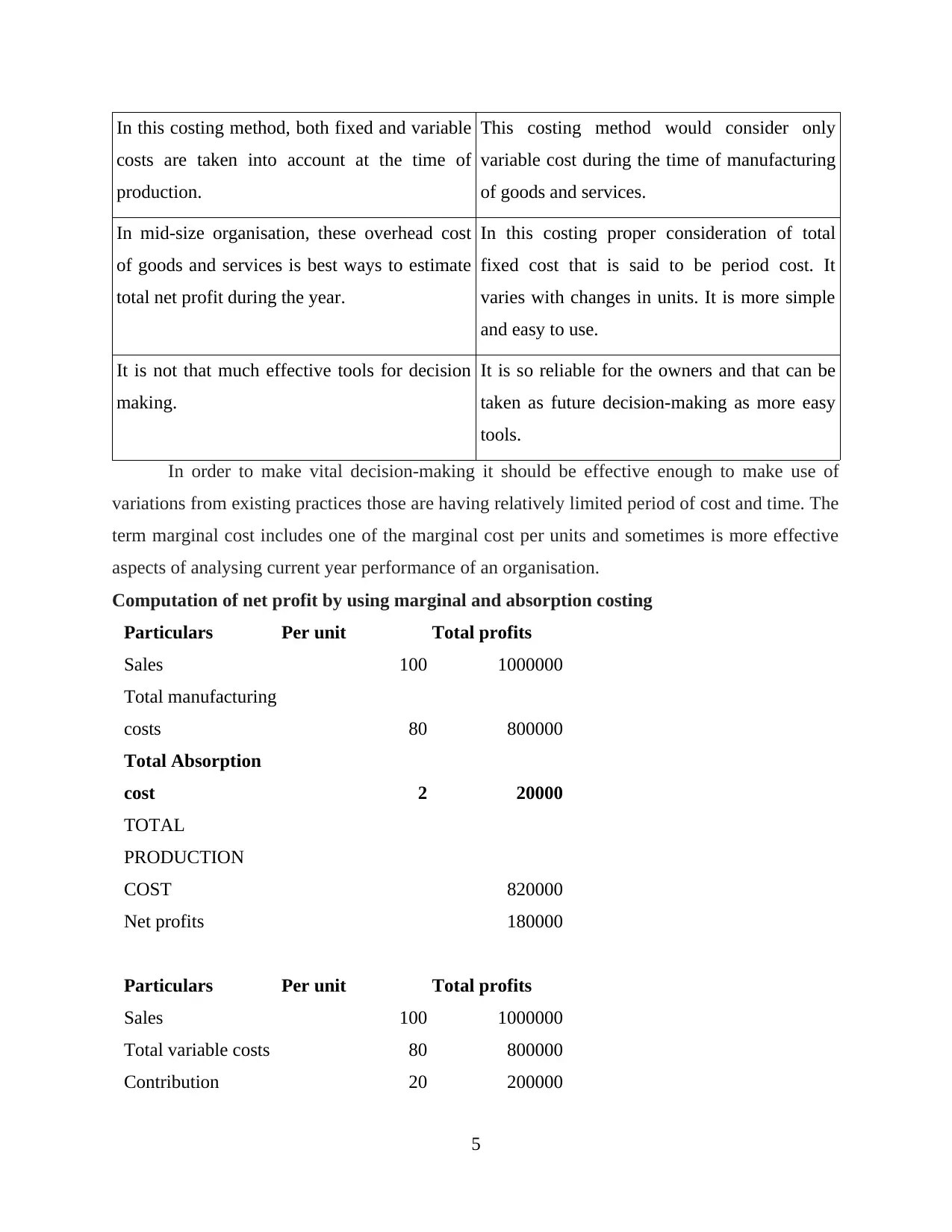
In this costing method, both fixed and variable
costs are taken into account at the time of
production.
This costing method would consider only
variable cost during the time of manufacturing
of goods and services.
In mid-size organisation, these overhead cost
of goods and services is best ways to estimate
total net profit during the year.
In this costing proper consideration of total
fixed cost that is said to be period cost. It
varies with changes in units. It is more simple
and easy to use.
It is not that much effective tools for decision
making.
It is so reliable for the owners and that can be
taken as future decision-making as more easy
tools.
In order to make vital decision-making it should be effective enough to make use of
variations from existing practices those are having relatively limited period of cost and time. The
term marginal cost includes one of the marginal cost per units and sometimes is more effective
aspects of analysing current year performance of an organisation.
Computation of net profit by using marginal and absorption costing
Particulars Per unit Total profits
Sales 100 1000000
Total manufacturing
costs 80 800000
Total Absorption
cost 2 20000
TOTAL
PRODUCTION
COST 820000
Net profits 180000
Particulars Per unit Total profits
Sales 100 1000000
Total variable costs 80 800000
Contribution 20 200000
5
costs are taken into account at the time of
production.
This costing method would consider only
variable cost during the time of manufacturing
of goods and services.
In mid-size organisation, these overhead cost
of goods and services is best ways to estimate
total net profit during the year.
In this costing proper consideration of total
fixed cost that is said to be period cost. It
varies with changes in units. It is more simple
and easy to use.
It is not that much effective tools for decision
making.
It is so reliable for the owners and that can be
taken as future decision-making as more easy
tools.
In order to make vital decision-making it should be effective enough to make use of
variations from existing practices those are having relatively limited period of cost and time. The
term marginal cost includes one of the marginal cost per units and sometimes is more effective
aspects of analysing current year performance of an organisation.
Computation of net profit by using marginal and absorption costing
Particulars Per unit Total profits
Sales 100 1000000
Total manufacturing
costs 80 800000
Total Absorption
cost 2 20000
TOTAL
PRODUCTION
COST 820000
Net profits 180000
Particulars Per unit Total profits
Sales 100 1000000
Total variable costs 80 800000
Contribution 20 200000
5
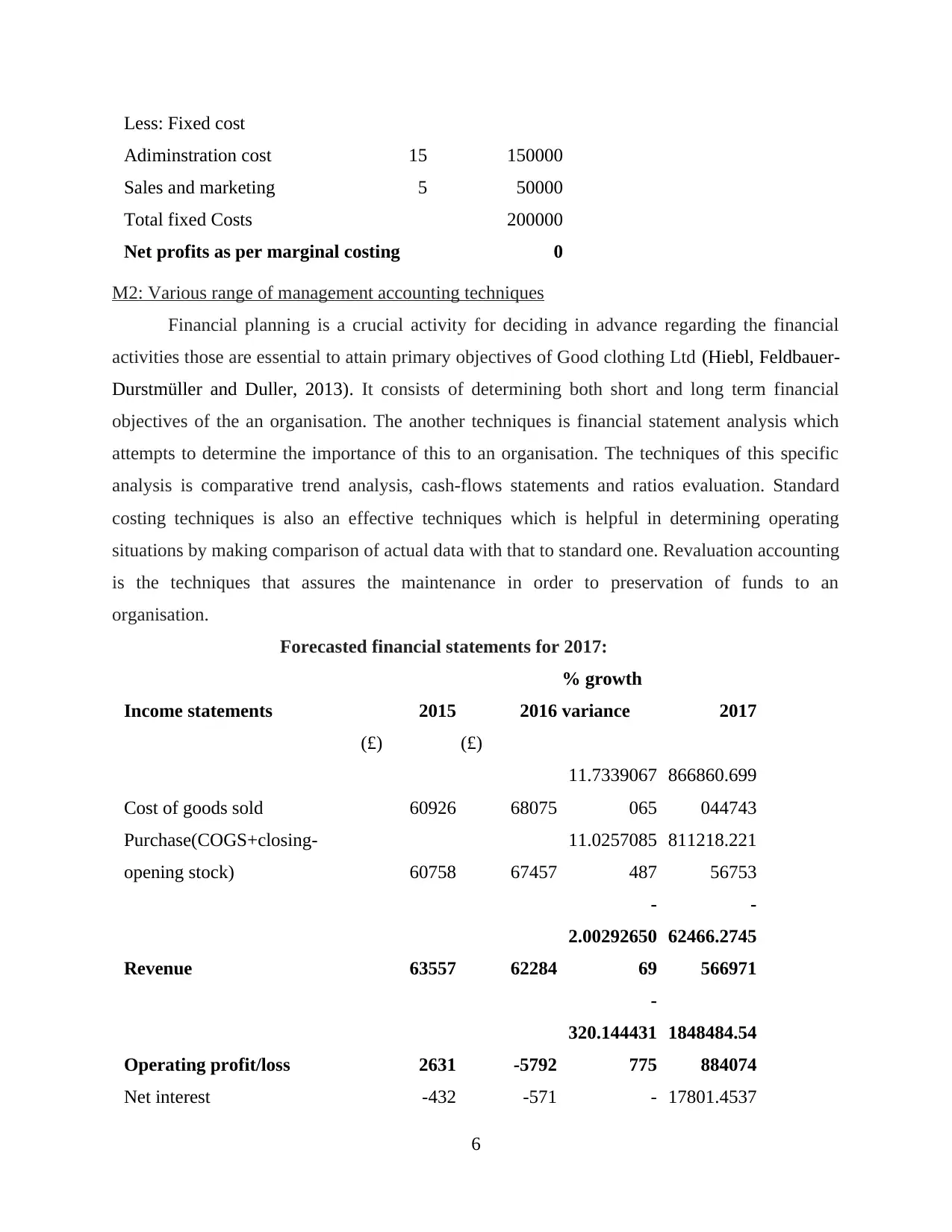
Less: Fixed cost
Adiminstration cost 15 150000
Sales and marketing 5 50000
Total fixed Costs 200000
Net profits as per marginal costing 0
M2: Various range of management accounting techniques
Financial planning is a crucial activity for deciding in advance regarding the financial
activities those are essential to attain primary objectives of Good clothing Ltd (Hiebl, Feldbauer-
Durstmüller and Duller, 2013). It consists of determining both short and long term financial
objectives of the an organisation. The another techniques is financial statement analysis which
attempts to determine the importance of this to an organisation. The techniques of this specific
analysis is comparative trend analysis, cash-flows statements and ratios evaluation. Standard
costing techniques is also an effective techniques which is helpful in determining operating
situations by making comparison of actual data with that to standard one. Revaluation accounting
is the techniques that assures the maintenance in order to preservation of funds to an
organisation.
Forecasted financial statements for 2017:
Income statements 2015 2016
% growth
variance 2017
(£) (£)
Cost of goods sold 60926 68075
11.7339067
065
866860.699
044743
Purchase(COGS+closing-
opening stock) 60758 67457
11.0257085
487
811218.221
56753
Revenue 63557 62284
-
2.00292650
69
-
62466.2745
566971
Operating profit/loss 2631 -5792
-
320.144431
775
1848484.54
884074
Net interest -432 -571 - 17801.4537
6
Adiminstration cost 15 150000
Sales and marketing 5 50000
Total fixed Costs 200000
Net profits as per marginal costing 0
M2: Various range of management accounting techniques
Financial planning is a crucial activity for deciding in advance regarding the financial
activities those are essential to attain primary objectives of Good clothing Ltd (Hiebl, Feldbauer-
Durstmüller and Duller, 2013). It consists of determining both short and long term financial
objectives of the an organisation. The another techniques is financial statement analysis which
attempts to determine the importance of this to an organisation. The techniques of this specific
analysis is comparative trend analysis, cash-flows statements and ratios evaluation. Standard
costing techniques is also an effective techniques which is helpful in determining operating
situations by making comparison of actual data with that to standard one. Revaluation accounting
is the techniques that assures the maintenance in order to preservation of funds to an
organisation.
Forecasted financial statements for 2017:
Income statements 2015 2016
% growth
variance 2017
(£) (£)
Cost of goods sold 60926 68075
11.7339067
065
866860.699
044743
Purchase(COGS+closing-
opening stock) 60758 67457
11.0257085
487
811218.221
56753
Revenue 63557 62284
-
2.00292650
69
-
62466.2745
566971
Operating profit/loss 2631 -5792
-
320.144431
775
1848484.54
884074
Net interest -432 -571 - 17801.4537
6
⊘ This is a preview!⊘
Do you want full access?
Subscribe today to unlock all pages.
Trusted by 1+ million students worldwide
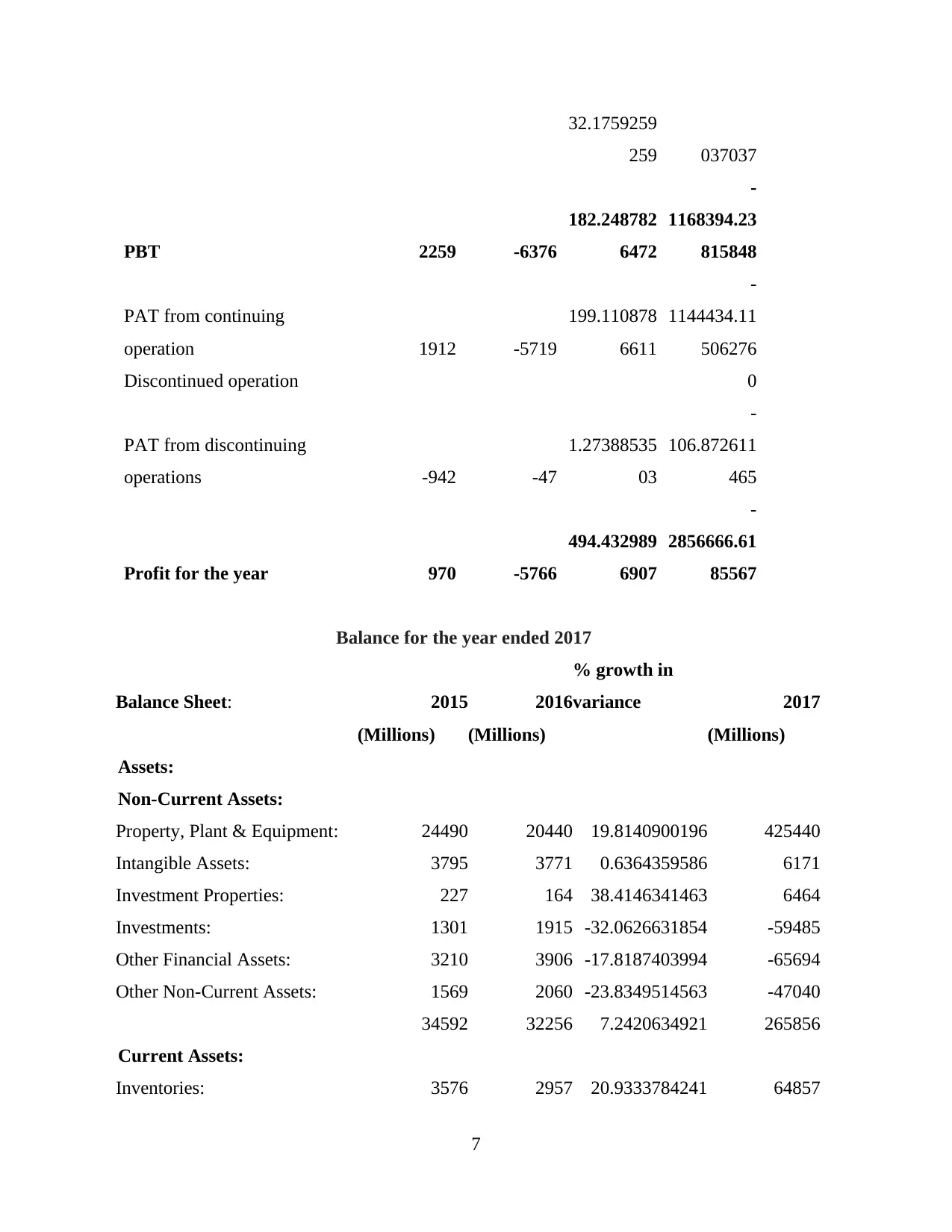
32.1759259
259 037037
PBT 2259 -6376
182.248782
6472
-
1168394.23
815848
PAT from continuing
operation 1912 -5719
199.110878
6611
-
1144434.11
506276
Discontinued operation 0
PAT from discontinuing
operations -942 -47
1.27388535
03
-
106.872611
465
Profit for the year 970 -5766
494.432989
6907
-
2856666.61
85567
Balance for the year ended 2017
Balance Sheet: 2015 2016
% growth in
variance 2017
(Millions) (Millions) (Millions)
Assets:
Non-Current Assets:
Property, Plant & Equipment: 24490 20440 19.8140900196 425440
Intangible Assets: 3795 3771 0.6364359586 6171
Investment Properties: 227 164 38.4146341463 6464
Investments: 1301 1915 -32.0626631854 -59485
Other Financial Assets: 3210 3906 -17.8187403994 -65694
Other Non-Current Assets: 1569 2060 -23.8349514563 -47040
34592 32256 7.2420634921 265856
Current Assets:
Inventories: 3576 2957 20.9333784241 64857
7
259 037037
PBT 2259 -6376
182.248782
6472
-
1168394.23
815848
PAT from continuing
operation 1912 -5719
199.110878
6611
-
1144434.11
506276
Discontinued operation 0
PAT from discontinuing
operations -942 -47
1.27388535
03
-
106.872611
465
Profit for the year 970 -5766
494.432989
6907
-
2856666.61
85567
Balance for the year ended 2017
Balance Sheet: 2015 2016
% growth in
variance 2017
(Millions) (Millions) (Millions)
Assets:
Non-Current Assets:
Property, Plant & Equipment: 24490 20440 19.8140900196 425440
Intangible Assets: 3795 3771 0.6364359586 6171
Investment Properties: 227 164 38.4146341463 6464
Investments: 1301 1915 -32.0626631854 -59485
Other Financial Assets: 3210 3906 -17.8187403994 -65694
Other Non-Current Assets: 1569 2060 -23.8349514563 -47040
34592 32256 7.2420634921 265856
Current Assets:
Inventories: 3576 2957 20.9333784241 64857
7
Paraphrase This Document
Need a fresh take? Get an instant paraphrase of this document with our AI Paraphraser
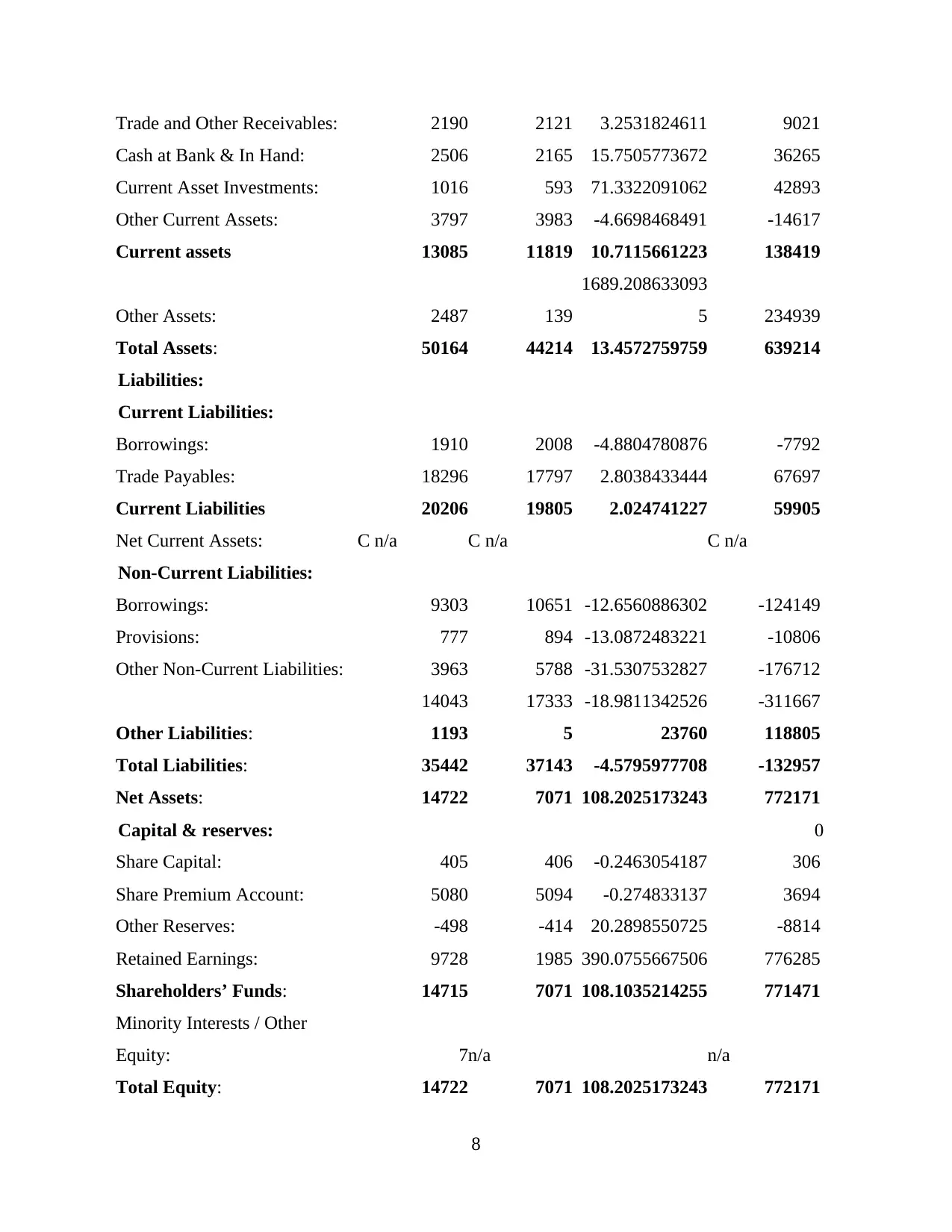
Trade and Other Receivables: 2190 2121 3.2531824611 9021
Cash at Bank & In Hand: 2506 2165 15.7505773672 36265
Current Asset Investments: 1016 593 71.3322091062 42893
Other Current Assets: 3797 3983 -4.6698468491 -14617
Current assets 13085 11819 10.7115661223 138419
Other Assets: 2487 139
1689.208633093
5 234939
Total Assets: 50164 44214 13.4572759759 639214
Liabilities:
Current Liabilities:
Borrowings: 1910 2008 -4.8804780876 -7792
Trade Payables: 18296 17797 2.8038433444 67697
Current Liabilities 20206 19805 2.024741227 59905
Net Current Assets: C n/a C n/a C n/a
Non-Current Liabilities:
Borrowings: 9303 10651 -12.6560886302 -124149
Provisions: 777 894 -13.0872483221 -10806
Other Non-Current Liabilities: 3963 5788 -31.5307532827 -176712
14043 17333 -18.9811342526 -311667
Other Liabilities: 1193 5 23760 118805
Total Liabilities: 35442 37143 -4.5795977708 -132957
Net Assets: 14722 7071 108.2025173243 772171
Capital & reserves: 0
Share Capital: 405 406 -0.2463054187 306
Share Premium Account: 5080 5094 -0.274833137 3694
Other Reserves: -498 -414 20.2898550725 -8814
Retained Earnings: 9728 1985 390.0755667506 776285
Shareholders’ Funds: 14715 7071 108.1035214255 771471
Minority Interests / Other
Equity: 7n/a n/a
Total Equity: 14722 7071 108.2025173243 772171
8
Cash at Bank & In Hand: 2506 2165 15.7505773672 36265
Current Asset Investments: 1016 593 71.3322091062 42893
Other Current Assets: 3797 3983 -4.6698468491 -14617
Current assets 13085 11819 10.7115661223 138419
Other Assets: 2487 139
1689.208633093
5 234939
Total Assets: 50164 44214 13.4572759759 639214
Liabilities:
Current Liabilities:
Borrowings: 1910 2008 -4.8804780876 -7792
Trade Payables: 18296 17797 2.8038433444 67697
Current Liabilities 20206 19805 2.024741227 59905
Net Current Assets: C n/a C n/a C n/a
Non-Current Liabilities:
Borrowings: 9303 10651 -12.6560886302 -124149
Provisions: 777 894 -13.0872483221 -10806
Other Non-Current Liabilities: 3963 5788 -31.5307532827 -176712
14043 17333 -18.9811342526 -311667
Other Liabilities: 1193 5 23760 118805
Total Liabilities: 35442 37143 -4.5795977708 -132957
Net Assets: 14722 7071 108.2025173243 772171
Capital & reserves: 0
Share Capital: 405 406 -0.2463054187 306
Share Premium Account: 5080 5094 -0.274833137 3694
Other Reserves: -498 -414 20.2898550725 -8814
Retained Earnings: 9728 1985 390.0755667506 776285
Shareholders’ Funds: 14715 7071 108.1035214255 771471
Minority Interests / Other
Equity: 7n/a n/a
Total Equity: 14722 7071 108.2025173243 772171
8
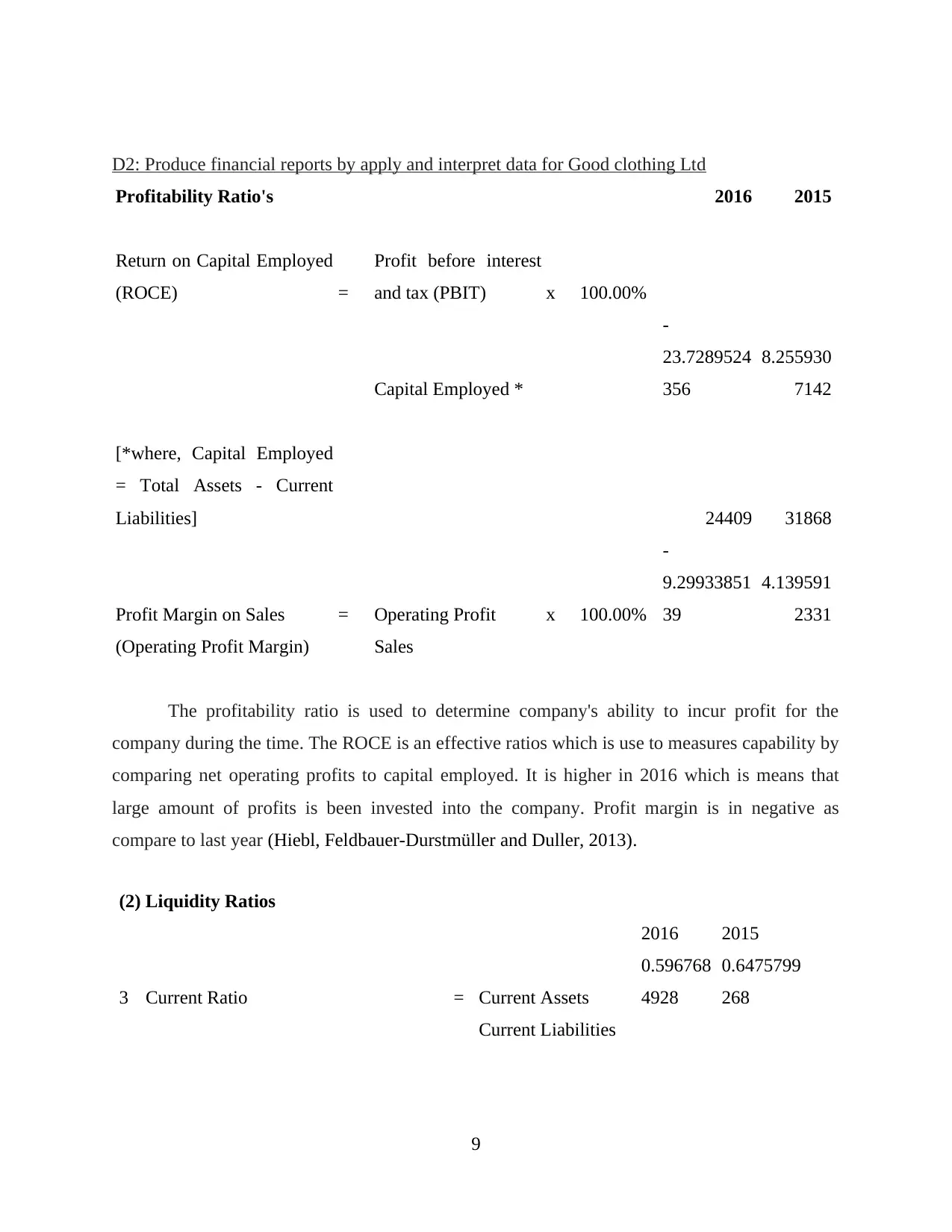
D2: Produce financial reports by apply and interpret data for Good clothing Ltd
Profitability Ratio's 2016 2015
Return on Capital Employed
(ROCE) =
Profit before interest
and tax (PBIT) x 100.00%
Capital Employed *
-
23.7289524
356
8.255930
7142
[*where, Capital Employed
= Total Assets - Current
Liabilities] 24409 31868
Profit Margin on Sales = Operating Profit x 100.00%
-
9.29933851
39
4.139591
2331
(Operating Profit Margin) Sales
The profitability ratio is used to determine company's ability to incur profit for the
company during the time. The ROCE is an effective ratios which is use to measures capability by
comparing net operating profits to capital employed. It is higher in 2016 which is means that
large amount of profits is been invested into the company. Profit margin is in negative as
compare to last year (Hiebl, Feldbauer-Durstmüller and Duller, 2013).
(2) Liquidity Ratios
2016 2015
3 Current Ratio = Current Assets
0.596768
4928
0.6475799
268
Current Liabilities
9
Profitability Ratio's 2016 2015
Return on Capital Employed
(ROCE) =
Profit before interest
and tax (PBIT) x 100.00%
Capital Employed *
-
23.7289524
356
8.255930
7142
[*where, Capital Employed
= Total Assets - Current
Liabilities] 24409 31868
Profit Margin on Sales = Operating Profit x 100.00%
-
9.29933851
39
4.139591
2331
(Operating Profit Margin) Sales
The profitability ratio is used to determine company's ability to incur profit for the
company during the time. The ROCE is an effective ratios which is use to measures capability by
comparing net operating profits to capital employed. It is higher in 2016 which is means that
large amount of profits is been invested into the company. Profit margin is in negative as
compare to last year (Hiebl, Feldbauer-Durstmüller and Duller, 2013).
(2) Liquidity Ratios
2016 2015
3 Current Ratio = Current Assets
0.596768
4928
0.6475799
268
Current Liabilities
9
⊘ This is a preview!⊘
Do you want full access?
Subscribe today to unlock all pages.
Trusted by 1+ million students worldwide
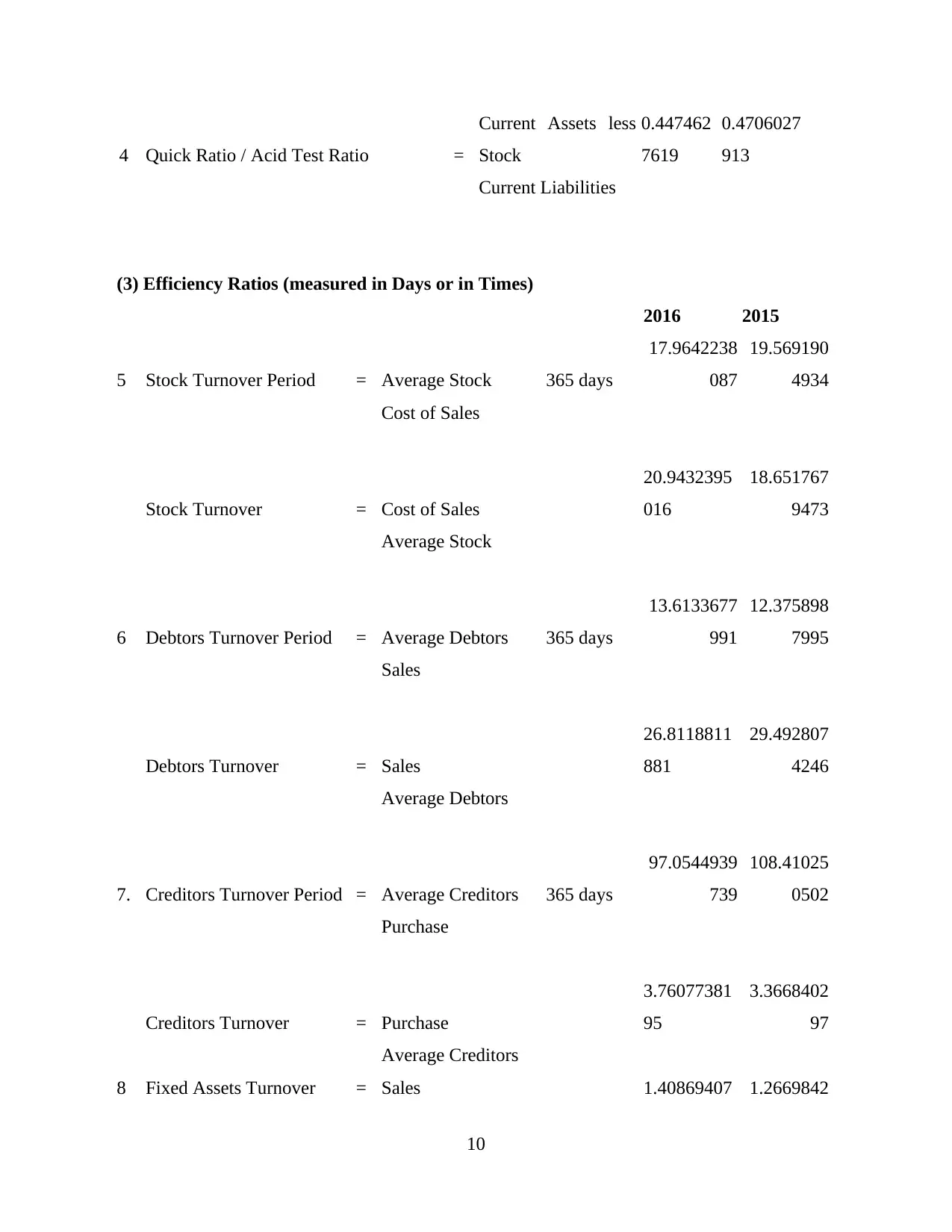
4 Quick Ratio / Acid Test Ratio =
Current Assets less
Stock
0.447462
7619
0.4706027
913
Current Liabilities
(3) Efficiency Ratios (measured in Days or in Times)
2016 2015
5 Stock Turnover Period = Average Stock 365 days
17.9642238
087
19.569190
4934
Cost of Sales
Stock Turnover = Cost of Sales
20.9432395
016
18.651767
9473
Average Stock
6 Debtors Turnover Period = Average Debtors 365 days
13.6133677
991
12.375898
7995
Sales
Debtors Turnover = Sales
26.8118811
881
29.492807
4246
Average Debtors
7. Creditors Turnover Period = Average Creditors 365 days
97.0544939
739
108.41025
0502
Purchase
Creditors Turnover = Purchase
3.76077381
95
3.3668402
97
Average Creditors
8 Fixed Assets Turnover = Sales 1.40869407 1.2669842
10
Current Assets less
Stock
0.447462
7619
0.4706027
913
Current Liabilities
(3) Efficiency Ratios (measured in Days or in Times)
2016 2015
5 Stock Turnover Period = Average Stock 365 days
17.9642238
087
19.569190
4934
Cost of Sales
Stock Turnover = Cost of Sales
20.9432395
016
18.651767
9473
Average Stock
6 Debtors Turnover Period = Average Debtors 365 days
13.6133677
991
12.375898
7995
Sales
Debtors Turnover = Sales
26.8118811
881
29.492807
4246
Average Debtors
7. Creditors Turnover Period = Average Creditors 365 days
97.0544939
739
108.41025
0502
Purchase
Creditors Turnover = Purchase
3.76077381
95
3.3668402
97
Average Creditors
8 Fixed Assets Turnover = Sales 1.40869407 1.2669842
10
Paraphrase This Document
Need a fresh take? Get an instant paraphrase of this document with our AI Paraphraser
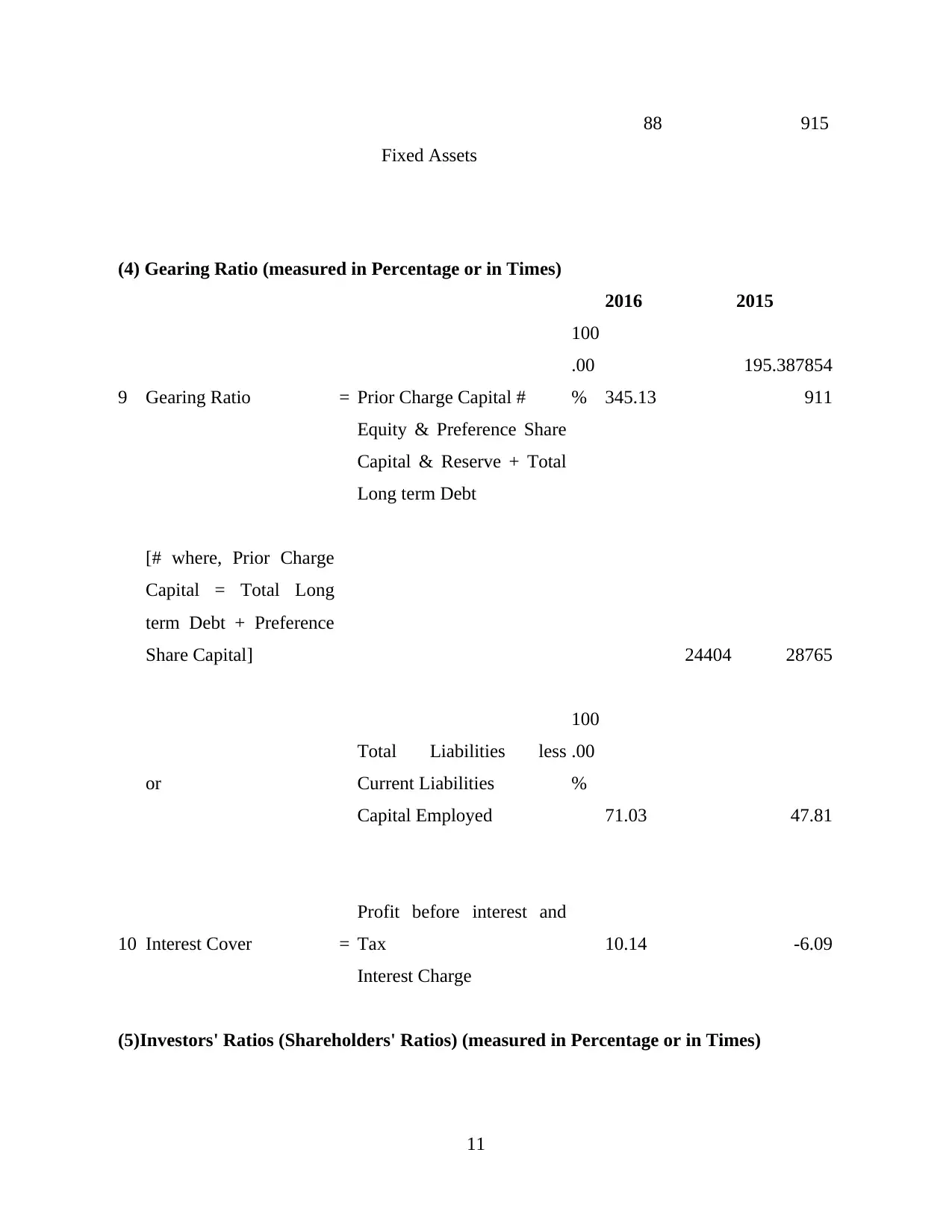
88 915
Fixed Assets
(4) Gearing Ratio (measured in Percentage or in Times)
2016 2015
9 Gearing Ratio = Prior Charge Capital #
100
.00
% 345.13
195.387854
911
Equity & Preference Share
Capital & Reserve + Total
Long term Debt
[# where, Prior Charge
Capital = Total Long
term Debt + Preference
Share Capital] 24404 28765
or
Total Liabilities less
Current Liabilities
100
.00
%
Capital Employed 71.03 47.81
10 Interest Cover =
Profit before interest and
Tax 10.14 -6.09
Interest Charge
(5)Investors' Ratios (Shareholders' Ratios) (measured in Percentage or in Times)
11
Fixed Assets
(4) Gearing Ratio (measured in Percentage or in Times)
2016 2015
9 Gearing Ratio = Prior Charge Capital #
100
.00
% 345.13
195.387854
911
Equity & Preference Share
Capital & Reserve + Total
Long term Debt
[# where, Prior Charge
Capital = Total Long
term Debt + Preference
Share Capital] 24404 28765
or
Total Liabilities less
Current Liabilities
100
.00
%
Capital Employed 71.03 47.81
10 Interest Cover =
Profit before interest and
Tax 10.14 -6.09
Interest Charge
(5)Investors' Ratios (Shareholders' Ratios) (measured in Percentage or in Times)
11
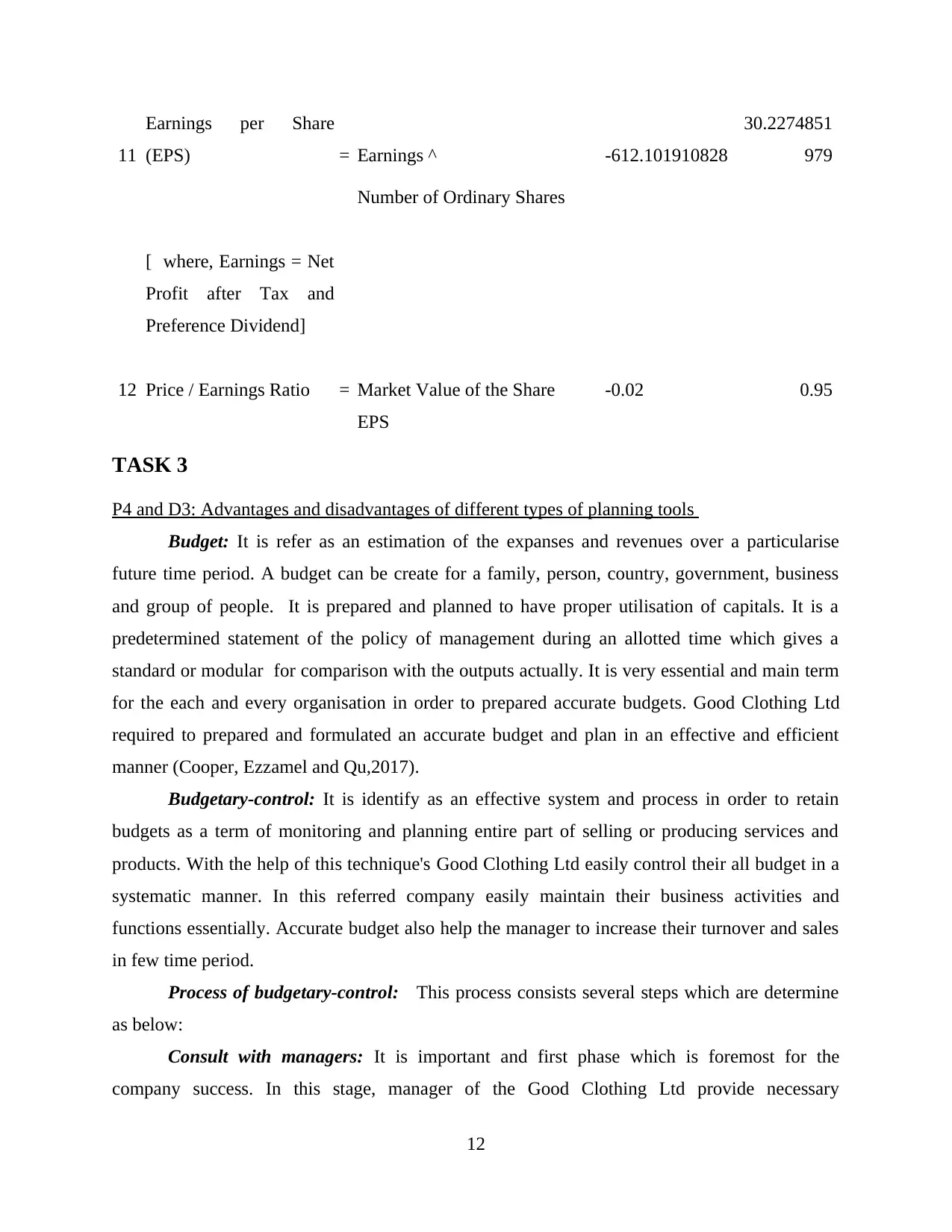
11
Earnings per Share
(EPS) = Earnings ^ -612.101910828
30.2274851
979
Number of Ordinary Shares
[ where, Earnings = Net
Profit after Tax and
Preference Dividend]
12 Price / Earnings Ratio = Market Value of the Share -0.02 0.95
EPS
TASK 3
P4 and D3: Advantages and disadvantages of different types of planning tools
Budget: It is refer as an estimation of the expanses and revenues over a particularise
future time period. A budget can be create for a family, person, country, government, business
and group of people. It is prepared and planned to have proper utilisation of capitals. It is a
predetermined statement of the policy of management during an allotted time which gives a
standard or modular for comparison with the outputs actually. It is very essential and main term
for the each and every organisation in order to prepared accurate budgets. Good Clothing Ltd
required to prepared and formulated an accurate budget and plan in an effective and efficient
manner (Cooper, Ezzamel and Qu,2017).
Budgetary-control: It is identify as an effective system and process in order to retain
budgets as a term of monitoring and planning entire part of selling or producing services and
products. With the help of this technique's Good Clothing Ltd easily control their all budget in a
systematic manner. In this referred company easily maintain their business activities and
functions essentially. Accurate budget also help the manager to increase their turnover and sales
in few time period.
Process of budgetary-control: This process consists several steps which are determine
as below:
Consult with managers: It is important and first phase which is foremost for the
company success. In this stage, manager of the Good Clothing Ltd provide necessary
12
Earnings per Share
(EPS) = Earnings ^ -612.101910828
30.2274851
979
Number of Ordinary Shares
[ where, Earnings = Net
Profit after Tax and
Preference Dividend]
12 Price / Earnings Ratio = Market Value of the Share -0.02 0.95
EPS
TASK 3
P4 and D3: Advantages and disadvantages of different types of planning tools
Budget: It is refer as an estimation of the expanses and revenues over a particularise
future time period. A budget can be create for a family, person, country, government, business
and group of people. It is prepared and planned to have proper utilisation of capitals. It is a
predetermined statement of the policy of management during an allotted time which gives a
standard or modular for comparison with the outputs actually. It is very essential and main term
for the each and every organisation in order to prepared accurate budgets. Good Clothing Ltd
required to prepared and formulated an accurate budget and plan in an effective and efficient
manner (Cooper, Ezzamel and Qu,2017).
Budgetary-control: It is identify as an effective system and process in order to retain
budgets as a term of monitoring and planning entire part of selling or producing services and
products. With the help of this technique's Good Clothing Ltd easily control their all budget in a
systematic manner. In this referred company easily maintain their business activities and
functions essentially. Accurate budget also help the manager to increase their turnover and sales
in few time period.
Process of budgetary-control: This process consists several steps which are determine
as below:
Consult with managers: It is important and first phase which is foremost for the
company success. In this stage, manager of the Good Clothing Ltd provide necessary
12
⊘ This is a preview!⊘
Do you want full access?
Subscribe today to unlock all pages.
Trusted by 1+ million students worldwide

1 out of 18


Related Documents


Your All-in-One AI-Powered Toolkit for Academic Success.
+13062052269
info@desklib.com
Available 24*7 on WhatsApp / Email
![[object Object]](/_next/static/media/star-bottom.7253800d.svg)
Unlock your academic potential
Copyright © 2020–2026 A2Z Services. All Rights Reserved. Developed and managed by ZUCOL.