Analysis of Management Accounting Techniques: Cost Measurement Methods
VerifiedAdded on 2020/06/04
|6
|769
|98
Homework Assignment
AI Summary
This assignment delves into the core concepts of management accounting, focusing on two primary costing techniques: absorption costing and marginal costing. It elucidates the methods for calculating unit costs, considering both fixed and variable production expenses. The document presents detailed calculations through tables, illustrating the application of each costing method and their impact on profit determination. Absorption costing, also known as full costing, allocates all manufacturing expenses to the product, while marginal costing only assigns variable costs. The assignment includes a reconciliation statement to compare the net profits derived from both methods. The analysis highlights how these techniques influence cost measurement, pricing decisions, and overall financial performance, supported by references to relevant literature.
MANAGEMENT ACCOUNTING
Paraphrase This Document
Need a fresh take? Get an instant paraphrase of this document with our AI Paraphraser

Table of Contents
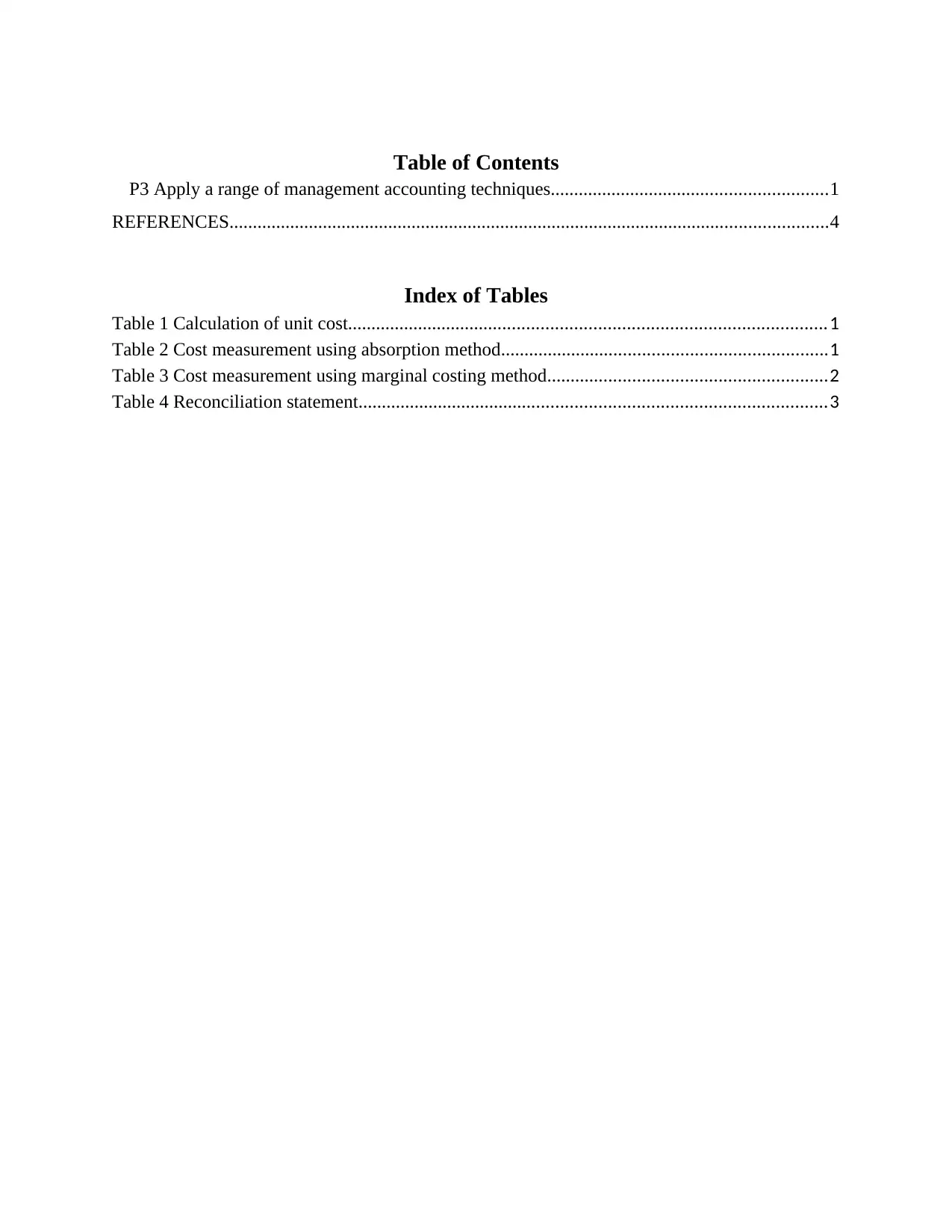
P3 Apply a range of management accounting techniques...........................................................1
REFERENCES................................................................................................................................4
Index of Tables
Table 1 Calculation of unit cost.....................................................................................................1
Table 2 Cost measurement using absorption method.....................................................................1
Table 3 Cost measurement using marginal costing method...........................................................2
Table 4 Reconciliation statement...................................................................................................3
P3 Apply a range of management accounting techniques...........................................................1
REFERENCES................................................................................................................................4
Index of Tables
Table 1 Calculation of unit cost.....................................................................................................1
Table 2 Cost measurement using absorption method.....................................................................1
Table 3 Cost measurement using marginal costing method...........................................................2
Table 4 Reconciliation statement...................................................................................................3

P3 Apply a range of management accounting techniques
Cost calculation is an important facet of the business, which aims at correct cost
measurement. Companies incur different kind of costs in their daily operations like material
purchase, payment of wages to laborers and overheads. It is important for the organization to
make cost-cutting strategies to drive efficiency and maximize profitability. Cost is an important
element of pricing decisions, therefore, by putting tight control over it, firms will be able to set
up economical charges for the people and generate increased revenue (Aleem, Khan and Hamad,
2016). There are two most popular techniques of cost measurement, absorption and marginal
costing detailed below:
Absorption costing: This technique of cost measurement uses both fixed and variable cost
of production to determine cost per unit. Thus, it assigns all the manufacturing expenses to the
product, therefore also called full costing and thereafter, set prices to recover total product cost
(Narasimhan, 2017). However, other expenses which are not related to production, non-
manufacturing expense are subtracted from gross return to determine net profit performance.
Marginal costing: It is a variable costing method, which only assigns variable cost of
production to each unit and exclude all the fixed cost. It is because, establishment need to pay
fixed charges even if they do not produce a single unit of the product. However, variable
expenses have a direct relation with the production volume (Medudula, Sagar and Gandhi, 2016).
The method determines contribution as an excess/surplus of sales revenue over sum of variable
expenditures.
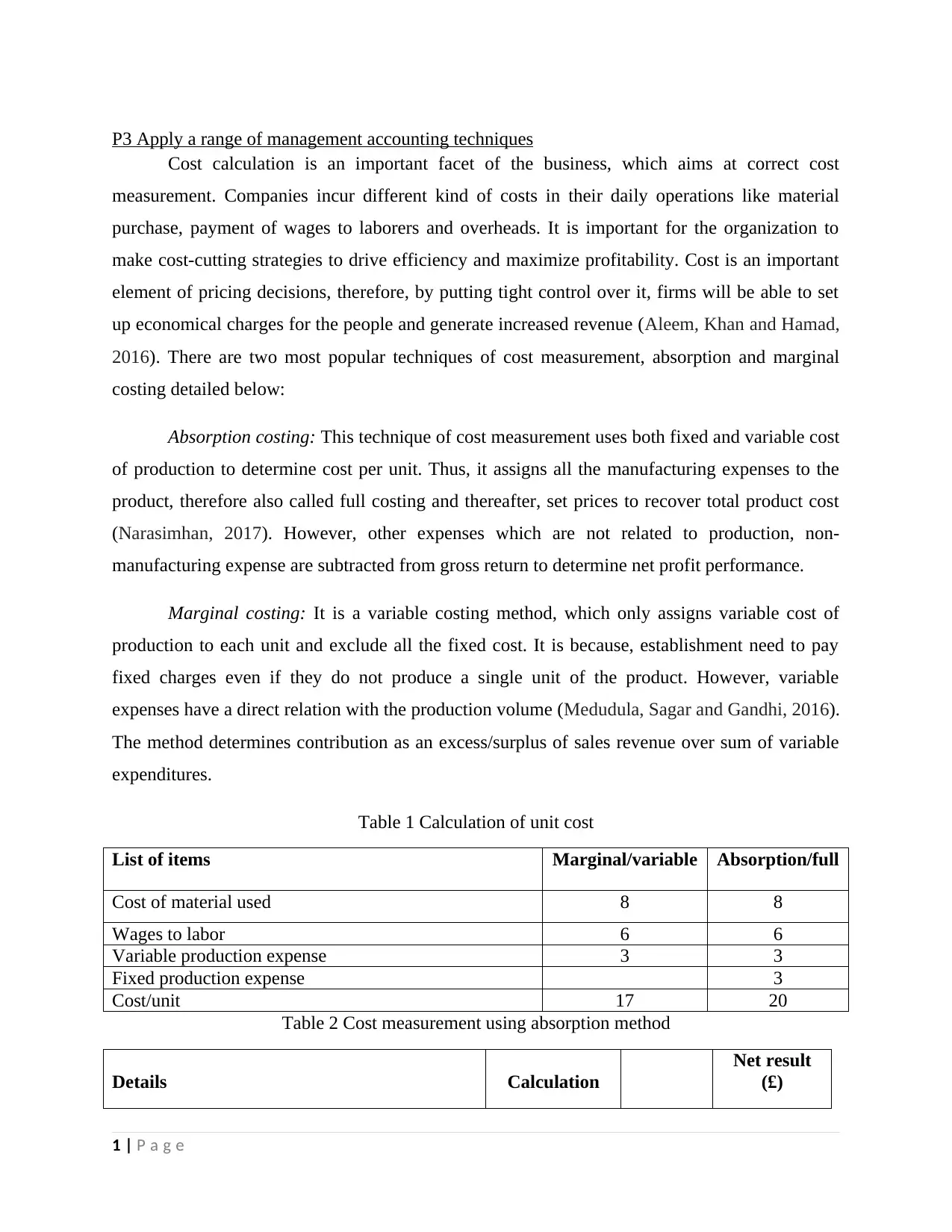
Table 1 Calculation of unit cost
List of items Marginal/variable Absorption/full
Cost of material used 8 8
Wages to labor 6 6
Variable production expense 3 3
Fixed production expense 3
Cost/unit 17 20
Table 2 Cost measurement using absorption method
Details Calculation
Net result
(£)
1 | P a g e
Cost calculation is an important facet of the business, which aims at correct cost
measurement. Companies incur different kind of costs in their daily operations like material
purchase, payment of wages to laborers and overheads. It is important for the organization to
make cost-cutting strategies to drive efficiency and maximize profitability. Cost is an important
element of pricing decisions, therefore, by putting tight control over it, firms will be able to set
up economical charges for the people and generate increased revenue (Aleem, Khan and Hamad,
2016). There are two most popular techniques of cost measurement, absorption and marginal
costing detailed below:
Absorption costing: This technique of cost measurement uses both fixed and variable cost
of production to determine cost per unit. Thus, it assigns all the manufacturing expenses to the
product, therefore also called full costing and thereafter, set prices to recover total product cost
(Narasimhan, 2017). However, other expenses which are not related to production, non-
manufacturing expense are subtracted from gross return to determine net profit performance.
Marginal costing: It is a variable costing method, which only assigns variable cost of
production to each unit and exclude all the fixed cost. It is because, establishment need to pay
fixed charges even if they do not produce a single unit of the product. However, variable
expenses have a direct relation with the production volume (Medudula, Sagar and Gandhi, 2016).
The method determines contribution as an excess/surplus of sales revenue over sum of variable
expenditures.
Table 1 Calculation of unit cost
List of items Marginal/variable Absorption/full
Cost of material used 8 8
Wages to labor 6 6
Variable production expense 3 3
Fixed production expense 3
Cost/unit 17 20
Table 2 Cost measurement using absorption method
Details Calculation
Net result
(£)
1 | P a g e
⊘ This is a preview!⊘
Do you want full access?
Subscribe today to unlock all pages.

Trusted by 1+ million students worldwide

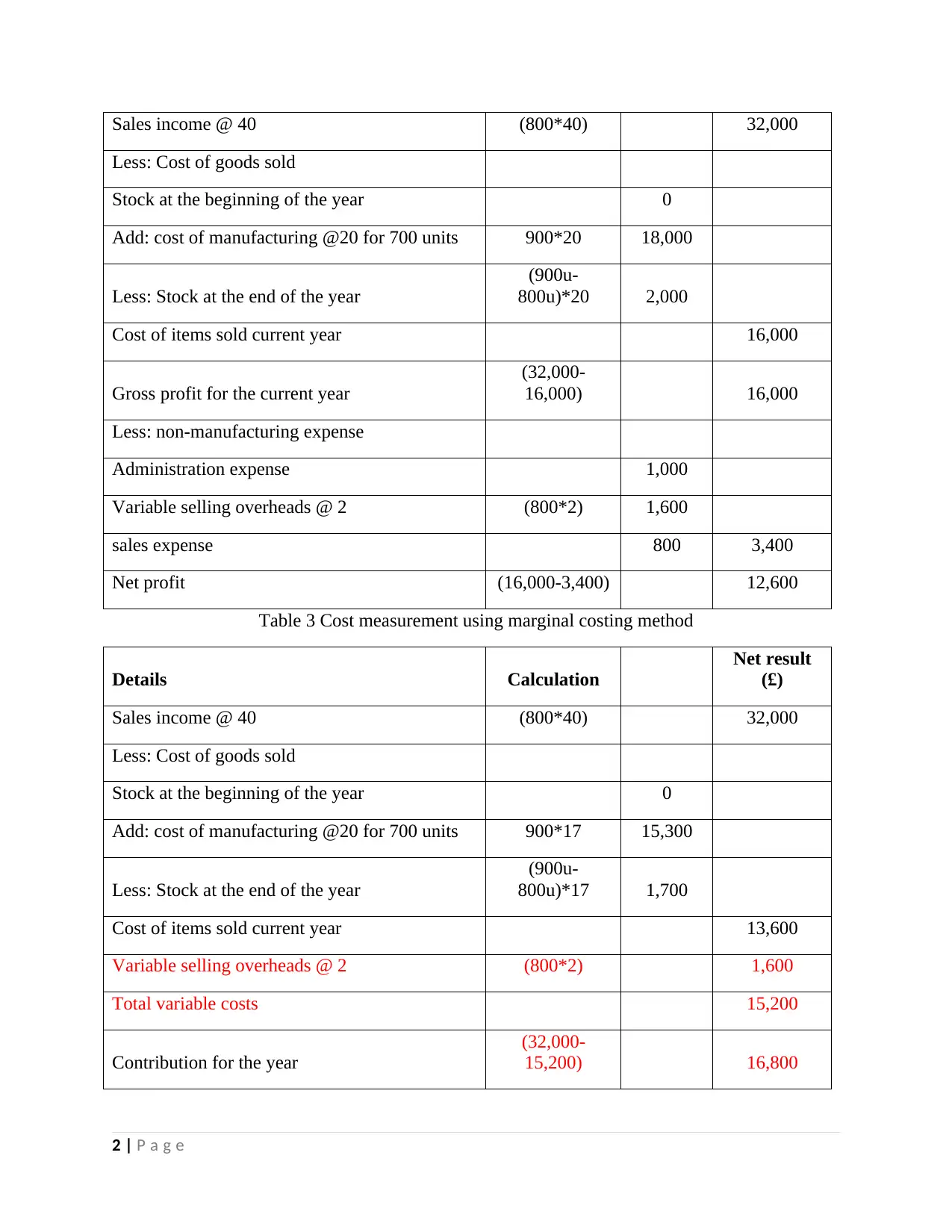
Sales income @ 40 (800*40) 32,000
Less: Cost of goods sold
Stock at the beginning of the year 0
Add: cost of manufacturing @20 for 700 units 900*20 18,000
Less: Stock at the end of the year
(900u-
800u)*20 2,000
Cost of items sold current year 16,000
Gross profit for the current year
(32,000-
16,000) 16,000
Less: non-manufacturing expense
Administration expense 1,000
Variable selling overheads @ 2 (800*2) 1,600
sales expense 800 3,400
Net profit (16,000-3,400) 12,600
Table 3 Cost measurement using marginal costing method
Details Calculation
Net result
(£)
Sales income @ 40 (800*40) 32,000
Less: Cost of goods sold
Stock at the beginning of the year 0
Add: cost of manufacturing @20 for 700 units 900*17 15,300
Less: Stock at the end of the year
(900u-
800u)*17 1,700
Cost of items sold current year 13,600
Variable selling overheads @ 2 (800*2) 1,600
Total variable costs 15,200
Contribution for the year
(32,000-
15,200) 16,800
2 | P a g e
Less: Cost of goods sold
Stock at the beginning of the year 0
Add: cost of manufacturing @20 for 700 units 900*20 18,000
Less: Stock at the end of the year
(900u-
800u)*20 2,000
Cost of items sold current year 16,000
Gross profit for the current year
(32,000-
16,000) 16,000
Less: non-manufacturing expense
Administration expense 1,000
Variable selling overheads @ 2 (800*2) 1,600
sales expense 800 3,400
Net profit (16,000-3,400) 12,600
Table 3 Cost measurement using marginal costing method
Details Calculation
Net result
(£)
Sales income @ 40 (800*40) 32,000
Less: Cost of goods sold
Stock at the beginning of the year 0
Add: cost of manufacturing @20 for 700 units 900*17 15,300
Less: Stock at the end of the year
(900u-
800u)*17 1,700
Cost of items sold current year 13,600
Variable selling overheads @ 2 (800*2) 1,600
Total variable costs 15,200
Contribution for the year
(32,000-
15,200) 16,800
2 | P a g e
Paraphrase This Document
Need a fresh take? Get an instant paraphrase of this document with our AI Paraphraser

Less: Fixed expenditures
Manufacturing expenditures (900*3) 2,700
Administration expense 1,000
sales expense 800 4,500
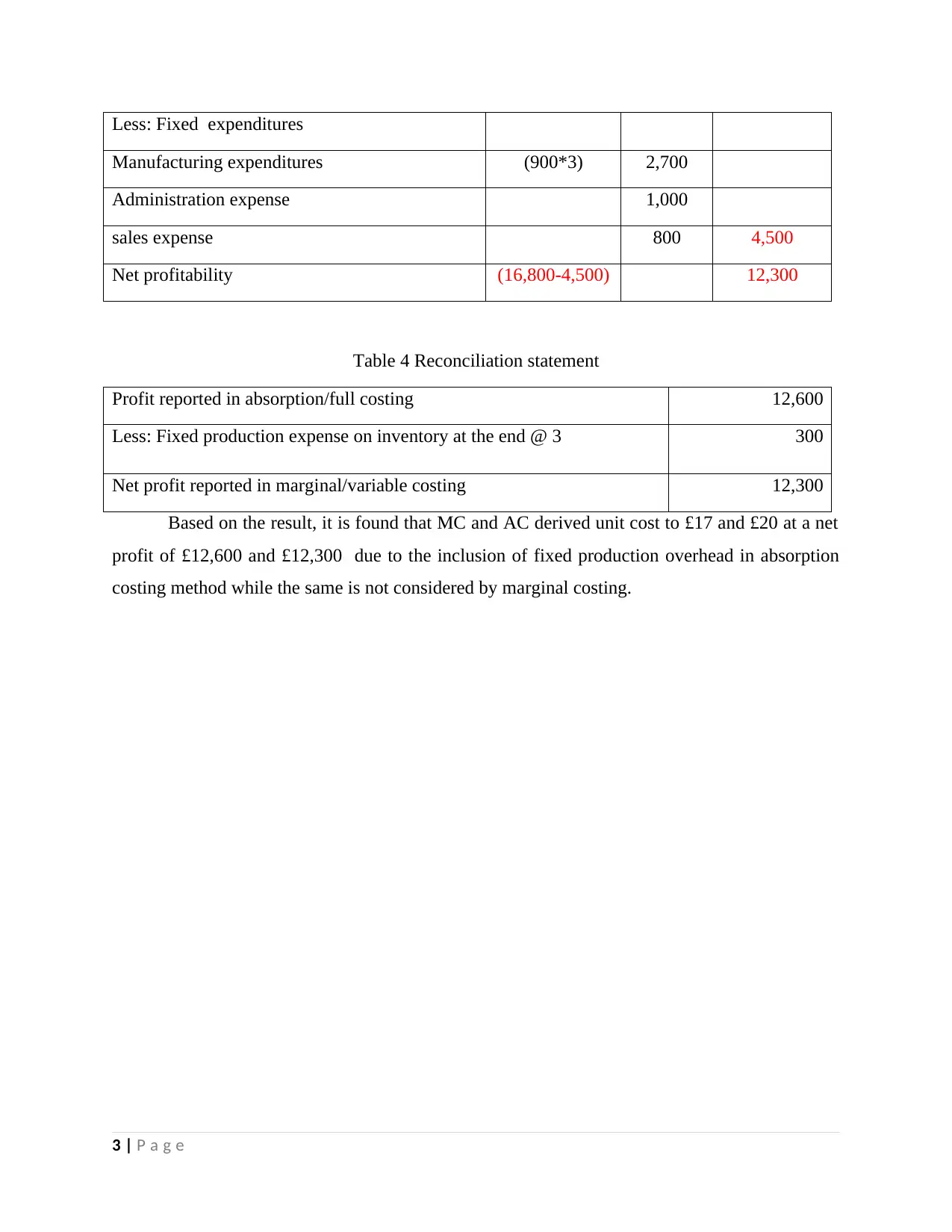
Net profitability (16,800-4,500) 12,300
Table 4 Reconciliation statement
Profit reported in absorption/full costing 12,600
Less: Fixed production expense on inventory at the end @ 3 300
Net profit reported in marginal/variable costing 12,300
Based on the result, it is found that MC and AC derived unit cost to £17 and £20 at a net
profit of £12,600 and £12,300 due to the inclusion of fixed production overhead in absorption
costing method while the same is not considered by marginal costing.
3 | P a g e
Manufacturing expenditures (900*3) 2,700
Administration expense 1,000
sales expense 800 4,500
Net profitability (16,800-4,500) 12,300
Table 4 Reconciliation statement
Profit reported in absorption/full costing 12,600
Less: Fixed production expense on inventory at the end @ 3 300
Net profit reported in marginal/variable costing 12,300
Based on the result, it is found that MC and AC derived unit cost to £17 and £20 at a net
profit of £12,600 and £12,300 due to the inclusion of fixed production overhead in absorption
costing method while the same is not considered by marginal costing.
3 | P a g e

REFERENCES
Books and Journals
Aleem, M., Khan, A.H. and Hamad, W., 2016. A comparative study of the different costing
techniques and their application in the pharmaceutical companies. Audit Financiar.
12(143). pp.1253-1263.
Medudula, M.K., Sagar, M. and Gandhi, R.P., 2016. Costing and Pricing Mechanism of Telecom
Services. In Telecom Management in Emerging Economies. Springer India. pp. 119-149.
Narasimhan, M.S., 2017. Absorption vs. Marginal Costing. Routledge.
4 | P a g e
Books and Journals
Aleem, M., Khan, A.H. and Hamad, W., 2016. A comparative study of the different costing
techniques and their application in the pharmaceutical companies. Audit Financiar.
12(143). pp.1253-1263.
Medudula, M.K., Sagar, M. and Gandhi, R.P., 2016. Costing and Pricing Mechanism of Telecom
Services. In Telecom Management in Emerging Economies. Springer India. pp. 119-149.
Narasimhan, M.S., 2017. Absorption vs. Marginal Costing. Routledge.
4 | P a g e
⊘ This is a preview!⊘
Do you want full access?
Subscribe today to unlock all pages.

Trusted by 1+ million students worldwide
1 out of 6
Related Documents
Your All-in-One AI-Powered Toolkit for Academic Success.
+13062052269
info@desklib.com
Available 24*7 on WhatsApp / Email
Unlock your academic potential
Copyright © 2020–2025 A2Z Services. All Rights Reserved. Developed and managed by ZUCOL.