Roles of Leadership and Management in M&S Ltd. Operations Report
VerifiedAdded on 2020/06/06
|13
|4107
|47
Report
AI Summary
This report provides a comprehensive analysis of leadership and management within Marks and Spencer (M&S) Ltd., exploring the roles and characteristics of leaders and managers in various situational contexts. It differentiates between leadership and management functions, highlighting their importance in achieving organizational goals and maximizing profitability. The report delves into different leadership theories and models, such as situational, systems, and contingency approaches, evaluating their strengths and weaknesses. Furthermore, it examines key approaches to operations management, including Six Sigma, Just-in-Time, and Total Quality Management (TQM), and discusses the roles of leaders and managers in implementing these approaches to improve efficiency and meet business objectives. The impact of internal factors on operational management and the influence of external factors on the business environment are also considered, providing a holistic view of the management and operational strategies at M&S Ltd.
MANAGEMENT AND
OPERATIONS
OPERATIONS

Paraphrase This Document
Need a fresh take? Get an instant paraphrase of this document with our AI Paraphraser
Table of Contents
INTRODUCTION...........................................................................................................................1
TASK 1............................................................................................................................................1
P1 Roles and characteristics of a leader and a manager..............................................................1
M1 Differentiating between the role of a leader and function of a manager..............................2
P2 Role of a leader and the function of manager applied in different situational context..........3
P3 Different theories and models of leadership..........................................................................4
M2 Strength and weakness of different approaches...................................................................4
TASK 2............................................................................................................................................5
P4 Key approaches to operations management and role that leaders and managers play..........5
P5 Importance of operations management in achieving business objectives.............................6
M3 Improvement in efficiencies of operational management for successfully meet business
aims.............................................................................................................................................7
P6 Impact of internal factors upon operational management and decision making....................7
M4 Influence of factors upon business environment and wider community..............................8
CONCLUSION................................................................................................................................9
REFERENCES..............................................................................................................................10
INTRODUCTION...........................................................................................................................1
TASK 1............................................................................................................................................1
P1 Roles and characteristics of a leader and a manager..............................................................1
M1 Differentiating between the role of a leader and function of a manager..............................2
P2 Role of a leader and the function of manager applied in different situational context..........3
P3 Different theories and models of leadership..........................................................................4
M2 Strength and weakness of different approaches...................................................................4
TASK 2............................................................................................................................................5
P4 Key approaches to operations management and role that leaders and managers play..........5
P5 Importance of operations management in achieving business objectives.............................6
M3 Improvement in efficiencies of operational management for successfully meet business
aims.............................................................................................................................................7
P6 Impact of internal factors upon operational management and decision making....................7
M4 Influence of factors upon business environment and wider community..............................8
CONCLUSION................................................................................................................................9
REFERENCES..............................................................................................................................10

⊘ This is a preview!⊘
Do you want full access?
Subscribe today to unlock all pages.

Trusted by 1+ million students worldwide
INTRODUCTION
The whole process from manufacturing of products and change into final goods and
services is known as operational management. It can be understood by conversion procedure of
raw materials, resources into final commodities according to requirements of consumers. By
fulfilling needs of end users, corporations can make long term relations with them. It is essential
for the firms to keep on satisfying clients by their services according to needs of every individual
so that they can attain set targets in an efficient and timely manner. In this report, the roles and
characteristics of leaders and managers have been discussed in different situations at workplace.
Marks and Spencer Ltd. is an organisation which is providing services to public in different
sectors like clothing, luxury food and commodities related to home (Barratt, Choi and 2011).
Apart from this, several models and theories has also been discussed which managers uses at the
time of decision making process and also put light on some key approaches of operational
management.
TASK 1
P1 Roles and characteristics of a leader and a manager
Main aim of M & S Ltd. is to make profit out of what services or products they are
providing to targeted customers. In this part, leaders and managers do have their own
responsibilities so that firm can attain targets in a given time frame. They both have different
working styles but work for same thing and that is profit maximization of corporation. A leader
can be anyone but most probably, he is the head or founder of company who gives proper vision
to subordinates. Manager is the one who manages operations in company. Their main aim is to
attain targets in a set time frame (Brown, Bessant and Lamming, 2013).
There are some role of leaders mentioned as below:
Needed at each level: Leaders are the one who show ways to subordinates so that they
can achieve their targets. To run business in a successful manner, leader is required in every
single level, top level, middle level and lower level of labour.
Representative of company: A leader is said to be the person represents the organisation
in front of outsiders (Role of Leaders, 2018). He/she deals and communicate in seminars,
meetings and etcetera. Basically a leader needs to have a proper and clear vision of the objectives
of M & S Ltd.
1
The whole process from manufacturing of products and change into final goods and
services is known as operational management. It can be understood by conversion procedure of
raw materials, resources into final commodities according to requirements of consumers. By
fulfilling needs of end users, corporations can make long term relations with them. It is essential
for the firms to keep on satisfying clients by their services according to needs of every individual
so that they can attain set targets in an efficient and timely manner. In this report, the roles and
characteristics of leaders and managers have been discussed in different situations at workplace.
Marks and Spencer Ltd. is an organisation which is providing services to public in different
sectors like clothing, luxury food and commodities related to home (Barratt, Choi and 2011).
Apart from this, several models and theories has also been discussed which managers uses at the
time of decision making process and also put light on some key approaches of operational
management.
TASK 1
P1 Roles and characteristics of a leader and a manager
Main aim of M & S Ltd. is to make profit out of what services or products they are
providing to targeted customers. In this part, leaders and managers do have their own
responsibilities so that firm can attain targets in a given time frame. They both have different
working styles but work for same thing and that is profit maximization of corporation. A leader
can be anyone but most probably, he is the head or founder of company who gives proper vision
to subordinates. Manager is the one who manages operations in company. Their main aim is to
attain targets in a set time frame (Brown, Bessant and Lamming, 2013).
There are some role of leaders mentioned as below:
Needed at each level: Leaders are the one who show ways to subordinates so that they
can achieve their targets. To run business in a successful manner, leader is required in every
single level, top level, middle level and lower level of labour.
Representative of company: A leader is said to be the person represents the organisation
in front of outsiders (Role of Leaders, 2018). He/she deals and communicate in seminars,
meetings and etcetera. Basically a leader needs to have a proper and clear vision of the objectives
of M & S Ltd.
1
Paraphrase This Document
Need a fresh take? Get an instant paraphrase of this document with our AI Paraphraser
Leader as a friend, guide and philosopher: It is necessary to have a healthy and positive
environment in M & S Ltd. Leaders are responsible to listen and help subordinates if they are
having any issues at workplace. It is necessary for him/her to treat others like a friend so that
they can listen to him and gets motivated.
Quality to resolve problems: It is essential to have this kind of quality, where leaders
listen to the problem of staff members or at the time of facing issue in the market. An intelligent
leader can resolve issues without even taking stress.
Polite nature: A positive or negative totally depends on the behaviour of employees at
work station. Therefore, it is important for leaders to listen to the people of the M & S and
behave in a proper way so that no conflicts can gets raise (Dekker, Bloemhof and Mallidis,
2012).
There are some role of managers discussed as beneath:
Managing the corporation: Main role of a manager is to manage the operational
activities in M & S. Other role is to control the systems and watch them if they are going in a
proper way or not.
Distribution of work among subordinates: Another responsibility of manager is to
assign projects to employees according to their abilities. So that they can achieve them as soon as
possible.
Allocation of limited resources: It is important for manager to keep an eye on resources
that they are using in manufacturing process. Because it is essential for our future.
Characteristics of managers:
Power to reduce the business risk: It is one of the major responsibilities to keep on
finding risk factor for organisation that may arise in future. This can be stated as one of the
characteristics of manager where he/she controls or manages the risky situations and comes up
positively so that no harm M & S will face (Drake and Spinler, 2013).
Patience: Situations comes up when whatever the manager is doing that goes wrong. At
this time, it is important for him or her to stay calm and take proper decisions.
M1 Differentiating between the role of a leader and function of a manager
Different functions and roles of both leaders and managers are mentioned as below:
Role of a leader Functions of a manager
2
environment in M & S Ltd. Leaders are responsible to listen and help subordinates if they are
having any issues at workplace. It is necessary for him/her to treat others like a friend so that
they can listen to him and gets motivated.
Quality to resolve problems: It is essential to have this kind of quality, where leaders
listen to the problem of staff members or at the time of facing issue in the market. An intelligent
leader can resolve issues without even taking stress.
Polite nature: A positive or negative totally depends on the behaviour of employees at
work station. Therefore, it is important for leaders to listen to the people of the M & S and
behave in a proper way so that no conflicts can gets raise (Dekker, Bloemhof and Mallidis,
2012).
There are some role of managers discussed as beneath:
Managing the corporation: Main role of a manager is to manage the operational
activities in M & S. Other role is to control the systems and watch them if they are going in a
proper way or not.
Distribution of work among subordinates: Another responsibility of manager is to
assign projects to employees according to their abilities. So that they can achieve them as soon as
possible.
Allocation of limited resources: It is important for manager to keep an eye on resources
that they are using in manufacturing process. Because it is essential for our future.
Characteristics of managers:
Power to reduce the business risk: It is one of the major responsibilities to keep on
finding risk factor for organisation that may arise in future. This can be stated as one of the
characteristics of manager where he/she controls or manages the risky situations and comes up
positively so that no harm M & S will face (Drake and Spinler, 2013).
Patience: Situations comes up when whatever the manager is doing that goes wrong. At
this time, it is important for him or her to stay calm and take proper decisions.
M1 Differentiating between the role of a leader and function of a manager
Different functions and roles of both leaders and managers are mentioned as below:
Role of a leader Functions of a manager
2
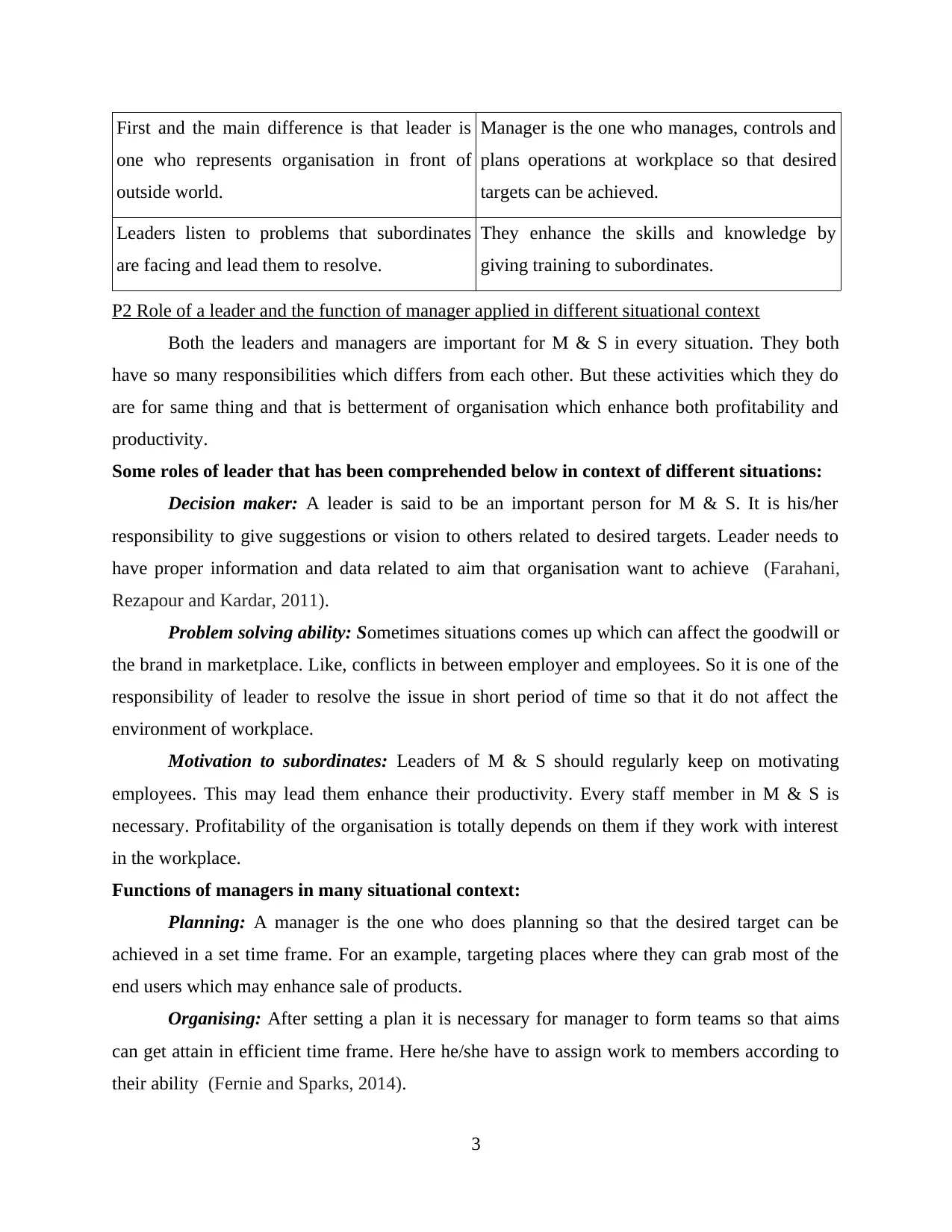
First and the main difference is that leader is
one who represents organisation in front of
outside world.
Manager is the one who manages, controls and
plans operations at workplace so that desired
targets can be achieved.
Leaders listen to problems that subordinates
are facing and lead them to resolve.
They enhance the skills and knowledge by
giving training to subordinates.
P2 Role of a leader and the function of manager applied in different situational context
Both the leaders and managers are important for M & S in every situation. They both
have so many responsibilities which differs from each other. But these activities which they do
are for same thing and that is betterment of organisation which enhance both profitability and
productivity.
Some roles of leader that has been comprehended below in context of different situations:
Decision maker: A leader is said to be an important person for M & S. It is his/her
responsibility to give suggestions or vision to others related to desired targets. Leader needs to
have proper information and data related to aim that organisation want to achieve (Farahani,
Rezapour and Kardar, 2011).
Problem solving ability: Sometimes situations comes up which can affect the goodwill or
the brand in marketplace. Like, conflicts in between employer and employees. So it is one of the
responsibility of leader to resolve the issue in short period of time so that it do not affect the
environment of workplace.
Motivation to subordinates: Leaders of M & S should regularly keep on motivating
employees. This may lead them enhance their productivity. Every staff member in M & S is
necessary. Profitability of the organisation is totally depends on them if they work with interest
in the workplace.
Functions of managers in many situational context:
Planning: A manager is the one who does planning so that the desired target can be
achieved in a set time frame. For an example, targeting places where they can grab most of the
end users which may enhance sale of products.
Organising: After setting a plan it is necessary for manager to form teams so that aims
can get attain in efficient time frame. Here he/she have to assign work to members according to
their ability (Fernie and Sparks, 2014).
3
one who represents organisation in front of
outside world.
Manager is the one who manages, controls and
plans operations at workplace so that desired
targets can be achieved.
Leaders listen to problems that subordinates
are facing and lead them to resolve.
They enhance the skills and knowledge by
giving training to subordinates.
P2 Role of a leader and the function of manager applied in different situational context
Both the leaders and managers are important for M & S in every situation. They both
have so many responsibilities which differs from each other. But these activities which they do
are for same thing and that is betterment of organisation which enhance both profitability and
productivity.
Some roles of leader that has been comprehended below in context of different situations:
Decision maker: A leader is said to be an important person for M & S. It is his/her
responsibility to give suggestions or vision to others related to desired targets. Leader needs to
have proper information and data related to aim that organisation want to achieve (Farahani,
Rezapour and Kardar, 2011).
Problem solving ability: Sometimes situations comes up which can affect the goodwill or
the brand in marketplace. Like, conflicts in between employer and employees. So it is one of the
responsibility of leader to resolve the issue in short period of time so that it do not affect the
environment of workplace.
Motivation to subordinates: Leaders of M & S should regularly keep on motivating
employees. This may lead them enhance their productivity. Every staff member in M & S is
necessary. Profitability of the organisation is totally depends on them if they work with interest
in the workplace.
Functions of managers in many situational context:
Planning: A manager is the one who does planning so that the desired target can be
achieved in a set time frame. For an example, targeting places where they can grab most of the
end users which may enhance sale of products.
Organising: After setting a plan it is necessary for manager to form teams so that aims
can get attain in efficient time frame. Here he/she have to assign work to members according to
their ability (Fernie and Sparks, 2014).
3
⊘ This is a preview!⊘
Do you want full access?
Subscribe today to unlock all pages.
Trusted by 1+ million students worldwide
Staffing: Another function of a manager in which he/she have duty to recruit or select
best candidates for organisation. This may help M & S to achieve goals that has been set for
future. A new member may have different innovative ideas which may help corporation to grow.
Controlling: When planning, implementation and everything has been done. Then also
managers duty is not finished yet. He/she also has to see if the plan is going accordingly or not.
Under this part, managers can give training to employees so that they can achieve targets of there
own in an efficient time frame.
P3 Different theories and models of leadership
Leadership can be known as to keep on guiding subordinates on the correct way so that
they can achieve their own targets in timely manner. There are many things comes under this like
motivating, controlling, distributing work among members and etcetera. Some theories and
models of leadership are discussed below:
Situational leadership: This type of model which was found in 1970 and used by most of
the organisations. A leader cannot deal in the same way in every situation. He/she may have to
make plans according to the issue so that it can be resolved. Same type of applications used by
leaders may affect in negative way.
Systems leadership: This kind of theory is based on rules and regulations that leaders
have made so that targets can be achieved. Every single subordinate under a team have to follow
the systems that made by leaders. This type of approach may help M & S staff members to work
properly in a systematic manner (Fuller and Martinec, 2011).
Contingency approach: According to this kind of approach every single concept is not
proper or enough to resolve the issues or attain targets that has been set by M & S. It is a little bit
similar to situational approach. Here leaders makes decision according to situations which may
create favourable conditions for the organisation.
M2 Strength and weakness of different approaches
Some strengths and weaknesses of approaches are given below:
Situational leadership:
Strengths Weaknesses
4
best candidates for organisation. This may help M & S to achieve goals that has been set for
future. A new member may have different innovative ideas which may help corporation to grow.
Controlling: When planning, implementation and everything has been done. Then also
managers duty is not finished yet. He/she also has to see if the plan is going accordingly or not.
Under this part, managers can give training to employees so that they can achieve targets of there
own in an efficient time frame.
P3 Different theories and models of leadership
Leadership can be known as to keep on guiding subordinates on the correct way so that
they can achieve their own targets in timely manner. There are many things comes under this like
motivating, controlling, distributing work among members and etcetera. Some theories and
models of leadership are discussed below:
Situational leadership: This type of model which was found in 1970 and used by most of
the organisations. A leader cannot deal in the same way in every situation. He/she may have to
make plans according to the issue so that it can be resolved. Same type of applications used by
leaders may affect in negative way.
Systems leadership: This kind of theory is based on rules and regulations that leaders
have made so that targets can be achieved. Every single subordinate under a team have to follow
the systems that made by leaders. This type of approach may help M & S staff members to work
properly in a systematic manner (Fuller and Martinec, 2011).
Contingency approach: According to this kind of approach every single concept is not
proper or enough to resolve the issues or attain targets that has been set by M & S. It is a little bit
similar to situational approach. Here leaders makes decision according to situations which may
create favourable conditions for the organisation.
M2 Strength and weakness of different approaches
Some strengths and weaknesses of approaches are given below:
Situational leadership:
Strengths Weaknesses
4
Paraphrase This Document
Need a fresh take? Get an instant paraphrase of this document with our AI Paraphraser
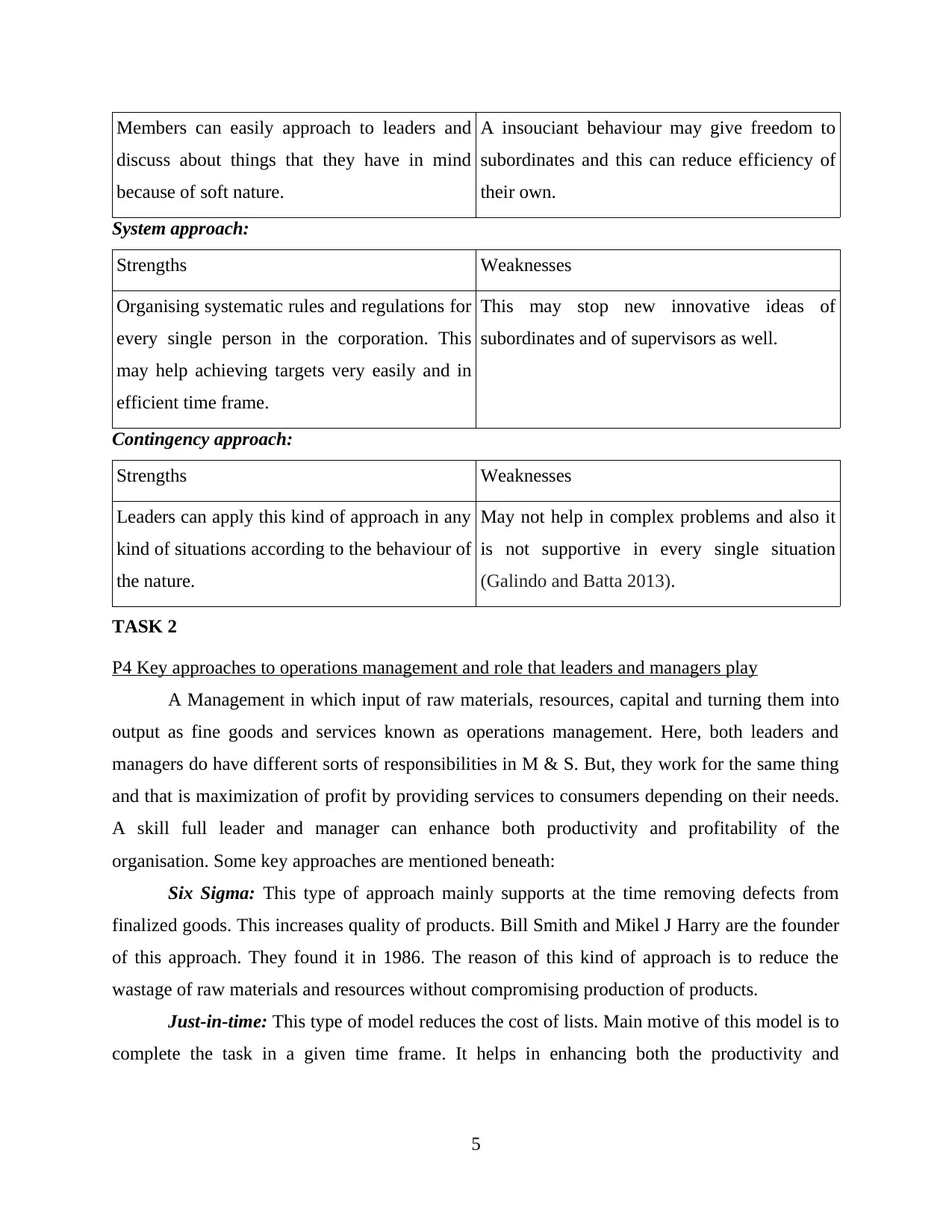
Members can easily approach to leaders and
discuss about things that they have in mind
because of soft nature.
A insouciant behaviour may give freedom to
subordinates and this can reduce efficiency of
their own.
System approach:
Strengths Weaknesses
Organising systematic rules and regulations for
every single person in the corporation. This
may help achieving targets very easily and in
efficient time frame.
This may stop new innovative ideas of
subordinates and of supervisors as well.
Contingency approach:
Strengths Weaknesses
Leaders can apply this kind of approach in any
kind of situations according to the behaviour of
the nature.
May not help in complex problems and also it
is not supportive in every single situation
(Galindo and Batta 2013).
TASK 2
P4 Key approaches to operations management and role that leaders and managers play
A Management in which input of raw materials, resources, capital and turning them into
output as fine goods and services known as operations management. Here, both leaders and
managers do have different sorts of responsibilities in M & S. But, they work for the same thing
and that is maximization of profit by providing services to consumers depending on their needs.
A skill full leader and manager can enhance both productivity and profitability of the
organisation. Some key approaches are mentioned beneath:
Six Sigma: This type of approach mainly supports at the time removing defects from
finalized goods. This increases quality of products. Bill Smith and Mikel J Harry are the founder
of this approach. They found it in 1986. The reason of this kind of approach is to reduce the
wastage of raw materials and resources without compromising production of products.
Just-in-time: This type of model reduces the cost of lists. Main motive of this model is to
complete the task in a given time frame. It helps in enhancing both the productivity and
5
discuss about things that they have in mind
because of soft nature.
A insouciant behaviour may give freedom to
subordinates and this can reduce efficiency of
their own.
System approach:
Strengths Weaknesses
Organising systematic rules and regulations for
every single person in the corporation. This
may help achieving targets very easily and in
efficient time frame.
This may stop new innovative ideas of
subordinates and of supervisors as well.
Contingency approach:
Strengths Weaknesses
Leaders can apply this kind of approach in any
kind of situations according to the behaviour of
the nature.
May not help in complex problems and also it
is not supportive in every single situation
(Galindo and Batta 2013).
TASK 2
P4 Key approaches to operations management and role that leaders and managers play
A Management in which input of raw materials, resources, capital and turning them into
output as fine goods and services known as operations management. Here, both leaders and
managers do have different sorts of responsibilities in M & S. But, they work for the same thing
and that is maximization of profit by providing services to consumers depending on their needs.
A skill full leader and manager can enhance both productivity and profitability of the
organisation. Some key approaches are mentioned beneath:
Six Sigma: This type of approach mainly supports at the time removing defects from
finalized goods. This increases quality of products. Bill Smith and Mikel J Harry are the founder
of this approach. They found it in 1986. The reason of this kind of approach is to reduce the
wastage of raw materials and resources without compromising production of products.
Just-in-time: This type of model reduces the cost of lists. Main motive of this model is to
complete the task in a given time frame. It helps in enhancing both the productivity and
5
profitability of M & S. This reduces the cost of raw material and aid to keep on running business
in a continues manner.
Total quality management(TQM): This model gives opportunity to leaders and managers
to keep on maintaining the quality of goods and services. Also, helps in keeping environment
healthy. This aid in removing barriers which are coming in between that can reduce the quality
of the commodities (Gibson, 2012) (Goodale and et. al., 2011).
Dynamic approaches: An approach, where leaders and managers of M & S try to find the
solution of many problem at a single time. This can be done by various techniques. This
approach, is mainly used by supervisor because it may help them in finding solutions in a short
period of time.
Lean production: Approach which can be stated as a systematic process. This helps in
enhancing process of production. Keeping in mind what exactly customers needs aid M & S to
make product accordingly. This approach can also be stated as the easy one than others.
Continuous Improvement: A process where M & S Ltd. keeps on bringing changes or
modifying products and services so that consumers don't loose interest from using there goods.
Managers and leaders are the one who analyses market place and sees what strategies their rivals
are using. This helps them in improving brand image in the marketplace.
Role of leaders and managers in M & S is to do planning, managing and coordinating all
the work related to operational management. Here, they have different responsibilities but work
for same thing and that is profit maximisation of the organisation.
P5 Importance of operations management in achieving business objectives
Operations management can be stated as one of the main part by which M & S can
achieve objectives or aims in a given time frame. Under this type of management there are so
many thoughts and concepts which managers and leaders can apply to resolve issue that they are
facing (Griffin, 2013). This also can be stated as input of materials changing into output like fine
goods. Operational management may also help in developing quality of products according to
requirements of the consumer. This aid M & S to enhance both profitability and productivity.
There are some points by which we can see the importance of operations management in M & S:
Input into output: Main purpose of operational management is changing the input like
raw materials, capital, limited resources into fine goods and services according to needs of
consumers in an effective manner by which M & S can earn profit at its maximum.
6
in a continues manner.
Total quality management(TQM): This model gives opportunity to leaders and managers
to keep on maintaining the quality of goods and services. Also, helps in keeping environment
healthy. This aid in removing barriers which are coming in between that can reduce the quality
of the commodities (Gibson, 2012) (Goodale and et. al., 2011).
Dynamic approaches: An approach, where leaders and managers of M & S try to find the
solution of many problem at a single time. This can be done by various techniques. This
approach, is mainly used by supervisor because it may help them in finding solutions in a short
period of time.
Lean production: Approach which can be stated as a systematic process. This helps in
enhancing process of production. Keeping in mind what exactly customers needs aid M & S to
make product accordingly. This approach can also be stated as the easy one than others.
Continuous Improvement: A process where M & S Ltd. keeps on bringing changes or
modifying products and services so that consumers don't loose interest from using there goods.
Managers and leaders are the one who analyses market place and sees what strategies their rivals
are using. This helps them in improving brand image in the marketplace.
Role of leaders and managers in M & S is to do planning, managing and coordinating all
the work related to operational management. Here, they have different responsibilities but work
for same thing and that is profit maximisation of the organisation.
P5 Importance of operations management in achieving business objectives
Operations management can be stated as one of the main part by which M & S can
achieve objectives or aims in a given time frame. Under this type of management there are so
many thoughts and concepts which managers and leaders can apply to resolve issue that they are
facing (Griffin, 2013). This also can be stated as input of materials changing into output like fine
goods. Operational management may also help in developing quality of products according to
requirements of the consumer. This aid M & S to enhance both profitability and productivity.
There are some points by which we can see the importance of operations management in M & S:
Input into output: Main purpose of operational management is changing the input like
raw materials, capital, limited resources into fine goods and services according to needs of
consumers in an effective manner by which M & S can earn profit at its maximum.
6
⊘ This is a preview!⊘
Do you want full access?
Subscribe today to unlock all pages.
Trusted by 1+ million students worldwide
Satisfied needs of consumers: Managers and leaders another role is to find what exactly
people needs in the current market. This helps them to modify or to manufacture new products.
By this step M & S can give satisfaction to its consumers by providing them commodities
according to their requirements.
Revenue generate: This can be done by various techniques that helps M & S to make
profit at its maximum. Modification in commodities which are already took existence in market
or launching of new products may aid company to make profit at its full (Peng and Lai, 2012).
M3 Improvement in efficiencies of operational management for successfully meet business aims
There are many improvement that operational management can bring in the organisation
by which aims can be achieved and these are mentioned below:
Employee motivation: This is one of the most important part where it is leaders and
managers responsibility to motivate employees. This improves productivity of their own.
Steps which are appropriate: Leaders and managers needs to follow proper steps towards
their goals by this they can attain them in a short period of time.
Plan and strategies: Before implementing anything it is necessary for M & S to make a
proper plan. This may reduce so many risk factors at the time of process.
P6 Impact of internal factors upon operational management and decision making
In business administration is given responsibility to make judgements which are
beneficial for their system and they should consider certain intrinsic elements which influence
decision making process and influence workability of people employed in enterprise to perform
tasks and contribute efforts towards achievement of objectives. These are some constituents
which M & S take care:
Corporate social responsibility: Company engaged in conducting activities for social
welfare are able to increase their goodwill and establish advantage over other firms offering
same items. By fulfilling these, they are able to compete with their competitors. If they are not
able to complete their CSR work, then this affect system as manager will not be able to carry
operations effectively. M & S firm is executing activities timely to serve society and able to
build powerful image in market and improve their share which help them to increase their
consumer base and attract new users to purchase their items (Singhal and Singhal, 2012).
Sustainability: Organisation should produce goods and services uniformly according to
particular standards to retain customers as user want to purchase item again to get same benefit.
7
people needs in the current market. This helps them to modify or to manufacture new products.
By this step M & S can give satisfaction to its consumers by providing them commodities
according to their requirements.
Revenue generate: This can be done by various techniques that helps M & S to make
profit at its maximum. Modification in commodities which are already took existence in market
or launching of new products may aid company to make profit at its full (Peng and Lai, 2012).
M3 Improvement in efficiencies of operational management for successfully meet business aims
There are many improvement that operational management can bring in the organisation
by which aims can be achieved and these are mentioned below:
Employee motivation: This is one of the most important part where it is leaders and
managers responsibility to motivate employees. This improves productivity of their own.
Steps which are appropriate: Leaders and managers needs to follow proper steps towards
their goals by this they can attain them in a short period of time.
Plan and strategies: Before implementing anything it is necessary for M & S to make a
proper plan. This may reduce so many risk factors at the time of process.
P6 Impact of internal factors upon operational management and decision making
In business administration is given responsibility to make judgements which are
beneficial for their system and they should consider certain intrinsic elements which influence
decision making process and influence workability of people employed in enterprise to perform
tasks and contribute efforts towards achievement of objectives. These are some constituents
which M & S take care:
Corporate social responsibility: Company engaged in conducting activities for social
welfare are able to increase their goodwill and establish advantage over other firms offering
same items. By fulfilling these, they are able to compete with their competitors. If they are not
able to complete their CSR work, then this affect system as manager will not be able to carry
operations effectively. M & S firm is executing activities timely to serve society and able to
build powerful image in market and improve their share which help them to increase their
consumer base and attract new users to purchase their items (Singhal and Singhal, 2012).
Sustainability: Organisation should produce goods and services uniformly according to
particular standards to retain customers as user want to purchase item again to get same benefit.
7
Paraphrase This Document
Need a fresh take? Get an instant paraphrase of this document with our AI Paraphraser
M & S has set certain standards which they follow in each manufacturing cycle so that they are
able to utilize resources optimally and workers can easily transform material into end product,
since they are doing work regularly which increase their speed and brings specialisation in their
tasks. This help then to sustainability of their image in consumers mind and maintain their
market share.
Stakeholders: An enterprise require funds to carry operations smoothly so that they are
able to purchase sufficient raw material and there is no delay in manufacturing process.
Therefore executives are required to make budget so that they are able to get capital on time
from various internal and external factors such as banks, institutions and employees and also to
expand their business. If firm is not having enough money then there activities got delayed and
they are not able to accomplish their target .
Intrapreneurship: Executives formulate policies and strategies to provide direction to
their staff and make them function effectively by informing them about outcome they are
required to accomplish in certain period of time. Board of directors are intrapreneur which take
care to run working properly as in M & S, they frame innovative methodologies for their
products and services and implement in their system so that they are able to satisfy their clients
requirements on time.
Therefore, it may be concluded that management should take care of following
components while making decision for selecting alternatives among various choices available in
their internal environment (Wu and Pagell, 2011).
M4 Influence of factors upon business environment and wider community
In an organisation accomplishment of goals and objectives depend upon internal and
external forces which affect their workability and organisation ability to utilize resources
efficiently and complete demands of customers to satisfy their needs. These are some factors
which are present in surrounding of M & S and affect their business:
Executives adopt various practices and changes its scenario for their expansion in
marketplace.
Company conducts research to find consumers taste and preferences and then
manufacture goods and services to satisfy their needs.
For organisation to succeed, they are required to keep their system interconnected with
users present in international market (Yang, Hong and Modi, 2011).
8
able to utilize resources optimally and workers can easily transform material into end product,
since they are doing work regularly which increase their speed and brings specialisation in their
tasks. This help then to sustainability of their image in consumers mind and maintain their
market share.
Stakeholders: An enterprise require funds to carry operations smoothly so that they are
able to purchase sufficient raw material and there is no delay in manufacturing process.
Therefore executives are required to make budget so that they are able to get capital on time
from various internal and external factors such as banks, institutions and employees and also to
expand their business. If firm is not having enough money then there activities got delayed and
they are not able to accomplish their target .
Intrapreneurship: Executives formulate policies and strategies to provide direction to
their staff and make them function effectively by informing them about outcome they are
required to accomplish in certain period of time. Board of directors are intrapreneur which take
care to run working properly as in M & S, they frame innovative methodologies for their
products and services and implement in their system so that they are able to satisfy their clients
requirements on time.
Therefore, it may be concluded that management should take care of following
components while making decision for selecting alternatives among various choices available in
their internal environment (Wu and Pagell, 2011).
M4 Influence of factors upon business environment and wider community
In an organisation accomplishment of goals and objectives depend upon internal and
external forces which affect their workability and organisation ability to utilize resources
efficiently and complete demands of customers to satisfy their needs. These are some factors
which are present in surrounding of M & S and affect their business:
Executives adopt various practices and changes its scenario for their expansion in
marketplace.
Company conducts research to find consumers taste and preferences and then
manufacture goods and services to satisfy their needs.
For organisation to succeed, they are required to keep their system interconnected with
users present in international market (Yang, Hong and Modi, 2011).
8
CONCLUSION
From the above mentioned assessment, it has been found that both leaders and managers
plays different roles which are mainly important for organisation. They have different
responsibilities but work for the same thing and that is enhancing productivity and profitability
of the corporation. It has also been discussed in the report that how companies can deal with so
many situations by different approaches. In the last phase, how manager and leaders can increase
knowledge of their own and also of subordinates by different internal factors that may effect
business of organisation.
9
From the above mentioned assessment, it has been found that both leaders and managers
plays different roles which are mainly important for organisation. They have different
responsibilities but work for the same thing and that is enhancing productivity and profitability
of the corporation. It has also been discussed in the report that how companies can deal with so
many situations by different approaches. In the last phase, how manager and leaders can increase
knowledge of their own and also of subordinates by different internal factors that may effect
business of organisation.
9
⊘ This is a preview!⊘
Do you want full access?
Subscribe today to unlock all pages.
Trusted by 1+ million students worldwide

1 out of 13


Related Documents


Your All-in-One AI-Powered Toolkit for Academic Success.
+13062052269
info@desklib.com
Available 24*7 on WhatsApp / Email
![[object Object]](/_next/static/media/star-bottom.7253800d.svg)
Unlock your academic potential
Copyright © 2020–2026 A2Z Services. All Rights Reserved. Developed and managed by ZUCOL.