Financial Management: Resources and Decision-Making Report, Semester 1
VerifiedAdded on 2019/12/03
|20
|7147
|28
Report
AI Summary
This report provides a comprehensive analysis of financial resources and decision-making within Taste PLC. It begins by exploring various sources of finance, including equity and debt, and evaluates their suitability for the company's expansion plans. The report compares and contrasts right issues of shares and loan notes, ultimately recommending equity financing. It then delves into financial statements, including the profit and loss statement, balance sheet, and cash flow statement, offering financial planning advice to the board of directors and calculating the company's earnings per share. The report also covers investment appraisal methods like net present value and payback period, recommending investment opportunities. Furthermore, it addresses cash flow versus profit, highlighting key trends and the importance of financial planning. The report concludes with an interpretation of financial statements using ratio analysis and a discussion of the differences in financial statements across different business structures. The report provides a detailed examination of Taste PLC's financial performance and strategic financial decisions.

MANAGING FINANCIAL
RESOURCES AND
DECISIONS
RESOURCES AND
DECISIONS

Paraphrase This Document
Need a fresh take? Get an instant paraphrase of this document with our AI Paraphraser

TABLE OF CONTENTS
1. Introduction............................................................................................................................................3
2. Sources of finance for business..............................................................................................................3
2.1. Type of business..............................................................................................................................3
2.2. Sources of Funds.............................................................................................................................3
2.3. Comparing and contrasting right issue of shares and loan notes....................................................6
2.4. Source which proves to be more suitable for raising finance.........................................................7
2.5. Advising source of finance for working capital to the board of directors ......................................7
3. Financial statements...............................................................................................................................8
3.1 Statement of profit and loss.............................................................................................................8
3.2 Statement of balance sheet...............................................................................................................8
3.3 Statement of cash flow statement.....................................................................................................9
3.4 Advising board of director in relation to the financial planning which proves to be more
beneficial for Taste PLC.........................................................................................................................9
3.5 Calculation of company's current earnings per share.......................................................................9
4. Investment appriasal............................................................................................................................10
4.1 Benefits of net present value method of investment appraisal.......................................................10
4.3 Calculation of the payback period and net present value for European investment opportunity. .10
4.4 Recommending the board of directors by evaluating investment opportunities............................11
4.5 Defining the concept of unit cost ..................................................................................................12
4.6 Factors needs to be considered while setting prices for their output.............................................12
5. Cash flow vs profit...............................................................................................................................13
5.1 Main trends which are in the cash flow of organization................................................................13
5.2 Importance of the financial planning.............................................................................................13
5.3 Reason due to which company faces the liquidity issues or problems..........................................13
5.4 Users of financial statements and their needs...............................................................................14
6. Interpretation of the financial statements.............................................................................................15
6. Ratio analysis of Taste PLC.............................................................................................................15
Interpretation of ratios..........................................................................................................................15
6.2 Overall opinion on the company's current performance................................................................16
7. Differences in financial statements of sole traders, partnership and limited companies.................16
CONCLUSION........................................................................................................................................17
REFERENCES.........................................................................................................................................18
1. Introduction............................................................................................................................................3
2. Sources of finance for business..............................................................................................................3
2.1. Type of business..............................................................................................................................3
2.2. Sources of Funds.............................................................................................................................3
2.3. Comparing and contrasting right issue of shares and loan notes....................................................6
2.4. Source which proves to be more suitable for raising finance.........................................................7
2.5. Advising source of finance for working capital to the board of directors ......................................7
3. Financial statements...............................................................................................................................8
3.1 Statement of profit and loss.............................................................................................................8
3.2 Statement of balance sheet...............................................................................................................8
3.3 Statement of cash flow statement.....................................................................................................9
3.4 Advising board of director in relation to the financial planning which proves to be more
beneficial for Taste PLC.........................................................................................................................9
3.5 Calculation of company's current earnings per share.......................................................................9
4. Investment appriasal............................................................................................................................10
4.1 Benefits of net present value method of investment appraisal.......................................................10
4.3 Calculation of the payback period and net present value for European investment opportunity. .10
4.4 Recommending the board of directors by evaluating investment opportunities............................11
4.5 Defining the concept of unit cost ..................................................................................................12
4.6 Factors needs to be considered while setting prices for their output.............................................12
5. Cash flow vs profit...............................................................................................................................13
5.1 Main trends which are in the cash flow of organization................................................................13
5.2 Importance of the financial planning.............................................................................................13
5.3 Reason due to which company faces the liquidity issues or problems..........................................13
5.4 Users of financial statements and their needs...............................................................................14
6. Interpretation of the financial statements.............................................................................................15
6. Ratio analysis of Taste PLC.............................................................................................................15
Interpretation of ratios..........................................................................................................................15
6.2 Overall opinion on the company's current performance................................................................16
7. Differences in financial statements of sole traders, partnership and limited companies.................16
CONCLUSION........................................................................................................................................17
REFERENCES.........................................................................................................................................18

1. INTRODUCTION
Successful run of a business enterprise depends upon the level of financial stability that
company maintains. However, looking at the present corporate environment in UK, it is important for
companies to manage their financial position in order to maintain competitive edge. Present report
focuses on evaluating and analysing the financial aspects of various PLC's such as Taste and Drink.
Hence, sources of finance required by the firm to carry out its business and its implications to select the
appropriate source for the investment are discussed in the report (Herman, 2011). Thereafter, researcher
suggests three different financial plans for the benefit of shareholders by using WACC. Along with this,
investigator calculates the current earnings per share of Taste PLC so that shareholders can make smart
and effective judgement regarding future contingency.
Thereafter, report focuses on different appraisal methods to evaluate and analyse the reliability
and validity of investment. Concept of unit costs has been considered and the factors that management
should consider while setting the prices of their products and services are focussed here. Further,
research illustrates the reason by which company can be profitable but run into problems with its
liquidity in terms of financial planning. Lastly, by using four financial ratios, researcher will analyse
the profitability and liquidity performance of Taste plc and differences in the financial statements
between sole traders, partnerships and limited companies.
2. SOURCES OF FINANCE FOR BUSINESS
2.1. Type of business
There are various types of business organizations such as sole proprietorship firm, partnership
firm as well as public and private limited organization. As per the case scenario, Taste plc is the public
limited organization whose main objective is to maximize the benefit by satisfying the needs of
customers.
2.2. Sources of Funds
In order to expand the business, it is essential for the firm to raise funds so that effective
expansion can be carried out. By operating in catering business, constantly increasing competition is
enforcing the firm to enhance their business operations for maintaining their competitive edge. There
are several sources of finance available to the top level management of Taste PLC through the help of
which they can easily carry out expansion strategy in an effective and efficient manner. However,
management is intended to invest $1000000 in buildings and non-current assets. Thus, various
available sources are as follows:
Successful run of a business enterprise depends upon the level of financial stability that
company maintains. However, looking at the present corporate environment in UK, it is important for
companies to manage their financial position in order to maintain competitive edge. Present report
focuses on evaluating and analysing the financial aspects of various PLC's such as Taste and Drink.
Hence, sources of finance required by the firm to carry out its business and its implications to select the
appropriate source for the investment are discussed in the report (Herman, 2011). Thereafter, researcher
suggests three different financial plans for the benefit of shareholders by using WACC. Along with this,
investigator calculates the current earnings per share of Taste PLC so that shareholders can make smart
and effective judgement regarding future contingency.
Thereafter, report focuses on different appraisal methods to evaluate and analyse the reliability
and validity of investment. Concept of unit costs has been considered and the factors that management
should consider while setting the prices of their products and services are focussed here. Further,
research illustrates the reason by which company can be profitable but run into problems with its
liquidity in terms of financial planning. Lastly, by using four financial ratios, researcher will analyse
the profitability and liquidity performance of Taste plc and differences in the financial statements
between sole traders, partnerships and limited companies.
2. SOURCES OF FINANCE FOR BUSINESS
2.1. Type of business
There are various types of business organizations such as sole proprietorship firm, partnership
firm as well as public and private limited organization. As per the case scenario, Taste plc is the public
limited organization whose main objective is to maximize the benefit by satisfying the needs of
customers.
2.2. Sources of Funds
In order to expand the business, it is essential for the firm to raise funds so that effective
expansion can be carried out. By operating in catering business, constantly increasing competition is
enforcing the firm to enhance their business operations for maintaining their competitive edge. There
are several sources of finance available to the top level management of Taste PLC through the help of
which they can easily carry out expansion strategy in an effective and efficient manner. However,
management is intended to invest $1000000 in buildings and non-current assets. Thus, various
available sources are as follows:
⊘ This is a preview!⊘
Do you want full access?
Subscribe today to unlock all pages.

Trusted by 1+ million students worldwide
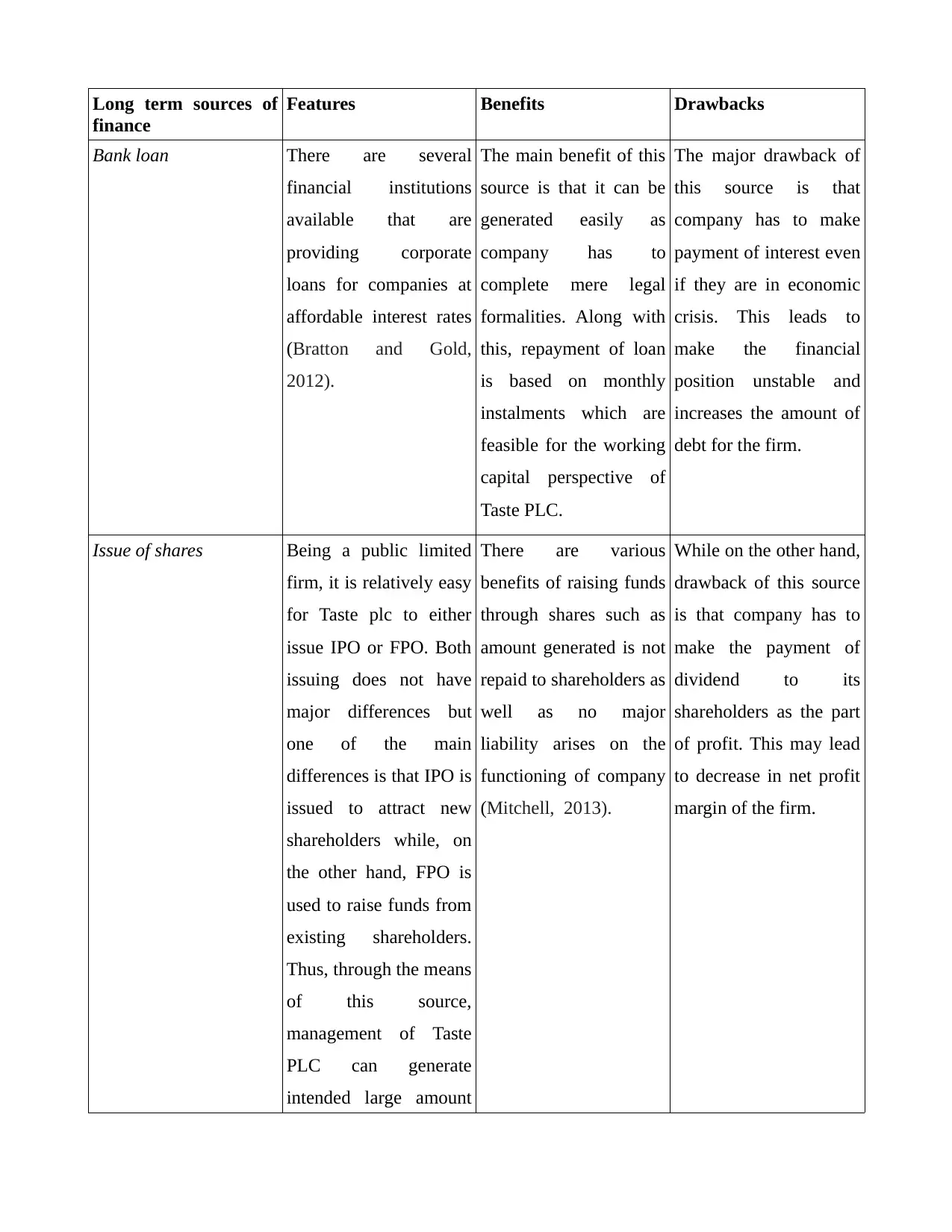
Long term sources of
finance
Features Benefits Drawbacks
Bank loan There are several
financial institutions
available that are
providing corporate
loans for companies at
affordable interest rates
(Bratton and Gold,
2012).
The main benefit of this
source is that it can be
generated easily as
company has to
complete mere legal
formalities. Along with
this, repayment of loan
is based on monthly
instalments which are
feasible for the working
capital perspective of
Taste PLC.
The major drawback of
this source is that
company has to make
payment of interest even
if they are in economic
crisis. This leads to
make the financial
position unstable and
increases the amount of
debt for the firm.
Issue of shares Being a public limited
firm, it is relatively easy
for Taste plc to either
issue IPO or FPO. Both
issuing does not have
major differences but
one of the main
differences is that IPO is
issued to attract new
shareholders while, on
the other hand, FPO is
used to raise funds from
existing shareholders.
Thus, through the means
of this source,
management of Taste
PLC can generate
intended large amount
There are various
benefits of raising funds
through shares such as
amount generated is not
repaid to shareholders as
well as no major
liability arises on the
functioning of company
(Mitchell, 2013).
While on the other hand,
drawback of this source
is that company has to
make the payment of
dividend to its
shareholders as the part
of profit. This may lead
to decrease in net profit
margin of the firm.
finance
Features Benefits Drawbacks
Bank loan There are several
financial institutions
available that are
providing corporate
loans for companies at
affordable interest rates
(Bratton and Gold,
2012).
The main benefit of this
source is that it can be
generated easily as
company has to
complete mere legal
formalities. Along with
this, repayment of loan
is based on monthly
instalments which are
feasible for the working
capital perspective of
Taste PLC.
The major drawback of
this source is that
company has to make
payment of interest even
if they are in economic
crisis. This leads to
make the financial
position unstable and
increases the amount of
debt for the firm.
Issue of shares Being a public limited
firm, it is relatively easy
for Taste plc to either
issue IPO or FPO. Both
issuing does not have
major differences but
one of the main
differences is that IPO is
issued to attract new
shareholders while, on
the other hand, FPO is
used to raise funds from
existing shareholders.
Thus, through the means
of this source,
management of Taste
PLC can generate
intended large amount
There are various
benefits of raising funds
through shares such as
amount generated is not
repaid to shareholders as
well as no major
liability arises on the
functioning of company
(Mitchell, 2013).
While on the other hand,
drawback of this source
is that company has to
make the payment of
dividend to its
shareholders as the part
of profit. This may lead
to decrease in net profit
margin of the firm.
Paraphrase This Document
Need a fresh take? Get an instant paraphrase of this document with our AI Paraphraser
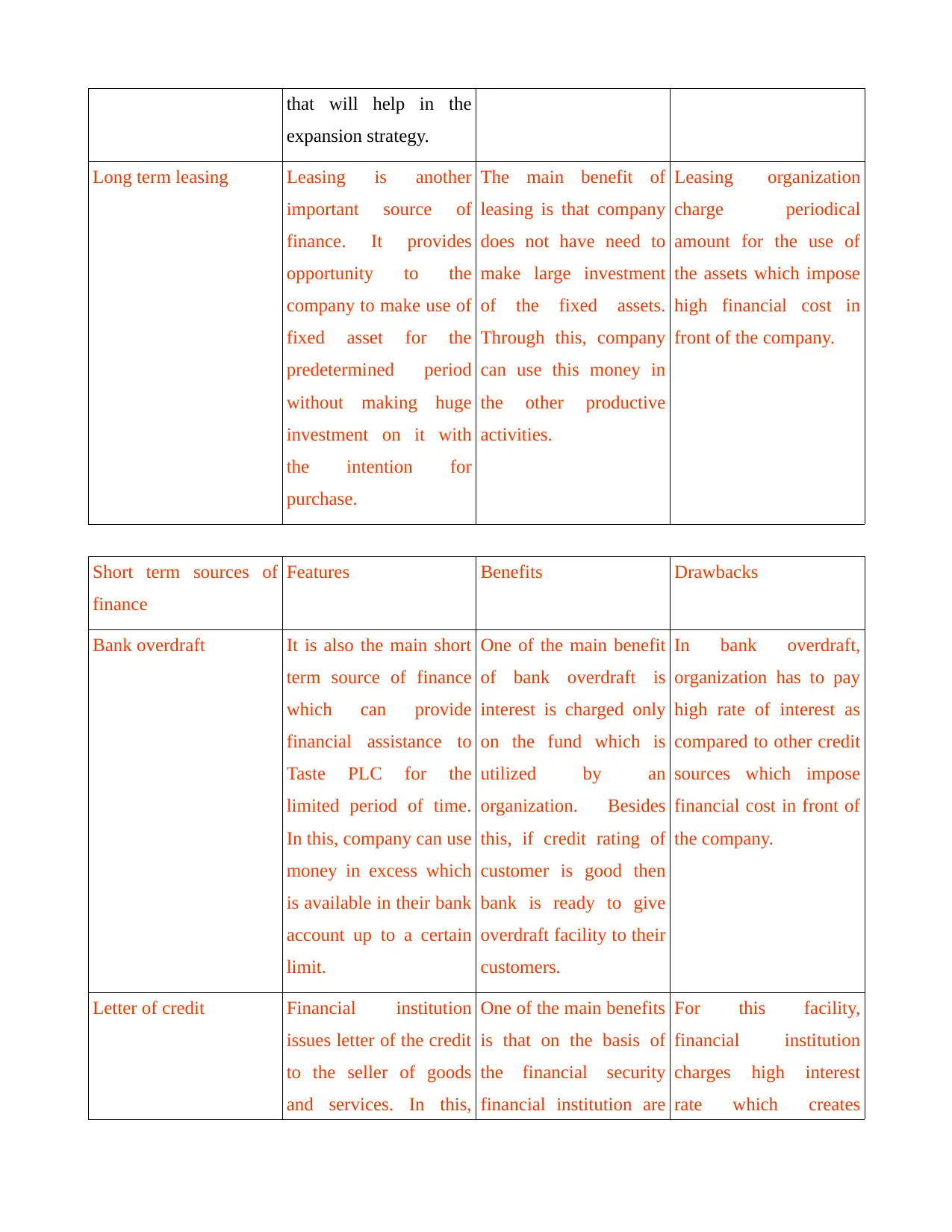
that will help in the
expansion strategy.
Long term leasing Leasing is another
important source of
finance. It provides
opportunity to the
company to make use of
fixed asset for the
predetermined period
without making huge
investment on it with
the intention for
purchase.
The main benefit of
leasing is that company
does not have need to
make large investment
of the fixed assets.
Through this, company
can use this money in
the other productive
activities.
Leasing organization
charge periodical
amount for the use of
the assets which impose
high financial cost in
front of the company.
Short term sources of
finance
Features Benefits Drawbacks
Bank overdraft It is also the main short
term source of finance
which can provide
financial assistance to
Taste PLC for the
limited period of time.
In this, company can use
money in excess which
is available in their bank
account up to a certain
limit.
One of the main benefit
of bank overdraft is
interest is charged only
on the fund which is
utilized by an
organization. Besides
this, if credit rating of
customer is good then
bank is ready to give
overdraft facility to their
customers.
In bank overdraft,
organization has to pay
high rate of interest as
compared to other credit
sources which impose
financial cost in front of
the company.
Letter of credit Financial institution
issues letter of the credit
to the seller of goods
and services. In this,
One of the main benefits
is that on the basis of
the financial security
financial institution are
For this facility,
financial institution
charges high interest
rate which creates
expansion strategy.
Long term leasing Leasing is another
important source of
finance. It provides
opportunity to the
company to make use of
fixed asset for the
predetermined period
without making huge
investment on it with
the intention for
purchase.
The main benefit of
leasing is that company
does not have need to
make large investment
of the fixed assets.
Through this, company
can use this money in
the other productive
activities.
Leasing organization
charge periodical
amount for the use of
the assets which impose
high financial cost in
front of the company.
Short term sources of
finance
Features Benefits Drawbacks
Bank overdraft It is also the main short
term source of finance
which can provide
financial assistance to
Taste PLC for the
limited period of time.
In this, company can use
money in excess which
is available in their bank
account up to a certain
limit.
One of the main benefit
of bank overdraft is
interest is charged only
on the fund which is
utilized by an
organization. Besides
this, if credit rating of
customer is good then
bank is ready to give
overdraft facility to their
customers.
In bank overdraft,
organization has to pay
high rate of interest as
compared to other credit
sources which impose
financial cost in front of
the company.
Letter of credit Financial institution
issues letter of the credit
to the seller of goods
and services. In this,
One of the main benefits
is that on the basis of
the financial security
financial institution are
For this facility,
financial institution
charges high interest
rate which creates

financial institution
takes responsibility to
give payment on the
behalf of the company.
ready to give credit to
the organization.
financial burden in front
of the company.
Leasing In leasing, Taste plc has
the opportunity to take
benefit from the assets
without making huge
investment on it.
Tax deduction is one of
the main benefits which
compel organization to
make use of the asset
without purchasing it.
Taste plc requires
paying periodical rent to
the real owner of assets
which imposing high
financial cost in front of
the organization.
2.3. Comparing and contrasting right issue of shares and loan notes Right issue: It can be defined as a form of dividend in which organization provides right to its
existing shareholders to purchase the shares of company. In this, firm initially offers the shares
to its existing investors instead of others. Right issues are usually undertaken by PLC because
they prefer to raise finance through issuing of equity shares rather than issuing of debt. Taste is
also the PLC which prefers to raise fund from the equity sources. Whereas, loan notes are the
financial instruments in which borrower provides a written form to the lender which contains
interest rate that borrower has to pay (Mitchell, 2013). It also consists of the time in which
Taste PLC needs to repay the whole amount of debt. Loan stock: Company also issues the loan note which can be easily convertible into equity
shares after a predetermined time period. Raising fund from right issues proves to be more
beneficial for Taste PLC as compared to debt issues. When company fulfils its financial needs
through its existing shareholders then it does not have need to incur extra expenses to attract
them. Besides this, financial position of Taste PLC is sound so, organization is able to attract its
existing shareholders. In contrary to this, corporation can meet its financial requirements
through debt issues. For this, company has to pay interest to the holders of loan notes after a
regular interval. As compared to equity sources, raising finance through loan notes imposes
high cost in front of the organization.
Implications of the right issue of shares: There are several implications of right issue of shares
upon the organization, invests and financial statement of an organization. In right issue
company issue shares to their existing shareholders. Thus, corporation does not have need to
takes responsibility to
give payment on the
behalf of the company.
ready to give credit to
the organization.
financial burden in front
of the company.
Leasing In leasing, Taste plc has
the opportunity to take
benefit from the assets
without making huge
investment on it.
Tax deduction is one of
the main benefits which
compel organization to
make use of the asset
without purchasing it.
Taste plc requires
paying periodical rent to
the real owner of assets
which imposing high
financial cost in front of
the organization.
2.3. Comparing and contrasting right issue of shares and loan notes Right issue: It can be defined as a form of dividend in which organization provides right to its
existing shareholders to purchase the shares of company. In this, firm initially offers the shares
to its existing investors instead of others. Right issues are usually undertaken by PLC because
they prefer to raise finance through issuing of equity shares rather than issuing of debt. Taste is
also the PLC which prefers to raise fund from the equity sources. Whereas, loan notes are the
financial instruments in which borrower provides a written form to the lender which contains
interest rate that borrower has to pay (Mitchell, 2013). It also consists of the time in which
Taste PLC needs to repay the whole amount of debt. Loan stock: Company also issues the loan note which can be easily convertible into equity
shares after a predetermined time period. Raising fund from right issues proves to be more
beneficial for Taste PLC as compared to debt issues. When company fulfils its financial needs
through its existing shareholders then it does not have need to incur extra expenses to attract
them. Besides this, financial position of Taste PLC is sound so, organization is able to attract its
existing shareholders. In contrary to this, corporation can meet its financial requirements
through debt issues. For this, company has to pay interest to the holders of loan notes after a
regular interval. As compared to equity sources, raising finance through loan notes imposes
high cost in front of the organization.
Implications of the right issue of shares: There are several implications of right issue of shares
upon the organization, invests and financial statement of an organization. In right issue
company issue shares to their existing shareholders. Thus, corporation does not have need to
⊘ This is a preview!⊘
Do you want full access?
Subscribe today to unlock all pages.
Trusted by 1+ million students worldwide
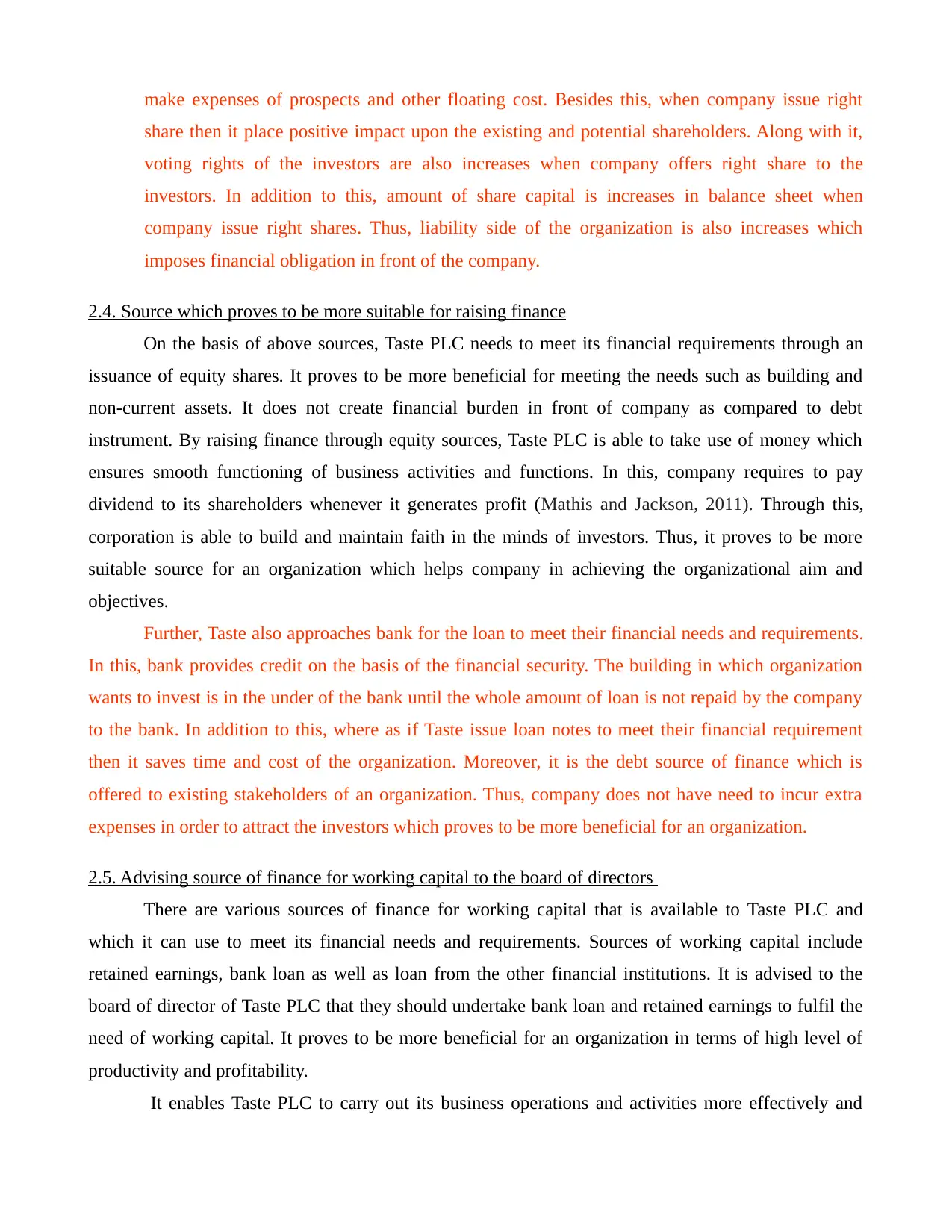
make expenses of prospects and other floating cost. Besides this, when company issue right
share then it place positive impact upon the existing and potential shareholders. Along with it,
voting rights of the investors are also increases when company offers right share to the
investors. In addition to this, amount of share capital is increases in balance sheet when
company issue right shares. Thus, liability side of the organization is also increases which
imposes financial obligation in front of the company.
2.4. Source which proves to be more suitable for raising finance
On the basis of above sources, Taste PLC needs to meet its financial requirements through an
issuance of equity shares. It proves to be more beneficial for meeting the needs such as building and
non-current assets. It does not create financial burden in front of company as compared to debt
instrument. By raising finance through equity sources, Taste PLC is able to take use of money which
ensures smooth functioning of business activities and functions. In this, company requires to pay
dividend to its shareholders whenever it generates profit (Mathis and Jackson, 2011). Through this,
corporation is able to build and maintain faith in the minds of investors. Thus, it proves to be more
suitable source for an organization which helps company in achieving the organizational aim and
objectives.
Further, Taste also approaches bank for the loan to meet their financial needs and requirements.
In this, bank provides credit on the basis of the financial security. The building in which organization
wants to invest is in the under of the bank until the whole amount of loan is not repaid by the company
to the bank. In addition to this, where as if Taste issue loan notes to meet their financial requirement
then it saves time and cost of the organization. Moreover, it is the debt source of finance which is
offered to existing stakeholders of an organization. Thus, company does not have need to incur extra
expenses in order to attract the investors which proves to be more beneficial for an organization.
2.5. Advising source of finance for working capital to the board of directors
There are various sources of finance for working capital that is available to Taste PLC and
which it can use to meet its financial needs and requirements. Sources of working capital include
retained earnings, bank loan as well as loan from the other financial institutions. It is advised to the
board of director of Taste PLC that they should undertake bank loan and retained earnings to fulfil the
need of working capital. It proves to be more beneficial for an organization in terms of high level of
productivity and profitability.
It enables Taste PLC to carry out its business operations and activities more effectively and
share then it place positive impact upon the existing and potential shareholders. Along with it,
voting rights of the investors are also increases when company offers right share to the
investors. In addition to this, amount of share capital is increases in balance sheet when
company issue right shares. Thus, liability side of the organization is also increases which
imposes financial obligation in front of the company.
2.4. Source which proves to be more suitable for raising finance
On the basis of above sources, Taste PLC needs to meet its financial requirements through an
issuance of equity shares. It proves to be more beneficial for meeting the needs such as building and
non-current assets. It does not create financial burden in front of company as compared to debt
instrument. By raising finance through equity sources, Taste PLC is able to take use of money which
ensures smooth functioning of business activities and functions. In this, company requires to pay
dividend to its shareholders whenever it generates profit (Mathis and Jackson, 2011). Through this,
corporation is able to build and maintain faith in the minds of investors. Thus, it proves to be more
suitable source for an organization which helps company in achieving the organizational aim and
objectives.
Further, Taste also approaches bank for the loan to meet their financial needs and requirements.
In this, bank provides credit on the basis of the financial security. The building in which organization
wants to invest is in the under of the bank until the whole amount of loan is not repaid by the company
to the bank. In addition to this, where as if Taste issue loan notes to meet their financial requirement
then it saves time and cost of the organization. Moreover, it is the debt source of finance which is
offered to existing stakeholders of an organization. Thus, company does not have need to incur extra
expenses in order to attract the investors which proves to be more beneficial for an organization.
2.5. Advising source of finance for working capital to the board of directors
There are various sources of finance for working capital that is available to Taste PLC and
which it can use to meet its financial needs and requirements. Sources of working capital include
retained earnings, bank loan as well as loan from the other financial institutions. It is advised to the
board of director of Taste PLC that they should undertake bank loan and retained earnings to fulfil the
need of working capital. It proves to be more beneficial for an organization in terms of high level of
productivity and profitability.
It enables Taste PLC to carry out its business operations and activities more effectively and
Paraphrase This Document
Need a fresh take? Get an instant paraphrase of this document with our AI Paraphraser

efficiently. Retained earnings are the best source which enables the organization to fulfil its financial
needs. Nevertheless, if firm retains high level of profit then it is unable to pay dividend to the
shareholders which make negative impact upon them. On the other hand, if company undertakes only
bank loan then it has to pay high interest amount which imposes difficulty in front of the firm ( Brealey,
2012). Thus, Taste PLC needs to use both the sources of finance to meet the financial requirement.
Sources of finance include trade credit, factoring, lines of credit and bank loan are the major sources of
working capital.
3. FINANCIAL STATEMENTS
3.1 Statement of profit and loss
It is one of the main part of financial statement which provides deeper insight about the profit
generated by the firm during the accounting year. Besides this, it also provides information about the
expenditure which are incurred by the business organization. One of the main purpose behind the
preparation of profit and loss a/c is make analysis of the profit upon which dividend, investment and
other business decisions are highly dependent. In addition to this, business entity can also make review
of their expenditure on which company needs to exert control.
Debit side Credit side
Particulars Amount Particulars Amount
To salaries and wages xxx By gross profit xxx
To electricity expenses xxx By interest receive xxx
To office expenses xxx By dividend receive xxx
3.2 Statement of balance sheet
This statement summarizes company's assets, liabilities and shareholders equity which is highly
associated with the particular time period. Every organization prepares balance sheet at the end of the
financial year to evaluate its financial strength and weaknesses. Through this, manager of the firm is
able to employ competent strategies which helps them in converting their weaknesses into strengths.
Liabilities Amount Assets Amount
Shareholders equity xxx Fixed assets:
Furnitures &
xxx
needs. Nevertheless, if firm retains high level of profit then it is unable to pay dividend to the
shareholders which make negative impact upon them. On the other hand, if company undertakes only
bank loan then it has to pay high interest amount which imposes difficulty in front of the firm ( Brealey,
2012). Thus, Taste PLC needs to use both the sources of finance to meet the financial requirement.
Sources of finance include trade credit, factoring, lines of credit and bank loan are the major sources of
working capital.
3. FINANCIAL STATEMENTS
3.1 Statement of profit and loss
It is one of the main part of financial statement which provides deeper insight about the profit
generated by the firm during the accounting year. Besides this, it also provides information about the
expenditure which are incurred by the business organization. One of the main purpose behind the
preparation of profit and loss a/c is make analysis of the profit upon which dividend, investment and
other business decisions are highly dependent. In addition to this, business entity can also make review
of their expenditure on which company needs to exert control.
Debit side Credit side
Particulars Amount Particulars Amount
To salaries and wages xxx By gross profit xxx
To electricity expenses xxx By interest receive xxx
To office expenses xxx By dividend receive xxx
3.2 Statement of balance sheet
This statement summarizes company's assets, liabilities and shareholders equity which is highly
associated with the particular time period. Every organization prepares balance sheet at the end of the
financial year to evaluate its financial strength and weaknesses. Through this, manager of the firm is
able to employ competent strategies which helps them in converting their weaknesses into strengths.
Liabilities Amount Assets Amount
Shareholders equity xxx Fixed assets:
Furnitures &
xxx
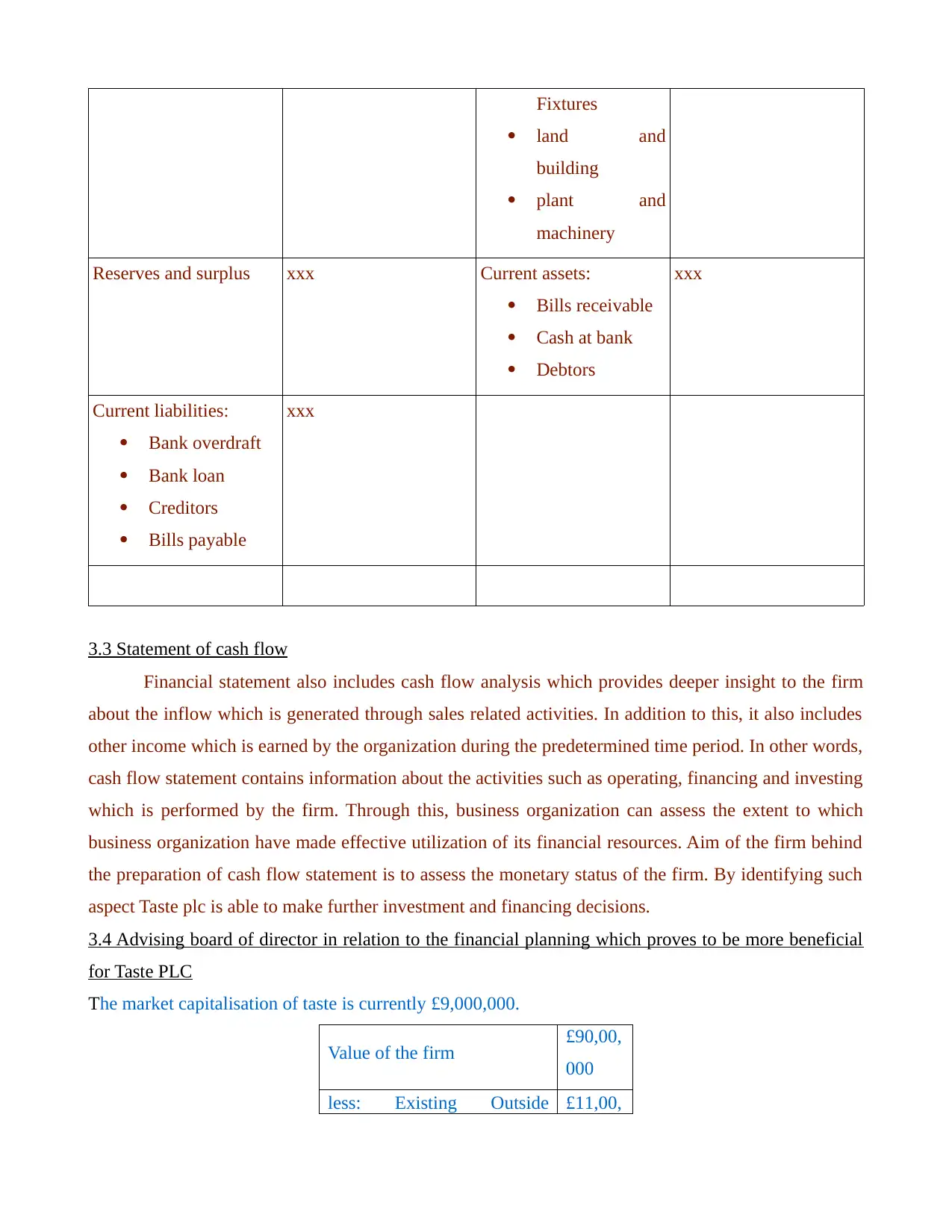
Fixtures
land and
building
plant and
machinery
Reserves and surplus xxx Current assets:
Bills receivable
Cash at bank
Debtors
xxx
Current liabilities:
Bank overdraft
Bank loan
Creditors
Bills payable
xxx
3.3 Statement of cash flow
Financial statement also includes cash flow analysis which provides deeper insight to the firm
about the inflow which is generated through sales related activities. In addition to this, it also includes
other income which is earned by the organization during the predetermined time period. In other words,
cash flow statement contains information about the activities such as operating, financing and investing
which is performed by the firm. Through this, business organization can assess the extent to which
business organization have made effective utilization of its financial resources. Aim of the firm behind
the preparation of cash flow statement is to assess the monetary status of the firm. By identifying such
aspect Taste plc is able to make further investment and financing decisions.
3.4 Advising board of director in relation to the financial planning which proves to be more beneficial
for Taste PLC
The market capitalisation of taste is currently £9,000,000.
Value of the firm £90,00,
000
less: Existing Outside £11,00,
land and
building
plant and
machinery
Reserves and surplus xxx Current assets:
Bills receivable
Cash at bank
Debtors
xxx
Current liabilities:
Bank overdraft
Bank loan
Creditors
Bills payable
xxx
3.3 Statement of cash flow
Financial statement also includes cash flow analysis which provides deeper insight to the firm
about the inflow which is generated through sales related activities. In addition to this, it also includes
other income which is earned by the organization during the predetermined time period. In other words,
cash flow statement contains information about the activities such as operating, financing and investing
which is performed by the firm. Through this, business organization can assess the extent to which
business organization have made effective utilization of its financial resources. Aim of the firm behind
the preparation of cash flow statement is to assess the monetary status of the firm. By identifying such
aspect Taste plc is able to make further investment and financing decisions.
3.4 Advising board of director in relation to the financial planning which proves to be more beneficial
for Taste PLC
The market capitalisation of taste is currently £9,000,000.
Value of the firm £90,00,
000
less: Existing Outside £11,00,
⊘ This is a preview!⊘
Do you want full access?
Subscribe today to unlock all pages.
Trusted by 1+ million students worldwide
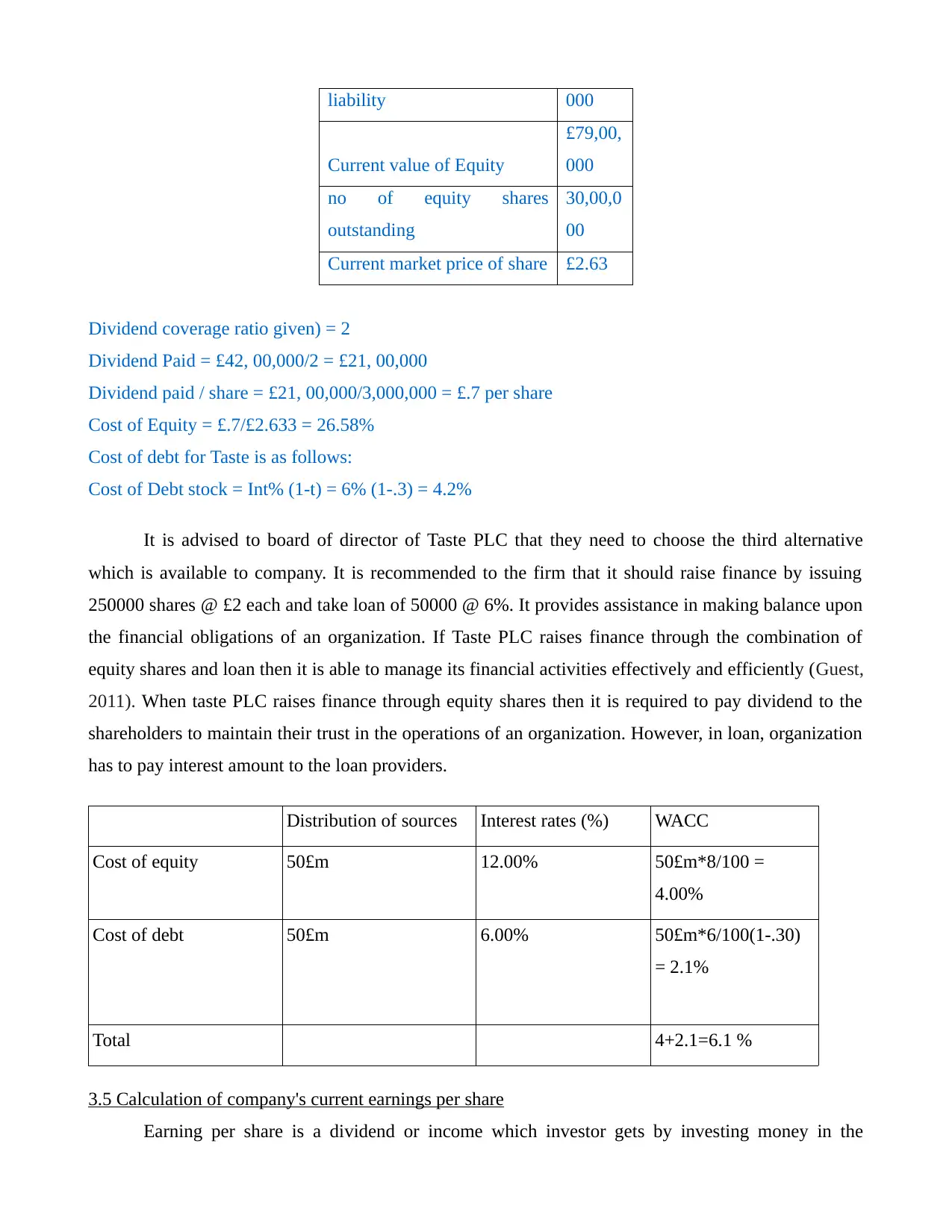
liability 000
Current value of Equity
£79,00,
000
no of equity shares
outstanding
30,00,0
00
Current market price of share £2.63
Dividend coverage ratio given) = 2
Dividend Paid = £42, 00,000/2 = £21, 00,000
Dividend paid / share = £21, 00,000/3,000,000 = £.7 per share
Cost of Equity = £.7/£2.633 = 26.58%
Cost of debt for Taste is as follows:
Cost of Debt stock = Int% (1-t) = 6% (1-.3) = 4.2%
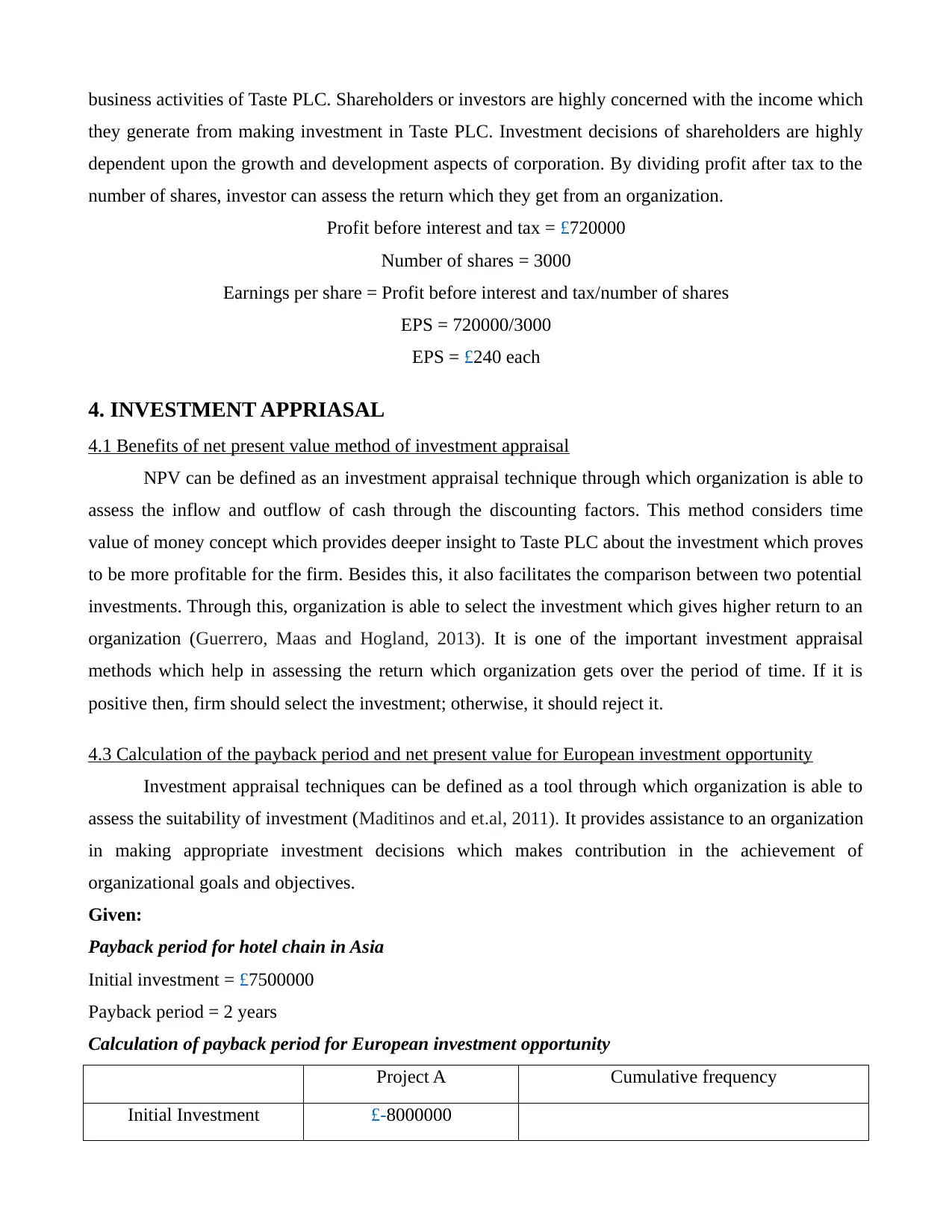
It is advised to board of director of Taste PLC that they need to choose the third alternative
which is available to company. It is recommended to the firm that it should raise finance by issuing
250000 shares @ £2 each and take loan of 50000 @ 6%. It provides assistance in making balance upon
the financial obligations of an organization. If Taste PLC raises finance through the combination of
equity shares and loan then it is able to manage its financial activities effectively and efficiently (Guest,
2011). When taste PLC raises finance through equity shares then it is required to pay dividend to the
shareholders to maintain their trust in the operations of an organization. However, in loan, organization
has to pay interest amount to the loan providers.
Distribution of sources Interest rates (%) WACC
Cost of equity 50£m 12.00% 50£m*8/100 =
4.00%
Cost of debt 50£m 6.00% 50£m*6/100(1-.30)
= 2.1%
Total 4+2.1=6.1 %
3.5 Calculation of company's current earnings per share
Earning per share is a dividend or income which investor gets by investing money in the
Current value of Equity
£79,00,
000
no of equity shares
outstanding
30,00,0
00
Current market price of share £2.63
Dividend coverage ratio given) = 2
Dividend Paid = £42, 00,000/2 = £21, 00,000
Dividend paid / share = £21, 00,000/3,000,000 = £.7 per share
Cost of Equity = £.7/£2.633 = 26.58%
Cost of debt for Taste is as follows:
Cost of Debt stock = Int% (1-t) = 6% (1-.3) = 4.2%
It is advised to board of director of Taste PLC that they need to choose the third alternative
which is available to company. It is recommended to the firm that it should raise finance by issuing
250000 shares @ £2 each and take loan of 50000 @ 6%. It provides assistance in making balance upon
the financial obligations of an organization. If Taste PLC raises finance through the combination of
equity shares and loan then it is able to manage its financial activities effectively and efficiently (Guest,
2011). When taste PLC raises finance through equity shares then it is required to pay dividend to the
shareholders to maintain their trust in the operations of an organization. However, in loan, organization
has to pay interest amount to the loan providers.
Distribution of sources Interest rates (%) WACC
Cost of equity 50£m 12.00% 50£m*8/100 =
4.00%
Cost of debt 50£m 6.00% 50£m*6/100(1-.30)
= 2.1%
Total 4+2.1=6.1 %
3.5 Calculation of company's current earnings per share
Earning per share is a dividend or income which investor gets by investing money in the
Paraphrase This Document
Need a fresh take? Get an instant paraphrase of this document with our AI Paraphraser
business activities of Taste PLC. Shareholders or investors are highly concerned with the income which
they generate from making investment in Taste PLC. Investment decisions of shareholders are highly
dependent upon the growth and development aspects of corporation. By dividing profit after tax to the
number of shares, investor can assess the return which they get from an organization.
Profit before interest and tax = £720000
Number of shares = 3000
Earnings per share = Profit before interest and tax/number of shares
EPS = 720000/3000
EPS = £240 each
4. INVESTMENT APPRIASAL
4.1 Benefits of net present value method of investment appraisal
NPV can be defined as an investment appraisal technique through which organization is able to
assess the inflow and outflow of cash through the discounting factors. This method considers time
value of money concept which provides deeper insight to Taste PLC about the investment which proves
to be more profitable for the firm. Besides this, it also facilitates the comparison between two potential
investments. Through this, organization is able to select the investment which gives higher return to an
organization (Guerrero, Maas and Hogland, 2013). It is one of the important investment appraisal
methods which help in assessing the return which organization gets over the period of time. If it is
positive then, firm should select the investment; otherwise, it should reject it.
4.3 Calculation of the payback period and net present value for European investment opportunity
Investment appraisal techniques can be defined as a tool through which organization is able to
assess the suitability of investment (Maditinos and et.al, 2011). It provides assistance to an organization
in making appropriate investment decisions which makes contribution in the achievement of
organizational goals and objectives.
Given:
Payback period for hotel chain in Asia
Initial investment = £7500000
Payback period = 2 years
Calculation of payback period for European investment opportunity
Project A Cumulative frequency
Initial Investment £-8000000
they generate from making investment in Taste PLC. Investment decisions of shareholders are highly
dependent upon the growth and development aspects of corporation. By dividing profit after tax to the
number of shares, investor can assess the return which they get from an organization.
Profit before interest and tax = £720000
Number of shares = 3000
Earnings per share = Profit before interest and tax/number of shares
EPS = 720000/3000
EPS = £240 each
4. INVESTMENT APPRIASAL
4.1 Benefits of net present value method of investment appraisal
NPV can be defined as an investment appraisal technique through which organization is able to
assess the inflow and outflow of cash through the discounting factors. This method considers time
value of money concept which provides deeper insight to Taste PLC about the investment which proves
to be more profitable for the firm. Besides this, it also facilitates the comparison between two potential
investments. Through this, organization is able to select the investment which gives higher return to an
organization (Guerrero, Maas and Hogland, 2013). It is one of the important investment appraisal
methods which help in assessing the return which organization gets over the period of time. If it is
positive then, firm should select the investment; otherwise, it should reject it.
4.3 Calculation of the payback period and net present value for European investment opportunity
Investment appraisal techniques can be defined as a tool through which organization is able to
assess the suitability of investment (Maditinos and et.al, 2011). It provides assistance to an organization
in making appropriate investment decisions which makes contribution in the achievement of
organizational goals and objectives.
Given:
Payback period for hotel chain in Asia
Initial investment = £7500000
Payback period = 2 years
Calculation of payback period for European investment opportunity
Project A Cumulative frequency
Initial Investment £-8000000
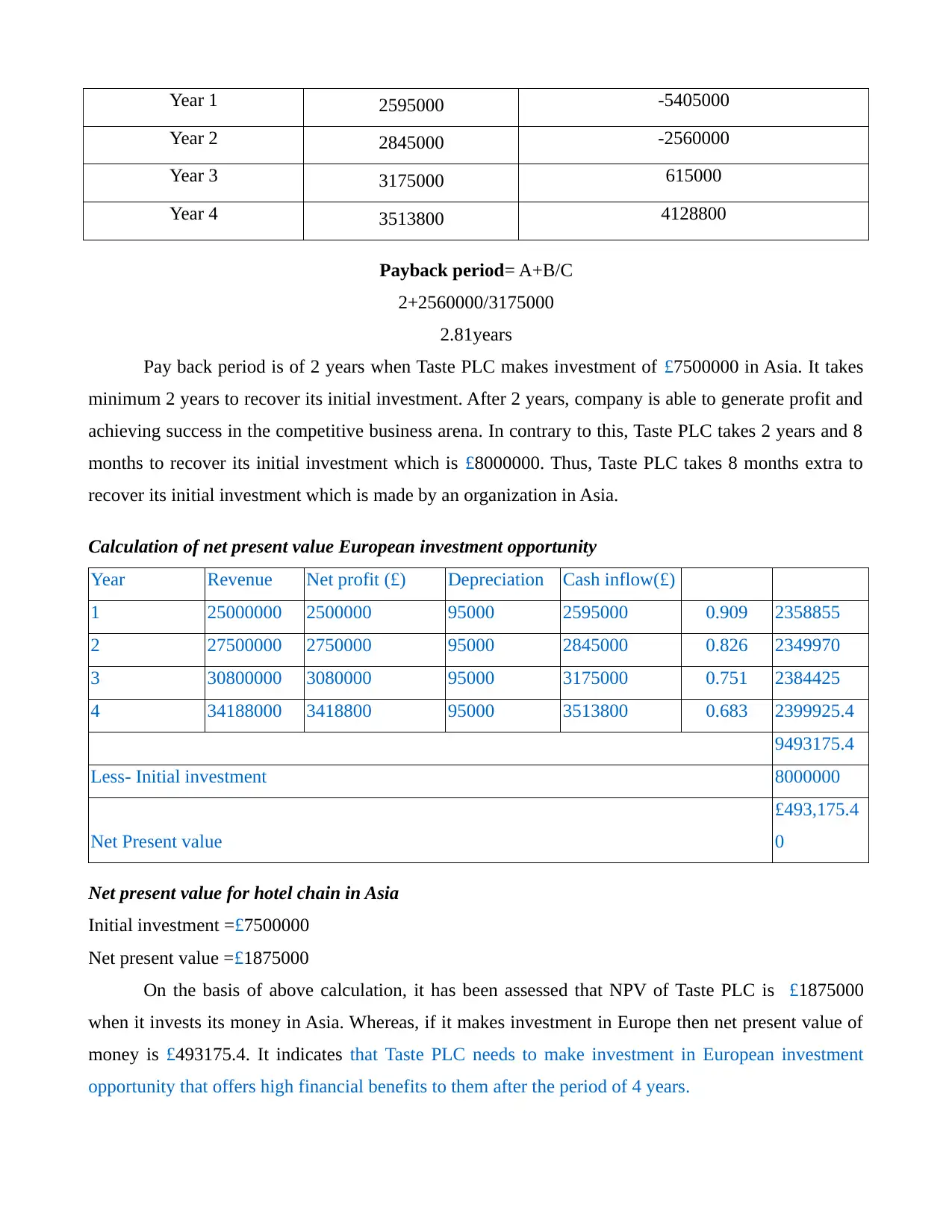
Year 1 2595000 -5405000
Year 2 2845000 -2560000
Year 3 3175000 615000
Year 4 3513800 4128800
Payback period= A+B/C
2+2560000/3175000
2.81years
Pay back period is of 2 years when Taste PLC makes investment of £7500000 in Asia. It takes
minimum 2 years to recover its initial investment. After 2 years, company is able to generate profit and
achieving success in the competitive business arena. In contrary to this, Taste PLC takes 2 years and 8
months to recover its initial investment which is £8000000. Thus, Taste PLC takes 8 months extra to
recover its initial investment which is made by an organization in Asia.
Calculation of net present value European investment opportunity
Year Revenue Net profit (£) Depreciation Cash inflow(£)
1 25000000 2500000 95000 2595000 0.909 2358855
2 27500000 2750000 95000 2845000 0.826 2349970
3 30800000 3080000 95000 3175000 0.751 2384425
4 34188000 3418800 95000 3513800 0.683 2399925.4
9493175.4
Less- Initial investment 8000000
Net Present value
£493,175.4
0
Net present value for hotel chain in Asia
Initial investment =£7500000
Net present value =£1875000
On the basis of above calculation, it has been assessed that NPV of Taste PLC is £1875000
when it invests its money in Asia. Whereas, if it makes investment in Europe then net present value of
money is £493175.4. It indicates that Taste PLC needs to make investment in European investment
opportunity that offers high financial benefits to them after the period of 4 years.
Year 2 2845000 -2560000
Year 3 3175000 615000
Year 4 3513800 4128800
Payback period= A+B/C
2+2560000/3175000
2.81years
Pay back period is of 2 years when Taste PLC makes investment of £7500000 in Asia. It takes
minimum 2 years to recover its initial investment. After 2 years, company is able to generate profit and
achieving success in the competitive business arena. In contrary to this, Taste PLC takes 2 years and 8
months to recover its initial investment which is £8000000. Thus, Taste PLC takes 8 months extra to
recover its initial investment which is made by an organization in Asia.
Calculation of net present value European investment opportunity
Year Revenue Net profit (£) Depreciation Cash inflow(£)
1 25000000 2500000 95000 2595000 0.909 2358855
2 27500000 2750000 95000 2845000 0.826 2349970
3 30800000 3080000 95000 3175000 0.751 2384425
4 34188000 3418800 95000 3513800 0.683 2399925.4
9493175.4
Less- Initial investment 8000000
Net Present value
£493,175.4
0
Net present value for hotel chain in Asia
Initial investment =£7500000
Net present value =£1875000
On the basis of above calculation, it has been assessed that NPV of Taste PLC is £1875000
when it invests its money in Asia. Whereas, if it makes investment in Europe then net present value of
money is £493175.4. It indicates that Taste PLC needs to make investment in European investment
opportunity that offers high financial benefits to them after the period of 4 years.
⊘ This is a preview!⊘
Do you want full access?
Subscribe today to unlock all pages.
Trusted by 1+ million students worldwide

1 out of 20


Related Documents


Your All-in-One AI-Powered Toolkit for Academic Success.
+13062052269
info@desklib.com
Available 24*7 on WhatsApp / Email
![[object Object]](/_next/static/media/star-bottom.7253800d.svg)
Unlock your academic potential
Copyright © 2020–2026 A2Z Services. All Rights Reserved. Developed and managed by ZUCOL.