IHP 510 - Strategic Planning: A SWOT Analysis of the Mayo Clinic
VerifiedAdded on 2023/06/11
|5
|1035
|482
Case Study
AI Summary
This case study presents a SWOT analysis of the Mayo Clinic, a non-profit healthcare organization founded in 1883. The analysis identifies the clinic's strengths, weaknesses, opportunities, and threats in the context of the evolving healthcare industry. Strengths include a focus on research, high-quality treatment, and integrated medical systems. Weaknesses include competition from specialized hospitals and inconsistencies across facilities. Opportunities include translating research into practice and expanding affiliations. Threats include increased competition, unpredictable government policies, and reduced reimbursements. The analysis concludes that the Mayo Clinic has significant opportunities to leverage its strengths but must address the identified threats to ensure future success. Desklib offers a range of resources, including past papers and solved assignments, to support students in their academic endeavors.
Running head: MAYO CLINIC SWOT ANALYSIS
Mayo Clinic SWOT Analysis
Student’s name
Institution’s name
Mayo Clinic SWOT Analysis
Student’s name
Institution’s name
Paraphrase This Document
Need a fresh take? Get an instant paraphrase of this document with our AI Paraphraser

MAYO CLINIC SWOT ANALYSIS 2
Mayo Clinic SWOT Analysis
Introduction
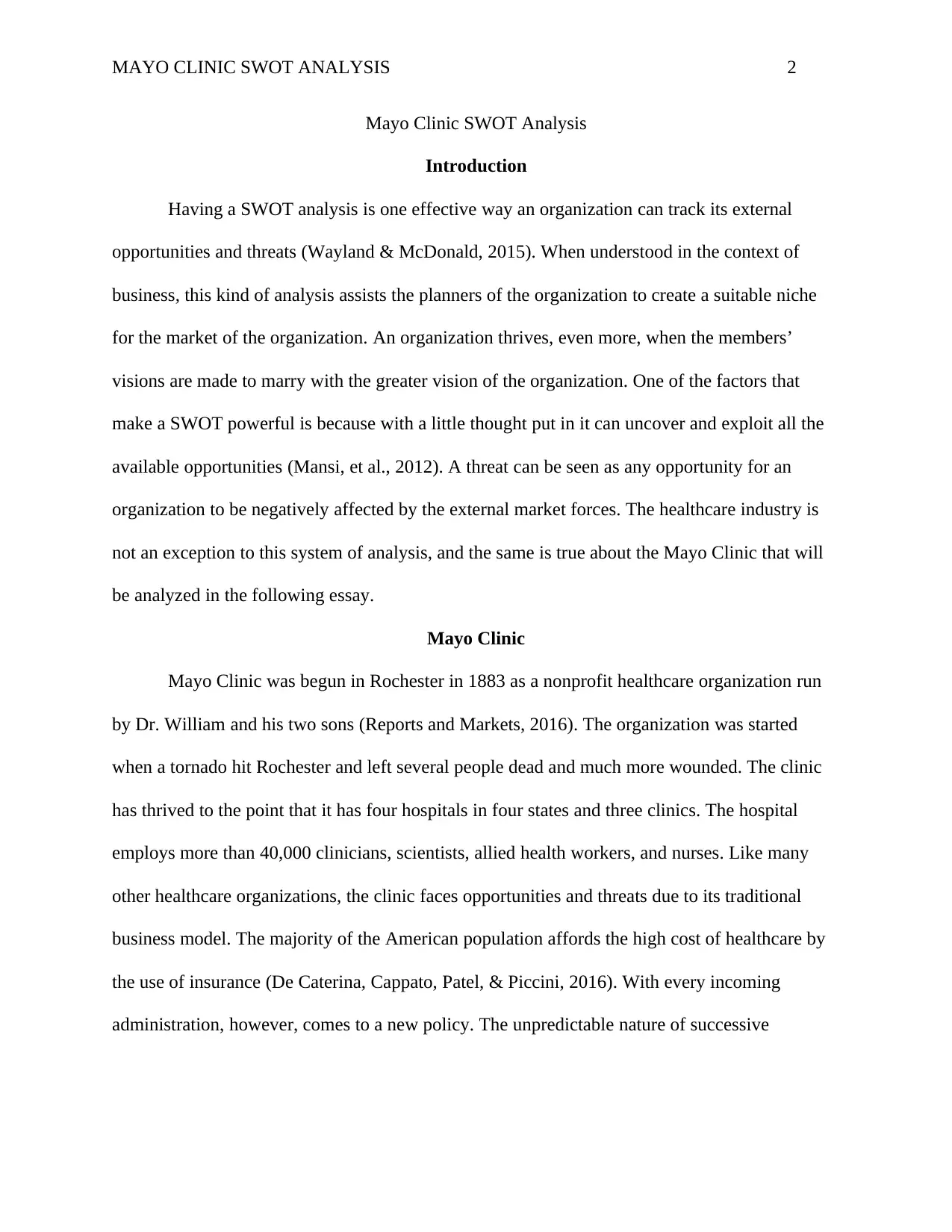
Having a SWOT analysis is one effective way an organization can track its external
opportunities and threats (Wayland & McDonald, 2015). When understood in the context of
business, this kind of analysis assists the planners of the organization to create a suitable niche
for the market of the organization. An organization thrives, even more, when the members’
visions are made to marry with the greater vision of the organization. One of the factors that
make a SWOT powerful is because with a little thought put in it can uncover and exploit all the
available opportunities (Mansi, et al., 2012). A threat can be seen as any opportunity for an
organization to be negatively affected by the external market forces. The healthcare industry is
not an exception to this system of analysis, and the same is true about the Mayo Clinic that will
be analyzed in the following essay.
Mayo Clinic
Mayo Clinic was begun in Rochester in 1883 as a nonprofit healthcare organization run
by Dr. William and his two sons (Reports and Markets, 2016). The organization was started
when a tornado hit Rochester and left several people dead and much more wounded. The clinic
has thrived to the point that it has four hospitals in four states and three clinics. The hospital
employs more than 40,000 clinicians, scientists, allied health workers, and nurses. Like many
other healthcare organizations, the clinic faces opportunities and threats due to its traditional
business model. The majority of the American population affords the high cost of healthcare by
the use of insurance (De Caterina, Cappato, Patel, & Piccini, 2016). With every incoming
administration, however, comes to a new policy. The unpredictable nature of successive
Mayo Clinic SWOT Analysis
Introduction
Having a SWOT analysis is one effective way an organization can track its external
opportunities and threats (Wayland & McDonald, 2015). When understood in the context of
business, this kind of analysis assists the planners of the organization to create a suitable niche
for the market of the organization. An organization thrives, even more, when the members’
visions are made to marry with the greater vision of the organization. One of the factors that
make a SWOT powerful is because with a little thought put in it can uncover and exploit all the
available opportunities (Mansi, et al., 2012). A threat can be seen as any opportunity for an
organization to be negatively affected by the external market forces. The healthcare industry is
not an exception to this system of analysis, and the same is true about the Mayo Clinic that will
be analyzed in the following essay.
Mayo Clinic
Mayo Clinic was begun in Rochester in 1883 as a nonprofit healthcare organization run
by Dr. William and his two sons (Reports and Markets, 2016). The organization was started
when a tornado hit Rochester and left several people dead and much more wounded. The clinic
has thrived to the point that it has four hospitals in four states and three clinics. The hospital
employs more than 40,000 clinicians, scientists, allied health workers, and nurses. Like many
other healthcare organizations, the clinic faces opportunities and threats due to its traditional
business model. The majority of the American population affords the high cost of healthcare by
the use of insurance (De Caterina, Cappato, Patel, & Piccini, 2016). With every incoming
administration, however, comes to a new policy. The unpredictable nature of successive

MAYO CLINIC SWOT ANALYSIS 3
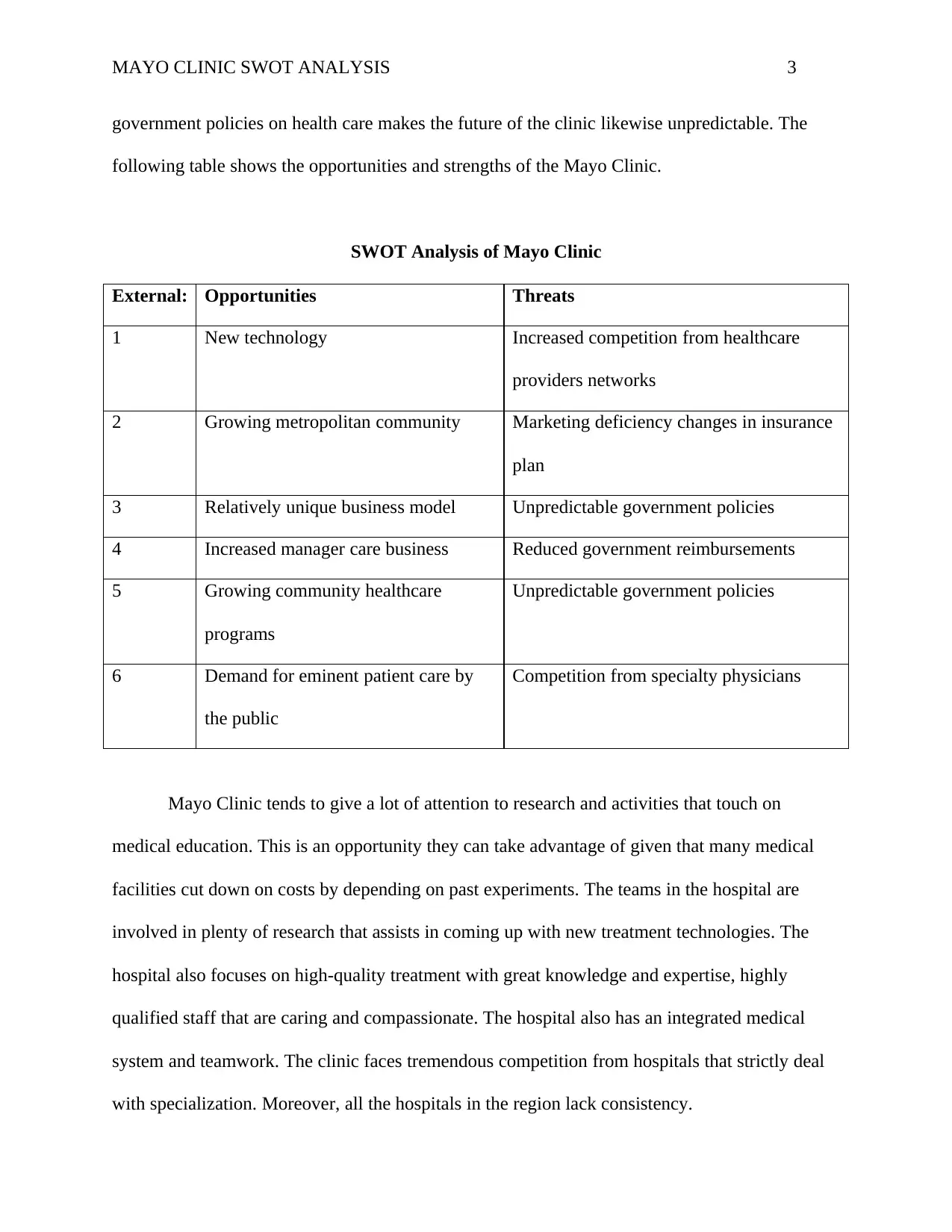
government policies on health care makes the future of the clinic likewise unpredictable. The
following table shows the opportunities and strengths of the Mayo Clinic.
SWOT Analysis of Mayo Clinic
External: Opportunities Threats
1 New technology Increased competition from healthcare
providers networks
2 Growing metropolitan community Marketing deficiency changes in insurance
plan
3 Relatively unique business model Unpredictable government policies
4 Increased manager care business Reduced government reimbursements
5 Growing community healthcare
programs
Unpredictable government policies
6 Demand for eminent patient care by
the public
Competition from specialty physicians
Mayo Clinic tends to give a lot of attention to research and activities that touch on
medical education. This is an opportunity they can take advantage of given that many medical
facilities cut down on costs by depending on past experiments. The teams in the hospital are
involved in plenty of research that assists in coming up with new treatment technologies. The
hospital also focuses on high-quality treatment with great knowledge and expertise, highly
qualified staff that are caring and compassionate. The hospital also has an integrated medical
system and teamwork. The clinic faces tremendous competition from hospitals that strictly deal
with specialization. Moreover, all the hospitals in the region lack consistency.
government policies on health care makes the future of the clinic likewise unpredictable. The
following table shows the opportunities and strengths of the Mayo Clinic.
SWOT Analysis of Mayo Clinic
External: Opportunities Threats
1 New technology Increased competition from healthcare
providers networks
2 Growing metropolitan community Marketing deficiency changes in insurance
plan
3 Relatively unique business model Unpredictable government policies
4 Increased manager care business Reduced government reimbursements
5 Growing community healthcare
programs
Unpredictable government policies
6 Demand for eminent patient care by
the public
Competition from specialty physicians
Mayo Clinic tends to give a lot of attention to research and activities that touch on
medical education. This is an opportunity they can take advantage of given that many medical
facilities cut down on costs by depending on past experiments. The teams in the hospital are
involved in plenty of research that assists in coming up with new treatment technologies. The
hospital also focuses on high-quality treatment with great knowledge and expertise, highly
qualified staff that are caring and compassionate. The hospital also has an integrated medical
system and teamwork. The clinic faces tremendous competition from hospitals that strictly deal
with specialization. Moreover, all the hospitals in the region lack consistency.
⊘ This is a preview!⊘
Do you want full access?
Subscribe today to unlock all pages.

Trusted by 1+ million students worldwide

MAYO CLINIC SWOT ANALYSIS 4
The Future of Mayo Clinic
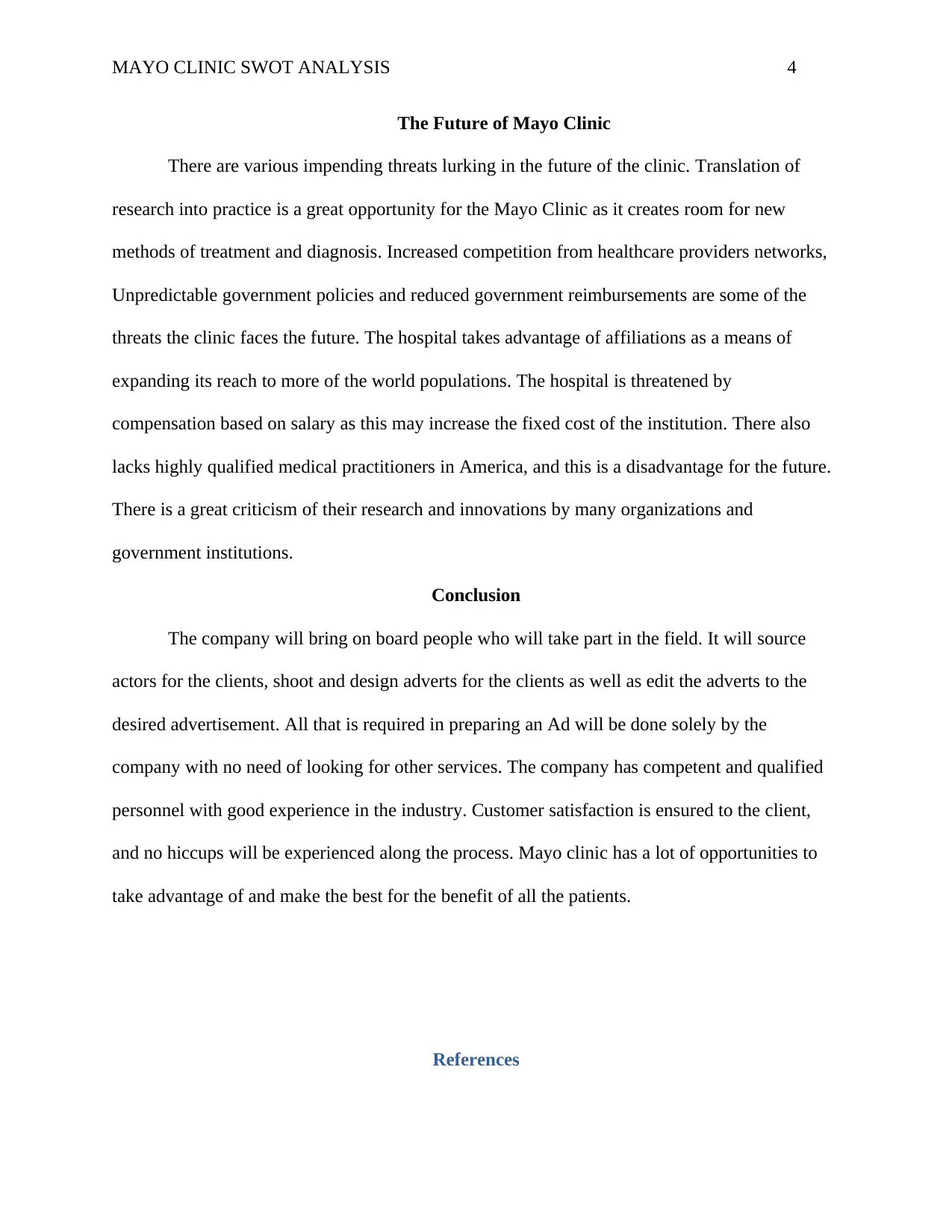
There are various impending threats lurking in the future of the clinic. Translation of
research into practice is a great opportunity for the Mayo Clinic as it creates room for new
methods of treatment and diagnosis. Increased competition from healthcare providers networks,
Unpredictable government policies and reduced government reimbursements are some of the
threats the clinic faces the future. The hospital takes advantage of affiliations as a means of
expanding its reach to more of the world populations. The hospital is threatened by
compensation based on salary as this may increase the fixed cost of the institution. There also
lacks highly qualified medical practitioners in America, and this is a disadvantage for the future.
There is a great criticism of their research and innovations by many organizations and
government institutions.
Conclusion
The company will bring on board people who will take part in the field. It will source
actors for the clients, shoot and design adverts for the clients as well as edit the adverts to the
desired advertisement. All that is required in preparing an Ad will be done solely by the
company with no need of looking for other services. The company has competent and qualified
personnel with good experience in the industry. Customer satisfaction is ensured to the client,
and no hiccups will be experienced along the process. Mayo clinic has a lot of opportunities to
take advantage of and make the best for the benefit of all the patients.
References
The Future of Mayo Clinic
There are various impending threats lurking in the future of the clinic. Translation of
research into practice is a great opportunity for the Mayo Clinic as it creates room for new
methods of treatment and diagnosis. Increased competition from healthcare providers networks,
Unpredictable government policies and reduced government reimbursements are some of the
threats the clinic faces the future. The hospital takes advantage of affiliations as a means of
expanding its reach to more of the world populations. The hospital is threatened by
compensation based on salary as this may increase the fixed cost of the institution. There also
lacks highly qualified medical practitioners in America, and this is a disadvantage for the future.
There is a great criticism of their research and innovations by many organizations and
government institutions.
Conclusion
The company will bring on board people who will take part in the field. It will source
actors for the clients, shoot and design adverts for the clients as well as edit the adverts to the
desired advertisement. All that is required in preparing an Ad will be done solely by the
company with no need of looking for other services. The company has competent and qualified
personnel with good experience in the industry. Customer satisfaction is ensured to the client,
and no hiccups will be experienced along the process. Mayo clinic has a lot of opportunities to
take advantage of and make the best for the benefit of all the patients.
References
Paraphrase This Document
Need a fresh take? Get an instant paraphrase of this document with our AI Paraphraser

MAYO CLINIC SWOT ANALYSIS 5
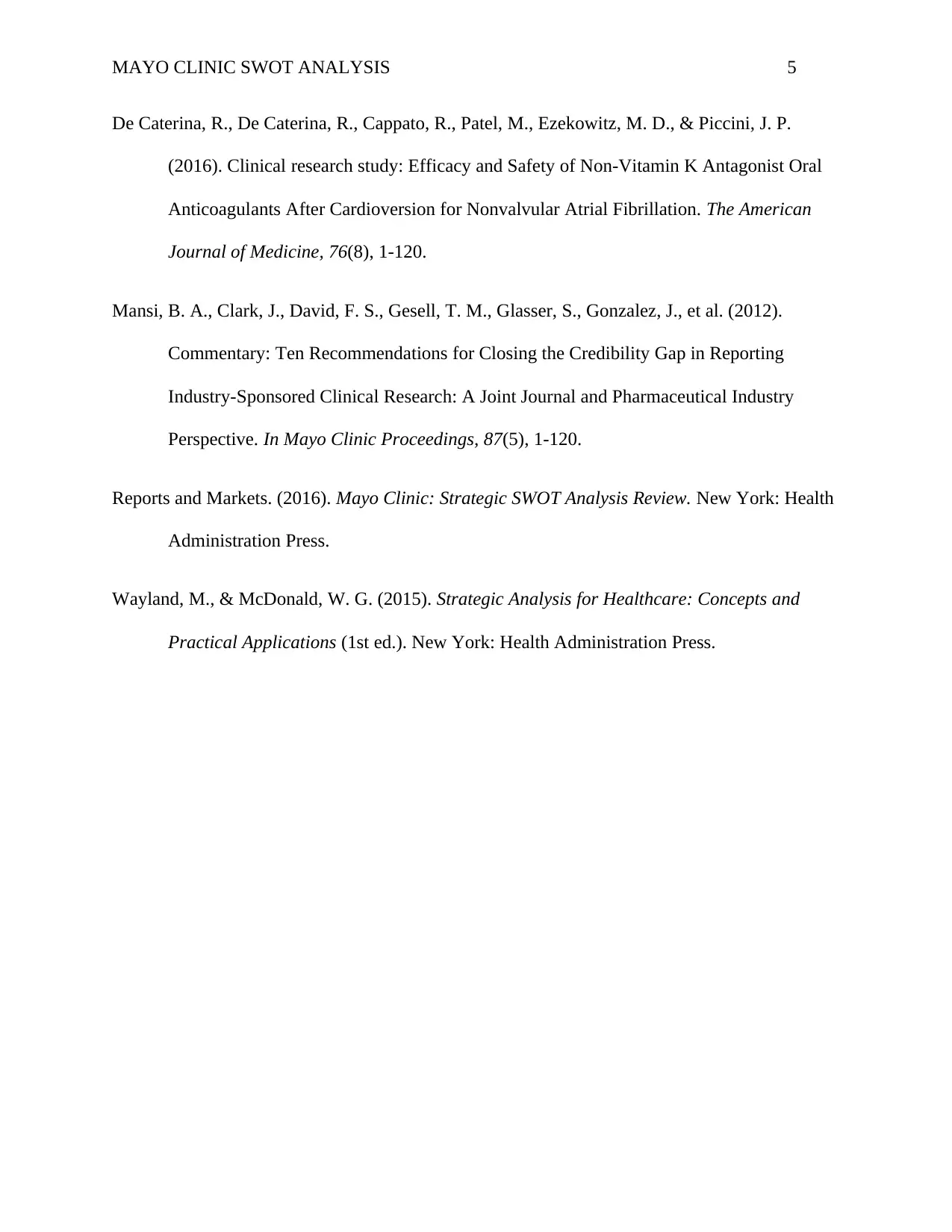
De Caterina, R., De Caterina, R., Cappato, R., Patel, M., Ezekowitz, M. D., & Piccini, J. P.
(2016). Clinical research study: Efficacy and Safety of Non-Vitamin K Antagonist Oral
Anticoagulants After Cardioversion for Nonvalvular Atrial Fibrillation. The American
Journal of Medicine, 76(8), 1-120.
Mansi, B. A., Clark, J., David, F. S., Gesell, T. M., Glasser, S., Gonzalez, J., et al. (2012).
Commentary: Ten Recommendations for Closing the Credibility Gap in Reporting
Industry-Sponsored Clinical Research: A Joint Journal and Pharmaceutical Industry
Perspective. In Mayo Clinic Proceedings, 87(5), 1-120.
Reports and Markets. (2016). Mayo Clinic: Strategic SWOT Analysis Review. New York: Health
Administration Press.
Wayland, M., & McDonald, W. G. (2015). Strategic Analysis for Healthcare: Concepts and
Practical Applications (1st ed.). New York: Health Administration Press.
De Caterina, R., De Caterina, R., Cappato, R., Patel, M., Ezekowitz, M. D., & Piccini, J. P.
(2016). Clinical research study: Efficacy and Safety of Non-Vitamin K Antagonist Oral
Anticoagulants After Cardioversion for Nonvalvular Atrial Fibrillation. The American
Journal of Medicine, 76(8), 1-120.
Mansi, B. A., Clark, J., David, F. S., Gesell, T. M., Glasser, S., Gonzalez, J., et al. (2012).
Commentary: Ten Recommendations for Closing the Credibility Gap in Reporting
Industry-Sponsored Clinical Research: A Joint Journal and Pharmaceutical Industry
Perspective. In Mayo Clinic Proceedings, 87(5), 1-120.
Reports and Markets. (2016). Mayo Clinic: Strategic SWOT Analysis Review. New York: Health
Administration Press.
Wayland, M., & McDonald, W. G. (2015). Strategic Analysis for Healthcare: Concepts and
Practical Applications (1st ed.). New York: Health Administration Press.
1 out of 5
Related Documents
Your All-in-One AI-Powered Toolkit for Academic Success.
+13062052269
info@desklib.com
Available 24*7 on WhatsApp / Email
Unlock your academic potential
Copyright © 2020–2025 A2Z Services. All Rights Reserved. Developed and managed by ZUCOL.