Microeconomics Assignment Solution - Risk, Utility and Investment
VerifiedAdded on 2021/11/18
|6
|1040
|306
Homework Assignment
AI Summary
This microeconomics assignment solution addresses key concepts in financial decision-making under uncertainty. Part I examines the truth or falsity of statements related to investment decisions, probability, risk aversion, and utility maximization. Part II delves into investment analysis, comparing two companies based on risk and return, and how new market information can alter investment choices. The assignment also provides a detailed explanation of indifference curves, which are used to select the best portfolio for an investor based on risk and return preferences, and includes graphical representations of different investor risk profiles. The solution references academic sources to support its analysis.

Microeconomics
Paraphrase This Document
Need a fresh take? Get an instant paraphrase of this document with our AI Paraphraser

TABLE OF CONTENTS
Part I...........................................................................................................................................3
1..............................................................................................................................................3
2..............................................................................................................................................3
3..............................................................................................................................................3
4..............................................................................................................................................3
5..............................................................................................................................................3
Part II..........................................................................................................................................4
6..............................................................................................................................................4
7..............................................................................................................................................4
References..................................................................................................................................6
Part I...........................................................................................................................................3
1..............................................................................................................................................3
2..............................................................................................................................................3
3..............................................................................................................................................3
4..............................................................................................................................................3
5..............................................................................................................................................3
Part II..........................................................................................................................................4
6..............................................................................................................................................4
7..............................................................................................................................................4
References..................................................................................................................................6

PART I
1
This statement is uncertain, as investment decision is not merely based on return provided by
security as risk is equally important for investors (İmrohoroğlu and Tüzel, 2014). Therefore,
investment option with highest expected return will not always be selected as not all investors
are risk averse.
2
True. Sum of all probabilities of possible events in mathematics or statistics is considered to
be one (Dudley, 2018).
3
False. A risk averse person always aim to generate high return by taking risk on the
investment. Further, gambling is highly risk associated and tend to provide high returns in
contrast to risk taken by person (Deck, Lee and Reyes, 2014).
4
The provided statement is true as in uncertain situation it seem intuitive for individuals to
maximize their expected utility as it is directly associated with their level of satisfaction
(Diamond and Rothschild, 2014).
5
Saving by taking risk
$100/60 minutes*20minutes
=$33.33
Probability of being caught 1/10
There probable possibility of fine:
=1/10*50(Value of fine)
$5
No statement is not true as this fine is not sufficient to deter person from double parking as
their earning capacity is higher than probability of imposition of fine.
1
This statement is uncertain, as investment decision is not merely based on return provided by
security as risk is equally important for investors (İmrohoroğlu and Tüzel, 2014). Therefore,
investment option with highest expected return will not always be selected as not all investors
are risk averse.
2
True. Sum of all probabilities of possible events in mathematics or statistics is considered to
be one (Dudley, 2018).
3
False. A risk averse person always aim to generate high return by taking risk on the
investment. Further, gambling is highly risk associated and tend to provide high returns in
contrast to risk taken by person (Deck, Lee and Reyes, 2014).
4
The provided statement is true as in uncertain situation it seem intuitive for individuals to
maximize their expected utility as it is directly associated with their level of satisfaction
(Diamond and Rothschild, 2014).
5
Saving by taking risk
$100/60 minutes*20minutes
=$33.33
Probability of being caught 1/10
There probable possibility of fine:
=1/10*50(Value of fine)
$5
No statement is not true as this fine is not sufficient to deter person from double parking as
their earning capacity is higher than probability of imposition of fine.
⊘ This is a preview!⊘
Do you want full access?
Subscribe today to unlock all pages.

Trusted by 1+ million students worldwide

PART II
6
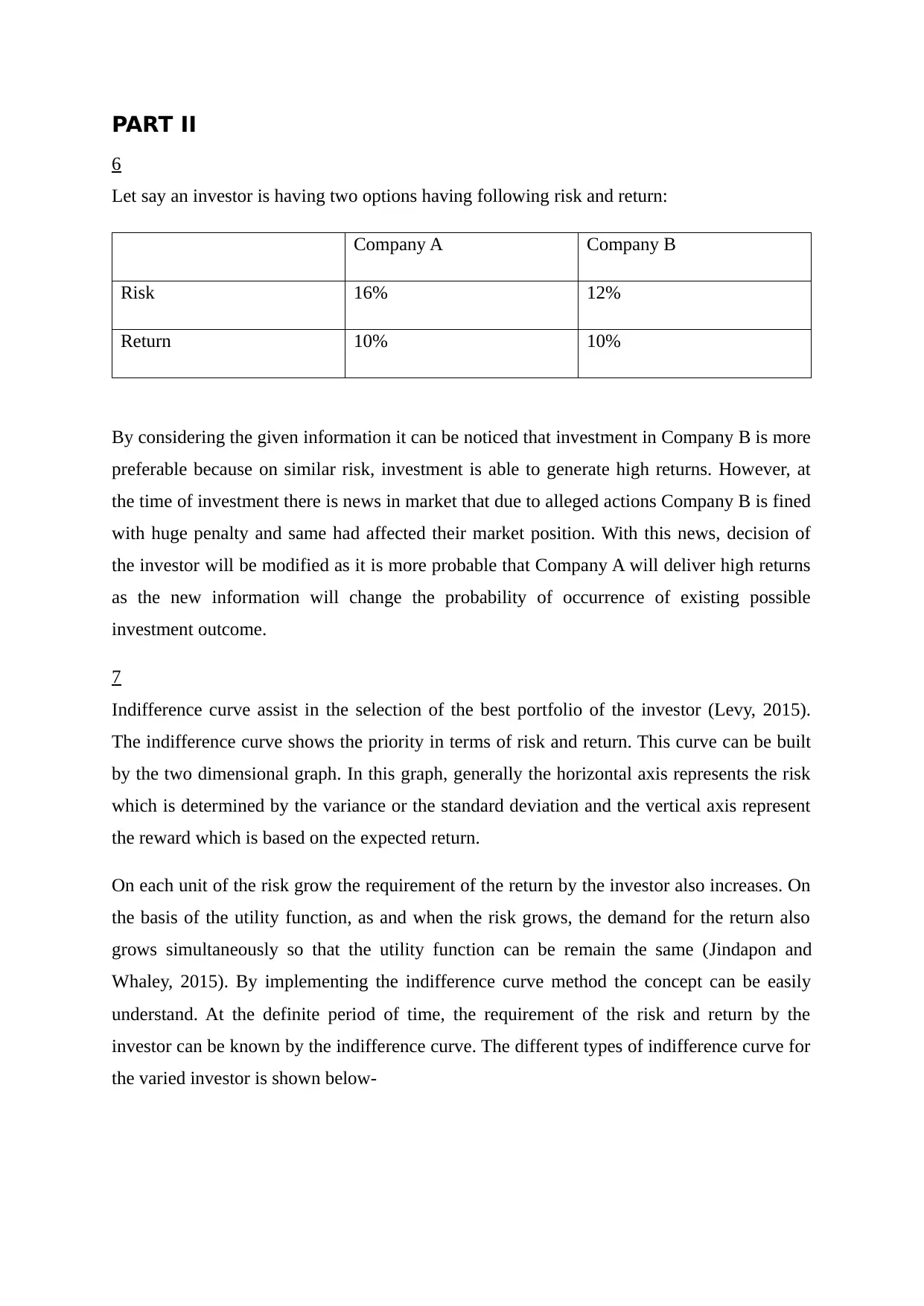
Let say an investor is having two options having following risk and return:
Company A Company B
Risk 16% 12%
Return 10% 10%
By considering the given information it can be noticed that investment in Company B is more
preferable because on similar risk, investment is able to generate high returns. However, at
the time of investment there is news in market that due to alleged actions Company B is fined
with huge penalty and same had affected their market position. With this news, decision of
the investor will be modified as it is more probable that Company A will deliver high returns
as the new information will change the probability of occurrence of existing possible
investment outcome.
7
Indifference curve assist in the selection of the best portfolio of the investor (Levy, 2015).
The indifference curve shows the priority in terms of risk and return. This curve can be built
by the two dimensional graph. In this graph, generally the horizontal axis represents the risk
which is determined by the variance or the standard deviation and the vertical axis represent
the reward which is based on the expected return.
On each unit of the risk grow the requirement of the return by the investor also increases. On
the basis of the utility function, as and when the risk grows, the demand for the return also
grows simultaneously so that the utility function can be remain the same (Jindapon and
Whaley, 2015). By implementing the indifference curve method the concept can be easily
understand. At the definite period of time, the requirement of the risk and return by the
investor can be known by the indifference curve. The different types of indifference curve for
the varied investor is shown below-
6
Let say an investor is having two options having following risk and return:
Company A Company B
Risk 16% 12%
Return 10% 10%
By considering the given information it can be noticed that investment in Company B is more
preferable because on similar risk, investment is able to generate high returns. However, at
the time of investment there is news in market that due to alleged actions Company B is fined
with huge penalty and same had affected their market position. With this news, decision of
the investor will be modified as it is more probable that Company A will deliver high returns
as the new information will change the probability of occurrence of existing possible
investment outcome.
7
Indifference curve assist in the selection of the best portfolio of the investor (Levy, 2015).
The indifference curve shows the priority in terms of risk and return. This curve can be built
by the two dimensional graph. In this graph, generally the horizontal axis represents the risk
which is determined by the variance or the standard deviation and the vertical axis represent
the reward which is based on the expected return.
On each unit of the risk grow the requirement of the return by the investor also increases. On
the basis of the utility function, as and when the risk grows, the demand for the return also
grows simultaneously so that the utility function can be remain the same (Jindapon and
Whaley, 2015). By implementing the indifference curve method the concept can be easily
understand. At the definite period of time, the requirement of the risk and return by the
investor can be known by the indifference curve. The different types of indifference curve for
the varied investor is shown below-
Paraphrase This Document
Need a fresh take? Get an instant paraphrase of this document with our AI Paraphraser

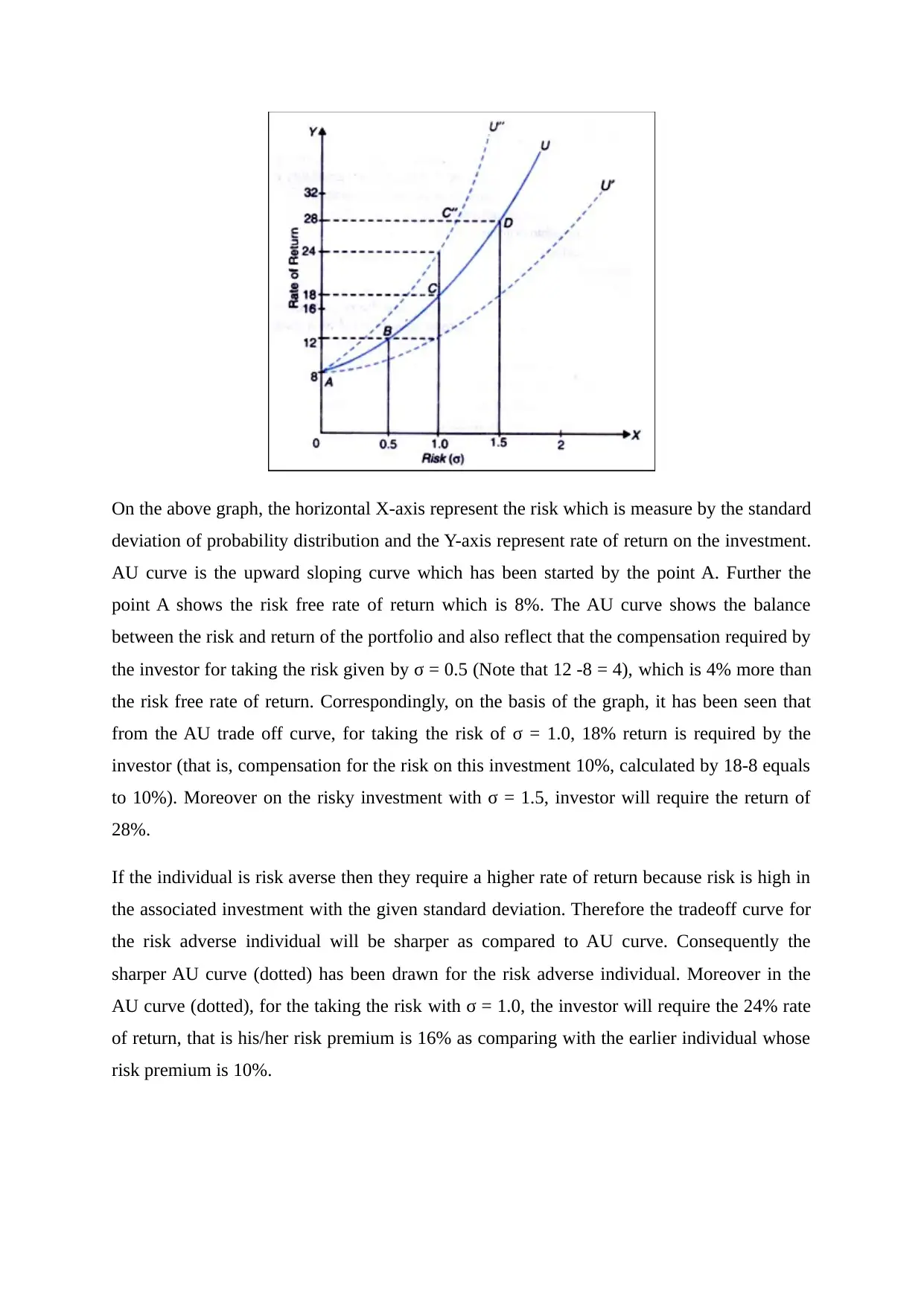
On the above graph, the horizontal X-axis represent the risk which is measure by the standard
deviation of probability distribution and the Y-axis represent rate of return on the investment.
AU curve is the upward sloping curve which has been started by the point A. Further the
point A shows the risk free rate of return which is 8%. The AU curve shows the balance
between the risk and return of the portfolio and also reflect that the compensation required by
the investor for taking the risk given by σ = 0.5 (Note that 12 -8 = 4), which is 4% more than
the risk free rate of return. Correspondingly, on the basis of the graph, it has been seen that
from the AU trade off curve, for taking the risk of σ = 1.0, 18% return is required by the
investor (that is, compensation for the risk on this investment 10%, calculated by 18-8 equals
to 10%). Moreover on the risky investment with σ = 1.5, investor will require the return of
28%.
If the individual is risk averse then they require a higher rate of return because risk is high in
the associated investment with the given standard deviation. Therefore the tradeoff curve for
the risk adverse individual will be sharper as compared to AU curve. Consequently the
sharper AU curve (dotted) has been drawn for the risk adverse individual. Moreover in the
AU curve (dotted), for the taking the risk with σ = 1.0, the investor will require the 24% rate
of return, that is his/her risk premium is 16% as comparing with the earlier individual whose
risk premium is 10%.
deviation of probability distribution and the Y-axis represent rate of return on the investment.
AU curve is the upward sloping curve which has been started by the point A. Further the
point A shows the risk free rate of return which is 8%. The AU curve shows the balance
between the risk and return of the portfolio and also reflect that the compensation required by
the investor for taking the risk given by σ = 0.5 (Note that 12 -8 = 4), which is 4% more than
the risk free rate of return. Correspondingly, on the basis of the graph, it has been seen that
from the AU trade off curve, for taking the risk of σ = 1.0, 18% return is required by the
investor (that is, compensation for the risk on this investment 10%, calculated by 18-8 equals
to 10%). Moreover on the risky investment with σ = 1.5, investor will require the return of
28%.
If the individual is risk averse then they require a higher rate of return because risk is high in
the associated investment with the given standard deviation. Therefore the tradeoff curve for
the risk adverse individual will be sharper as compared to AU curve. Consequently the
sharper AU curve (dotted) has been drawn for the risk adverse individual. Moreover in the
AU curve (dotted), for the taking the risk with σ = 1.0, the investor will require the 24% rate
of return, that is his/her risk premium is 16% as comparing with the earlier individual whose
risk premium is 10%.

REFERENCES
Deck, C., Lee, J. and Reyes, J., 2014. Investing versus gambling: experimental evidence of
multi-domain risk attitudes. Applied economics letters, 21(1), pp.19-23.
Diamond, P. and Rothschild, M. eds., 2014. Uncertainty in economics: readings and
exercises. Academic Press.
Dudley, R.M., 2018. Real Analysis and Probability: 0. Chapman and Hall/CRC.
İmrohoroğlu, A. and Tüzel, Ş., 2014. Firm-level productivity, risk, and return. Management
Science, 60(8), pp.2073-2090.
Jindapon, P. and Whaley, C.A., 2015. Risk lovers and the rent over-investment puzzle. Public
Choice, 164(1-2), pp.87-101.
Levy, H., 2015. Stochastic dominance: Investment decision making under uncertainty.
Springer.
Deck, C., Lee, J. and Reyes, J., 2014. Investing versus gambling: experimental evidence of
multi-domain risk attitudes. Applied economics letters, 21(1), pp.19-23.
Diamond, P. and Rothschild, M. eds., 2014. Uncertainty in economics: readings and
exercises. Academic Press.
Dudley, R.M., 2018. Real Analysis and Probability: 0. Chapman and Hall/CRC.
İmrohoroğlu, A. and Tüzel, Ş., 2014. Firm-level productivity, risk, and return. Management
Science, 60(8), pp.2073-2090.
Jindapon, P. and Whaley, C.A., 2015. Risk lovers and the rent over-investment puzzle. Public
Choice, 164(1-2), pp.87-101.
Levy, H., 2015. Stochastic dominance: Investment decision making under uncertainty.
Springer.
⊘ This is a preview!⊘
Do you want full access?
Subscribe today to unlock all pages.

Trusted by 1+ million students worldwide
1 out of 6
Related Documents
Your All-in-One AI-Powered Toolkit for Academic Success.
+13062052269
info@desklib.com
Available 24*7 on WhatsApp / Email
Unlock your academic potential
Copyright © 2020–2026 A2Z Services. All Rights Reserved. Developed and managed by ZUCOL.