Mobile App Development: System Analysis, Design, and Requirements
VerifiedAdded on 2023/04/23
|21
|3755
|460
Report
AI Summary
This report presents a system analysis and design for a mobile application, focusing on an order management system for a trade's person. It begins by defining mobile applications and their usage in society and business, followed by an exploration of available devices and their impact on design choices. The report analyzes development kits and then delves into the software development lifecycle, presenting a user specification document, functional and non-functional requirements, flowcharts, use case descriptions, mood boards, storyboards, an entity-relationship diagram (ERD), and pseudo code. The emphasis is on creating a secure, user-friendly application that automates back-office processes, improves customer communication, and provides accurate data management for the organization. This student-contributed assignment is available on Desklib, a platform offering a wide range of study tools and resources.
Running head: SYSTEM ANALYSIS AND DESIGN
System Analysis and Design
Name of the Student
Name of the University
Author’s note:
System Analysis and Design
Name of the Student
Name of the University
Author’s note:

Paraphrase This Document
Need a fresh take? Get an instant paraphrase of this document with our AI Paraphraser
1SYSTEM ANALYSIS AND DESIGN
Table of Contents
1. Introduction:................................................................................................................................2
1.1 Purpose of Document:...........................................................................................................2
1.2 Project Summary:..................................................................................................................2
1.3 Background:...........................................................................................................................3
1.4 Project Scope:........................................................................................................................4
1.5 System Purpose:.....................................................................................................................4
1.5.1 Users:..............................................................................................................................4
1.5.2 Location:.........................................................................................................................5
1.5.3 Responsibilities:..............................................................................................................5
1.5.4 Need:...............................................................................................................................6
1.6 Overview of the Document:...................................................................................................6
1.7 Mobile Application:...............................................................................................................7
2. System Requirements:.................................................................................................................7
2.1 Functional Requirements:......................................................................................................7
2.2 Non-Functional Requirements:..............................................................................................8
3. Flow Charts:...............................................................................................................................10
4. Use Case Description:................................................................................................................11
5. Moodboard:................................................................................................................................12
6. Storyboard:................................................................................................................................13
7. ERD:..........................................................................................................................................14
8. Pseudo Code:.............................................................................................................................14
Bibliography:.................................................................................................................................17
Table of Contents
1. Introduction:................................................................................................................................2
1.1 Purpose of Document:...........................................................................................................2
1.2 Project Summary:..................................................................................................................2
1.3 Background:...........................................................................................................................3
1.4 Project Scope:........................................................................................................................4
1.5 System Purpose:.....................................................................................................................4
1.5.1 Users:..............................................................................................................................4
1.5.2 Location:.........................................................................................................................5
1.5.3 Responsibilities:..............................................................................................................5
1.5.4 Need:...............................................................................................................................6
1.6 Overview of the Document:...................................................................................................6
1.7 Mobile Application:...............................................................................................................7
2. System Requirements:.................................................................................................................7
2.1 Functional Requirements:......................................................................................................7
2.2 Non-Functional Requirements:..............................................................................................8
3. Flow Charts:...............................................................................................................................10
4. Use Case Description:................................................................................................................11
5. Moodboard:................................................................................................................................12
6. Storyboard:................................................................................................................................13
7. ERD:..........................................................................................................................................14
8. Pseudo Code:.............................................................................................................................14
Bibliography:.................................................................................................................................17
2SYSTEM ANALYSIS AND DESIGN
1. Introduction:
1.1 Purpose of Document:
The user specification document regarding the newly proposed smart phone based
business order management system for an organisation. The organisation takes order from the
customers for tile installation. The organisation also install wood, vinyl, laminate and carpet. The
proposed system will be able to modify the business process of the organisation along with how
they communicate with the customers. The organisation will access the system for accessing the
order related information. The customers can automatically make the order by inserting data into
the order form (Laudon and Laudon 2016). The system will store all the data in a structured
database so that every data can be retrieved individually. This document is created for describing
the objectives, scope and goals of the proposed system. Moreover, the document will also
describe the functional and non-functional requirements of the system. The flowchart and entity-
relationship diagram shows the data requirements of the system (Nugroho et al. 2017). The mood
boards and story boards describe how the end users will interact the system. The document also
shows the use case descriptions that are based on the functional requirements. The document is
created with the intention of providing guidance to designing and implementing the proposed
system in an object oriented language.
1.2 Project Summary:
Project Name: Order Management System
Project Manager: <<Please Fill>>
Project Analysts: <<Please Fill>>, <<Please Fill>>, <<Please Fill>>
1. Introduction:
1.1 Purpose of Document:
The user specification document regarding the newly proposed smart phone based
business order management system for an organisation. The organisation takes order from the
customers for tile installation. The organisation also install wood, vinyl, laminate and carpet. The
proposed system will be able to modify the business process of the organisation along with how
they communicate with the customers. The organisation will access the system for accessing the
order related information. The customers can automatically make the order by inserting data into
the order form (Laudon and Laudon 2016). The system will store all the data in a structured
database so that every data can be retrieved individually. This document is created for describing
the objectives, scope and goals of the proposed system. Moreover, the document will also
describe the functional and non-functional requirements of the system. The flowchart and entity-
relationship diagram shows the data requirements of the system (Nugroho et al. 2017). The mood
boards and story boards describe how the end users will interact the system. The document also
shows the use case descriptions that are based on the functional requirements. The document is
created with the intention of providing guidance to designing and implementing the proposed
system in an object oriented language.
1.2 Project Summary:
Project Name: Order Management System
Project Manager: <<Please Fill>>
Project Analysts: <<Please Fill>>, <<Please Fill>>, <<Please Fill>>
⊘ This is a preview!⊘
Do you want full access?
Subscribe today to unlock all pages.

Trusted by 1+ million students worldwide
3SYSTEM ANALYSIS AND DESIGN
Responsible Users: The Staff of the Organisation and The customers
1.3 Background:
The organisation is providing services to the customer for fitting the wood, tile, vinyl,
carpet and other material to room. The organisation calculates the orders through fixed price of
material, room area and percentage of vat. Currently the organisation maintaining the business
through manual process and paper based works. Each of the work in the organisation is done
manually. As the customer base is increasing, the organisation needs to provide more service.
This is resulting in more data that organisation can handle manually. The organisation has two
options for maintaining the business through information technology solution such as web-based
and mobile-based application. The organisation wants a system that can allow them accessing
their data without affecting the customer data. The organisation wants a mobile-phone based
application that can be installed in major mobile operating systems like Android and iOS.
Currently the organisation wants to focus on the customer part that is order acceptance and order
management. The application will do all the back-office processes automatically.
The issues with the current processes done in the organisation are as following.
i. The organisation facing issues like inaccurate data and improper data
management
ii. The communication with the customer is done manually so quality is poor in
comparison with present day customer relationship approaches
iii. The customers are not able to understand the progress of their requests. Because
of unavailability of data the representatives are also not able to provide right
information to customers all the time
Responsible Users: The Staff of the Organisation and The customers
1.3 Background:
The organisation is providing services to the customer for fitting the wood, tile, vinyl,
carpet and other material to room. The organisation calculates the orders through fixed price of
material, room area and percentage of vat. Currently the organisation maintaining the business
through manual process and paper based works. Each of the work in the organisation is done
manually. As the customer base is increasing, the organisation needs to provide more service.
This is resulting in more data that organisation can handle manually. The organisation has two
options for maintaining the business through information technology solution such as web-based
and mobile-based application. The organisation wants a system that can allow them accessing
their data without affecting the customer data. The organisation wants a mobile-phone based
application that can be installed in major mobile operating systems like Android and iOS.
Currently the organisation wants to focus on the customer part that is order acceptance and order
management. The application will do all the back-office processes automatically.
The issues with the current processes done in the organisation are as following.
i. The organisation facing issues like inaccurate data and improper data
management
ii. The communication with the customer is done manually so quality is poor in
comparison with present day customer relationship approaches
iii. The customers are not able to understand the progress of their requests. Because
of unavailability of data the representatives are also not able to provide right
information to customers all the time
Paraphrase This Document
Need a fresh take? Get an instant paraphrase of this document with our AI Paraphraser
4SYSTEM ANALYSIS AND DESIGN
1.4 Project Scope:
The project scope is to build a mobile application that can be supported by major mobile
operating systems. The application must include the core business processes of the organisation
along with maintaining the customer relationship. The customers can directly communicate with
the organisation through this mobile application. The application will be connected to the
inventory of the organisation so that if an order is placed, it can track what materials would be
required to complete the order. The mobile application will sent notifications to the management,
customers and staff. The project would put extreme focus on the data security of the application.
That is why encryption-decryption approach would be taken as a part of the project. Each of the
project related activities would be shared with the management executives of the organisation
along with the organisation’s key stakeholders.
1.5 System Purpose:
1.5.1 Users:
The main advantage would be provided to the customers of the organisation from the
development of the application.
Customers: Regarding the development of the new mobile application, the clients of the
organisation will find application navigation, service identification and service order placement
much efficient and accurate. The customer can choose their desired room number and area of
room. The customer can also see their previous order details. They will receive the invoice
through the mail and in the application too. This invoice can be downloaded as PDF and printed
out later.
1.4 Project Scope:
The project scope is to build a mobile application that can be supported by major mobile
operating systems. The application must include the core business processes of the organisation
along with maintaining the customer relationship. The customers can directly communicate with
the organisation through this mobile application. The application will be connected to the
inventory of the organisation so that if an order is placed, it can track what materials would be
required to complete the order. The mobile application will sent notifications to the management,
customers and staff. The project would put extreme focus on the data security of the application.
That is why encryption-decryption approach would be taken as a part of the project. Each of the
project related activities would be shared with the management executives of the organisation
along with the organisation’s key stakeholders.
1.5 System Purpose:
1.5.1 Users:
The main advantage would be provided to the customers of the organisation from the
development of the application.
Customers: Regarding the development of the new mobile application, the clients of the
organisation will find application navigation, service identification and service order placement
much efficient and accurate. The customer can choose their desired room number and area of
room. The customer can also see their previous order details. They will receive the invoice
through the mail and in the application too. This invoice can be downloaded as PDF and printed
out later.
5SYSTEM ANALYSIS AND DESIGN
Management of Organisation: Management of organisation will be able to secure the
access to the application. The management can track the availability of the products in the
inventory. They can track customer orders and progress of the tasks. The biggest advantage that
management would receive is for day to day operation as the application would accept only the
correct information.
Staff of the Organisation: The employees of the organisation would be able to track their
work through the application. They will not need to rely on the paper based data any more. They
can login to the application and see the address, name and what work they ordered in the
application. They can also input the details of the work done after their working shift is
complete.
1.5.2 Location:
The application can be used by any end user who has a smartphone and internet
connection. The application can be downloaded from respective app stores. The system can be
accessed from any location irrespective of time.
1.5.3 Responsibilities:
The main responsibilities of the proposed order management system are as following.
i. Offering the client direct access for up-to-date. The information regarding the
services and invoice must be accurate
ii. Customisation of the services to meet the client requirement
iii. Permit different types of authorisation based on the position of the user
iv. The customer can request for assistance through the application
v. Permitting the management to access the inventory
Management of Organisation: Management of organisation will be able to secure the
access to the application. The management can track the availability of the products in the
inventory. They can track customer orders and progress of the tasks. The biggest advantage that
management would receive is for day to day operation as the application would accept only the
correct information.
Staff of the Organisation: The employees of the organisation would be able to track their
work through the application. They will not need to rely on the paper based data any more. They
can login to the application and see the address, name and what work they ordered in the
application. They can also input the details of the work done after their working shift is
complete.
1.5.2 Location:
The application can be used by any end user who has a smartphone and internet
connection. The application can be downloaded from respective app stores. The system can be
accessed from any location irrespective of time.
1.5.3 Responsibilities:
The main responsibilities of the proposed order management system are as following.
i. Offering the client direct access for up-to-date. The information regarding the
services and invoice must be accurate
ii. Customisation of the services to meet the client requirement
iii. Permit different types of authorisation based on the position of the user
iv. The customer can request for assistance through the application
v. Permitting the management to access the inventory
⊘ This is a preview!⊘
Do you want full access?
Subscribe today to unlock all pages.
Trusted by 1+ million students worldwide
6SYSTEM ANALYSIS AND DESIGN
vi. Include accurate information of availability of the products
vii. Allow the customers to see their previous information
1.5.4 Need:
The proposed information system is required regarding service the expected enhancement
in the order demand so that different services. The replacement of the current manual paper
based operations will prevent the issues of the organisation. The new system will allow the
organisation to quickly increase the communication quality with the customers.
1.6 Overview of the Document:
The rest of the document provides the details of the specifications for the proposed order
management system. The document is organisation in the following manner.
i. System requirements: The system requirement consists of the functional and
non-functional requirements of the proposed system.
ii. Flow charts: The flowchart shows how the user interacts with the system in a
sequence of order
iii. Use cases: The sequence diagram shows the interaction among the system and
end users
iv. Moodboards: The moodbaords are used for communicating the styles, language
and direction of the application design
v. Storyboards: The storyboard would provide narrative description of the stories of
how the user will access the system
vi. ERD: The ERD or Entity Relationship Diagrams will provide the data model of
the application
vii. Pseudo Code: The pseudo code would show the login behind the application
vi. Include accurate information of availability of the products
vii. Allow the customers to see their previous information
1.5.4 Need:
The proposed information system is required regarding service the expected enhancement
in the order demand so that different services. The replacement of the current manual paper
based operations will prevent the issues of the organisation. The new system will allow the
organisation to quickly increase the communication quality with the customers.
1.6 Overview of the Document:
The rest of the document provides the details of the specifications for the proposed order
management system. The document is organisation in the following manner.
i. System requirements: The system requirement consists of the functional and
non-functional requirements of the proposed system.
ii. Flow charts: The flowchart shows how the user interacts with the system in a
sequence of order
iii. Use cases: The sequence diagram shows the interaction among the system and
end users
iv. Moodboards: The moodbaords are used for communicating the styles, language
and direction of the application design
v. Storyboards: The storyboard would provide narrative description of the stories of
how the user will access the system
vi. ERD: The ERD or Entity Relationship Diagrams will provide the data model of
the application
vii. Pseudo Code: The pseudo code would show the login behind the application
Paraphrase This Document
Need a fresh take? Get an instant paraphrase of this document with our AI Paraphraser
7SYSTEM ANALYSIS AND DESIGN
1.7 Mobile Application:
Definition: The mobile applications are special software programs that are developed for
specific mobile operating system (Scott 2015). The application is also specific about the device
such as phone or tablet.
Usage in Society and Business: The application of mobile application is significant in
both society and business. The social media apps enabled online based communication that
covers the whole world. The business use the mobile application like an alternative to websites.
The mobile applications are more effective than websites.
Available Devices: Currently the market is filled with flagship android devices and
iPhones. Developing the application for these two kind of mobile devices are enough.
Understanding the devices is the key to designing the architecture of the application (Hoehle and
Venkatesh 2015). That is why identifying available mobile devices in the market can have major
impact on the design.
Development Kit: For android development, the Android Studio is available. It is the
most trusted and robust development tool (DiMarzio 2015). To develop applications for iPhone,
iOS SDK can be used.
2. System Requirements:
2.1 Functional Requirements:
Authentication: Authentication is the primary functional requirement of the system. The
system would provide a login id and password to individual users. The login id would be unique
for every distinct users (Khan et al. 2017). The user would enter the login id and password to
login to the system and access the authorised information.
1.7 Mobile Application:
Definition: The mobile applications are special software programs that are developed for
specific mobile operating system (Scott 2015). The application is also specific about the device
such as phone or tablet.
Usage in Society and Business: The application of mobile application is significant in
both society and business. The social media apps enabled online based communication that
covers the whole world. The business use the mobile application like an alternative to websites.
The mobile applications are more effective than websites.
Available Devices: Currently the market is filled with flagship android devices and
iPhones. Developing the application for these two kind of mobile devices are enough.
Understanding the devices is the key to designing the architecture of the application (Hoehle and
Venkatesh 2015). That is why identifying available mobile devices in the market can have major
impact on the design.
Development Kit: For android development, the Android Studio is available. It is the
most trusted and robust development tool (DiMarzio 2015). To develop applications for iPhone,
iOS SDK can be used.
2. System Requirements:
2.1 Functional Requirements:
Authentication: Authentication is the primary functional requirement of the system. The
system would provide a login id and password to individual users. The login id would be unique
for every distinct users (Khan et al. 2017). The user would enter the login id and password to
login to the system and access the authorised information.
8SYSTEM ANALYSIS AND DESIGN
Authorisation: After the user logs in to the system, the application would differentiate
the authorisation of the user based on the login id. The application will assign different
authorisation levels to the set of login ids based on the position in the organisation (Eckhardt,
Vogelsang and Fernandez 2016). The authorisation is considered to the process of distinguishing
the access to the system based on the function and data they can access.
Data Storage: Data storage is another essential functional requirement of the system
which defines how the data will be recorded, manipulated and retrieved from a single structured
location. The system will be connected to the database management system, manages the
database. Each database management system will record each activity of the user based on their
login id.
Order: As the application will accept order from the customer automatically and also
manage the orders, it is a very important functional requirement (Khan et al. 2017). The
customer will enter the details of the service they require.
Payment: Payment is an essential functional requirement of the application. To increase
the customer satisfaction, the application will accept payment for the service through the
payment gateway installed within it (Eckhardt, Vogelsang and Fernández 2016). The application
will accept, PayPal, net banking, cards and many more options.
2.2 Non-Functional Requirements:
Performance: The system would be able to support more than hundred customer requests
simultaneously. The mean time for seeing the application sections for 100kbps connecting
should not exceed more than 2 seconds (Pacheco et al. 2017). The mean time for converting the
invoice into PDF and start to download it should be within 5 seconds.
Authorisation: After the user logs in to the system, the application would differentiate
the authorisation of the user based on the login id. The application will assign different
authorisation levels to the set of login ids based on the position in the organisation (Eckhardt,
Vogelsang and Fernandez 2016). The authorisation is considered to the process of distinguishing
the access to the system based on the function and data they can access.
Data Storage: Data storage is another essential functional requirement of the system
which defines how the data will be recorded, manipulated and retrieved from a single structured
location. The system will be connected to the database management system, manages the
database. Each database management system will record each activity of the user based on their
login id.
Order: As the application will accept order from the customer automatically and also
manage the orders, it is a very important functional requirement (Khan et al. 2017). The
customer will enter the details of the service they require.
Payment: Payment is an essential functional requirement of the application. To increase
the customer satisfaction, the application will accept payment for the service through the
payment gateway installed within it (Eckhardt, Vogelsang and Fernández 2016). The application
will accept, PayPal, net banking, cards and many more options.
2.2 Non-Functional Requirements:
Performance: The system would be able to support more than hundred customer requests
simultaneously. The mean time for seeing the application sections for 100kbps connecting
should not exceed more than 2 seconds (Pacheco et al. 2017). The mean time for converting the
invoice into PDF and start to download it should be within 5 seconds.
⊘ This is a preview!⊘
Do you want full access?
Subscribe today to unlock all pages.
Trusted by 1+ million students worldwide
9SYSTEM ANALYSIS AND DESIGN
Security: As the customers would make payment through the application, it is highly
recommended that application must be protected from most of the cyber attacks (Noaman and
Ahmed 2015). The application will use RAS encryption-decryption method for communicating
with the server.
Usability: The customers must recognise how they can use the system to place a service
order. The customer must be able to recognise the main menu and navigate to desired sections
automatically (Pacheco et al. 2017).
Interfaces: the application with interface with the database management system for
storing the data, acquire a search engine and many more.
Security: As the customers would make payment through the application, it is highly
recommended that application must be protected from most of the cyber attacks (Noaman and
Ahmed 2015). The application will use RAS encryption-decryption method for communicating
with the server.
Usability: The customers must recognise how they can use the system to place a service
order. The customer must be able to recognise the main menu and navigate to desired sections
automatically (Pacheco et al. 2017).
Interfaces: the application with interface with the database management system for
storing the data, acquire a search engine and many more.
Paraphrase This Document
Need a fresh take? Get an instant paraphrase of this document with our AI Paraphraser
10SYSTEM ANALYSIS AND DESIGN
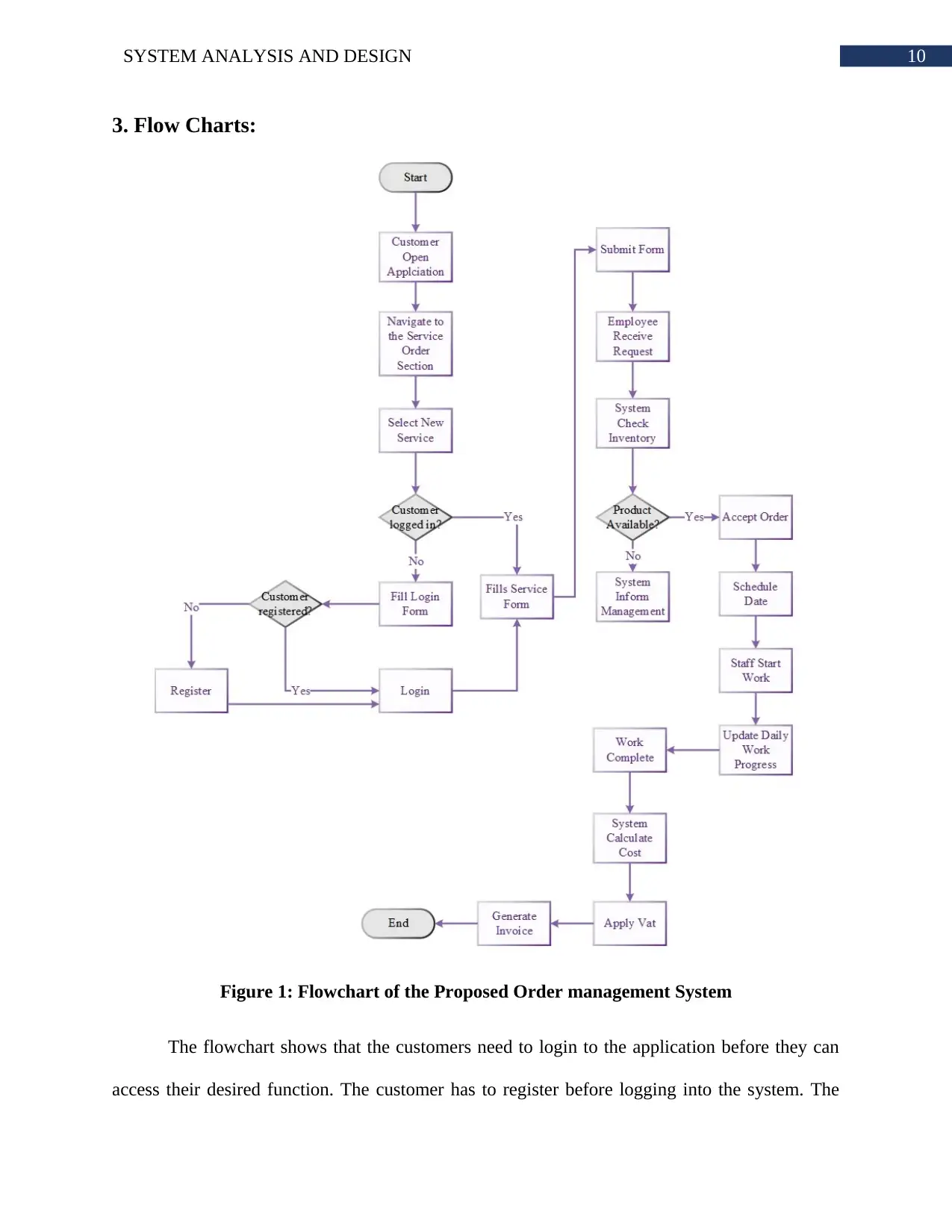
3. Flow Charts:
Figure 1: Flowchart of the Proposed Order management System
The flowchart shows that the customers need to login to the application before they can
access their desired function. The customer has to register before logging into the system. The
3. Flow Charts:
Figure 1: Flowchart of the Proposed Order management System
The flowchart shows that the customers need to login to the application before they can
access their desired function. The customer has to register before logging into the system. The
11SYSTEM ANALYSIS AND DESIGN
customer will fill the service form and then submit it. The flowchart also visualises that system
will accept the order once the product is available in the inventory.
4. Use Case Description:
Use Case Name: Login User
Summary: The users of the system will login to the application so that application
can restrict their access to information and functions
Basic Flow: The user will open the application
The user will click on login button
The system will redirect the user to login page
The user will enter the login id and password
The system will verify the login credentials
The system after successful verification allow user to access the system
Alternative Flows: The customer will try to enter service order details
The system will check if customer is login
If no logged in system will redirect the customer to login page
Extension Points:
Preconditions: The user is already registered into the system
Postconditions: The user can access the authorised and functions
Business Rules: Few information and requests are restricted to particular categories of
users with a specific level of access
customer will fill the service form and then submit it. The flowchart also visualises that system
will accept the order once the product is available in the inventory.
4. Use Case Description:
Use Case Name: Login User
Summary: The users of the system will login to the application so that application
can restrict their access to information and functions
Basic Flow: The user will open the application
The user will click on login button
The system will redirect the user to login page
The user will enter the login id and password
The system will verify the login credentials
The system after successful verification allow user to access the system
Alternative Flows: The customer will try to enter service order details
The system will check if customer is login
If no logged in system will redirect the customer to login page
Extension Points:
Preconditions: The user is already registered into the system
Postconditions: The user can access the authorised and functions
Business Rules: Few information and requests are restricted to particular categories of
users with a specific level of access
⊘ This is a preview!⊘
Do you want full access?
Subscribe today to unlock all pages.
Trusted by 1+ million students worldwide

1 out of 21


Related Documents


Your All-in-One AI-Powered Toolkit for Academic Success.
+13062052269
info@desklib.com
Available 24*7 on WhatsApp / Email
![[object Object]](/_next/static/media/star-bottom.7253800d.svg)
Unlock your academic potential
Copyright © 2020–2026 A2Z Services. All Rights Reserved. Developed and managed by ZUCOL.