University Network Technology 2 (KF5003) Assignment Solution Report
VerifiedAdded on 2022/08/26
|12
|3670
|18
Report
AI Summary
This document presents a comprehensive solution to a Network Technology 2 assignment (KF5003) focusing on key networking concepts. The solution begins by addressing IP addressing, including classful and classless schemes, subnetting, and the calculation of network addresses, subnet masks, and host ranges. It then delves into routing protocols, contrasting distance vector routing and link-state routing, and provides a detailed analysis of Enhanced Interior Gateway Routing Protocol (EIGRP), exploring its features and comparing it with Interior Gateway Routing Protocol (IGRP) and Open Shortest Path First (OSPF). The assignment also covers access control lists (ACLs), analyzing the impact of different rules on network traffic and providing a rearranged configuration to enhance effectiveness. Finally, it addresses DHCP server configuration and its interaction with client devices. The solution includes detailed explanations, tables, and examples to illustrate the concepts.
Table of Contents
Question 1.............................................................................................................................................1
Question 2.............................................................................................................................................3
Question 3.............................................................................................................................................5
Question 4.............................................................................................................................................7
References...........................................................................................................................................10
1
Question 1.............................................................................................................................................1
Question 2.............................................................................................................................................3
Question 3.............................................................................................................................................5
Question 4.............................................................................................................................................7
References...........................................................................................................................................10
1

Paraphrase This Document
Need a fresh take? Get an instant paraphrase of this document with our AI Paraphraser
Question 1
a).
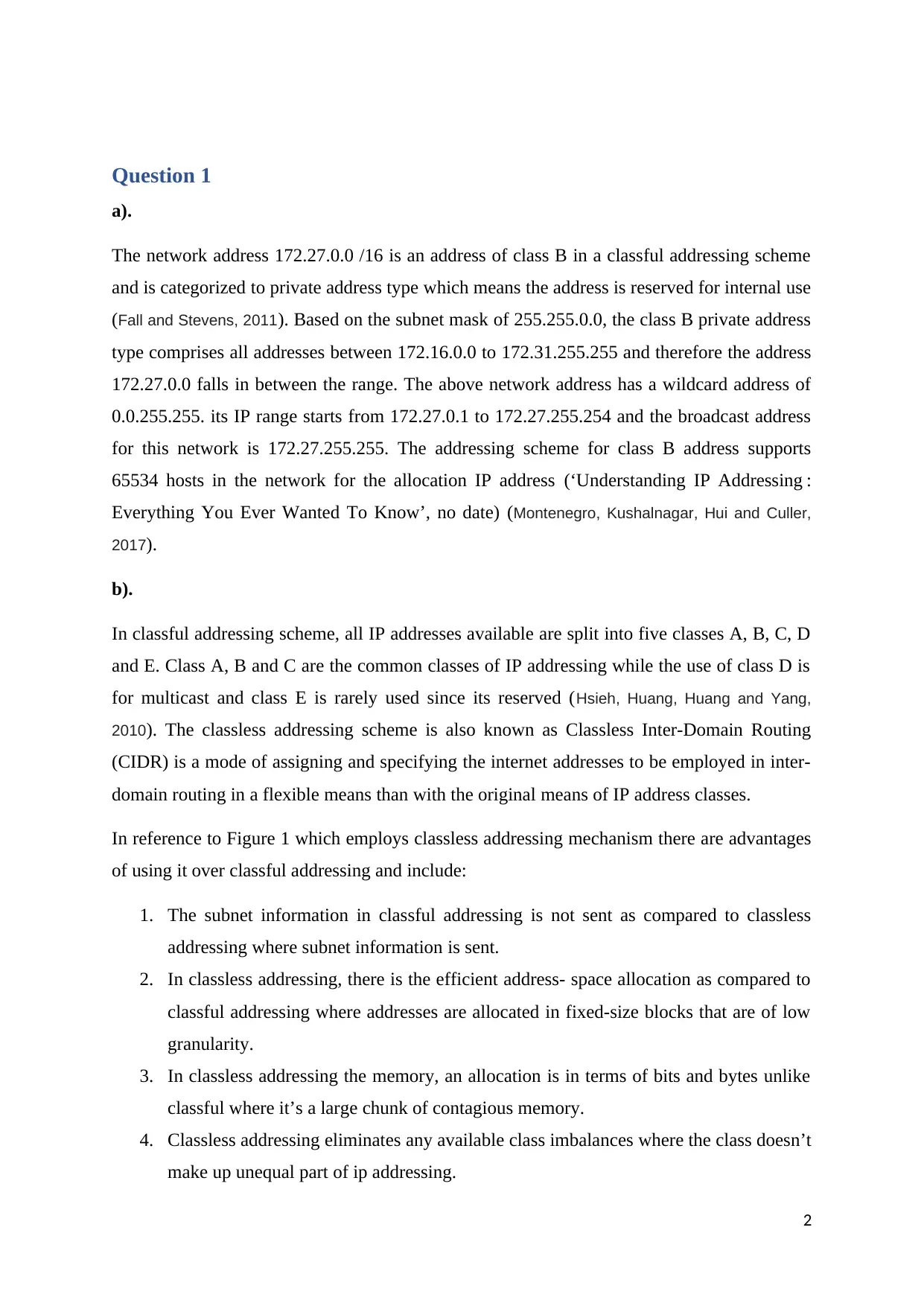
The network address 172.27.0.0 /16 is an address of class B in a classful addressing scheme
and is categorized to private address type which means the address is reserved for internal use
(Fall and Stevens, 2011). Based on the subnet mask of 255.255.0.0, the class B private address
type comprises all addresses between 172.16.0.0 to 172.31.255.255 and therefore the address
172.27.0.0 falls in between the range. The above network address has a wildcard address of
0.0.255.255. its IP range starts from 172.27.0.1 to 172.27.255.254 and the broadcast address
for this network is 172.27.255.255. The addressing scheme for class B address supports
65534 hosts in the network for the allocation IP address (‘Understanding IP Addressing :
Everything You Ever Wanted To Know’, no date) (Montenegro, Kushalnagar, Hui and Culler,
2017).
b).
In classful addressing scheme, all IP addresses available are split into five classes A, B, C, D
and E. Class A, B and C are the common classes of IP addressing while the use of class D is
for multicast and class E is rarely used since its reserved (Hsieh, Huang, Huang and Yang,
2010). The classless addressing scheme is also known as Classless Inter-Domain Routing
(CIDR) is a mode of assigning and specifying the internet addresses to be employed in inter-
domain routing in a flexible means than with the original means of IP address classes.
In reference to Figure 1 which employs classless addressing mechanism there are advantages
of using it over classful addressing and include:
1. The subnet information in classful addressing is not sent as compared to classless
addressing where subnet information is sent.
2. In classless addressing, there is the efficient address- space allocation as compared to
classful addressing where addresses are allocated in fixed-size blocks that are of low
granularity.
3. In classless addressing the memory, an allocation is in terms of bits and bytes unlike
classful where it’s a large chunk of contagious memory.
4. Classless addressing eliminates any available class imbalances where the class doesn’t
make up unequal part of ip addressing.
2
a).
The network address 172.27.0.0 /16 is an address of class B in a classful addressing scheme
and is categorized to private address type which means the address is reserved for internal use
(Fall and Stevens, 2011). Based on the subnet mask of 255.255.0.0, the class B private address
type comprises all addresses between 172.16.0.0 to 172.31.255.255 and therefore the address
172.27.0.0 falls in between the range. The above network address has a wildcard address of
0.0.255.255. its IP range starts from 172.27.0.1 to 172.27.255.254 and the broadcast address
for this network is 172.27.255.255. The addressing scheme for class B address supports
65534 hosts in the network for the allocation IP address (‘Understanding IP Addressing :
Everything You Ever Wanted To Know’, no date) (Montenegro, Kushalnagar, Hui and Culler,
2017).
b).
In classful addressing scheme, all IP addresses available are split into five classes A, B, C, D
and E. Class A, B and C are the common classes of IP addressing while the use of class D is
for multicast and class E is rarely used since its reserved (Hsieh, Huang, Huang and Yang,
2010). The classless addressing scheme is also known as Classless Inter-Domain Routing
(CIDR) is a mode of assigning and specifying the internet addresses to be employed in inter-
domain routing in a flexible means than with the original means of IP address classes.
In reference to Figure 1 which employs classless addressing mechanism there are advantages
of using it over classful addressing and include:
1. The subnet information in classful addressing is not sent as compared to classless
addressing where subnet information is sent.
2. In classless addressing, there is the efficient address- space allocation as compared to
classful addressing where addresses are allocated in fixed-size blocks that are of low
granularity.
3. In classless addressing the memory, an allocation is in terms of bits and bytes unlike
classful where it’s a large chunk of contagious memory.
4. Classless addressing eliminates any available class imbalances where the class doesn’t
make up unequal part of ip addressing.
2
5. There is more efficiency in routing entries in classless addressing.
6. Entities for subnetting in classless addressing are not separate.
c).
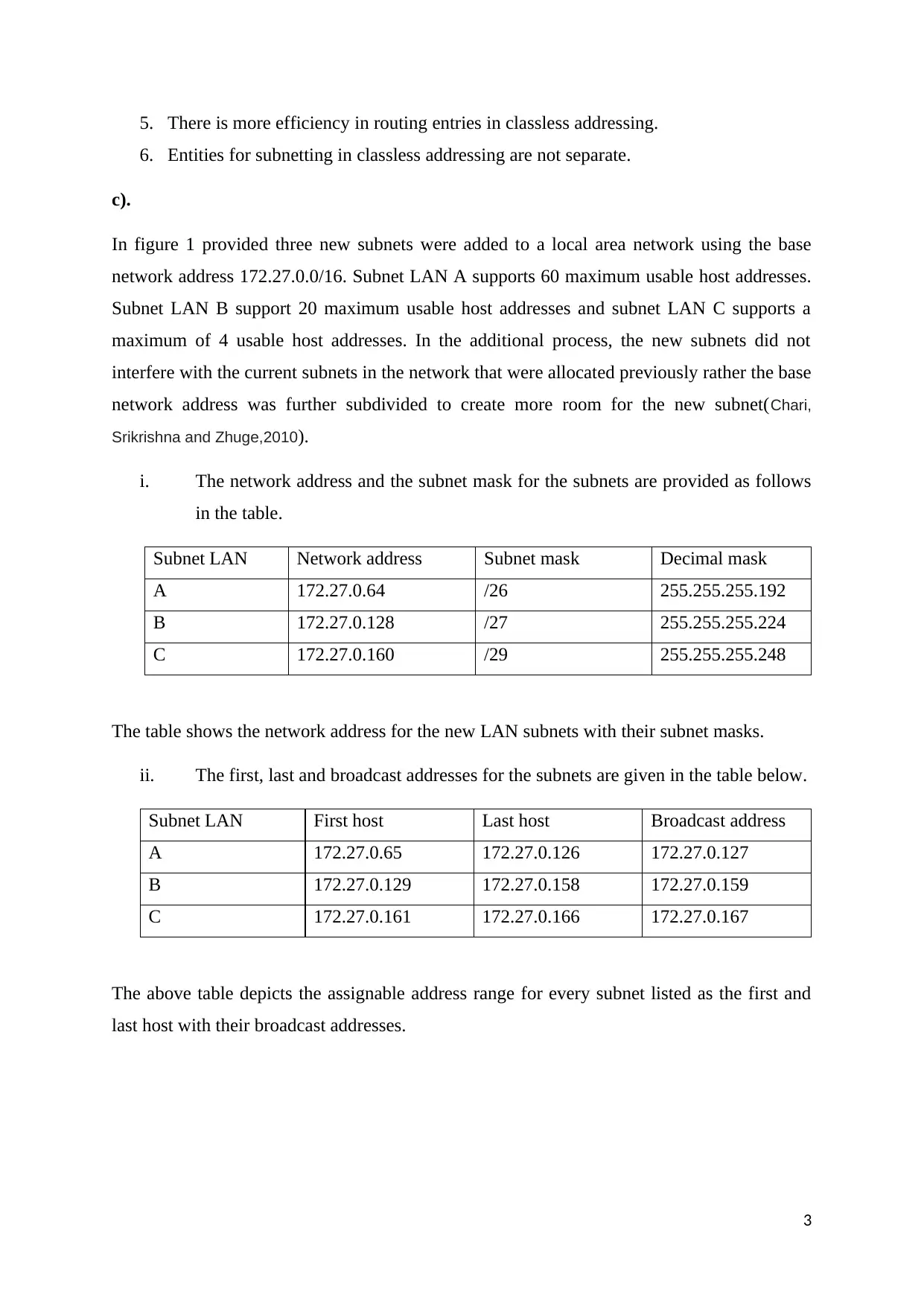
In figure 1 provided three new subnets were added to a local area network using the base
network address 172.27.0.0/16. Subnet LAN A supports 60 maximum usable host addresses.
Subnet LAN B support 20 maximum usable host addresses and subnet LAN C supports a
maximum of 4 usable host addresses. In the additional process, the new subnets did not
interfere with the current subnets in the network that were allocated previously rather the base
network address was further subdivided to create more room for the new subnet(Chari,
Srikrishna and Zhuge,2010).
i. The network address and the subnet mask for the subnets are provided as follows
in the table.
Subnet LAN Network address Subnet mask Decimal mask
A 172.27.0.64 /26 255.255.255.192
B 172.27.0.128 /27 255.255.255.224
C 172.27.0.160 /29 255.255.255.248
The table shows the network address for the new LAN subnets with their subnet masks.
ii. The first, last and broadcast addresses for the subnets are given in the table below.
Subnet LAN First host Last host Broadcast address
A 172.27.0.65 172.27.0.126 172.27.0.127
B 172.27.0.129 172.27.0.158 172.27.0.159
C 172.27.0.161 172.27.0.166 172.27.0.167
The above table depicts the assignable address range for every subnet listed as the first and
last host with their broadcast addresses.
3
6. Entities for subnetting in classless addressing are not separate.
c).
In figure 1 provided three new subnets were added to a local area network using the base
network address 172.27.0.0/16. Subnet LAN A supports 60 maximum usable host addresses.
Subnet LAN B support 20 maximum usable host addresses and subnet LAN C supports a
maximum of 4 usable host addresses. In the additional process, the new subnets did not
interfere with the current subnets in the network that were allocated previously rather the base
network address was further subdivided to create more room for the new subnet(Chari,
Srikrishna and Zhuge,2010).
i. The network address and the subnet mask for the subnets are provided as follows
in the table.
Subnet LAN Network address Subnet mask Decimal mask
A 172.27.0.64 /26 255.255.255.192
B 172.27.0.128 /27 255.255.255.224
C 172.27.0.160 /29 255.255.255.248
The table shows the network address for the new LAN subnets with their subnet masks.
ii. The first, last and broadcast addresses for the subnets are given in the table below.
Subnet LAN First host Last host Broadcast address
A 172.27.0.65 172.27.0.126 172.27.0.127
B 172.27.0.129 172.27.0.158 172.27.0.159
C 172.27.0.161 172.27.0.166 172.27.0.167
The above table depicts the assignable address range for every subnet listed as the first and
last host with their broadcast addresses.
3
⊘ This is a preview!⊘
Do you want full access?
Subscribe today to unlock all pages.

Trusted by 1+ million students worldwide
Question 2
a). Difference between distance vector routing and link-state routing.
Distance vector routing is a routing algorithm where the router needs to know the direction
where to send the packets and not the path to every segment in the network (Hacene,
Lehireche, and Meddahi, 2016). This routing algorithm sends its routing table to the immediate
neighbors and a router executing the algorithm sends the updates periodically even when the
network has no changes. However, the router can confirm the recognized routes and thereby
altering the routing table based on information received from a neighboring route that is
updated.
Link state routing is a routing algorithm in which every router attempts to generate its
particular internal map of the topology of the network(Clausen, Dearlove, Jacquet and Herberg,
2014.). At the beginning state, the router is initiated and it sends messages to the network
collecting data from the router that is connected to it directly. It also gives information on if
the link to reach the router is active or not active and in return, the information is used to
construct the topology of the network.
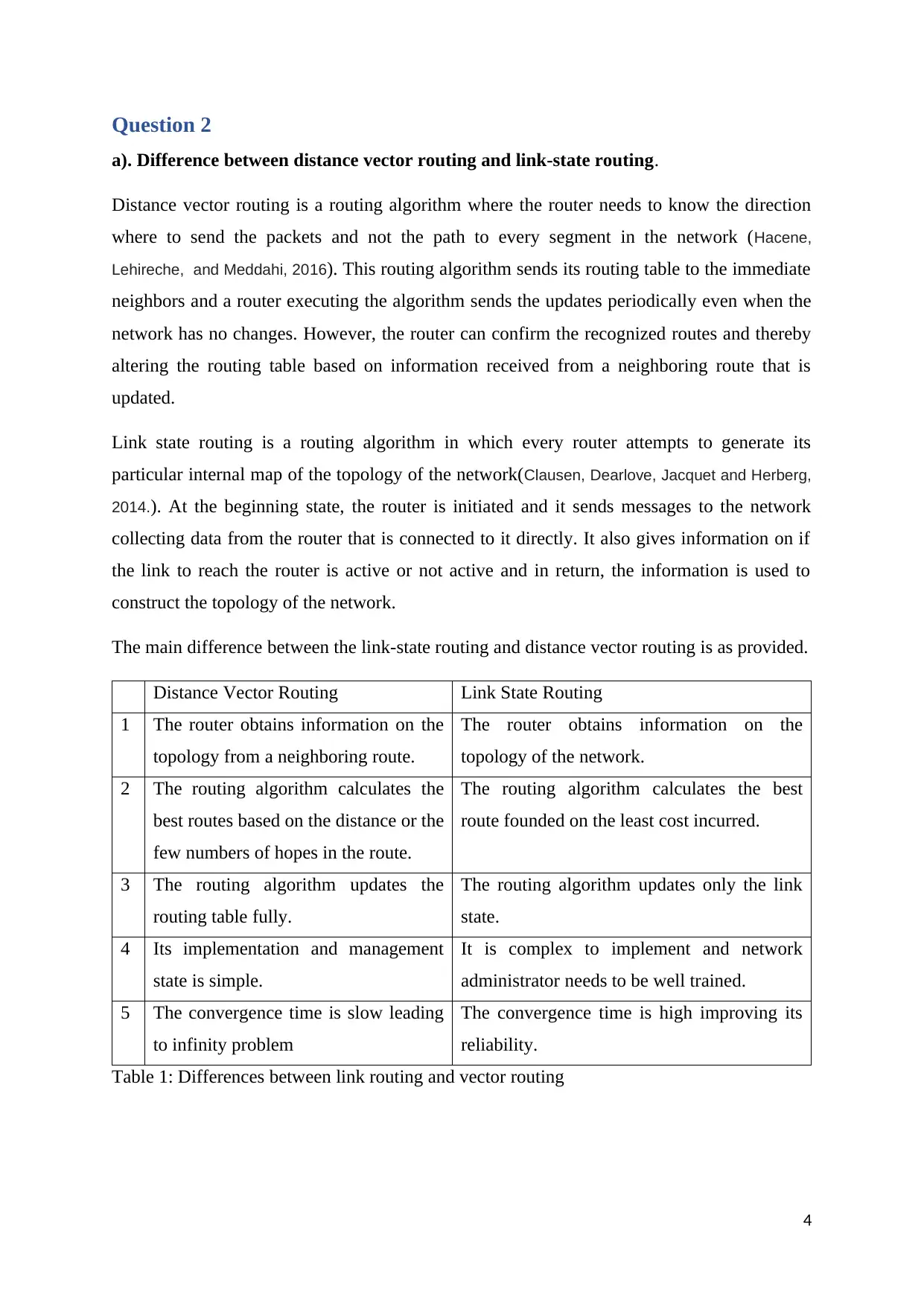
The main difference between the link-state routing and distance vector routing is as provided.
Distance Vector Routing Link State Routing
1 The router obtains information on the
topology from a neighboring route.
The router obtains information on the
topology of the network.
2 The routing algorithm calculates the
best routes based on the distance or the
few numbers of hopes in the route.
The routing algorithm calculates the best
route founded on the least cost incurred.
3 The routing algorithm updates the
routing table fully.
The routing algorithm updates only the link
state.
4 Its implementation and management
state is simple.
It is complex to implement and network
administrator needs to be well trained.
5 The convergence time is slow leading
to infinity problem
The convergence time is high improving its
reliability.
Table 1: Differences between link routing and vector routing
4
a). Difference between distance vector routing and link-state routing.
Distance vector routing is a routing algorithm where the router needs to know the direction
where to send the packets and not the path to every segment in the network (Hacene,
Lehireche, and Meddahi, 2016). This routing algorithm sends its routing table to the immediate
neighbors and a router executing the algorithm sends the updates periodically even when the
network has no changes. However, the router can confirm the recognized routes and thereby
altering the routing table based on information received from a neighboring route that is
updated.
Link state routing is a routing algorithm in which every router attempts to generate its
particular internal map of the topology of the network(Clausen, Dearlove, Jacquet and Herberg,
2014.). At the beginning state, the router is initiated and it sends messages to the network
collecting data from the router that is connected to it directly. It also gives information on if
the link to reach the router is active or not active and in return, the information is used to
construct the topology of the network.
The main difference between the link-state routing and distance vector routing is as provided.
Distance Vector Routing Link State Routing
1 The router obtains information on the
topology from a neighboring route.
The router obtains information on the
topology of the network.
2 The routing algorithm calculates the
best routes based on the distance or the
few numbers of hopes in the route.
The routing algorithm calculates the best
route founded on the least cost incurred.
3 The routing algorithm updates the
routing table fully.
The routing algorithm updates only the link
state.
4 Its implementation and management
state is simple.
It is complex to implement and network
administrator needs to be well trained.
5 The convergence time is slow leading
to infinity problem
The convergence time is high improving its
reliability.
Table 1: Differences between link routing and vector routing
4
Paraphrase This Document
Need a fresh take? Get an instant paraphrase of this document with our AI Paraphraser
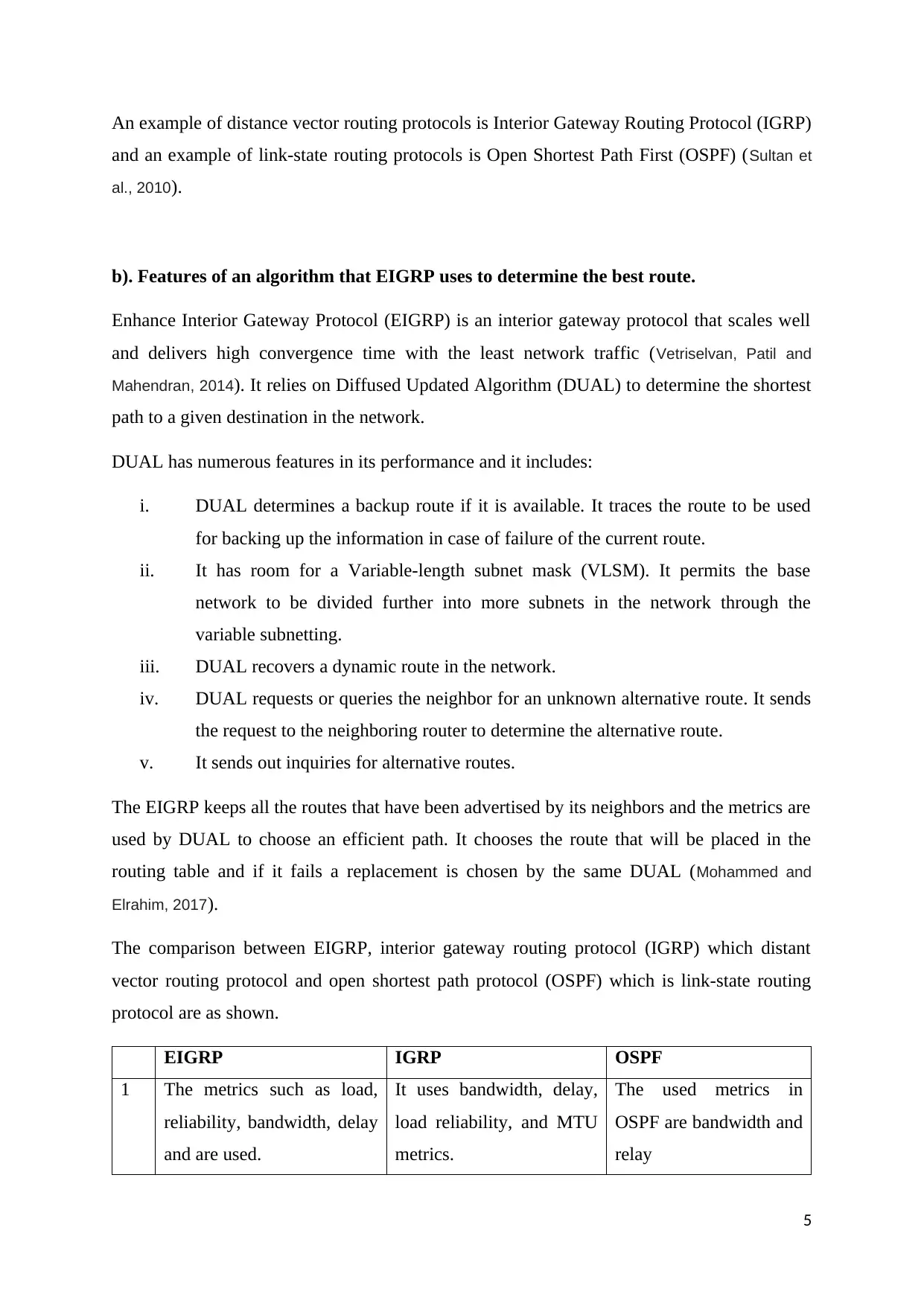
An example of distance vector routing protocols is Interior Gateway Routing Protocol (IGRP)
and an example of link-state routing protocols is Open Shortest Path First (OSPF) (Sultan et
al., 2010).
b). Features of an algorithm that EIGRP uses to determine the best route.
Enhance Interior Gateway Protocol (EIGRP) is an interior gateway protocol that scales well
and delivers high convergence time with the least network traffic (Vetriselvan, Patil and
Mahendran, 2014). It relies on Diffused Updated Algorithm (DUAL) to determine the shortest
path to a given destination in the network.
DUAL has numerous features in its performance and it includes:
i. DUAL determines a backup route if it is available. It traces the route to be used
for backing up the information in case of failure of the current route.
ii. It has room for a Variable-length subnet mask (VLSM). It permits the base
network to be divided further into more subnets in the network through the
variable subnetting.
iii. DUAL recovers a dynamic route in the network.
iv. DUAL requests or queries the neighbor for an unknown alternative route. It sends
the request to the neighboring router to determine the alternative route.
v. It sends out inquiries for alternative routes.
The EIGRP keeps all the routes that have been advertised by its neighbors and the metrics are
used by DUAL to choose an efficient path. It chooses the route that will be placed in the
routing table and if it fails a replacement is chosen by the same DUAL (Mohammed and
Elrahim, 2017).
The comparison between EIGRP, interior gateway routing protocol (IGRP) which distant
vector routing protocol and open shortest path protocol (OSPF) which is link-state routing
protocol are as shown.
EIGRP IGRP OSPF
1 The metrics such as load,
reliability, bandwidth, delay
and are used.
It uses bandwidth, delay,
load reliability, and MTU
metrics.
The used metrics in
OSPF are bandwidth and
relay
5
and an example of link-state routing protocols is Open Shortest Path First (OSPF) (Sultan et
al., 2010).
b). Features of an algorithm that EIGRP uses to determine the best route.
Enhance Interior Gateway Protocol (EIGRP) is an interior gateway protocol that scales well
and delivers high convergence time with the least network traffic (Vetriselvan, Patil and
Mahendran, 2014). It relies on Diffused Updated Algorithm (DUAL) to determine the shortest
path to a given destination in the network.
DUAL has numerous features in its performance and it includes:
i. DUAL determines a backup route if it is available. It traces the route to be used
for backing up the information in case of failure of the current route.
ii. It has room for a Variable-length subnet mask (VLSM). It permits the base
network to be divided further into more subnets in the network through the
variable subnetting.
iii. DUAL recovers a dynamic route in the network.
iv. DUAL requests or queries the neighbor for an unknown alternative route. It sends
the request to the neighboring router to determine the alternative route.
v. It sends out inquiries for alternative routes.
The EIGRP keeps all the routes that have been advertised by its neighbors and the metrics are
used by DUAL to choose an efficient path. It chooses the route that will be placed in the
routing table and if it fails a replacement is chosen by the same DUAL (Mohammed and
Elrahim, 2017).
The comparison between EIGRP, interior gateway routing protocol (IGRP) which distant
vector routing protocol and open shortest path protocol (OSPF) which is link-state routing
protocol are as shown.
EIGRP IGRP OSPF
1 The metrics such as load,
reliability, bandwidth, delay
and are used.
It uses bandwidth, delay,
load reliability, and MTU
metrics.
The used metrics in
OSPF are bandwidth and
relay
5
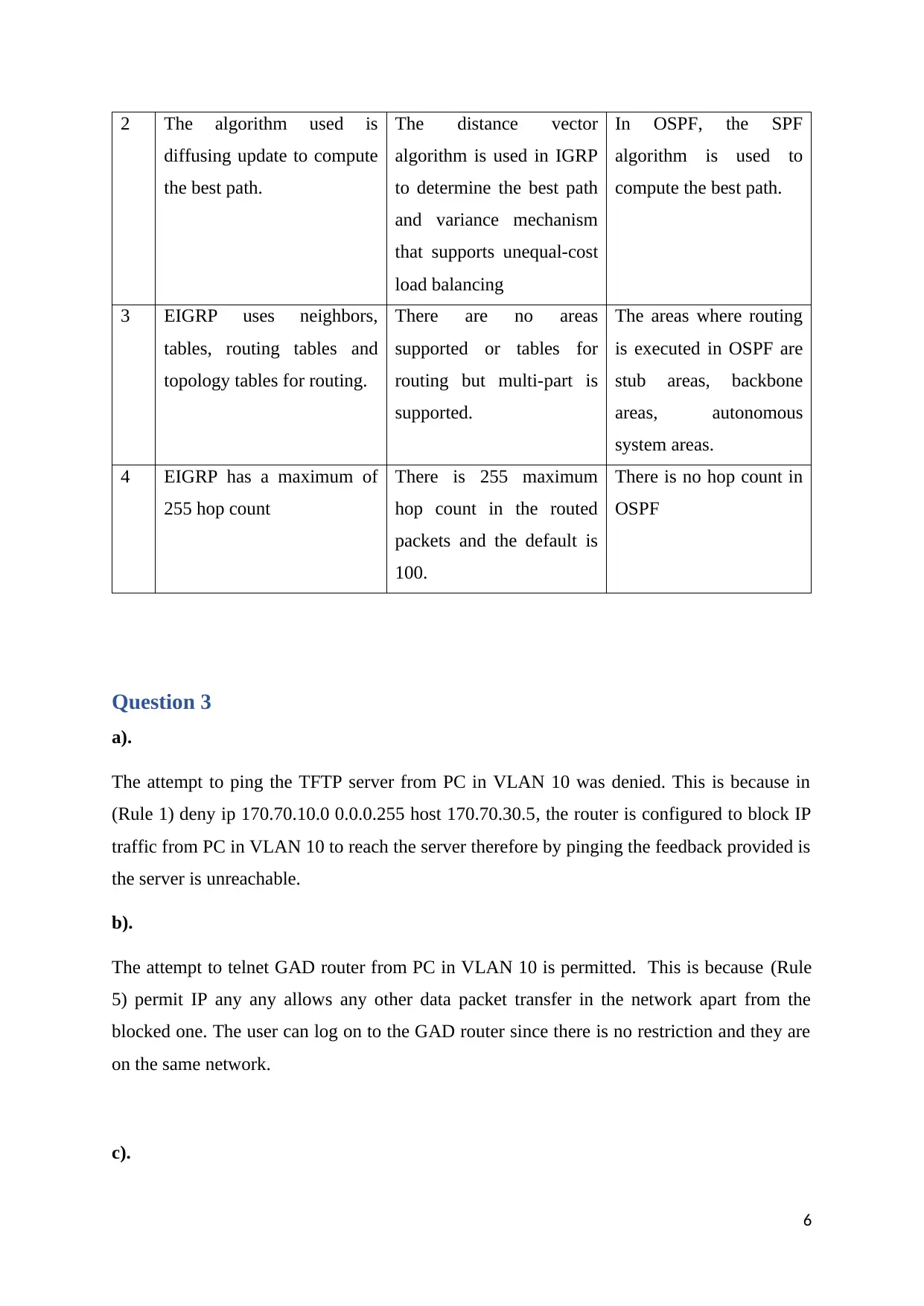
2 The algorithm used is
diffusing update to compute
the best path.
The distance vector
algorithm is used in IGRP
to determine the best path
and variance mechanism
that supports unequal-cost
load balancing
In OSPF, the SPF
algorithm is used to
compute the best path.
3 EIGRP uses neighbors,
tables, routing tables and
topology tables for routing.
There are no areas
supported or tables for
routing but multi-part is
supported.
The areas where routing
is executed in OSPF are
stub areas, backbone
areas, autonomous
system areas.
4 EIGRP has a maximum of
255 hop count
There is 255 maximum
hop count in the routed
packets and the default is
100.
There is no hop count in
OSPF
Question 3
a).
The attempt to ping the TFTP server from PC in VLAN 10 was denied. This is because in
(Rule 1) deny ip 170.70.10.0 0.0.0.255 host 170.70.30.5, the router is configured to block IP
traffic from PC in VLAN 10 to reach the server therefore by pinging the feedback provided is
the server is unreachable.
b).
The attempt to telnet GAD router from PC in VLAN 10 is permitted. This is because (Rule
5) permit IP any any allows any other data packet transfer in the network apart from the
blocked one. The user can log on to the GAD router since there is no restriction and they are
on the same network.
c).
6
diffusing update to compute
the best path.
The distance vector
algorithm is used in IGRP
to determine the best path
and variance mechanism
that supports unequal-cost
load balancing
In OSPF, the SPF
algorithm is used to
compute the best path.
3 EIGRP uses neighbors,
tables, routing tables and
topology tables for routing.
There are no areas
supported or tables for
routing but multi-part is
supported.
The areas where routing
is executed in OSPF are
stub areas, backbone
areas, autonomous
system areas.
4 EIGRP has a maximum of
255 hop count
There is 255 maximum
hop count in the routed
packets and the default is
100.
There is no hop count in
OSPF
Question 3
a).
The attempt to ping the TFTP server from PC in VLAN 10 was denied. This is because in
(Rule 1) deny ip 170.70.10.0 0.0.0.255 host 170.70.30.5, the router is configured to block IP
traffic from PC in VLAN 10 to reach the server therefore by pinging the feedback provided is
the server is unreachable.
b).
The attempt to telnet GAD router from PC in VLAN 10 is permitted. This is because (Rule
5) permit IP any any allows any other data packet transfer in the network apart from the
blocked one. The user can log on to the GAD router since there is no restriction and they are
on the same network.
c).
6
⊘ This is a preview!⊘
Do you want full access?
Subscribe today to unlock all pages.
Trusted by 1+ million students worldwide
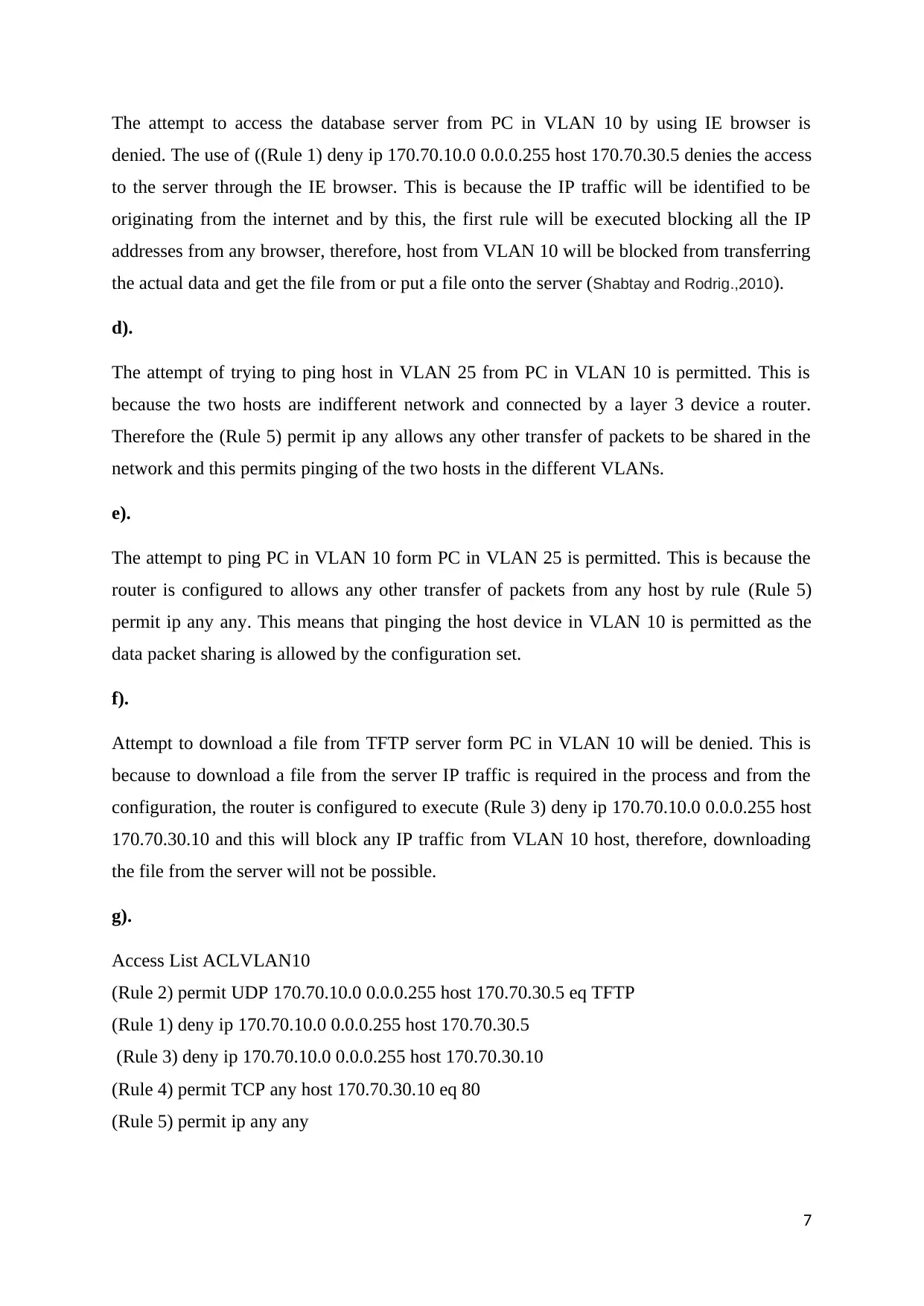
The attempt to access the database server from PC in VLAN 10 by using IE browser is
denied. The use of ((Rule 1) deny ip 170.70.10.0 0.0.0.255 host 170.70.30.5 denies the access
to the server through the IE browser. This is because the IP traffic will be identified to be
originating from the internet and by this, the first rule will be executed blocking all the IP
addresses from any browser, therefore, host from VLAN 10 will be blocked from transferring
the actual data and get the file from or put a file onto the server (Shabtay and Rodrig.,2010).
d).
The attempt of trying to ping host in VLAN 25 from PC in VLAN 10 is permitted. This is
because the two hosts are indifferent network and connected by a layer 3 device a router.
Therefore the (Rule 5) permit ip any allows any other transfer of packets to be shared in the
network and this permits pinging of the two hosts in the different VLANs.
e).
The attempt to ping PC in VLAN 10 form PC in VLAN 25 is permitted. This is because the
router is configured to allows any other transfer of packets from any host by rule (Rule 5)
permit ip any any. This means that pinging the host device in VLAN 10 is permitted as the
data packet sharing is allowed by the configuration set.
f).
Attempt to download a file from TFTP server form PC in VLAN 10 will be denied. This is
because to download a file from the server IP traffic is required in the process and from the
configuration, the router is configured to execute (Rule 3) deny ip 170.70.10.0 0.0.0.255 host
170.70.30.10 and this will block any IP traffic from VLAN 10 host, therefore, downloading
the file from the server will not be possible.
g).
Access List ACLVLAN10
(Rule 2) permit UDP 170.70.10.0 0.0.0.255 host 170.70.30.5 eq TFTP
(Rule 1) deny ip 170.70.10.0 0.0.0.255 host 170.70.30.5
(Rule 3) deny ip 170.70.10.0 0.0.0.255 host 170.70.30.10
(Rule 4) permit TCP any host 170.70.30.10 eq 80
(Rule 5) permit ip any any
7
denied. The use of ((Rule 1) deny ip 170.70.10.0 0.0.0.255 host 170.70.30.5 denies the access
to the server through the IE browser. This is because the IP traffic will be identified to be
originating from the internet and by this, the first rule will be executed blocking all the IP
addresses from any browser, therefore, host from VLAN 10 will be blocked from transferring
the actual data and get the file from or put a file onto the server (Shabtay and Rodrig.,2010).
d).
The attempt of trying to ping host in VLAN 25 from PC in VLAN 10 is permitted. This is
because the two hosts are indifferent network and connected by a layer 3 device a router.
Therefore the (Rule 5) permit ip any allows any other transfer of packets to be shared in the
network and this permits pinging of the two hosts in the different VLANs.
e).
The attempt to ping PC in VLAN 10 form PC in VLAN 25 is permitted. This is because the
router is configured to allows any other transfer of packets from any host by rule (Rule 5)
permit ip any any. This means that pinging the host device in VLAN 10 is permitted as the
data packet sharing is allowed by the configuration set.
f).
Attempt to download a file from TFTP server form PC in VLAN 10 will be denied. This is
because to download a file from the server IP traffic is required in the process and from the
configuration, the router is configured to execute (Rule 3) deny ip 170.70.10.0 0.0.0.255 host
170.70.30.10 and this will block any IP traffic from VLAN 10 host, therefore, downloading
the file from the server will not be possible.
g).
Access List ACLVLAN10
(Rule 2) permit UDP 170.70.10.0 0.0.0.255 host 170.70.30.5 eq TFTP
(Rule 1) deny ip 170.70.10.0 0.0.0.255 host 170.70.30.5
(Rule 3) deny ip 170.70.10.0 0.0.0.255 host 170.70.30.10
(Rule 4) permit TCP any host 170.70.30.10 eq 80
(Rule 5) permit ip any any
7
Paraphrase This Document
Need a fresh take? Get an instant paraphrase of this document with our AI Paraphraser
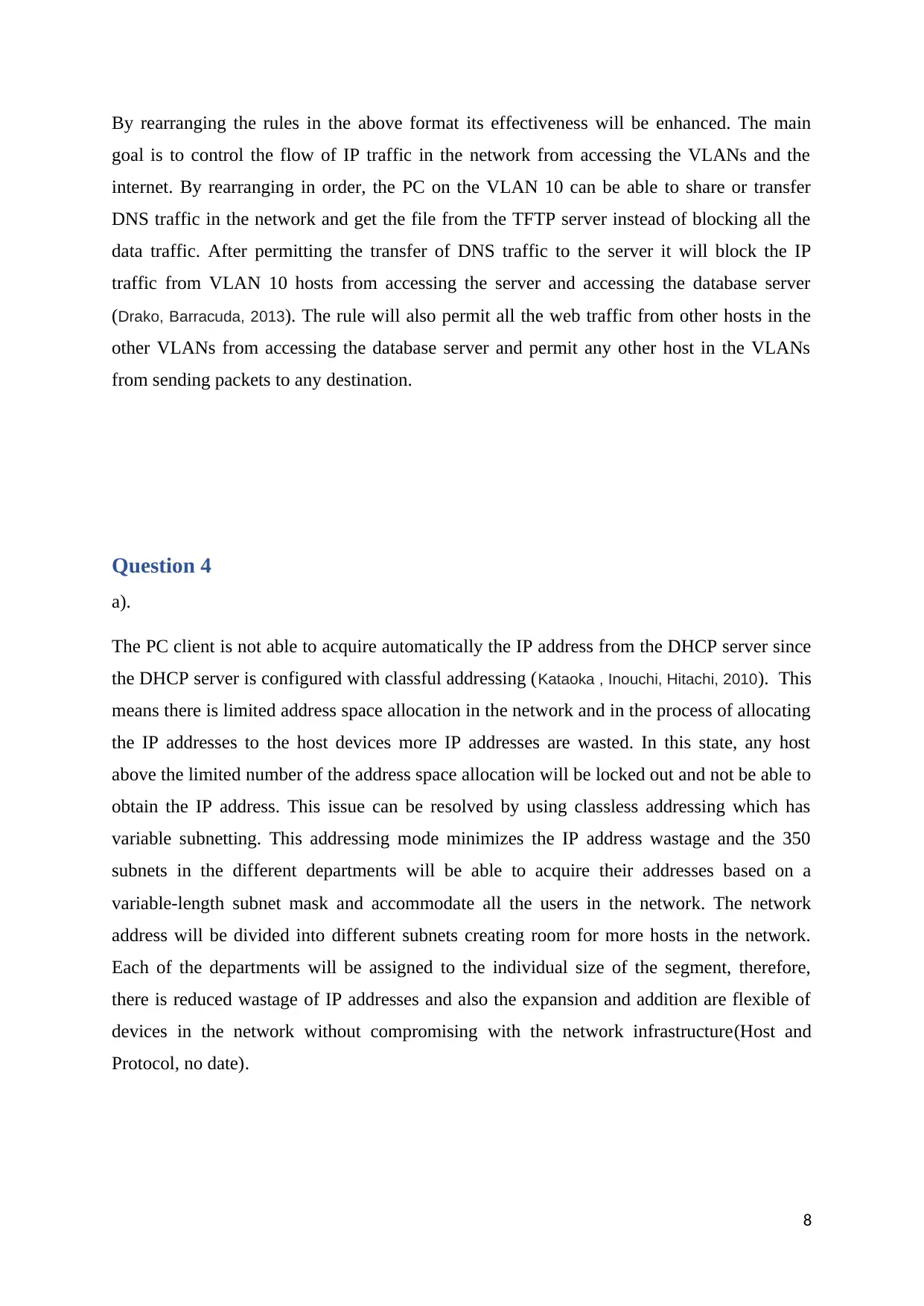
By rearranging the rules in the above format its effectiveness will be enhanced. The main
goal is to control the flow of IP traffic in the network from accessing the VLANs and the
internet. By rearranging in order, the PC on the VLAN 10 can be able to share or transfer
DNS traffic in the network and get the file from the TFTP server instead of blocking all the
data traffic. After permitting the transfer of DNS traffic to the server it will block the IP
traffic from VLAN 10 hosts from accessing the server and accessing the database server
(Drako, Barracuda, 2013). The rule will also permit all the web traffic from other hosts in the
other VLANs from accessing the database server and permit any other host in the VLANs
from sending packets to any destination.
Question 4
a).
The PC client is not able to acquire automatically the IP address from the DHCP server since
the DHCP server is configured with classful addressing (Kataoka , Inouchi, Hitachi, 2010). This
means there is limited address space allocation in the network and in the process of allocating
the IP addresses to the host devices more IP addresses are wasted. In this state, any host
above the limited number of the address space allocation will be locked out and not be able to
obtain the IP address. This issue can be resolved by using classless addressing which has
variable subnetting. This addressing mode minimizes the IP address wastage and the 350
subnets in the different departments will be able to acquire their addresses based on a
variable-length subnet mask and accommodate all the users in the network. The network
address will be divided into different subnets creating room for more hosts in the network.
Each of the departments will be assigned to the individual size of the segment, therefore,
there is reduced wastage of IP addresses and also the expansion and addition are flexible of
devices in the network without compromising with the network infrastructure(Host and
Protocol, no date).
8
goal is to control the flow of IP traffic in the network from accessing the VLANs and the
internet. By rearranging in order, the PC on the VLAN 10 can be able to share or transfer
DNS traffic in the network and get the file from the TFTP server instead of blocking all the
data traffic. After permitting the transfer of DNS traffic to the server it will block the IP
traffic from VLAN 10 hosts from accessing the server and accessing the database server
(Drako, Barracuda, 2013). The rule will also permit all the web traffic from other hosts in the
other VLANs from accessing the database server and permit any other host in the VLANs
from sending packets to any destination.
Question 4
a).
The PC client is not able to acquire automatically the IP address from the DHCP server since
the DHCP server is configured with classful addressing (Kataoka , Inouchi, Hitachi, 2010). This
means there is limited address space allocation in the network and in the process of allocating
the IP addresses to the host devices more IP addresses are wasted. In this state, any host
above the limited number of the address space allocation will be locked out and not be able to
obtain the IP address. This issue can be resolved by using classless addressing which has
variable subnetting. This addressing mode minimizes the IP address wastage and the 350
subnets in the different departments will be able to acquire their addresses based on a
variable-length subnet mask and accommodate all the users in the network. The network
address will be divided into different subnets creating room for more hosts in the network.
Each of the departments will be assigned to the individual size of the segment, therefore,
there is reduced wastage of IP addresses and also the expansion and addition are flexible of
devices in the network without compromising with the network infrastructure(Host and
Protocol, no date).
8
b). Benefits of using NAT.
NAT which stands for Network Address Translation translates the computers' IP addresses
into a single Ip address in the local network (Den Kohalmi and Chinitz, Airvana, 2013). There are
pros of using NAT in the local network(‘Network Address Translation’, no date).
1. NAT helps in conserving address space in IPV4 when there are no enough assigned
public IPs in the network and there is a need to protect the local hosts from requests
originating from the internet.
2. It increases reliability and flexibility of local network connection to the public
network since it allows the implementation of load-balancing pools, backup pools and
multiple pools in the network.
3. NAT provides a consistent network addressing scheme.
4. NAT provides an additional layer for network security since the hosts within the NAT
network cannot be accessed by the hosts outside the network unless authorization is
granted on the same.
c). Disadvantages of using NAT.
There are drawbacks associated to implement NAT in the network topology. They include:
1. The network performance can be degraded in that when the host within the local
network makes requests to remote site hosts the connection will be identified to be
origination from the local network NAT router. Some hosts may put in place the level
of security on the number of connections to be accepted however they may not reply
when the distinct number of connections has been attained leading to the low level of
network performance.
2. There is the loss of end- to- end IP traceability in the network. When troubleshooting
in the network is required from a remote site it may be impossible to do so.
3. It may be complicated to use protocols like IPsec since NAT modifies the header
values that hinder with integrity checks by IPsec.
4. Sometimes it may not be possible to use services that need TCP or UDP connection
initiation from outside.
9
NAT which stands for Network Address Translation translates the computers' IP addresses
into a single Ip address in the local network (Den Kohalmi and Chinitz, Airvana, 2013). There are
pros of using NAT in the local network(‘Network Address Translation’, no date).
1. NAT helps in conserving address space in IPV4 when there are no enough assigned
public IPs in the network and there is a need to protect the local hosts from requests
originating from the internet.
2. It increases reliability and flexibility of local network connection to the public
network since it allows the implementation of load-balancing pools, backup pools and
multiple pools in the network.
3. NAT provides a consistent network addressing scheme.
4. NAT provides an additional layer for network security since the hosts within the NAT
network cannot be accessed by the hosts outside the network unless authorization is
granted on the same.
c). Disadvantages of using NAT.
There are drawbacks associated to implement NAT in the network topology. They include:
1. The network performance can be degraded in that when the host within the local
network makes requests to remote site hosts the connection will be identified to be
origination from the local network NAT router. Some hosts may put in place the level
of security on the number of connections to be accepted however they may not reply
when the distinct number of connections has been attained leading to the low level of
network performance.
2. There is the loss of end- to- end IP traceability in the network. When troubleshooting
in the network is required from a remote site it may be impossible to do so.
3. It may be complicated to use protocols like IPsec since NAT modifies the header
values that hinder with integrity checks by IPsec.
4. Sometimes it may not be possible to use services that need TCP or UDP connection
initiation from outside.
9
⊘ This is a preview!⊘
Do you want full access?
Subscribe today to unlock all pages.
Trusted by 1+ million students worldwide
d). DHCP use and it's working in network communication.
Dynamic Host Configuration Protocol is an application layer protocol that is used to
allocate network configuration parameters like network IP addresses, the Subnet masks,
network default gateway to the end or host devices in the IP network. It employs the
client-server architecture where the client requests for IP address from the DHCP server
and the DHCP server having an IP address pool assigns each host with internet protocol
address. The DHCP works in the following steps to facilitates communication between
the client and the server(‘Chapter 9.pdf’, no date).
i. The host devices connecting the network either by the cable or the wireless
connection sends the DHCP to discover message to hosts in the layer 2 section
and the frame with the DISCOVER message reaches the DHCP server.
ii. When the DHCP server receives the discover message, through unicast it proposes
the IP addressing to provide to client host and the OFFER message has the
suggested IP address for the clients, subnet mask, default gateway IP and DNS
server IP (Kanekar and Foschiano, 2011).
iii. When the clients receive the proposal it thereby requests official information
sending REQUEST message to the server through unicast.
iv. The server then sends an ACKNOWLEDGE message to confirm the lease of
DHCP to the client and now the client is permitted to use the new IP address.
In the current cyber world, there is increased cyber attackers and hackers whose main
target is to compromise data in the network and the entire network security policies. The
DHCP communication can be compromised through denial of service attacks on the
DHCP server. This is done by overflowing the server with lease requests and in turn
draining or depleting the number of leases available in the server for other DHCP clients.
Another attack is DHCP starvation where the address space available to DHCP servers
for a specified period is exhausted by the attacker. Another attack is DHCP sniffing
where the DHCP server is set on the network by a hacker named Rogue DHCP server.
An attacker then sources the clients with fake Ip addresses and other network information
to snoop into the data packets.
e). DHCP excluded-address
10
Dynamic Host Configuration Protocol is an application layer protocol that is used to
allocate network configuration parameters like network IP addresses, the Subnet masks,
network default gateway to the end or host devices in the IP network. It employs the
client-server architecture where the client requests for IP address from the DHCP server
and the DHCP server having an IP address pool assigns each host with internet protocol
address. The DHCP works in the following steps to facilitates communication between
the client and the server(‘Chapter 9.pdf’, no date).
i. The host devices connecting the network either by the cable or the wireless
connection sends the DHCP to discover message to hosts in the layer 2 section
and the frame with the DISCOVER message reaches the DHCP server.
ii. When the DHCP server receives the discover message, through unicast it proposes
the IP addressing to provide to client host and the OFFER message has the
suggested IP address for the clients, subnet mask, default gateway IP and DNS
server IP (Kanekar and Foschiano, 2011).
iii. When the clients receive the proposal it thereby requests official information
sending REQUEST message to the server through unicast.
iv. The server then sends an ACKNOWLEDGE message to confirm the lease of
DHCP to the client and now the client is permitted to use the new IP address.
In the current cyber world, there is increased cyber attackers and hackers whose main
target is to compromise data in the network and the entire network security policies. The
DHCP communication can be compromised through denial of service attacks on the
DHCP server. This is done by overflowing the server with lease requests and in turn
draining or depleting the number of leases available in the server for other DHCP clients.
Another attack is DHCP starvation where the address space available to DHCP servers
for a specified period is exhausted by the attacker. Another attack is DHCP sniffing
where the DHCP server is set on the network by a hacker named Rogue DHCP server.
An attacker then sources the clients with fake Ip addresses and other network information
to snoop into the data packets.
e). DHCP excluded-address
10
Paraphrase This Document
Need a fresh take? Get an instant paraphrase of this document with our AI Paraphraser
This is a global configuration command that prevents the specific IP addresses from being
assigned by the routers DHCP server. It prevents conflicting IP addresses on the servers
and routers in the network that have statically assigned IP addresses. The example of the
syntax for the command is: Router(config)# ip DHCP excluded-address 172.16.1.103
172.16.1.199
References
Fall, K.R. and Stevens, W.R., 2011. TCP/IP illustrated, volume 1: The protocols. addison-Wesley.
Montenegro, G., Kushalnagar, N., Hui, J. and Culler, D., 2017. Transmission of IPv6 packets over
IEEE 802.15. 4 networks. Internet proposed standard RFC, 4944, p.130.
Hsieh, S.Y., Huang, C.W., Huang, Y.L. and Yang, Y.C., 2010, May. A novel dynamic router-tables
design for IP lookup and update. In 2010 5th International Conference on Future Information
Technology (pp. 1-6). IEEE.
Chari, A., Srikrishna, D. and Zhuge, J., Tropos Networks Inc, 2010. Method of subnet roaming within
a network. U.S. Patent 7,649,866.
Hacene, S.B., Lehireche, A. and Meddahi, A., 2016. Predictive preemptive ad hoc on-demand
distance vector routing. Malaysian Journal of Computer Science, 19(2), pp.189-195.
Clausen, T., Dearlove, C., Jacquet, P. and Herberg, U., 2014. The optimized link state routing
protocol version 2. draft-ietf-manet-olsrv2-04. txt, July, 7.
Sultan, N.T., Jamieson, D.D. and Simpson, V.A., Avaya Holdings Ltd, 2010. Policy-based forwarding
in open shortest path first (OSPF) networks. U.S. Patent 7,831,733.
Vetriselvan, V., Patil, P.R. and Mahendran, M., 2014. Survey on the RIP, OSPF, EIGRP routing
protocols. International Journal of Computer Science and Information Technologies, 5(2), pp.1058-
1065.
Mohammed, Z.K.A. and Elrahim, A.G.A., 2017. Performance Evaluation Comparison of RIP, IGRP,
EIGRP, and OSPF routing protocols in UMTS.
Shabtay, L. and Rodrig, B., Avaya Communications Israel Ltd, 2011. IP multicast in VLAN
environment. U.S. Patent 7,924,837.
Wang, Z., Jian, R., Sun, Y. and Song, C., Intel Corp, 2011. Server side TFTP flow control. U.S. Patent
7,934,007.
Drako, D., Barracuda Networks Inc, 2013. Policy-managed DNS server for to control network traffic.
U.S. Patent 8,447,856.
11
assigned by the routers DHCP server. It prevents conflicting IP addresses on the servers
and routers in the network that have statically assigned IP addresses. The example of the
syntax for the command is: Router(config)# ip DHCP excluded-address 172.16.1.103
172.16.1.199
References
Fall, K.R. and Stevens, W.R., 2011. TCP/IP illustrated, volume 1: The protocols. addison-Wesley.
Montenegro, G., Kushalnagar, N., Hui, J. and Culler, D., 2017. Transmission of IPv6 packets over
IEEE 802.15. 4 networks. Internet proposed standard RFC, 4944, p.130.
Hsieh, S.Y., Huang, C.W., Huang, Y.L. and Yang, Y.C., 2010, May. A novel dynamic router-tables
design for IP lookup and update. In 2010 5th International Conference on Future Information
Technology (pp. 1-6). IEEE.
Chari, A., Srikrishna, D. and Zhuge, J., Tropos Networks Inc, 2010. Method of subnet roaming within
a network. U.S. Patent 7,649,866.
Hacene, S.B., Lehireche, A. and Meddahi, A., 2016. Predictive preemptive ad hoc on-demand
distance vector routing. Malaysian Journal of Computer Science, 19(2), pp.189-195.
Clausen, T., Dearlove, C., Jacquet, P. and Herberg, U., 2014. The optimized link state routing
protocol version 2. draft-ietf-manet-olsrv2-04. txt, July, 7.
Sultan, N.T., Jamieson, D.D. and Simpson, V.A., Avaya Holdings Ltd, 2010. Policy-based forwarding
in open shortest path first (OSPF) networks. U.S. Patent 7,831,733.
Vetriselvan, V., Patil, P.R. and Mahendran, M., 2014. Survey on the RIP, OSPF, EIGRP routing
protocols. International Journal of Computer Science and Information Technologies, 5(2), pp.1058-
1065.
Mohammed, Z.K.A. and Elrahim, A.G.A., 2017. Performance Evaluation Comparison of RIP, IGRP,
EIGRP, and OSPF routing protocols in UMTS.
Shabtay, L. and Rodrig, B., Avaya Communications Israel Ltd, 2011. IP multicast in VLAN
environment. U.S. Patent 7,924,837.
Wang, Z., Jian, R., Sun, Y. and Song, C., Intel Corp, 2011. Server side TFTP flow control. U.S. Patent
7,934,007.
Drako, D., Barracuda Networks Inc, 2013. Policy-managed DNS server for to control network traffic.
U.S. Patent 8,447,856.
11

Kataoka, M. and Inouchi, H., Hitachi Ltd, 2010. Network system, dhcp server device, and dhcp client
device. U.S. Patent Application 12/615,452.
Den, M., Kohalmi, S. and Chinitz, L.M., Airvana Inc, 2013. Network address translation for tunnel
mobility. U.S. Patent 8,345,694.
Kanekar, B.M. and Foschiano, M.E., Cisco Technology Inc, 2011. Extending sso for DHCP snooping
to two box redundancy. U.S. Patent 7,903,647.
12
device. U.S. Patent Application 12/615,452.
Den, M., Kohalmi, S. and Chinitz, L.M., Airvana Inc, 2013. Network address translation for tunnel
mobility. U.S. Patent 8,345,694.
Kanekar, B.M. and Foschiano, M.E., Cisco Technology Inc, 2011. Extending sso for DHCP snooping
to two box redundancy. U.S. Patent 7,903,647.
12
⊘ This is a preview!⊘
Do you want full access?
Subscribe today to unlock all pages.
Trusted by 1+ million students worldwide

1 out of 12


Related Documents


Your All-in-One AI-Powered Toolkit for Academic Success.
+13062052269
info@desklib.com
Available 24*7 on WhatsApp / Email
![[object Object]](/_next/static/media/star-bottom.7253800d.svg)
Unlock your academic potential
Copyright © 2020–2026 A2Z Services. All Rights Reserved. Developed and managed by ZUCOL.