Strategic Analysis Report: New Business Opportunity at Imperial NHS
VerifiedAdded on 2021/04/05
|15
|5079
|1013
Report
AI Summary
This report presents a strategic analysis of a new business opportunity focused on supplying pre-labelled medicinal products to wards and clinics within the Imperial NHS Trust. The study investigates the macro-environment using PESTEL analysis, identifies business competitiveness through Porter's five forces, and assesses resources and capabilities. The opportunity aligns with the NHS's vision of providing quality patient care and addresses the increasing demand for readily available, pre-labelled medicines to improve efficiency, patient safety, and reduce costs. The report evaluates external and internal factors, including demographic trends, the impact of Brexit, and technological advancements. It recommends establishing an over-labelling unit within the Imperial Pharmacy Department to enhance patient services, safeguard public health, and improve financial performance. The analysis incorporates forecasting and scenario planning to address market uncertainties and proposes further research to improve the business proposal.
Report brief
You are required to prepare a strategic analysis related to the development of
a new business opportunity in your area of expertise/field. You are required to
use theories and frameworks presented during the module to inform your
ideas and structure your thinking. This will form the basis for your individual
written assignment.
Please note: markers will be focusing on how you have applied models,
frameworks and theory from the module rather than judging the quality of the
final business opportunity.
Each student will submit a 3,500-word report in which they will:
describe the business opportunity and how it is consistent with their
organisation’s vision and values
describe and justify, using relevant models, frameworks and theories, the
process used to reach your conclusion
reflect on the process that you went through in completing the assignment
and the learning achieved
Executive summary (10 marks) (200 words)
You should provide a concise executive summary at the front of your
assignment report presenting a high-level summary of your findings.
Increasing demand for pre-labelled medicinal products has opened up business
opportunity for supplying such products to wards and clinics. Additional labels on
medicine packages give specific instructions for use and warning statements in
accordance with local clinical prescriptions. Prescribing commonly used
medicines to individual patients deemed to be repetitive, laborious, costly, and
time-consuming. There is a need for a steady and continuous supply of readily
labelled medicines both in and out of pharmacy opening hours.
This study examined the macro-environment analysis and the strategic position
on this new business opportunity on labelling medicines in bulk at Imperial NHS
Trust. PESTEL analysis suggested that there are political, social, and economic
needs for this business opportunity. Business forecasting recognised
demographic factors such as the aging population and obesity are likely to
increase medical demands for at least 20 years.
Business competitiveness was evaluated by Porter’s five forces principle. The
threat of rivals and the rest of threats, i.e. new entrants, substitutes, suppliers,
and customers, are low to medium suggesting sustainable profits can be
generated with this business plan.
Resources and capabilities analysis identified that low cost and swift product
despatch are the sustainable strategic advantages of this business proposal.
You are required to prepare a strategic analysis related to the development of
a new business opportunity in your area of expertise/field. You are required to
use theories and frameworks presented during the module to inform your
ideas and structure your thinking. This will form the basis for your individual
written assignment.
Please note: markers will be focusing on how you have applied models,
frameworks and theory from the module rather than judging the quality of the
final business opportunity.
Each student will submit a 3,500-word report in which they will:
describe the business opportunity and how it is consistent with their
organisation’s vision and values
describe and justify, using relevant models, frameworks and theories, the
process used to reach your conclusion
reflect on the process that you went through in completing the assignment
and the learning achieved
Executive summary (10 marks) (200 words)
You should provide a concise executive summary at the front of your
assignment report presenting a high-level summary of your findings.
Increasing demand for pre-labelled medicinal products has opened up business
opportunity for supplying such products to wards and clinics. Additional labels on
medicine packages give specific instructions for use and warning statements in
accordance with local clinical prescriptions. Prescribing commonly used
medicines to individual patients deemed to be repetitive, laborious, costly, and
time-consuming. There is a need for a steady and continuous supply of readily
labelled medicines both in and out of pharmacy opening hours.
This study examined the macro-environment analysis and the strategic position
on this new business opportunity on labelling medicines in bulk at Imperial NHS
Trust. PESTEL analysis suggested that there are political, social, and economic
needs for this business opportunity. Business forecasting recognised
demographic factors such as the aging population and obesity are likely to
increase medical demands for at least 20 years.
Business competitiveness was evaluated by Porter’s five forces principle. The
threat of rivals and the rest of threats, i.e. new entrants, substitutes, suppliers,
and customers, are low to medium suggesting sustainable profits can be
generated with this business plan.
Resources and capabilities analysis identified that low cost and swift product
despatch are the sustainable strategic advantages of this business proposal.

Paraphrase This Document
Need a fresh take? Get an instant paraphrase of this document with our AI Paraphraser
To conclude, the external and internal factors support this business opportunity.
Part 1 (15 marks) Opportunity description (600
words)
You should summarise your new business opportunity. This should identify the
linkages between your idea and your organisation’s vision and values as well
their existing strategy.
National Healthcare Service’s (NHS) core value is providing quality care for
patients (The NHS Constitution, 2021). Lord Carter (2016) published a report on
hospital efficiency leading to Hospital Pharmacy Transformation Plan (HPTP).
“HPTP plans include a review of these services and have a plan in place for
improving productivity and efficiency, including consideration of alternative
supply routes, such as homecare providers or community pharmacies.”. This
business plan aims to supply medicines to patients safely, effectively and
economically by dispensing commonly used medicines in bulk. The commitment
on the quality of care and patients’ hospital experience is the drive of this project
and is in-line with NHS’s visions.
Pre-labelled medicines, that manufactured under a good quality management
system, play a critical role in quality patient care. Imperial NHS Trust dispensed
nearly 170,000 medicines in 2019. The annual financial turnover on dispensed
medicines was about £424,000 at this Trust. There is a business and clinical need
for the pre-labelled medicines both in and outside of pharmacy opening hours.
Front-line clinical staff benefits from the ready supply of pre-approved medicines,
and therefore able to divert their focus on other important tasks for better patient
care. A study conducted by Gross (2001) advocated that patients’ waiting time
could be reduced from six to seven hours to the same morning at 10 am for 90%
of dispensed items. Because of the efficient discharge of patients, bed spaces
were saved, and this result in extra capacity on patient admission. Abderrahmane
M. (2019) also concluded such an approach led to better drug availability and
patient satisfaction.
Apart from the HPTP recommendation, patient safety also plays a crucial role. All
medical errors, including prescribing errors that pharmacy can clinically
screened, cost the NHS £98.5m per year, which consumed 181,626 bed-days,
caused 712 deaths, and contributed to 1,708 deaths. (Cousins, 2019). Whittlesea
(2011) suggested labelling errors contributed 27%, with another 16% combined
drug and labelling errors in 1005 dispensing incidents. A similar finding in a US
journal (Berman, 2004) showed 33% of medication error was contributed by
packaging and labelling confusion. Most dispensing errors result in no harm or
low to moderate harm, but some could cause severe harm or death to patients.
Part 1 (15 marks) Opportunity description (600
words)
You should summarise your new business opportunity. This should identify the
linkages between your idea and your organisation’s vision and values as well
their existing strategy.
National Healthcare Service’s (NHS) core value is providing quality care for
patients (The NHS Constitution, 2021). Lord Carter (2016) published a report on
hospital efficiency leading to Hospital Pharmacy Transformation Plan (HPTP).
“HPTP plans include a review of these services and have a plan in place for
improving productivity and efficiency, including consideration of alternative
supply routes, such as homecare providers or community pharmacies.”. This
business plan aims to supply medicines to patients safely, effectively and
economically by dispensing commonly used medicines in bulk. The commitment
on the quality of care and patients’ hospital experience is the drive of this project
and is in-line with NHS’s visions.
Pre-labelled medicines, that manufactured under a good quality management
system, play a critical role in quality patient care. Imperial NHS Trust dispensed
nearly 170,000 medicines in 2019. The annual financial turnover on dispensed
medicines was about £424,000 at this Trust. There is a business and clinical need
for the pre-labelled medicines both in and outside of pharmacy opening hours.
Front-line clinical staff benefits from the ready supply of pre-approved medicines,
and therefore able to divert their focus on other important tasks for better patient
care. A study conducted by Gross (2001) advocated that patients’ waiting time
could be reduced from six to seven hours to the same morning at 10 am for 90%
of dispensed items. Because of the efficient discharge of patients, bed spaces
were saved, and this result in extra capacity on patient admission. Abderrahmane
M. (2019) also concluded such an approach led to better drug availability and
patient satisfaction.
Apart from the HPTP recommendation, patient safety also plays a crucial role. All
medical errors, including prescribing errors that pharmacy can clinically
screened, cost the NHS £98.5m per year, which consumed 181,626 bed-days,
caused 712 deaths, and contributed to 1,708 deaths. (Cousins, 2019). Whittlesea
(2011) suggested labelling errors contributed 27%, with another 16% combined
drug and labelling errors in 1005 dispensing incidents. A similar finding in a US
journal (Berman, 2004) showed 33% of medication error was contributed by
packaging and labelling confusion. Most dispensing errors result in no harm or
low to moderate harm, but some could cause severe harm or death to patients.
As labelling error is one of the most common dispensing errors, Medicines and
Healthcare Products Regulatory Agency (MHRA) established the maximum limit
on overlabelling medicine of 100 packs per month in an unlicensed pharmacy
unit. An MHRA license is required for over-labelling activity exceeding that
volume. The license, that ensures consistent product quality is met with a high
volume of repackaging/ over-labelling activity, safeguards public health with
controlled processes. The adequate facility, equipment, quality management and
training, etc are essential to grant a license for the labelling of medicinal
products. Not all hospitals have the capability and resources to support such an
over-labelling activity. Imperial Trust has a license for compounding aseptic
products that helps approval of the MHRA labelling license.
The last reason to support this business opportunity is the potential for income
generation. Some hospitals rely on their local clinical staff to dispense medicines
or buy-in the pre-labelled drugs from commercial units. Imperial NHS can be one
of the suppliers of the labelled products to other hospitals.
To summarise, developing an over-labelling unit in Imperial Pharmacy
Department can improve patient services, safeguard public health, increase staff
capacity and potentially improve financial performance in the pharmacy
department at Imperial NHS Trust.
Part 2 (60 marks) Critical evaluation (2,200
words)
Describe and justify, using relevant models, frameworks and theories, the
process used to generate your business opportunity.
Critically analyse the frameworks and theories used.
Propose further research/work you would want to do to improve your
proposal.
External and internal factors were categorically assessed on this business
proposal. Not one single strategic management tool could offer a full picture of a
particular business. A range of strategic tools with suitable modifications were
used to examine these factors in this strategic analysis report in a more
integrated manner. Another limitation of some strategic tools was the robustness
to future changes. Therefore, forecasting and scenario analysis were conducted
for recent and foreseeable events such as pandemic, demographic factors, and
Brexit, as part of the external factor analysis.
Healthcare Products Regulatory Agency (MHRA) established the maximum limit
on overlabelling medicine of 100 packs per month in an unlicensed pharmacy
unit. An MHRA license is required for over-labelling activity exceeding that
volume. The license, that ensures consistent product quality is met with a high
volume of repackaging/ over-labelling activity, safeguards public health with
controlled processes. The adequate facility, equipment, quality management and
training, etc are essential to grant a license for the labelling of medicinal
products. Not all hospitals have the capability and resources to support such an
over-labelling activity. Imperial Trust has a license for compounding aseptic
products that helps approval of the MHRA labelling license.
The last reason to support this business opportunity is the potential for income
generation. Some hospitals rely on their local clinical staff to dispense medicines
or buy-in the pre-labelled drugs from commercial units. Imperial NHS can be one
of the suppliers of the labelled products to other hospitals.
To summarise, developing an over-labelling unit in Imperial Pharmacy
Department can improve patient services, safeguard public health, increase staff
capacity and potentially improve financial performance in the pharmacy
department at Imperial NHS Trust.
Part 2 (60 marks) Critical evaluation (2,200
words)
Describe and justify, using relevant models, frameworks and theories, the
process used to generate your business opportunity.
Critically analyse the frameworks and theories used.
Propose further research/work you would want to do to improve your
proposal.
External and internal factors were categorically assessed on this business
proposal. Not one single strategic management tool could offer a full picture of a
particular business. A range of strategic tools with suitable modifications were
used to examine these factors in this strategic analysis report in a more
integrated manner. Another limitation of some strategic tools was the robustness
to future changes. Therefore, forecasting and scenario analysis were conducted
for recent and foreseeable events such as pandemic, demographic factors, and
Brexit, as part of the external factor analysis.
⊘ This is a preview!⊘
Do you want full access?
Subscribe today to unlock all pages.

Trusted by 1+ million students worldwide
Opportunities and threats of the external macro-environment were evaluated
more comprehensively in conjunction with PESTEL analysis. Porter’s five forces
analysis was conducted to examine the level of rivalry. Similarly, the internal
strength and weakness of this business opportunity and VRIO analysis are
assessed alongside the resources and capabilities.
The above findings were summarised in SWOT analysis to provide a strategic
position of this business opportunity.
External factors
The following key factors: political, economic, social, technological, ecological and
legal, are assessed in the PESTEL analysis.
Opportunity Threats
NHS provides essential medicinal
instructions on the medicine
packages that comply with the
regulation.
Lord Carter’s report (2016)
recommends a review on
medicine supply in a cost-
effective way.
P Brexit may affect the medicine supply
chain resulting in longer delivery
times and higher costs.
Studies had shown supply of pre-
labelled products saves patients’
waiting time, bed space and
reduces the workload of clinical
staff.
The cost of batch production of
labelled medicines is lower. The
salary of pharmacists who
responsible for dispensing
individually is significantly higher
than pharmacy operators who
pack medicinal products in bulk.
The productivity packing in bulk
is also higher.
The supply of medicines is more
agile because the usage of
medicines can be forecasted.
At least 170,000 packs of pre-
labelled medicines were needed
in 2019 at Imperial NHS Trust.
E Investment is required for additional
staff, equipment, software, and facility
for the over-labelling process.
Competition may be raised against
other NHS over-labelling suppliers.
more comprehensively in conjunction with PESTEL analysis. Porter’s five forces
analysis was conducted to examine the level of rivalry. Similarly, the internal
strength and weakness of this business opportunity and VRIO analysis are
assessed alongside the resources and capabilities.
The above findings were summarised in SWOT analysis to provide a strategic
position of this business opportunity.
External factors
The following key factors: political, economic, social, technological, ecological and
legal, are assessed in the PESTEL analysis.
Opportunity Threats
NHS provides essential medicinal
instructions on the medicine
packages that comply with the
regulation.
Lord Carter’s report (2016)
recommends a review on
medicine supply in a cost-
effective way.
P Brexit may affect the medicine supply
chain resulting in longer delivery
times and higher costs.
Studies had shown supply of pre-
labelled products saves patients’
waiting time, bed space and
reduces the workload of clinical
staff.
The cost of batch production of
labelled medicines is lower. The
salary of pharmacists who
responsible for dispensing
individually is significantly higher
than pharmacy operators who
pack medicinal products in bulk.
The productivity packing in bulk
is also higher.
The supply of medicines is more
agile because the usage of
medicines can be forecasted.
At least 170,000 packs of pre-
labelled medicines were needed
in 2019 at Imperial NHS Trust.
E Investment is required for additional
staff, equipment, software, and facility
for the over-labelling process.
Competition may be raised against
other NHS over-labelling suppliers.
Paraphrase This Document
Need a fresh take? Get an instant paraphrase of this document with our AI Paraphraser
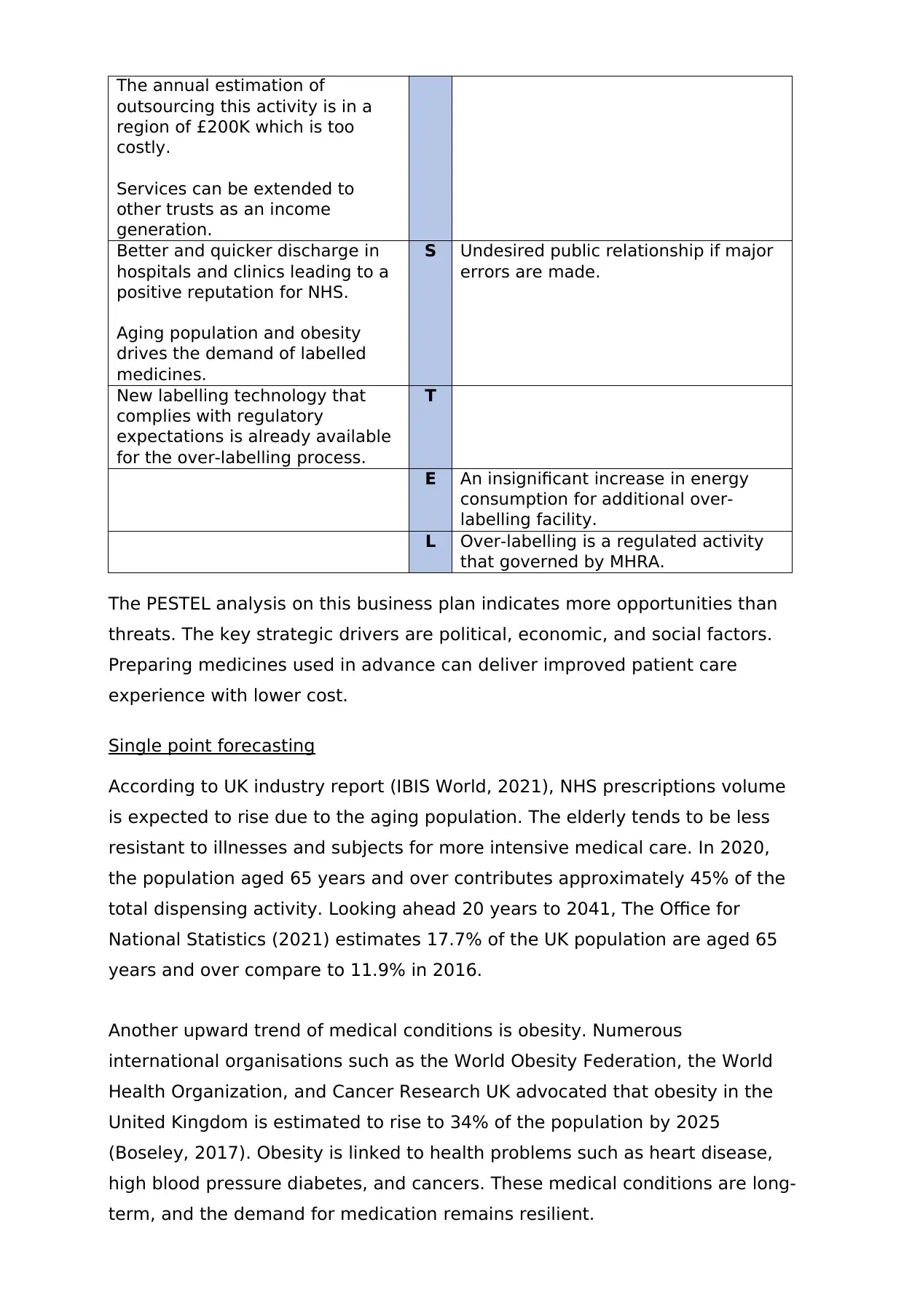
The annual estimation of
outsourcing this activity is in a
region of £200K which is too
costly.
Services can be extended to
other trusts as an income
generation.
Better and quicker discharge in
hospitals and clinics leading to a
positive reputation for NHS.
Aging population and obesity
drives the demand of labelled
medicines.
S Undesired public relationship if major
errors are made.
New labelling technology that
complies with regulatory
expectations is already available
for the over-labelling process.
T
E An insignificant increase in energy
consumption for additional over-
labelling facility.
L Over-labelling is a regulated activity
that governed by MHRA.
The PESTEL analysis on this business plan indicates more opportunities than
threats. The key strategic drivers are political, economic, and social factors.
Preparing medicines used in advance can deliver improved patient care
experience with lower cost.
Single point forecasting
According to UK industry report (IBIS World, 2021), NHS prescriptions volume
is expected to rise due to the aging population. The elderly tends to be less
resistant to illnesses and subjects for more intensive medical care. In 2020,
the population aged 65 years and over contributes approximately 45% of the
total dispensing activity. Looking ahead 20 years to 2041, The Office for
National Statistics (2021) estimates 17.7% of the UK population are aged 65
years and over compare to 11.9% in 2016.
Another upward trend of medical conditions is obesity. Numerous
international organisations such as the World Obesity Federation, the World
Health Organization, and Cancer Research UK advocated that obesity in the
United Kingdom is estimated to rise to 34% of the population by 2025
(Boseley, 2017). Obesity is linked to health problems such as heart disease,
high blood pressure diabetes, and cancers. These medical conditions are long-
term, and the demand for medication remains resilient.
outsourcing this activity is in a
region of £200K which is too
costly.
Services can be extended to
other trusts as an income
generation.
Better and quicker discharge in
hospitals and clinics leading to a
positive reputation for NHS.
Aging population and obesity
drives the demand of labelled
medicines.
S Undesired public relationship if major
errors are made.
New labelling technology that
complies with regulatory
expectations is already available
for the over-labelling process.
T
E An insignificant increase in energy
consumption for additional over-
labelling facility.
L Over-labelling is a regulated activity
that governed by MHRA.
The PESTEL analysis on this business plan indicates more opportunities than
threats. The key strategic drivers are political, economic, and social factors.
Preparing medicines used in advance can deliver improved patient care
experience with lower cost.
Single point forecasting
According to UK industry report (IBIS World, 2021), NHS prescriptions volume
is expected to rise due to the aging population. The elderly tends to be less
resistant to illnesses and subjects for more intensive medical care. In 2020,
the population aged 65 years and over contributes approximately 45% of the
total dispensing activity. Looking ahead 20 years to 2041, The Office for
National Statistics (2021) estimates 17.7% of the UK population are aged 65
years and over compare to 11.9% in 2016.
Another upward trend of medical conditions is obesity. Numerous
international organisations such as the World Obesity Federation, the World
Health Organization, and Cancer Research UK advocated that obesity in the
United Kingdom is estimated to rise to 34% of the population by 2025
(Boseley, 2017). Obesity is linked to health problems such as heart disease,
high blood pressure diabetes, and cancers. These medical conditions are long-
term, and the demand for medication remains resilient.
The volume of dispensed medicines at Imperial NHS Trust has also gradually
increased. Demand over labelling products has raised about 2% annually from
2017 to 2020.
Short to medium forecasting
A short-term forecast is related to the pandemic. A higher turnover and
volume of emergency medicines to treat coronavirus must be maintained.
Individually screened medicines are time-consuming. Pre-packing and
stocking essential medicines are clinically critical for rapid treatment of the
coronavirus.
This business proposal that streamlining the medical supply chain is likely to
benefit patients and frontline clinical staff. This business opportunity meets
future medical demands in a more cost-effective way.
Long term forecasting
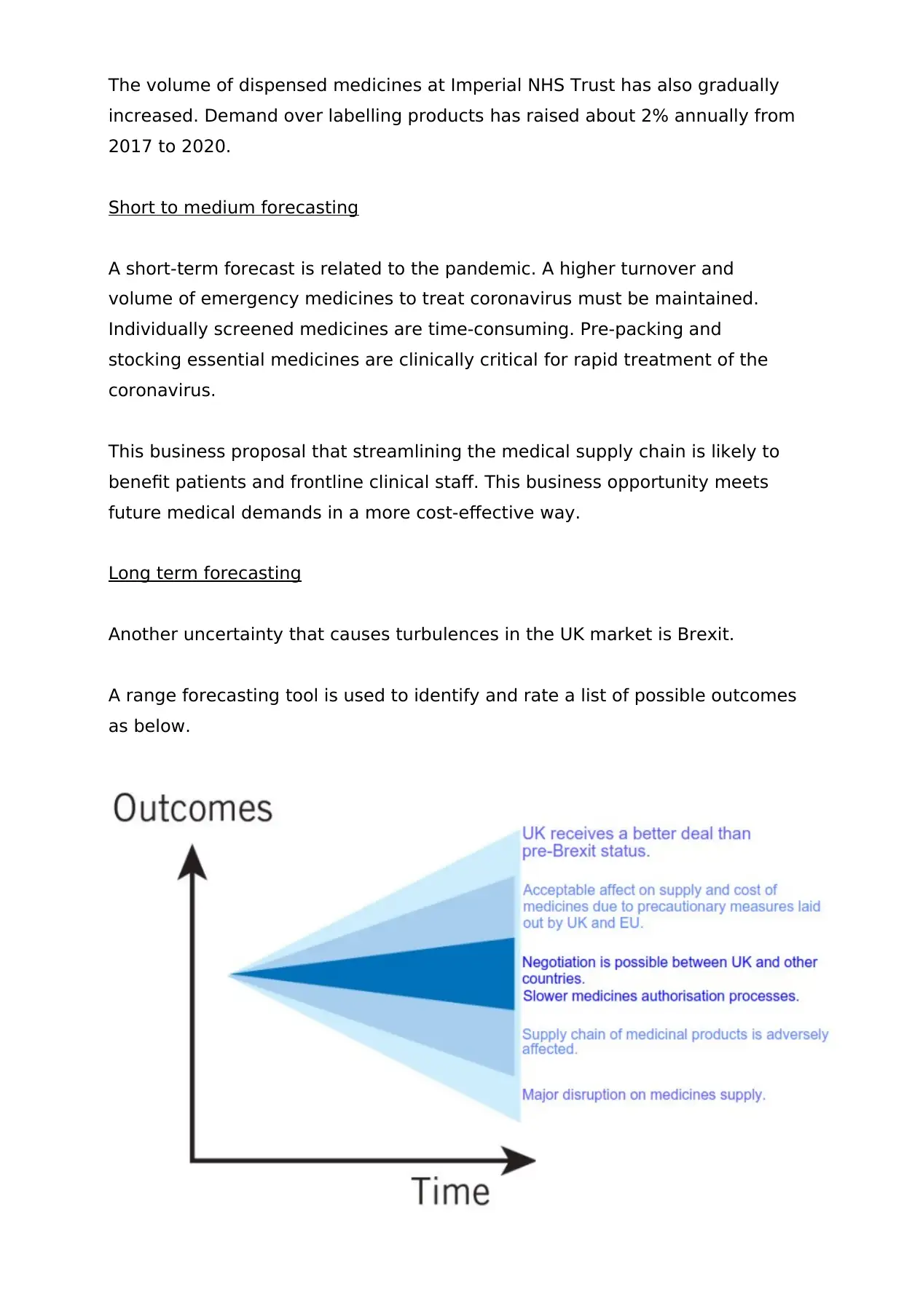
Another uncertainty that causes turbulences in the UK market is Brexit.
A range forecasting tool is used to identify and rate a list of possible outcomes
as below.
increased. Demand over labelling products has raised about 2% annually from
2017 to 2020.
Short to medium forecasting
A short-term forecast is related to the pandemic. A higher turnover and
volume of emergency medicines to treat coronavirus must be maintained.
Individually screened medicines are time-consuming. Pre-packing and
stocking essential medicines are clinically critical for rapid treatment of the
coronavirus.
This business proposal that streamlining the medical supply chain is likely to
benefit patients and frontline clinical staff. This business opportunity meets
future medical demands in a more cost-effective way.
Long term forecasting
Another uncertainty that causes turbulences in the UK market is Brexit.
A range forecasting tool is used to identify and rate a list of possible outcomes
as below.
⊘ This is a preview!⊘
Do you want full access?
Subscribe today to unlock all pages.
Trusted by 1+ million students worldwide
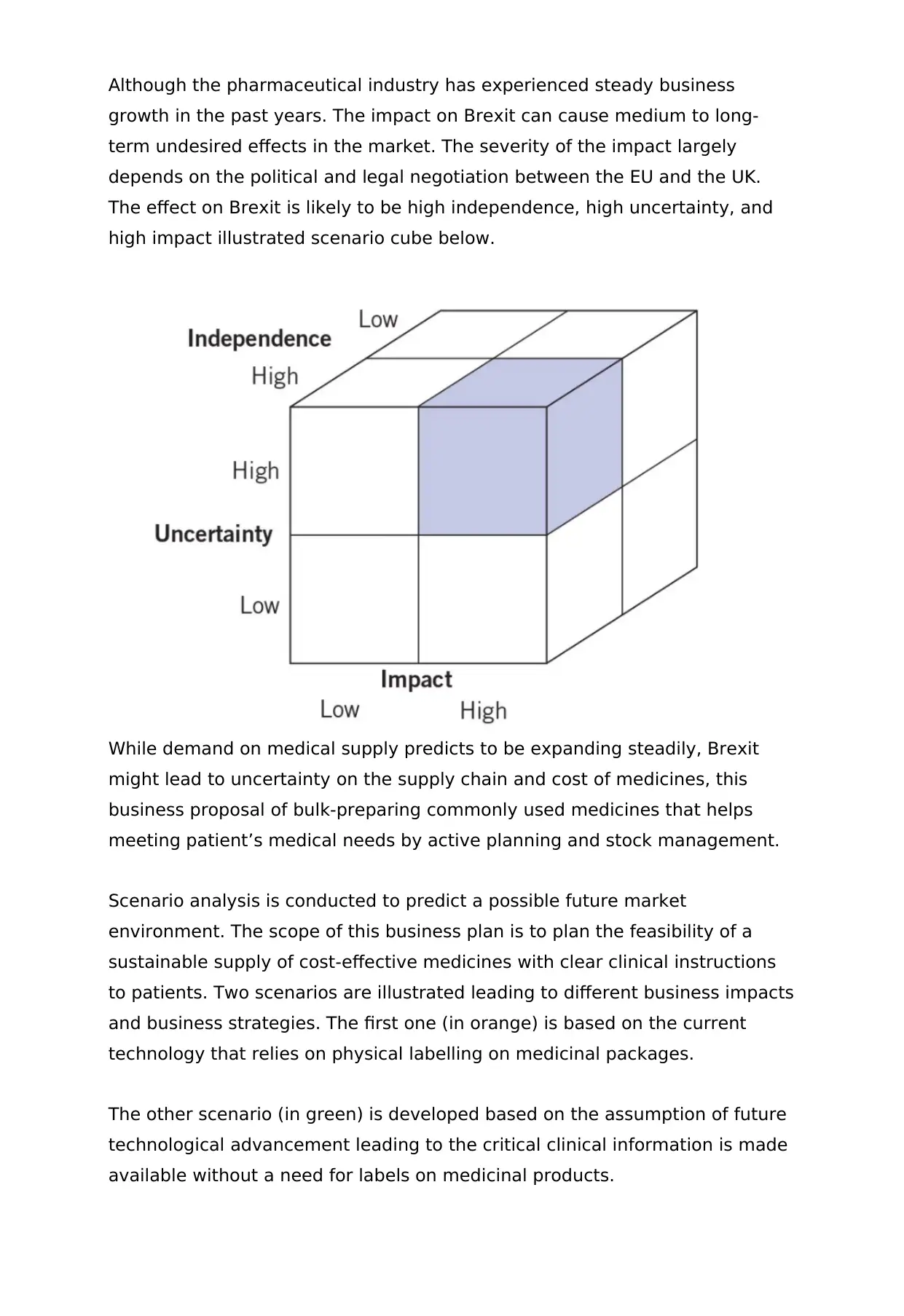
Although the pharmaceutical industry has experienced steady business
growth in the past years. The impact on Brexit can cause medium to long-
term undesired effects in the market. The severity of the impact largely
depends on the political and legal negotiation between the EU and the UK.
The effect on Brexit is likely to be high independence, high uncertainty, and
high impact illustrated scenario cube below.
While demand on medical supply predicts to be expanding steadily, Brexit
might lead to uncertainty on the supply chain and cost of medicines, this
business proposal of bulk-preparing commonly used medicines that helps
meeting patient’s medical needs by active planning and stock management.
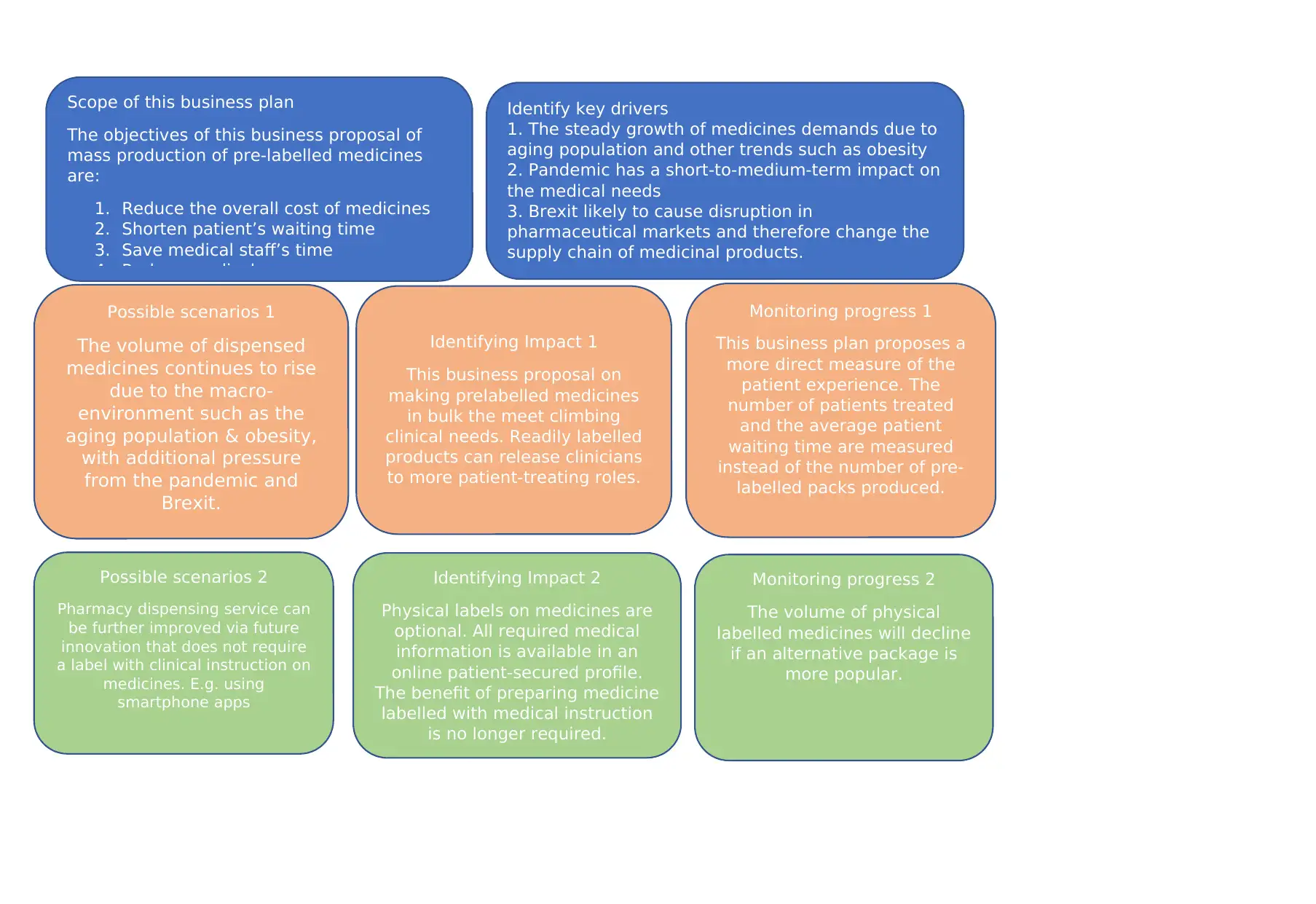
Scenario analysis is conducted to predict a possible future market
environment. The scope of this business plan is to plan the feasibility of a
sustainable supply of cost-effective medicines with clear clinical instructions
to patients. Two scenarios are illustrated leading to different business impacts
and business strategies. The first one (in orange) is based on the current
technology that relies on physical labelling on medicinal packages.
The other scenario (in green) is developed based on the assumption of future
technological advancement leading to the critical clinical information is made
available without a need for labels on medicinal products.
growth in the past years. The impact on Brexit can cause medium to long-
term undesired effects in the market. The severity of the impact largely
depends on the political and legal negotiation between the EU and the UK.
The effect on Brexit is likely to be high independence, high uncertainty, and
high impact illustrated scenario cube below.
While demand on medical supply predicts to be expanding steadily, Brexit
might lead to uncertainty on the supply chain and cost of medicines, this
business proposal of bulk-preparing commonly used medicines that helps
meeting patient’s medical needs by active planning and stock management.
Scenario analysis is conducted to predict a possible future market
environment. The scope of this business plan is to plan the feasibility of a
sustainable supply of cost-effective medicines with clear clinical instructions
to patients. Two scenarios are illustrated leading to different business impacts
and business strategies. The first one (in orange) is based on the current
technology that relies on physical labelling on medicinal packages.
The other scenario (in green) is developed based on the assumption of future
technological advancement leading to the critical clinical information is made
available without a need for labels on medicinal products.
Paraphrase This Document
Need a fresh take? Get an instant paraphrase of this document with our AI Paraphraser
Identify key drivers
1. The steady growth of medicines demands due to
aging population and other trends such as obesity
2. Pandemic has a short-to-medium-term impact on
the medical needs
3. Brexit likely to cause disruption in
pharmaceutical markets and therefore change the
supply chain of medicinal products.
Scope of this business plan
The objectives of this business proposal of
mass production of pre-labelled medicines
are:
1. Reduce the overall cost of medicines
2. Shorten patient’s waiting time
3. Save medical staff’s time
4. Reduce medical errors.
Monitoring progress 1
This business plan proposes a
more direct measure of the
patient experience. The
number of patients treated
and the average patient
waiting time are measured
instead of the number of pre-
labelled packs produced.
Identifying Impact 1
This business proposal on
making prelabelled medicines
in bulk the meet climbing
clinical needs. Readily labelled
products can release clinicians
to more patient-treating roles.
Possible scenarios 1
The volume of dispensed
medicines continues to rise
due to the macro-
environment such as the
aging population & obesity,
with additional pressure
from the pandemic and
Brexit.
Possible scenarios 2
Pharmacy dispensing service can
be further improved via future
innovation that does not require
a label with clinical instruction on
medicines. E.g. using
smartphone apps
Identifying Impact 2
Physical labels on medicines are
optional. All required medical
information is available in an
online patient-secured profile.
The benefit of preparing medicine
labelled with medical instruction
is no longer required.
Monitoring progress 2
The volume of physical
labelled medicines will decline
if an alternative package is
more popular.
1. The steady growth of medicines demands due to
aging population and other trends such as obesity
2. Pandemic has a short-to-medium-term impact on
the medical needs
3. Brexit likely to cause disruption in
pharmaceutical markets and therefore change the
supply chain of medicinal products.
Scope of this business plan
The objectives of this business proposal of
mass production of pre-labelled medicines
are:
1. Reduce the overall cost of medicines
2. Shorten patient’s waiting time
3. Save medical staff’s time
4. Reduce medical errors.
Monitoring progress 1
This business plan proposes a
more direct measure of the
patient experience. The
number of patients treated
and the average patient
waiting time are measured
instead of the number of pre-
labelled packs produced.
Identifying Impact 1
This business proposal on
making prelabelled medicines
in bulk the meet climbing
clinical needs. Readily labelled
products can release clinicians
to more patient-treating roles.
Possible scenarios 1
The volume of dispensed
medicines continues to rise
due to the macro-
environment such as the
aging population & obesity,
with additional pressure
from the pandemic and
Brexit.
Possible scenarios 2
Pharmacy dispensing service can
be further improved via future
innovation that does not require
a label with clinical instruction on
medicines. E.g. using
smartphone apps
Identifying Impact 2
Physical labels on medicines are
optional. All required medical
information is available in an
online patient-secured profile.
The benefit of preparing medicine
labelled with medical instruction
is no longer required.
Monitoring progress 2
The volume of physical
labelled medicines will decline
if an alternative package is
more popular.
The traditional way of dispensing labelling on medicine packs is expected to
continue. Although smartphone technology has been more popular in the last
few decades, the technology is not universalised, especially in the older
generation.
External rivalry
Potential competition was analysed by Porter’s five force framework.
The extent of rivalry between competitors
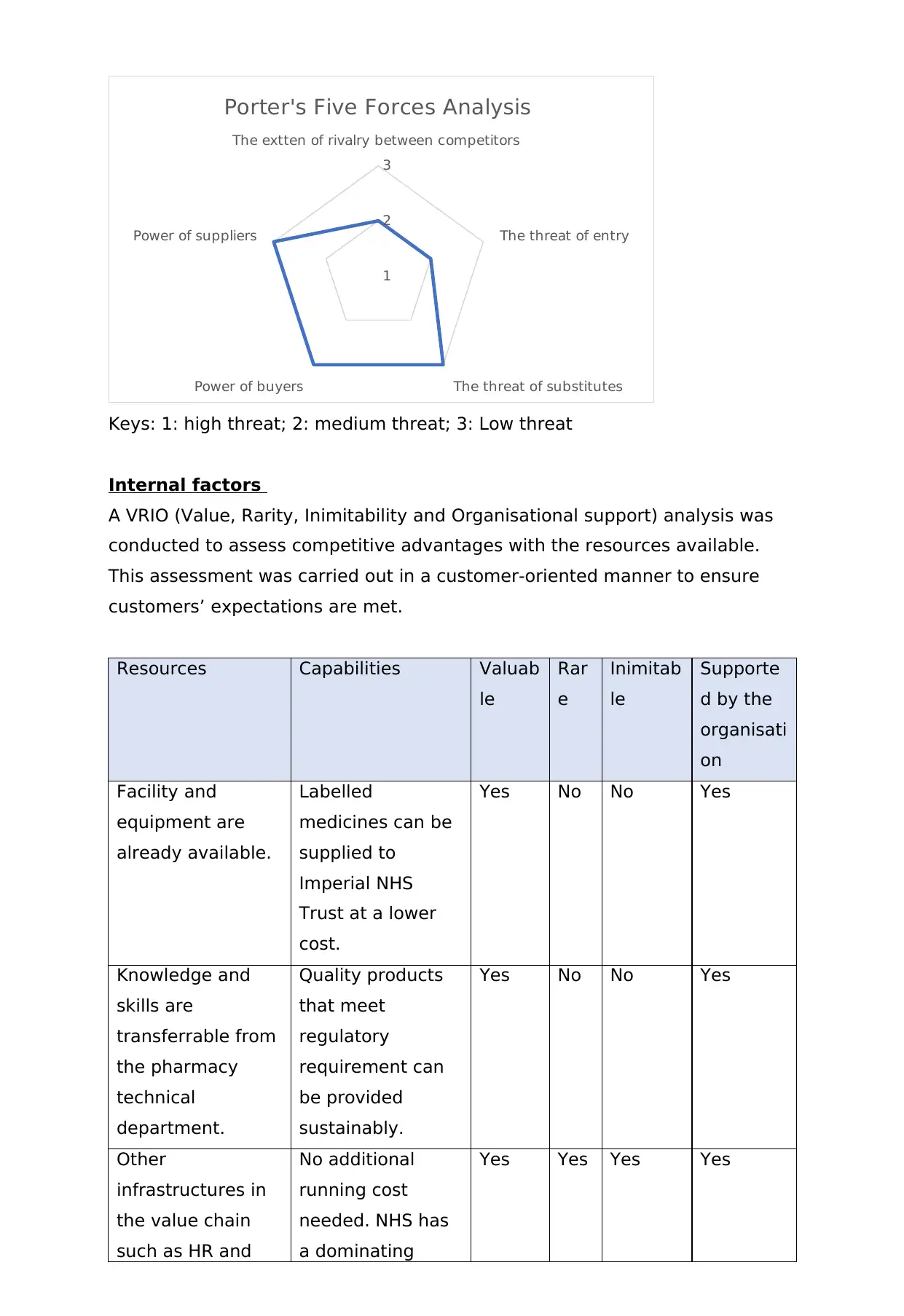
As NHS is a not-for-profit organisation that has little profit motives, external
competition is low to medium. The primary objective of this business plan is to
provide low-cost pre-labelled medicines internally to Imperial NHS Trust to
provide better clinical care for patients, earlier patient discharge, and save
bed spaces in hospitals.
NHS over-labelling departments that situate in hospitals do not require rental
costs or other expenses such as council tax. The cost of setting up and
running an over-labelling facility is considered low. Non-NHS incumbents pay
for premises that contribute to the higher production cost than NHS units
mean losing position in a price war. Another advantage is that our primary
customer is on the same site that minimising the logistic issues.
The over-labelling activities can be offered to other organisations. Imperial
NHS Trust needs to be in a strategic advanced position to be competitive
among its competitors. It is likely that market share can be taken over from
commercial companies that provide products to other NHS Trusts if our
services are comparable to those external companies.
The threat of entry
One of the requirements of the over labelling activity is gaining a licence from
the regulatory governing body, MHRA. Initial regulatory inspection and
periodic re-inspections are mandatory to ensure the over-labelling process
does not put patients in harm. The MHRA inspection is comprehensive and
required a sufficient level of pharmaceutical knowledge and experience to
gain such a license.
continue. Although smartphone technology has been more popular in the last
few decades, the technology is not universalised, especially in the older
generation.
External rivalry
Potential competition was analysed by Porter’s five force framework.
The extent of rivalry between competitors
As NHS is a not-for-profit organisation that has little profit motives, external
competition is low to medium. The primary objective of this business plan is to
provide low-cost pre-labelled medicines internally to Imperial NHS Trust to
provide better clinical care for patients, earlier patient discharge, and save
bed spaces in hospitals.
NHS over-labelling departments that situate in hospitals do not require rental
costs or other expenses such as council tax. The cost of setting up and
running an over-labelling facility is considered low. Non-NHS incumbents pay
for premises that contribute to the higher production cost than NHS units
mean losing position in a price war. Another advantage is that our primary
customer is on the same site that minimising the logistic issues.
The over-labelling activities can be offered to other organisations. Imperial
NHS Trust needs to be in a strategic advanced position to be competitive
among its competitors. It is likely that market share can be taken over from
commercial companies that provide products to other NHS Trusts if our
services are comparable to those external companies.
The threat of entry
One of the requirements of the over labelling activity is gaining a licence from
the regulatory governing body, MHRA. Initial regulatory inspection and
periodic re-inspections are mandatory to ensure the over-labelling process
does not put patients in harm. The MHRA inspection is comprehensive and
required a sufficient level of pharmaceutical knowledge and experience to
gain such a license.
⊘ This is a preview!⊘
Do you want full access?
Subscribe today to unlock all pages.
Trusted by 1+ million students worldwide
New entrant is difficult to gain NHS customers if another NHS is providing the
same over labelling service. Some NHS Trusts prefer such service from other
NHS Trusts so that there is no real overall costing to the NHS.
Therefore, the threat of entry is medium based on legal requirement and cost.
The threat of substitutes
The threat of substitutes is low. The need of clinical instructions on medicinal
products is not substitutable.
The power of buyers
The customers of the over-labelling medicines are hospital pharmacies. The
primary customer of this business opportunity is the Imperial NHS Trust. This
business proposal is the most cost-effective way to supply labelled medicines
internally, therefore, the power of the primary buyer is low. Labelled products
are planned to sell to other Trusts with a minimal profit margin. This business
plan focuses on reduction on expenditure to external.
The power of suppliers
As NHS is the biggest customers in the UK pharmaceutical market, the
bargaining power of NHS is high. A centralised NHS procurement is set up to
enhance the purchasing power on a national scale to get the best deal and
high quality of products. The NHS set up a registered company, Supply Chain
Coordination Limited (SCCL), to manage the NHS supply chain. SCCL aims to
deliver a £2.4 billion saving by 2023/2024 (Supply Chain Coordination Limited,
2021). Centralised procurement of medical supplies addresses current
disintegrated purchasing which leads to widespread price variation and lack of
consistency of products. (NHS Supply Chain, 2021)
A summery of the Porter’s five force is illustrated below:
same over labelling service. Some NHS Trusts prefer such service from other
NHS Trusts so that there is no real overall costing to the NHS.
Therefore, the threat of entry is medium based on legal requirement and cost.
The threat of substitutes
The threat of substitutes is low. The need of clinical instructions on medicinal
products is not substitutable.
The power of buyers
The customers of the over-labelling medicines are hospital pharmacies. The
primary customer of this business opportunity is the Imperial NHS Trust. This
business proposal is the most cost-effective way to supply labelled medicines
internally, therefore, the power of the primary buyer is low. Labelled products
are planned to sell to other Trusts with a minimal profit margin. This business
plan focuses on reduction on expenditure to external.
The power of suppliers
As NHS is the biggest customers in the UK pharmaceutical market, the
bargaining power of NHS is high. A centralised NHS procurement is set up to
enhance the purchasing power on a national scale to get the best deal and
high quality of products. The NHS set up a registered company, Supply Chain
Coordination Limited (SCCL), to manage the NHS supply chain. SCCL aims to
deliver a £2.4 billion saving by 2023/2024 (Supply Chain Coordination Limited,
2021). Centralised procurement of medical supplies addresses current
disintegrated purchasing which leads to widespread price variation and lack of
consistency of products. (NHS Supply Chain, 2021)
A summery of the Porter’s five force is illustrated below:
Paraphrase This Document
Need a fresh take? Get an instant paraphrase of this document with our AI Paraphraser
The extten of rivalry between competitors
The threat of entry
The threat of substitutesPower of buyers
Power of suppliers
1
2
3
Porter's Five Forces Analysis
Keys: 1: high threat; 2: medium threat; 3: Low threat
Internal factors
A VRIO (Value, Rarity, Inimitability and Organisational support) analysis was
conducted to assess competitive advantages with the resources available.
This assessment was carried out in a customer-oriented manner to ensure
customers’ expectations are met.
Resources Capabilities Valuab
le
Rar
e
Inimitab
le
Supporte
d by the
organisati
on
Facility and
equipment are
already available.
Labelled
medicines can be
supplied to
Imperial NHS
Trust at a lower
cost.
Yes No No Yes
Knowledge and
skills are
transferrable from
the pharmacy
technical
department.
Quality products
that meet
regulatory
requirement can
be provided
sustainably.
Yes No No Yes
Other
infrastructures in
the value chain
such as HR and
No additional
running cost
needed. NHS has
a dominating
Yes Yes Yes Yes
The threat of entry
The threat of substitutesPower of buyers
Power of suppliers
1
2
3
Porter's Five Forces Analysis
Keys: 1: high threat; 2: medium threat; 3: Low threat
Internal factors
A VRIO (Value, Rarity, Inimitability and Organisational support) analysis was
conducted to assess competitive advantages with the resources available.
This assessment was carried out in a customer-oriented manner to ensure
customers’ expectations are met.
Resources Capabilities Valuab
le
Rar
e
Inimitab
le
Supporte
d by the
organisati
on
Facility and
equipment are
already available.
Labelled
medicines can be
supplied to
Imperial NHS
Trust at a lower
cost.
Yes No No Yes
Knowledge and
skills are
transferrable from
the pharmacy
technical
department.
Quality products
that meet
regulatory
requirement can
be provided
sustainably.
Yes No No Yes
Other
infrastructures in
the value chain
such as HR and
No additional
running cost
needed. NHS has
a dominating
Yes Yes Yes Yes
centralised
procurement are
already in place.
buying power that
the purchasing
cost is lower.
Primary customer
is on the same
site.
Lead time of
product supply is
minimal.
Yes Yes Yes Yes
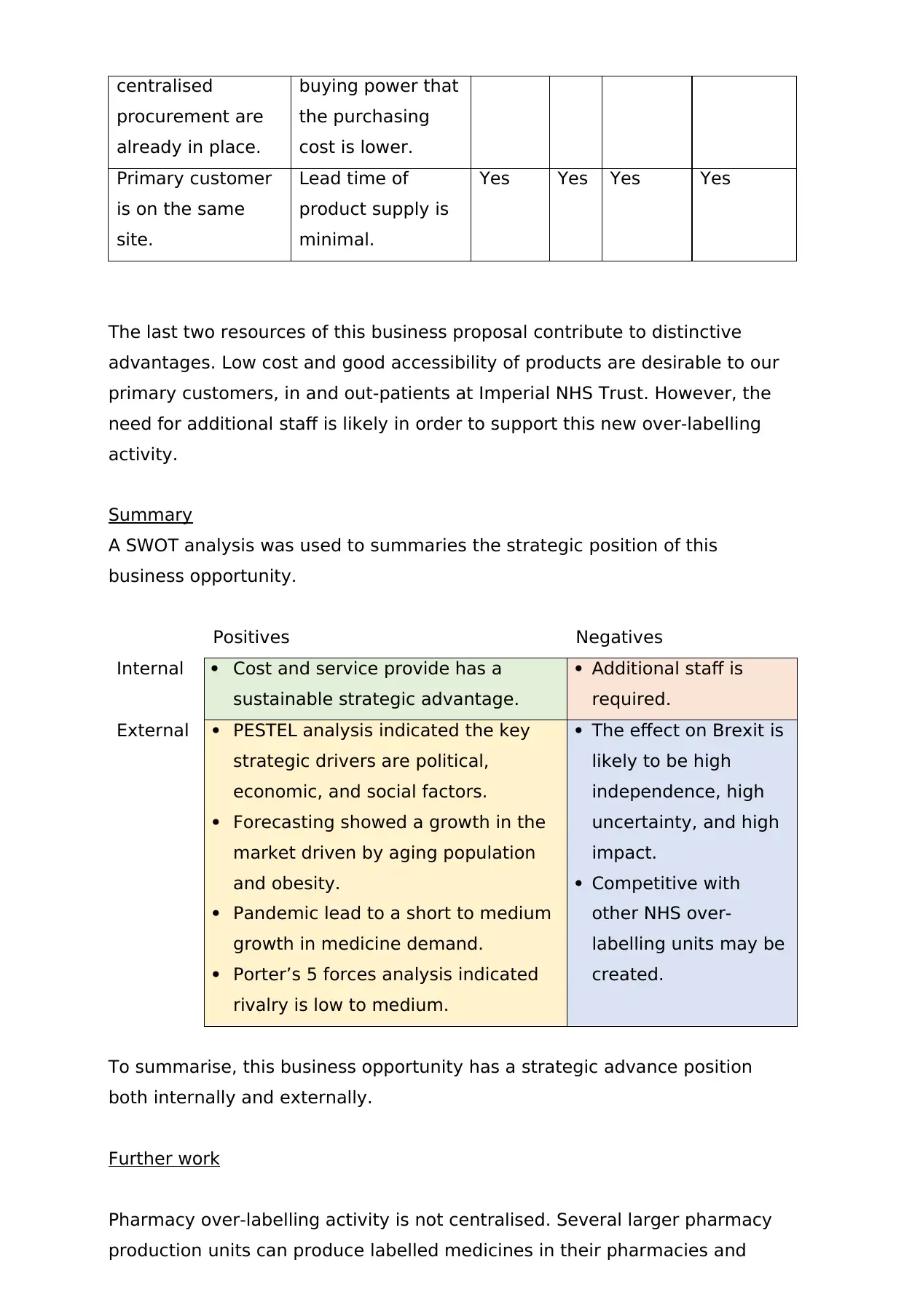
The last two resources of this business proposal contribute to distinctive
advantages. Low cost and good accessibility of products are desirable to our
primary customers, in and out-patients at Imperial NHS Trust. However, the
need for additional staff is likely in order to support this new over-labelling
activity.
Summary
A SWOT analysis was used to summaries the strategic position of this
business opportunity.
Positives Negatives
Internal Cost and service provide has a
sustainable strategic advantage.
Additional staff is
required.
External PESTEL analysis indicated the key
strategic drivers are political,
economic, and social factors.
Forecasting showed a growth in the
market driven by aging population
and obesity.
Pandemic lead to a short to medium
growth in medicine demand.
Porter’s 5 forces analysis indicated
rivalry is low to medium.
The effect on Brexit is
likely to be high
independence, high
uncertainty, and high
impact.
Competitive with
other NHS over-
labelling units may be
created.
To summarise, this business opportunity has a strategic advance position
both internally and externally.
Further work
Pharmacy over-labelling activity is not centralised. Several larger pharmacy
production units can produce labelled medicines in their pharmacies and
procurement are
already in place.
buying power that
the purchasing
cost is lower.
Primary customer
is on the same
site.
Lead time of
product supply is
minimal.
Yes Yes Yes Yes
The last two resources of this business proposal contribute to distinctive
advantages. Low cost and good accessibility of products are desirable to our
primary customers, in and out-patients at Imperial NHS Trust. However, the
need for additional staff is likely in order to support this new over-labelling
activity.
Summary
A SWOT analysis was used to summaries the strategic position of this
business opportunity.
Positives Negatives
Internal Cost and service provide has a
sustainable strategic advantage.
Additional staff is
required.
External PESTEL analysis indicated the key
strategic drivers are political,
economic, and social factors.
Forecasting showed a growth in the
market driven by aging population
and obesity.
Pandemic lead to a short to medium
growth in medicine demand.
Porter’s 5 forces analysis indicated
rivalry is low to medium.
The effect on Brexit is
likely to be high
independence, high
uncertainty, and high
impact.
Competitive with
other NHS over-
labelling units may be
created.
To summarise, this business opportunity has a strategic advance position
both internally and externally.
Further work
Pharmacy over-labelling activity is not centralised. Several larger pharmacy
production units can produce labelled medicines in their pharmacies and
⊘ This is a preview!⊘
Do you want full access?
Subscribe today to unlock all pages.
Trusted by 1+ million students worldwide

1 out of 15


Related Documents


Your All-in-One AI-Powered Toolkit for Academic Success.
+13062052269
info@desklib.com
Available 24*7 on WhatsApp / Email
![[object Object]](/_next/static/media/star-bottom.7253800d.svg)
Unlock your academic potential
Copyright © 2020–2025 A2Z Services. All Rights Reserved. Developed and managed by ZUCOL.