Non-Destructive Testing Analysis: Ultrasonic and Magnetic Methods

Verified

Added on  2023/01/11

|8
|1193
|39
Report
AI Summary
This report provides an overview of Non-Destructive Testing (NDT) methods, with a focus on ultrasonic and magnetic testing techniques, for detecting flaws in the manufacturing of motor vehicles and airplanes. The introduction highlights the importance of NDT in ensuring structural integrity and preventing accidents. The report details the principles of operation, experimental setups, advantages, and disadvantages of both ultrasonic and magnetic testing methods. Ultrasonic testing utilizes high-frequency sound waves to identify micro-cracks and hidden flaws, while magnetic testing employs magnetic fields and fine magnetic particles to reveal surface and subsurface defects in ferromagnetic materials. The report includes diagrams illustrating experimental setups and results for both methods. The conclusion suggests that ultrasonic NDT is the most suitable method for detecting metal flaws in the aerospace and automotive industries. This report is a valuable resource for students and professionals in mechanical engineering, materials science, and related fields. Students can access past papers and solved assignments on Desklib.
Document Page
NON DESTRUCTIVE TESTS 1
NON DESTRUCTIVE TESTS
Name of Student
Institution Affiliation
tabler-icon-diamond-filled.svg

Paraphrase This Document

Need a fresh take? Get an instant paraphrase of this document with our AI Paraphraser
Document Page
NON DESTRUCTIVE TESTS 2
Introduction
The structure of both motor vehicles and airplane should be strong enough to enable
them to carry the weights in them this is done during the manufacture the manufacturing stage.
This will help in reducing the chances of accidents which may arise if these failures occur
without the knowledge of human being. Some of these damages may result due to fatigue in the
structure which are employed in the manufacture of these machines. Such failures are detected
using NDT. The Non-Destructive Test is done by the use of two methods that is Ultrasonic test
and also magnetic test.
Methods and principle of operation
Ultrasonic Test
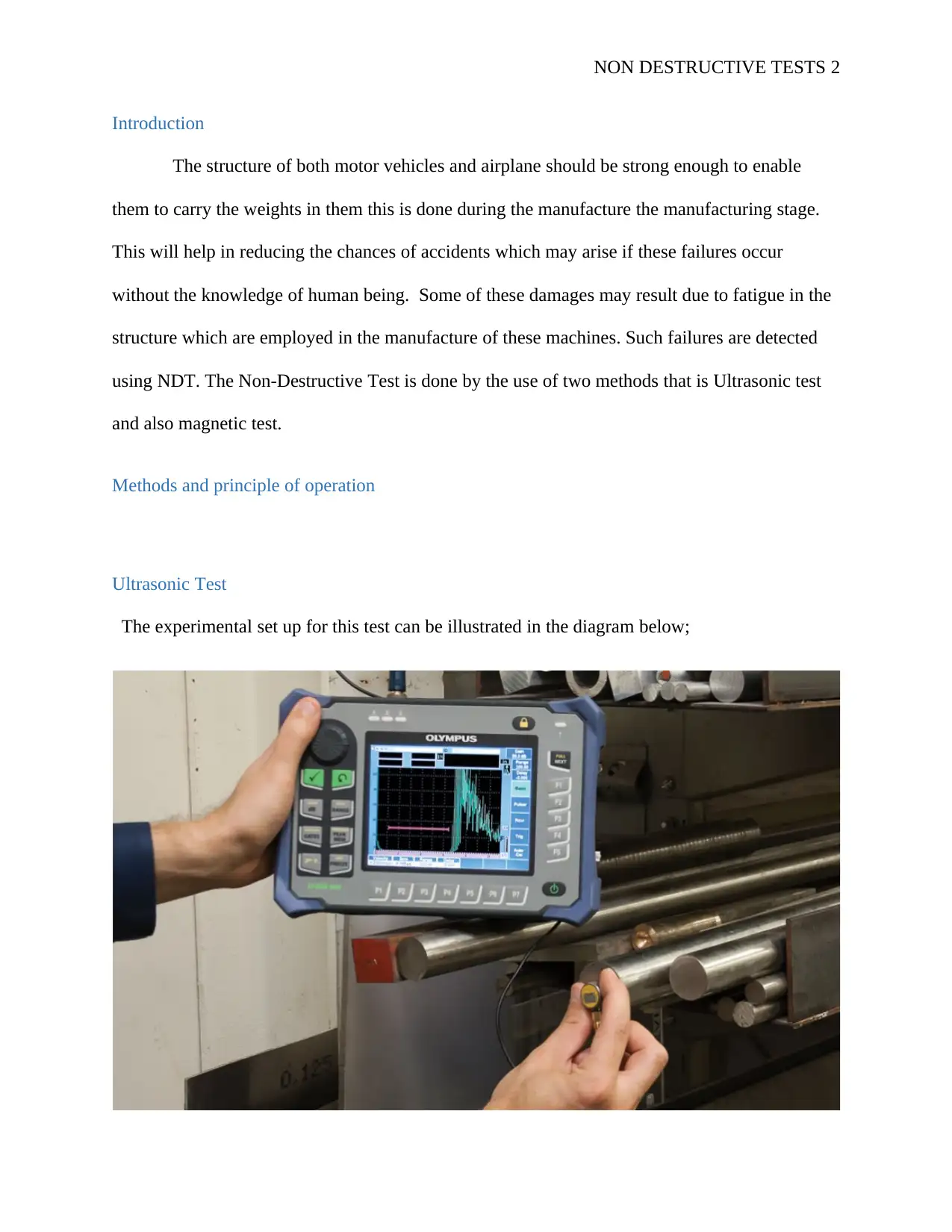
The experimental set up for this test can be illustrated in the diagram below;
Document Page
NON DESTRUCTIVE TESTS 3
Figure 1: Showing experimental set up of Ultrasonic NDT (Hau, 2017).
Ultrasonic sound is a technique which uses higher frequency sound wave to detect any
micro cracks and also other hidden flaw metals which might be in metals used by the companies
making airplane and vehicles. For such industry, this method is not just used to inspect the final
metal product but also to inspect the raw metal in a form of bars, plates or even billets (Mordfin,
2012). This method is very accurate and quick as well. The concept behind the working
principle of this type of metals flaws testing is that the technique is measuring the time for
travelling of the acoustic wave in any medium then this time will be correlated to the elastic
property as well as the density of the same material (Mayer, 2012).
Time for travelling of the waves for ultrasonic will reflect the internal condition of the
test area. Basically for a particular trajectory, higher the time of travelling the low the quality of
the metal under test. But the lower time of travelling of the waves the higher the quality of the
metal with very fewer anomalies (Hau, 2017). When the ultrasonic wave spreads through the
test area the wave will be reflected in the anomalies boundaries resulting in a higher travelling
time. This will lead to a higher time of transmission (lower speed of wave) in the poor quality of
the metal while the lower time of transmission (higher speed of waves) in good quality in metals.
These can be illustrated using the following diagrams.
Advantages of Ultrasonic test
Some of the advantages of using this method in testing the presence of flaws in aeroplane and
motor vehicles industries include;
i. This method of testing is very accurate and quick.
Document Page
NON DESTRUCTIVE TESTS 4
ii. Portability. Several portable ultrasonic gadgets are used in doing the test and they are
very easy to use.
iii. This method has a deep flaw test as compared to other NDT test, this makes it
superior to other methods of testing.
iv. In the aeroplane and motor vehicles, there are some cases where it is only a small part
of the material is visible, this method can still be employed in such cases.
Disadvantages of Ultrasonic test
i. It is hard to use this method of testing for parts that are very thin for example the
airplane skin. But this can be overcome through the use of very high-frequency
techniques.
ii. This method will need well-trained personnel for the interpretation of the obtained
results.
iii. This method will not detect the metal flaws which are oriented parallel to the
propagation waves.
iv. The material inspected must be characterized earlier before the inspection.
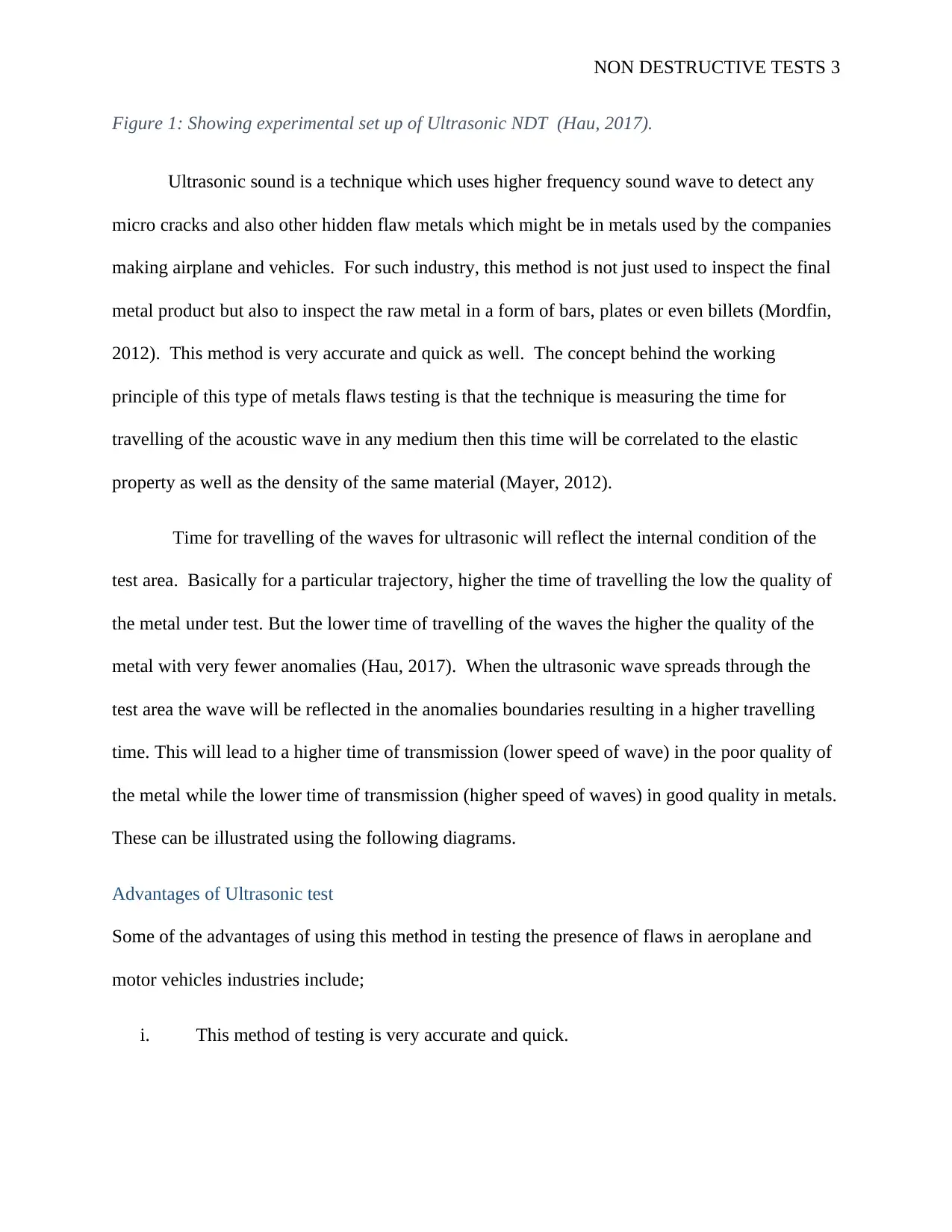
The result of Ultrasonic NDT can be illustrated in the diagram below;
tabler-icon-diamond-filled.svg

Paraphrase This Document

Need a fresh take? Get an instant paraphrase of this document with our AI Paraphraser
Document Page
NON DESTRUCTIVE TESTS 5
Figure 2: Showing result of Ultrasonic NDT (Hau, 2017).
Magnetic test
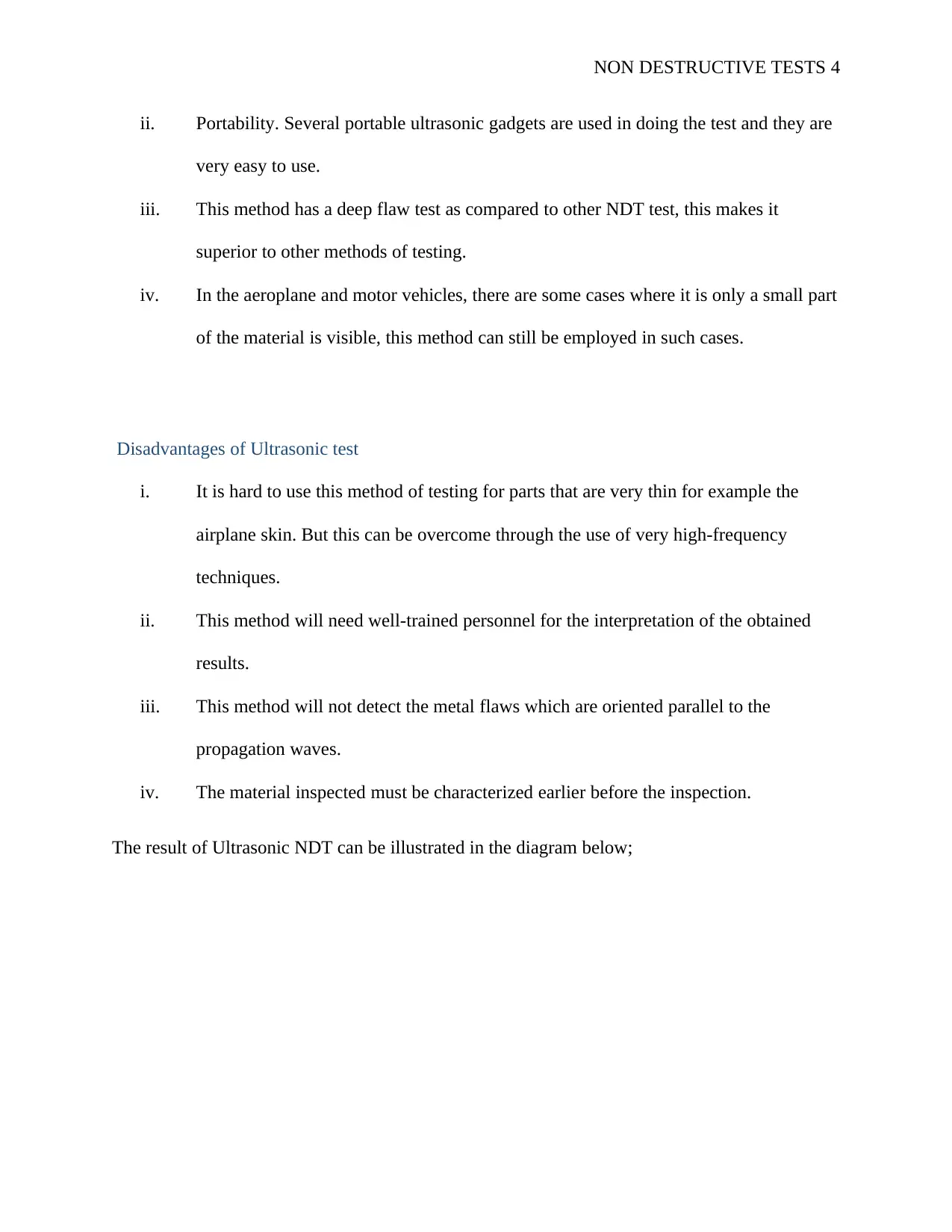
The experimental setup of this experiment can be illustrated using the following diagram;
Figure 3: Showing magnetic experimental setup
Document Page
NON DESTRUCTIVE TESTS 6
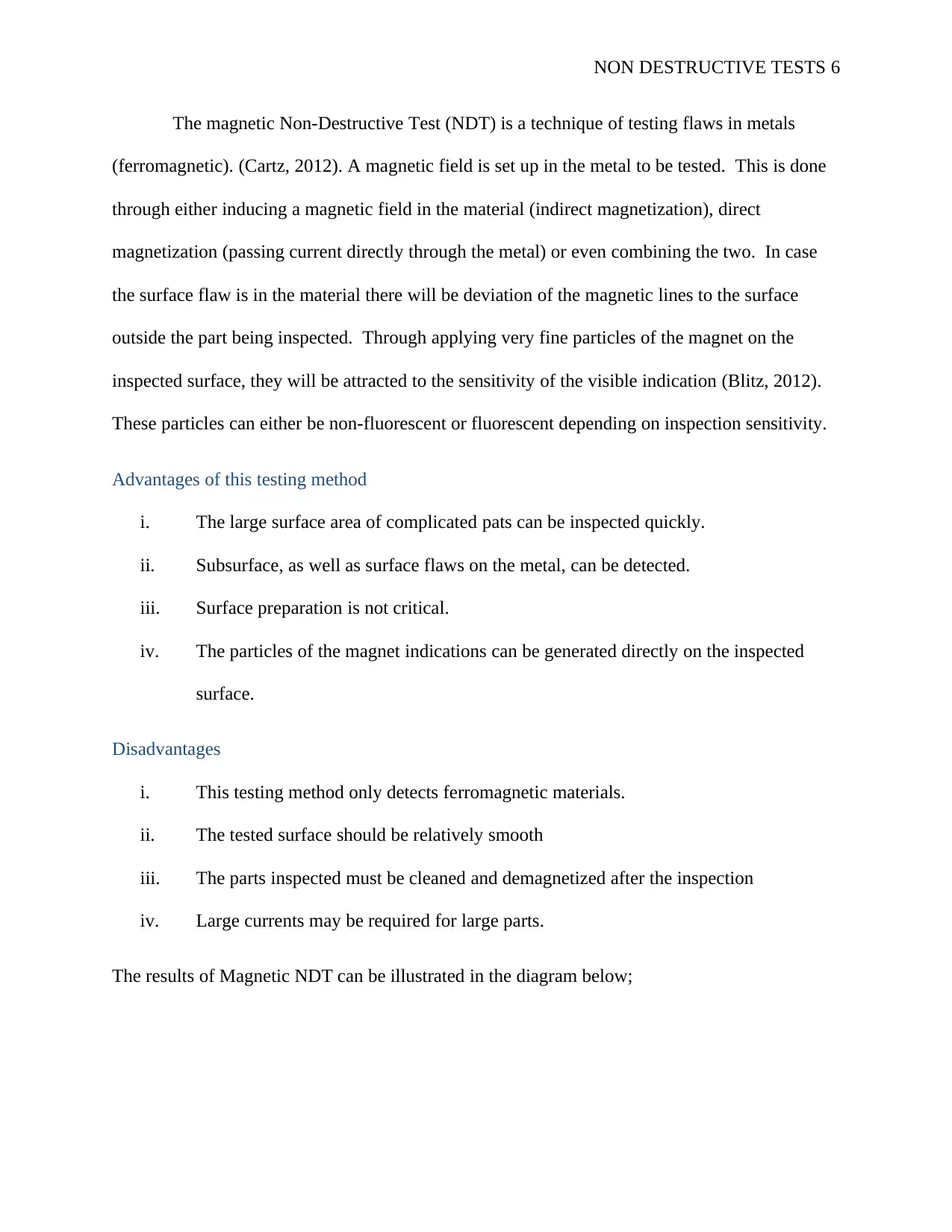
The magnetic Non-Destructive Test (NDT) is a technique of testing flaws in metals
(ferromagnetic). (Cartz, 2012). A magnetic field is set up in the metal to be tested. This is done
through either inducing a magnetic field in the material (indirect magnetization), direct
magnetization (passing current directly through the metal) or even combining the two. In case
the surface flaw is in the material there will be deviation of the magnetic lines to the surface
outside the part being inspected. Through applying very fine particles of the magnet on the
inspected surface, they will be attracted to the sensitivity of the visible indication (Blitz, 2012).
These particles can either be non-fluorescent or fluorescent depending on inspection sensitivity.
Advantages of this testing method
i. The large surface area of complicated pats can be inspected quickly.
ii. Subsurface, as well as surface flaws on the metal, can be detected.
iii. Surface preparation is not critical.
iv. The particles of the magnet indications can be generated directly on the inspected
surface.
Disadvantages
i. This testing method only detects ferromagnetic materials.
ii. The tested surface should be relatively smooth
iii. The parts inspected must be cleaned and demagnetized after the inspection
iv. Large currents may be required for large parts.
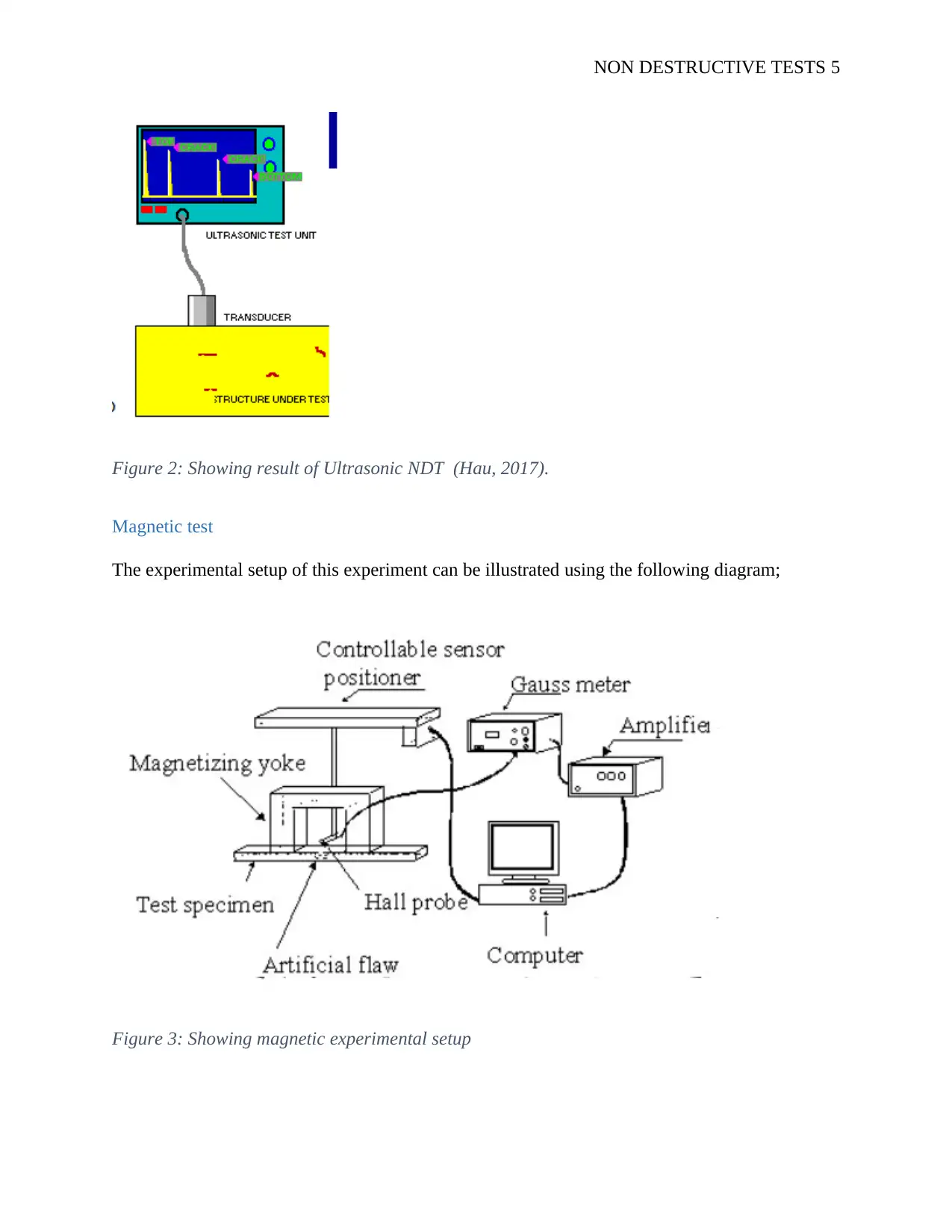
The results of Magnetic NDT can be illustrated in the diagram below;
Document Page
NON DESTRUCTIVE TESTS 7
Figure 4: Showing results of Magnetic NDT
From the benefits of the two methods given above, it is clear that ultrasonic NDT best
suits the use in detecting the metal flaws in the aeroplane/ motor vehicle industries. Some of the
supportive merits are that Ultrasonic NDT is very portal, quick and very accurate. And at the
same time, Magnetic NDT will require a large amount of current, it also requires several
attentions like cleaning and demagnetizing the inspected area.
tabler-icon-diamond-filled.svg

Paraphrase This Document

Need a fresh take? Get an instant paraphrase of this document with our AI Paraphraser
Document Page
NON DESTRUCTIVE TESTS 8
Bibliography
Blitz, J., 2012. Electrical and Magnetic Methods of Non-destructive Testing. 2nd ed. Chicago:
Springer Science & Business Media.
Cartz, L., 2012. Nondestructive Testing: Radiography, Ultrasonics, Liquid Penetrant, Magnetic
Particle, Eddy Current. 4th ed. Hull: ASM International.
Hau, C. C., 2017. Ultrasonic And Advanced Methods For Nondestructive Testing And Material
Characterization. 3rd ed. Beijing: World Scientific.
Mayer, K., 2012. Ultrasonic Nondestructive Testing of Materials: Theoretical Foundations. 2nd
ed. Liverpool: CRC Press.
Mordfin, L., 2012. Nondestructive Testing Standards--present and Future. 2nd ed. Liverpool:
ASTM International.
chevron_up_icon
1 out of 8
circle_padding
hide_on_mobile
zoom_out_icon
[object Object]