MBA Project: Analysing Organisational Change in Education Sector
VerifiedAdded on 2021/01/02
|15
|3445
|51
Project
AI Summary
This MBA project, structured as a dissertation, investigates the impact of organisational change on employee behaviour within the UK education sector, specifically focusing on universities, secondary, and primary schools. The introduction highlights the importance of the education sector for economic and social growth, and sets out the aims, objectives, research questions, and hypotheses. The literature review explores the factors driving organisational changes, such as structural modifications, socio-cultural influences, and educational reforms, and their effects on employee behaviour, engagement, and performance. The research methodology section, using interpretivism philosophy, will delve into how these changes affect teaching styles, employee productivity, and overall service quality. The study aims to analyse these impacts at different educational levels and recommend strategies to mitigate negative consequences. The research also examines the influence of management changes which are part of organisational changes and the impact on employee skills.
MBA – PROJECT:
(DISSERTATION)
(DISSERTATION)

Paraphrase This Document
Need a fresh take? Get an instant paraphrase of this document with our AI Paraphraser
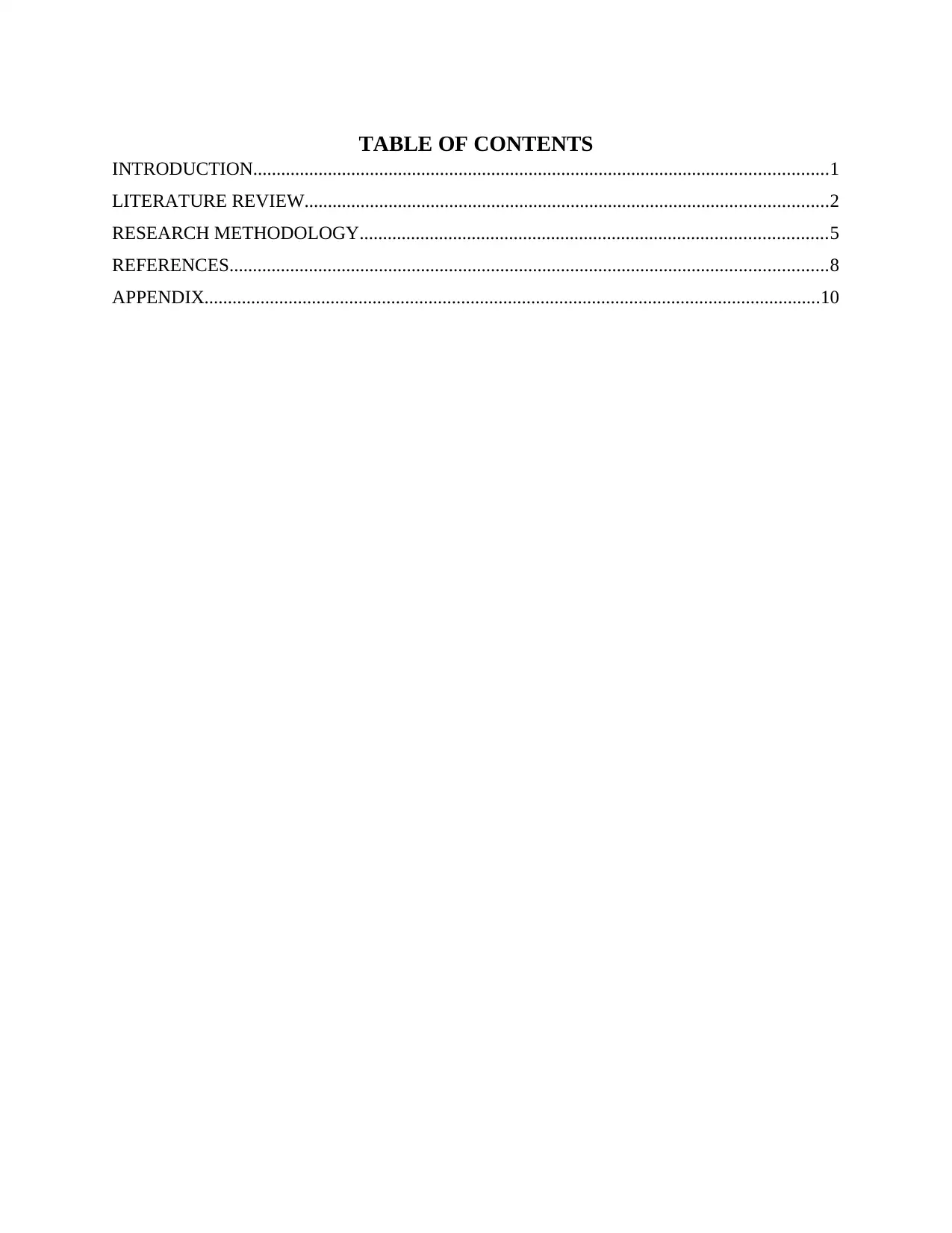
TABLE OF CONTENTS
INTRODUCTION...........................................................................................................................1
LITERATURE REVIEW................................................................................................................2
RESEARCH METHODOLOGY....................................................................................................5
REFERENCES................................................................................................................................8
APPENDIX....................................................................................................................................10
INTRODUCTION...........................................................................................................................1
LITERATURE REVIEW................................................................................................................2
RESEARCH METHODOLOGY....................................................................................................5
REFERENCES................................................................................................................................8
APPENDIX....................................................................................................................................10
Title - To analyse the impact of organisational change on behaviour of employees in Educational
sector: A case study on universities, Secondary and Primary Schools in UK
INTRODUCTION
The education sector of a country plays a crucial in economic and social growth and
development. It includes schools, universities, etc. through which education services are
provided to students. The backbone of nation growth lies in its education sector framework.
Government regulates overall sector and develop certain goals and objectives. Also, it includes a
framework which consists of a specified method or procedure and way of teaching. Through this,
students learn and gain knowledge. In many countries education sector is governed by a proper
framework (Braced for Turbulence: Understanding and Managing Resistance to Change in the
Higher Education Sector, 2013). At every level, structure of organisation is different. It enables
in providing flexibility in working and developing culture. It is necessary to have a positive
environment within an organisation. So, having a positive culture within a university is essential
in gaining knowledge in effective way. The development of culture entirely depends on teacher
and professors. It also depends on type of structure which is followed. Any change that occurs
within university or school directly impacts on behaviour of employees.
Organisational change refers to any change in set of actions or process which affects the
way in which operations are performed. Due to shift in way of working behaviour of employees
is impacted. It can be either positively or negative depending upon the change. When an
employee is not able to cope with change it confronts his behaviour (Bell, Bryman and Harley,
2018). This is the major reason due to which in education sector employee’s productivity
degrades. There are several measures and strategy taken to mitigate impact of organisational
change on employees. But in education sector, there are still some levels in which impact is not
reduced. There are several changes that are made in educational institutes. It is done to enhance
overall performance and to attain higher goals and objectives.
Aims and objectives
Aim- To analyse the impact of organisational change on behaviour of employees in Educational
sector: A case study on universities, Secondary and Primary Schools in UK
Objectives
To examine factors for organisational changes in education sector
To analyse impact of organisational change in behaviour of employees
1
sector: A case study on universities, Secondary and Primary Schools in UK
INTRODUCTION
The education sector of a country plays a crucial in economic and social growth and
development. It includes schools, universities, etc. through which education services are
provided to students. The backbone of nation growth lies in its education sector framework.
Government regulates overall sector and develop certain goals and objectives. Also, it includes a
framework which consists of a specified method or procedure and way of teaching. Through this,
students learn and gain knowledge. In many countries education sector is governed by a proper
framework (Braced for Turbulence: Understanding and Managing Resistance to Change in the
Higher Education Sector, 2013). At every level, structure of organisation is different. It enables
in providing flexibility in working and developing culture. It is necessary to have a positive
environment within an organisation. So, having a positive culture within a university is essential
in gaining knowledge in effective way. The development of culture entirely depends on teacher
and professors. It also depends on type of structure which is followed. Any change that occurs
within university or school directly impacts on behaviour of employees.
Organisational change refers to any change in set of actions or process which affects the
way in which operations are performed. Due to shift in way of working behaviour of employees
is impacted. It can be either positively or negative depending upon the change. When an
employee is not able to cope with change it confronts his behaviour (Bell, Bryman and Harley,
2018). This is the major reason due to which in education sector employee’s productivity
degrades. There are several measures and strategy taken to mitigate impact of organisational
change on employees. But in education sector, there are still some levels in which impact is not
reduced. There are several changes that are made in educational institutes. It is done to enhance
overall performance and to attain higher goals and objectives.
Aims and objectives
Aim- To analyse the impact of organisational change on behaviour of employees in Educational
sector: A case study on universities, Secondary and Primary Schools in UK
Objectives
To examine factors for organisational changes in education sector
To analyse impact of organisational change in behaviour of employees
1
⊘ This is a preview!⊘
Do you want full access?
Subscribe today to unlock all pages.

Trusted by 1+ million students worldwide
To recommend how negative impact can be mitigated by using strategies
Research questions
What are the factors for organisational changes in education sector?
What is the impact of organisational change on behaviour of employees?
How employee’s engagement is affected due to organisational change?
Hypothesis
H1- There is significant relationship between organisational change and behaviour of employees
in Educational sector.
H0- There is no significant relationship between organisational change and behaviour of
employees in Educational sector.
Rationale of study
There are several reasons due to which research is been conducted. Here, scholar will
throw light on factors due to which organisational changes occurs. Also, it will describe how
there is change in behaviour of employees due to change and what is the impact on teaching
style. Moreover, it will find out differences of change in all three levels and how employee
engagement is reduced due to this. The researcher will gather information about how overall
results are affected due to organisational change in education sector.
LITERATURE REVIEW
According to (Van Nieuwerburgh, 2018) an organisational culture is developed by
employees. They are the core component through which goals and objectives are accomplished.
But in recent times, there has been a lot of organisational changes occurred in educational sector
in UK. They are related to structure, administration, etc. It has been analysed that behaviour of
employee is directly related to position, roles and responsibilities, etc. Therefore, any change in it
impacts on behaviour of employees. Organisational change is an inevitable process which helps
in enhancing overall productivity. Thus, managing change has been the most critical challenges
faced by business. This is because it involves modifying process, reforming policies, etc. In
addition, it is essential to mitigate impact of behavioural change in employees so that goals are
accomplished in effective manner.
In education sector, organisational change occurs at large level rather and is continuous
process to provide more flexibility in working. The behaviour of employees is defined by nature
of organisation.
2
Research questions
What are the factors for organisational changes in education sector?
What is the impact of organisational change on behaviour of employees?
How employee’s engagement is affected due to organisational change?
Hypothesis
H1- There is significant relationship between organisational change and behaviour of employees
in Educational sector.
H0- There is no significant relationship between organisational change and behaviour of
employees in Educational sector.
Rationale of study
There are several reasons due to which research is been conducted. Here, scholar will
throw light on factors due to which organisational changes occurs. Also, it will describe how
there is change in behaviour of employees due to change and what is the impact on teaching
style. Moreover, it will find out differences of change in all three levels and how employee
engagement is reduced due to this. The researcher will gather information about how overall
results are affected due to organisational change in education sector.
LITERATURE REVIEW
According to (Van Nieuwerburgh, 2018) an organisational culture is developed by
employees. They are the core component through which goals and objectives are accomplished.
But in recent times, there has been a lot of organisational changes occurred in educational sector
in UK. They are related to structure, administration, etc. It has been analysed that behaviour of
employee is directly related to position, roles and responsibilities, etc. Therefore, any change in it
impacts on behaviour of employees. Organisational change is an inevitable process which helps
in enhancing overall productivity. Thus, managing change has been the most critical challenges
faced by business. This is because it involves modifying process, reforming policies, etc. In
addition, it is essential to mitigate impact of behavioural change in employees so that goals are
accomplished in effective manner.
In education sector, organisational change occurs at large level rather and is continuous
process to provide more flexibility in working. The behaviour of employees is defined by nature
of organisation.
2
Paraphrase This Document
Need a fresh take? Get an instant paraphrase of this document with our AI Paraphraser
Factors for organisational changes in education sector
As said by (Beare, Caldwell and Millikan, 2018) there is need to bring change in
organisation so that goals and objective are attained. The occurrence of change impacts on
behaviour of employees to a great extent. Usually, in education sector changes are related to
management and culture. There are several factors due to which changes occurs in all levels in
education. But it differs in different level. The major factors are described below :-
Structural – This is major factor due to which changes are made in organisation. In education
sector, at primary and secondary level different structure is followed. Also, the structure is
developed according to norms and guidelines of government. In addition to it, at university level
structure becomes more complex. Therefore, any modification in it enforces overall redesign of
school or university structure (Day, Gu and Sammons, 2016). Basically, here changes are related
to management and administration. Furthermore, it includes transfers, promotion, etc. of
employees in universities. In this unplanned change is made in structure due to certain reason.
Sometimes an additional curriculum is added in university or school. It results in structural
change.
Socio Culture- In education sector, there are diversified people employed. They belong to
different caste, creed, etc. and speak different language. It reflects their socio culture
background. So, when change occurs it enables employees to interact with others. They meet
new people and communicate with them. With this their behaviour is influenced. Besides this,
their way of teaching and nature depends on their background. So, socio culture enables them to
inherit teaching style of others. This impacts on their behaviour in negative way. When
employees interact with each other it reflects their behaviour. During organisational change
employees interact with each other.
Educational reforms- It includes laws and legislation which is formed by government in
education sector. According to the norms and guidelines structure is developed. so, when
changes are made in policies and laws, it enforces university and school to redesign structure.
Here, remedial changes are done to improve results in education sector (Nicholls, 2018).
Therefore, from top to bottom position at management level are either removed or added. It
bounds them to follow those reforms in their working. Due to this, their traditional way of
teaching affects. Furthermore, they are not able to openly perform their duty. It impacts on their
behaviour and performance.
3
As said by (Beare, Caldwell and Millikan, 2018) there is need to bring change in
organisation so that goals and objective are attained. The occurrence of change impacts on
behaviour of employees to a great extent. Usually, in education sector changes are related to
management and culture. There are several factors due to which changes occurs in all levels in
education. But it differs in different level. The major factors are described below :-
Structural – This is major factor due to which changes are made in organisation. In education
sector, at primary and secondary level different structure is followed. Also, the structure is
developed according to norms and guidelines of government. In addition to it, at university level
structure becomes more complex. Therefore, any modification in it enforces overall redesign of
school or university structure (Day, Gu and Sammons, 2016). Basically, here changes are related
to management and administration. Furthermore, it includes transfers, promotion, etc. of
employees in universities. In this unplanned change is made in structure due to certain reason.
Sometimes an additional curriculum is added in university or school. It results in structural
change.
Socio Culture- In education sector, there are diversified people employed. They belong to
different caste, creed, etc. and speak different language. It reflects their socio culture
background. So, when change occurs it enables employees to interact with others. They meet
new people and communicate with them. With this their behaviour is influenced. Besides this,
their way of teaching and nature depends on their background. So, socio culture enables them to
inherit teaching style of others. This impacts on their behaviour in negative way. When
employees interact with each other it reflects their behaviour. During organisational change
employees interact with each other.
Educational reforms- It includes laws and legislation which is formed by government in
education sector. According to the norms and guidelines structure is developed. so, when
changes are made in policies and laws, it enforces university and school to redesign structure.
Here, remedial changes are done to improve results in education sector (Nicholls, 2018).
Therefore, from top to bottom position at management level are either removed or added. It
bounds them to follow those reforms in their working. Due to this, their traditional way of
teaching affects. Furthermore, they are not able to openly perform their duty. It impacts on their
behaviour and performance.
3
As stated by (Jašarević and Kuka, 2016) the involvement of these factors in education
sector has degraded the quality and value of education delivered to students. The results are not
attained in proper way. Furthermore, there has been increase in cases of rude behaviour of
professors towards students. They employees are not performing their duties due to which
service quality is been degraded. All the above stated factors which are reason behind
organisational change in educational sector it could be stated that it is required that all employees
are informed for this. Due to change performance of employees are always affected as rather
they will perform effectively or ineffectively. But the management changes will be combination
of bot leadership and managerial which is part of organisational changes. This will be including
factors like that of reflection, rationality, authority, flexibility, innovation and mobility as well.
Thus, as included by (Chaplain, 2017) the change within educational sector will not be possible
unless there is no positive understanding that of education. As this is very essential tool in
resolving challenges in lifelong learning and teamwork as well. But rather just implementing
changes it is required that management is executing it only after proper formulation of strategies
and then giving training to its employees. as with strategy it will be easy them to track what are
the changes that are taking place and are, they all according to plan or not. After analysing the
environment, it will helpful for management in educational sector that they are starting their
decision-making process and acknowledging the need of stakeholders.
Impact of organisational change in behaviour of employees
In view of (Moxen and Strachan, 2017) with any change that occurs in organisation it
directly influences on behaviour of employees. This is because new methods or procedure are to
be followed while working. Moreover, various rules and regulations are also to be followed at all
levels that is primary, secondary and university levels. When an employee is transferred from
one place to another, the culture, structure, etc. is unidentified. So, it makes it difficult for them
to adjust and work in that environment. Also, there are certain reforms or curriculum that differs.
As critiqued by (Blyton and Morris, 2017) when an employee position is changes in
structure it negatively impacts on his behaviour. In this the overall roles and responsibilities are
modified. They have to work through new methods. If an employee is demoted from their
position the motivation level is degraded. Due to this their performance is impacted. Also, they
are not able to communicate properly with colleagues. The negativity in their behaviour impacts
on way of teaching. Furthermore, employees are not able to concentrate on their work. The
4
sector has degraded the quality and value of education delivered to students. The results are not
attained in proper way. Furthermore, there has been increase in cases of rude behaviour of
professors towards students. They employees are not performing their duties due to which
service quality is been degraded. All the above stated factors which are reason behind
organisational change in educational sector it could be stated that it is required that all employees
are informed for this. Due to change performance of employees are always affected as rather
they will perform effectively or ineffectively. But the management changes will be combination
of bot leadership and managerial which is part of organisational changes. This will be including
factors like that of reflection, rationality, authority, flexibility, innovation and mobility as well.
Thus, as included by (Chaplain, 2017) the change within educational sector will not be possible
unless there is no positive understanding that of education. As this is very essential tool in
resolving challenges in lifelong learning and teamwork as well. But rather just implementing
changes it is required that management is executing it only after proper formulation of strategies
and then giving training to its employees. as with strategy it will be easy them to track what are
the changes that are taking place and are, they all according to plan or not. After analysing the
environment, it will helpful for management in educational sector that they are starting their
decision-making process and acknowledging the need of stakeholders.
Impact of organisational change in behaviour of employees
In view of (Moxen and Strachan, 2017) with any change that occurs in organisation it
directly influences on behaviour of employees. This is because new methods or procedure are to
be followed while working. Moreover, various rules and regulations are also to be followed at all
levels that is primary, secondary and university levels. When an employee is transferred from
one place to another, the culture, structure, etc. is unidentified. So, it makes it difficult for them
to adjust and work in that environment. Also, there are certain reforms or curriculum that differs.
As critiqued by (Blyton and Morris, 2017) when an employee position is changes in
structure it negatively impacts on his behaviour. In this the overall roles and responsibilities are
modified. They have to work through new methods. If an employee is demoted from their
position the motivation level is degraded. Due to this their performance is impacted. Also, they
are not able to communicate properly with colleagues. The negativity in their behaviour impacts
on way of teaching. Furthermore, employees are not able to concentrate on their work. The
4
⊘ This is a preview!⊘
Do you want full access?
Subscribe today to unlock all pages.
Trusted by 1+ million students worldwide
employee engagement reduced which leads to ineffective decision making and incompletion of
curriculum on time.
On the other hand, (Al-Husseini and Elbeltagi, 2016) elucidated the positive structural
change can also impact in positive way as well. This can be stated by the fact that when
employee is promoted his performance is improved. The behaviour reflects more positivity in
their work. In addition to it, they become more responsible and loyal towards their work.
Alongside it, employee starts encouraging others to work in creative way. More interest is
developed in teaching other subjects as well. Employee engagement increases which helps in
designing an effective curriculum.
In the opinion of (Wilson, 2018) in universities the extent of impacts on professor’s
behaviour depends in education sector at which it has occurred. Contrary the staffs of primary
schools are restricted in nature and have high impact as compared with universities. This is
because the structure is complex and employees work as pre-defined procedure and are assigned
specific roles.
Apart from it, at both primary and secondary levels changes with respect to regulations
and rules whereas at university the rules are followed. So, its impact can be mitigated by taking
corrective measures.
While it could also be included by (Yousef, 2017) that organisational change is very
much essential as will enable all employees to learn new and improved skills. This will also help
them to explore their skills with knowledge to gain new opportunities so that they could be able
to exercise their level of creativity. The overall impact will be on organisation and increasing
commitment within employees as well so there is need of change and modification within team
and its structures. But several time all teachers are regarded to as hesitant and reluctant when
they are informed about any change in policies or procedures. This shows that there are many
sorts of impact on behaviour of staff which is affecting the organisation and its productivity as
well.
RESEARCH METHODOLOGY
Research philosophy - It is the belief of way in which information on research aim and
objectives is collected and analysed. It encompasses ways of analysing research information
which is final part of study that helps in determining outcomes. The technique deals with nature,
scope and development of knowledge on the basis of investigation. There is various type of
5
curriculum on time.
On the other hand, (Al-Husseini and Elbeltagi, 2016) elucidated the positive structural
change can also impact in positive way as well. This can be stated by the fact that when
employee is promoted his performance is improved. The behaviour reflects more positivity in
their work. In addition to it, they become more responsible and loyal towards their work.
Alongside it, employee starts encouraging others to work in creative way. More interest is
developed in teaching other subjects as well. Employee engagement increases which helps in
designing an effective curriculum.
In the opinion of (Wilson, 2018) in universities the extent of impacts on professor’s
behaviour depends in education sector at which it has occurred. Contrary the staffs of primary
schools are restricted in nature and have high impact as compared with universities. This is
because the structure is complex and employees work as pre-defined procedure and are assigned
specific roles.
Apart from it, at both primary and secondary levels changes with respect to regulations
and rules whereas at university the rules are followed. So, its impact can be mitigated by taking
corrective measures.
While it could also be included by (Yousef, 2017) that organisational change is very
much essential as will enable all employees to learn new and improved skills. This will also help
them to explore their skills with knowledge to gain new opportunities so that they could be able
to exercise their level of creativity. The overall impact will be on organisation and increasing
commitment within employees as well so there is need of change and modification within team
and its structures. But several time all teachers are regarded to as hesitant and reluctant when
they are informed about any change in policies or procedures. This shows that there are many
sorts of impact on behaviour of staff which is affecting the organisation and its productivity as
well.
RESEARCH METHODOLOGY
Research philosophy - It is the belief of way in which information on research aim and
objectives is collected and analysed. It encompasses ways of analysing research information
which is final part of study that helps in determining outcomes. The technique deals with nature,
scope and development of knowledge on the basis of investigation. There is various type of
5
Paraphrase This Document
Need a fresh take? Get an instant paraphrase of this document with our AI Paraphraser
research philosophy that is interpretivism, positivism, realism, etc. In present study, researcher
will use interpretivism philosophy (Young, Unsworth and Clegg, 2015). It will help in
integrating human behaviour due to organisational change.
Research approach - It is the set of procedure which are planned by scholar according to
research topic. It enables systemic path and procedure to conduct research in simplified and
approachable way. The approach derives flexibility of data collection and analysis with regard to
chosen research process. Deductive, inductive and abductive are three type of research
approaches. The researcher will use deductive approach.
Data collection- It is the process of gathering relevant and precise data from various available
sources. Usually, there are two types of data collection method that are primary and secondary.
Primary refers to collecting fresh data through interviews, survey, etc (Van Nieuwerburgh,
2018). In secondary data and information is collected from previous articles, journals, etc. In this
study, primary data will be collected via filling forms (questionnaire) and will be sent via e mail
to communicate in formal and professional manner.
Data sampling - It is necessary for researcher to select target people on which research will be
conducted. This is done by applying data sampling method. They are of different types of
methods like random, stratified, etc. In this study random sampling method will be used. Here,
scholar will select 5 employees each from university, primary and secondary school.
Data analysis - It is a procedure through which data is analysed and relevant outcomes are
obtained. This is done by applying various tools and techniques. Data analysis must be done in
proper way so that accurate results are produced and aims and objectives are achieved. In present
study, researcher will use SPSS software to analyse data. In this quantitative analysis will be
done.
Validity and reliability – It refer to maintaining validity of research by obtaining answers
properly. In present study, scholar will do proper citations and references in order to maintain
reliability.
Cost required – There are many resources which are required in conducting research. Therefore,
it is necessary to estimate cost for various activities such as travelling, other costs, etc. so that
study is completed in effective way. For present total cost required will be approx. €850.
6
will use interpretivism philosophy (Young, Unsworth and Clegg, 2015). It will help in
integrating human behaviour due to organisational change.
Research approach - It is the set of procedure which are planned by scholar according to
research topic. It enables systemic path and procedure to conduct research in simplified and
approachable way. The approach derives flexibility of data collection and analysis with regard to
chosen research process. Deductive, inductive and abductive are three type of research
approaches. The researcher will use deductive approach.
Data collection- It is the process of gathering relevant and precise data from various available
sources. Usually, there are two types of data collection method that are primary and secondary.
Primary refers to collecting fresh data through interviews, survey, etc (Van Nieuwerburgh,
2018). In secondary data and information is collected from previous articles, journals, etc. In this
study, primary data will be collected via filling forms (questionnaire) and will be sent via e mail
to communicate in formal and professional manner.
Data sampling - It is necessary for researcher to select target people on which research will be
conducted. This is done by applying data sampling method. They are of different types of
methods like random, stratified, etc. In this study random sampling method will be used. Here,
scholar will select 5 employees each from university, primary and secondary school.
Data analysis - It is a procedure through which data is analysed and relevant outcomes are
obtained. This is done by applying various tools and techniques. Data analysis must be done in
proper way so that accurate results are produced and aims and objectives are achieved. In present
study, researcher will use SPSS software to analyse data. In this quantitative analysis will be
done.
Validity and reliability – It refer to maintaining validity of research by obtaining answers
properly. In present study, scholar will do proper citations and references in order to maintain
reliability.
Cost required – There are many resources which are required in conducting research. Therefore,
it is necessary to estimate cost for various activities such as travelling, other costs, etc. so that
study is completed in effective way. For present total cost required will be approx. €850.
6

7
⊘ This is a preview!⊘
Do you want full access?
Subscribe today to unlock all pages.
Trusted by 1+ million students worldwide
REFERENCES
Books and journals
Al-Husseini, S. and Elbeltagi, I., 2016. Transformational leadership and innovation: a
comparison study between Iraq's public and private higher education. Studies in Higher
Education. 41(1). pp.159-181.
Beare, H., Caldwell, B. J. and Millikan, R. H., 2018. Creating an excellent school: Some new
management techniques. Routledge.
Bell, E., Bryman, A. and Harley, B., 2018. Business research methods. Oxford university press.
Blyton, P. and Morris, J. eds., 2017. A Flexible Future?: prospects for employment and
organization (Vol. 30). Walter de Gruyter GmbH & Co KG.
Chaplain, R., 2017. Teaching Without Disruption in the Secondary School: A Practical Approach
to Managing Pupil Behaviour. Routledge.
Day, C., Gu, Q. and Sammons, P., 2016. The impact of leadership on student outcomes: How
successful school leaders use transformational and instructional strategies to make a
difference. Educational Administration Quarterly. 52(2). pp.221-258.
Jayaweera, T., 2015. Impact of work environmental factors on job performance, mediating role
of work motivation: a study of hotel sector in England. International journal of business
and management. 10(3). p.271.
Moxen, J. and Strachan, P., 2017. Managing green teams: environmental change in
organisations and networks. Routledge.
Nicholls, A., 2018. Managing educational innovations. Routledge.
Van Nieuwerburgh, C., 2018. Coaching in education: Getting better results for students,
educators, and parents. Routledge.
Van Nieuwerburgh, C., 2018. Coaching in education: Getting better results for students,
educators, and parents. Routledge.
Wilson, F. M., 2018. Organizational behaviour and work: a critical introduction. Oxford
university press.
8
Books and journals
Al-Husseini, S. and Elbeltagi, I., 2016. Transformational leadership and innovation: a
comparison study between Iraq's public and private higher education. Studies in Higher
Education. 41(1). pp.159-181.
Beare, H., Caldwell, B. J. and Millikan, R. H., 2018. Creating an excellent school: Some new
management techniques. Routledge.
Bell, E., Bryman, A. and Harley, B., 2018. Business research methods. Oxford university press.
Blyton, P. and Morris, J. eds., 2017. A Flexible Future?: prospects for employment and
organization (Vol. 30). Walter de Gruyter GmbH & Co KG.
Chaplain, R., 2017. Teaching Without Disruption in the Secondary School: A Practical Approach
to Managing Pupil Behaviour. Routledge.
Day, C., Gu, Q. and Sammons, P., 2016. The impact of leadership on student outcomes: How
successful school leaders use transformational and instructional strategies to make a
difference. Educational Administration Quarterly. 52(2). pp.221-258.
Jayaweera, T., 2015. Impact of work environmental factors on job performance, mediating role
of work motivation: a study of hotel sector in England. International journal of business
and management. 10(3). p.271.
Moxen, J. and Strachan, P., 2017. Managing green teams: environmental change in
organisations and networks. Routledge.
Nicholls, A., 2018. Managing educational innovations. Routledge.
Van Nieuwerburgh, C., 2018. Coaching in education: Getting better results for students,
educators, and parents. Routledge.
Van Nieuwerburgh, C., 2018. Coaching in education: Getting better results for students,
educators, and parents. Routledge.
Wilson, F. M., 2018. Organizational behaviour and work: a critical introduction. Oxford
university press.
8
Paraphrase This Document
Need a fresh take? Get an instant paraphrase of this document with our AI Paraphraser
Young, W., Unsworth, K. and Clegg, C. W., 2015. Changing behaviour: successful
environmental programmes in the workplace. Business Strategy and the
Environment. 24(8). pp.689-703.
Yousef, D. A., 2017. Organizational commitment, job satisfaction and attitudes toward
organizational change: A study in the local government. International Journal of Public
Administration. 40(1). pp.77-88.
Online
Braced for Turbulence: Understanding and Managing Resistance to Change in the Higher
Education Sector. 2013. [Online] Available through:
<http://article.sapub.org/pdf/10.5923.j.mm.20130305.01.pdf>.
Jašarević, F. and Kuka, E., 2016. MANAGEMENT CHANGE IN EDUCATION. [PDF] Available
through : < https://hrcak.srce.hr/file/249200>.
9
environmental programmes in the workplace. Business Strategy and the
Environment. 24(8). pp.689-703.
Yousef, D. A., 2017. Organizational commitment, job satisfaction and attitudes toward
organizational change: A study in the local government. International Journal of Public
Administration. 40(1). pp.77-88.
Online
Braced for Turbulence: Understanding and Managing Resistance to Change in the Higher
Education Sector. 2013. [Online] Available through:
<http://article.sapub.org/pdf/10.5923.j.mm.20130305.01.pdf>.
Jašarević, F. and Kuka, E., 2016. MANAGEMENT CHANGE IN EDUCATION. [PDF] Available
through : < https://hrcak.srce.hr/file/249200>.
9
APPENDIX
Ghantt chart
11th
Feb
2019
Mar
2019
April
2019
May
2019
May
2019
June
2019
June
2019
July
2019
August
2019
5
Sep
2019
Identify research
topic
Review of
Literature
Drafting
Methodologies
Complete Proposal
Designing
questionnaire
Collection of data
Analysing data
and interpretation
Discussion and
Conclusion
Submitting
Appendices
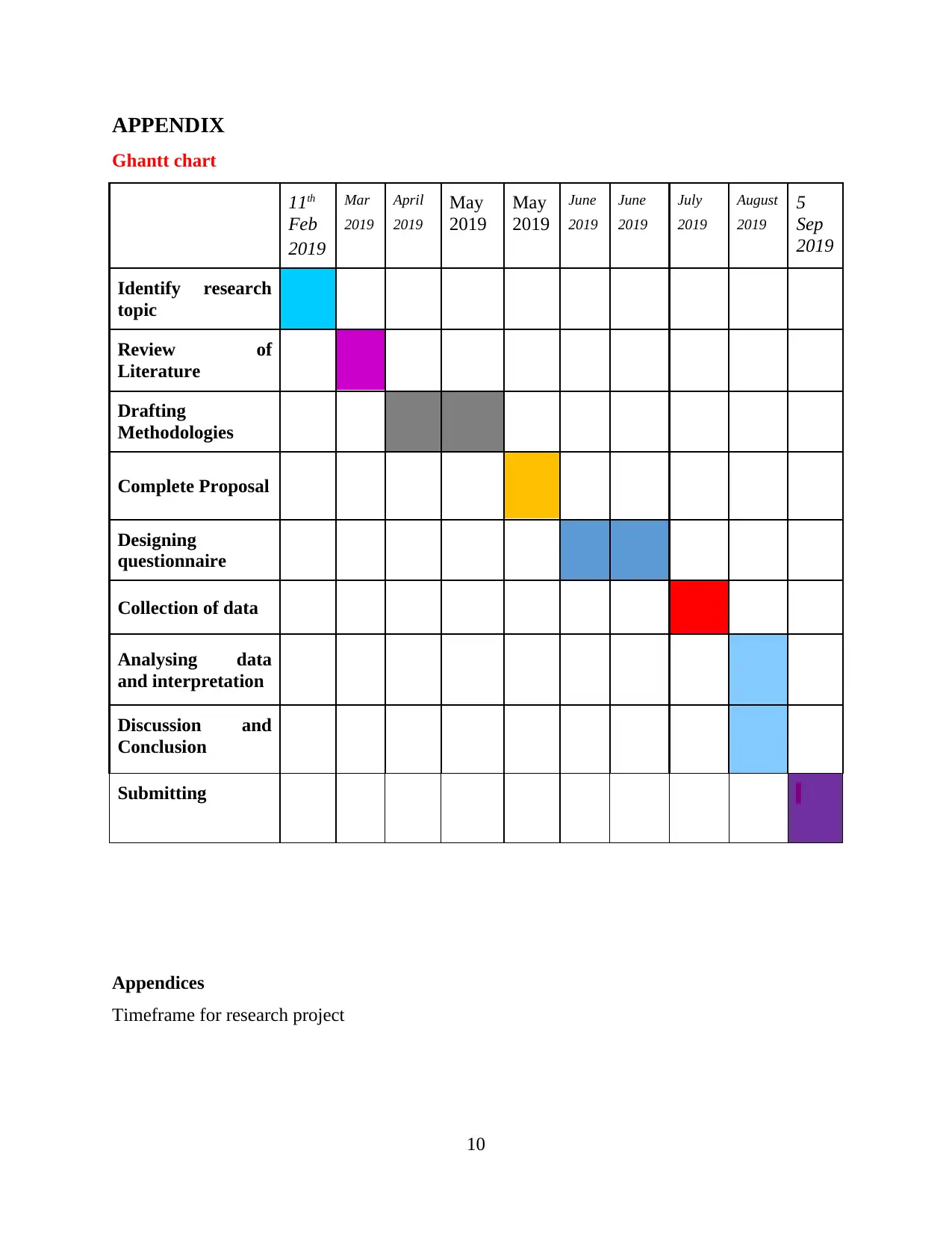
Timeframe for research project
10
Ghantt chart
11th
Feb
2019
Mar
2019
April
2019
May
2019
May
2019
June
2019
June
2019
July
2019
August
2019
5
Sep
2019
Identify research
topic
Review of
Literature
Drafting
Methodologies
Complete Proposal
Designing
questionnaire
Collection of data
Analysing data
and interpretation
Discussion and
Conclusion
Submitting
Appendices
Timeframe for research project
10
⊘ This is a preview!⊘
Do you want full access?
Subscribe today to unlock all pages.
Trusted by 1+ million students worldwide

1 out of 15


Related Documents


Your All-in-One AI-Powered Toolkit for Academic Success.
+13062052269
info@desklib.com
Available 24*7 on WhatsApp / Email
![[object Object]](/_next/static/media/star-bottom.7253800d.svg)
Unlock your academic potential
Copyright © 2020–2026 A2Z Services. All Rights Reserved. Developed and managed by ZUCOL.