Organisational Culture, Motivation, and Effectiveness Report - MG414
VerifiedAdded on 2023/02/01
|13
|1104
|35
Report
AI Summary
This report examines the organizational culture of Sainsbury's, utilizing both primary and secondary research methods. The study identifies Sainsbury's culture based on Handy's typology, highlighting its role-based and task-oriented approach, with elements of power and person culture. The research explores how Sainsbury uses its culture to improve organizational effectiveness, focusing on communication and employee motivation, drawing upon Maslow's hierarchy of needs. It evaluates the impact of culture on employee motivation, emphasizing the role of effective communication and a supportive work environment. The report concludes by assessing how Sainsbury can leverage its existing culture to enhance its success, suggesting strategies such as empowering employees and aligning decision-making processes with cultural values. The research uses interviews and questionnaires for primary data and draws on existing literature to support its findings, providing a comprehensive analysis of Sainsbury's organizational dynamics.
ORGANISATIONAL
BEHAVIOUR
BEHAVIOUR
Paraphrase This Document
Need a fresh take? Get an instant paraphrase of this document with our AI Paraphraser

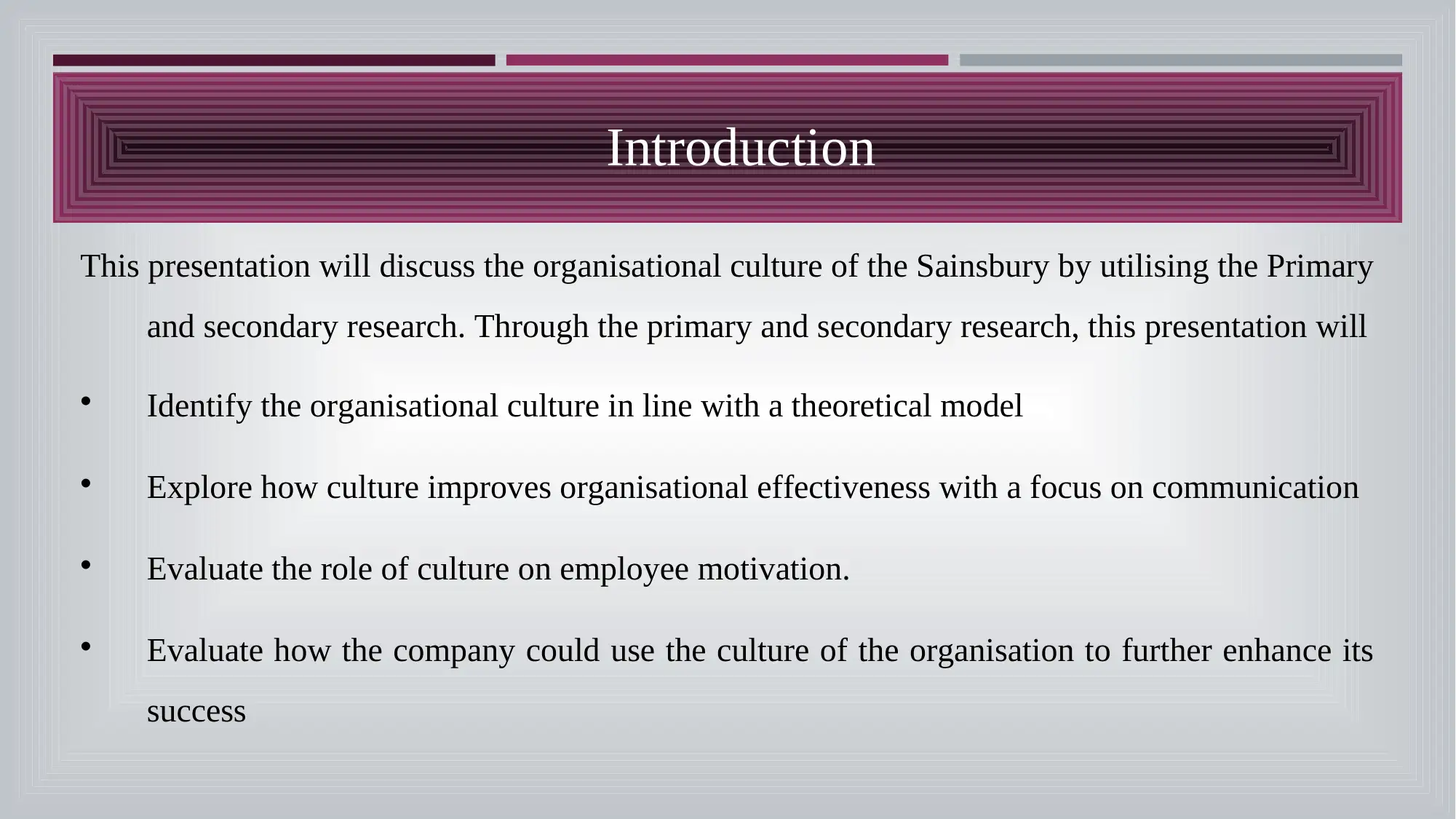
Introduction
This presentation will discuss the organisational culture of the Sainsbury by utilising the Primary
and secondary research. Through the primary and secondary research, this presentation will
Identify the organisational culture in line with a theoretical model
Explore how culture improves organisational effectiveness with a focus on communication
Evaluate the role of culture on employee motivation.
Evaluate how the company could use the culture of the organisation to further enhance its
success
This presentation will discuss the organisational culture of the Sainsbury by utilising the Primary
and secondary research. Through the primary and secondary research, this presentation will
Identify the organisational culture in line with a theoretical model
Explore how culture improves organisational effectiveness with a focus on communication
Evaluate the role of culture on employee motivation.
Evaluate how the company could use the culture of the organisation to further enhance its
success

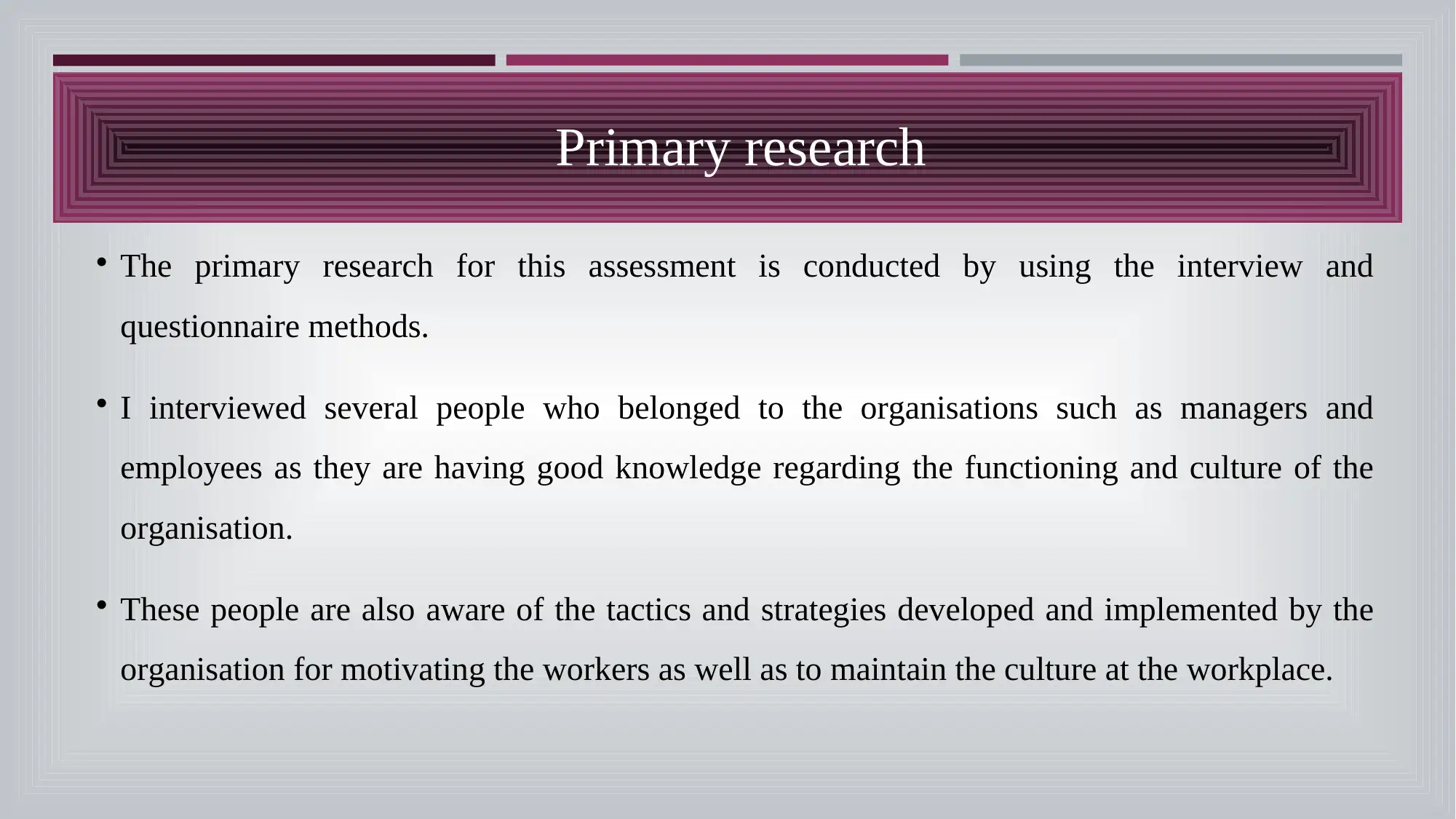
Primary research
The primary research for this assessment is conducted by using the interview and
questionnaire methods.
I interviewed several people who belonged to the organisations such as managers and
employees as they are having good knowledge regarding the functioning and culture of the
organisation.
These people are also aware of the tactics and strategies developed and implemented by the
organisation for motivating the workers as well as to maintain the culture at the workplace.
The primary research for this assessment is conducted by using the interview and
questionnaire methods.
I interviewed several people who belonged to the organisations such as managers and
employees as they are having good knowledge regarding the functioning and culture of the
organisation.
These people are also aware of the tactics and strategies developed and implemented by the
organisation for motivating the workers as well as to maintain the culture at the workplace.
⊘ This is a preview!⊘
Do you want full access?
Subscribe today to unlock all pages.

Trusted by 1+ million students worldwide

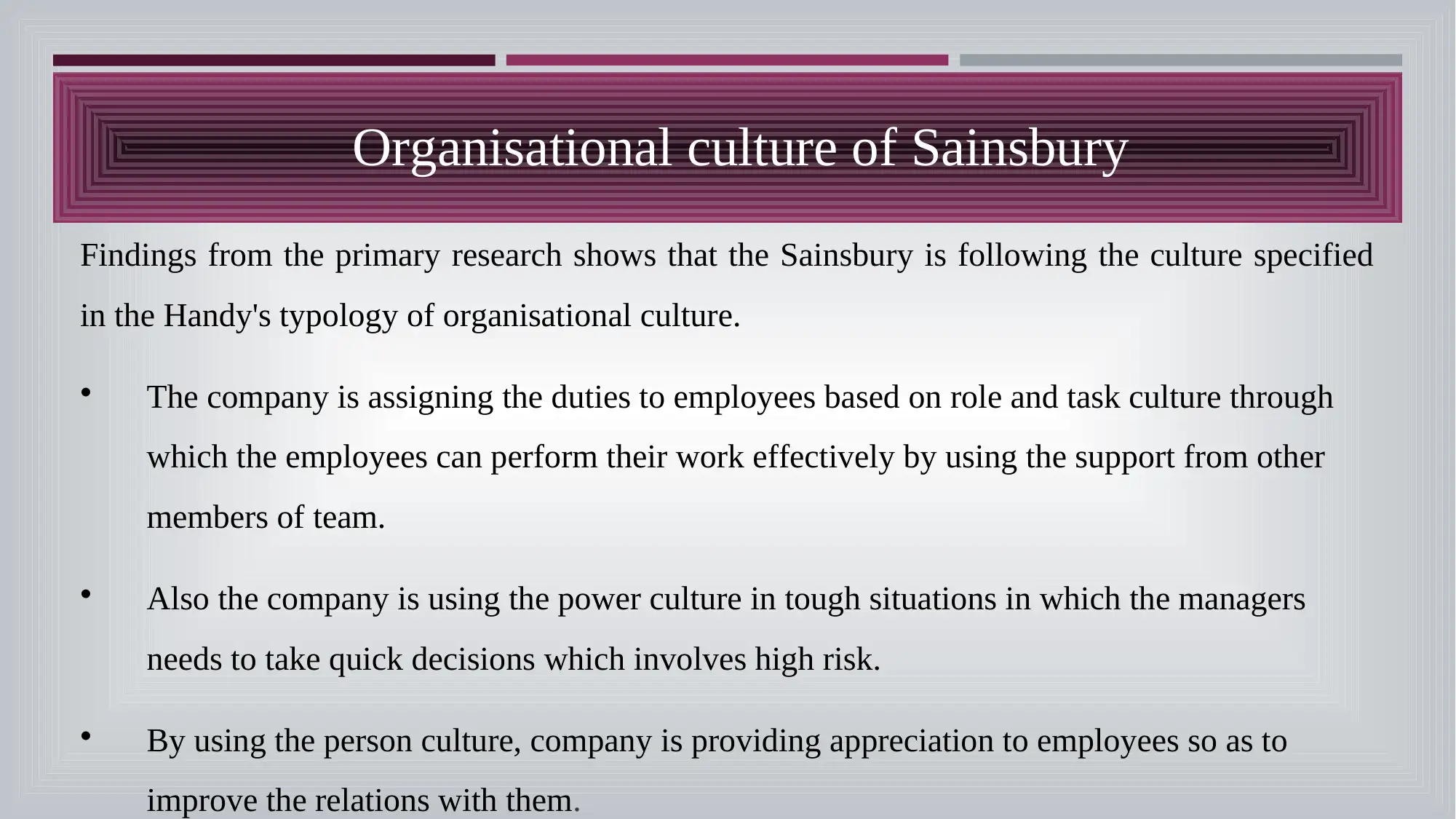
Organisational culture of Sainsbury
Findings from the primary research shows that the Sainsbury is following the culture specified
in the Handy's typology of organisational culture.
The company is assigning the duties to employees based on role and task culture through
which the employees can perform their work effectively by using the support from other
members of team.
Also the company is using the power culture in tough situations in which the managers
needs to take quick decisions which involves high risk.
By using the person culture, company is providing appreciation to employees so as to
improve the relations with them.
Findings from the primary research shows that the Sainsbury is following the culture specified
in the Handy's typology of organisational culture.
The company is assigning the duties to employees based on role and task culture through
which the employees can perform their work effectively by using the support from other
members of team.
Also the company is using the power culture in tough situations in which the managers
needs to take quick decisions which involves high risk.
By using the person culture, company is providing appreciation to employees so as to
improve the relations with them.
Paraphrase This Document
Need a fresh take? Get an instant paraphrase of this document with our AI Paraphraser

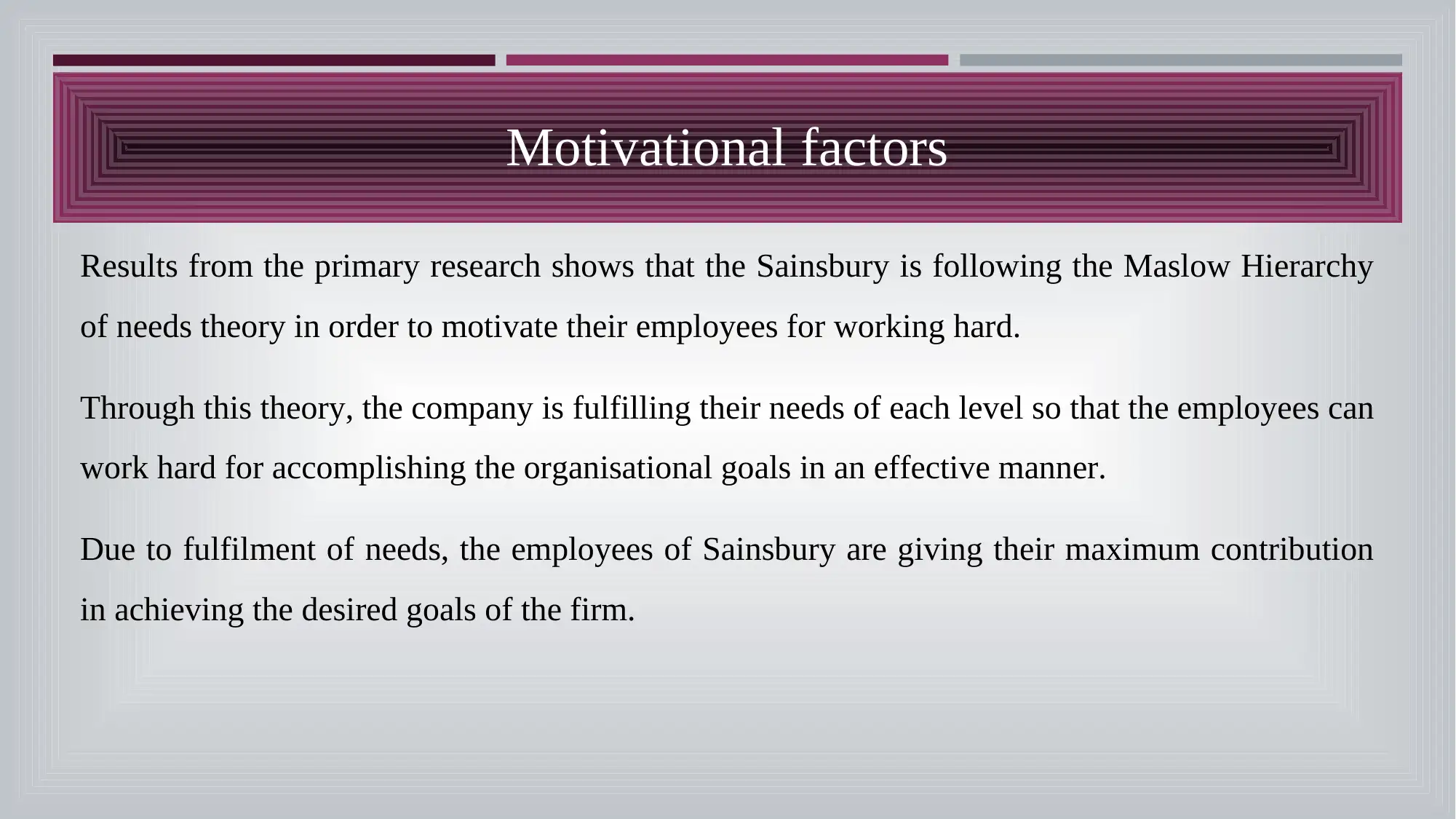
Motivational factors
Results from the primary research shows that the Sainsbury is following the Maslow Hierarchy
of needs theory in order to motivate their employees for working hard.
Through this theory, the company is fulfilling their needs of each level so that the employees can
work hard for accomplishing the organisational goals in an effective manner.
Due to fulfilment of needs, the employees of Sainsbury are giving their maximum contribution
in achieving the desired goals of the firm.
Results from the primary research shows that the Sainsbury is following the Maslow Hierarchy
of needs theory in order to motivate their employees for working hard.
Through this theory, the company is fulfilling their needs of each level so that the employees can
work hard for accomplishing the organisational goals in an effective manner.
Due to fulfilment of needs, the employees of Sainsbury are giving their maximum contribution
in achieving the desired goals of the firm.

Communication
Sainsbury is following the flat organisational structure in their business operations due to which
the level among the employees are less and the employees can communicate with each other in
an effective manner.
Through this structure, the employees of Sainsbury is divided into 3 three level which are
middle, lower and higher.
The higher level employees communicate with medium level employees regarding the issues
and challenges of Lower level employees.
The lower level employees shares their concerns and issues to the middle level or their managers
which are then conveyed to the higher level management by the middle level management.
Sainsbury is following the flat organisational structure in their business operations due to which
the level among the employees are less and the employees can communicate with each other in
an effective manner.
Through this structure, the employees of Sainsbury is divided into 3 three level which are
middle, lower and higher.
The higher level employees communicate with medium level employees regarding the issues
and challenges of Lower level employees.
The lower level employees shares their concerns and issues to the middle level or their managers
which are then conveyed to the higher level management by the middle level management.
⊘ This is a preview!⊘
Do you want full access?
Subscribe today to unlock all pages.

Trusted by 1+ million students worldwide

Culture of Sainsbury according to secondary research
According to secondary research, Sainsbury is following the Handy typology of culture so that
the company can execute its business operations and activities effectively by coordination
among the employees. The culture according to this model are:
Power culture
Role culture
Task culture
Person culture
According to secondary research, Sainsbury is following the Handy typology of culture so that
the company can execute its business operations and activities effectively by coordination
among the employees. The culture according to this model are:
Power culture
Role culture
Task culture
Person culture
Paraphrase This Document
Need a fresh take? Get an instant paraphrase of this document with our AI Paraphraser

How culture can improve organisational effectiveness
Based on the findings from the secondary research, it can be said that the Sainsbury can improve
the organisational effectiveness by motivating their workforce so that they can improve their
efficiency and performance. Through this motivation, the employees can work properly by
resolving their issues as they are getting the required support from each other due to the
effective culture of the workplace. Through the effective culture which is developed by
motivated employees, Sainsbury can get the desired success as employees can coordinate and
communicate with each other effectively as they are motivated in their working. The company
can also use the Theory X and Y for motivating the workers to maintain good culture and
communication at the workplace.
Based on the findings from the secondary research, it can be said that the Sainsbury can improve
the organisational effectiveness by motivating their workforce so that they can improve their
efficiency and performance. Through this motivation, the employees can work properly by
resolving their issues as they are getting the required support from each other due to the
effective culture of the workplace. Through the effective culture which is developed by
motivated employees, Sainsbury can get the desired success as employees can coordinate and
communicate with each other effectively as they are motivated in their working. The company
can also use the Theory X and Y for motivating the workers to maintain good culture and
communication at the workplace.

Role of culture on employees motivation
Culture plays a major role in the motivation of employees as effective culture provides the ease
to employees in their working. Also through effective work culture, employees can
communicate with each other for resolving their issues and problems which will ultimately
motivate them. However, the company is using the theory X and Y for motivating their workers
so that they can maintain effective culture at the workplace. Through effective culture,
employees can interact with each other effectively which will assist them in supporting each
other in complex situations which will keep them motivated.
Culture plays a major role in the motivation of employees as effective culture provides the ease
to employees in their working. Also through effective work culture, employees can
communicate with each other for resolving their issues and problems which will ultimately
motivate them. However, the company is using the theory X and Y for motivating their workers
so that they can maintain effective culture at the workplace. Through effective culture,
employees can interact with each other effectively which will assist them in supporting each
other in complex situations which will keep them motivated.
⊘ This is a preview!⊘
Do you want full access?
Subscribe today to unlock all pages.

Trusted by 1+ million students worldwide

How company can use its culture for enhancing the
success
From the secondary research, it has been said that Sainsbury can use its culture for enhancing
the organisational success. By using the task culture, company can provide the responsibility to
a responsible person so that the work can be executed in effective manner. BY using the power
culture, company can assign the decision making power to a person having adequate knowledge
and skills for taking better decision. BY using the person culture, company can provide
opportunities to employees for making improvement in their working so that they can perform
their work effectively for enhancing the success of the firm.
success
From the secondary research, it has been said that Sainsbury can use its culture for enhancing
the organisational success. By using the task culture, company can provide the responsibility to
a responsible person so that the work can be executed in effective manner. BY using the power
culture, company can assign the decision making power to a person having adequate knowledge
and skills for taking better decision. BY using the person culture, company can provide
opportunities to employees for making improvement in their working so that they can perform
their work effectively for enhancing the success of the firm.
Paraphrase This Document
Need a fresh take? Get an instant paraphrase of this document with our AI Paraphraser

Conclusion
It has been concluded from the above presentation that the organisations should focus on
their culture in order to achieve their goals and objectives in an effective manner so that
the goals can be accomplished in the pre-determined deadlines. Also the organisations
needs to focus on their teams and employees too so that their efficiency and productivity
can be enhanced and they can work without any problems. The organisation should use
various theories and implement them at the workplace in order to maintain effective
culture in which the workers can perform their work effectively for attaining the
organisational goals.
It has been concluded from the above presentation that the organisations should focus on
their culture in order to achieve their goals and objectives in an effective manner so that
the goals can be accomplished in the pre-determined deadlines. Also the organisations
needs to focus on their teams and employees too so that their efficiency and productivity
can be enhanced and they can work without any problems. The organisation should use
various theories and implement them at the workplace in order to maintain effective
culture in which the workers can perform their work effectively for attaining the
organisational goals.

References
Boxall and et. al., 2016. Editorial introduction: Progressing our understanding of the
mediating variables linking HRM, employee well‐being and organisational
performance. Human Resource Management Journal. 26(2). pp.103-111.
Cassidy, T., 2013. Environmental psychology: Behaviour and experience in context.
Psychology Press.
Laforet, S., 2011. A framework of organisational innovation and outcomes in SMEs.
International Journal of Entrepreneurial Behavior & Research. 17(4). pp.380-408.
Piercy, N., 2014. Marketing Budgeting (RLE Marketing): A Political and
Organisational Model. Routledge.
Waddell and et. al., 2016. Organisational change: Development and transformation.
Boxall and et. al., 2016. Editorial introduction: Progressing our understanding of the
mediating variables linking HRM, employee well‐being and organisational
performance. Human Resource Management Journal. 26(2). pp.103-111.
Cassidy, T., 2013. Environmental psychology: Behaviour and experience in context.
Psychology Press.
Laforet, S., 2011. A framework of organisational innovation and outcomes in SMEs.
International Journal of Entrepreneurial Behavior & Research. 17(4). pp.380-408.
Piercy, N., 2014. Marketing Budgeting (RLE Marketing): A Political and
Organisational Model. Routledge.
Waddell and et. al., 2016. Organisational change: Development and transformation.
⊘ This is a preview!⊘
Do you want full access?
Subscribe today to unlock all pages.

Trusted by 1+ million students worldwide
1 out of 13
Related Documents
Your All-in-One AI-Powered Toolkit for Academic Success.
+13062052269
info@desklib.com
Available 24*7 on WhatsApp / Email
Unlock your academic potential
Copyright © 2020–2025 A2Z Services. All Rights Reserved. Developed and managed by ZUCOL.