HRMT19012: Performance Management, Job Analysis, and Ethics
VerifiedAdded on 2023/06/11
|10
|2822
|128
Report
AI Summary
This report provides a detailed analysis of performance management, focusing on the importance of job analysis in organizational performance, the impact of focusing on results on ethical behavior, and the significance of employee development programs. It highlights the benefits of job analysis in hiring, organizational design, and human resource planning, while also discussing the potential for unethical behavior when organizations prioritize results over ethical considerations. Furthermore, the report explores the components and benefits of employee development programs, emphasizing their role in enhancing employee skills, promoting organizational commitment, and improving overall performance. Desklib offers a wealth of resources, including solved assignments and past papers, to aid students in their understanding of these critical management concepts.
Running head: Performance Management 1
Performance Management
Name
Institutional Affiliation
Performance Management
Name
Institutional Affiliation

Paraphrase This Document
Need a fresh take? Get an instant paraphrase of this document with our AI Paraphraser
Performance Management 2
Task-Element One: Job Analysis
Aguinis (2015), defines job analysis as the analysis of job-related activities in an
organization. However, Wright (2016) defines job analysis as the collection and studying of
information that is related to a particular job. In other words, job analysis is involved in
determining the requirements for a specific position. For job analysis to be done correctly,
information about various features of a job has to be collected and studied (Tomić, Tadić, &
Sedlak, 2013). Job analysis is performed to determine the nature of jobs and duties in an
organization. It is an essential human resource function that is related to numerous activities of
human resource management. Job analysis is vital in assessing the value of a job position and is
considered to be the core of human resource management (Cardy, 2014). Features of
employment such as compensation and benefits, legal considerations, training and development,
and safety and health factors of a position are covered by job analysis (Schleicher, Baumann, &
Sullivan, 2018). Discussed below are some of the significant benefits of job analysis.
The benefits of job analysis are linked with the prospect of hiring the most qualified
candidate for a job position. Specifically, job analysis is required, so that skill sets and
competencies that are essential to carry out duties of a particular position are determined, and the
same competencies and skills can be used when searching for suitable candidates (Schleicher,
Baumann, & Sullivan, 2018). Therefore, one of the benefits of conduction job analysis is that it
helps in the preparation of organizational design and structure. In other words, the job analysis
helps in determining how jobs relate to one another and the hierarchy of positions is established.
Also, human resource planning can only be done after a thorough job analysis has been
performed. Job analysis provides qualitative features of jobs in an organization. Job analysis
Task-Element One: Job Analysis
Aguinis (2015), defines job analysis as the analysis of job-related activities in an
organization. However, Wright (2016) defines job analysis as the collection and studying of
information that is related to a particular job. In other words, job analysis is involved in
determining the requirements for a specific position. For job analysis to be done correctly,
information about various features of a job has to be collected and studied (Tomić, Tadić, &
Sedlak, 2013). Job analysis is performed to determine the nature of jobs and duties in an
organization. It is an essential human resource function that is related to numerous activities of
human resource management. Job analysis is vital in assessing the value of a job position and is
considered to be the core of human resource management (Cardy, 2014). Features of
employment such as compensation and benefits, legal considerations, training and development,
and safety and health factors of a position are covered by job analysis (Schleicher, Baumann, &
Sullivan, 2018). Discussed below are some of the significant benefits of job analysis.
The benefits of job analysis are linked with the prospect of hiring the most qualified
candidate for a job position. Specifically, job analysis is required, so that skill sets and
competencies that are essential to carry out duties of a particular position are determined, and the
same competencies and skills can be used when searching for suitable candidates (Schleicher,
Baumann, & Sullivan, 2018). Therefore, one of the benefits of conduction job analysis is that it
helps in the preparation of organizational design and structure. In other words, the job analysis
helps in determining how jobs relate to one another and the hierarchy of positions is established.
Also, human resource planning can only be done after a thorough job analysis has been
performed. Job analysis provides qualitative features of jobs in an organization. Job analysis
Performance Management 3
assists in establishing what job demands will be with regards to the duties to be executed, and
qualifications that a candidate is required to have. Expressly, it is a tool used to match jobs in an
organization with people who can perform the duties (Qureshi & Hassan, 2015). Another
importance of job analysis is in the selection and recruitment of candidates. Bonham (2008)
argues that job analysis helps to select and recruit the most suitable people for jobs that are
available in an organization. He adds that job analysis offers relevant information to select the
right candidate by its instant products such as job specification and description.
Wright (2016) asserted that job analysis helps in performance evaluation and training and
development. Job training needs of a candidate can be done easily after a job analysis has been
carried out. Training helps to boost the performance of employees in an organization. Job
evaluation is another significant benefit of job analysis. Goedegebuure (2017) defines job
evaluation as the in-depth studying of job performance by employees in an organization. Job
evaluation helps in establishing the difficulties in doing a job, the skills needed and the basis on
which salaries are fixed (Kim & Holzer, 2015). Information required to know the required skills
for a job, qualities of a candidate, levels of difficulty, and salary is obtained after job analysis has
been carried out. Nielsen (2016) gives detailed importance of job analysis and identifies
promotions and transfer as a benefit of job description analysis. Job analysis enables human
resource managers to promote employees based on the talent and skill sets required for the job.
Similarly, job analysis ensures that when an employee is transferred to another department or
branch, the role is similar to the roles he held before (Nielsen, 2016). Job analysis is crucial
because it provides the information needed for these decisions to be made.
assists in establishing what job demands will be with regards to the duties to be executed, and
qualifications that a candidate is required to have. Expressly, it is a tool used to match jobs in an
organization with people who can perform the duties (Qureshi & Hassan, 2015). Another
importance of job analysis is in the selection and recruitment of candidates. Bonham (2008)
argues that job analysis helps to select and recruit the most suitable people for jobs that are
available in an organization. He adds that job analysis offers relevant information to select the
right candidate by its instant products such as job specification and description.
Wright (2016) asserted that job analysis helps in performance evaluation and training and
development. Job training needs of a candidate can be done easily after a job analysis has been
carried out. Training helps to boost the performance of employees in an organization. Job
evaluation is another significant benefit of job analysis. Goedegebuure (2017) defines job
evaluation as the in-depth studying of job performance by employees in an organization. Job
evaluation helps in establishing the difficulties in doing a job, the skills needed and the basis on
which salaries are fixed (Kim & Holzer, 2015). Information required to know the required skills
for a job, qualities of a candidate, levels of difficulty, and salary is obtained after job analysis has
been carried out. Nielsen (2016) gives detailed importance of job analysis and identifies
promotions and transfer as a benefit of job description analysis. Job analysis enables human
resource managers to promote employees based on the talent and skill sets required for the job.
Similarly, job analysis ensures that when an employee is transferred to another department or
branch, the role is similar to the roles he held before (Nielsen, 2016). Job analysis is crucial
because it provides the information needed for these decisions to be made.
⊘ This is a preview!⊘
Do you want full access?
Subscribe today to unlock all pages.

Trusted by 1+ million students worldwide
Performance Management 4
According to Bonham (2008) an organization that fails to carry out job analysis risks
having high employee turnover in future. He asserts that many organizations do not assist their
employees in planning their career paths. Planning of career path helps in preventing employees
from leaving. Therefore, job analysis is required because it helps human resource managers to
know the limitations of a job regarding career development. Human resource managers are then
able to guide employees concerning their progress in future (Bonham, 2008). Additionally,
human resource managers can address health and safety aspects of a job. Job analysis offers risk
factors that are related to a specific job hence action can be taken to ensure that the employees
are safe (Sharma, 2016). Finally, job analysis helps in setting performance standards. The
performance standards may in turn help in performance appraisal (Sharma, 2016).
Task-Element Two: Measuring Results and Behaviors
Edwards (2014) argues that striving to achieve results is not usually beneficial from an
ethical viewpoint. He adds that in many cases achieving the results can take precedence over
how the results are obtained. While many institutions and organizations use results as
motivation to direct energy on the desired result, the focus on results raises the possibility of
unethical behavior (Aguinis, 2015). When employees focus their attention on results, their moral
awareness is diminished. Khourshed (2014) asserts that employees may be more disengaged
morally or less likely to focus on making choices that are moral while attempting to achieve a
result. To attain the results, employees may use immoral and risky means of stealing, cheating,
or lying, which they would not do if circumstances were different (Khourshed, 2014).
Over the past few years, unethical behavior in organizations have been rampant. This can
be attributed to the increased focus on profits by organizations. Therefore, unethical behavior is
According to Bonham (2008) an organization that fails to carry out job analysis risks
having high employee turnover in future. He asserts that many organizations do not assist their
employees in planning their career paths. Planning of career path helps in preventing employees
from leaving. Therefore, job analysis is required because it helps human resource managers to
know the limitations of a job regarding career development. Human resource managers are then
able to guide employees concerning their progress in future (Bonham, 2008). Additionally,
human resource managers can address health and safety aspects of a job. Job analysis offers risk
factors that are related to a specific job hence action can be taken to ensure that the employees
are safe (Sharma, 2016). Finally, job analysis helps in setting performance standards. The
performance standards may in turn help in performance appraisal (Sharma, 2016).
Task-Element Two: Measuring Results and Behaviors
Edwards (2014) argues that striving to achieve results is not usually beneficial from an
ethical viewpoint. He adds that in many cases achieving the results can take precedence over
how the results are obtained. While many institutions and organizations use results as
motivation to direct energy on the desired result, the focus on results raises the possibility of
unethical behavior (Aguinis, 2015). When employees focus their attention on results, their moral
awareness is diminished. Khourshed (2014) asserts that employees may be more disengaged
morally or less likely to focus on making choices that are moral while attempting to achieve a
result. To attain the results, employees may use immoral and risky means of stealing, cheating,
or lying, which they would not do if circumstances were different (Khourshed, 2014).
Over the past few years, unethical behavior in organizations have been rampant. This can
be attributed to the increased focus on profits by organizations. Therefore, unethical behavior is
Paraphrase This Document
Need a fresh take? Get an instant paraphrase of this document with our AI Paraphraser
Performance Management 5
inescapable. Due to the increase in unethical behavior in organizations, causes of unethical
behavior are being discovered, and one of them is focus on results by organizations (Jones,
2016). Bonham (2008) argues that people usually think unethical behavior is as a result of bad
character. However, this conclusion is inadequate. Bonham (2008) adds that most people can
behave unethically. This is because people often engage in unethical behavior without realizing
that they are behaving unethically. It is plausible that certain situations make people blind to the
fact that they may be behaving in an unethical way. An organization that focuses on results as a
measure of success makes employees to focus on meeting expectations that they forget about
other goals (Bonham, 2008). When results is the focus and other goals fade away from view,
employees become unaware of unethical behavior. Therefore, it is not ones character that makes
them behave unethically. It is the situation that they are in that cause them to behave unethically.
Ying (2013) asserts that focus on results in the short term is what leads to unethical
because of the pressure it exerts on employees. Therefore, managers can limit unethical behavior
in organizations if they eliminate short-term deadlines and results. Instead, they should have
employees focus on long-term results. Ying (2013) also identified focus on results as one of the
factors that lead to unethical behavior. He point out that intense focus on results in an
organization forces employees to focus on profits and not on business ethics, which increases
possibility of unethical behavior. Also, performance measurement based on end results without
taking into account how ethical the ways of achieving the results were promotes unethical
behavior (Tomić, Tadić, & Sedlak, 2013). According to Aguinis (2015) focus on short-term
results lead to unethical behavior. He evaluated pressure to perform in the workplace and the
actions and behaviors that are caused by pressure to perform. He found that when people in an
inescapable. Due to the increase in unethical behavior in organizations, causes of unethical
behavior are being discovered, and one of them is focus on results by organizations (Jones,
2016). Bonham (2008) argues that people usually think unethical behavior is as a result of bad
character. However, this conclusion is inadequate. Bonham (2008) adds that most people can
behave unethically. This is because people often engage in unethical behavior without realizing
that they are behaving unethically. It is plausible that certain situations make people blind to the
fact that they may be behaving in an unethical way. An organization that focuses on results as a
measure of success makes employees to focus on meeting expectations that they forget about
other goals (Bonham, 2008). When results is the focus and other goals fade away from view,
employees become unaware of unethical behavior. Therefore, it is not ones character that makes
them behave unethically. It is the situation that they are in that cause them to behave unethically.
Ying (2013) asserts that focus on results in the short term is what leads to unethical
because of the pressure it exerts on employees. Therefore, managers can limit unethical behavior
in organizations if they eliminate short-term deadlines and results. Instead, they should have
employees focus on long-term results. Ying (2013) also identified focus on results as one of the
factors that lead to unethical behavior. He point out that intense focus on results in an
organization forces employees to focus on profits and not on business ethics, which increases
possibility of unethical behavior. Also, performance measurement based on end results without
taking into account how ethical the ways of achieving the results were promotes unethical
behavior (Tomić, Tadić, & Sedlak, 2013). According to Aguinis (2015) focus on short-term
results lead to unethical behavior. He evaluated pressure to perform in the workplace and the
actions and behaviors that are caused by pressure to perform. He found that when people in an
Performance Management 6
organization feel that their jobs depend on high results for them to remain employed, they strive
to achieve the results by all means and disregard ethical behavior. He adds that performance
pressure evokes cheating when employees feel that their jobs are threatened. Although they are
aware that they will get massive payoff if they raise their performance, employees are also
significantly aware that if they do not meet expectations they will be at risk of losing their jobs.
This is particularly true if employees feel that they cannot achieve the expected outcome any
other way. The perception that they cannot meet expectations any other way leads to anger,
which result in unethical behavior. This pressure to perform and anger make employees to focus
on what will be of benefit to them even if it causes harm to the organization (Aguinis, 2015).
Employees in this emotional state turn to unethical behavior like cheating or lying to meet the
organizations demands with respect to results.
Pulakos & Mueller-Hanson (2017) argue that businesses today operate in a cycle where
no performance is ever good enough. Even if an employee sets records this month, they will be
required to break that record the following month. People become angry and self-serving as a
result, hence the likelihood to behave unethically. They conclude that while performance
pressure might motivate employees and make them creative, it can also make them act
unethically.
Task-Element Three: Employee Development
Employee development programs are comprised of elements like mentoring, career
counseling, job rotation, in-service training, and promotion (Wright, 2016). As defined by Jones
(2016) employee development is the realization of an employee’s potential and ability by
providing educational and learning experiences. He adds that there are no procedures for creating
organization feel that their jobs depend on high results for them to remain employed, they strive
to achieve the results by all means and disregard ethical behavior. He adds that performance
pressure evokes cheating when employees feel that their jobs are threatened. Although they are
aware that they will get massive payoff if they raise their performance, employees are also
significantly aware that if they do not meet expectations they will be at risk of losing their jobs.
This is particularly true if employees feel that they cannot achieve the expected outcome any
other way. The perception that they cannot meet expectations any other way leads to anger,
which result in unethical behavior. This pressure to perform and anger make employees to focus
on what will be of benefit to them even if it causes harm to the organization (Aguinis, 2015).
Employees in this emotional state turn to unethical behavior like cheating or lying to meet the
organizations demands with respect to results.
Pulakos & Mueller-Hanson (2017) argue that businesses today operate in a cycle where
no performance is ever good enough. Even if an employee sets records this month, they will be
required to break that record the following month. People become angry and self-serving as a
result, hence the likelihood to behave unethically. They conclude that while performance
pressure might motivate employees and make them creative, it can also make them act
unethically.
Task-Element Three: Employee Development
Employee development programs are comprised of elements like mentoring, career
counseling, job rotation, in-service training, and promotion (Wright, 2016). As defined by Jones
(2016) employee development is the realization of an employee’s potential and ability by
providing educational and learning experiences. He adds that there are no procedures for creating
⊘ This is a preview!⊘
Do you want full access?
Subscribe today to unlock all pages.
Trusted by 1+ million students worldwide
Performance Management 7
employee development programs, but there are essential aspects that must be considered. Jones
(2016) asserts that an effective employee development program is comprised of goal setting,
learning, evaluation, career planning. These factors if considered make employee development
beneficial to both the employee and the organization.
Running a successful organization requires employees that are efficient. Skills that are
specific to jobs, competence, knowledge needed in the workplace are not taught in formal
learning institutions (Edwards, 2014). For this reason, it is essential for organizations to engage
in employee development if the employees are to have a significant contribution to the growth of
the organization. Therefore, continuous and extensive employee development programs are often
needed to achieve high performance in organizations (Edwards, 2014). Employee development
enable employees to be effective and flexible in their jobs. It leads to high performance in
organizations because employees feel that the organization values them. Also, employee
development results in high performance in the organization because it makes employees feel
that they are the organization’s integral part of the organization. This also shows that the
organization is committed to their development needs. Kim & Holzer (2015) asserts that to make
employees feel that they are an integral part of an organization, employee development should be
considered by all organizations. They add that the aim of employee development is to enhance
competencies and skill sets to make them effective and efficient. This in turn leads to enhanced
performance in the entire organization. In addition, employee development makes employees to
identify with an organization. If employees identify with the organization they work in they are
likely to perform and produce desired outcomes. According to Jones (2016) employee
development helps in improving the overall performance. It does not merely enhance individual
employee development programs, but there are essential aspects that must be considered. Jones
(2016) asserts that an effective employee development program is comprised of goal setting,
learning, evaluation, career planning. These factors if considered make employee development
beneficial to both the employee and the organization.
Running a successful organization requires employees that are efficient. Skills that are
specific to jobs, competence, knowledge needed in the workplace are not taught in formal
learning institutions (Edwards, 2014). For this reason, it is essential for organizations to engage
in employee development if the employees are to have a significant contribution to the growth of
the organization. Therefore, continuous and extensive employee development programs are often
needed to achieve high performance in organizations (Edwards, 2014). Employee development
enable employees to be effective and flexible in their jobs. It leads to high performance in
organizations because employees feel that the organization values them. Also, employee
development results in high performance in the organization because it makes employees feel
that they are the organization’s integral part of the organization. This also shows that the
organization is committed to their development needs. Kim & Holzer (2015) asserts that to make
employees feel that they are an integral part of an organization, employee development should be
considered by all organizations. They add that the aim of employee development is to enhance
competencies and skill sets to make them effective and efficient. This in turn leads to enhanced
performance in the entire organization. In addition, employee development makes employees to
identify with an organization. If employees identify with the organization they work in they are
likely to perform and produce desired outcomes. According to Jones (2016) employee
development helps in improving the overall performance. It does not merely enhance individual
Paraphrase This Document
Need a fresh take? Get an instant paraphrase of this document with our AI Paraphraser
Performance Management 8
employee’s skill sets. According Bonham (2008), knowledge is capital for the organization and
the individual employee. Therefore, organizations must value learning as much as employees.
Jones (2016) argues that many companies cannot guarantee that they will promote employees to
the top. Therefore, employees may not see the need to perform exceptionally. He asserts that
employee development programs make them feel that they are in the long-term plans of the
organization and cares about their future, and this enhances their performance.
Employee development has many positive organizational outcomes such as preventing
conflicts between organizations and their employees and limiting liabilities for the organization.
However, there are also negative organizational outcomes that are related to employee
development. For instance, one might think that the amount of money invested by organizations
in employee development programs is negligible. However, according to Jones (2016),
organizations spending for employee development programs amount to over $1,200 per
employee. For organizations that have less than 500 employees, the amount spent on employee
development is much higher at about $2,000 per employee. Jones (2016) also adds that
organizations spend about 32 hours per year engaging in employee development. This might
affect an organization's bottom-line. It is clear that employee development comes at a cost. Also,
managing and monitoring costs associated with employee development is difficult because the
costs are unpredictable and substantial (Jones, 2016).
References
employee’s skill sets. According Bonham (2008), knowledge is capital for the organization and
the individual employee. Therefore, organizations must value learning as much as employees.
Jones (2016) argues that many companies cannot guarantee that they will promote employees to
the top. Therefore, employees may not see the need to perform exceptionally. He asserts that
employee development programs make them feel that they are in the long-term plans of the
organization and cares about their future, and this enhances their performance.
Employee development has many positive organizational outcomes such as preventing
conflicts between organizations and their employees and limiting liabilities for the organization.
However, there are also negative organizational outcomes that are related to employee
development. For instance, one might think that the amount of money invested by organizations
in employee development programs is negligible. However, according to Jones (2016),
organizations spending for employee development programs amount to over $1,200 per
employee. For organizations that have less than 500 employees, the amount spent on employee
development is much higher at about $2,000 per employee. Jones (2016) also adds that
organizations spend about 32 hours per year engaging in employee development. This might
affect an organization's bottom-line. It is clear that employee development comes at a cost. Also,
managing and monitoring costs associated with employee development is difficult because the
costs are unpredictable and substantial (Jones, 2016).
References
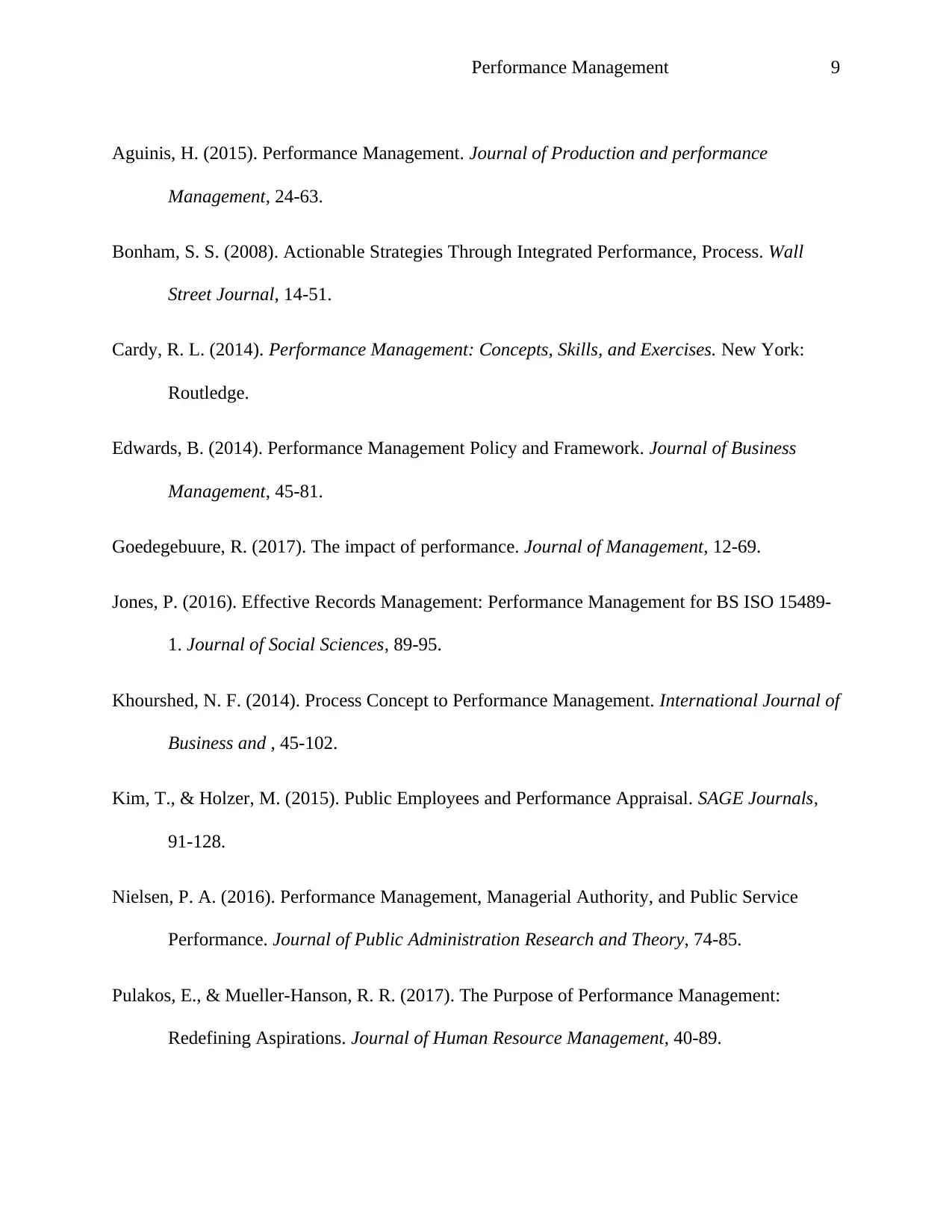
Performance Management 9
Aguinis, H. (2015). Performance Management. Journal of Production and performance
Management, 24-63.
Bonham, S. S. (2008). Actionable Strategies Through Integrated Performance, Process. Wall
Street Journal, 14-51.
Cardy, R. L. (2014). Performance Management: Concepts, Skills, and Exercises. New York:
Routledge.
Edwards, B. (2014). Performance Management Policy and Framework. Journal of Business
Management, 45-81.
Goedegebuure, R. (2017). The impact of performance. Journal of Management, 12-69.
Jones, P. (2016). Effective Records Management: Performance Management for BS ISO 15489-
1. Journal of Social Sciences, 89-95.
Khourshed, N. F. (2014). Process Concept to Performance Management. International Journal of
Business and , 45-102.
Kim, T., & Holzer, M. (2015). Public Employees and Performance Appraisal. SAGE Journals,
91-128.
Nielsen, P. A. (2016). Performance Management, Managerial Authority, and Public Service
Performance. Journal of Public Administration Research and Theory, 74-85.
Pulakos, E., & Mueller-Hanson, R. R. (2017). The Purpose of Performance Management:
Redefining Aspirations. Journal of Human Resource Management, 40-89.
Aguinis, H. (2015). Performance Management. Journal of Production and performance
Management, 24-63.
Bonham, S. S. (2008). Actionable Strategies Through Integrated Performance, Process. Wall
Street Journal, 14-51.
Cardy, R. L. (2014). Performance Management: Concepts, Skills, and Exercises. New York:
Routledge.
Edwards, B. (2014). Performance Management Policy and Framework. Journal of Business
Management, 45-81.
Goedegebuure, R. (2017). The impact of performance. Journal of Management, 12-69.
Jones, P. (2016). Effective Records Management: Performance Management for BS ISO 15489-
1. Journal of Social Sciences, 89-95.
Khourshed, N. F. (2014). Process Concept to Performance Management. International Journal of
Business and , 45-102.
Kim, T., & Holzer, M. (2015). Public Employees and Performance Appraisal. SAGE Journals,
91-128.
Nielsen, P. A. (2016). Performance Management, Managerial Authority, and Public Service
Performance. Journal of Public Administration Research and Theory, 74-85.
Pulakos, E., & Mueller-Hanson, R. R. (2017). The Purpose of Performance Management:
Redefining Aspirations. Journal of Human Resource Management, 40-89.
⊘ This is a preview!⊘
Do you want full access?
Subscribe today to unlock all pages.
Trusted by 1+ million students worldwide
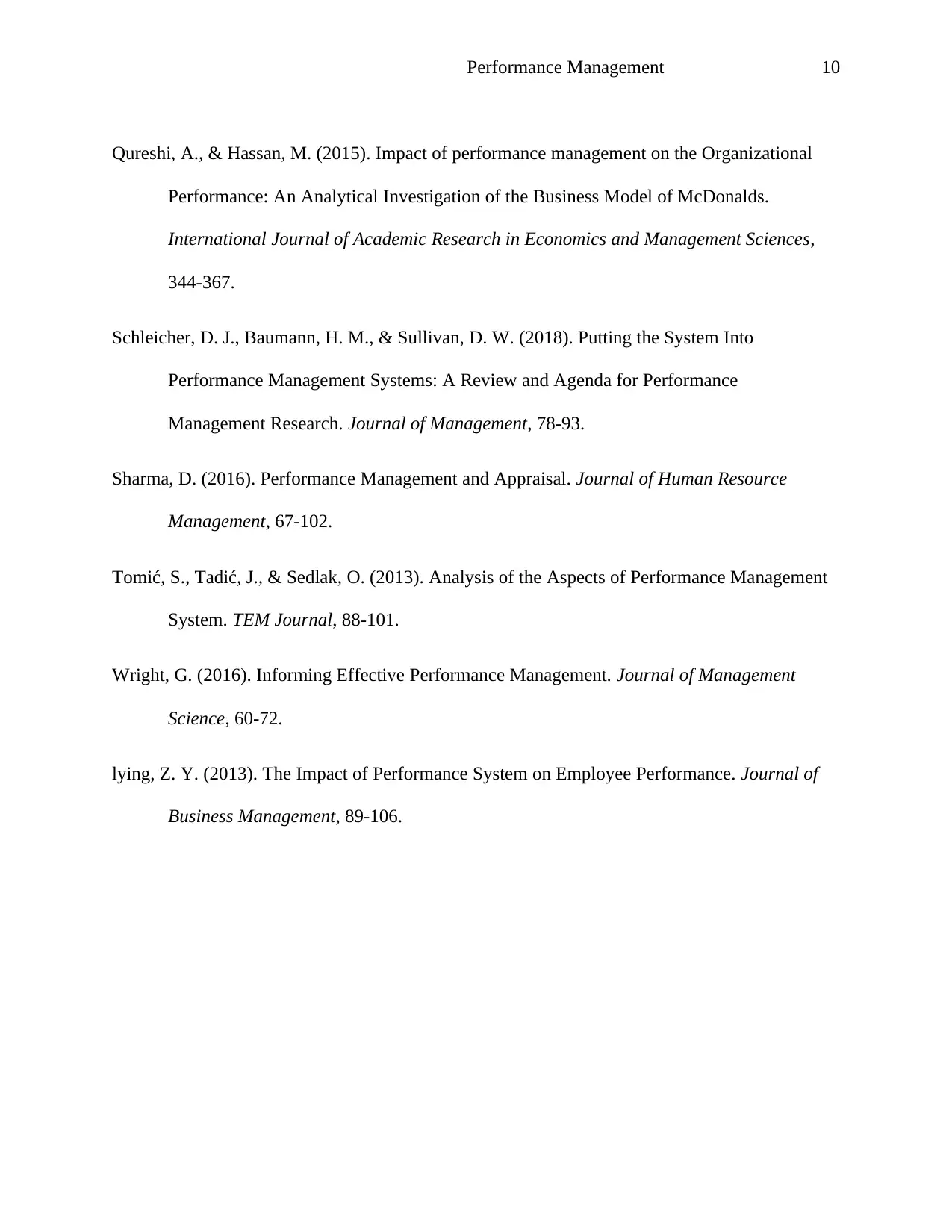
Performance Management 10
Qureshi, A., & Hassan, M. (2015). Impact of performance management on the Organizational
Performance: An Analytical Investigation of the Business Model of McDonalds.
International Journal of Academic Research in Economics and Management Sciences,
344-367.
Schleicher, D. J., Baumann, H. M., & Sullivan, D. W. (2018). Putting the System Into
Performance Management Systems: A Review and Agenda for Performance
Management Research. Journal of Management, 78-93.
Sharma, D. (2016). Performance Management and Appraisal. Journal of Human Resource
Management, 67-102.
Tomić, S., Tadić, J., & Sedlak, O. (2013). Analysis of the Aspects of Performance Management
System. TEM Journal, 88-101.
Wright, G. (2016). Informing Effective Performance Management. Journal of Management
Science, 60-72.
lying, Z. Y. (2013). The Impact of Performance System on Employee Performance. Journal of
Business Management, 89-106.
Qureshi, A., & Hassan, M. (2015). Impact of performance management on the Organizational
Performance: An Analytical Investigation of the Business Model of McDonalds.
International Journal of Academic Research in Economics and Management Sciences,
344-367.
Schleicher, D. J., Baumann, H. M., & Sullivan, D. W. (2018). Putting the System Into
Performance Management Systems: A Review and Agenda for Performance
Management Research. Journal of Management, 78-93.
Sharma, D. (2016). Performance Management and Appraisal. Journal of Human Resource
Management, 67-102.
Tomić, S., Tadić, J., & Sedlak, O. (2013). Analysis of the Aspects of Performance Management
System. TEM Journal, 88-101.
Wright, G. (2016). Informing Effective Performance Management. Journal of Management
Science, 60-72.
lying, Z. Y. (2013). The Impact of Performance System on Employee Performance. Journal of
Business Management, 89-106.

1 out of 10


Related Documents


Your All-in-One AI-Powered Toolkit for Academic Success.
+13062052269
info@desklib.com
Available 24*7 on WhatsApp / Email
![[object Object]](/_next/static/media/star-bottom.7253800d.svg)
Unlock your academic potential
Copyright © 2020–2026 A2Z Services. All Rights Reserved. Developed and managed by ZUCOL.