Individual Quantitative Literacy Study: Business Financial Evaluation

Verified

Added on  2022/09/01

|7
|1787
|13
Homework Assignment
AI Summary
This assignment is a quantitative literacy study that analyzes the financial performance of two businesses: a car wash and a kebab van. The study calculates the maximum gross revenue of the car wash, considering both hand washing and vacuum cleaning services, and accounts for employee breaks. It also assesses the revenue of the kebab van, taking into account operating hours and staff breaks. Furthermore, the study considers a competing business and its potential impact on the car wash. The analysis includes calculations of revenue, break times, and the impact of competition. The author recommends merging the two businesses with a coffee shop to increase capital muscle and market share. The study uses the provided data to evaluate the businesses and make recommendations based on financial analysis.
Document Page
Quantitative Literacy Study 1
INDIVIDUAL QUANTITATIVE LITERACY STUDY
By (Name)
Course
Professor
University Name
City and State
Date
tabler-icon-diamond-filled.svg

Paraphrase This Document

Need a fresh take? Get an instant paraphrase of this document with our AI Paraphraser
Document Page
Quantitative Literacy Study 2
Introduction
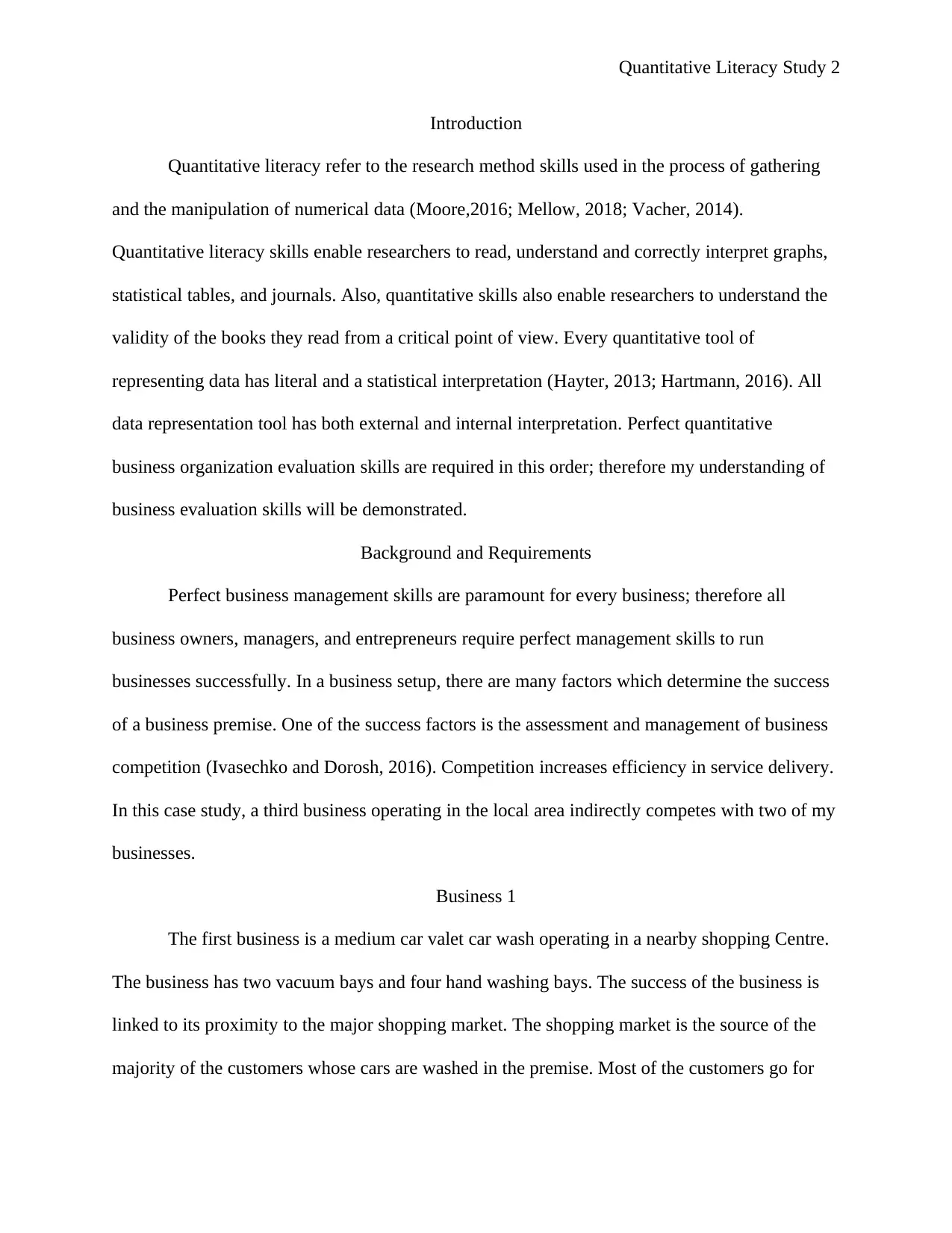
Quantitative literacy refer to the research method skills used in the process of gathering
and the manipulation of numerical data (Moore,2016; Mellow, 2018; Vacher, 2014).
Quantitative literacy skills enable researchers to read, understand and correctly interpret graphs,
statistical tables, and journals. Also, quantitative skills also enable researchers to understand the
validity of the books they read from a critical point of view. Every quantitative tool of
representing data has literal and a statistical interpretation (Hayter, 2013; Hartmann, 2016). All
data representation tool has both external and internal interpretation. Perfect quantitative
business organization evaluation skills are required in this order; therefore my understanding of
business evaluation skills will be demonstrated.
Background and Requirements
Perfect business management skills are paramount for every business; therefore all
business owners, managers, and entrepreneurs require perfect management skills to run
businesses successfully. In a business setup, there are many factors which determine the success
of a business premise. One of the success factors is the assessment and management of business
competition (Ivasechko and Dorosh, 2016). Competition increases efficiency in service delivery.
In this case study, a third business operating in the local area indirectly competes with two of my
businesses.
Business 1
The first business is a medium car valet car wash operating in a nearby shopping Centre.
The business has two vacuum bays and four hand washing bays. The success of the business is
linked to its proximity to the major shopping market. The shopping market is the source of the
majority of the customers whose cars are washed in the premise. Most of the customers go for
Document Page
Quantitative Literacy Study 3
shopping as their cars are washed. The car was business is dependent on the activities of the
shopping Centre therefore, operating hours of the shopping center defines the operating hours of
the business. However, there is an option of extending the operating hours if loyal customers
visit the business at odd hours.
In normal circumstances, the business operates 8 hours per day in 6 days a week because
the shopping center is non-operational on Sundays thus no many customers on Sundays to
support business operations. A total of 12 employees work in the car wash each taking a one-
hour break during the 8-hours working hours operation. The vacuum and hand wash bays share
the 12 employees equally who work under instructions of one overall operations manager. The
charge for a vacuum cleaning is $10 and $40 for hand washing service. Each takes an average of
10 minutes to vacuum clean while hand washing takes an average of twenty minutes. All this
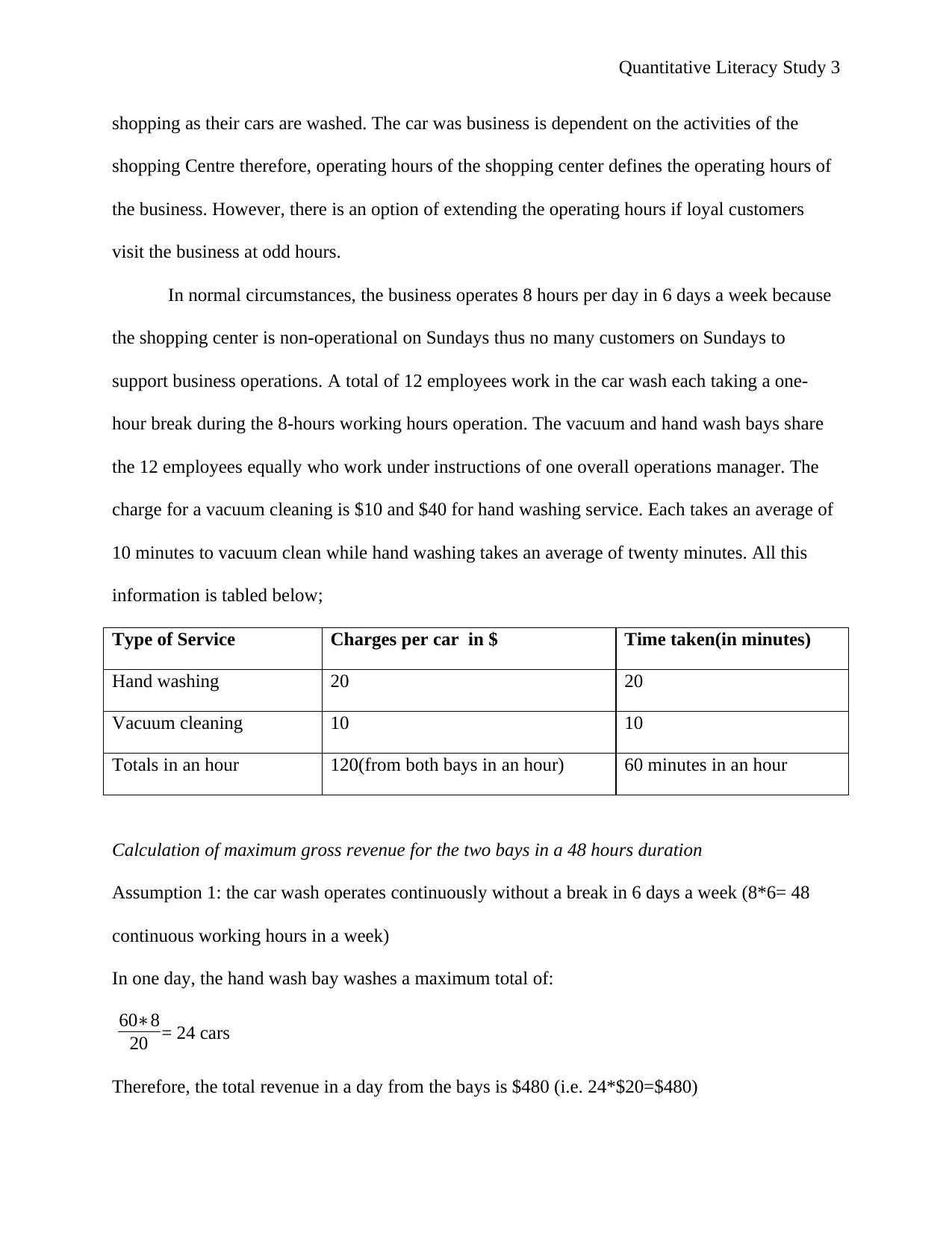
information is tabled below;
Type of Service Charges per car in $ Time taken(in minutes)
Hand washing 20 20
Vacuum cleaning 10 10
Totals in an hour 120(from both bays in an hour) 60 minutes in an hour
Calculation of maximum gross revenue for the two bays in a 48 hours duration
Assumption 1: the car wash operates continuously without a break in 6 days a week (8*6= 48
continuous working hours in a week)
In one day, the hand wash bay washes a maximum total of:
608
20 = 24 cars
Therefore, the total revenue in a day from the bays is $480 (i.e. 24*$20=$480)
Document Page
Quantitative Literacy Study 4
In six days, the total revenue is from this bay is:
480*6=$2880
On the other hand, in one day, the vacuum bay washes a maximum total of:
608
10 = 48 cars
Therefore, the total revenue in a day from the vacuum bay is $480 (i.e. 48*$10=$480)
In six days, the total revenue is from this bay is:
480*6=$2880
In six days, the total revenue from both bays disregarding the number of employees resting hours
will be $2880+$2880= $5760
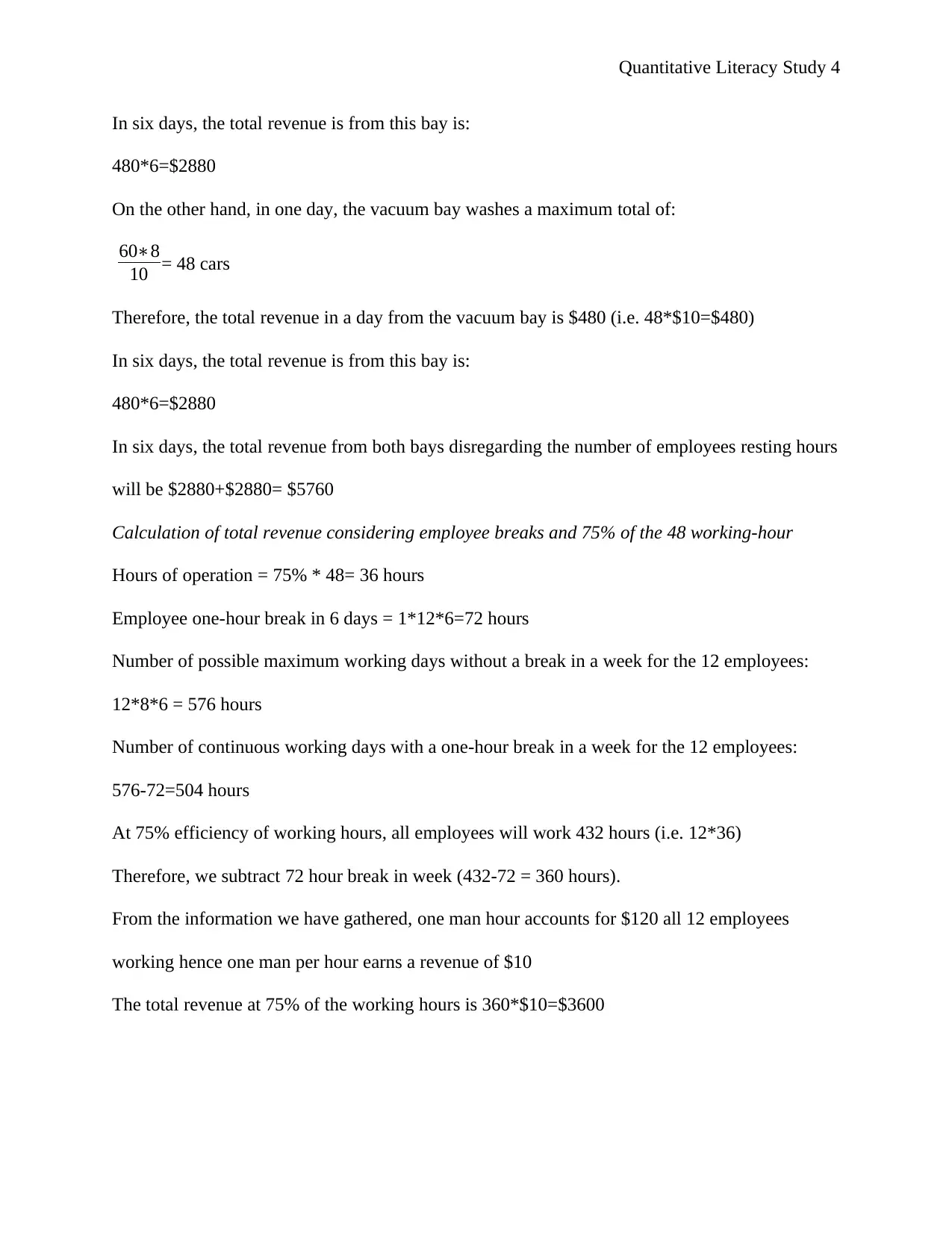
Calculation of total revenue considering employee breaks and 75% of the 48 working-hour
Hours of operation = 75% * 48= 36 hours
Employee one-hour break in 6 days = 1*12*6=72 hours
Number of possible maximum working days without a break in a week for the 12 employees:
12*8*6 = 576 hours
Number of continuous working days with a one-hour break in a week for the 12 employees:
576-72=504 hours
At 75% efficiency of working hours, all employees will work 432 hours (i.e. 12*36)
Therefore, we subtract 72 hour break in week (432-72 = 360 hours).
From the information we have gathered, one man hour accounts for $120 all 12 employees
working hence one man per hour earns a revenue of $10
The total revenue at 75% of the working hours is 360*$10=$3600
tabler-icon-diamond-filled.svg

Paraphrase This Document

Need a fresh take? Get an instant paraphrase of this document with our AI Paraphraser
Document Page
Quantitative Literacy Study 5
Business 2
The second business is that of a small kebab van operating adjacent to the car wash. The
business operates from 12 noon to 2am for 7 days a week. A total of four staff work in the kebab
business and are always on duty. Staff rotation takes places every 8 hours and all employees are
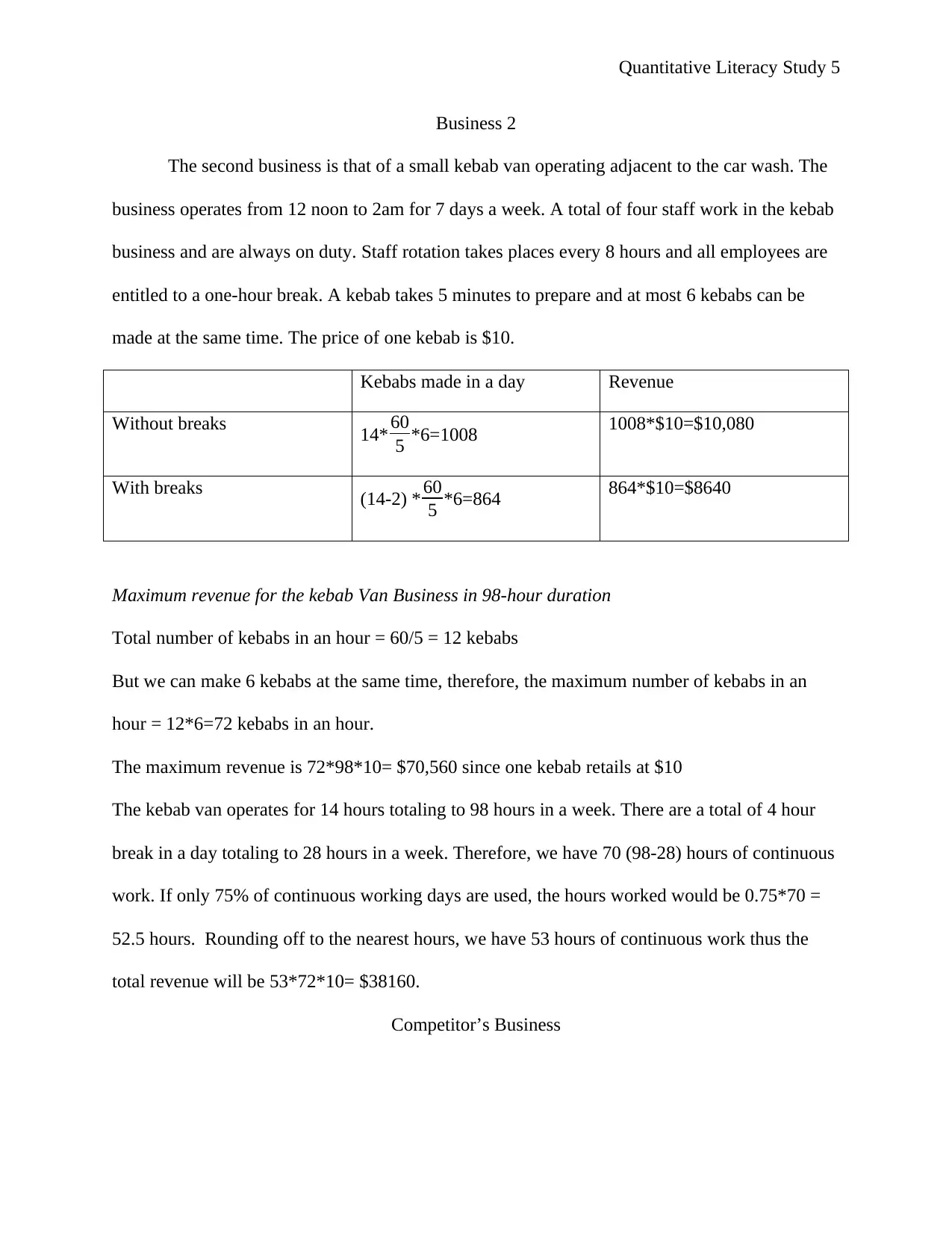
entitled to a one-hour break. A kebab takes 5 minutes to prepare and at most 6 kebabs can be
made at the same time. The price of one kebab is $10.
Kebabs made in a day Revenue
Without breaks 14* 60
5 *6=1008 1008*$10=$10,080
With breaks (14-2) * 60
5 *6=864 864*$10=$8640
Maximum revenue for the kebab Van Business in 98-hour duration
Total number of kebabs in an hour = 60/5 = 12 kebabs
But we can make 6 kebabs at the same time, therefore, the maximum number of kebabs in an
hour = 12*6=72 kebabs in an hour.
The maximum revenue is 72*98*10= $70,560 since one kebab retails at $10
The kebab van operates for 14 hours totaling to 98 hours in a week. There are a total of 4 hour
break in a day totaling to 28 hours in a week. Therefore, we have 70 (98-28) hours of continuous
work. If only 75% of continuous working days are used, the hours worked would be 0.75*70 =
52.5 hours. Rounding off to the nearest hours, we have 53 hours of continuous work thus the
total revenue will be 53*72*10= $38160.
Competitor’s Business
Document Page
Quantitative Literacy Study 6
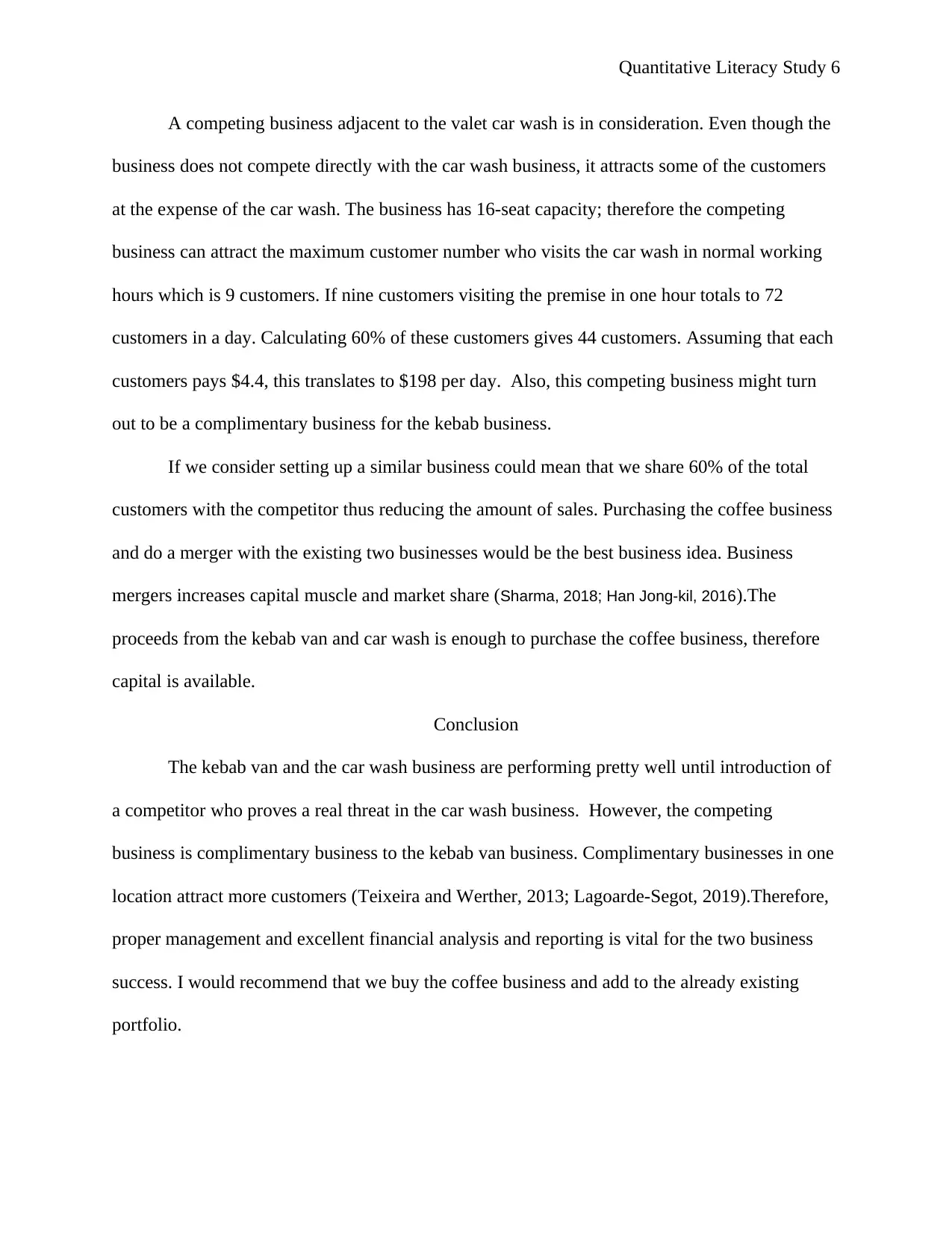
A competing business adjacent to the valet car wash is in consideration. Even though the
business does not compete directly with the car wash business, it attracts some of the customers
at the expense of the car wash. The business has 16-seat capacity; therefore the competing
business can attract the maximum customer number who visits the car wash in normal working
hours which is 9 customers. If nine customers visiting the premise in one hour totals to 72
customers in a day. Calculating 60% of these customers gives 44 customers. Assuming that each
customers pays $4.4, this translates to $198 per day. Also, this competing business might turn
out to be a complimentary business for the kebab business.
If we consider setting up a similar business could mean that we share 60% of the total
customers with the competitor thus reducing the amount of sales. Purchasing the coffee business
and do a merger with the existing two businesses would be the best business idea. Business
mergers increases capital muscle and market share (Sharma, 2018; Han Jong-kil, 2016).The
proceeds from the kebab van and car wash is enough to purchase the coffee business, therefore
capital is available.
Conclusion
The kebab van and the car wash business are performing pretty well until introduction of
a competitor who proves a real threat in the car wash business. However, the competing
business is complimentary business to the kebab van business. Complimentary businesses in one
location attract more customers (Teixeira and Werther, 2013; Lagoarde-Segot, 2019).Therefore,
proper management and excellent financial analysis and reporting is vital for the two business
success. I would recommend that we buy the coffee business and add to the already existing
portfolio.
Document Page
Quantitative Literacy Study 7
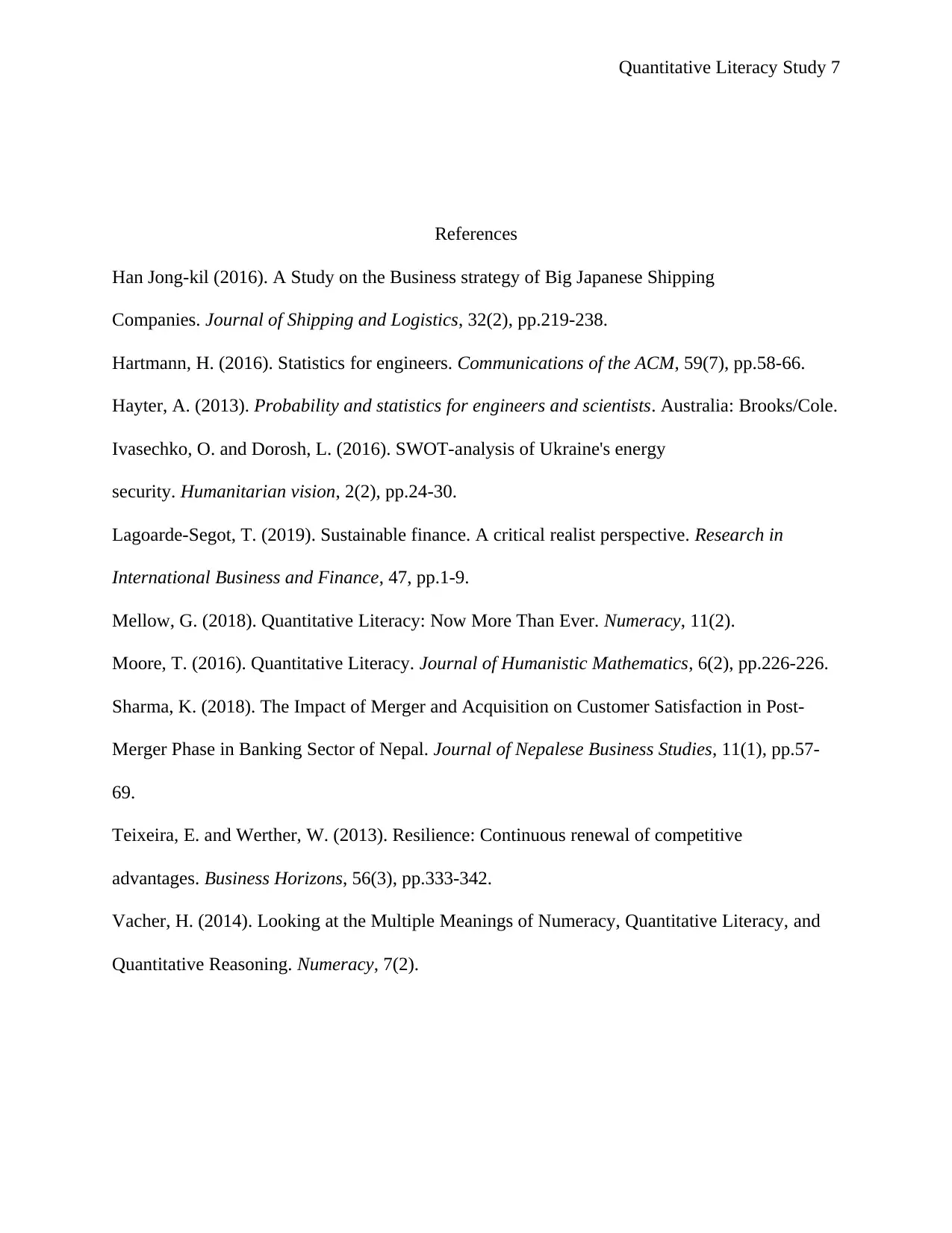
References
Han Jong-kil (2016). A Study on the Business strategy of Big Japanese Shipping
Companies. Journal of Shipping and Logistics, 32(2), pp.219-238.
Hartmann, H. (2016). Statistics for engineers. Communications of the ACM, 59(7), pp.58-66.
Hayter, A. (2013). Probability and statistics for engineers and scientists. Australia: Brooks/Cole.
Ivasechko, O. and Dorosh, L. (2016). SWOT-analysis of Ukraine's energy
security. Humanitarian vision, 2(2), pp.24-30.
Lagoarde-Segot, T. (2019). Sustainable finance. A critical realist perspective. Research in
International Business and Finance, 47, pp.1-9.
Mellow, G. (2018). Quantitative Literacy: Now More Than Ever. Numeracy, 11(2).
Moore, T. (2016). Quantitative Literacy. Journal of Humanistic Mathematics, 6(2), pp.226-226.
Sharma, K. (2018). The Impact of Merger and Acquisition on Customer Satisfaction in Post-
Merger Phase in Banking Sector of Nepal. Journal of Nepalese Business Studies, 11(1), pp.57-
69.
Teixeira, E. and Werther, W. (2013). Resilience: Continuous renewal of competitive
advantages. Business Horizons, 56(3), pp.333-342.
Vacher, H. (2014). Looking at the Multiple Meanings of Numeracy, Quantitative Literacy, and
Quantitative Reasoning. Numeracy, 7(2).
chevron_up_icon
1 out of 7
circle_padding
hide_on_mobile
zoom_out_icon
[object Object]