A Study on Socio-Cultural Diversity Impact on Leadership at Diageo Plc
VerifiedAdded on 2019/09/26
|56
|14775
|170
Dissertation
AI Summary
This dissertation investigates the impact of socio-cultural diversity on leadership within Diageo Plc, a multinational alcoholic beverage company. The research explores workforce diversity, its advantages and disadvantages, and how it influences leadership styles and skills. The study employs both qualitative and quantitative research methods, including literature reviews, interviews with management executives, and employee surveys. Key findings reveal that inclusive leadership is crucial for sustaining and improving diversity within Diageo. The research aims to identify the most suitable leadership styles for managing a diverse workplace and offers recommendations for organizations to effectively manage their diverse workforces. The dissertation covers the company's background, research rationale, objectives, and questions, followed by a literature review, methodology, findings, and conclusions with recommendations for future research. The study highlights the importance of understanding and adapting to socio-cultural differences to foster effective leadership in a globalized business environment.
Dissertation – A study on the impact of
socio-cultural diversity on leadership in
an organization
1
socio-cultural diversity on leadership in
an organization
1

Paraphrase This Document
Need a fresh take? Get an instant paraphrase of this document with our AI Paraphraser
Abstract
In today’s business world, every organization is striving hard to attract and
retain the best of talents, as it is now clear, that it is the human resources who make
or break the organization. Workforce diversity is one such very eminent concept, and
it is the imperative for every organization to bring in and manage diversity in its work
settings. It was the aim of this paper, to understand how diversity in the form of
socio-cultural aspects impacts the organization’s leadership and other operations.
Diageo Plc was chosen as the target organization on which the primary research
was conducted. Diageo was selected, as it is one of the most diverse companies of
today – having presence in more than 180 countries and employing more than
30,000 individuals.
Primary research and secondary research were conducted. Secondary
research in the form of literature review was done, where journals, articles, books
and studies conducted by large corporate were analyzed and the findings presented.
Primary research was done in two modes – qualitative research and quantitative
research on the management executives and employees of Diageo. It was found
that, diversity impacts leadership, and it is inclusive leadership which helps in the
sustenance and improvement of such diversity in the work settings of Diageo Plc.
2
In today’s business world, every organization is striving hard to attract and
retain the best of talents, as it is now clear, that it is the human resources who make
or break the organization. Workforce diversity is one such very eminent concept, and
it is the imperative for every organization to bring in and manage diversity in its work
settings. It was the aim of this paper, to understand how diversity in the form of
socio-cultural aspects impacts the organization’s leadership and other operations.
Diageo Plc was chosen as the target organization on which the primary research
was conducted. Diageo was selected, as it is one of the most diverse companies of
today – having presence in more than 180 countries and employing more than
30,000 individuals.
Primary research and secondary research were conducted. Secondary
research in the form of literature review was done, where journals, articles, books
and studies conducted by large corporate were analyzed and the findings presented.
Primary research was done in two modes – qualitative research and quantitative
research on the management executives and employees of Diageo. It was found
that, diversity impacts leadership, and it is inclusive leadership which helps in the
sustenance and improvement of such diversity in the work settings of Diageo Plc.
2
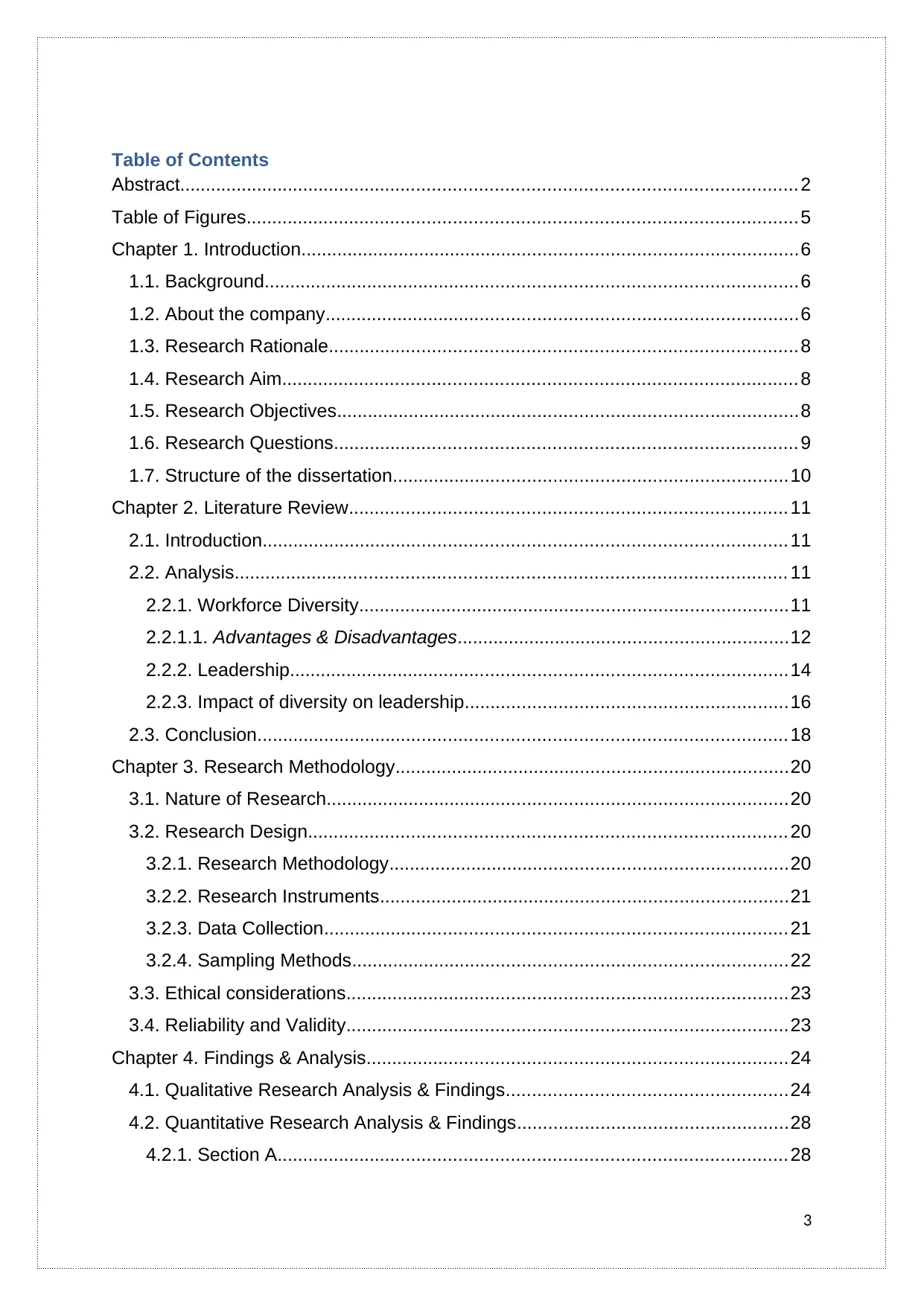
Table of Contents
Abstract....................................................................................................................... 2
Table of Figures..........................................................................................................5
Chapter 1. Introduction................................................................................................6
1.1. Background.......................................................................................................6
1.2. About the company...........................................................................................6
1.3. Research Rationale..........................................................................................8
1.4. Research Aim................................................................................................... 8
1.5. Research Objectives.........................................................................................8
1.6. Research Questions......................................................................................... 9
1.7. Structure of the dissertation............................................................................10
Chapter 2. Literature Review.................................................................................... 11
2.1. Introduction.....................................................................................................11
2.2. Analysis.......................................................................................................... 11
2.2.1. Workforce Diversity...................................................................................11
2.2.1.1. Advantages & Disadvantages................................................................12
2.2.2. Leadership................................................................................................14
2.2.3. Impact of diversity on leadership..............................................................16
2.3. Conclusion......................................................................................................18
Chapter 3. Research Methodology............................................................................20
3.1. Nature of Research.........................................................................................20
3.2. Research Design............................................................................................ 20
3.2.1. Research Methodology.............................................................................20
3.2.2. Research Instruments...............................................................................21
3.2.3. Data Collection.........................................................................................21
3.2.4. Sampling Methods....................................................................................22
3.3. Ethical considerations.....................................................................................23
3.4. Reliability and Validity.....................................................................................23
Chapter 4. Findings & Analysis.................................................................................24
4.1. Qualitative Research Analysis & Findings......................................................24
4.2. Quantitative Research Analysis & Findings....................................................28
4.2.1. Section A.................................................................................................. 28
3
Abstract....................................................................................................................... 2
Table of Figures..........................................................................................................5
Chapter 1. Introduction................................................................................................6
1.1. Background.......................................................................................................6
1.2. About the company...........................................................................................6
1.3. Research Rationale..........................................................................................8
1.4. Research Aim................................................................................................... 8
1.5. Research Objectives.........................................................................................8
1.6. Research Questions......................................................................................... 9
1.7. Structure of the dissertation............................................................................10
Chapter 2. Literature Review.................................................................................... 11
2.1. Introduction.....................................................................................................11
2.2. Analysis.......................................................................................................... 11
2.2.1. Workforce Diversity...................................................................................11
2.2.1.1. Advantages & Disadvantages................................................................12
2.2.2. Leadership................................................................................................14
2.2.3. Impact of diversity on leadership..............................................................16
2.3. Conclusion......................................................................................................18
Chapter 3. Research Methodology............................................................................20
3.1. Nature of Research.........................................................................................20
3.2. Research Design............................................................................................ 20
3.2.1. Research Methodology.............................................................................20
3.2.2. Research Instruments...............................................................................21
3.2.3. Data Collection.........................................................................................21
3.2.4. Sampling Methods....................................................................................22
3.3. Ethical considerations.....................................................................................23
3.4. Reliability and Validity.....................................................................................23
Chapter 4. Findings & Analysis.................................................................................24
4.1. Qualitative Research Analysis & Findings......................................................24
4.2. Quantitative Research Analysis & Findings....................................................28
4.2.1. Section A.................................................................................................. 28
3
⊘ This is a preview!⊘
Do you want full access?
Subscribe today to unlock all pages.

Trusted by 1+ million students worldwide
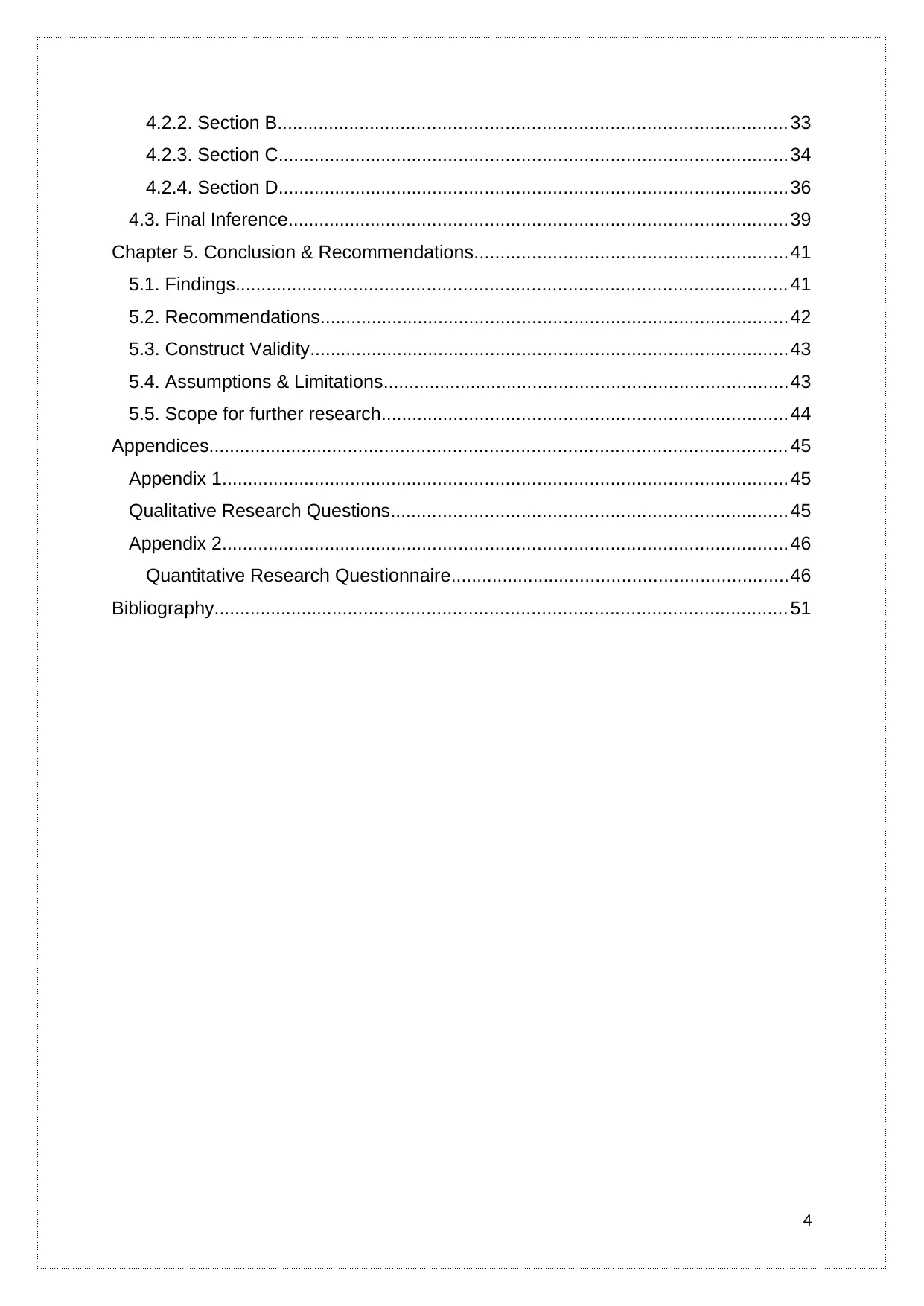
4.2.2. Section B.................................................................................................. 33
4.2.3. Section C..................................................................................................34
4.2.4. Section D..................................................................................................36
4.3. Final Inference................................................................................................39
Chapter 5. Conclusion & Recommendations............................................................41
5.1. Findings.......................................................................................................... 41
5.2. Recommendations..........................................................................................42
5.3. Construct Validity............................................................................................43
5.4. Assumptions & Limitations..............................................................................43
5.5. Scope for further research..............................................................................44
Appendices............................................................................................................... 45
Appendix 1.............................................................................................................45
Qualitative Research Questions............................................................................45
Appendix 2.............................................................................................................46
Quantitative Research Questionnaire.................................................................46
Bibliography.............................................................................................................. 51
4
4.2.3. Section C..................................................................................................34
4.2.4. Section D..................................................................................................36
4.3. Final Inference................................................................................................39
Chapter 5. Conclusion & Recommendations............................................................41
5.1. Findings.......................................................................................................... 41
5.2. Recommendations..........................................................................................42
5.3. Construct Validity............................................................................................43
5.4. Assumptions & Limitations..............................................................................43
5.5. Scope for further research..............................................................................44
Appendices............................................................................................................... 45
Appendix 1.............................................................................................................45
Qualitative Research Questions............................................................................45
Appendix 2.............................................................................................................46
Quantitative Research Questionnaire.................................................................46
Bibliography.............................................................................................................. 51
4
Paraphrase This Document
Need a fresh take? Get an instant paraphrase of this document with our AI Paraphraser
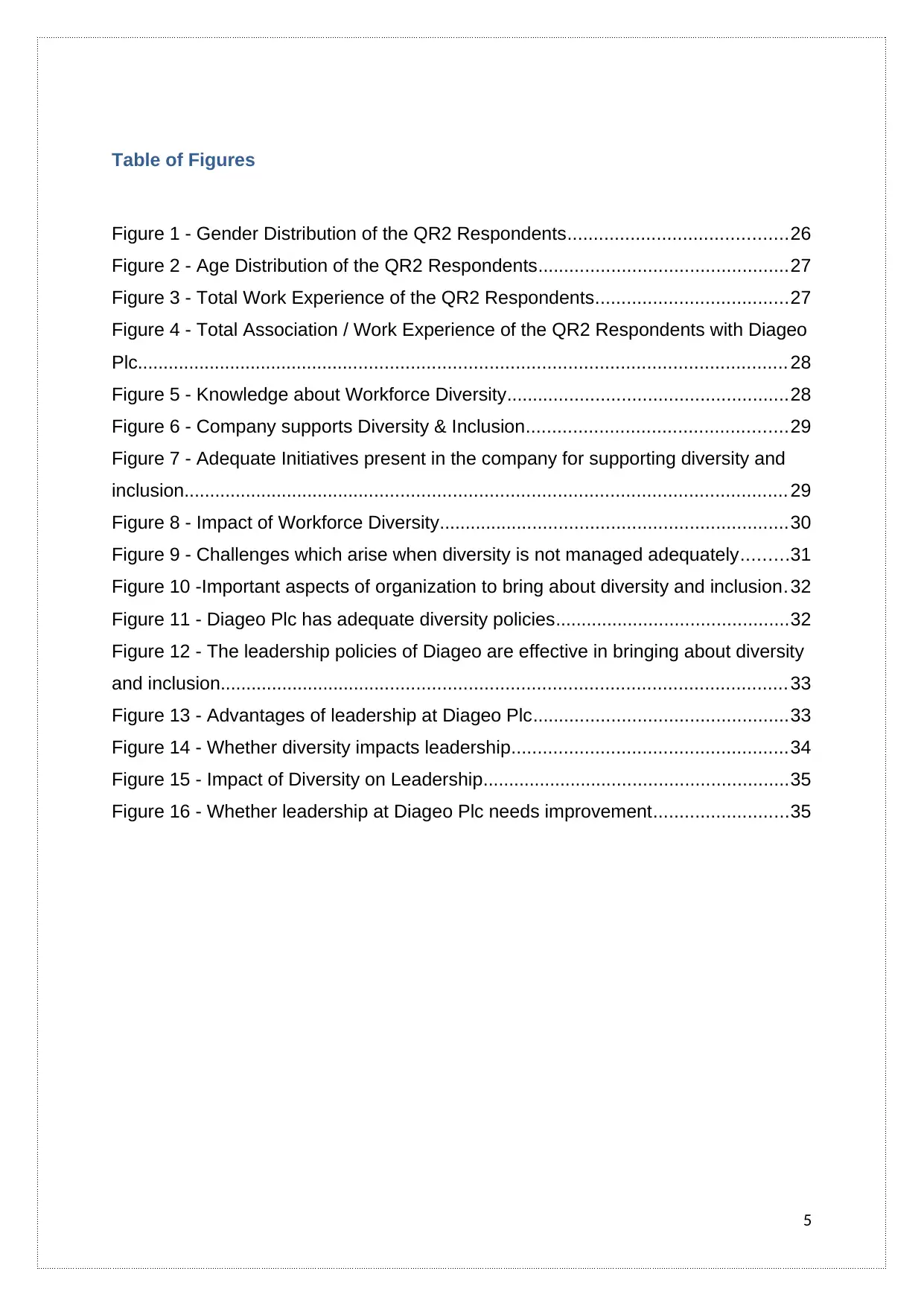
Table of Figures
Figure 1 - Gender Distribution of the QR2 Respondents..........................................26
Figure 2 - Age Distribution of the QR2 Respondents................................................27
Figure 3 - Total Work Experience of the QR2 Respondents.....................................27
Figure 4 - Total Association / Work Experience of the QR2 Respondents with Diageo
Plc............................................................................................................................. 28
Figure 5 - Knowledge about Workforce Diversity......................................................28
Figure 6 - Company supports Diversity & Inclusion..................................................29
Figure 7 - Adequate Initiatives present in the company for supporting diversity and
inclusion.................................................................................................................... 29
Figure 8 - Impact of Workforce Diversity...................................................................30
Figure 9 - Challenges which arise when diversity is not managed adequately.........31
Figure 10 -Important aspects of organization to bring about diversity and inclusion. 32
Figure 11 - Diageo Plc has adequate diversity policies.............................................32
Figure 12 - The leadership policies of Diageo are effective in bringing about diversity
and inclusion............................................................................................................. 33
Figure 13 - Advantages of leadership at Diageo Plc.................................................33
Figure 14 - Whether diversity impacts leadership.....................................................34
Figure 15 - Impact of Diversity on Leadership...........................................................35
Figure 16 - Whether leadership at Diageo Plc needs improvement..........................35
5
Figure 1 - Gender Distribution of the QR2 Respondents..........................................26
Figure 2 - Age Distribution of the QR2 Respondents................................................27
Figure 3 - Total Work Experience of the QR2 Respondents.....................................27
Figure 4 - Total Association / Work Experience of the QR2 Respondents with Diageo
Plc............................................................................................................................. 28
Figure 5 - Knowledge about Workforce Diversity......................................................28
Figure 6 - Company supports Diversity & Inclusion..................................................29
Figure 7 - Adequate Initiatives present in the company for supporting diversity and
inclusion.................................................................................................................... 29
Figure 8 - Impact of Workforce Diversity...................................................................30
Figure 9 - Challenges which arise when diversity is not managed adequately.........31
Figure 10 -Important aspects of organization to bring about diversity and inclusion. 32
Figure 11 - Diageo Plc has adequate diversity policies.............................................32
Figure 12 - The leadership policies of Diageo are effective in bringing about diversity
and inclusion............................................................................................................. 33
Figure 13 - Advantages of leadership at Diageo Plc.................................................33
Figure 14 - Whether diversity impacts leadership.....................................................34
Figure 15 - Impact of Diversity on Leadership...........................................................35
Figure 16 - Whether leadership at Diageo Plc needs improvement..........................35
5
Chapter 1. Introduction
1.1. Background
Diversity in the workplace is not just a mere impression of having individuals
from different genders, ages and races working with one another. It is a deep seated
concept which can push a company forward with innovative fresh ideas from a
shared group of experience, which otherwise one would not be able to grasp on
his/her own (Roberge & Dick, 2010). Workforce diversity does not act like a stamp,
which are carried by an organization but it is a realistic necessity of today, and it can
help a company survive and sustain in this increasingly competitive and connected
business environment. It is now a necessity in which all individuals hailing from
different ethnicities, social backgrounds, genders, ages, experiences, abilities work
together not for their own sake or for the sake of their own demographic classes, but
for the entire organization’s sake in which they are proud to be associated with
(Scroggins & Benson, 2010).
However, managing workforce diversity effectively and efficiently is not an
easy task, and requires specialized management strategies and leadership skills.
Diversities in employees and differences in their socio-cultural aspects, can leave an
impact on the manner in which an organization is governed and the manner of
leadership (Alcazar, Fernandez, & Gardey, 2013). How and to what extent such
socio-cultural diversities impact the leadership styles and skills in a multinational
organization, became the purpose of this paper.
1.2. About the company
Diageo Plc is a United Kingdom based multinational manufacturer and
distributer of alcoholic beverages and has been in operation since 1997.
Headquartered at London, the main products of this company is spirits, wine and
beer. The company owns over 200 brands some of which are – Smirn Off, Baileys,
Johnny Walker, Ciroc, Captain Morgan, Guinness Don Julio, Buchannan etc. The
company boasts of possessing a product line, which meets every category possible
in consumer demands – new or old, small or large, local or global etc. The products
6
1.1. Background
Diversity in the workplace is not just a mere impression of having individuals
from different genders, ages and races working with one another. It is a deep seated
concept which can push a company forward with innovative fresh ideas from a
shared group of experience, which otherwise one would not be able to grasp on
his/her own (Roberge & Dick, 2010). Workforce diversity does not act like a stamp,
which are carried by an organization but it is a realistic necessity of today, and it can
help a company survive and sustain in this increasingly competitive and connected
business environment. It is now a necessity in which all individuals hailing from
different ethnicities, social backgrounds, genders, ages, experiences, abilities work
together not for their own sake or for the sake of their own demographic classes, but
for the entire organization’s sake in which they are proud to be associated with
(Scroggins & Benson, 2010).
However, managing workforce diversity effectively and efficiently is not an
easy task, and requires specialized management strategies and leadership skills.
Diversities in employees and differences in their socio-cultural aspects, can leave an
impact on the manner in which an organization is governed and the manner of
leadership (Alcazar, Fernandez, & Gardey, 2013). How and to what extent such
socio-cultural diversities impact the leadership styles and skills in a multinational
organization, became the purpose of this paper.
1.2. About the company
Diageo Plc is a United Kingdom based multinational manufacturer and
distributer of alcoholic beverages and has been in operation since 1997.
Headquartered at London, the main products of this company is spirits, wine and
beer. The company owns over 200 brands some of which are – Smirn Off, Baileys,
Johnny Walker, Ciroc, Captain Morgan, Guinness Don Julio, Buchannan etc. The
company boasts of possessing a product line, which meets every category possible
in consumer demands – new or old, small or large, local or global etc. The products
6
⊘ This is a preview!⊘
Do you want full access?
Subscribe today to unlock all pages.
Trusted by 1+ million students worldwide
of Diageo are sold in more than 180 countries in every price points – starting from
very affordable to luxurious premium brands (Diageo Plc, 2018).
Though the business is comparatively new, but the principles on which the
business operates now has been led on the foundations created by the iconic figures
of this beverages industry – Elizabeth Cumming, John Walker, Arthur Guinness etc.
The company has been built on the inspiration of their philosophies, ideas,
determination and grit. The aim of Diageo is to become one of the most trusted and
best performing consumer product companies in the whole world. They feel they are
in a very strong position to achieve this, due to their scale of operations, wide
geographical diversity and the continuous desire to out-perform their own selves.
Diageo believes that innovation, and creativity have been central to their strategy of
growth, and they are extremely proud of their 30,400 employees working around the
globe to grow their business and nurture their brands, creating new categories and
products and developing newer experiences for their consumers (Diageo Plc, 2018).
The company has very strong values and commitments in place and they
attribute their success on these values and overall business philosophy. The work
culture of Diageo is deeply embedded in these values and sense of purpose. The
company believes in – being passionate about their customers and their consumers;
they work as a team and provide each other the freedom to succeed; they are proud
of what they do, and follow the highest standards of social responsibility and
integrity; they strive to be the best and are always improving and lastly, they value
each other and strive to create mutually beneficial partnerships and relationships.
As mentioned before, Diageo has more than 30,000 employees working all
around the globe together to nurture the business and grow their brands. The
company is focused on these employees’ personal and professional development
and ensures that the work culture is positive, intellectually stimulating and rewarding
for every individual who operates here. The company has a very vibrant and diverse
workforce, and they specifically look for individuals having a variety of personalities,
perspectives and experiences to create a very innovative and diverse work
environment which can provide everyone with a chance to flourish. The company
itself focuses its attention on achieving diversity in its workplace (Diageo, 2018).
7
very affordable to luxurious premium brands (Diageo Plc, 2018).
Though the business is comparatively new, but the principles on which the
business operates now has been led on the foundations created by the iconic figures
of this beverages industry – Elizabeth Cumming, John Walker, Arthur Guinness etc.
The company has been built on the inspiration of their philosophies, ideas,
determination and grit. The aim of Diageo is to become one of the most trusted and
best performing consumer product companies in the whole world. They feel they are
in a very strong position to achieve this, due to their scale of operations, wide
geographical diversity and the continuous desire to out-perform their own selves.
Diageo believes that innovation, and creativity have been central to their strategy of
growth, and they are extremely proud of their 30,400 employees working around the
globe to grow their business and nurture their brands, creating new categories and
products and developing newer experiences for their consumers (Diageo Plc, 2018).
The company has very strong values and commitments in place and they
attribute their success on these values and overall business philosophy. The work
culture of Diageo is deeply embedded in these values and sense of purpose. The
company believes in – being passionate about their customers and their consumers;
they work as a team and provide each other the freedom to succeed; they are proud
of what they do, and follow the highest standards of social responsibility and
integrity; they strive to be the best and are always improving and lastly, they value
each other and strive to create mutually beneficial partnerships and relationships.
As mentioned before, Diageo has more than 30,000 employees working all
around the globe together to nurture the business and grow their brands. The
company is focused on these employees’ personal and professional development
and ensures that the work culture is positive, intellectually stimulating and rewarding
for every individual who operates here. The company has a very vibrant and diverse
workforce, and they specifically look for individuals having a variety of personalities,
perspectives and experiences to create a very innovative and diverse work
environment which can provide everyone with a chance to flourish. The company
itself focuses its attention on achieving diversity in its workplace (Diageo, 2018).
7
Paraphrase This Document
Need a fresh take? Get an instant paraphrase of this document with our AI Paraphraser
1.3. Research Rationale
Advancements in technology, the ever rising competition in business,
regulatory changes, the opening up of trade barriers together all of these have made
the whole world into one uniform place (Pollitt, 2005). Individuals now work in
organizations which have headquarters in other nations, people move around the
globe; individuals are connected with one another irrespective of how far they are
geographically situated. Though with globalization we are increasingly ceasing to be
different from one another but there is one aspect which differentiates each and
every one of us – and that is our culture (Parekh, 2002).
In such a backdrop, it was felt only logical to conduct a research on
how such diversities in work are managed effectively, and whether these socio-
cultural diversities impact specifically the leadership and its functions within an
organization. Diageo is chosen, as it is one of the largest organizations consisting of
a huge diverse workforce present throughout the 180 countries, in which the
company operates. Therefore, this organization can act as the right basis on which
the research can be done – as it has wide presence in a large number of countries
having different values, norms, cultures, social structures etc, and alongside it has its
management directing and working with diverse employees in its operations. Hence,
conducting this research on Diageo would help the researchers in gaining firsthand
knowledge about the implications of a diverse workforce and the ideal leadership
style and skills to manage such diversity effectively.
1.4. Research Aim
The core aim of this research paper is to explore the manner in which different
socio-cultural norms present in an organization, impact the leadership and its
functioning within such organization setting. In order to conduct this paper, primary
research is intended to be conducted on the UK based multinational company
Diageo Plc.
1.5. Research Objectives
Constructing of research objectives is a significant part of writing a research
paper, as the effectiveness and success of the research paper depends on it. After
8
Advancements in technology, the ever rising competition in business,
regulatory changes, the opening up of trade barriers together all of these have made
the whole world into one uniform place (Pollitt, 2005). Individuals now work in
organizations which have headquarters in other nations, people move around the
globe; individuals are connected with one another irrespective of how far they are
geographically situated. Though with globalization we are increasingly ceasing to be
different from one another but there is one aspect which differentiates each and
every one of us – and that is our culture (Parekh, 2002).
In such a backdrop, it was felt only logical to conduct a research on
how such diversities in work are managed effectively, and whether these socio-
cultural diversities impact specifically the leadership and its functions within an
organization. Diageo is chosen, as it is one of the largest organizations consisting of
a huge diverse workforce present throughout the 180 countries, in which the
company operates. Therefore, this organization can act as the right basis on which
the research can be done – as it has wide presence in a large number of countries
having different values, norms, cultures, social structures etc, and alongside it has its
management directing and working with diverse employees in its operations. Hence,
conducting this research on Diageo would help the researchers in gaining firsthand
knowledge about the implications of a diverse workforce and the ideal leadership
style and skills to manage such diversity effectively.
1.4. Research Aim
The core aim of this research paper is to explore the manner in which different
socio-cultural norms present in an organization, impact the leadership and its
functioning within such organization setting. In order to conduct this paper, primary
research is intended to be conducted on the UK based multinational company
Diageo Plc.
1.5. Research Objectives
Constructing of research objectives is a significant part of writing a research
paper, as the effectiveness and success of the research paper depends on it. After
8
the findings are identified, an account of “construct validity” is to be provided at the
end which accounts the degree to which the research objectives constructed at the
wake of the paper, have been met or not. If construct validity is completely met with,
then the research is successful and effective. The research objectives for this paper
are;
- Exploration of the concept of a socio-culturally diverse workplace and the
manner in which such a diverse work culture leaves an impact on the regular
operations and work settings of the organization.
- Conducting an investigation on the influence of such a diverse work place on
its leadership aspects and the challenges of leadership
- Exploring the suitability of different leadership styles and key leadership skills
and identifying the most suitable ones for managing a diverse work place
- Constructing a recommendation strategy which can be used by every
organization, irrespective of its size and nature of operations, to successfully
manage a diverse workforce.
1.6. Research Questions
- What is work force diversity? What are the socio-cultural differences between
individuals?
- How is work force diversity managed in organizations?
- Is workforce diversity preferred? What are the advantages and limitations?
- How is workforce diversity managed in your organization? Is it something your
company strives to achieve?
- Why is workforce diversity preferred? How would you define your leadership
philosophy?
- What style of leadership do you follow in your organization? Do you think it is
effective in managing diversity?
- Transactional or transformational – which style is preferred by you in terms of
managing workforce diversity?
- How does workforce diversity impact the leadership aspects in your
organization? Do you have to consciously undertake specific strategies or
initiatives as a result of such diversity?
- What is the future, when it comes to workforce diversity in your organization?
How can you improve further?
9
end which accounts the degree to which the research objectives constructed at the
wake of the paper, have been met or not. If construct validity is completely met with,
then the research is successful and effective. The research objectives for this paper
are;
- Exploration of the concept of a socio-culturally diverse workplace and the
manner in which such a diverse work culture leaves an impact on the regular
operations and work settings of the organization.
- Conducting an investigation on the influence of such a diverse work place on
its leadership aspects and the challenges of leadership
- Exploring the suitability of different leadership styles and key leadership skills
and identifying the most suitable ones for managing a diverse work place
- Constructing a recommendation strategy which can be used by every
organization, irrespective of its size and nature of operations, to successfully
manage a diverse workforce.
1.6. Research Questions
- What is work force diversity? What are the socio-cultural differences between
individuals?
- How is work force diversity managed in organizations?
- Is workforce diversity preferred? What are the advantages and limitations?
- How is workforce diversity managed in your organization? Is it something your
company strives to achieve?
- Why is workforce diversity preferred? How would you define your leadership
philosophy?
- What style of leadership do you follow in your organization? Do you think it is
effective in managing diversity?
- Transactional or transformational – which style is preferred by you in terms of
managing workforce diversity?
- How does workforce diversity impact the leadership aspects in your
organization? Do you have to consciously undertake specific strategies or
initiatives as a result of such diversity?
- What is the future, when it comes to workforce diversity in your organization?
How can you improve further?
9
⊘ This is a preview!⊘
Do you want full access?
Subscribe today to unlock all pages.
Trusted by 1+ million students worldwide
1.7. Structure of the dissertation
This research paper will be divided into five key segments – primarily, the
introduction which will present the aim of the paper, its objectives, and research
questions to be asked and also present the rationale for the research to be
conducted. The second segment is the literature review segment, which will present
a thorough review of the published literature on the same relevant topic. The
segment following this is the Research Methodology segment which will present the
nature of the research to be conducted, its design, methodologies, research
instruments chosen etc. Ethical considerations and reliability and validity of the
research instruments will be mentioned in this segment only.
The data collected through the deployment of the research design, will be
analyzed in the fourth segment of the paper known as the Findings & Analysis
segment. As the research conducted is deductive of nature, after the findings and
analysis segment an account on the final inference will be drawn. Lastly, in the
conclusion segment – a framework of recommendation strategies will be developed
which can be utilized in all organizations intending to manage and nurture a diverse
workforce. Construct validity, scope of further research and the assumptions and the
limitations of this research paper will be presented in the last segment as well.
10
This research paper will be divided into five key segments – primarily, the
introduction which will present the aim of the paper, its objectives, and research
questions to be asked and also present the rationale for the research to be
conducted. The second segment is the literature review segment, which will present
a thorough review of the published literature on the same relevant topic. The
segment following this is the Research Methodology segment which will present the
nature of the research to be conducted, its design, methodologies, research
instruments chosen etc. Ethical considerations and reliability and validity of the
research instruments will be mentioned in this segment only.
The data collected through the deployment of the research design, will be
analyzed in the fourth segment of the paper known as the Findings & Analysis
segment. As the research conducted is deductive of nature, after the findings and
analysis segment an account on the final inference will be drawn. Lastly, in the
conclusion segment – a framework of recommendation strategies will be developed
which can be utilized in all organizations intending to manage and nurture a diverse
workforce. Construct validity, scope of further research and the assumptions and the
limitations of this research paper will be presented in the last segment as well.
10
Paraphrase This Document
Need a fresh take? Get an instant paraphrase of this document with our AI Paraphraser
Chapter 2. Literature Review
2.1. Introduction
The literature review is an account of all the published literature on this
specific topic (Dawidowicz, 2010). This literature review, for understanding the
impact of socio-cultural diversities in workforce is divided in three main segments –
primarily, the importance of workforce diversity, its advantages and disadvantages in
the present work settings in mentioned; secondarily, the leadership styles and how
they are suitable for a diverse workforce is mentioned and lastly, the impact of socio-
cultural and other diversities on the leadership styles and skills are mentioned.
Literature review thus conducted, has analyzed journal articles published on this
topic, white papers published by organizations, books, articles and reports, and
websites etc. Lastly, the key findings of this literature review, which shall act as a
secondary research will be presented in the Conclusion segment.
2.2. Analysis
2.2.1. Workforce Diversity
Workforce diversity and its management is the process of systematic and
planned dedication and commitment by the organization to recruit and select, retain
and reward, and finally promote a heterogeneous combination of the employees.
Academics, diversity consultants, management executives etc have all worked and
developed the theories and the techniques of diversity management (Human
Services.gov.au, 2018). It is a widely accepted truth, that attaining diversity and
effective management of such leads to improved organizational effectiveness. The
companies which gain experience and the reputation for managing and nurturing,
and empowering a diverse work group has more tendency to attract the right talent
(Alcazar, Fernandez, & Gardey, 2013).
Diversity depicts an ideal co-existence of the employees hailing from different
socio-cultural and cultural backgrounds and having other dissimilarities, but
peacefully working in harmony within an organization (Byrd & Scott, 2014). The
diversities can be in form of – race, age, education, colour, gender, physical abilities,
ethnicities etc (Konrad, Prasad, & Pringle, 2005). However, such diversities can also
11
2.1. Introduction
The literature review is an account of all the published literature on this
specific topic (Dawidowicz, 2010). This literature review, for understanding the
impact of socio-cultural diversities in workforce is divided in three main segments –
primarily, the importance of workforce diversity, its advantages and disadvantages in
the present work settings in mentioned; secondarily, the leadership styles and how
they are suitable for a diverse workforce is mentioned and lastly, the impact of socio-
cultural and other diversities on the leadership styles and skills are mentioned.
Literature review thus conducted, has analyzed journal articles published on this
topic, white papers published by organizations, books, articles and reports, and
websites etc. Lastly, the key findings of this literature review, which shall act as a
secondary research will be presented in the Conclusion segment.
2.2. Analysis
2.2.1. Workforce Diversity
Workforce diversity and its management is the process of systematic and
planned dedication and commitment by the organization to recruit and select, retain
and reward, and finally promote a heterogeneous combination of the employees.
Academics, diversity consultants, management executives etc have all worked and
developed the theories and the techniques of diversity management (Human
Services.gov.au, 2018). It is a widely accepted truth, that attaining diversity and
effective management of such leads to improved organizational effectiveness. The
companies which gain experience and the reputation for managing and nurturing,
and empowering a diverse work group has more tendency to attract the right talent
(Alcazar, Fernandez, & Gardey, 2013).
Diversity depicts an ideal co-existence of the employees hailing from different
socio-cultural and cultural backgrounds and having other dissimilarities, but
peacefully working in harmony within an organization (Byrd & Scott, 2014). The
diversities can be in form of – race, age, education, colour, gender, physical abilities,
ethnicities etc (Konrad, Prasad, & Pringle, 2005). However, such diversities can also
11
include differences in the national origin, disability, religion, gender, ethnic culture,
language, beliefs, lifestyles, economic status, physical appearances etc. In order for
a company to establish workforce diversity in its midst, it needs to create its work
culture and management support in a manner so that every employee feels
empowered and can pursue her own career aspirations without facing any
discrimination in terms of nationalities, gender, sex, ethnicities etc. Hence, a work
culture which promotes the wellbeing and progression for every individual
irrespective of their unique characteristics is the ideal setting for ensuring diversity
amongst employees (Henry & Evans, 2007). Several studies have depicted that with
time, business organizations are embracing diverse work groups as a mix of strategy
and structure in realizing the organizational goals (Ehimare & Ogaga-Oghene, 2011).
This new trend in the organizational of work is developed on the expectation that
such diverse workgroups lead to infusing of fresh ideas and talent and improves on
innovation, flexibility, decision making associated in a team work setting. In the
present light of business competitions, with time, more and more organizations are
undertaking strategies of introducing diverse work groups. Along with this, recent
changes of demographics, globalized markets, higher mobility, transparent laws at
promoting fairness etc are all working as drivers for creation of a diverse workforce
(Arokiasamy, 2013).
2.2.1.1. Advantages & Disadvantages
Workforce diversity is given immense importance in today’s business world.
This is due to the several advantages which are associated with workforce diversity.
However, experts are of the opinion, that along with benefits stemming from
workforce diversity, if such diversity is not effectively managed, it can lead to a
number of disadvantages as well. Diversity and inclusion has been one of the top
most management concepts for high performing and smart organizations for years,
but in recent times, as per CIPHR, actual diversity and inclusion have grown
significantly – as government initiatives like, GGPR or Gender Gap Pay Reporting
system of UK has been started.
The key reasons or advantages associated with having an inclusive and
diverse workforce are – companies can have a better understanding of their
customers, as a diverse workforce is an actual sample of the market in which the
company operates. Secondly, diverse workforce has been for years associated with
12
language, beliefs, lifestyles, economic status, physical appearances etc. In order for
a company to establish workforce diversity in its midst, it needs to create its work
culture and management support in a manner so that every employee feels
empowered and can pursue her own career aspirations without facing any
discrimination in terms of nationalities, gender, sex, ethnicities etc. Hence, a work
culture which promotes the wellbeing and progression for every individual
irrespective of their unique characteristics is the ideal setting for ensuring diversity
amongst employees (Henry & Evans, 2007). Several studies have depicted that with
time, business organizations are embracing diverse work groups as a mix of strategy
and structure in realizing the organizational goals (Ehimare & Ogaga-Oghene, 2011).
This new trend in the organizational of work is developed on the expectation that
such diverse workgroups lead to infusing of fresh ideas and talent and improves on
innovation, flexibility, decision making associated in a team work setting. In the
present light of business competitions, with time, more and more organizations are
undertaking strategies of introducing diverse work groups. Along with this, recent
changes of demographics, globalized markets, higher mobility, transparent laws at
promoting fairness etc are all working as drivers for creation of a diverse workforce
(Arokiasamy, 2013).
2.2.1.1. Advantages & Disadvantages
Workforce diversity is given immense importance in today’s business world.
This is due to the several advantages which are associated with workforce diversity.
However, experts are of the opinion, that along with benefits stemming from
workforce diversity, if such diversity is not effectively managed, it can lead to a
number of disadvantages as well. Diversity and inclusion has been one of the top
most management concepts for high performing and smart organizations for years,
but in recent times, as per CIPHR, actual diversity and inclusion have grown
significantly – as government initiatives like, GGPR or Gender Gap Pay Reporting
system of UK has been started.
The key reasons or advantages associated with having an inclusive and
diverse workforce are – companies can have a better understanding of their
customers, as a diverse workforce is an actual sample of the market in which the
company operates. Secondly, diverse workforce has been for years associated with
12
⊘ This is a preview!⊘
Do you want full access?
Subscribe today to unlock all pages.
Trusted by 1+ million students worldwide

1 out of 56


Related Documents


Your All-in-One AI-Powered Toolkit for Academic Success.
+13062052269
info@desklib.com
Available 24*7 on WhatsApp / Email
![[object Object]](/_next/static/media/star-bottom.7253800d.svg)
Unlock your academic potential
Copyright © 2020–2026 A2Z Services. All Rights Reserved. Developed and managed by ZUCOL.