Strategic Planning and Project Management for Business Events Analysis
VerifiedAdded on 2023/06/08
|10
|2686
|112
Report
AI Summary
This report analyzes the importance of strategic planning, project management, and risk management in the context of various business events. It begins with an introduction highlighting the significance of organized planning for successful event execution. The literature review explores different types of business events, including seminars, product launches, trade shows, appreciation events, and executive retreats, detailing their purposes and objectives. The core of the report focuses on strategic planning, defining its process and benefits, followed by an examination of project management principles, emphasizing its role in achieving event goals within specified timeframes. A crucial aspect is the discussion of risk factors, underscoring the need for risk assessment and mitigation strategies to prevent event failures. The conclusion reinforces the necessity of these elements for effective business event management.
BUSINESS MANAGEMENT
Why is it important to take a strategic planning and
project management approach which includes risk
management to business events?
Submitted by:
Student Number:
Why is it important to take a strategic planning and
project management approach which includes risk
management to business events?
Submitted by:
Student Number:

Paraphrase This Document
Need a fresh take? Get an instant paraphrase of this document with our AI Paraphraser
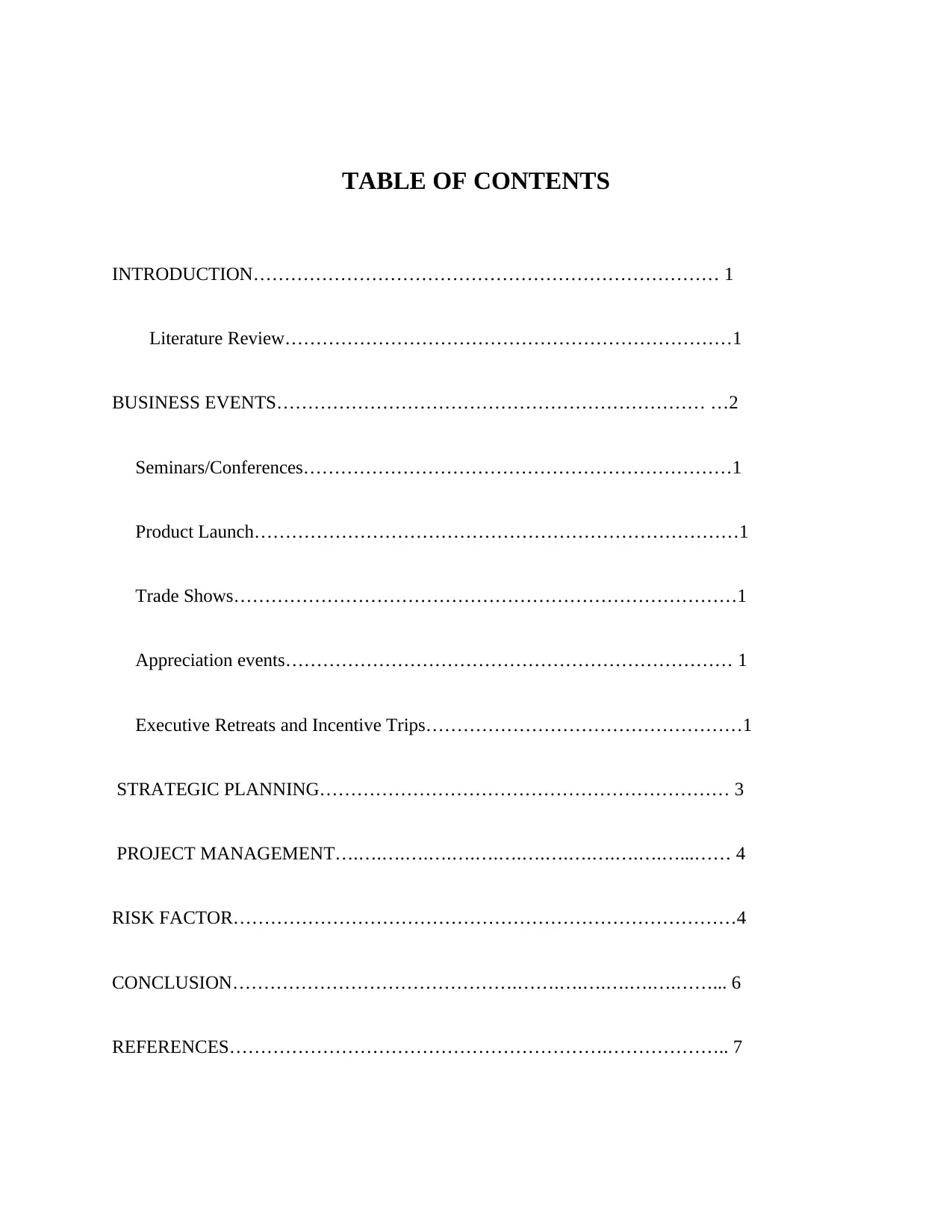
TABLE OF CONTENTS
INTRODUCTION………………………………………………………………… 1
Literature Review………………………………………………………………1
BUSINESS EVENTS…………………………………………………………… …2
Seminars/Conferences……………………………………………………………1
Product Launch……………………………………………………………………1
Trade Shows………………………………………………………………………1
Appreciation events……………………………………………………………… 1
Executive Retreats and Incentive Trips……………………………………………1
STRATEGIC PLANNING………………………………………………………… 3
PROJECT MANAGEMENT….….….….….….….….….….….….….….…...…… 4
RISK FACTOR………………………………………………………………………4
CONCLUSION……………………………………….…….….….….….….……... 6
REFERENCES…………………………………………………….……………….. 7
INTRODUCTION………………………………………………………………… 1
Literature Review………………………………………………………………1
BUSINESS EVENTS…………………………………………………………… …2
Seminars/Conferences……………………………………………………………1
Product Launch……………………………………………………………………1
Trade Shows………………………………………………………………………1
Appreciation events……………………………………………………………… 1
Executive Retreats and Incentive Trips……………………………………………1
STRATEGIC PLANNING………………………………………………………… 3
PROJECT MANAGEMENT….….….….….….….….….….….….….….…...…… 4
RISK FACTOR………………………………………………………………………4
CONCLUSION……………………………………….…….….….….….….……... 6
REFERENCES…………………………………………………….……………….. 7
INTRODUCTION:
Business Management requires a lot of planning and processing which can be executed
efficiently by professionals’ only. In order to manage business events and organize them in a
proper manner, one needs to be having a plan ready with them so that they do not face any
difficulties further on. This assignment will give us a fair idea about the different business events
that are organized and the reasons behind and further on, elaborate the different factors we need
to keep on mind while organizing business events and managing them proficiently.
Literature Review:
A lot of research has been done already on the different types of business events and the amount
of work they require to be executed perfectly. Hard (2017) stated that any event being sponsored
by a corporation in order to target its employees and clients with the goal of aligning the aims of
an association with the events activities can be called a business event. To execute any business
event, one needs strategic planning and there are various ways in which a person can do strategic
planning. It all depends on the purpose you are planning for, the stage at which the organization
is in terms of development, the culture of the staff, and the kinds of issues being faced by the
organization currently (McNamara, 2010).
Another important factor is of Project Management. Nokes and Kelly (2007) stated that what
differentiates it from just ‘management’ is that it holds the final deliverable and a given time
period, which is different from management which is a continuous procurement. Due to this a
project professional requires a wide range of skills which is elaborated further in this essay.
Business Management requires a lot of planning and processing which can be executed
efficiently by professionals’ only. In order to manage business events and organize them in a
proper manner, one needs to be having a plan ready with them so that they do not face any
difficulties further on. This assignment will give us a fair idea about the different business events
that are organized and the reasons behind and further on, elaborate the different factors we need
to keep on mind while organizing business events and managing them proficiently.
Literature Review:
A lot of research has been done already on the different types of business events and the amount
of work they require to be executed perfectly. Hard (2017) stated that any event being sponsored
by a corporation in order to target its employees and clients with the goal of aligning the aims of
an association with the events activities can be called a business event. To execute any business
event, one needs strategic planning and there are various ways in which a person can do strategic
planning. It all depends on the purpose you are planning for, the stage at which the organization
is in terms of development, the culture of the staff, and the kinds of issues being faced by the
organization currently (McNamara, 2010).
Another important factor is of Project Management. Nokes and Kelly (2007) stated that what
differentiates it from just ‘management’ is that it holds the final deliverable and a given time
period, which is different from management which is a continuous procurement. Due to this a
project professional requires a wide range of skills which is elaborated further in this essay.
⊘ This is a preview!⊘
Do you want full access?
Subscribe today to unlock all pages.

Trusted by 1+ million students worldwide
DIFFERENT TYPES OF BUSINESS EVENTS AND WHY THEY’RE HELD:
When a business firm is looking for some new methods to engage their employees and clients,
they organize different kinds of business events for them The reasons why the associations are
organizing such business events are to entertain or reward the members of their staff, launch new
products, establish partnerships, and many more.
Seminars/Conferences:
The main motive behind organizing a seminar or a conference is to impart ideas, apply solutions
or advance their proficiencies by addressing the target audience while gathering them at one
place (Hanchar, 2018). Seminars are usually shorter than conferences where seminars last only
for a couple hours, conferences can stretch for a course of two days or more.
Product launches:
These are done in order to promote the new product the company is releasing or to secure new
clients. These events are usually held to get maximum media coverage and create a buzz
surrounding the upcoming product’s release. They are also held on a larger level with a grand
party, dinner, renowned guests, etc. depending on the business.
Trade Shows:
The main goal of a tradeshow is to create leads and form partnerships. Companies can enhance
their profits by forming promising business relations. Trade shows provide the startups and
reputable firms with a brilliant chance to raise awareness about their ventures and develop their
networks. Sometimes, organizations also host or sponsor a trade show to strengthen their image
as a business leader.
Appreciation Events:
Reniee (2017) states that such events aim to appreciate their employees’ accomplishments or
form a tight connection with their trustworthy clienteles. These events are more relaxed in nature
and give the event host an opportunity to build a rapport with their guests outside the traditional
norms of office. People can also learn about mutual business primacies with the help of these
events.
Executive Retreats and Incentive Trips:
While business development and planning are the main agendas of a corporation, weightage is
also given to recreational activities and incentive trips to keep the staff entertained and reward
them and to maintain the corporation’s reputation. They are often held at exclusive destinations
in luxury resorts to gain visibility.
When a business firm is looking for some new methods to engage their employees and clients,
they organize different kinds of business events for them The reasons why the associations are
organizing such business events are to entertain or reward the members of their staff, launch new
products, establish partnerships, and many more.
Seminars/Conferences:
The main motive behind organizing a seminar or a conference is to impart ideas, apply solutions
or advance their proficiencies by addressing the target audience while gathering them at one
place (Hanchar, 2018). Seminars are usually shorter than conferences where seminars last only
for a couple hours, conferences can stretch for a course of two days or more.
Product launches:
These are done in order to promote the new product the company is releasing or to secure new
clients. These events are usually held to get maximum media coverage and create a buzz
surrounding the upcoming product’s release. They are also held on a larger level with a grand
party, dinner, renowned guests, etc. depending on the business.
Trade Shows:
The main goal of a tradeshow is to create leads and form partnerships. Companies can enhance
their profits by forming promising business relations. Trade shows provide the startups and
reputable firms with a brilliant chance to raise awareness about their ventures and develop their
networks. Sometimes, organizations also host or sponsor a trade show to strengthen their image
as a business leader.
Appreciation Events:
Reniee (2017) states that such events aim to appreciate their employees’ accomplishments or
form a tight connection with their trustworthy clienteles. These events are more relaxed in nature
and give the event host an opportunity to build a rapport with their guests outside the traditional
norms of office. People can also learn about mutual business primacies with the help of these
events.
Executive Retreats and Incentive Trips:
While business development and planning are the main agendas of a corporation, weightage is
also given to recreational activities and incentive trips to keep the staff entertained and reward
them and to maintain the corporation’s reputation. They are often held at exclusive destinations
in luxury resorts to gain visibility.
Paraphrase This Document
Need a fresh take? Get an instant paraphrase of this document with our AI Paraphraser
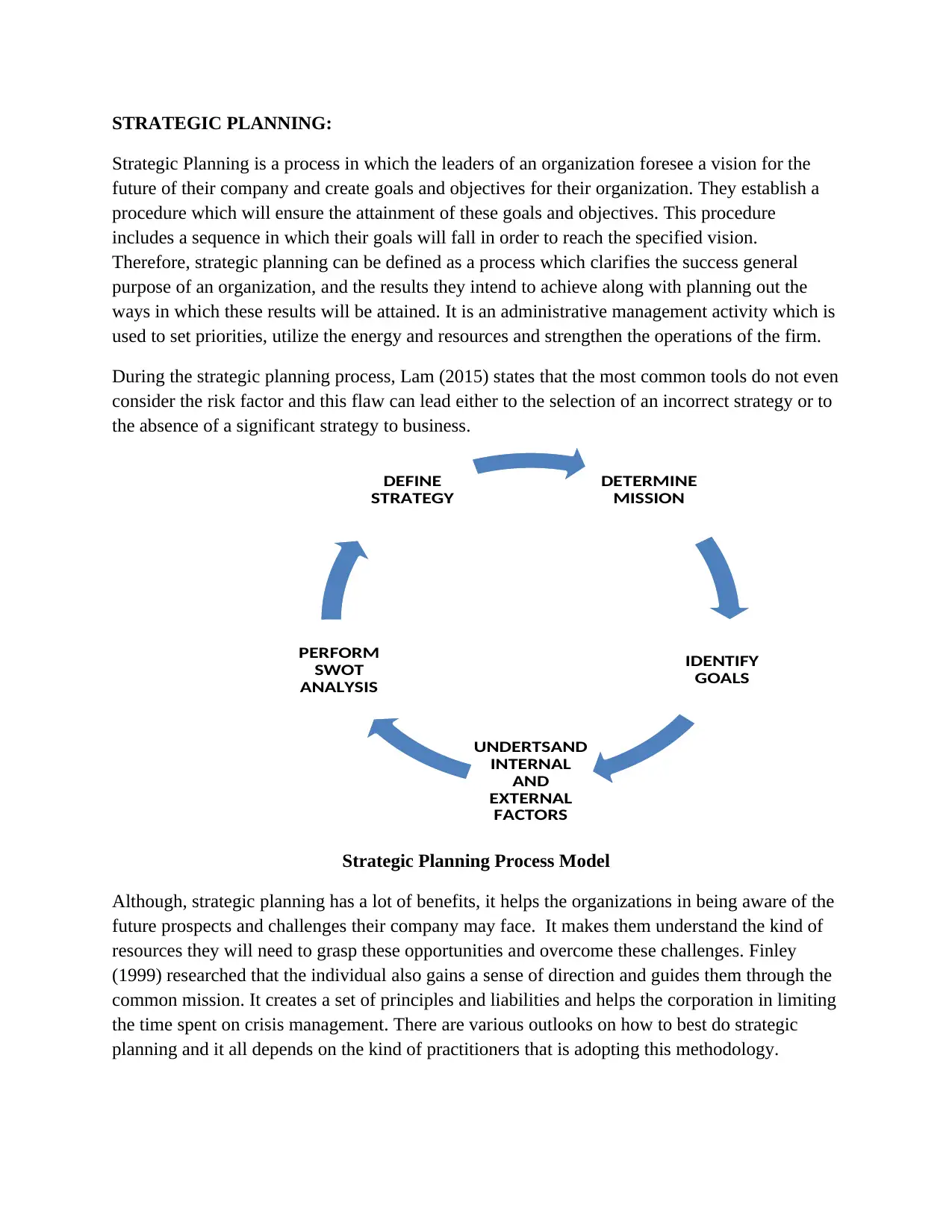
STRATEGIC PLANNING:
Strategic Planning is a process in which the leaders of an organization foresee a vision for the
future of their company and create goals and objectives for their organization. They establish a
procedure which will ensure the attainment of these goals and objectives. This procedure
includes a sequence in which their goals will fall in order to reach the specified vision.
Therefore, strategic planning can be defined as a process which clarifies the success general
purpose of an organization, and the results they intend to achieve along with planning out the
ways in which these results will be attained. It is an administrative management activity which is
used to set priorities, utilize the energy and resources and strengthen the operations of the firm.
During the strategic planning process, Lam (2015) states that the most common tools do not even
consider the risk factor and this flaw can lead either to the selection of an incorrect strategy or to
the absence of a significant strategy to business.
Strategic Planning Process Model
Although, strategic planning has a lot of benefits, it helps the organizations in being aware of the
future prospects and challenges their company may face. It makes them understand the kind of
resources they will need to grasp these opportunities and overcome these challenges. Finley
(1999) researched that the individual also gains a sense of direction and guides them through the
common mission. It creates a set of principles and liabilities and helps the corporation in limiting
the time spent on crisis management. There are various outlooks on how to best do strategic
planning and it all depends on the kind of practitioners that is adopting this methodology.
DETERMINE
MISSION
IDENTIFY
GOALS
UNDERTSAND
INTERNAL
AND
EXTERNAL
FACTORS
PERFORM
SWOT
ANALYSIS
DEFINE
STRATEGY
Strategic Planning is a process in which the leaders of an organization foresee a vision for the
future of their company and create goals and objectives for their organization. They establish a
procedure which will ensure the attainment of these goals and objectives. This procedure
includes a sequence in which their goals will fall in order to reach the specified vision.
Therefore, strategic planning can be defined as a process which clarifies the success general
purpose of an organization, and the results they intend to achieve along with planning out the
ways in which these results will be attained. It is an administrative management activity which is
used to set priorities, utilize the energy and resources and strengthen the operations of the firm.
During the strategic planning process, Lam (2015) states that the most common tools do not even
consider the risk factor and this flaw can lead either to the selection of an incorrect strategy or to
the absence of a significant strategy to business.
Strategic Planning Process Model
Although, strategic planning has a lot of benefits, it helps the organizations in being aware of the
future prospects and challenges their company may face. It makes them understand the kind of
resources they will need to grasp these opportunities and overcome these challenges. Finley
(1999) researched that the individual also gains a sense of direction and guides them through the
common mission. It creates a set of principles and liabilities and helps the corporation in limiting
the time spent on crisis management. There are various outlooks on how to best do strategic
planning and it all depends on the kind of practitioners that is adopting this methodology.
DETERMINE
MISSION
IDENTIFY
GOALS
UNDERTSAND
INTERNAL
AND
EXTERNAL
FACTORS
PERFORM
SWOT
ANALYSIS
DEFINE
STRATEGY
PROJECT MANAGEMENT
Lock (2007) states that the activity of starting, strategizing, implementation, and winding up the
work of a team to accomplish targeted goals and achieve success in specific time duration is
called Project Management. A project is a temporary design to generate a different product,
goods, result or service which should have a defined beginning and the end with the purpose to
achieve different targets and the objectives, in order to bring about beneficial developments or
values. This nature of the projects seems to be in contrast with trade that is usually repetitive or
permanent functional works to manufacture goods and services. In working, the management of
these different manufacturing approaches needs the development of different technical work and
management planning.
The foremost challenge of the project management is to accomplish all the targets of the project
in the given period of time. The information is already given in the documentation of the project
management, given at the very start of the process of development. Zwikael and Sadel
(2007) stated that:
The main things are the time duration, budget, scope and quality whereas the secondary and
more serious step is where the challenge is to start the allocation of the needed things and
implement them to achieve objectives which are pre-defined. (pp. 755-767)
The work of the project management is to give a whole project that should go with the
customer’s objectives. In some cases the work of project management is to design and reframe
the customer’s brief so to positively be able to show the customer’s target. After the targets of
the customer are clear they may create an impact on all the decisions made by the different
people who are a part of the project like the project managers, project designers, project
contractors, sub-contractors etc. Harrison and Lock (2004) stated that if the objectives of project
management are not well defined or are described too tightly it will result in an adverse effect on
decision making.
WHY IS RISK AN IMPORTANT ASPECT OF PROJECT MANAGEMENT?
In such present situations, because of the worst economic situations as well as aggressive
competitions, firms have to experience different risks on the same moment. While, the degree of
such risks might differ rather risks commonly influence the output of your task. Debono (2006)
states that management of risk appears to be the solo manner for being protected by the risk of
projects and risk seems to be any annoying situation or event, which might direct it to the
letdown of the event or project. Kezner (2013) states that there are various forms of risks like
cultural, political, social, etc. and large number of the risks might be regulated by carrying out
the management of risk.
Management of risk or risk administration is generally a method in that we discover, mitigate,
evaluate, and recognize the risks, which might influence the project. Kezner (2012) states that
Lock (2007) states that the activity of starting, strategizing, implementation, and winding up the
work of a team to accomplish targeted goals and achieve success in specific time duration is
called Project Management. A project is a temporary design to generate a different product,
goods, result or service which should have a defined beginning and the end with the purpose to
achieve different targets and the objectives, in order to bring about beneficial developments or
values. This nature of the projects seems to be in contrast with trade that is usually repetitive or
permanent functional works to manufacture goods and services. In working, the management of
these different manufacturing approaches needs the development of different technical work and
management planning.
The foremost challenge of the project management is to accomplish all the targets of the project
in the given period of time. The information is already given in the documentation of the project
management, given at the very start of the process of development. Zwikael and Sadel
(2007) stated that:
The main things are the time duration, budget, scope and quality whereas the secondary and
more serious step is where the challenge is to start the allocation of the needed things and
implement them to achieve objectives which are pre-defined. (pp. 755-767)
The work of the project management is to give a whole project that should go with the
customer’s objectives. In some cases the work of project management is to design and reframe
the customer’s brief so to positively be able to show the customer’s target. After the targets of
the customer are clear they may create an impact on all the decisions made by the different
people who are a part of the project like the project managers, project designers, project
contractors, sub-contractors etc. Harrison and Lock (2004) stated that if the objectives of project
management are not well defined or are described too tightly it will result in an adverse effect on
decision making.
WHY IS RISK AN IMPORTANT ASPECT OF PROJECT MANAGEMENT?
In such present situations, because of the worst economic situations as well as aggressive
competitions, firms have to experience different risks on the same moment. While, the degree of
such risks might differ rather risks commonly influence the output of your task. Debono (2006)
states that management of risk appears to be the solo manner for being protected by the risk of
projects and risk seems to be any annoying situation or event, which might direct it to the
letdown of the event or project. Kezner (2013) states that there are various forms of risks like
cultural, political, social, etc. and large number of the risks might be regulated by carrying out
the management of risk.
Management of risk or risk administration is generally a method in that we discover, mitigate,
evaluate, and recognize the risks, which might influence the project. Kezner (2012) states that
⊘ This is a preview!⊘
Do you want full access?
Subscribe today to unlock all pages.
Trusted by 1+ million students worldwide
risk administration appears to be a significant segment of the project administration that when
carried out competently moves further to the triumph of the project. Risk administration seems to
be a strategy of action, which includes of different measures that are executed for making sure
for the elimination of the risk. When you are tackling with irrepressible risk, then you might
establish these strategies of action, which might lessen the impact of such risks as you, might not
completely be free from these risks. Management of risk is executed from the administrators of
risk that are quite known of each of the risk related with any specific project or business as well
as various manners for diminishing them. Basically, huge counts of project administration
centers are providing courses of risk management regarding the administrators of project. The
subjects not just assist you for being aware of the forms as well as traits of project risks rather
too different methods employed for handling with such risks. Majeed (2012) states that the risk
easing method for being employed is based on traits of risk of project experienced from your
staff; hence you should be quite obvious in establishing a strategy regarding the struggling
against risks.
Management of risk appears to be a necessity of the management of project. It elevates the
possibilities of your victory to a larger degree. Below are few of the advantages of establishing
as well as applying a well-organized strategy of risk administration although executing any other
project.
Assists you in evading any huge tragedy
Improves your incomes by saving your outlays
Offers you emotional contentment
Make sure the effective end of project
Offers you economical edge across others
Rises the accountability and responsibility’s sense
Assists you in discovering fresh chances
When you have not still presented a strategy of risk management in case of your project then it is
recommendable that you must execute it as you get to know this as it might not require sufficient
time in case of risks for becoming tragedies.
carried out competently moves further to the triumph of the project. Risk administration seems to
be a strategy of action, which includes of different measures that are executed for making sure
for the elimination of the risk. When you are tackling with irrepressible risk, then you might
establish these strategies of action, which might lessen the impact of such risks as you, might not
completely be free from these risks. Management of risk is executed from the administrators of
risk that are quite known of each of the risk related with any specific project or business as well
as various manners for diminishing them. Basically, huge counts of project administration
centers are providing courses of risk management regarding the administrators of project. The
subjects not just assist you for being aware of the forms as well as traits of project risks rather
too different methods employed for handling with such risks. Majeed (2012) states that the risk
easing method for being employed is based on traits of risk of project experienced from your
staff; hence you should be quite obvious in establishing a strategy regarding the struggling
against risks.
Management of risk appears to be a necessity of the management of project. It elevates the
possibilities of your victory to a larger degree. Below are few of the advantages of establishing
as well as applying a well-organized strategy of risk administration although executing any other
project.
Assists you in evading any huge tragedy
Improves your incomes by saving your outlays
Offers you emotional contentment
Make sure the effective end of project
Offers you economical edge across others
Rises the accountability and responsibility’s sense
Assists you in discovering fresh chances
When you have not still presented a strategy of risk management in case of your project then it is
recommendable that you must execute it as you get to know this as it might not require sufficient
time in case of risks for becoming tragedies.
Paraphrase This Document
Need a fresh take? Get an instant paraphrase of this document with our AI Paraphraser
CONCLUSION:
Business events require a lot of planning and management. Without proper management, the
chances of your business event being a success become very low. In order to plan and execute
the business events, one requires a number of factors so that the implementation goes smoothly.
For these purposes, strategic planning, assessing the risk factor, project management are
important concepts which can be related to business events as well. For any business event to be
free of errors, one needs to have a strategic plan ready so that they can plan everything step-wise
and also come up with the procedures needed to implement those steps. So that just shows how
improvement strategic planning is while organizing any business event as it ensures the smooth
functioning of the event. Hartman (n.d.) states that project management is a concept without
which any business event won’t be successful and to head the whole event and manage it
efficiently, project management is supposed to be applied along with assessing the risks that can
come up during the course of event. After learning about all these concepts, it is clear now that
we must make use of each of these and then go about with the event. Potter (2017) states that if
one hasn’t assessed the risk factor during the project management of the business event, then one
might find it difficult to manage the other steps efficiently. The smarter and safer way is to
always weigh out everything beforehand which all comes under the strategic planning and
project management.
Business events require a lot of planning and management. Without proper management, the
chances of your business event being a success become very low. In order to plan and execute
the business events, one requires a number of factors so that the implementation goes smoothly.
For these purposes, strategic planning, assessing the risk factor, project management are
important concepts which can be related to business events as well. For any business event to be
free of errors, one needs to have a strategic plan ready so that they can plan everything step-wise
and also come up with the procedures needed to implement those steps. So that just shows how
improvement strategic planning is while organizing any business event as it ensures the smooth
functioning of the event. Hartman (n.d.) states that project management is a concept without
which any business event won’t be successful and to head the whole event and manage it
efficiently, project management is supposed to be applied along with assessing the risks that can
come up during the course of event. After learning about all these concepts, it is clear now that
we must make use of each of these and then go about with the event. Potter (2017) states that if
one hasn’t assessed the risk factor during the project management of the business event, then one
might find it difficult to manage the other steps efficiently. The smarter and safer way is to
always weigh out everything beforehand which all comes under the strategic planning and
project management.
REFERENCES:
Debono R. (2016, April). Project Risk Management. Retrieved from
https://pdfs.semanticscholar.org/presentation/02bf/fa85ee01b3a81ac839913f8dfbee5d8bd
9e4.pdf
Finley, P. (1999). Strategic Management. Harlow: Pearson Education Ltd.
Hanchar, T. (2018, April 10). The Top 10 Most Common Types of Corporate Events. Retrieved
from https://www.gevme.com/blog/top-10-common-types-corporate-events/
Hard, R. (2017, March 05). The Most Common Types of Corporate Events. Retrieved from
https://www.thebalancesmb.com/corporate-events-common-types-1223785
Harrison, F. and Lock, D. (2004) Advanced Project Management: A Structured Approach. 4th
Edition, Gower Publishing Limited, Aldershot, 80.
Hartman, D. (n.d.). Examples of Strategic Event Planning. Retrieved from
https://smallbusiness.chron.com/examples-strategic-event-planning-12708.html
Kezner, H. (2012, June). Project management tips [Video File]. Retrieved from
http://www.youtube.com/watch?
v=2AnmsPNLaY&list=PLBAB9055490726BB0&index=2&hd=1
Kezner, H.R. (2013). A systems approach to planning, scheduling and controlling, Project
Management, 11ème edition, 2013, pp. 871-949.
Lam, J. (2015). Strategic Risk Management: The Next Frontier for ERM. Retrieved from
https://texastricities.nacdonline.org/files/ChaptersLayout/ChapterContent/
TexasTriCities/Strategic%20Risk%20White%20Paper_2015.pdf
Lock, D. (2007). Project Management, 9th edn, MPG Books Ltd.
Debono R. (2016, April). Project Risk Management. Retrieved from
https://pdfs.semanticscholar.org/presentation/02bf/fa85ee01b3a81ac839913f8dfbee5d8bd
9e4.pdf
Finley, P. (1999). Strategic Management. Harlow: Pearson Education Ltd.
Hanchar, T. (2018, April 10). The Top 10 Most Common Types of Corporate Events. Retrieved
from https://www.gevme.com/blog/top-10-common-types-corporate-events/
Hard, R. (2017, March 05). The Most Common Types of Corporate Events. Retrieved from
https://www.thebalancesmb.com/corporate-events-common-types-1223785
Harrison, F. and Lock, D. (2004) Advanced Project Management: A Structured Approach. 4th
Edition, Gower Publishing Limited, Aldershot, 80.
Hartman, D. (n.d.). Examples of Strategic Event Planning. Retrieved from
https://smallbusiness.chron.com/examples-strategic-event-planning-12708.html
Kezner, H. (2012, June). Project management tips [Video File]. Retrieved from
http://www.youtube.com/watch?
v=2AnmsPNLaY&list=PLBAB9055490726BB0&index=2&hd=1
Kezner, H.R. (2013). A systems approach to planning, scheduling and controlling, Project
Management, 11ème edition, 2013, pp. 871-949.
Lam, J. (2015). Strategic Risk Management: The Next Frontier for ERM. Retrieved from
https://texastricities.nacdonline.org/files/ChaptersLayout/ChapterContent/
TexasTriCities/Strategic%20Risk%20White%20Paper_2015.pdf
Lock, D. (2007). Project Management, 9th edn, MPG Books Ltd.
⊘ This is a preview!⊘
Do you want full access?
Subscribe today to unlock all pages.
Trusted by 1+ million students worldwide
Majeed, M. (2012, April). Risk Management: an Important Part of Project Management.
Retrieved from https://project-management.com/risk-management-an-important-part-of-
project-management/
McNamara, C. (2010, September 30). What is Strategic Planning? Retrieved from
https://managementhelp.org/blogs/strategic-planning/2010/09/30/what-is-strategic-
planning/
Nokes S. and Kelly, S. (2007). The Definitive Guide to Project Management, 2nd edn, Prentice
Hill, Financial Times.
Potter, B. (2017, August 21). The Five Principles of Project Management for Event Planners.
Retrieved from https://www.mpiweb.org/blog/article/five-principles-successful-project-
management-event-planners
Rennie. (2017, January 9). Your Guide to the Different Types of Corporate Events. Retrieved
from https://www.bbblanc.com/your-guide-to-the-different-types-of-corporate-events/
Zwikael O. and Sadel, A. (2007). Planning effort as an effective risk management tool, Journal
of operation management, Vol. 25, pp. 755-767.
Retrieved from https://project-management.com/risk-management-an-important-part-of-
project-management/
McNamara, C. (2010, September 30). What is Strategic Planning? Retrieved from
https://managementhelp.org/blogs/strategic-planning/2010/09/30/what-is-strategic-
planning/
Nokes S. and Kelly, S. (2007). The Definitive Guide to Project Management, 2nd edn, Prentice
Hill, Financial Times.
Potter, B. (2017, August 21). The Five Principles of Project Management for Event Planners.
Retrieved from https://www.mpiweb.org/blog/article/five-principles-successful-project-
management-event-planners
Rennie. (2017, January 9). Your Guide to the Different Types of Corporate Events. Retrieved
from https://www.bbblanc.com/your-guide-to-the-different-types-of-corporate-events/
Zwikael O. and Sadel, A. (2007). Planning effort as an effective risk management tool, Journal
of operation management, Vol. 25, pp. 755-767.

1 out of 10


Related Documents


Your All-in-One AI-Powered Toolkit for Academic Success.
+13062052269
info@desklib.com
Available 24*7 on WhatsApp / Email
![[object Object]](/_next/static/media/star-bottom.7253800d.svg)
Unlock your academic potential
Copyright © 2020–2025 A2Z Services. All Rights Reserved. Developed and managed by ZUCOL.