A Comprehensive Report on Locsin's Nursing Theory: Technology and Care

Verified

Added on  2022/09/14

|25
|3412
|33
Report
AI Summary
This report provides a detailed examination of Rozzano Locsin's nursing theory, "Technological Competency as Caring in Nursing." It begins with a biographical overview of Locsin, situating his theory within its socio-political context. The report then dissects the theory's structural components, including its assumptions, concepts (technology as completing human beings, machine technologies, and mimicking human activities), and propositions. Furthermore, the functional components like focus, client, nursing, and nurse-patient interactions are discussed. A critical analysis of the theory is presented, comparing and contrasting two articles that critique the theory, evaluating clarity, consistency, simplicity, and the diagrams used. The report also assesses the theory's usefulness in practice, research, education, and administration, highlighting its relevance in modern healthcare settings and the integration of technology in patient care. The report concludes with a comprehensive evaluation of the theory's strengths and limitations, providing insights into its practical applications and future implications for nursing practice.
Document Page
Technological competency as caring
in nursing – a model for practice
tabler-icon-diamond-filled.svg

Paraphrase This Document

Need a fresh take? Get an instant paraphrase of this document with our AI Paraphraser
Document Page
Theorist description
Rozzano Locsin is a professor in the field of nursing. He teaches at Tokushima university Japan. He
is also a Emeritus professor at United state’s Florida Atlantic University. Born in the year of 1954,
he was initially a registered nurse at Dumageuete City. He finished his bachelor of science in
nursing in the year of 1976 and the master of arts in nursing in the year of 1978. He completed is
doctorate in the field if nursing in the year of 1988. He begun his academic career as a professor
in the year of 1991. Winner of many awards and contributor to various field fields and
departments of nursing, his scholarly nursing projects and theories has focussed on the use of
technology, art and on the broader understanding of transitions of life to death, in a human
being.
Document Page
Socio-political context
Personally, Rozzano Locsin was driven towards arts and strong believed in the healing
power of therapeutic arts which could used in nursing as well, in order to better the
care process in nursing. Through the application of metaphysical properties of nature
that can transcend a human nature and improve the process of nursing of terminal
and acutely ill patients – he worked on severe middle range nursing theories that was
shifting pace with the emergence of new technologies (Archibald & Barnard, 2018).
Throughout his long career as an academician, he always understood the importance
of growing forward beyond one’s time and more than anything, he believed in the
application of epistemological evidences into day to day nursing practice and getting
its validity and reliability tested in the clinical scenario. As a scholar and professor, he
understood the importance of using the advancing technologies in the field of health
care such as the health information technology to bring the most of nursing care. As a
matter of fact, throughout his scholarly writings to the development of his nursing
theory ‘Technological competence as caring in nursing’ – he strong recommended and
insisted on the use of extensive technologies for nursing diagnostic purposes to
nursing therapeutic purposes.
Document Page
Theory description
Theory: Technological competency as caring in nursing – a model for
practice
Structural Components
Assumptions – the nursing theory focuses on a harmony that is present between the humanistic
aspects of nursing care and the use of technology in the more advanced aspects of biomedical
nursing care.
The chief assumptions of the nursing theory are the every human being including the nurses
are caring in nature and this defines the human side of human beings.
The completeness of a human being, as in this case, a patient who is cared by the nurse is
complete and fulfilled in and within the dimension of a moment.
The next assumption of ‘Technology competency as caring in nursing’ defines the knowing
process of a human being about another individual should be bought with appreciation and
the respect for dignity and integrity of the person (Vehko et al., 2019).
Technology is a critical factor that should aid the nurses in practice in knowing about the
‘wholeness’ of the person from one moment to another
The profession of nursing is discipline and a practice that is to be undertaken professionals by
every means possible, complying with the evidence based practice guidelines and making the
best use of technology in forming the diagnoses and in delivering the therapies to the patient.
tabler-icon-diamond-filled.svg

Paraphrase This Document

Need a fresh take? Get an instant paraphrase of this document with our AI Paraphraser
Document Page
Theory description
Concepts
There are various concepts being covered by the nursing theory of ‘Technology competency as
caring in nursing’ and the concepts are mostly aimed at understanding of the various viewpoints,
aspects, usefulness and functions of technology and technology in nursing practice. According to
theorist, there are three concepts that can define the three sides of technology :-
1. Technology as completing human beings’ – nowadays the biomedical technologies that are
extensively used in prosthetic implants and organ transplants uses technology at hand to
complete a human being who has either structural or functional deficits.
2. Technology as machine technologies’ - the biomedical devices and the electronic medical
records, health medical records plus other type of health information technologies that are
used in the operation theatres as well as in the patient wards to monitor or to treat the
patient is a great deal of assistance to the nursing care and this is how ‘technology can be
used as an extensive part of nursing care’ in the clinical scenario.
3. Technology that mimic human beings and human activities – more advanced technologies
such as robotics has greatly transformed the nursing care as various cyborgs has been
designed to perform the nursing activities and
Document Page
Theory description
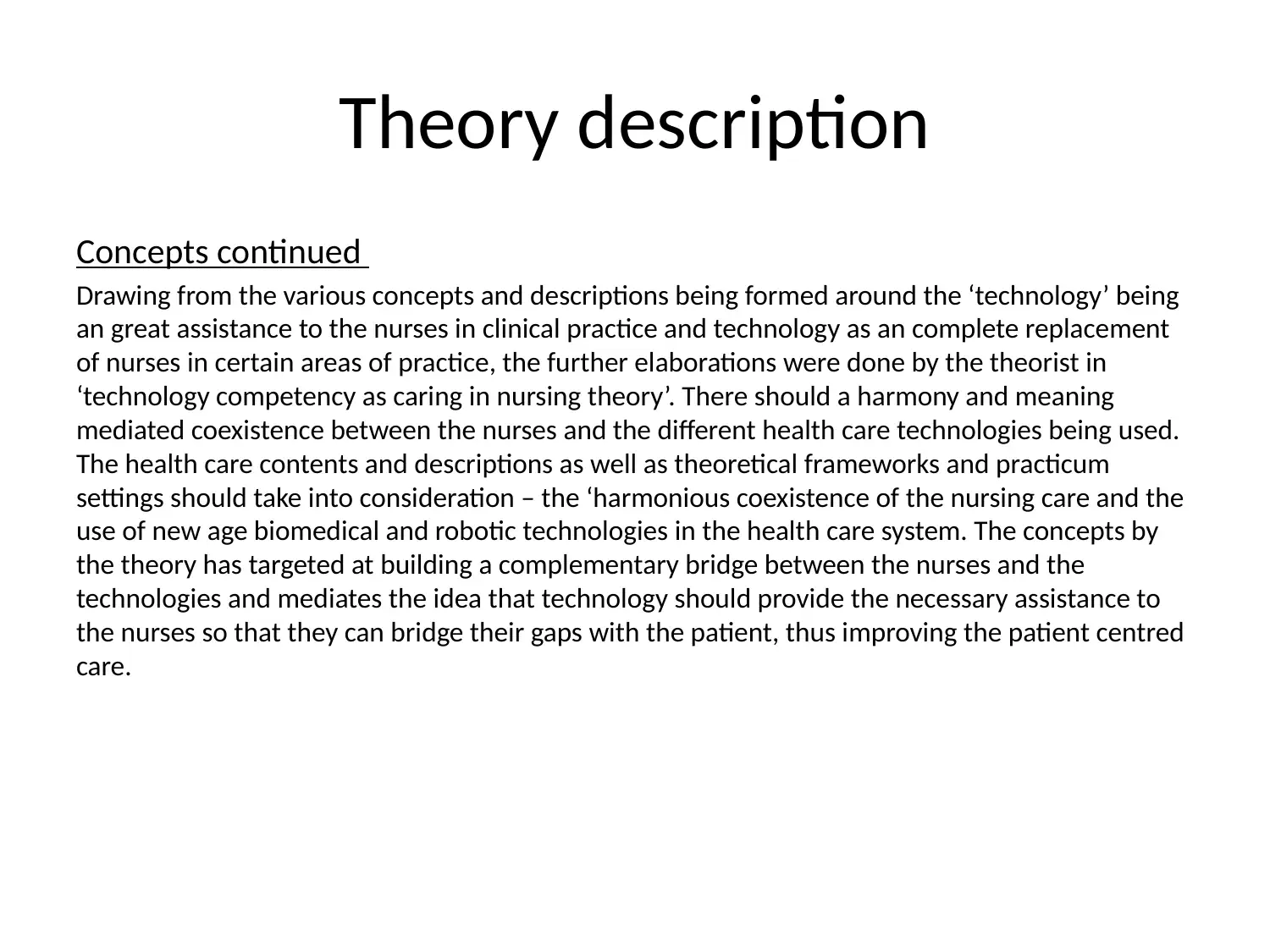
Concepts continued
Drawing from the various concepts and descriptions being formed around the ‘technology’ being
an great assistance to the nurses in clinical practice and technology as an complete replacement
of nurses in certain areas of practice, the further elaborations were done by the theorist in
‘technology competency as caring in nursing theory’. There should a harmony and meaning
mediated coexistence between the nurses and the different health care technologies being used.
The health care contents and descriptions as well as theoretical frameworks and practicum
settings should take into consideration – the ‘harmonious coexistence of the nursing care and the
use of new age biomedical and robotic technologies in the health care system. The concepts by
the theory has targeted at building a complementary bridge between the nurses and the
technologies and mediates the idea that technology should provide the necessary assistance to
the nurses so that they can bridge their gaps with the patient, thus improving the patient centred
care.
Document Page
Theory description
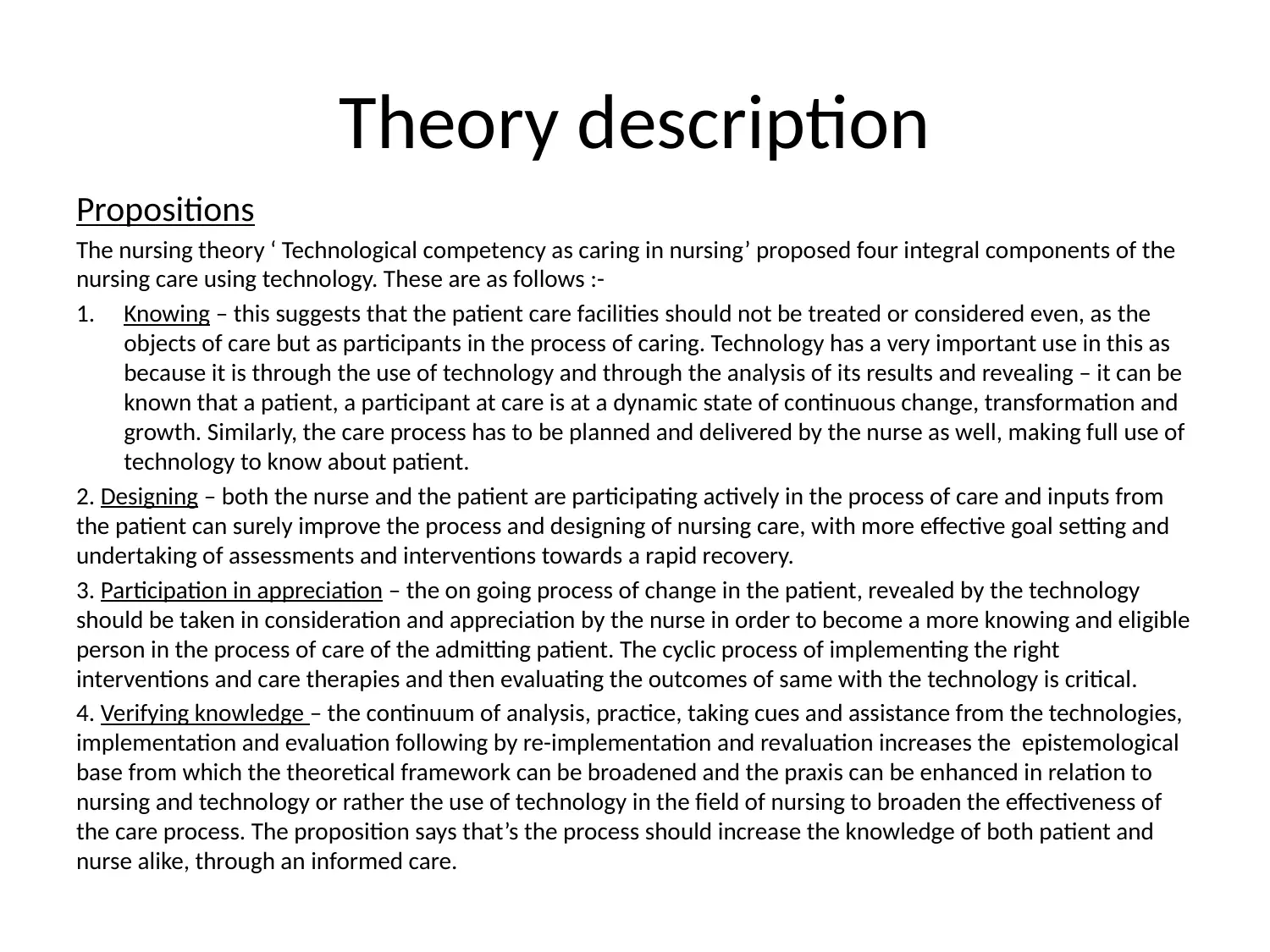
Propositions
The nursing theory ‘ Technological competency as caring in nursing’ proposed four integral components of the
nursing care using technology. These are as follows :-
1. Knowing – this suggests that the patient care facilities should not be treated or considered even, as the
objects of care but as participants in the process of caring. Technology has a very important use in this as
because it is through the use of technology and through the analysis of its results and revealing – it can be
known that a patient, a participant at care is at a dynamic state of continuous change, transformation and
growth. Similarly, the care process has to be planned and delivered by the nurse as well, making full use of
technology to know about patient.
2. Designing – both the nurse and the patient are participating actively in the process of care and inputs from
the patient can surely improve the process and designing of nursing care, with more effective goal setting and
undertaking of assessments and interventions towards a rapid recovery.
3. Participation in appreciation – the on going process of change in the patient, revealed by the technology
should be taken in consideration and appreciation by the nurse in order to become a more knowing and eligible
person in the process of care of the admitting patient. The cyclic process of implementing the right
interventions and care therapies and then evaluating the outcomes of same with the technology is critical.
4. Verifying knowledge – the continuum of analysis, practice, taking cues and assistance from the technologies,
implementation and evaluation following by re-implementation and revaluation increases the epistemological
base from which the theoretical framework can be broadened and the praxis can be enhanced in relation to
nursing and technology or rather the use of technology in the field of nursing to broaden the effectiveness of
the care process. The proposition says that’s the process should increase the knowledge of both patient and
nurse alike, through an informed care.
tabler-icon-diamond-filled.svg

Paraphrase This Document

Need a fresh take? Get an instant paraphrase of this document with our AI Paraphraser
Document Page
Theory description
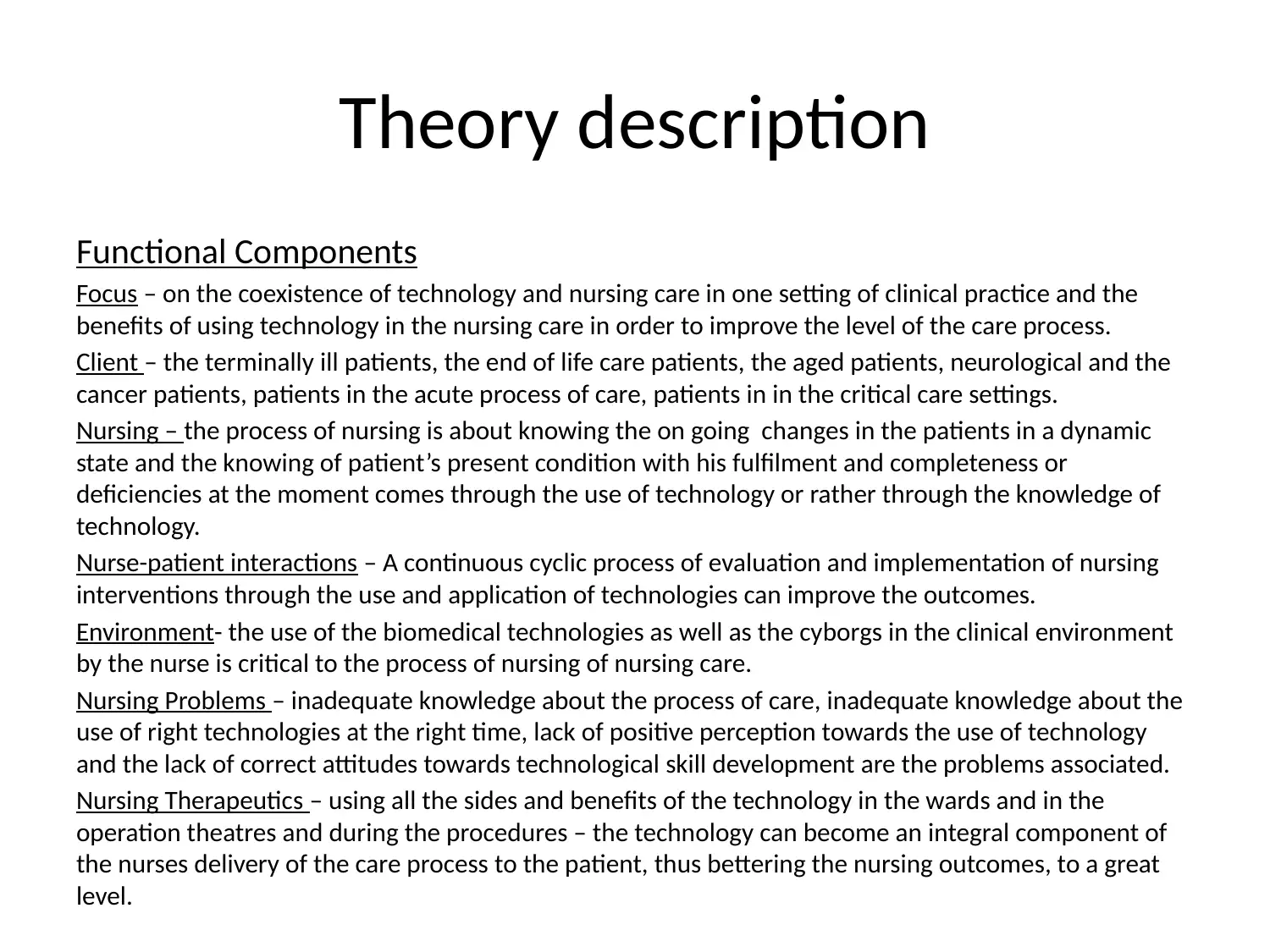
Functional Components
Focus – on the coexistence of technology and nursing care in one setting of clinical practice and the
benefits of using technology in the nursing care in order to improve the level of the care process.
Client – the terminally ill patients, the end of life care patients, the aged patients, neurological and the
cancer patients, patients in the acute process of care, patients in in the critical care settings.
Nursing – the process of nursing is about knowing the on going changes in the patients in a dynamic
state and the knowing of patient’s present condition with his fulfilment and completeness or
deficiencies at the moment comes through the use of technology or rather through the knowledge of
technology.
Nurse-patient interactions – A continuous cyclic process of evaluation and implementation of nursing
interventions through the use and application of technologies can improve the outcomes.
Environment- the use of the biomedical technologies as well as the cyborgs in the clinical environment
by the nurse is critical to the process of nursing of nursing care.
Nursing Problems – inadequate knowledge about the process of care, inadequate knowledge about the
use of right technologies at the right time, lack of positive perception towards the use of technology
and the lack of correct attitudes towards technological skill development are the problems associated.
Nursing Therapeutics – using all the sides and benefits of the technology in the wards and in the
operation theatres and during the procedures – the technology can become an integral component of
the nurses delivery of the care process to the patient, thus bettering the nursing outcomes, to a great
level.
Document Page
ARTICLES
Theory – ‘Technological competency as caring in nursing’
The articles chosen for critiquing are :-
Article 1 :
Tanioka, T. (2019). Nursing and Rehabilitative Care of the Elderly Using
Humanoid Robots. The Journal of Medical Investigation, 66(1.2)
Article 2: Diño, M. J. S., & Ong, I. L. (2019). Research, technology, education &
scholarship in the fourth industrial revolution [4IR]: Influences in nursing and
the health sciences. The Journal of Medical Investigation, 66(1.2), 3-7.
Document Page
Relationship between
structure and function
Article 1 :
Clarity : the article clearly defines the use and application of this nursing
theory into the clinical framework as being a bit ambiguous as because
the theories and the philosophies of the nursing theory is a bit
complicated for the new nursing graduate nurse to comprehend.
Consistency : the consistency of the nursing theory description and
critiquing is thorough throughout the scholarly paper.
Simplicity / Complexity : a simple language has been used to full effect.
Tautology / Teleology : absent throughout the paper. The context is
original and effective.
tabler-icon-diamond-filled.svg

Paraphrase This Document

Need a fresh take? Get an instant paraphrase of this document with our AI Paraphraser
Document Page
Relationship between
structure and function
Article 2
Clarity : the article although supports, interprets and analyses the theory with
critiquing in parts but the overall clarity is lacking. In the introduction, and
analysis section – the content becomes difficult to be understood.
Consistency : the content is unstructured and lack a thorough consistency.
Simplicity / Complexity : complex language has been used. Difficult,
incoherent and irrelevant terms has been used throughout the article which
make the theory critiquing ineffective on the overall.
Tautology / Teleology : present at certain parts of the paper.
Document Page
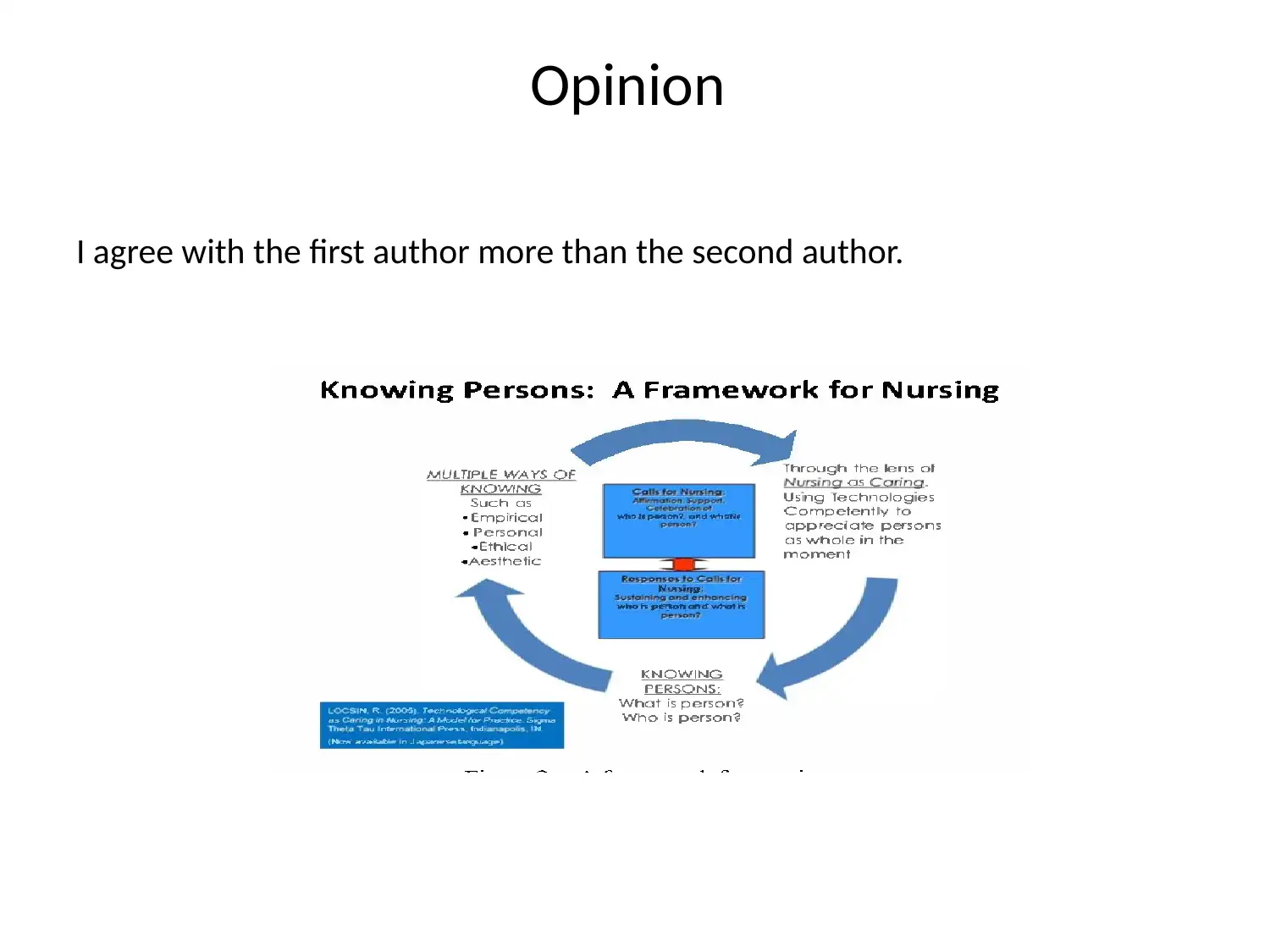
Opinion
I agree with the first author more than the second author.
chevron_up_icon
1 out of 25
circle_padding
hide_on_mobile
zoom_out_icon
[object Object]