Research Project: Social Media's Impact on the Travel & Tourism
VerifiedAdded on 2024/06/25
|34
|6290
|190
Report
AI Summary
This research project investigates the impacts and influences of social media on the travel and tourism industry. It begins by outlining the research background, noting the increasing role of digital technologies and social media in the sector. The research questions focus on identifying technological factors transforming the industry, how these technologies affect customer behavior and sales, the advantages and disadvantages of adopting digital technologies, and their impact on industry systems and processes. The aims and objectives include understanding the contribution of digital technologies to the sector's growth, assessing their impact on business activities, and identifying how they affect customer decision-making. The rationale emphasizes the role of digital technologies in enhancing travel services and attracting customers through online platforms and simplified processes. The literature review highlights the significance of the travel and tourism industry, its evolution, and the impact of technology on customer experiences and industry operations. The research employs both primary and secondary research techniques, using qualitative data from various sources and quantitative data collected through questionnaire surveys to analyze the impacts of digital technologies on customer behavior and satisfaction.
RESEARCH PROJECT IN TRAVEL AND TOURISM INDUSTRY
Impacts and influences of Social Media on the Travel and Tourism industry
0
Impacts and influences of Social Media on the Travel and Tourism industry
0

Paraphrase This Document
Need a fresh take? Get an instant paraphrase of this document with our AI Paraphraser
Introduction
The main aim of this unit is to develop research skills and to make one confident in using different
research techniques and methods. This is done by addressing some elements that are making up
the formal research methodologies, including the research proposal and methodologies along with
the presentation of research findings. The main theme of this research project is “the influence of
technology in the travel and tourism sector”. This topic has been chosen because in this modern
world, digital technologies are impacting on each and every sector to a great extent and hence it is
very important to analyse its impacts on travel and tourism sector, as it is one of the major sectors
that is contributing a high part in a country's economic growth. Hence, the implementation of
digital technologies in the field of travel and tourism sector is also influencing consumers' decision-
making processes, which is also highlighted in this research project. The main focus of this
assignment is on the “Impacts and influences of Social Media on the Travel and Tourism industry”.
The main aim of this unit is to develop research skills and to make one confident in using different
research techniques and methods. This is done by addressing some elements that are making up
the formal research methodologies, including the research proposal and methodologies along with
the presentation of research findings. The main theme of this research project is “the influence of
technology in the travel and tourism sector”. This topic has been chosen because in this modern
world, digital technologies are impacting on each and every sector to a great extent and hence it is
very important to analyse its impacts on travel and tourism sector, as it is one of the major sectors
that is contributing a high part in a country's economic growth. Hence, the implementation of
digital technologies in the field of travel and tourism sector is also influencing consumers' decision-
making processes, which is also highlighted in this research project. The main focus of this
assignment is on the “Impacts and influences of Social Media on the Travel and Tourism industry”.
Task 1 – Research Proposal
1.1 Formulating and recording possible research project outline
specifications
Research Background
In the last few decades, it has been observed that there is a significant increase in the use of social
media and digital technologies in almost the entire sector in the world. Also, the travel and tourism
sector has seen an impressive development and growth since the beginning of a digital era. Over
the past few years due to the recession, the travel and tourism industry has faced many of the
challenges like people have started to cut down their spending on vacations and hence the sales of
travel and tourism industry has decreased to a great extent. This decrease has led to the generation
of lower revenues, payrolls and there is also a decrease in work segments as job opportunities are
less due to less demand in the business industry (Xiang, et al., 2015).
But today, the travel and tourism industry is on the rise again as there are many changes like the
introduction of digital technologies in their business activities. Also, the use of social media
platforms is creating new opportunities to progress and attract a large number of customers
towards the services and products of the travel and tourism industry. Social media platforms are
facilitating many of the customers with proper communication and empower guest engagement in
many ways. This research will be focusing on the identification of major digital technological
implementation and adoption which is creating a positive influence on the mind of customers and
impacting their decision making to a great extent (Jacobsen and Munar, 2012).
Research Questions
1. What are the major technological and digital factors that are transforming and facilitating
the travel and tourism industry?
2. How is the implementation and adopting of digital technologies helpful in affecting the
customers’ behaviour and hence increasing the sales of products in the travel and tourism
sector?
3. What are the major advantages and disadvantages of adopting digital technologies in the
business activities like marketing of travel and tourism sector?
1.1 Formulating and recording possible research project outline
specifications
Research Background
In the last few decades, it has been observed that there is a significant increase in the use of social
media and digital technologies in almost the entire sector in the world. Also, the travel and tourism
sector has seen an impressive development and growth since the beginning of a digital era. Over
the past few years due to the recession, the travel and tourism industry has faced many of the
challenges like people have started to cut down their spending on vacations and hence the sales of
travel and tourism industry has decreased to a great extent. This decrease has led to the generation
of lower revenues, payrolls and there is also a decrease in work segments as job opportunities are
less due to less demand in the business industry (Xiang, et al., 2015).
But today, the travel and tourism industry is on the rise again as there are many changes like the
introduction of digital technologies in their business activities. Also, the use of social media
platforms is creating new opportunities to progress and attract a large number of customers
towards the services and products of the travel and tourism industry. Social media platforms are
facilitating many of the customers with proper communication and empower guest engagement in
many ways. This research will be focusing on the identification of major digital technological
implementation and adoption which is creating a positive influence on the mind of customers and
impacting their decision making to a great extent (Jacobsen and Munar, 2012).
Research Questions
1. What are the major technological and digital factors that are transforming and facilitating
the travel and tourism industry?
2. How is the implementation and adopting of digital technologies helpful in affecting the
customers’ behaviour and hence increasing the sales of products in the travel and tourism
sector?
3. What are the major advantages and disadvantages of adopting digital technologies in the
business activities like marketing of travel and tourism sector?
⊘ This is a preview!⊘
Do you want full access?
Subscribe today to unlock all pages.

Trusted by 1+ million students worldwide
4. How the systems and processes in the travel and tourism industry have been affected by the
introduction and implementation of technologies?
Aims and Objectives
The main aim of the research is to obtain meaningful results on the impacts of technologies in the
field of travel and tourism industry. It is also aimed to observe and identify the major factors that
are increasing the growth of the travel industry. This growth, development and implementation of
digital technologies in the travel and tourism industry are inspiring the customers of travel and
tourism industry to buy more and more products and services, as the processes are new becoming
easy and compatible for using (Bryman and Bell, 2015).
In order to achieve the aims of this research, they have been divided into following objectives with
which they can be achieved properly and effectively:
1. To develop an understanding of how digital technologies are contributing to the growth and
development of travel and tourism sector.
2. To identify how the major implementation and changes in digital technologies have
impacted the business activities in the travel and tourism industry.
3. To identify and assess the impacts of digital technologies on the travel industry along with
its business activities.
4. To identify that how the decision making of customers are affected due to digital
technologies and how they are becoming more satisfied through the implementation
processes.
5. To identify the contribution of social networking sites in marketing the products and
services of travel and tourism industry.
introduction and implementation of technologies?
Aims and Objectives
The main aim of the research is to obtain meaningful results on the impacts of technologies in the
field of travel and tourism industry. It is also aimed to observe and identify the major factors that
are increasing the growth of the travel industry. This growth, development and implementation of
digital technologies in the travel and tourism industry are inspiring the customers of travel and
tourism industry to buy more and more products and services, as the processes are new becoming
easy and compatible for using (Bryman and Bell, 2015).
In order to achieve the aims of this research, they have been divided into following objectives with
which they can be achieved properly and effectively:
1. To develop an understanding of how digital technologies are contributing to the growth and
development of travel and tourism sector.
2. To identify how the major implementation and changes in digital technologies have
impacted the business activities in the travel and tourism industry.
3. To identify and assess the impacts of digital technologies on the travel industry along with
its business activities.
4. To identify that how the decision making of customers are affected due to digital
technologies and how they are becoming more satisfied through the implementation
processes.
5. To identify the contribution of social networking sites in marketing the products and
services of travel and tourism industry.
Paraphrase This Document
Need a fresh take? Get an instant paraphrase of this document with our AI Paraphraser
1.2 Identifying the factors that are contributing to the process of
research project selection
Rationale for Research
The main focus of this research is to help in understanding the role and significance of various
digital technologies in the travel and tourism industry. This research will be helpful in providing and
listing all the evidence and factors that are contributing to the growth of the travel and tourism
industry and that are coming in the digital sector. All the technologies that are adopted by the
travel and tourism industry’s companies and organizations are basically based on the internet
service (Jacobsen and Munar, 2012). The travel and tourism industry is enhancing its services and
facilities by introducing many of the technologies like mobile, digital, transportation, e-commerce
technologies along with other digital and internet technologies. Hence, it can be said that with the
help of modern technology and digital concepts, the travel and tourism industry is providing
services and facilities to its customers on one click and moreover in a few steps. The technological
development in the field of the travel industry is attracting many of the customers because of ease
and less complexity; hence they are motivating the customers to use the travel services and to
travel the world destinations with satisfaction in their minds (Bryman and Bell, 2015).
It is also observed that the booking of hotels and selection of packages have become easier as many
travel agencies and trip advisors are offering their services online. They are also offering their
customers to have a pre-visit look at the locations at which at will travel by showing them photos
and videos of the ex-customers. Booking of hotels becomes easy for accommodation with the
option of pre and online booking systems. Hence, it can be concluded that technology is acting as a
backbone for the travel and tourism industry (Jacobsen and Munar, 2012).
research project selection
Rationale for Research
The main focus of this research is to help in understanding the role and significance of various
digital technologies in the travel and tourism industry. This research will be helpful in providing and
listing all the evidence and factors that are contributing to the growth of the travel and tourism
industry and that are coming in the digital sector. All the technologies that are adopted by the
travel and tourism industry’s companies and organizations are basically based on the internet
service (Jacobsen and Munar, 2012). The travel and tourism industry is enhancing its services and
facilities by introducing many of the technologies like mobile, digital, transportation, e-commerce
technologies along with other digital and internet technologies. Hence, it can be said that with the
help of modern technology and digital concepts, the travel and tourism industry is providing
services and facilities to its customers on one click and moreover in a few steps. The technological
development in the field of the travel industry is attracting many of the customers because of ease
and less complexity; hence they are motivating the customers to use the travel services and to
travel the world destinations with satisfaction in their minds (Bryman and Bell, 2015).
It is also observed that the booking of hotels and selection of packages have become easier as many
travel agencies and trip advisors are offering their services online. They are also offering their
customers to have a pre-visit look at the locations at which at will travel by showing them photos
and videos of the ex-customers. Booking of hotels becomes easy for accommodation with the
option of pre and online booking systems. Hence, it can be concluded that technology is acting as a
backbone for the travel and tourism industry (Jacobsen and Munar, 2012).
1.3 A critical review of key references
Literature Review
UNWTO has defined that “travel and tourism industry is a social, cultural and economic
phenomenon which involves the movement of various travels to different parts of the world for
their personal, business or travel purpose.” In addition to this, it has also been listed that the travel
industry is a source of employment to various nations as millions of people are getting job
opportunities and improving their standard of living from this (Benea, 2014). Thus, it becomes very
important to research, analyse and study on the travel and tourism industry with deep
understanding and attention.
Robinson, Lück and Smith (2013), added that since the staring of the 1950s, the travel and tourism
sector is emerging with high rate and goes through various social and environmental changes. Thus,
it becomes one of the most serious fields of research for many of the scholars and researchers since
1970s.
According to Page (2009), it can be said that the hospitality and travel industry has become a
commercialized experience, where the customers are paying for the particular services and
products that they have consumed via a bill. Robinson, Lück and Smith (2013), added more in this,
that the hospitality industry is a subset of the tourism industry and also a fundamental part of the
domestic and inbound leisure market. Consistent increase in the demands of different customers is
allowing both the tourism and hospitality industry to forecast the demands of customers and work
as per their needs. In addition to this, the identification of opportunities in order to increase the
customers spending power and creating a wave becomes very important (Bearne, 2016).
As per Belkon (2017), planning of a trip 10 years ago and now is very different, as many of the
aspects have changes in the last few years, due to which the facilities have also updated. The
modern travellers find it easier to book, travel and enjoy travelling as it is the result of technology
integration and other conveniences. With the help of internet facilities like mobile technologies,
Wi-Fi and online booking applications, the travel and tourism industry’s organizations become able
to attract a large number of customers (Trout, 2013).
Literature Review
UNWTO has defined that “travel and tourism industry is a social, cultural and economic
phenomenon which involves the movement of various travels to different parts of the world for
their personal, business or travel purpose.” In addition to this, it has also been listed that the travel
industry is a source of employment to various nations as millions of people are getting job
opportunities and improving their standard of living from this (Benea, 2014). Thus, it becomes very
important to research, analyse and study on the travel and tourism industry with deep
understanding and attention.
Robinson, Lück and Smith (2013), added that since the staring of the 1950s, the travel and tourism
sector is emerging with high rate and goes through various social and environmental changes. Thus,
it becomes one of the most serious fields of research for many of the scholars and researchers since
1970s.
According to Page (2009), it can be said that the hospitality and travel industry has become a
commercialized experience, where the customers are paying for the particular services and
products that they have consumed via a bill. Robinson, Lück and Smith (2013), added more in this,
that the hospitality industry is a subset of the tourism industry and also a fundamental part of the
domestic and inbound leisure market. Consistent increase in the demands of different customers is
allowing both the tourism and hospitality industry to forecast the demands of customers and work
as per their needs. In addition to this, the identification of opportunities in order to increase the
customers spending power and creating a wave becomes very important (Bearne, 2016).
As per Belkon (2017), planning of a trip 10 years ago and now is very different, as many of the
aspects have changes in the last few years, due to which the facilities have also updated. The
modern travellers find it easier to book, travel and enjoy travelling as it is the result of technology
integration and other conveniences. With the help of internet facilities like mobile technologies,
Wi-Fi and online booking applications, the travel and tourism industry’s organizations become able
to attract a large number of customers (Trout, 2013).
⊘ This is a preview!⊘
Do you want full access?
Subscribe today to unlock all pages.
Trusted by 1+ million students worldwide
Digital technologies have also helped in making the payment systems and procedures easy by
introducing various software and applications. This is said by Anonymous in an article which has
been published in the year 2014 on travel technology and science. Digital technologies are also
helpful in providing various facilities like providing various options through the internet so that the
customers can choose from them as per their requirement and then they can have a satisfaction in
their minds.
As per an article on Tourism in a World Technology (2011), it can be said that the modern
technology is providing various advantages to the travel industry like reducing the expensive human
labour and avoiding issues related to customer services and dissatisfaction. This is done by them for
providing whole responsibility of booking and selecting to the customers and allow them to make
their own decisions by providing them digital software and applications in their hands.
In the year 2015, the World Travel and Tourism Council has declared that the travel and tourism
industry's systems and processes have transformed to a great extent with the introduction of digital
technologies. It is also said that there are 7 ways in which the modern technologies are changing
and disturbing the travel industry which includes, smartphones, trip-advisors, satellite navigations,
GPRS, Google glass etc. With the help of GPRS systems, it becomes very easy to track the location of
a particular destination and hence the travellers who are travelling in their own vehicle found it
easier to reach a particular destination.
According to Chakraborty (2013), the modern technologies are providing customer-focused
solutions to many of the travel organizations along with collaborative working platforms which are
helpful in satisfying their customers.
introducing various software and applications. This is said by Anonymous in an article which has
been published in the year 2014 on travel technology and science. Digital technologies are also
helpful in providing various facilities like providing various options through the internet so that the
customers can choose from them as per their requirement and then they can have a satisfaction in
their minds.
As per an article on Tourism in a World Technology (2011), it can be said that the modern
technology is providing various advantages to the travel industry like reducing the expensive human
labour and avoiding issues related to customer services and dissatisfaction. This is done by them for
providing whole responsibility of booking and selecting to the customers and allow them to make
their own decisions by providing them digital software and applications in their hands.
In the year 2015, the World Travel and Tourism Council has declared that the travel and tourism
industry's systems and processes have transformed to a great extent with the introduction of digital
technologies. It is also said that there are 7 ways in which the modern technologies are changing
and disturbing the travel industry which includes, smartphones, trip-advisors, satellite navigations,
GPRS, Google glass etc. With the help of GPRS systems, it becomes very easy to track the location of
a particular destination and hence the travellers who are travelling in their own vehicle found it
easier to reach a particular destination.
According to Chakraborty (2013), the modern technologies are providing customer-focused
solutions to many of the travel organizations along with collaborative working platforms which are
helpful in satisfying their customers.
Paraphrase This Document
Need a fresh take? Get an instant paraphrase of this document with our AI Paraphraser
1.4 Producing a research project specification
This research project will use a large number of research tools and techniques for finding various
information and knowledge. This will be helpful in reaching to exact results and conclusion of the
research project. Both primary and secondary research techniques are used in the research in order
to collect relevant data and information related to the research questions. Secondary research will
be done by reviewing the existing data from different research proposals, scholars, articles and
journals which are based on the impacts of digital technologies in the travel and tourism industry
(Neuman, 2013).
On the other hand, primary research will use both qualitative and quantitative research techniques
which will be helpful in collecting the first-hand data on the research topic.
Qualitative Research
This research will be helpful in collecting the non-numeric data from different newspapers, articles,
books, journals and from various internet sources (Lewis, 2015). From all these sources,
information that is relevant to technological impacts in the travel industry is taken into
consideration along with the current trends in the field that is driving customers' mindset and
improving their satisfaction level.
Quantitative Research
Questionnaire survey method will be used in this method for collecting relevant data and
information related to the research topic, as this technique will be helpful in collecting the
numerical data (Brannen, 2017). The major factors that are responsible for affecting the customers
behaviour and decision making along with their satisfaction level are collected which is relevant to
the travel and tourism industry. Following are the major questions that will be asked to college
students, colleagues and friends which will have a sample size of 100.
Questionnaire
1. What is the major purpose for your travel?
Enjoyment and leisure
Business purpose
Religious purpose
This research project will use a large number of research tools and techniques for finding various
information and knowledge. This will be helpful in reaching to exact results and conclusion of the
research project. Both primary and secondary research techniques are used in the research in order
to collect relevant data and information related to the research questions. Secondary research will
be done by reviewing the existing data from different research proposals, scholars, articles and
journals which are based on the impacts of digital technologies in the travel and tourism industry
(Neuman, 2013).
On the other hand, primary research will use both qualitative and quantitative research techniques
which will be helpful in collecting the first-hand data on the research topic.
Qualitative Research
This research will be helpful in collecting the non-numeric data from different newspapers, articles,
books, journals and from various internet sources (Lewis, 2015). From all these sources,
information that is relevant to technological impacts in the travel industry is taken into
consideration along with the current trends in the field that is driving customers' mindset and
improving their satisfaction level.
Quantitative Research
Questionnaire survey method will be used in this method for collecting relevant data and
information related to the research topic, as this technique will be helpful in collecting the
numerical data (Brannen, 2017). The major factors that are responsible for affecting the customers
behaviour and decision making along with their satisfaction level are collected which is relevant to
the travel and tourism industry. Following are the major questions that will be asked to college
students, colleagues and friends which will have a sample size of 100.
Questionnaire
1. What is the major purpose for your travel?
Enjoyment and leisure
Business purpose
Religious purpose
Personal purposes (including meeting relatives and friends, attending family
functions and gatherings)
2. Do you use Social Media like Facebook, Instagram for planning your trip?
Yes
No
3. Do you use Social Media while travelling?
Yes
No
4. Among the following Social Media platforms, which is the most useful one to help you in
planning a trip?
Facebook
Twitter
Instagram
Google+
5. What is your main purpose for using various social networking sites like Facebook and
Instagram?
Searching new locations
Reading travel reviews and recommendations of ex-visitors
Posting photos and videos of the latest travel trip
Posting travel reviews and recommendations
6. What do you search for on social networking sites like Facebook and Instagram?
Destination ideas and new locations for travelling
Hotels and accommodation facilities
Transportation choice and food deals
Hotel Recommendations
7. Do photos and videos of travel destinations that are posted on social networking sites are
encouraging you to travel to that particular place?
Yes
No
8. Which form of advertising, do you trust the most?
Mouth advertising/ word of mouth
Recommendations from peers
functions and gatherings)
2. Do you use Social Media like Facebook, Instagram for planning your trip?
Yes
No
3. Do you use Social Media while travelling?
Yes
No
4. Among the following Social Media platforms, which is the most useful one to help you in
planning a trip?
Google+
5. What is your main purpose for using various social networking sites like Facebook and
Instagram?
Searching new locations
Reading travel reviews and recommendations of ex-visitors
Posting photos and videos of the latest travel trip
Posting travel reviews and recommendations
6. What do you search for on social networking sites like Facebook and Instagram?
Destination ideas and new locations for travelling
Hotels and accommodation facilities
Transportation choice and food deals
Hotel Recommendations
7. Do photos and videos of travel destinations that are posted on social networking sites are
encouraging you to travel to that particular place?
Yes
No
8. Which form of advertising, do you trust the most?
Mouth advertising/ word of mouth
Recommendations from peers
⊘ This is a preview!⊘
Do you want full access?
Subscribe today to unlock all pages.
Trusted by 1+ million students worldwide
Online reviews
Aids on TV, magazines and newspapers
9. Which of the following is the most important one on which the travel and tourism industry
rely on?
Digital technologies
Transportation technologies
Both of them
10. Do you believe that the entire processes and systems of the travel and tourism industry are
dependent on modern technology?
Yes
No
11. Are you satisfied with the implementation of digital technologies in the travel and tourism
sector?
Yes
No
Average
Ethical Consideration
Any kind of unethical acts will not be entertained at the time of research activities. All the
techniques and tools that will be used in this research will be highly ethical and truthful as they will
not harm any of the suspects in the research activities. All the privacies and confidentiality will be
assured with respect to the identities of participants (Roberts, 2015).
Aids on TV, magazines and newspapers
9. Which of the following is the most important one on which the travel and tourism industry
rely on?
Digital technologies
Transportation technologies
Both of them
10. Do you believe that the entire processes and systems of the travel and tourism industry are
dependent on modern technology?
Yes
No
11. Are you satisfied with the implementation of digital technologies in the travel and tourism
sector?
Yes
No
Average
Ethical Consideration
Any kind of unethical acts will not be entertained at the time of research activities. All the
techniques and tools that will be used in this research will be highly ethical and truthful as they will
not harm any of the suspects in the research activities. All the privacies and confidentiality will be
assured with respect to the identities of participants (Roberts, 2015).
Paraphrase This Document
Need a fresh take? Get an instant paraphrase of this document with our AI Paraphraser
1.5 Providing an appropriate plan and procedures for the agreed
research specification
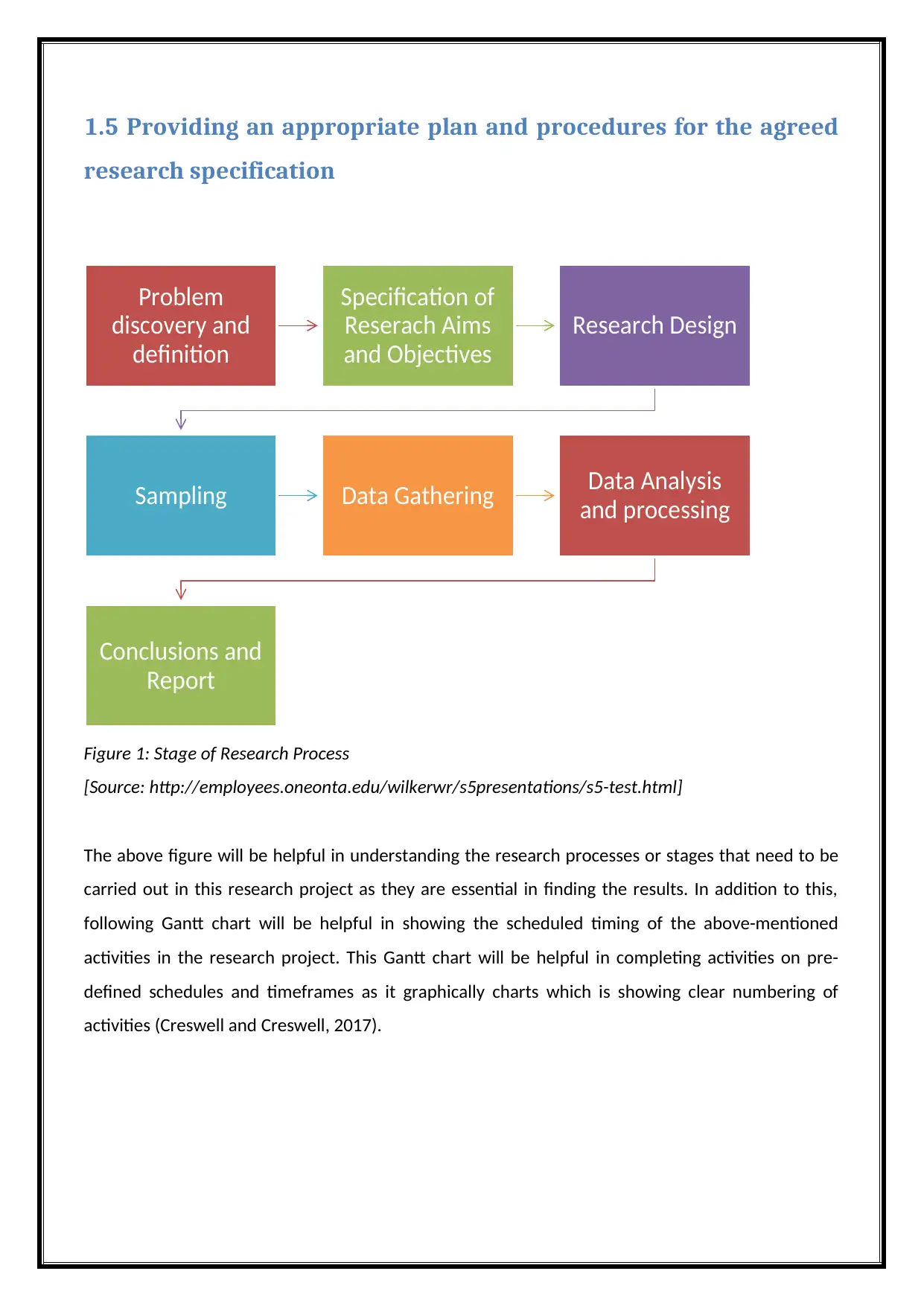
Figure 1: Stage of Research Process
[Source: http://employees.oneonta.edu/wilkerwr/s5presentations/s5-test.html]
The above figure will be helpful in understanding the research processes or stages that need to be
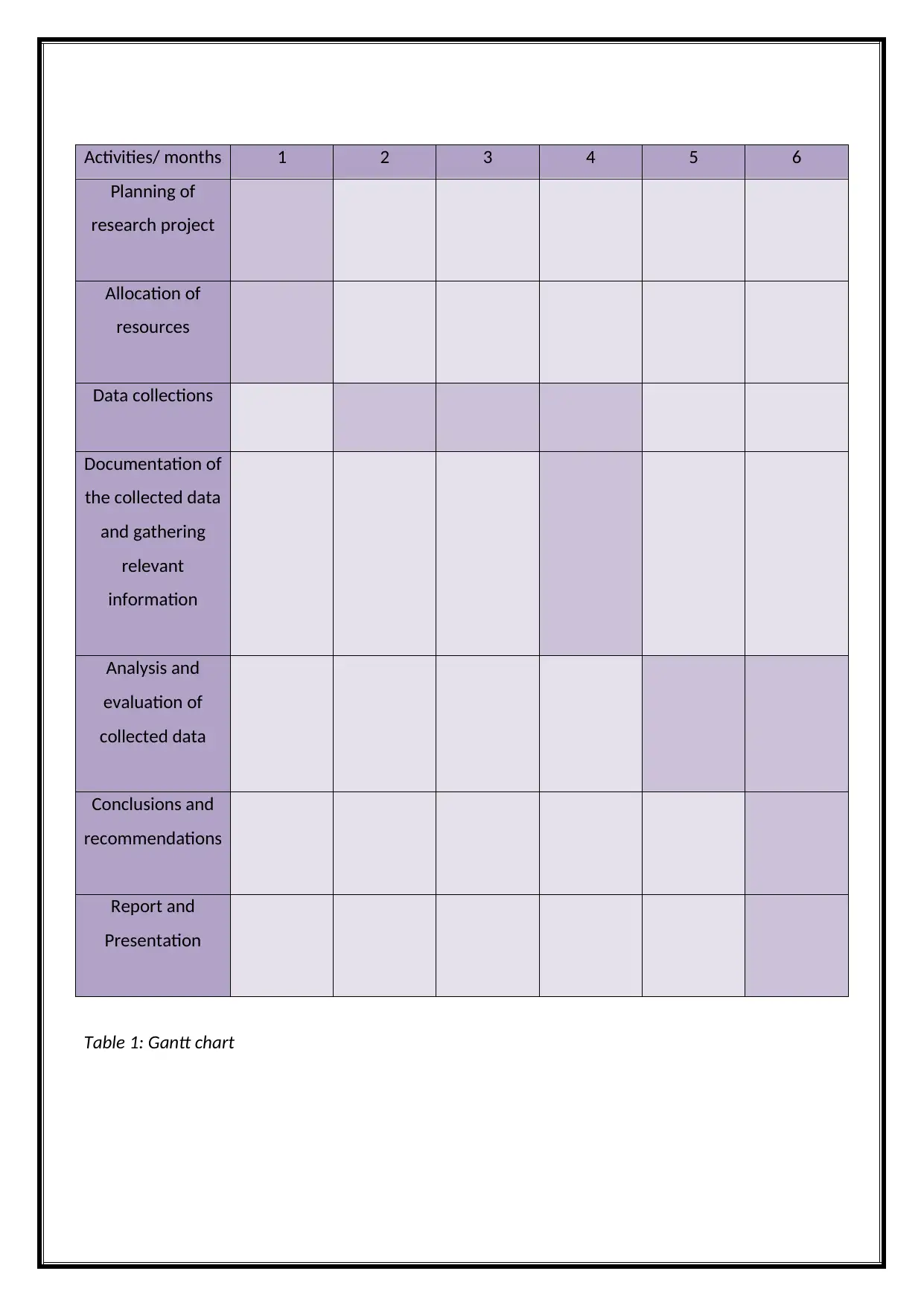
carried out in this research project as they are essential in finding the results. In addition to this,
following Gantt chart will be helpful in showing the scheduled timing of the above-mentioned
activities in the research project. This Gantt chart will be helpful in completing activities on pre-
defined schedules and timeframes as it graphically charts which is showing clear numbering of
activities (Creswell and Creswell, 2017).
Problem
discovery and
definition
Specification of
Reserach Aims
and Objectives
Research Design
Sampling Data Gathering Data Analysis
and processing
Conclusions and
Report
research specification
Figure 1: Stage of Research Process
[Source: http://employees.oneonta.edu/wilkerwr/s5presentations/s5-test.html]
The above figure will be helpful in understanding the research processes or stages that need to be
carried out in this research project as they are essential in finding the results. In addition to this,
following Gantt chart will be helpful in showing the scheduled timing of the above-mentioned
activities in the research project. This Gantt chart will be helpful in completing activities on pre-
defined schedules and timeframes as it graphically charts which is showing clear numbering of
activities (Creswell and Creswell, 2017).
Problem
discovery and
definition
Specification of
Reserach Aims
and Objectives
Research Design
Sampling Data Gathering Data Analysis
and processing
Conclusions and
Report
Activities/ months 1 2 3 4 5 6
Planning of
research project
Allocation of
resources
Data collections
Documentation of
the collected data
and gathering
relevant
information
Analysis and
evaluation of
collected data
Conclusions and
recommendations
Report and
Presentation
Table 1: Gantt chart
Planning of
research project
Allocation of
resources
Data collections
Documentation of
the collected data
and gathering
relevant
information
Analysis and
evaluation of
collected data
Conclusions and
recommendations
Report and
Presentation
Table 1: Gantt chart
⊘ This is a preview!⊘
Do you want full access?
Subscribe today to unlock all pages.
Trusted by 1+ million students worldwide

1 out of 34


Related Documents


Your All-in-One AI-Powered Toolkit for Academic Success.
+13062052269
info@desklib.com
Available 24*7 on WhatsApp / Email
![[object Object]](/_next/static/media/star-bottom.7253800d.svg)
Unlock your academic potential
Copyright © 2020–2026 A2Z Services. All Rights Reserved. Developed and managed by ZUCOL.