Macroeconomics Report: Exploring the U.S. Financial System

Verified

Added on  2022/10/15

|4
|485
|495
Report
AI Summary
This report provides an overview of the U.S. financial system, highlighting its significance as the world's largest and most developed. It discusses the role of the U.S. dollar, the influence of inflation and economic instability, and various money supply measures such as the monetary base, M1, and M2. The report traces the evolution of money from commodity-based systems to modern paper money and emphasizes the role of banks in creating money through loans and the subsequent impact on the money supply. Furthermore, it outlines the dual banking system in the U.S., detailing the roles of both state and federal banks, and the regulatory bodies involved, including the Comptroller of the Currency and the Federal Reserve System.
Document Page
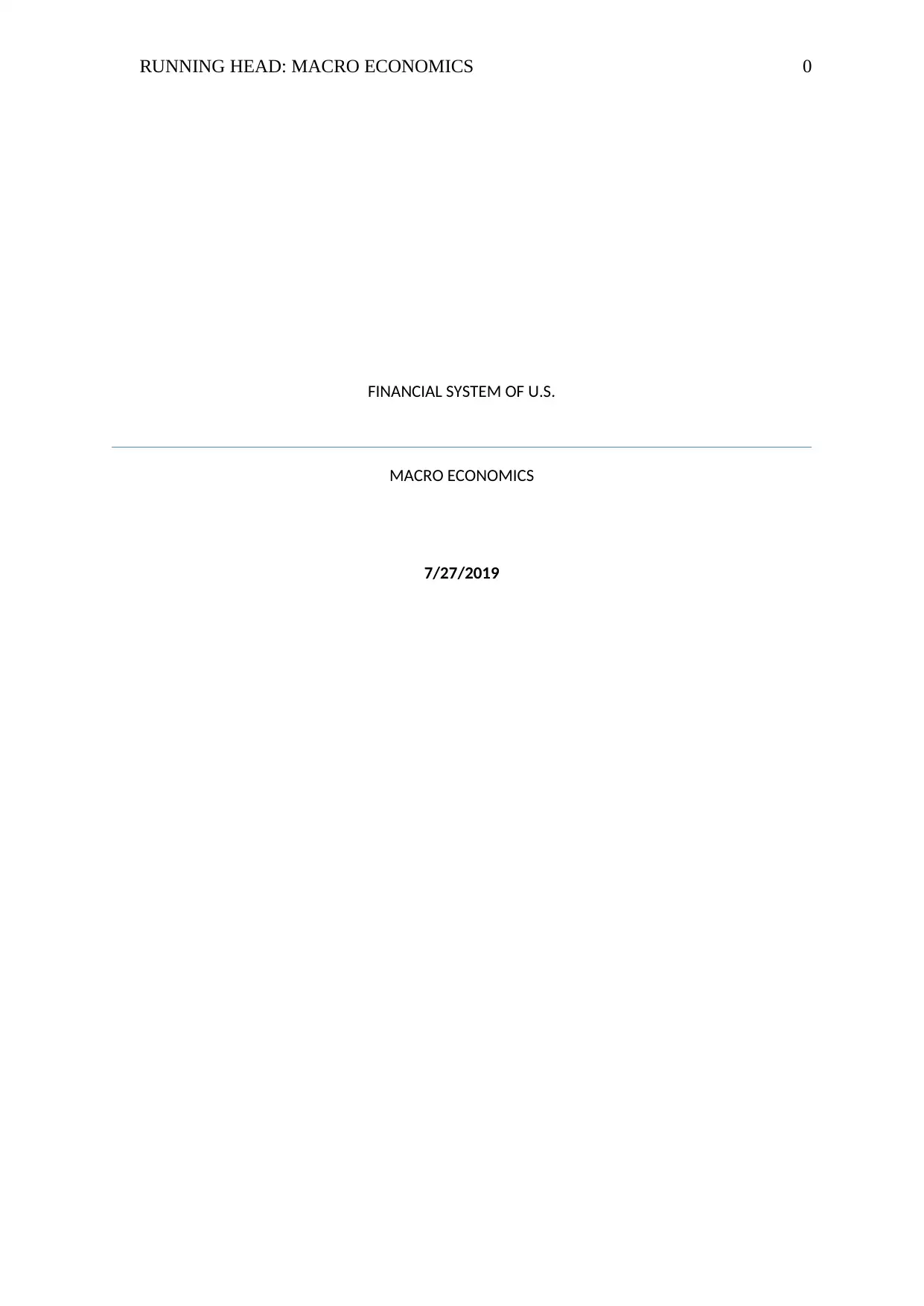
RUNNING HEAD: MACRO ECONOMICS 0
FINANCIAL SYSTEM OF U.S.
MACRO ECONOMICS
7/27/2019
tabler-icon-diamond-filled.svg

Paraphrase This Document

Need a fresh take? Get an instant paraphrase of this document with our AI Paraphraser
Document Page
MACRO ECONOMICS 1
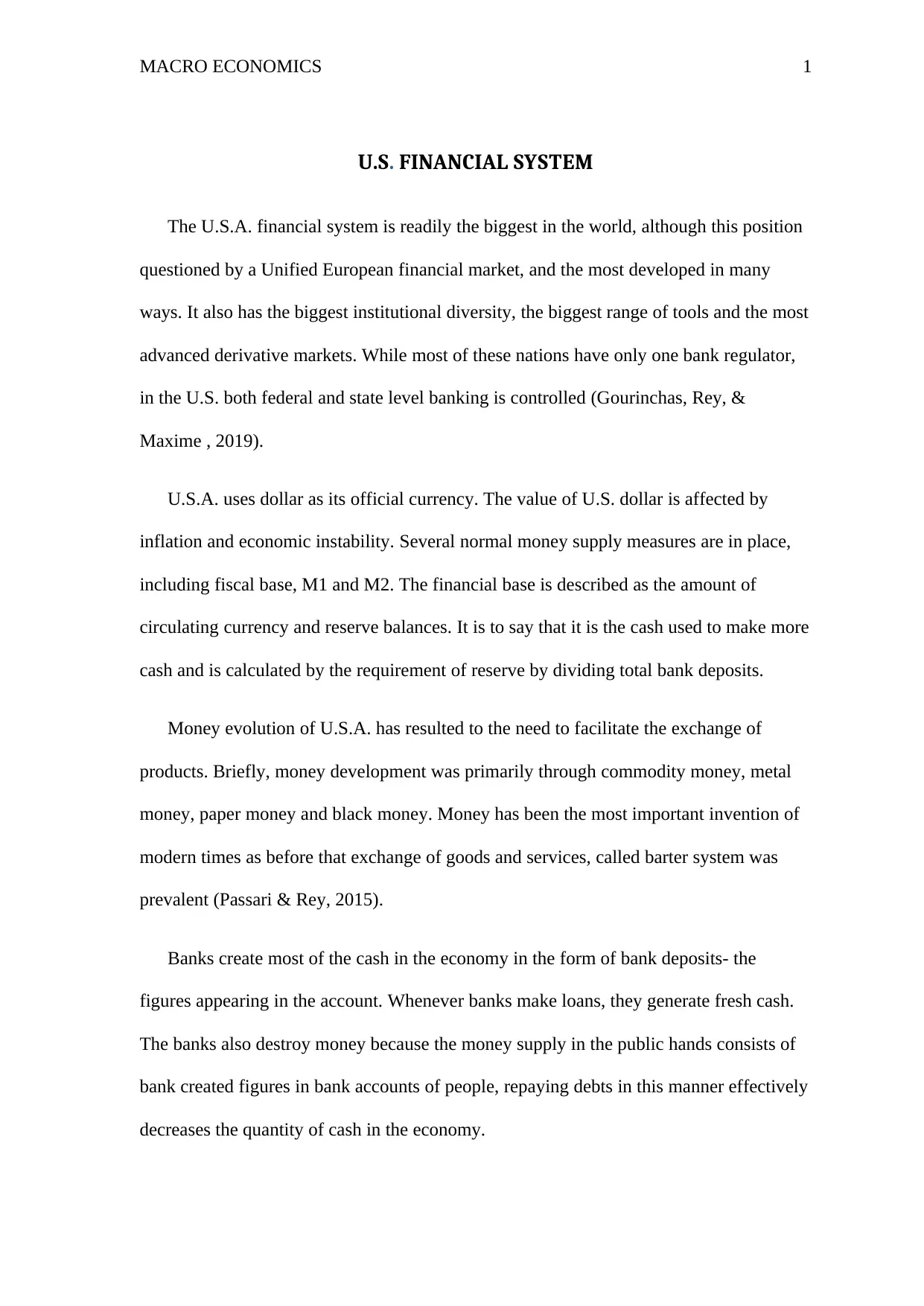
U.S. FINANCIAL SYSTEM
The U.S.A. financial system is readily the biggest in the world, although this position
questioned by a Unified European financial market, and the most developed in many
ways. It also has the biggest institutional diversity, the biggest range of tools and the most
advanced derivative markets. While most of these nations have only one bank regulator,
in the U.S. both federal and state level banking is controlled (Gourinchas, Rey, &
Maxime , 2019).
U.S.A. uses dollar as its official currency. The value of U.S. dollar is affected by
inflation and economic instability. Several normal money supply measures are in place,
including fiscal base, M1 and M2. The financial base is described as the amount of
circulating currency and reserve balances. It is to say that it is the cash used to make more
cash and is calculated by the requirement of reserve by dividing total bank deposits.
Money evolution of U.S.A. has resulted to the need to facilitate the exchange of
products. Briefly, money development was primarily through commodity money, metal
money, paper money and black money. Money has been the most important invention of
modern times as before that exchange of goods and services, called barter system was
prevalent (Passari & Rey, 2015).
Banks create most of the cash in the economy in the form of bank deposits- the
figures appearing in the account. Whenever banks make loans, they generate fresh cash.
The banks also destroy money because the money supply in the public hands consists of
bank created figures in bank accounts of people, repaying debts in this manner effectively
decreases the quantity of cash in the economy.
Document Page
MACRO ECONOMICS 2
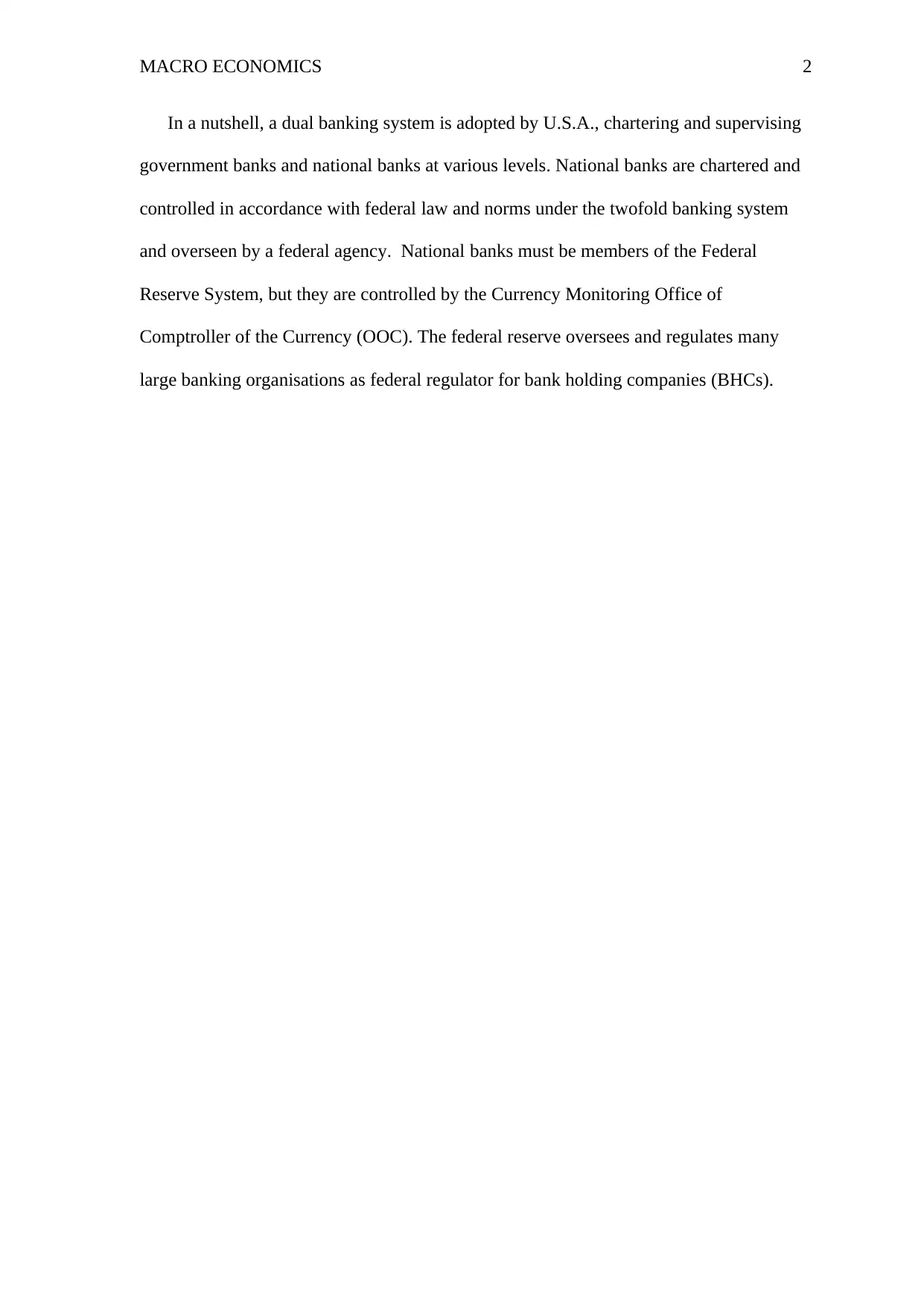
In a nutshell, a dual banking system is adopted by U.S.A., chartering and supervising
government banks and national banks at various levels. National banks are chartered and
controlled in accordance with federal law and norms under the twofold banking system
and overseen by a federal agency. National banks must be members of the Federal
Reserve System, but they are controlled by the Currency Monitoring Office of
Comptroller of the Currency (OOC). The federal reserve oversees and regulates many
large banking organisations as federal regulator for bank holding companies (BHCs).
Document Page
MACRO ECONOMICS 3
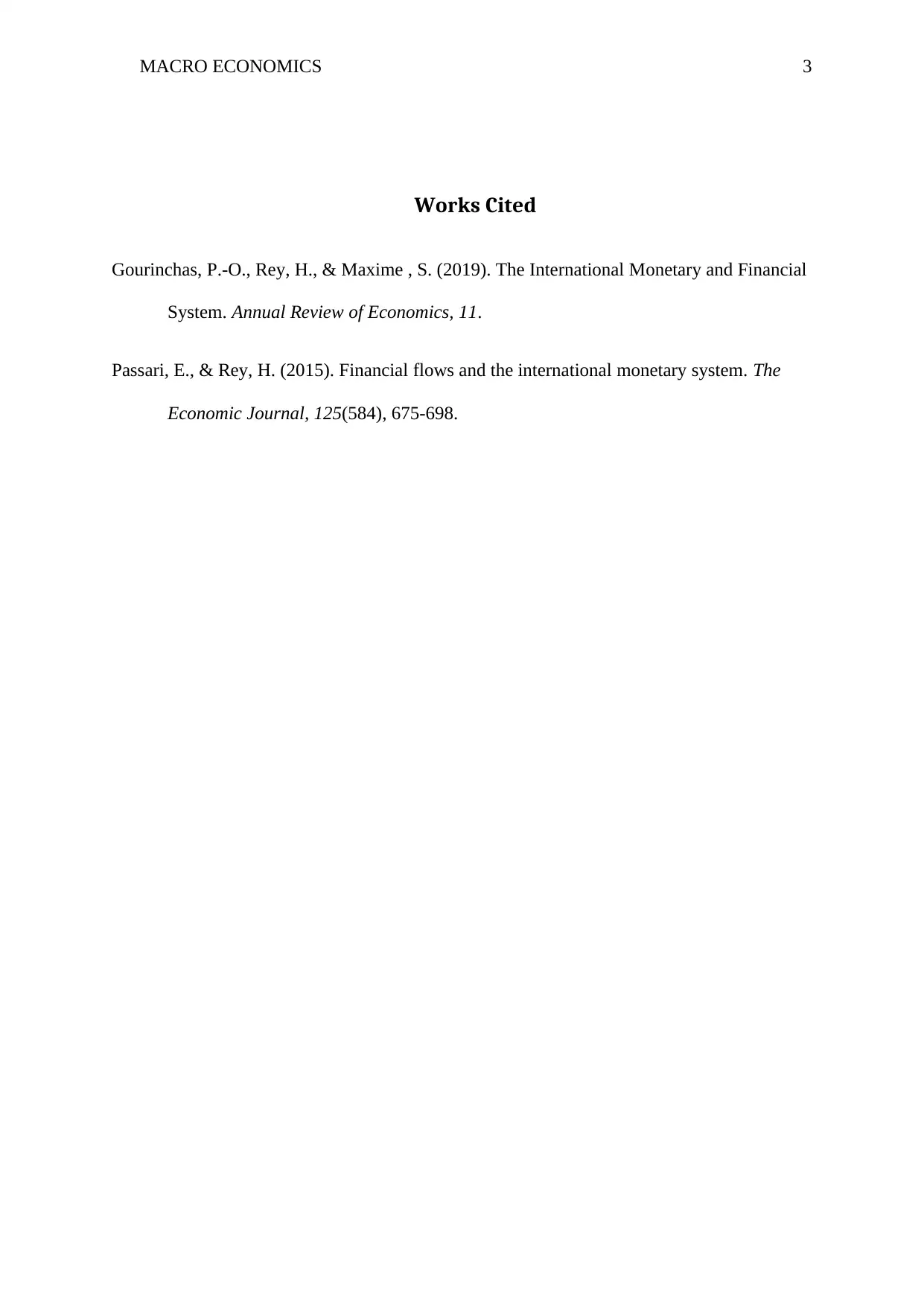
Works Cited
Gourinchas, P.-O., Rey, H., & Maxime , S. (2019). The International Monetary and Financial
System. Annual Review of Economics, 11.
Passari, E., & Rey, H. (2015). Financial flows and the international monetary system. The
Economic Journal, 125(584), 675-698.
chevron_up_icon
1 out of 4
circle_padding
hide_on_mobile
zoom_out_icon
[object Object]