Ethical Implications of Technology in Dementia Patient Tracking Report
VerifiedAdded on 2022/10/17
|11
|3338
|419
Report
AI Summary
This report provides a comprehensive analysis of the ethical issues associated with the use of tracking technologies for individuals with dementia. It examines the rise of dementia-related disorders and the associated challenges of wandering behavior, which has prompted the development of various tracking systems, including GPS devices, electronic tagging, and RFID technologies. The report delves into the current practices and modern applications of these technologies, highlighting their benefits in terms of patient safety and caregiver support. However, it critically evaluates the ethical concerns, particularly regarding privacy, autonomy, and the potential for diminished human contact. The report reviews existing literature, including the views of caregivers and the perspectives of individuals with dementia, to explore the balance between security and individual rights. It also addresses the limitations of current practices, such as physical restraints and medication, and explores the potential of music therapy and medical alert systems. The report emphasizes the need for informed consent, the consideration of risks and benefits, and the importance of recognizing the unique needs of both patients and caregivers. Finally, it offers recommendations for future studies and the development of ethical guidelines for the use of these technologies. The report is contributed by a student and available on Desklib.

USER CENTRED DESIGN 1
User Centred Design
My Name
Course Title
Professor name
Date
User Centred Design
My Name
Course Title
Professor name
Date

Paraphrase This Document
Need a fresh take? Get an instant paraphrase of this document with our AI Paraphraser
USER CENTRED DESIGN 2
Executive Summary 3
Introduction 3
Background 3
Purpose 4
Definition of Key Terms 5
Body 5
Literature Review 5
Concept of Dementia 5
Current Practices 6
Modern Practices 6
Use of GPS 6
Use of Electronic Tagging 8
Use of RFID 8
Ethical considerations 9
Summary 9
References 10
Executive Summary 3
Introduction 3
Background 3
Purpose 4
Definition of Key Terms 5
Body 5
Literature Review 5
Concept of Dementia 5
Current Practices 6
Modern Practices 6
Use of GPS 6
Use of Electronic Tagging 8
Use of RFID 8
Ethical considerations 9
Summary 9
References 10
USER CENTRED DESIGN 3
Executive Summary
In this report, a detailed review of the current ethical issues that arise from the tracking systems
used in the tracking of persons with demensia is discussed. From the report, the key finding was
the need to have a better tracking tracking system that don’t violate the rights of privacy of the
person under the dementia disorder.
The key technologies invented for use in the tracking includes the use of GPS devices, tagging
systems and RFID technologies. Although these systems have been linked to the safety of the
patients, some research has shown that to some extent, these devices violates the privacy and
liberty rights of the individuals hence should be used with care.
The key recommendation from the report includes;
One, the need to ensure the interest of both parties are captures in key decision making stages
Secondly, the devices used in tracking should be lightweight and small to make them more
comfortable for the patients
Thirdly,the caregivers should be actively involved in the life of their patients even after the
introduction of the device and the technology
Last but not the least, there should be informed consent from the patients before such
technologies are adapted
Introduction
Background
Dementia related disorders are on the rise as the global population seems to be aging. Of these
age related disorders, the problems with the out of home mobility still remains a key behavioral
issue that is common among this population with about 38-60% of those diagnosed with
dementia exhibiting these traits at some stages of the disorder. These characteristics of the
disorder has been very stressful and bothersome to the family members and caregivers who
sometimes are also old. Since this disorder generally is considered unsafe , most people view it
as a medical condition that requires medical solutions. The key medical solution has been the
legitimization of some social controls to help protect the wanderers. Despite this approach,
Executive Summary
In this report, a detailed review of the current ethical issues that arise from the tracking systems
used in the tracking of persons with demensia is discussed. From the report, the key finding was
the need to have a better tracking tracking system that don’t violate the rights of privacy of the
person under the dementia disorder.
The key technologies invented for use in the tracking includes the use of GPS devices, tagging
systems and RFID technologies. Although these systems have been linked to the safety of the
patients, some research has shown that to some extent, these devices violates the privacy and
liberty rights of the individuals hence should be used with care.
The key recommendation from the report includes;
One, the need to ensure the interest of both parties are captures in key decision making stages
Secondly, the devices used in tracking should be lightweight and small to make them more
comfortable for the patients
Thirdly,the caregivers should be actively involved in the life of their patients even after the
introduction of the device and the technology
Last but not the least, there should be informed consent from the patients before such
technologies are adapted
Introduction
Background
Dementia related disorders are on the rise as the global population seems to be aging. Of these
age related disorders, the problems with the out of home mobility still remains a key behavioral
issue that is common among this population with about 38-60% of those diagnosed with
dementia exhibiting these traits at some stages of the disorder. These characteristics of the
disorder has been very stressful and bothersome to the family members and caregivers who
sometimes are also old. Since this disorder generally is considered unsafe , most people view it
as a medical condition that requires medical solutions. The key medical solution has been the
legitimization of some social controls to help protect the wanderers. Despite this approach,
⊘ This is a preview!⊘
Do you want full access?
Subscribe today to unlock all pages.

Trusted by 1+ million students worldwide
USER CENTRED DESIGN 4
several concerns have been raised concerning the abuse of such controls by the caregivers by
means of denying the person their freedom of movement (Foley et al., 2017) .
Currently, research has been ongoing on the utilization of technology to help in the monitoring.
As technologies evolve, new and better ways are emerging that can be used to provide individual
aid to the persons with dementia. Such technologies include but are not limited to monitors and
video cameras, standard telephone communication. Most of the attention has been drawn to the
use of this technology in residential care. Few studies have been focused on the usage of the
technology to help the people in terms of independence and autonomy within the areas of
residence. Additionally, few ethical debates exists to discuss the ethical issues of these
technologies. Unlike the various assistive technologies, the residential care homes have adopted
the use of GPS which constantly sends data about the location of the perons (Novitzky et al.,
2015).
Thus report study the current literature on the usage and ethical issues that exists on the
utilization of these GPS technology and other surveillance technologies to track the location and
whereabouts of persons with dementia and other related disorders.
Purpose
The objectives of this report are;
1. To understand the current state of surveillance for persons with dementia
2. To understand the ethical and legal issues surrounding the use of advanced technologies
in controlling dementia disorder
3. To recommend better approach to controlling and monitoring the movements of persons
with dementia.
Definition of Key Terms
GPS - Global Positioning System
several concerns have been raised concerning the abuse of such controls by the caregivers by
means of denying the person their freedom of movement (Foley et al., 2017) .
Currently, research has been ongoing on the utilization of technology to help in the monitoring.
As technologies evolve, new and better ways are emerging that can be used to provide individual
aid to the persons with dementia. Such technologies include but are not limited to monitors and
video cameras, standard telephone communication. Most of the attention has been drawn to the
use of this technology in residential care. Few studies have been focused on the usage of the
technology to help the people in terms of independence and autonomy within the areas of
residence. Additionally, few ethical debates exists to discuss the ethical issues of these
technologies. Unlike the various assistive technologies, the residential care homes have adopted
the use of GPS which constantly sends data about the location of the perons (Novitzky et al.,
2015).
Thus report study the current literature on the usage and ethical issues that exists on the
utilization of these GPS technology and other surveillance technologies to track the location and
whereabouts of persons with dementia and other related disorders.
Purpose
The objectives of this report are;
1. To understand the current state of surveillance for persons with dementia
2. To understand the ethical and legal issues surrounding the use of advanced technologies
in controlling dementia disorder
3. To recommend better approach to controlling and monitoring the movements of persons
with dementia.
Definition of Key Terms
GPS - Global Positioning System
Paraphrase This Document
Need a fresh take? Get an instant paraphrase of this document with our AI Paraphraser
USER CENTRED DESIGN 5
Dementia-a chronic or persistent disorder of the mental processes caused by brain disease or
injury and marked by memory disorders, personality changes, and impaired reasoning.
Caregivers-is an unpaid or paid member of a person's social network who helps them with
activities of daily living.
Autonomy-the right or condition of self-government.
Section two of this report documents some of the literature done on the ethical issues in the
usage of tracking mechanism to control and monitor persons with dementia. Section three
summarises the key concepts from the review of the literature and give recommendations for
future studies.
Body
Literature Review
Concept of Dementia
Dementia is a disorder of the mental processes caused by brain disease or injury and marked by
memory disorders, personality changes, and impaired reasoning. The unique characteristic of this
disorder is the wandering about of those affected. This wandering coupled with cognitive
impairment makes them highly susceptible to getting lost and becoming disoriented (Attarwala,
Munteanu and Baecker, 2013). Tracking them hence requires constant close monitoring of the
affected persons. Traditionally, this task has been very manual as caregivers had to physically
look for the affected persons incase they get lost and or become disoriented. This prompted
scholars to research on better mechanism to use in the location of the patients (McCartney,
2014). The key results of this research was the recommendation of location based service and
other assistive technologies to be used in the process of monitoring and control.
Dementia-a chronic or persistent disorder of the mental processes caused by brain disease or
injury and marked by memory disorders, personality changes, and impaired reasoning.
Caregivers-is an unpaid or paid member of a person's social network who helps them with
activities of daily living.
Autonomy-the right or condition of self-government.
Section two of this report documents some of the literature done on the ethical issues in the
usage of tracking mechanism to control and monitor persons with dementia. Section three
summarises the key concepts from the review of the literature and give recommendations for
future studies.
Body
Literature Review
Concept of Dementia
Dementia is a disorder of the mental processes caused by brain disease or injury and marked by
memory disorders, personality changes, and impaired reasoning. The unique characteristic of this
disorder is the wandering about of those affected. This wandering coupled with cognitive
impairment makes them highly susceptible to getting lost and becoming disoriented (Attarwala,
Munteanu and Baecker, 2013). Tracking them hence requires constant close monitoring of the
affected persons. Traditionally, this task has been very manual as caregivers had to physically
look for the affected persons incase they get lost and or become disoriented. This prompted
scholars to research on better mechanism to use in the location of the patients (McCartney,
2014). The key results of this research was the recommendation of location based service and
other assistive technologies to be used in the process of monitoring and control.
USER CENTRED DESIGN 6
Current Practices
The current practices includes the identification of the reason for wandering has become the
number one step in designing the best approach to deal with the situation. Physical barrier ana
restraints which may be physical and drugs have been deployed and used to prevent people from
wandering (Ienca et al., 2018). This practices have been however reported to cause pressure ,
sedation, fall anc unexpected increase in anxiety. The use of music have also been researched to
be very useful in the provision of dementia friendly environment and makes the patients more
pleasant with their environment hence reducing wandering .
In addition, there is the use of medica alerts and emergency bracelets have been designed to be
used in case of emergencies. Ths bracelets have the medical emergency hotline number that can
be used incase of emergency that requires specialist assistance and obtain the patient's medical
condition and history (Kyriazakos et al., 2016)
Modern Practices
Use of GPS
Currently, several digital based tracking mechanism exists which can be used to gather location
based data. The GPS system consists of a series of satellites which orbit around the Earth and
broadcast their signals to any set receiver. The position of the receiver is determined by means of
triangulation of the incoming data from a set of at least four satellites. Land based tracking
systems consists of a series of antenna stations which have RF detection mechanisms and are
well distributed in a given locale. A hybrid tracking systems combines elements from both the
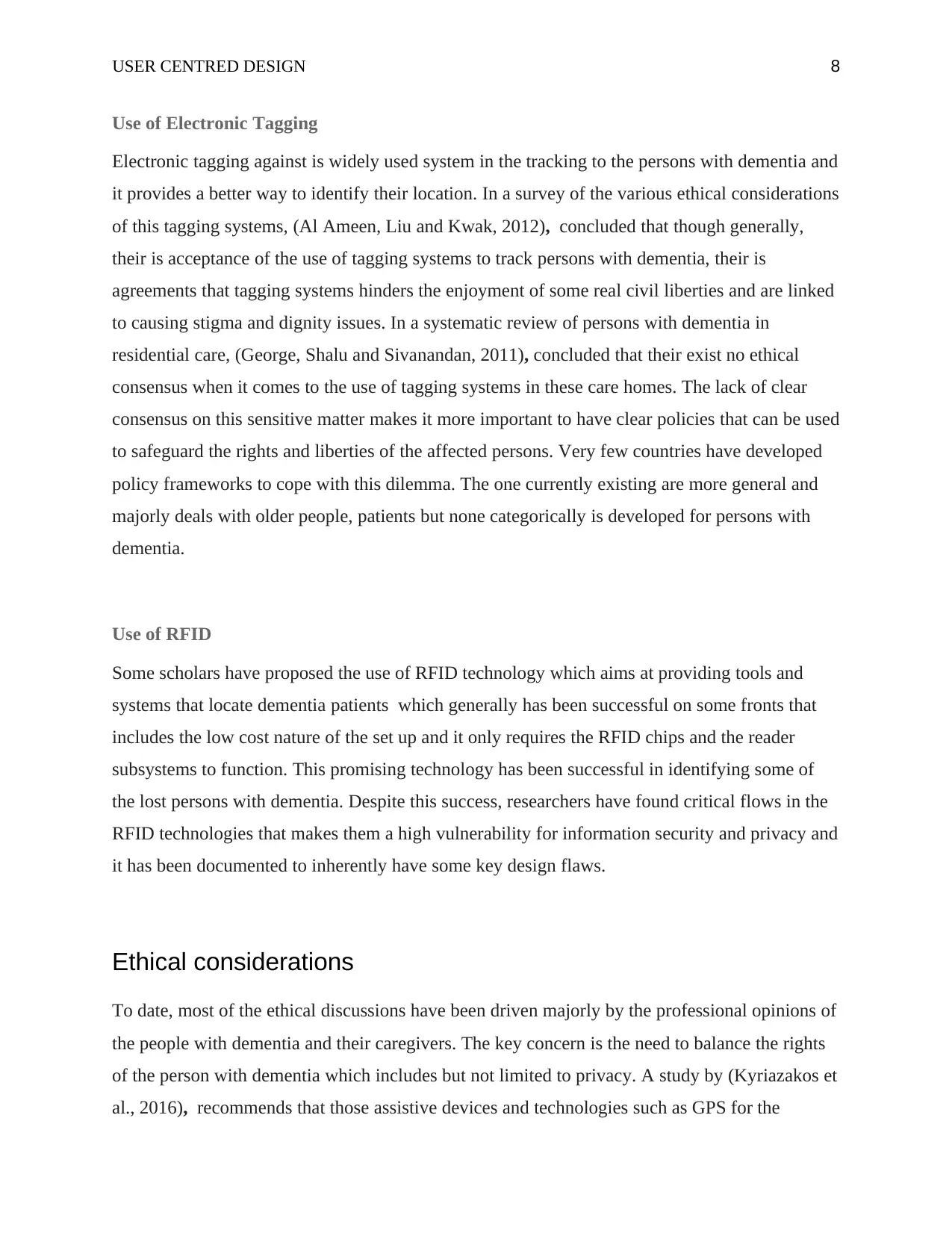
land based systems and satellite based systems (Giezendanner et al., 2019). The figure below
shows a device which consists of a GPS receiver .
Current Practices
The current practices includes the identification of the reason for wandering has become the
number one step in designing the best approach to deal with the situation. Physical barrier ana
restraints which may be physical and drugs have been deployed and used to prevent people from
wandering (Ienca et al., 2018). This practices have been however reported to cause pressure ,
sedation, fall anc unexpected increase in anxiety. The use of music have also been researched to
be very useful in the provision of dementia friendly environment and makes the patients more
pleasant with their environment hence reducing wandering .
In addition, there is the use of medica alerts and emergency bracelets have been designed to be
used in case of emergencies. Ths bracelets have the medical emergency hotline number that can
be used incase of emergency that requires specialist assistance and obtain the patient's medical
condition and history (Kyriazakos et al., 2016)
Modern Practices
Use of GPS
Currently, several digital based tracking mechanism exists which can be used to gather location
based data. The GPS system consists of a series of satellites which orbit around the Earth and
broadcast their signals to any set receiver. The position of the receiver is determined by means of
triangulation of the incoming data from a set of at least four satellites. Land based tracking
systems consists of a series of antenna stations which have RF detection mechanisms and are
well distributed in a given locale. A hybrid tracking systems combines elements from both the
land based systems and satellite based systems (Giezendanner et al., 2019). The figure below
shows a device which consists of a GPS receiver .
⊘ This is a preview!⊘
Do you want full access?
Subscribe today to unlock all pages.
Trusted by 1+ million students worldwide
USER CENTRED DESIGN 7
The system makes it possible for the carer to know the whereabouts of an individual. Such
mechanism of tracking can allow the elderly or persons with dementia to be given some care
within the community as compared to older technologies that existed before. However, some
scholars view the use of GPS location which get transmitted to a central computer for processing
and an invasion of the individual rights to privacy as it is seen to threaten the personal autonomy
and liberty of the individuals (Scott et al., 2019). Those opposed to the technology again argues
that tracking systems may lead to a dimining human contact between the person with dementia
and or the older persons and the environment.
Ethical concerns about the use of these devices with the persons with dementia was aired out
even before the actual systems were deployed for use. These concerns have attracted a lot of
attention from many scholars. In their study (Sriram, Jenkinson and Peters, 2019), family based
caregiver more often preferred the use of electronic tracking devices and oppose to the physical
controls as it allowed them to locate their patients more quickly hence reduce their exposure to
risks of harm. However, their was also concerns raised by these caregivers on the autonomy and
privacy infringements caused by the usage of these devices as some of this tagging devices and
systems are majorly associated with offenders .
In his survey (Feng, 2000) 99 caregivers were surveyed and the results of the survey showed that
few caregivers would give little freedom to the persons with dementia despite the advent of this
technology. The ethical consideration here therefore is not about the maximization of the
autonomy of the individual but the reduction of time spent in locating a lost individual .
The system makes it possible for the carer to know the whereabouts of an individual. Such
mechanism of tracking can allow the elderly or persons with dementia to be given some care
within the community as compared to older technologies that existed before. However, some
scholars view the use of GPS location which get transmitted to a central computer for processing
and an invasion of the individual rights to privacy as it is seen to threaten the personal autonomy
and liberty of the individuals (Scott et al., 2019). Those opposed to the technology again argues
that tracking systems may lead to a dimining human contact between the person with dementia
and or the older persons and the environment.
Ethical concerns about the use of these devices with the persons with dementia was aired out
even before the actual systems were deployed for use. These concerns have attracted a lot of
attention from many scholars. In their study (Sriram, Jenkinson and Peters, 2019), family based
caregiver more often preferred the use of electronic tracking devices and oppose to the physical
controls as it allowed them to locate their patients more quickly hence reduce their exposure to
risks of harm. However, their was also concerns raised by these caregivers on the autonomy and
privacy infringements caused by the usage of these devices as some of this tagging devices and
systems are majorly associated with offenders .
In his survey (Feng, 2000) 99 caregivers were surveyed and the results of the survey showed that
few caregivers would give little freedom to the persons with dementia despite the advent of this
technology. The ethical consideration here therefore is not about the maximization of the
autonomy of the individual but the reduction of time spent in locating a lost individual .
Paraphrase This Document
Need a fresh take? Get an instant paraphrase of this document with our AI Paraphraser
USER CENTRED DESIGN 8
Use of Electronic Tagging
Electronic tagging against is widely used system in the tracking to the persons with dementia and
it provides a better way to identify their location. In a survey of the various ethical considerations
of this tagging systems, (Al Ameen, Liu and Kwak, 2012), concluded that though generally,
their is acceptance of the use of tagging systems to track persons with dementia, their is
agreements that tagging systems hinders the enjoyment of some real civil liberties and are linked
to causing stigma and dignity issues. In a systematic review of persons with dementia in
residential care, (George, Shalu and Sivanandan, 2011), concluded that their exist no ethical
consensus when it comes to the use of tagging systems in these care homes. The lack of clear
consensus on this sensitive matter makes it more important to have clear policies that can be used
to safeguard the rights and liberties of the affected persons. Very few countries have developed
policy frameworks to cope with this dilemma. The one currently existing are more general and
majorly deals with older people, patients but none categorically is developed for persons with
dementia.
Use of RFID
Some scholars have proposed the use of RFID technology which aims at providing tools and
systems that locate dementia patients which generally has been successful on some fronts that
includes the low cost nature of the set up and it only requires the RFID chips and the reader
subsystems to function. This promising technology has been successful in identifying some of
the lost persons with dementia. Despite this success, researchers have found critical flows in the
RFID technologies that makes them a high vulnerability for information security and privacy and
it has been documented to inherently have some key design flaws.
Ethical considerations
To date, most of the ethical discussions have been driven majorly by the professional opinions of
the people with dementia and their caregivers. The key concern is the need to balance the rights
of the person with dementia which includes but not limited to privacy. A study by (Kyriazakos et
al., 2016), recommends that those assistive devices and technologies such as GPS for the
Use of Electronic Tagging
Electronic tagging against is widely used system in the tracking to the persons with dementia and
it provides a better way to identify their location. In a survey of the various ethical considerations
of this tagging systems, (Al Ameen, Liu and Kwak, 2012), concluded that though generally,
their is acceptance of the use of tagging systems to track persons with dementia, their is
agreements that tagging systems hinders the enjoyment of some real civil liberties and are linked
to causing stigma and dignity issues. In a systematic review of persons with dementia in
residential care, (George, Shalu and Sivanandan, 2011), concluded that their exist no ethical
consensus when it comes to the use of tagging systems in these care homes. The lack of clear
consensus on this sensitive matter makes it more important to have clear policies that can be used
to safeguard the rights and liberties of the affected persons. Very few countries have developed
policy frameworks to cope with this dilemma. The one currently existing are more general and
majorly deals with older people, patients but none categorically is developed for persons with
dementia.
Use of RFID
Some scholars have proposed the use of RFID technology which aims at providing tools and
systems that locate dementia patients which generally has been successful on some fronts that
includes the low cost nature of the set up and it only requires the RFID chips and the reader
subsystems to function. This promising technology has been successful in identifying some of
the lost persons with dementia. Despite this success, researchers have found critical flows in the
RFID technologies that makes them a high vulnerability for information security and privacy and
it has been documented to inherently have some key design flaws.
Ethical considerations
To date, most of the ethical discussions have been driven majorly by the professional opinions of
the people with dementia and their caregivers. The key concern is the need to balance the rights
of the person with dementia which includes but not limited to privacy. A study by (Kyriazakos et
al., 2016), recommends that those assistive devices and technologies such as GPS for the
USER CENTRED DESIGN 9
persons with dementia should be assessed for any risks-benefits rather than just risk assessment.
More advance directives would involve the consensus by the person with dementia before such
technologies are used on them since most of the times, the people are able to make informed
decisions. According to (Johnson et al., 2014), there is a need to recognize the various unique
needs of the caregiver and the patients and ensure the caregiver too are treated as individuals
beyond their caregiving mantle..
According to (Jennings, Boyle and Foley, 2018), the main motivation for the use of GPS locators
is to improve the security and safety of the persons with dementia who are characteristically likes
wandering. The designs of this system with security focus took precedence over the patient’s
individual rights to privacy as seen by the constant surveillance by the caregivers. Another
concern was raised by (Adlam et al, 2004), on whether these technologies will result in any
decreased personal between the caregiver and the patient which can potentially leads to greater
social isolation. Some studies again view the usage of this technology as some cost reduction
techniques for those for profit organization taking care of the patients in their facilities which
seems to be very unethical according to (Milne et al., 2014)
Summary
In summary, the report deep dived into the current technologies and techniques used by various
entities to provide a solution that can be used to locate the whereabouts of persons with
dementia.In this report is it found that use of GPS, tagging systems and RFID among other key
technologies have been adopted to bridge the gap between the old systems and new system of
controlling and monitoring the safety and security of the persons with dementia. Despite these
advances in technology, several key ethical issues emergence from their utility. Some scholars
argue most of the technology is designed with security and safety in mind while overlooking the
privacy concerns of the persons with dementia. The data about the affected persons is aggregated
in some central place for purposes of caregiver monitoring. This has led to quick division among
scholars on the best practices to use. The lack of policy frameworks by the government have
furter led to exploitation of these sad state. After thorough analysis of the various sources, the
report recommends the following approaches;
persons with dementia should be assessed for any risks-benefits rather than just risk assessment.
More advance directives would involve the consensus by the person with dementia before such
technologies are used on them since most of the times, the people are able to make informed
decisions. According to (Johnson et al., 2014), there is a need to recognize the various unique
needs of the caregiver and the patients and ensure the caregiver too are treated as individuals
beyond their caregiving mantle..
According to (Jennings, Boyle and Foley, 2018), the main motivation for the use of GPS locators
is to improve the security and safety of the persons with dementia who are characteristically likes
wandering. The designs of this system with security focus took precedence over the patient’s
individual rights to privacy as seen by the constant surveillance by the caregivers. Another
concern was raised by (Adlam et al, 2004), on whether these technologies will result in any
decreased personal between the caregiver and the patient which can potentially leads to greater
social isolation. Some studies again view the usage of this technology as some cost reduction
techniques for those for profit organization taking care of the patients in their facilities which
seems to be very unethical according to (Milne et al., 2014)
Summary
In summary, the report deep dived into the current technologies and techniques used by various
entities to provide a solution that can be used to locate the whereabouts of persons with
dementia.In this report is it found that use of GPS, tagging systems and RFID among other key
technologies have been adopted to bridge the gap between the old systems and new system of
controlling and monitoring the safety and security of the persons with dementia. Despite these
advances in technology, several key ethical issues emergence from their utility. Some scholars
argue most of the technology is designed with security and safety in mind while overlooking the
privacy concerns of the persons with dementia. The data about the affected persons is aggregated
in some central place for purposes of caregiver monitoring. This has led to quick division among
scholars on the best practices to use. The lack of policy frameworks by the government have
furter led to exploitation of these sad state. After thorough analysis of the various sources, the
report recommends the following approaches;
⊘ This is a preview!⊘
Do you want full access?
Subscribe today to unlock all pages.
Trusted by 1+ million students worldwide
USER CENTRED DESIGN 10
1. Ensure the interest of both parties are captures in key decision making stages
2. The devices used in tracking should be lightweight and small
3. The caregivers should be actively involved in life of their patients
4. There should be informed consent from the patients before such technologies are adapted
References
Adlam, T., Faulkner, R., Orpwood, R., Jones, K., Macijauskiene, J. and Budraitiene, A., 2004.
The Installation and Support of Internationally Distributed Equipment for People With Dementia.
IEEE Transactions on Information Technology in Biomedicine, 8(3), pp.253–257.
Al Ameen, M., Liu, J. and Kwak, K., 2012. Security and Privacy Issues in Wireless Sensor
Networks for Healthcare Applications. Journal of Medical Systems, 36(1), pp.93–101.
Attarwala, A., Munteanu, C., Baecker, R., 2013. An accessible, large-print, listening and talking
e-book to support families reading together. In: Proceedings of the 15th international
conference on Human-computer interaction with mobile devices and services - MobileHCI ’13.
[online] the 15th international conference. Munich, Germany: ACM Press.p.440. Available at:
<http://dl.acm.org/citation.cfm?doid=2493190.2494658> [Accessed 20 Sep. 2019].
Feng, P., 2000. Rethinking technology, revitalizing ethics: Overcoming barriers to ethical design.
Science and Engineering Ethics, 6(2), pp.207–220.
Foley, T., Boyle, S., Jennings, A. and Smithson, W.H., 2017. “We’re certainly not in our comfort
zone”: a qualitative study of GPs’ dementia-care educational needs. BMC Family Practice,
18(1), p.66.
George, T., Shalu, G.K. and Sivanandan, K.S., 2011. Sensing, processing and application of
EMG signals for HAL (Hybrid Assistive Limb). In: International Conference on Sustainable
Energy and Intelligent Systems (SEISCON 2011). [online] International Conference on
Sustainable Energy and Intelligent Systems (SEISCON 2011). Chennai, India: IET.pp.749–753.
Available at: <https://digital-library.theiet.org/content/conferences/10.1049/cp.2011.0463>
[Accessed 20 Sep. 2019].
1. Ensure the interest of both parties are captures in key decision making stages
2. The devices used in tracking should be lightweight and small
3. The caregivers should be actively involved in life of their patients
4. There should be informed consent from the patients before such technologies are adapted
References
Adlam, T., Faulkner, R., Orpwood, R., Jones, K., Macijauskiene, J. and Budraitiene, A., 2004.
The Installation and Support of Internationally Distributed Equipment for People With Dementia.
IEEE Transactions on Information Technology in Biomedicine, 8(3), pp.253–257.
Al Ameen, M., Liu, J. and Kwak, K., 2012. Security and Privacy Issues in Wireless Sensor
Networks for Healthcare Applications. Journal of Medical Systems, 36(1), pp.93–101.
Attarwala, A., Munteanu, C., Baecker, R., 2013. An accessible, large-print, listening and talking
e-book to support families reading together. In: Proceedings of the 15th international
conference on Human-computer interaction with mobile devices and services - MobileHCI ’13.
[online] the 15th international conference. Munich, Germany: ACM Press.p.440. Available at:
<http://dl.acm.org/citation.cfm?doid=2493190.2494658> [Accessed 20 Sep. 2019].
Feng, P., 2000. Rethinking technology, revitalizing ethics: Overcoming barriers to ethical design.
Science and Engineering Ethics, 6(2), pp.207–220.
Foley, T., Boyle, S., Jennings, A. and Smithson, W.H., 2017. “We’re certainly not in our comfort
zone”: a qualitative study of GPs’ dementia-care educational needs. BMC Family Practice,
18(1), p.66.
George, T., Shalu, G.K. and Sivanandan, K.S., 2011. Sensing, processing and application of
EMG signals for HAL (Hybrid Assistive Limb). In: International Conference on Sustainable
Energy and Intelligent Systems (SEISCON 2011). [online] International Conference on
Sustainable Energy and Intelligent Systems (SEISCON 2011). Chennai, India: IET.pp.749–753.
Available at: <https://digital-library.theiet.org/content/conferences/10.1049/cp.2011.0463>
[Accessed 20 Sep. 2019].
Paraphrase This Document
Need a fresh take? Get an instant paraphrase of this document with our AI Paraphraser
USER CENTRED DESIGN 11
Giezendanner, S., Monsch, A.U., Kressig, R.W., Mueller, Y., Streit, S., Essig, S., Zeller, A. and
Bally, K., 2019. General practitioners’ attitudes towards early diagnosis of dementia: a cross-
sectional survey. BMC Family Practice, 20(1), pp.1–9.
Ienca, M., Wangmo, T., Jotterand, F., Kressig, R.W. and Elger, B., 2018. Ethical Design of
Intelligent Assistive Technologies for Dementia: A Descriptive Review. Science and Engineering
Ethics, 24(4), pp.1035–1055.
Jennings, A.A., Boyle, S. and Foley, T., 2018. The development and evaluation of an online
dementia resource for primary care based health professionals. Internet Interventions, 11,
pp.47–52.
Johnson, D.O., Cuijpers, R.H., Juola, J.F., Torta, E., Simonov, M., Frisiello, A., Bazzani, M.,
Yan, W., Weber, C., Wermter, S., Meins, N., Oberzaucher, J., Panek, P., Edelmayer, G., Mayer,
P. and Beck, C., 2014. Socially Assistive Robots: A Comprehensive Approach to Extending
Independent Living. International Journal of Social Robotics, 6(2), pp.195–211.
Kyriazakos, S., Mihaylov, M., Anggorojati, B., Mihovska, A., Craciunescu, R., Fratu, O. and
Prasad, R., 2016. eWALL: An Intelligent Caring Home Environment Offering Personalized
Context-Aware Applications Based on Advanced Sensing. Wireless Personal Communications,
87(3), pp.1093–1111.
McCartney, M., 2014. ‘Case finding’ in dementia is simply screening with no evidence of benefit.
BMJ, 349(jul24 3), pp.g4791–g4791.
Milne, H., van der Pol, M., McCloughan, L., Hanley, J., Mead, G., Starr, J., Sheikh, A. and
McKinstry, B., 2014. The use of global positional satellite location in dementia: a feasibility study
for a randomised controlled trial. BMC Psychiatry, 14(1), p.160.
Novitzky, P., Smeaton, A., Chen, C., Irving, K., Jacquemard, T., O’Brolcháin, F., O’Mathúna, D.
and Gordijn, B., 2015. A Review of Contemporary Work on the Ethics of Ambient Assisted
Living Technologies for People with Dementia. Science & Engineering Ethics, 21(3), pp.707–
765.
Scott, T., Liddle, J., Mitchell, G., Beattie, E. and Pachana, N., 2019. Implementation and
evaluation of a driving cessation intervention to improve community mobility and wellbeing
outcomes for people living with dementia: study protocol of the ‘CarFreeMe’ for people with
dementia program. BMC Geriatrics, 19(1), p.1.
Sriram, V., Jenkinson, C. and Peters, M., 2019. Informal carers’ experience of assistive
technology use in dementia care at home: a systematic review. BMC Geriatrics, 19(1), p.1.
Giezendanner, S., Monsch, A.U., Kressig, R.W., Mueller, Y., Streit, S., Essig, S., Zeller, A. and
Bally, K., 2019. General practitioners’ attitudes towards early diagnosis of dementia: a cross-
sectional survey. BMC Family Practice, 20(1), pp.1–9.
Ienca, M., Wangmo, T., Jotterand, F., Kressig, R.W. and Elger, B., 2018. Ethical Design of
Intelligent Assistive Technologies for Dementia: A Descriptive Review. Science and Engineering
Ethics, 24(4), pp.1035–1055.
Jennings, A.A., Boyle, S. and Foley, T., 2018. The development and evaluation of an online
dementia resource for primary care based health professionals. Internet Interventions, 11,
pp.47–52.
Johnson, D.O., Cuijpers, R.H., Juola, J.F., Torta, E., Simonov, M., Frisiello, A., Bazzani, M.,
Yan, W., Weber, C., Wermter, S., Meins, N., Oberzaucher, J., Panek, P., Edelmayer, G., Mayer,
P. and Beck, C., 2014. Socially Assistive Robots: A Comprehensive Approach to Extending
Independent Living. International Journal of Social Robotics, 6(2), pp.195–211.
Kyriazakos, S., Mihaylov, M., Anggorojati, B., Mihovska, A., Craciunescu, R., Fratu, O. and
Prasad, R., 2016. eWALL: An Intelligent Caring Home Environment Offering Personalized
Context-Aware Applications Based on Advanced Sensing. Wireless Personal Communications,
87(3), pp.1093–1111.
McCartney, M., 2014. ‘Case finding’ in dementia is simply screening with no evidence of benefit.
BMJ, 349(jul24 3), pp.g4791–g4791.
Milne, H., van der Pol, M., McCloughan, L., Hanley, J., Mead, G., Starr, J., Sheikh, A. and
McKinstry, B., 2014. The use of global positional satellite location in dementia: a feasibility study
for a randomised controlled trial. BMC Psychiatry, 14(1), p.160.
Novitzky, P., Smeaton, A., Chen, C., Irving, K., Jacquemard, T., O’Brolcháin, F., O’Mathúna, D.
and Gordijn, B., 2015. A Review of Contemporary Work on the Ethics of Ambient Assisted
Living Technologies for People with Dementia. Science & Engineering Ethics, 21(3), pp.707–
765.
Scott, T., Liddle, J., Mitchell, G., Beattie, E. and Pachana, N., 2019. Implementation and
evaluation of a driving cessation intervention to improve community mobility and wellbeing
outcomes for people living with dementia: study protocol of the ‘CarFreeMe’ for people with
dementia program. BMC Geriatrics, 19(1), p.1.
Sriram, V., Jenkinson, C. and Peters, M., 2019. Informal carers’ experience of assistive
technology use in dementia care at home: a systematic review. BMC Geriatrics, 19(1), p.1.

1 out of 11


Related Documents


Your All-in-One AI-Powered Toolkit for Academic Success.
+13062052269
info@desklib.com
Available 24*7 on WhatsApp / Email
![[object Object]](/_next/static/media/star-bottom.7253800d.svg)
Unlock your academic potential
Copyright © 2020–2026 A2Z Services. All Rights Reserved. Developed and managed by ZUCOL.