Analysis of Visitor Attractions Management and Strategic Planning
VerifiedAdded on 2020/07/23
|13
|4230
|83
Report
AI Summary
This report delves into the multifaceted realm of visitor attraction management, a critical component of the travel and tourism industry. It commences with an introduction that underscores the significance of visitor attraction management, highlighting its role in enhancing the value of tourist experiences and boosting a country's economy by attracting a large number of visitors. The report explores the overlapping aspects of visitor attractions and their relationship to various attraction types, along with the importance of different visitor attractions. Task 2 examines the motivations and needs of visitors, the impact of tourism on destinations, and the influence of different theories on visitor attraction management. The report further investigates issues involved in the development of visitor attraction management and the strategies employed, including techniques related to sustainability, culminating in a comprehensive analysis of the subject. The report emphasizes the importance of understanding visitor needs, the impact of tourism, and the implementation of effective management strategies for sustainable tourism.
Visitors Attraction
Management
Management

Paraphrase This Document
Need a fresh take? Get an instant paraphrase of this document with our AI Paraphraser

Table of Contents
INTRODUCTION...........................................................................................................................1
1.1 Overlap of visitor attractions relation to particular type of attraction...................................1
1.2 Importance of different visitor attractions.............................................................................2
TASK 2............................................................................................................................................3
2.1 Motivation and needs of different places of visitors attractions management......................3
2.2 Impact of tourism on various destinations of visitors attractions.........................................4
2.3 Effect of different theories on management of visitor attractions.........................................5
TASK 3............................................................................................................................................6
3.1 Different issues involved in the development of visitors attraction management................6
TASK 4............................................................................................................................................8
4.1 Various strategies of visitor management.............................................................................8
4.2 Techniques of management in relation with sustainability...................................................8
CONCLUSION................................................................................................................................9
REFERENCES..............................................................................................................................10
INTRODUCTION...........................................................................................................................1
1.1 Overlap of visitor attractions relation to particular type of attraction...................................1
1.2 Importance of different visitor attractions.............................................................................2
TASK 2............................................................................................................................................3
2.1 Motivation and needs of different places of visitors attractions management......................3
2.2 Impact of tourism on various destinations of visitors attractions.........................................4
2.3 Effect of different theories on management of visitor attractions.........................................5
TASK 3............................................................................................................................................6
3.1 Different issues involved in the development of visitors attraction management................6
TASK 4............................................................................................................................................8
4.1 Various strategies of visitor management.............................................................................8
4.2 Techniques of management in relation with sustainability...................................................8
CONCLUSION................................................................................................................................9
REFERENCES..............................................................................................................................10
INTRODUCTION
Visitor attraction management is an important component of travel and tourism industry.
It provides basic facilities, interests or excitements to tourist for satisfying their needs or to add
the value to their whole journey (Ab Karim and Chi, 2010). It is important because it helps in
influencing large number of visitors to the various destination. Increasing number of visitors help
in increasing the economy of country. Government or various agencies of every country give
emphasis on this critical issues or provide various services in order to increase the economy by
earning foreign exchange. Present report contain the detail about importance of various
destinations of visitors attractions. Basic needs and motives which attract an individual to a
particular place is mentioned in this report. By proper analysing the needs and wants of different
people manager of a tourist destination can attract large number of customers there. Large
number of issues involved in the management of visitors attraction or various strategies of this is
discussed under this essay.
1.1 Overlap of visitor attractions relation to particular type of attraction
Overlap of visitors attraction Date- 15 July 2017
From- XYZ
Success or survival of tourism industry based on large number of visitors. In order to attract
large number of people it is the responsibility of every manager of this sector to enhance the
features of the products or services delivered to visitors. As a tourism consultant of a national
tourism agency for increasing the number of visitors there is a need to give emphasis that place
of attraction should be clean and all basic features should be there in order to enhance the value
to the journey of visitors. Values or facilities of that place should be maintained by tourism
agency. Every nation has its own places to attract large numbers of visitors while some places
attract large number of people while other places fails to attract a huge crowd of individuals.
For example: London eye, Thorpe park and Eden project attract large number of visitors every
year. Decision of visitor to go to a particular place depend on large number of factors including
their needs, wants, income level, demands and many other. Every person has different
personality which affect their decision of visiting to particular place. Gender or age is one of
the important factor which affect or influence the decision of visitors. For example people of
old age like or prefer the religious places or temple whether young people like to go to the
adventurous places. For attracting large number of visitors to the various place consultant of
1
Visitor attraction management is an important component of travel and tourism industry.
It provides basic facilities, interests or excitements to tourist for satisfying their needs or to add
the value to their whole journey (Ab Karim and Chi, 2010). It is important because it helps in
influencing large number of visitors to the various destination. Increasing number of visitors help
in increasing the economy of country. Government or various agencies of every country give
emphasis on this critical issues or provide various services in order to increase the economy by
earning foreign exchange. Present report contain the detail about importance of various
destinations of visitors attractions. Basic needs and motives which attract an individual to a
particular place is mentioned in this report. By proper analysing the needs and wants of different
people manager of a tourist destination can attract large number of customers there. Large
number of issues involved in the management of visitors attraction or various strategies of this is
discussed under this essay.
1.1 Overlap of visitor attractions relation to particular type of attraction
Overlap of visitors attraction Date- 15 July 2017
From- XYZ
Success or survival of tourism industry based on large number of visitors. In order to attract
large number of people it is the responsibility of every manager of this sector to enhance the
features of the products or services delivered to visitors. As a tourism consultant of a national
tourism agency for increasing the number of visitors there is a need to give emphasis that place
of attraction should be clean and all basic features should be there in order to enhance the value
to the journey of visitors. Values or facilities of that place should be maintained by tourism
agency. Every nation has its own places to attract large numbers of visitors while some places
attract large number of people while other places fails to attract a huge crowd of individuals.
For example: London eye, Thorpe park and Eden project attract large number of visitors every
year. Decision of visitor to go to a particular place depend on large number of factors including
their needs, wants, income level, demands and many other. Every person has different
personality which affect their decision of visiting to particular place. Gender or age is one of
the important factor which affect or influence the decision of visitors. For example people of
old age like or prefer the religious places or temple whether young people like to go to the
adventurous places. For attracting large number of visitors to the various place consultant of
1
⊘ This is a preview!⊘
Do you want full access?
Subscribe today to unlock all pages.

Trusted by 1+ million students worldwide
national tourism agency need to address the needs of different age of people. Places which
attract large number of visitors can be the historical, man made or can be the natural one.
Historical places attract people who have interest in the past history of a specific event other
than this religious or temple attract large number of religious or old age people. Man made
events attract visitors having curiosity or interest to learn something new or who want to join or
enjoy that special event. Decision of a visitor is influences by various factors including his
needs, beliefs or behaviour. By analysing these desires or needs of different people manager
can influence them for visiting a particular place by using a different or unique method of
advertising. Using an attractive advertising method is not enough proper maintenance or
establishment of basic facilities is also require to satisfying the needs of visitors. Being a
tourism consultant of national agency, proper emphasis should be give to enhance the facilities
of place of attraction . This will help agency in enhancing or adding value to the whole
experience of visitor.
1.2 Importance of different visitor attractions
Importance of visitors attractions Date- 15 July 2017
From- XYZ
Increasing number of visitors help in increasing the economy of country. As number of people
increase to a particular place it help country to earn more foreign exchange. For increasing the
level of economy it is very necessary for a firm to encourage international as well as domestic
tourism. Promotion of a place helps in promoting the cultural values of a country. For
increasing the number visitors or promoting the cultural or ethical values of a country visitors
can be attracted towards the natural, man made, heritage attractions. Influencing or attracting
large number of visitors is one of the main element of success of the tourism industry. To attract
large number of visitors national tourism agency ban use the following type of attraction: Natural attractions: This includes attracting large number of visitors towards the natural
destination of a country. These type of attractions are god gifted and every country or
nation have these king of attractions. Government spent a large amount of funds for
maintenance of these natural attractions or to attract large number of visitors there.
These type of attractions help a country in earning large amount of foreign exchange. Heritage attraction: It includes attracting visitors to a place having existence from many
years. These type of attractions are done to gain a appreciation of history of nation.
2
attract large number of visitors can be the historical, man made or can be the natural one.
Historical places attract people who have interest in the past history of a specific event other
than this religious or temple attract large number of religious or old age people. Man made
events attract visitors having curiosity or interest to learn something new or who want to join or
enjoy that special event. Decision of a visitor is influences by various factors including his
needs, beliefs or behaviour. By analysing these desires or needs of different people manager
can influence them for visiting a particular place by using a different or unique method of
advertising. Using an attractive advertising method is not enough proper maintenance or
establishment of basic facilities is also require to satisfying the needs of visitors. Being a
tourism consultant of national agency, proper emphasis should be give to enhance the facilities
of place of attraction . This will help agency in enhancing or adding value to the whole
experience of visitor.
1.2 Importance of different visitor attractions
Importance of visitors attractions Date- 15 July 2017
From- XYZ
Increasing number of visitors help in increasing the economy of country. As number of people
increase to a particular place it help country to earn more foreign exchange. For increasing the
level of economy it is very necessary for a firm to encourage international as well as domestic
tourism. Promotion of a place helps in promoting the cultural values of a country. For
increasing the number visitors or promoting the cultural or ethical values of a country visitors
can be attracted towards the natural, man made, heritage attractions. Influencing or attracting
large number of visitors is one of the main element of success of the tourism industry. To attract
large number of visitors national tourism agency ban use the following type of attraction: Natural attractions: This includes attracting large number of visitors towards the natural
destination of a country. These type of attractions are god gifted and every country or
nation have these king of attractions. Government spent a large amount of funds for
maintenance of these natural attractions or to attract large number of visitors there.
These type of attractions help a country in earning large amount of foreign exchange. Heritage attraction: It includes attracting visitors to a place having existence from many
years. These type of attractions are done to gain a appreciation of history of nation.
2
Paraphrase This Document
Need a fresh take? Get an instant paraphrase of this document with our AI Paraphraser
These can be the canals, temples or historical places of a country.
Man made events as attraction: Different type of events are help in every country on
yearly or quarterly basis including celebrating a big festival or Olympics programmes.
These special events helps in attracting a large number of visitors from different part of
a country. These events helps in creating large amount of employment opportunities for
local people and help them in increasing their standards of living. All this increase the
economy of nation.
For maintaining a number of visitors in a country it is important to maintain the natural beauty
of that country because it promotes the value or culture of that nation. Increasing number of
visitors help a country in earning foreign exchange. Other than this visitors attraction
management ensures the maintenance of natural or heritage places of a nation. Overall
increasing number of visitors increase the wealth of a firm and provide large number of
employment opportunities to local people of the country. All these factors should be given
proper emphasis by the agency of national tourism for increase the number of visitors their and
to increase or maintain the economy of the country.
TASK 2
2.1 Motivation and needs of different places of visitors attractions management
Needs are the basic wants of a person to satisfy. Needs of a person by various factors
these can be social, personal, cultural or can be any other factor. When it comes about a need of a
visitor than it can be anything which influence him or her to go to a particular place. Motives are
the factors that influence an individual for taking leisure or enjoyment (Barros and et. al., 2011).
These motives can be internal or can be external. Internal motives are exist within the person
including his attitude,behaviour, perception, personality and many more. Perception: This include the thinking of a person on or about a particular place, object or
thing. This perception is take form by getting knowledge on that or by listening
something about that place or thing. Personality: This include the process of how an individual think or behave in a particular
situation. This play an effective role in the process of taking decision about going to a
particular place. Values: This include how much a parson can relate him with the place of visiting.
3
Man made events as attraction: Different type of events are help in every country on
yearly or quarterly basis including celebrating a big festival or Olympics programmes.
These special events helps in attracting a large number of visitors from different part of
a country. These events helps in creating large amount of employment opportunities for
local people and help them in increasing their standards of living. All this increase the
economy of nation.
For maintaining a number of visitors in a country it is important to maintain the natural beauty
of that country because it promotes the value or culture of that nation. Increasing number of
visitors help a country in earning foreign exchange. Other than this visitors attraction
management ensures the maintenance of natural or heritage places of a nation. Overall
increasing number of visitors increase the wealth of a firm and provide large number of
employment opportunities to local people of the country. All these factors should be given
proper emphasis by the agency of national tourism for increase the number of visitors their and
to increase or maintain the economy of the country.
TASK 2
2.1 Motivation and needs of different places of visitors attractions management
Needs are the basic wants of a person to satisfy. Needs of a person by various factors
these can be social, personal, cultural or can be any other factor. When it comes about a need of a
visitor than it can be anything which influence him or her to go to a particular place. Motives are
the factors that influence an individual for taking leisure or enjoyment (Barros and et. al., 2011).
These motives can be internal or can be external. Internal motives are exist within the person
including his attitude,behaviour, perception, personality and many more. Perception: This include the thinking of a person on or about a particular place, object or
thing. This perception is take form by getting knowledge on that or by listening
something about that place or thing. Personality: This include the process of how an individual think or behave in a particular
situation. This play an effective role in the process of taking decision about going to a
particular place. Values: This include how much a parson can relate him with the place of visiting.
3
Attitude: Attitude of a person is formed about a place after getting or collecting large
amount of knowledge about that. This can be positive or negative (Beritelli, Bieger and
Laesser, 2014).
External factors or motives include the following: Place: Features or basic facilities of a place influence a person's decision about visit it or
not. Culture: Culture of a person play a big role and affect the way of thinking or decisions he
take. This also play an important role while taking decisions for going in a particular
place.
Friends and family: behaviour of friends and family play a big role in making or
influencing the decision of a visitor.
In order to make right advertising strategies or to attract larger number of customer’s
national tourism agency need to give attention on these factors which affect the decision of a
visitor. By doing this agency can influence large number of customers.
The cited firm can categorize its customers in to following segment which is mentioned below:
Demographic On the basis of this segmentation a company can divide its
customers on the basis of age, marital, occupation, income,
education etc.
Geographic In the tourism sector, there are various tourist which can be
categorizes on the basis of cultural, adventure, sports and so on. This
will help in the offering product to its target customers in an
effective manner.
2.2 Impact of tourism on various destinations of visitors attractions
Increasing number of visitors in a country impact or affect the activities of that country in
various ways. In some extent increasing number of visitors positively affect on the country while
there are some negative effects of it.
Positive impact
One of the main advantage or positive impact of increasing tourism activities is that it
create or provide large number of employment opportunities to large number of local people. All
4
amount of knowledge about that. This can be positive or negative (Beritelli, Bieger and
Laesser, 2014).
External factors or motives include the following: Place: Features or basic facilities of a place influence a person's decision about visit it or
not. Culture: Culture of a person play a big role and affect the way of thinking or decisions he
take. This also play an important role while taking decisions for going in a particular
place.
Friends and family: behaviour of friends and family play a big role in making or
influencing the decision of a visitor.
In order to make right advertising strategies or to attract larger number of customer’s
national tourism agency need to give attention on these factors which affect the decision of a
visitor. By doing this agency can influence large number of customers.
The cited firm can categorize its customers in to following segment which is mentioned below:
Demographic On the basis of this segmentation a company can divide its
customers on the basis of age, marital, occupation, income,
education etc.
Geographic In the tourism sector, there are various tourist which can be
categorizes on the basis of cultural, adventure, sports and so on. This
will help in the offering product to its target customers in an
effective manner.
2.2 Impact of tourism on various destinations of visitors attractions
Increasing number of visitors in a country impact or affect the activities of that country in
various ways. In some extent increasing number of visitors positively affect on the country while
there are some negative effects of it.
Positive impact
One of the main advantage or positive impact of increasing tourism activities is that it
create or provide large number of employment opportunities to large number of local people. All
4
⊘ This is a preview!⊘
Do you want full access?
Subscribe today to unlock all pages.
Trusted by 1+ million students worldwide
this helps in increasing the standards of living of people and economy. This increase the demand
of local products or services and promote cultural or ethical values of a country.
Negative impact
Increasing number of tourism activities sometime effect the country in negative way.
Like it damage the natural resources of a country and do lot of harm to environment. Demands of
tourist products are season based (Cellini, 2011).
Before promoting the visitors activities national tourism agency should need to consider
all its effect on country. This will helps the agency in decreasing the negative effect and
maximise the positive impact of these activities.
Other than negative or positive impact, activities of tourism has the following impacts: Cultural impact: Every nation or country has its own set values, at one hand tourism
activities promote the culture of one nation on the other hand increasing number of
visitors harm the culture of a country and tries to change it. Environmental impact: Harm the environmental or natural resources of a country.
Economic impacts: Increasing number of visitors help country in earning large number
of foreign currency. On other hand increase number of visitors raise the price of local
products which creates problems for local people (Coghlan, 2012).
To decrease the negative impacts tourist activities national tourism agency should take
decisions by giving considerations on all factors.
2.3 Effect of different theories on management of visitor attractions
Motivation is a factor which positively influence a person for do something. In travel and
tourism industry motivation play an important role as it influence visitors to take travel visiting
decision. Main motives behind the process of travelling of a person is relation, rest, exploring or
learn new things. Understanding the motives that motivate visitors is very important for a
national tourism agency in order to shape its activities (Garrod and et.al., 2012). Motivation
factor of visitors can be understood by the following theories:
Maslow hierarchy theory
Smart theory
Response theory
Push or pull theory
5
of local products or services and promote cultural or ethical values of a country.
Negative impact
Increasing number of tourism activities sometime effect the country in negative way.
Like it damage the natural resources of a country and do lot of harm to environment. Demands of
tourist products are season based (Cellini, 2011).
Before promoting the visitors activities national tourism agency should need to consider
all its effect on country. This will helps the agency in decreasing the negative effect and
maximise the positive impact of these activities.
Other than negative or positive impact, activities of tourism has the following impacts: Cultural impact: Every nation or country has its own set values, at one hand tourism
activities promote the culture of one nation on the other hand increasing number of
visitors harm the culture of a country and tries to change it. Environmental impact: Harm the environmental or natural resources of a country.
Economic impacts: Increasing number of visitors help country in earning large number
of foreign currency. On other hand increase number of visitors raise the price of local
products which creates problems for local people (Coghlan, 2012).
To decrease the negative impacts tourist activities national tourism agency should take
decisions by giving considerations on all factors.
2.3 Effect of different theories on management of visitor attractions
Motivation is a factor which positively influence a person for do something. In travel and
tourism industry motivation play an important role as it influence visitors to take travel visiting
decision. Main motives behind the process of travelling of a person is relation, rest, exploring or
learn new things. Understanding the motives that motivate visitors is very important for a
national tourism agency in order to shape its activities (Garrod and et.al., 2012). Motivation
factor of visitors can be understood by the following theories:
Maslow hierarchy theory
Smart theory
Response theory
Push or pull theory
5
Paraphrase This Document
Need a fresh take? Get an instant paraphrase of this document with our AI Paraphraser
All these theory have real life existence or importance because these helps marketer in
understanding the motives or reasons which affect or motivate a visitor for travelling. All these
helps managers in making their marketing plan. These theories help marketer in understanding
what a visitor want if he go to a destination and by building that facilities on that place marketer
can better satisfy the needs of visitors or can add more value to their overall journey. Push and
pull theory of motivation can be used by the national tourism agency to attract large number of
visitors. Push factors are the benefits or unique features of a place which attract or influence a
person to visit that place. Pull factors are the conditions created by marketer to attract large
number of people toward the tourist destination. This include discounts used by marketer.
Maslow need hierarchy theory can be used by the marketer to understand or knowing the
features which influence a visitor for taking decision of travelling or going to a particular place
(Gössling and et.al., 2011). Understanding the motives behind decision of a visitor is not a easy
task. But these theories can be used by the marketer to understand this complex concept.
TASK 3
3.1 Different issues involved in the development of visitors attraction management
Success of every tourism industry is depend on the number of visitors. In order to attract
large number of visitors towards visitors destinations it is very necessary for a manager to first
understand the needs and wants of them. For increasing the crowd of people toward a destination
national tourism agency can make a effective business plan. Under which following things
should be included:
Destinations of visitors should have all basic or proper facilities in order to adding value
to the journey of visitors.
Services and products delivered to people during their journey should be full of quality.
New and innovative products should be delivered to customers.
Process of visitor attraction includes the following steps: Assess or evaluate the potential: This can be done by finding the innovative ways to
deliver services to visitors for adding a value to their journey. Under this safety and
health of individuals should be given consideration by marketer.
6
understanding the motives or reasons which affect or motivate a visitor for travelling. All these
helps managers in making their marketing plan. These theories help marketer in understanding
what a visitor want if he go to a destination and by building that facilities on that place marketer
can better satisfy the needs of visitors or can add more value to their overall journey. Push and
pull theory of motivation can be used by the national tourism agency to attract large number of
visitors. Push factors are the benefits or unique features of a place which attract or influence a
person to visit that place. Pull factors are the conditions created by marketer to attract large
number of people toward the tourist destination. This include discounts used by marketer.
Maslow need hierarchy theory can be used by the marketer to understand or knowing the
features which influence a visitor for taking decision of travelling or going to a particular place
(Gössling and et.al., 2011). Understanding the motives behind decision of a visitor is not a easy
task. But these theories can be used by the marketer to understand this complex concept.
TASK 3
3.1 Different issues involved in the development of visitors attraction management
Success of every tourism industry is depend on the number of visitors. In order to attract
large number of visitors towards visitors destinations it is very necessary for a manager to first
understand the needs and wants of them. For increasing the crowd of people toward a destination
national tourism agency can make a effective business plan. Under which following things
should be included:
Destinations of visitors should have all basic or proper facilities in order to adding value
to the journey of visitors.
Services and products delivered to people during their journey should be full of quality.
New and innovative products should be delivered to customers.
Process of visitor attraction includes the following steps: Assess or evaluate the potential: This can be done by finding the innovative ways to
deliver services to visitors for adding a value to their journey. Under this safety and
health of individuals should be given consideration by marketer.
6

Seek advice: Community or relevant authorities plays an important role in give shape to
these activities. After analysing the potential advice form these authorities should be
taken by the manager of tourism company. Examine the inputs: In terms of delivering services to customers authenticity,
accessibility and economic return should be examine by the marketer. Goals should be set
by the marketer for getting minimum returns from these activities.
Protection of resources: Proper consideration should be given by the managers that
tourism activities should not harm the natural resources or cultural values of country
During the process of development of tourist destinations a manager need give
consideration on development of all basic facilities there. Absence of these facilities will hamper
the experience of visitor which will dissatisfy them. In order to maintain the economy it is very
essential for country to manage the number of visitors come there. For this, development or
maintenance of visitor's destination is necessary.
TASK 4
4.1 Various strategies of visitor management
The main responsibility of a manager of travel and tourism firm is to attract large number
of people. For this various strategies can be used by the national tourism agency. Main goal of
this to generate large number of profits. It help firm in getting maximum benefit from the
tourism activities, create a tourist destination with all basic infrastructure and minimum harm to
the natural or environmental resources (Horng and Tsai, 2010).
Needs and wants of different visitors are changing at a fast speed that why it create large
number of opportunities in the business environment. Manager should be aware of all
opportunities exist in the market in order to exploit or get maximum benefits form it. In order to
capture a greater market and and to deliver the quality services to large number of customers it is
essential for a marketeer to first study the needs and wants of visitors. For executing or
performing various activities large number of strategies are there and it is responsibility of a
manager to examine the cost and benefit of all strategies. Choosing the best which can provide
maximum benefits to firm. Being a service industry it become essential for a marketer to decide
the process of delivering services to large number of visitors and at the same time maintain the
quality. Evaluation of all available methods should be done by the manager and then the cost or
7
these activities. After analysing the potential advice form these authorities should be
taken by the manager of tourism company. Examine the inputs: In terms of delivering services to customers authenticity,
accessibility and economic return should be examine by the marketer. Goals should be set
by the marketer for getting minimum returns from these activities.
Protection of resources: Proper consideration should be given by the managers that
tourism activities should not harm the natural resources or cultural values of country
During the process of development of tourist destinations a manager need give
consideration on development of all basic facilities there. Absence of these facilities will hamper
the experience of visitor which will dissatisfy them. In order to maintain the economy it is very
essential for country to manage the number of visitors come there. For this, development or
maintenance of visitor's destination is necessary.
TASK 4
4.1 Various strategies of visitor management
The main responsibility of a manager of travel and tourism firm is to attract large number
of people. For this various strategies can be used by the national tourism agency. Main goal of
this to generate large number of profits. It help firm in getting maximum benefit from the
tourism activities, create a tourist destination with all basic infrastructure and minimum harm to
the natural or environmental resources (Horng and Tsai, 2010).
Needs and wants of different visitors are changing at a fast speed that why it create large
number of opportunities in the business environment. Manager should be aware of all
opportunities exist in the market in order to exploit or get maximum benefits form it. In order to
capture a greater market and and to deliver the quality services to large number of customers it is
essential for a marketeer to first study the needs and wants of visitors. For executing or
performing various activities large number of strategies are there and it is responsibility of a
manager to examine the cost and benefit of all strategies. Choosing the best which can provide
maximum benefits to firm. Being a service industry it become essential for a marketer to decide
the process of delivering services to large number of visitors and at the same time maintain the
quality. Evaluation of all available methods should be done by the manager and then the cost or
7
⊘ This is a preview!⊘
Do you want full access?
Subscribe today to unlock all pages.
Trusted by 1+ million students worldwide
time effective method should be should by the marketer. This will help firm in maintaining the
quality or cost of services.
4.2 Techniques of management in relation with sustainability
Sustainable development means managing or developing the activities of business. It
consists economy or environment in which business activities executed. It is one of the main
responsibility of manager to maintain the development of business activities. Development of
business activities in tourism industry include development or delivery of new or innovative
products or services to visitors in continuous basis (Page, 2014). For this manager can collect
information from large number of sources including management information system. While
developing the new services for large number of people manager should make sure that all
legislations should be followed by. Innovative products or services will influence visitors in
making [purchase decision or well featured products will add values to their overall journey.
Being a service based industry it is little complex to apply this concept in tourism industry
because needs and wants of visitors are changing at a fast speed. In this situation making a
innovative product to satisfy the needs of visitors is become a complex task for manager.
Following methods can be used by the national travel agency to maintain the sustainability. Economic sustainability: It means development of tourism activities with the
development of economy of nation. As rising number of tourism activities automatically
increase the economic of country by creating employment opportunities to large number
of people (Leask, Fyall and Barron, 2014).
Social sustainability: Under this development of tourism product is done for the
development of society and its activities. Increasing number of these activities ensures
the upliftment of society and its members. Main motive or reason behind this is to
develop or ensure the growth of people of society.
CONCLUSION
From the above data it can be concluded that manage the number of visitors is important
for every country. As this not only help nation in earning foreign exchange maintain the
economy of the country. Decisions of a visitor is affected or influences by large number of
factors including the needs and motives. Understanding of these factors is important for every
marketer to make or develop the marketing plan. Attract visitors to place help a country in
maintaining its valuable or religious places. National travel agency can use various strategies for
8
quality or cost of services.
4.2 Techniques of management in relation with sustainability
Sustainable development means managing or developing the activities of business. It
consists economy or environment in which business activities executed. It is one of the main
responsibility of manager to maintain the development of business activities. Development of
business activities in tourism industry include development or delivery of new or innovative
products or services to visitors in continuous basis (Page, 2014). For this manager can collect
information from large number of sources including management information system. While
developing the new services for large number of people manager should make sure that all
legislations should be followed by. Innovative products or services will influence visitors in
making [purchase decision or well featured products will add values to their overall journey.
Being a service based industry it is little complex to apply this concept in tourism industry
because needs and wants of visitors are changing at a fast speed. In this situation making a
innovative product to satisfy the needs of visitors is become a complex task for manager.
Following methods can be used by the national travel agency to maintain the sustainability. Economic sustainability: It means development of tourism activities with the
development of economy of nation. As rising number of tourism activities automatically
increase the economic of country by creating employment opportunities to large number
of people (Leask, Fyall and Barron, 2014).
Social sustainability: Under this development of tourism product is done for the
development of society and its activities. Increasing number of these activities ensures
the upliftment of society and its members. Main motive or reason behind this is to
develop or ensure the growth of people of society.
CONCLUSION
From the above data it can be concluded that manage the number of visitors is important
for every country. As this not only help nation in earning foreign exchange maintain the
economy of the country. Decisions of a visitor is affected or influences by large number of
factors including the needs and motives. Understanding of these factors is important for every
marketer to make or develop the marketing plan. Attract visitors to place help a country in
maintaining its valuable or religious places. National travel agency can use various strategies for
8
Paraphrase This Document
Need a fresh take? Get an instant paraphrase of this document with our AI Paraphraser

managing the number of visitors in their country. Process of developing various destinations of
tourist places importance of cultural or social factors in affecting the decision of the visitors is
also included in this report. By understanding the main issues which attract a visitor toward a
place or location or by using proper strategies managers of national tourism can attract large
number of visitors.
9
tourist places importance of cultural or social factors in affecting the decision of the visitors is
also included in this report. By understanding the main issues which attract a visitor toward a
place or location or by using proper strategies managers of national tourism can attract large
number of visitors.
9
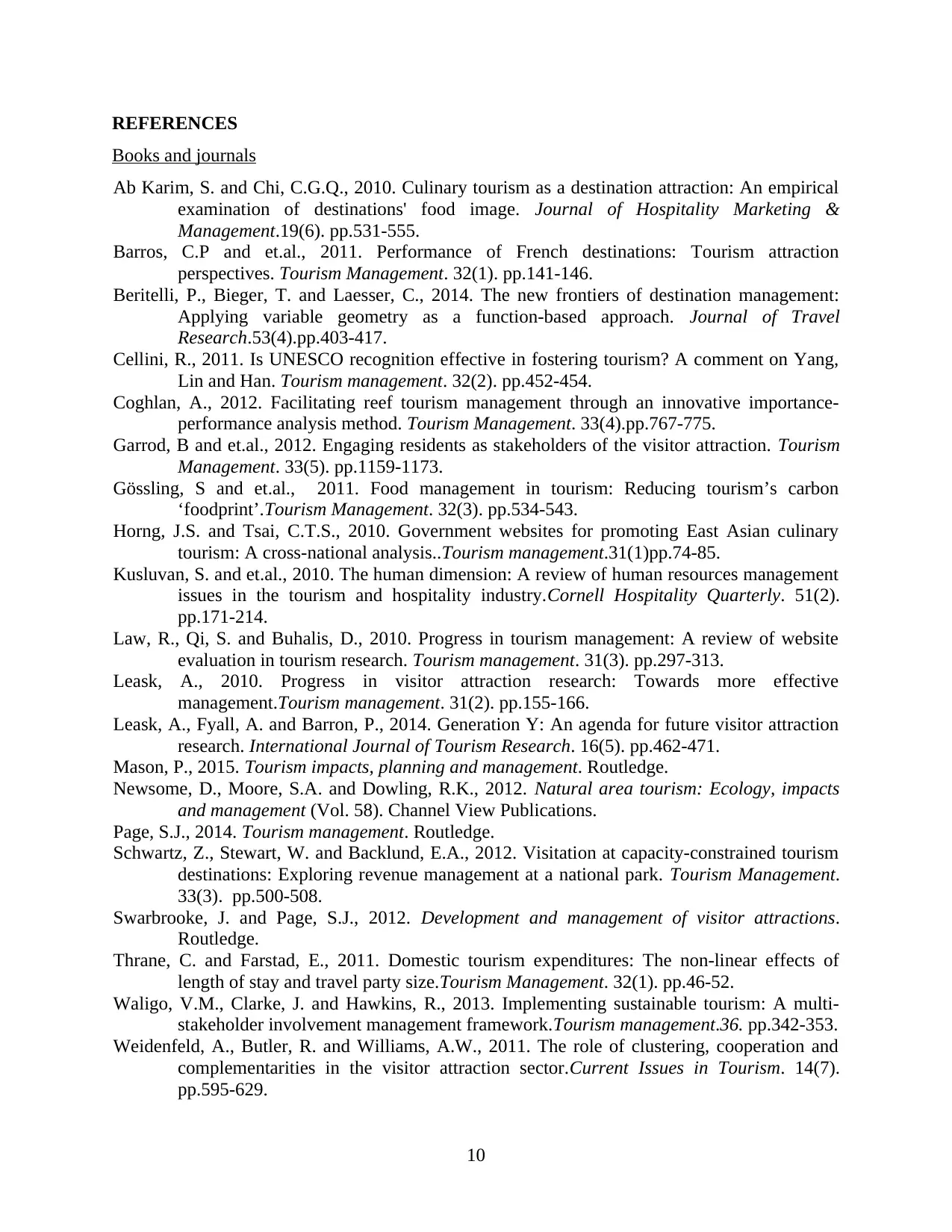
REFERENCES
Books and journals
Ab Karim, S. and Chi, C.G.Q., 2010. Culinary tourism as a destination attraction: An empirical
examination of destinations' food image. Journal of Hospitality Marketing &
Management.19(6). pp.531-555.
Barros, C.P and et.al., 2011. Performance of French destinations: Tourism attraction
perspectives. Tourism Management. 32(1). pp.141-146.
Beritelli, P., Bieger, T. and Laesser, C., 2014. The new frontiers of destination management:
Applying variable geometry as a function-based approach. Journal of Travel
Research.53(4).pp.403-417.
Cellini, R., 2011. Is UNESCO recognition effective in fostering tourism? A comment on Yang,
Lin and Han. Tourism management. 32(2). pp.452-454.
Coghlan, A., 2012. Facilitating reef tourism management through an innovative importance-
performance analysis method. Tourism Management. 33(4).pp.767-775.
Garrod, B and et.al., 2012. Engaging residents as stakeholders of the visitor attraction. Tourism
Management. 33(5). pp.1159-1173.
Gössling, S and et.al., 2011. Food management in tourism: Reducing tourism’s carbon
‘foodprint’.Tourism Management. 32(3). pp.534-543.
Horng, J.S. and Tsai, C.T.S., 2010. Government websites for promoting East Asian culinary
tourism: A cross-national analysis..Tourism management.31(1)pp.74-85.
Kusluvan, S. and et.al., 2010. The human dimension: A review of human resources management
issues in the tourism and hospitality industry.Cornell Hospitality Quarterly. 51(2).
pp.171-214.
Law, R., Qi, S. and Buhalis, D., 2010. Progress in tourism management: A review of website
evaluation in tourism research. Tourism management. 31(3). pp.297-313.
Leask, A., 2010. Progress in visitor attraction research: Towards more effective
management.Tourism management. 31(2). pp.155-166.
Leask, A., Fyall, A. and Barron, P., 2014. Generation Y: An agenda for future visitor attraction
research. International Journal of Tourism Research. 16(5). pp.462-471.
Mason, P., 2015. Tourism impacts, planning and management. Routledge.
Newsome, D., Moore, S.A. and Dowling, R.K., 2012. Natural area tourism: Ecology, impacts
and management (Vol. 58). Channel View Publications.
Page, S.J., 2014. Tourism management. Routledge.
Schwartz, Z., Stewart, W. and Backlund, E.A., 2012. Visitation at capacity-constrained tourism
destinations: Exploring revenue management at a national park. Tourism Management.
33(3). pp.500-508.
Swarbrooke, J. and Page, S.J., 2012. Development and management of visitor attractions.
Routledge.
Thrane, C. and Farstad, E., 2011. Domestic tourism expenditures: The non-linear effects of
length of stay and travel party size.Tourism Management. 32(1). pp.46-52.
Waligo, V.M., Clarke, J. and Hawkins, R., 2013. Implementing sustainable tourism: A multi-
stakeholder involvement management framework.Tourism management.36. pp.342-353.
Weidenfeld, A., Butler, R. and Williams, A.W., 2011. The role of clustering, cooperation and
complementarities in the visitor attraction sector.Current Issues in Tourism. 14(7).
pp.595-629.
10
Books and journals
Ab Karim, S. and Chi, C.G.Q., 2010. Culinary tourism as a destination attraction: An empirical
examination of destinations' food image. Journal of Hospitality Marketing &
Management.19(6). pp.531-555.
Barros, C.P and et.al., 2011. Performance of French destinations: Tourism attraction
perspectives. Tourism Management. 32(1). pp.141-146.
Beritelli, P., Bieger, T. and Laesser, C., 2014. The new frontiers of destination management:
Applying variable geometry as a function-based approach. Journal of Travel
Research.53(4).pp.403-417.
Cellini, R., 2011. Is UNESCO recognition effective in fostering tourism? A comment on Yang,
Lin and Han. Tourism management. 32(2). pp.452-454.
Coghlan, A., 2012. Facilitating reef tourism management through an innovative importance-
performance analysis method. Tourism Management. 33(4).pp.767-775.
Garrod, B and et.al., 2012. Engaging residents as stakeholders of the visitor attraction. Tourism
Management. 33(5). pp.1159-1173.
Gössling, S and et.al., 2011. Food management in tourism: Reducing tourism’s carbon
‘foodprint’.Tourism Management. 32(3). pp.534-543.
Horng, J.S. and Tsai, C.T.S., 2010. Government websites for promoting East Asian culinary
tourism: A cross-national analysis..Tourism management.31(1)pp.74-85.
Kusluvan, S. and et.al., 2010. The human dimension: A review of human resources management
issues in the tourism and hospitality industry.Cornell Hospitality Quarterly. 51(2).
pp.171-214.
Law, R., Qi, S. and Buhalis, D., 2010. Progress in tourism management: A review of website
evaluation in tourism research. Tourism management. 31(3). pp.297-313.
Leask, A., 2010. Progress in visitor attraction research: Towards more effective
management.Tourism management. 31(2). pp.155-166.
Leask, A., Fyall, A. and Barron, P., 2014. Generation Y: An agenda for future visitor attraction
research. International Journal of Tourism Research. 16(5). pp.462-471.
Mason, P., 2015. Tourism impacts, planning and management. Routledge.
Newsome, D., Moore, S.A. and Dowling, R.K., 2012. Natural area tourism: Ecology, impacts
and management (Vol. 58). Channel View Publications.
Page, S.J., 2014. Tourism management. Routledge.
Schwartz, Z., Stewart, W. and Backlund, E.A., 2012. Visitation at capacity-constrained tourism
destinations: Exploring revenue management at a national park. Tourism Management.
33(3). pp.500-508.
Swarbrooke, J. and Page, S.J., 2012. Development and management of visitor attractions.
Routledge.
Thrane, C. and Farstad, E., 2011. Domestic tourism expenditures: The non-linear effects of
length of stay and travel party size.Tourism Management. 32(1). pp.46-52.
Waligo, V.M., Clarke, J. and Hawkins, R., 2013. Implementing sustainable tourism: A multi-
stakeholder involvement management framework.Tourism management.36. pp.342-353.
Weidenfeld, A., Butler, R. and Williams, A.W., 2011. The role of clustering, cooperation and
complementarities in the visitor attraction sector.Current Issues in Tourism. 14(7).
pp.595-629.
10
⊘ This is a preview!⊘
Do you want full access?
Subscribe today to unlock all pages.
Trusted by 1+ million students worldwide

1 out of 13


Related Documents


Your All-in-One AI-Powered Toolkit for Academic Success.
+13062052269
info@desklib.com
Available 24*7 on WhatsApp / Email
![[object Object]](/_next/static/media/star-bottom.7253800d.svg)
Unlock your academic potential
Copyright © 2020–2026 A2Z Services. All Rights Reserved. Developed and managed by ZUCOL.