Comprehensive Report on Wireless Networking Concepts and Technologies

Verified

Added on  2020/03/07

|11
|1790
|14
Report
AI Summary
This report provides a comprehensive overview of wireless networking concepts. It begins by discussing various antenna types, including horn, YAGI, and microstrip antennas, highlighting their strengths, weaknesses, and potential for future dominance. The report then delves into a comparison of CDMA and FDMA multiplexing techniques, examining their designs, terminal operations, signal preparation methods, benefits, and drawbacks. Furthermore, it explores advanced wireless technologies such as RFID, Bluetooth, and WiFi Direct, detailing their applications, advantages, and disadvantages. The report concludes by summarizing the key findings and emphasizing the significance of microstrip antennas and the comparison between CDMA and FDMA. The report also emphasizes the strengths and weaknesses of each technology to provide a comprehensive overview of the subject.
Document Page
Running head: WIRELESS NETWORKING CONCEPTS
Wireless Networking Concepts
Name of the Student
Name of the University
Author’s note
tabler-icon-diamond-filled.svg

Paraphrase This Document

Need a fresh take? Get an instant paraphrase of this document with our AI Paraphraser
Document Page
1WIRELESS NETWORKING CONCEPTS
Executive Summary
There are various antennas used in today’s world of which microstrip antennas is expected to
dominate in mere future. The strength and weakness of all the antennas have been explained
in details. CDMA and FDMA have been compared and contrast in this report. The advanced
wireless technologies, their use, strength, weakness has also been showcased in this report.
Table of Contents
Document Page
2WIRELESS NETWORKING CONCEPTS
Introduction................................................................................................................................3
1. Different antennas, their strength, weakness, the antenna which will dominate in future.....3
2. Compare and contrast the multiplexing techniques CDMA and FDMA in the area of
wireless networking...................................................................................................................5
3. Advanced wireless technologies, their use, their strength, their weakness............................6
Conclusion..................................................................................................................................8
References..................................................................................................................................9
Document Page
3WIRELESS NETWORKING CONCEPTS
Introduction
There are various antennas used in today’s world of which microstrip antennas is
expected to dominate in mere future. The report showcases all the antennas, their strength,
weaknesses and also highlights the advanced wireless technologies with their use, strength
and weaknesses.
1. Different antennas, their strength, weakness, the antenna which will
dominate in future
Horn antenna
A horn antenna or microwave antenna comprises of the erupting waveguide that looks
like a horn and it directs radio wave in between the waveguide and the vacuum. The horn
antenna radiates radio waves from the waveguide out in the vacuum, it also accumulates
radio waves into the horn antenna’s waveguide for acceptance (Yin et al., 2013). The radio
waves are radiated from the horn antenna tube to the vacuum and horn antenna generally
provides a transmission structure where the impedance of the tube is matched with the
impedance of the vacuum.
The horn antenna is of five types- sectoral, pyramid, corrugated, conical, exponential.
Again, a sectoral horn antenna is divided into E-plane horn antenna and H-plane horn
antenna.
Strength
The horn antennas do not have resonant features and they can be operated over a long
extent of frequencies and bandwidth
The gain of the horn antenna extends up to 25 dBi (Lo & Lee, 2013).
The horn antenna offers broad bandwidth, low SWR, medium gain.
tabler-icon-diamond-filled.svg

Paraphrase This Document

Need a fresh take? Get an instant paraphrase of this document with our AI Paraphraser
Document Page
4WIRELESS NETWORKING CONCEPTS
Offers good efficiency
Weakness
The antenna requires being developed with utmost care (Yin et al., 2013)
The antenna lacks quality features.
YAGI antenna
Previously, YAGI antennas were broadly utilized for TV reception, however as they
are developed for only one frequency, they are not suitable for long frequency extent. YAGI
antennas composed of one or more directors, one driven element and one reflector.
Strength
The YAGI antenna has a gain that enables lower signal strength.
The antenna has permissive impedance levels that are minimized (Abhijyoti et al.,
2017).
The design of the antenna allows the antenna to be escalated very easily on vertical
and other beam poles
Weakness
The YAGI antenna extends for high gain levels
For a single YAGI antenna, the gain limits to 20dB
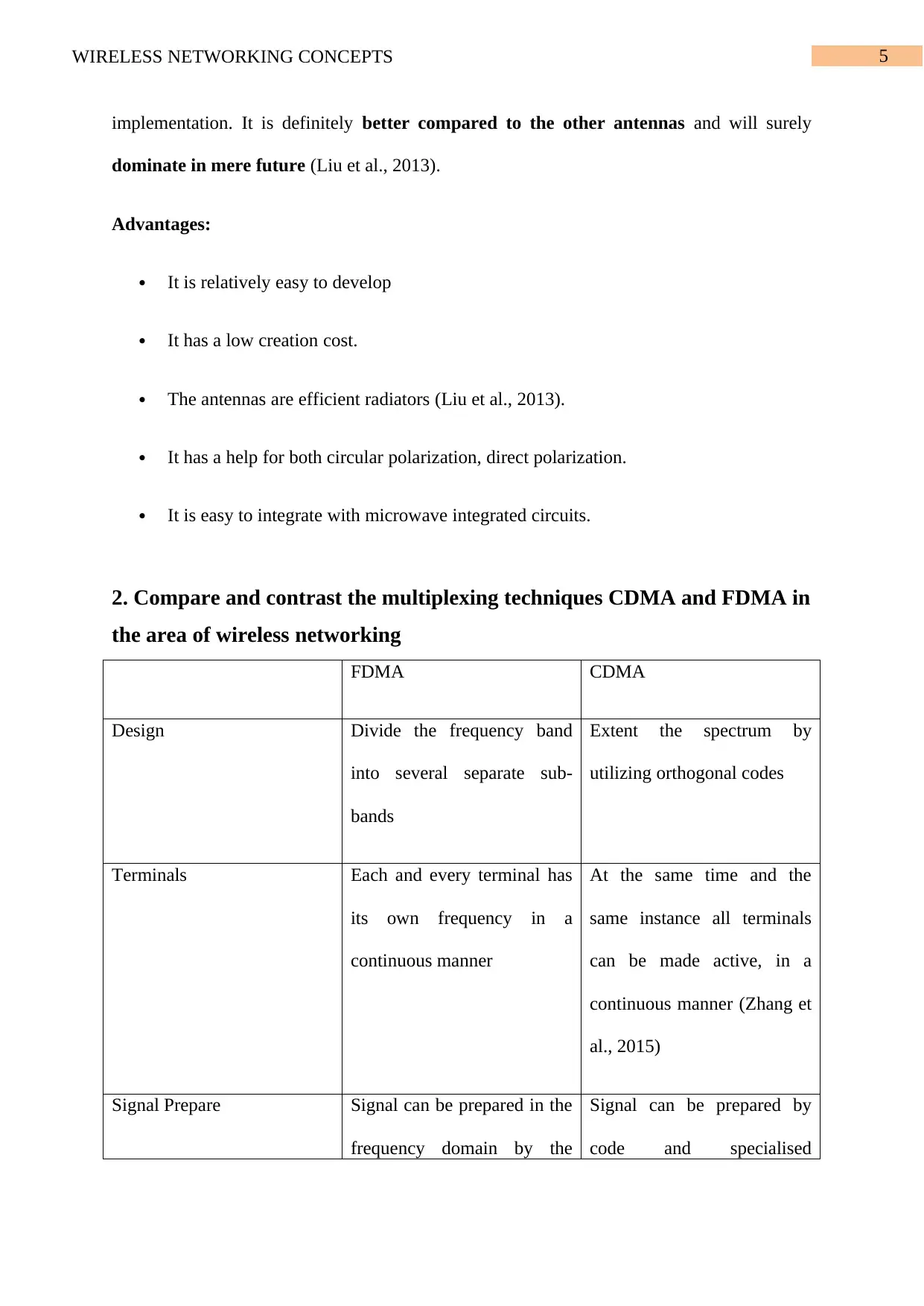
Microstrip antenna
Microstrip antennas are used worldwide. It is utilized as a part of satellite
communication, missile systems, and mobile, GPS because of its light weight and shape, easy
Document Page
5WIRELESS NETWORKING CONCEPTS
implementation. It is definitely better compared to the other antennas and will surely
dominate in mere future (Liu et al., 2013).
Advantages:
It is relatively easy to develop
It has a low creation cost.
The antennas are efficient radiators (Liu et al., 2013).
It has a help for both circular polarization, direct polarization.
It is easy to integrate with microwave integrated circuits.
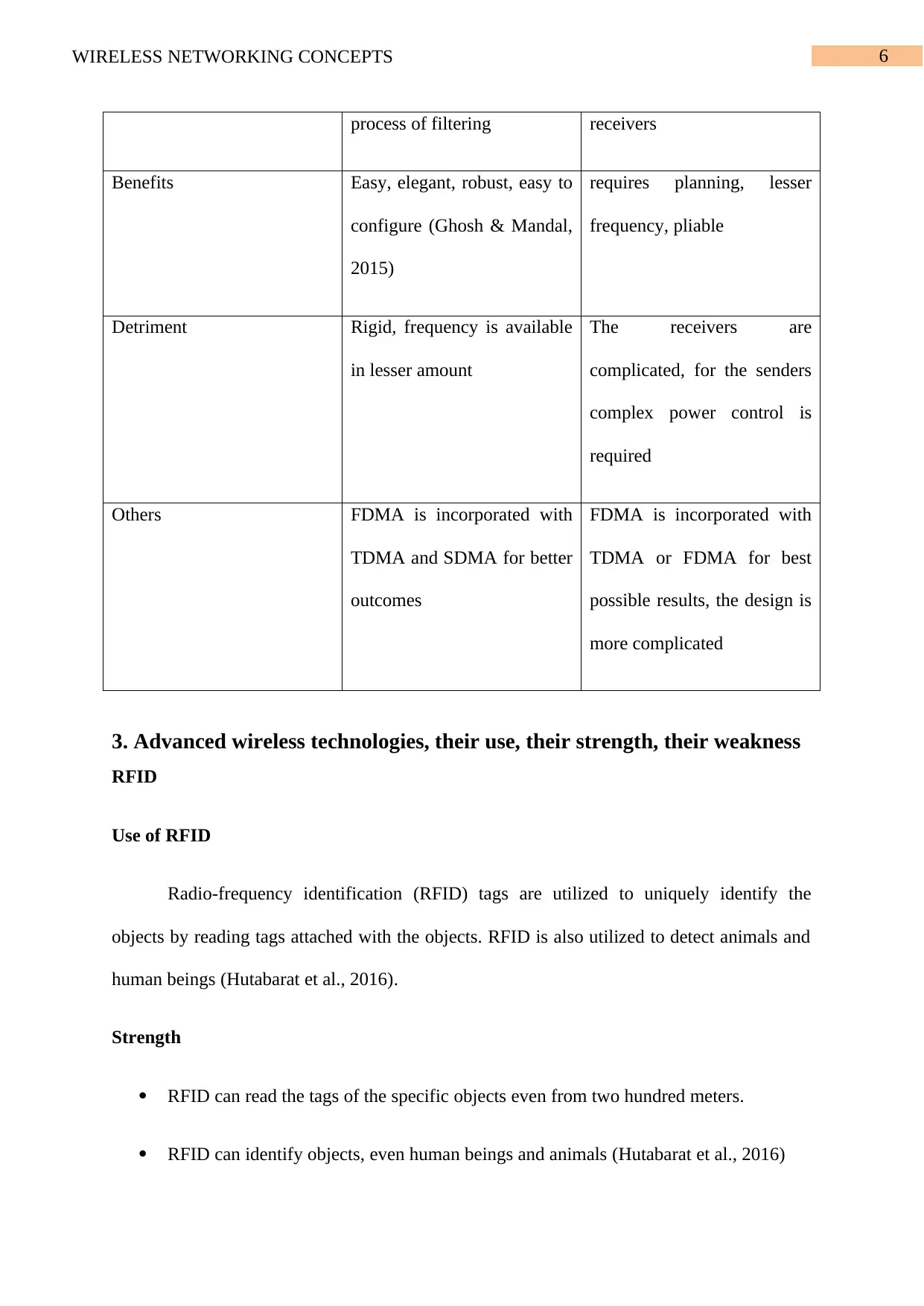
2. Compare and contrast the multiplexing techniques CDMA and FDMA in
the area of wireless networking
FDMA CDMA
Design Divide the frequency band
into several separate sub-
bands
Extent the spectrum by
utilizing orthogonal codes
Terminals Each and every terminal has
its own frequency in a
continuous manner
At the same time and the
same instance all terminals
can be made active, in a
continuous manner (Zhang et
al., 2015)
Signal Prepare Signal can be prepared in the
frequency domain by the
Signal can be prepared by
code and specialised
Document Page
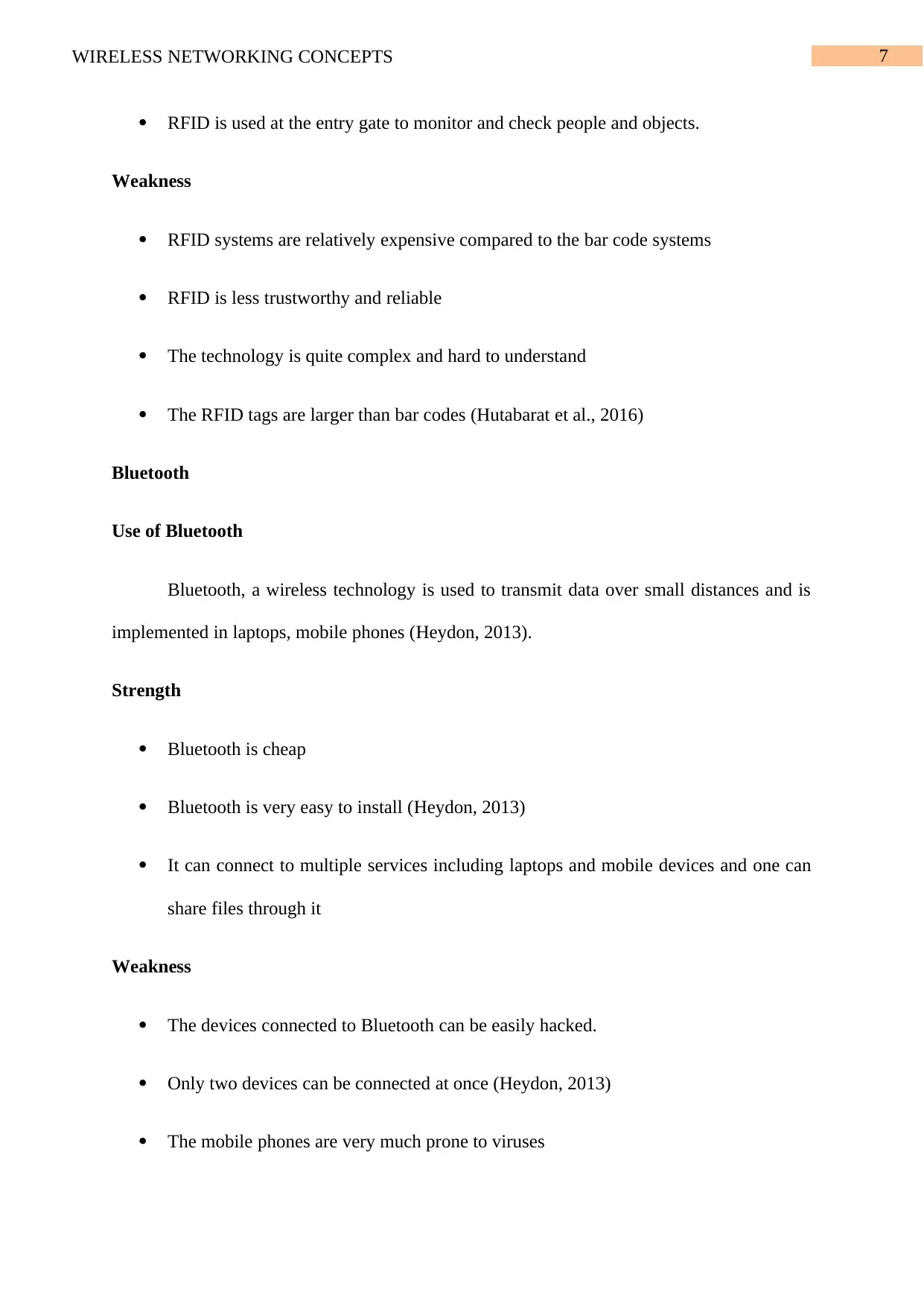
6WIRELESS NETWORKING CONCEPTS
process of filtering receivers
Benefits Easy, elegant, robust, easy to
configure (Ghosh & Mandal,
2015)
requires planning, lesser
frequency, pliable
Detriment Rigid, frequency is available
in lesser amount
The receivers are
complicated, for the senders
complex power control is
required
Others FDMA is incorporated with
TDMA and SDMA for better
outcomes
FDMA is incorporated with
TDMA or FDMA for best
possible results, the design is
more complicated
3. Advanced wireless technologies, their use, their strength, their weakness
RFID
Use of RFID
Radio-frequency identification (RFID) tags are utilized to uniquely identify the
objects by reading tags attached with the objects. RFID is also utilized to detect animals and
human beings (Hutabarat et al., 2016).
Strength
RFID can read the tags of the specific objects even from two hundred meters.
RFID can identify objects, even human beings and animals (Hutabarat et al., 2016)
tabler-icon-diamond-filled.svg

Paraphrase This Document

Need a fresh take? Get an instant paraphrase of this document with our AI Paraphraser
Document Page
7WIRELESS NETWORKING CONCEPTS
RFID is used at the entry gate to monitor and check people and objects.
Weakness
RFID systems are relatively expensive compared to the bar code systems
RFID is less trustworthy and reliable
The technology is quite complex and hard to understand
The RFID tags are larger than bar codes (Hutabarat et al., 2016)
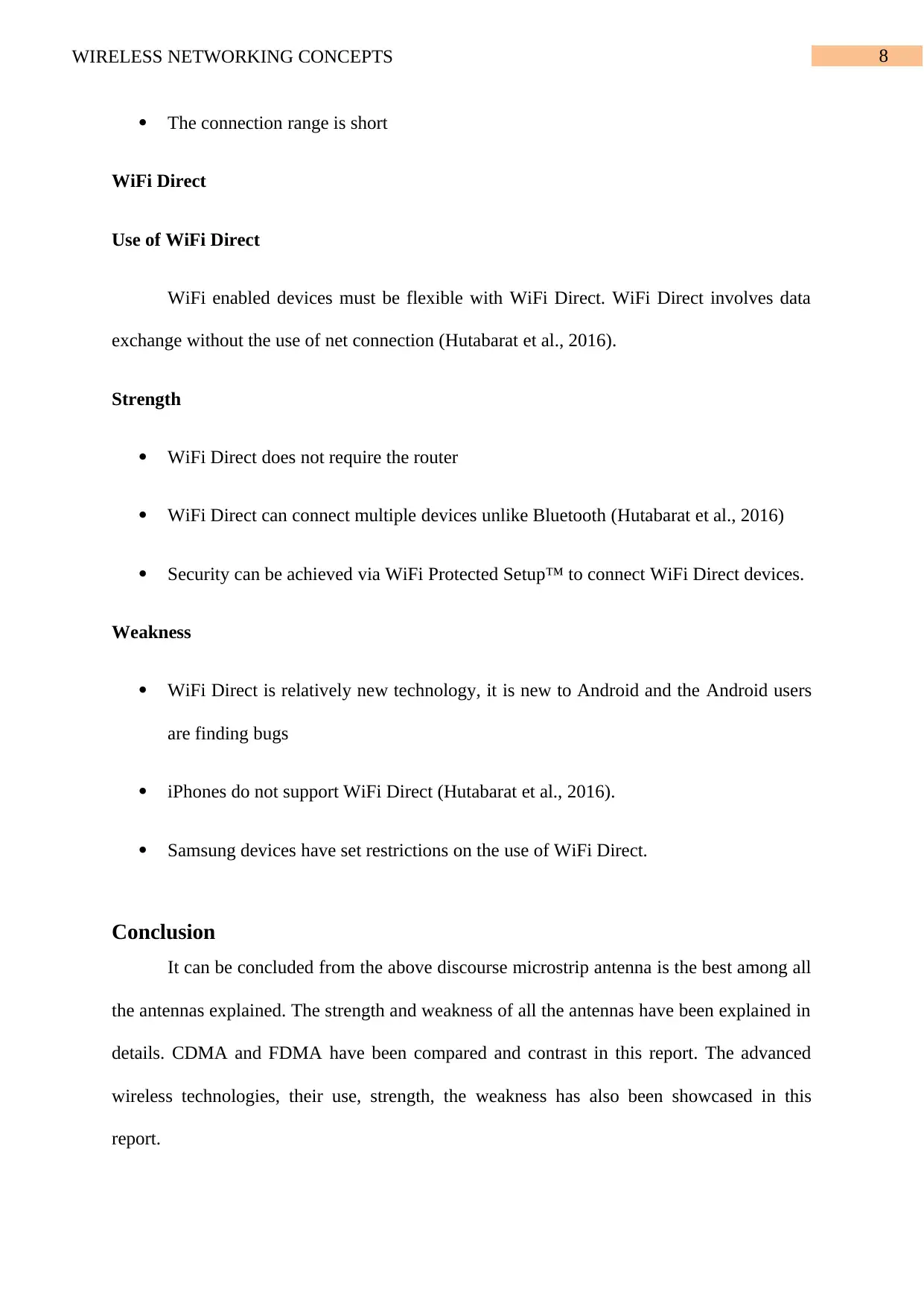
Bluetooth
Use of Bluetooth
Bluetooth, a wireless technology is used to transmit data over small distances and is
implemented in laptops, mobile phones (Heydon, 2013).
Strength
Bluetooth is cheap
Bluetooth is very easy to install (Heydon, 2013)
It can connect to multiple services including laptops and mobile devices and one can
share files through it
Weakness
The devices connected to Bluetooth can be easily hacked.
Only two devices can be connected at once (Heydon, 2013)
The mobile phones are very much prone to viruses
Document Page
8WIRELESS NETWORKING CONCEPTS
The connection range is short
WiFi Direct
Use of WiFi Direct
WiFi enabled devices must be flexible with WiFi Direct. WiFi Direct involves data
exchange without the use of net connection (Hutabarat et al., 2016).
Strength
WiFi Direct does not require the router
WiFi Direct can connect multiple devices unlike Bluetooth (Hutabarat et al., 2016)
Security can be achieved via WiFi Protected Setup™ to connect WiFi Direct devices.
Weakness
WiFi Direct is relatively new technology, it is new to Android and the Android users
are finding bugs
iPhones do not support WiFi Direct (Hutabarat et al., 2016).
Samsung devices have set restrictions on the use of WiFi Direct.
Conclusion
It can be concluded from the above discourse microstrip antenna is the best among all
the antennas explained. The strength and weakness of all the antennas have been explained in
details. CDMA and FDMA have been compared and contrast in this report. The advanced
wireless technologies, their use, strength, the weakness has also been showcased in this
report.
Document Page
9WIRELESS NETWORKING CONCEPTS
References
Abhijyoti, G., Subhradeep, C., Sanjay, G. K., Kumar, S. L. L., Sudipta, C., & Banani, B.
(2017). Slot-Loaded Microstrip Antenna: A Possible Solution for Wide Banding and
Attaining Low Cross-Polarization. In Recent Developments in Intelligent Computing,
Communication and Devices (pp. 113-119). Springer, Singapore.
Ghosh, S., & Mandal, P. (2015, April). A new algorithmic approach for the construction of
spreading codes for CDMA systems. In Communications and Signal Processing
(ICCSP), 2015 International Conference on (pp. 0190-0194). IEEE.
Heydon, R. (2013). Bluetooth low energy: the developer's handbook. Prentice Hall.
Hutabarat, D. P., Patria, D., Budijono, S., & Saleh, R. (2016, October). Human tracking
application in a certain closed area using RFID sensors and IP camera. In Information
Technology, Computer, and Electrical Engineering (ICITACEE), 2016 3rd
International Conference on (pp. 11-16). IEEE.
Liu, J., Xue, Q., Wong, H., Lai, H. W., & Long, Y. (2013). Design and analysis of a low-
profile and broadband microstrip monopolar patch antenna. IEEE Transactions on
Antennas and Propagation, 61(1), 11-18.
Lo, Y. T., & Lee, S. W. (2013). Antenna Handbook: theory, applications, and design.
Springer Science & Business Media.
Pyattaev, A., Johnsson, K., Andreev, S., & Koucheryavy, Y. (2013, April). 3GPP LTE traffic
offloading onto WiFi direct. In Wireless Communications and Networking Conference
Workshops (WCNCW), 2013 IEEE (pp. 135-140). IEEE.
tabler-icon-diamond-filled.svg

Paraphrase This Document

Need a fresh take? Get an instant paraphrase of this document with our AI Paraphraser
Document Page
10WIRELESS NETWORKING CONCEPTS
Yin, H., Gesbert, D., Filippou, M., & Liu, Y. (2013). A coordinated approach to channel
estimation in large-scale multiple-antenna systems. IEEE Journal on Selected Areas
in Communications, 31(2), 264-273.
Zhang, J., Yang, L. L., Hanzo, L., & Gharavi, H. (2015). Advances in cooperative single-
carrier FDMA communications: Beyond LTE-Advanced. IEEE Communications
Surveys & Tutorials, 17(2), 730-756.
chevron_up_icon
1 out of 11
circle_padding
hide_on_mobile
zoom_out_icon
[object Object]