Analysis of Climate-Related Risk Disclosures at Metcash Limited
VerifiedAdded on 2023/01/18
|10
|2868
|77
Report
AI Summary
This report provides an in-depth analysis of climate-related risk disclosures by Metcash Limited, an Australian distribution and marketing enterprise. It explores the importance of these disclosures for shareholders, highlighting the classification of climate risks into physical, technological, and regulatory categories. The report utilizes the managerial branch of stakeholder theory to identify shareholders and creditors as key stakeholders, examining their interests in climate change disclosures. It further discusses three major challenges Metcash Limited faces in climate risk disclosures, including securing leadership support, overcoming siloed risk management, and limited experience with climate scenario assessment. The report evaluates the climate-based risk disclosures adopted by the company, offering a comprehensive overview of the financial and societal implications of climate change for Metcash Limited and its stakeholders. The report also touches upon the agency, shareholder and legitimacy theories.
Financial Reporting

Paraphrase This Document
Need a fresh take? Get an instant paraphrase of this document with our AI Paraphraser
Executive summary
Accounting&Society aims in challenging and extending an understanding of roles of an
accounting and the related emergent and the calculative processes within construction of the
societal and the economic factors. The present report will highlight different climate risk relating
disclosures that the company need to make and the challenges attached to it with appropriate
actions adopted by it to cope up with such risk.
Accounting&Society aims in challenging and extending an understanding of roles of an
accounting and the related emergent and the calculative processes within construction of the
societal and the economic factors. The present report will highlight different climate risk relating
disclosures that the company need to make and the challenges attached to it with appropriate
actions adopted by it to cope up with such risk.
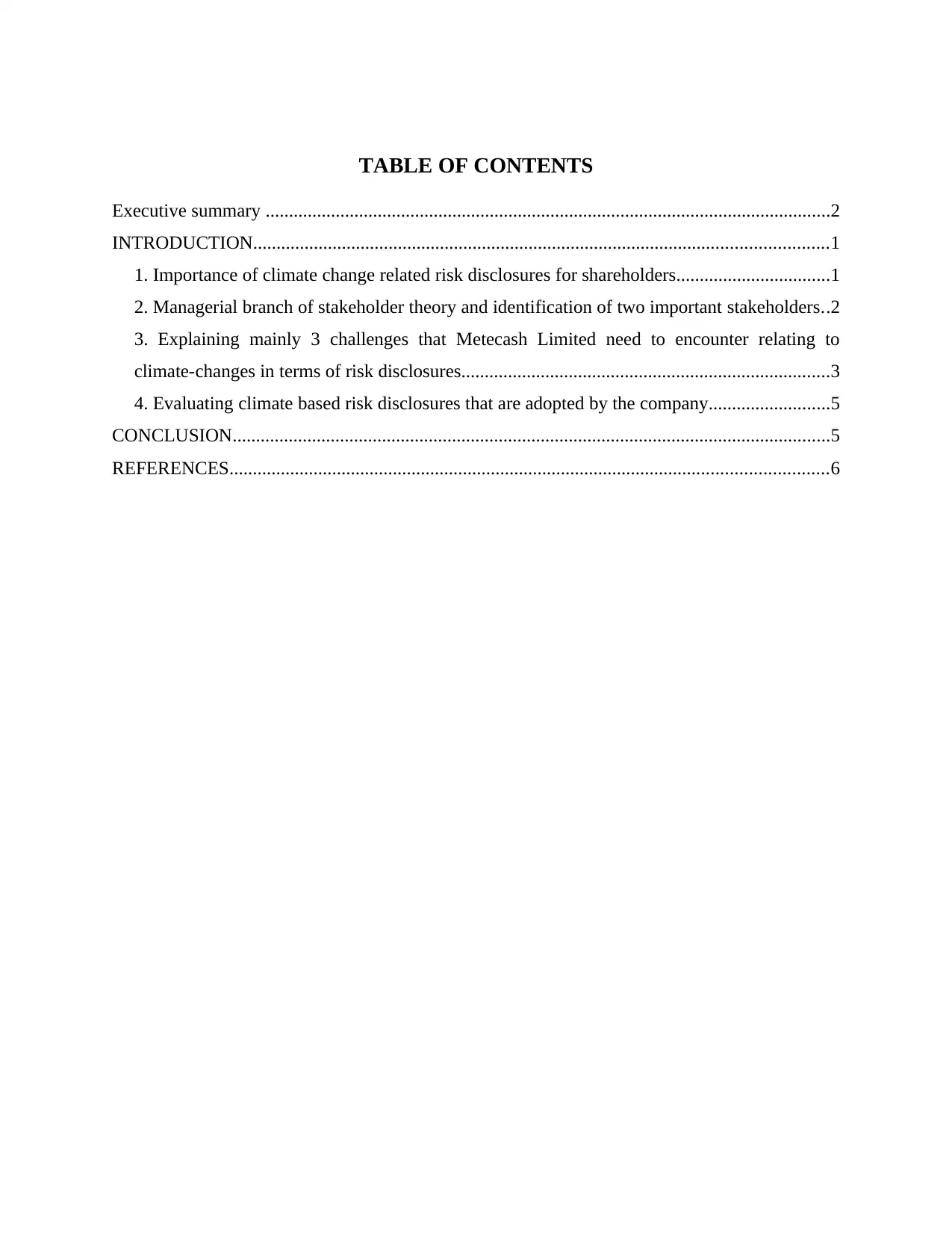
TABLE OF CONTENTS
Executive summary .........................................................................................................................2
INTRODUCTION...........................................................................................................................1
1. Importance of climate change related risk disclosures for shareholders.................................1
2. Managerial branch of stakeholder theory and identification of two important stakeholders..2
3. Explaining mainly 3 challenges that Metecash Limited need to encounter relating to
climate-changes in terms of risk disclosures...............................................................................3
4. Evaluating climate based risk disclosures that are adopted by the company..........................5
CONCLUSION................................................................................................................................5
REFERENCES................................................................................................................................6
Executive summary .........................................................................................................................2
INTRODUCTION...........................................................................................................................1
1. Importance of climate change related risk disclosures for shareholders.................................1
2. Managerial branch of stakeholder theory and identification of two important stakeholders..2
3. Explaining mainly 3 challenges that Metecash Limited need to encounter relating to
climate-changes in terms of risk disclosures...............................................................................3
4. Evaluating climate based risk disclosures that are adopted by the company..........................5
CONCLUSION................................................................................................................................5
REFERENCES................................................................................................................................6
⊘ This is a preview!⊘
Do you want full access?
Subscribe today to unlock all pages.

Trusted by 1+ million students worldwide
INTRODUCTION
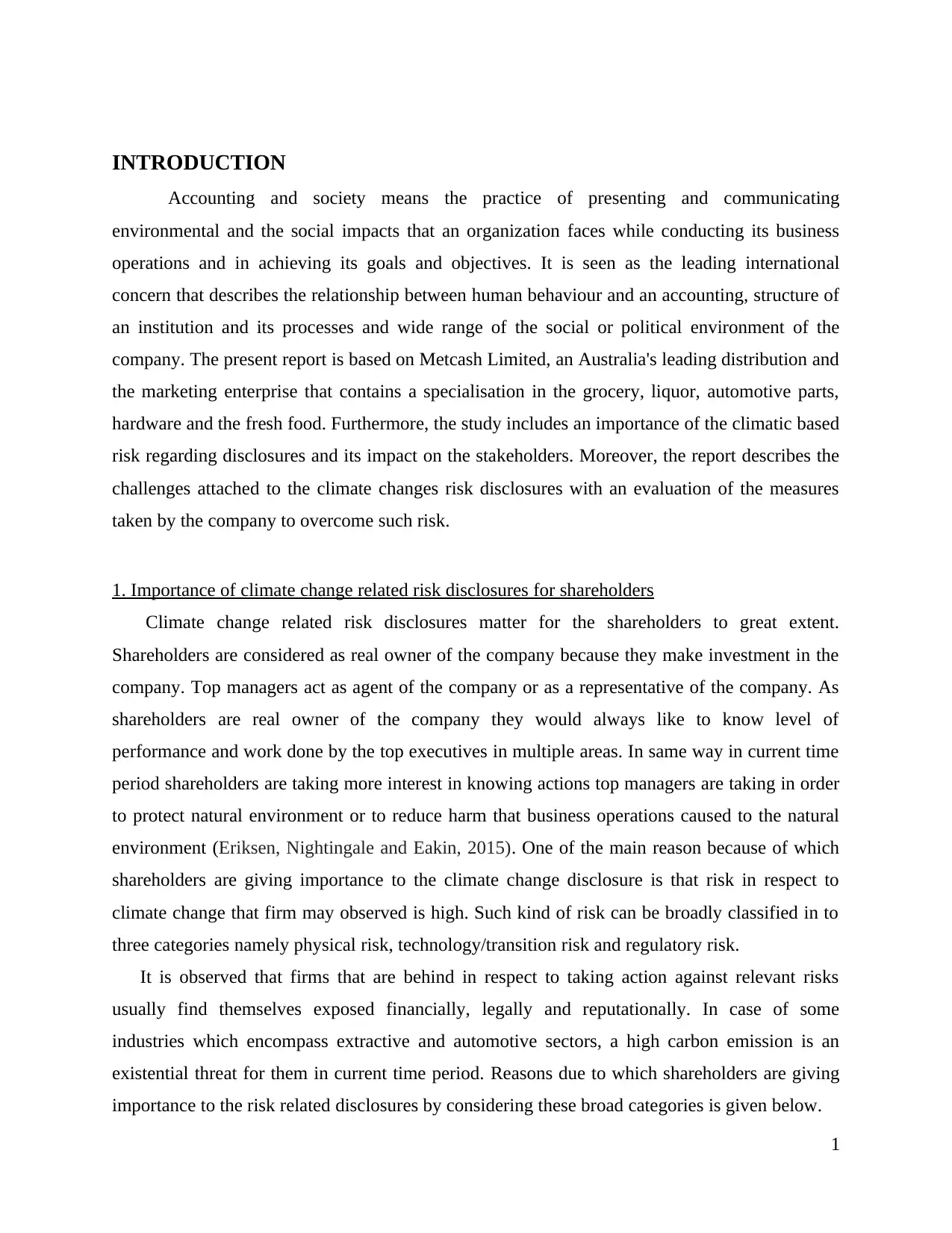
Accounting and society means the practice of presenting and communicating
environmental and the social impacts that an organization faces while conducting its business
operations and in achieving its goals and objectives. It is seen as the leading international
concern that describes the relationship between human behaviour and an accounting, structure of
an institution and its processes and wide range of the social or political environment of the
company. The present report is based on Metcash Limited, an Australia's leading distribution and
the marketing enterprise that contains a specialisation in the grocery, liquor, automotive parts,
hardware and the fresh food. Furthermore, the study includes an importance of the climatic based
risk regarding disclosures and its impact on the stakeholders. Moreover, the report describes the
challenges attached to the climate changes risk disclosures with an evaluation of the measures
taken by the company to overcome such risk.
1. Importance of climate change related risk disclosures for shareholders
Climate change related risk disclosures matter for the shareholders to great extent.
Shareholders are considered as real owner of the company because they make investment in the
company. Top managers act as agent of the company or as a representative of the company. As
shareholders are real owner of the company they would always like to know level of
performance and work done by the top executives in multiple areas. In same way in current time
period shareholders are taking more interest in knowing actions top managers are taking in order
to protect natural environment or to reduce harm that business operations caused to the natural
environment (Eriksen, Nightingale and Eakin, 2015). One of the main reason because of which
shareholders are giving importance to the climate change disclosure is that risk in respect to
climate change that firm may observed is high. Such kind of risk can be broadly classified in to
three categories namely physical risk, technology/transition risk and regulatory risk.
It is observed that firms that are behind in respect to taking action against relevant risks
usually find themselves exposed financially, legally and reputationally. In case of some
industries which encompass extractive and automotive sectors, a high carbon emission is an
existential threat for them in current time period. Reasons due to which shareholders are giving
importance to the risk related disclosures by considering these broad categories is given below.
1
Accounting and society means the practice of presenting and communicating
environmental and the social impacts that an organization faces while conducting its business
operations and in achieving its goals and objectives. It is seen as the leading international
concern that describes the relationship between human behaviour and an accounting, structure of
an institution and its processes and wide range of the social or political environment of the
company. The present report is based on Metcash Limited, an Australia's leading distribution and
the marketing enterprise that contains a specialisation in the grocery, liquor, automotive parts,
hardware and the fresh food. Furthermore, the study includes an importance of the climatic based
risk regarding disclosures and its impact on the stakeholders. Moreover, the report describes the
challenges attached to the climate changes risk disclosures with an evaluation of the measures
taken by the company to overcome such risk.
1. Importance of climate change related risk disclosures for shareholders
Climate change related risk disclosures matter for the shareholders to great extent.
Shareholders are considered as real owner of the company because they make investment in the
company. Top managers act as agent of the company or as a representative of the company. As
shareholders are real owner of the company they would always like to know level of
performance and work done by the top executives in multiple areas. In same way in current time
period shareholders are taking more interest in knowing actions top managers are taking in order
to protect natural environment or to reduce harm that business operations caused to the natural
environment (Eriksen, Nightingale and Eakin, 2015). One of the main reason because of which
shareholders are giving importance to the climate change disclosure is that risk in respect to
climate change that firm may observed is high. Such kind of risk can be broadly classified in to
three categories namely physical risk, technology/transition risk and regulatory risk.
It is observed that firms that are behind in respect to taking action against relevant risks
usually find themselves exposed financially, legally and reputationally. In case of some
industries which encompass extractive and automotive sectors, a high carbon emission is an
existential threat for them in current time period. Reasons due to which shareholders are giving
importance to the risk related disclosures by considering these broad categories is given below.
1
Paraphrase This Document
Need a fresh take? Get an instant paraphrase of this document with our AI Paraphraser
Physical risk: Shareholders give much importance to the physical risk or the harm that
factories caused to the natural environment. Government does not take action against
each and every company but those firms whose business operations openly reflect harm
to the natural environment quickly comes in eye of Government department and strict
actions are taken against them. In such situation heavy amount of penalty is imposed and
this factor create concern among shareholders (Fünfgeld, 2015). Mentioned entity due to
this reason always like to view climate change related disclosures so as to measure such
kind of risk and to make accurate decisions. Technological risk: Shareholders know very well that if technology get outdated then it
emits more pollution then before. Consider another scenario where with passage of time
many new upgraded versions of machine come in existence in terms of pollution control.
If firm knowingly use outdated version then it can harm natural environment and
Government may take strict action. Thus, because of technology risk shareholders like to
obtain climate change related risk disclosures.
Regulatory risk: Mentioned factor create more concern among shareholders that if
Government take any strict action against company then in that case image of the
company get tarnished among investors and business partners which ultimately lead to
decline in the business revenue and profit.
2. Managerial branch of stakeholder theory and identification of two important stakeholders
Managerial branch of stakeholder theory predicts that there are number of stakeholders of
any company and company management usually focus on meeting expectation of the
shareholders that have great potential to influence firm capability to generate more revenue in the
business. In other words, it can be said that management make discrimination among
stakeholders in terms of power they have. Other important fact is that influence of stakeholders
depends on the fact the extent of control they have on the company resources (Prokopy. and
et.al., 2015). Company management identify most powerful stakeholder on basis of power,
urgency and legitimacy. Stakeholders of the company are as follows. Shareholders: These are considered as real owner of the company as play crucial role in
making decisions. They have control on the company resources as they make investment
in the company. In case firm revenue and profit decline then in that case shareholders are
2
factories caused to the natural environment. Government does not take action against
each and every company but those firms whose business operations openly reflect harm
to the natural environment quickly comes in eye of Government department and strict
actions are taken against them. In such situation heavy amount of penalty is imposed and
this factor create concern among shareholders (Fünfgeld, 2015). Mentioned entity due to
this reason always like to view climate change related disclosures so as to measure such
kind of risk and to make accurate decisions. Technological risk: Shareholders know very well that if technology get outdated then it
emits more pollution then before. Consider another scenario where with passage of time
many new upgraded versions of machine come in existence in terms of pollution control.
If firm knowingly use outdated version then it can harm natural environment and
Government may take strict action. Thus, because of technology risk shareholders like to
obtain climate change related risk disclosures.
Regulatory risk: Mentioned factor create more concern among shareholders that if
Government take any strict action against company then in that case image of the
company get tarnished among investors and business partners which ultimately lead to
decline in the business revenue and profit.
2. Managerial branch of stakeholder theory and identification of two important stakeholders
Managerial branch of stakeholder theory predicts that there are number of stakeholders of
any company and company management usually focus on meeting expectation of the
shareholders that have great potential to influence firm capability to generate more revenue in the
business. In other words, it can be said that management make discrimination among
stakeholders in terms of power they have. Other important fact is that influence of stakeholders
depends on the fact the extent of control they have on the company resources (Prokopy. and
et.al., 2015). Company management identify most powerful stakeholder on basis of power,
urgency and legitimacy. Stakeholders of the company are as follows. Shareholders: These are considered as real owner of the company as play crucial role in
making decisions. They have control on the company resources as they make investment
in the company. In case firm revenue and profit decline then in that case shareholders are
2
one whose interest highly get affected in the firm. Thus, these are one of the most
important stakeholders also from climate change point of view. Creditor: These are those who lend money to the company and interested in its
performance because if that will be good then in that case creditors will be able to receive
debt amount on time (Gramberger and et.al., 2015). They also intend to know about
measures firm take to protect environment because if suppose company is emit pollutant
and Government take action against it then firm will need to pay penalty amount and, in
that year, it will not be able to pay debt amount to shareholders. In such case creditor
business get affected and due to this reason, it always like to know about efforts that are
made by the firm in respect to control of pollution from its business. Employee: These are also stakeholder of the firm but they do not have any sort of power
or control on company resources. Moreover, they also not give importance to the
environment protection. Hence, due to this reason they cannot be considered as important
stakeholder for the company from climate change disclosure point of view.
Government: It is another entity that have interest in the company in respect to way in
which company is following rules and regulations in its business and performing
operations. Government also need to information about efforts that are made by the
business firm to prevent harm to the natural environment.
Two main stakeholders are shareholders and creditors because in case any sort of strict action
is taken against the business firm then in that case their interest will heavily get affected
(Klenk. and et.al., 2015). Thus, climate change related risk disclosure heavily matters for the
stakeholders because in case Government taken action against company it will need to pay
large amount as penalty which will ultimately affect firm profitability. On basis of these
disclosures stakeholders which are shareholder and creditor come to know to know direction
in which efforts are made. In case they observe that efforts made are not sufficient
considering present condition then in that case shareholders alert top management and
creditors may give less debt to the company.
Theories
Agency theory: This theory state that there are two sorts of entities namely principal and
agent. Under this theory an agent is responsible to work on behalf of the principal and
have some rights to make decisions. In the corporate there are principle which is
3
important stakeholders also from climate change point of view. Creditor: These are those who lend money to the company and interested in its
performance because if that will be good then in that case creditors will be able to receive
debt amount on time (Gramberger and et.al., 2015). They also intend to know about
measures firm take to protect environment because if suppose company is emit pollutant
and Government take action against it then firm will need to pay penalty amount and, in
that year, it will not be able to pay debt amount to shareholders. In such case creditor
business get affected and due to this reason, it always like to know about efforts that are
made by the firm in respect to control of pollution from its business. Employee: These are also stakeholder of the firm but they do not have any sort of power
or control on company resources. Moreover, they also not give importance to the
environment protection. Hence, due to this reason they cannot be considered as important
stakeholder for the company from climate change disclosure point of view.
Government: It is another entity that have interest in the company in respect to way in
which company is following rules and regulations in its business and performing
operations. Government also need to information about efforts that are made by the
business firm to prevent harm to the natural environment.
Two main stakeholders are shareholders and creditors because in case any sort of strict action
is taken against the business firm then in that case their interest will heavily get affected
(Klenk. and et.al., 2015). Thus, climate change related risk disclosure heavily matters for the
stakeholders because in case Government taken action against company it will need to pay
large amount as penalty which will ultimately affect firm profitability. On basis of these
disclosures stakeholders which are shareholder and creditor come to know to know direction
in which efforts are made. In case they observe that efforts made are not sufficient
considering present condition then in that case shareholders alert top management and
creditors may give less debt to the company.
Theories
Agency theory: This theory state that there are two sorts of entities namely principal and
agent. Under this theory an agent is responsible to work on behalf of the principal and
have some rights to make decisions. In the corporate there are principle which is
3
⊘ This is a preview!⊘
Do you want full access?
Subscribe today to unlock all pages.
Trusted by 1+ million students worldwide
shareholders and agent which are managers who make day to day decisions on behalf of
principle. Under this theory it is responsibility of the managers to take some action to
control pollution from the workplace so that harm to natural environment can be
prevented. In case such kind of steps not take penalty can be imposed by government.
Thus, under agency theory it is responsibility of managers as agent to take in interest of
the shareholders who are real owner of the firm.
Shareholder theory: This theory state that management must work for interest of
shareholders of the business firm. Means that under this theory it is sole responsibility of
the managers to generate maximum return for the shareholders. In case Government
impose penalty because pollution spread by the manufacturing plan the in that case
shareholders return will reduce. Hence, in compliance with this theory management must
take strict action for pollution control.
Legitimacy theory: This theory state that firm must implement and develop social and
environmental disclosures. Means that firm must perform varied tasks that protect
environment and must disclose all those activities in annual reports so that shareholders
comes to know about efforts management made to handle situation.
3. Explaining mainly 3 challenges that Metecash Limited need to encounter relating to climate-
changes in terms of risk disclosures
Metcash Limited has been stated three major challenges that are involves in climatic risk
disclosures that are as follows-
Securing the leadership support- Board of directors and the leaders of the company
might primarily make use of the reputation lens in order to consider the climatic risk attached
with an entity's potential effect on an environment. They do not seek for full factoring in the long
and short term links with that of the financial performance (Christophers, 2017). Thus, securing
the support of the leaders is considered to be the major challenge as without their support
effective strategies cannot be developed for the purpose of coping up with the risk associated to
the climatic changes. It becomes essential for the company to attain shift in the corporate dial by
creating wider strategies, driving top-down and is been supported by the strong governance and
the leadership.
4
principle. Under this theory it is responsibility of the managers to take some action to
control pollution from the workplace so that harm to natural environment can be
prevented. In case such kind of steps not take penalty can be imposed by government.
Thus, under agency theory it is responsibility of managers as agent to take in interest of
the shareholders who are real owner of the firm.
Shareholder theory: This theory state that management must work for interest of
shareholders of the business firm. Means that under this theory it is sole responsibility of
the managers to generate maximum return for the shareholders. In case Government
impose penalty because pollution spread by the manufacturing plan the in that case
shareholders return will reduce. Hence, in compliance with this theory management must
take strict action for pollution control.
Legitimacy theory: This theory state that firm must implement and develop social and
environmental disclosures. Means that firm must perform varied tasks that protect
environment and must disclose all those activities in annual reports so that shareholders
comes to know about efforts management made to handle situation.
3. Explaining mainly 3 challenges that Metecash Limited need to encounter relating to climate-
changes in terms of risk disclosures
Metcash Limited has been stated three major challenges that are involves in climatic risk
disclosures that are as follows-
Securing the leadership support- Board of directors and the leaders of the company
might primarily make use of the reputation lens in order to consider the climatic risk attached
with an entity's potential effect on an environment. They do not seek for full factoring in the long
and short term links with that of the financial performance (Christophers, 2017). Thus, securing
the support of the leaders is considered to be the major challenge as without their support
effective strategies cannot be developed for the purpose of coping up with the risk associated to
the climatic changes. It becomes essential for the company to attain shift in the corporate dial by
creating wider strategies, driving top-down and is been supported by the strong governance and
the leadership.
4
Paraphrase This Document
Need a fresh take? Get an instant paraphrase of this document with our AI Paraphraser
Overcoming the process the siloed management of risk- Metcash had developed a better
understanding in mitigating the conventional risk that could be easily isolated and is addressed
with the standard approaches of the risk management. However, in some of the cases that
includes complex risks attached in an interconnected systems, like such that relates with the
climatic risks and changes attached along with the transition to the low-carbon economy where
the standard approaches do not work.
Limited and climate risk for short period analyses will not be counted as sufficient in
providing a long range view to he investors, stakeholders and the investors in relation to the
potential transitional and direct effect of the climate opportunities and risks. Moreover, managing
the climate risks cannot be considered as the sole responsibility of the siloed group and
individual within an enterprise like sustainability team.
Limited experience with the changes in climate scenario assessment – Company had
faced wide range of the challenges and the roadblocks towards translating the climate scenarios
to the integrated and useful financial assessment. There are different types of the climatic
scenarios and the widely varied results that introduced an uncertainty on which the climatic
conditions seems as adequate in using (Hahn, Reimsbach and Schiemann, 2015). Majority of the
climatic scenario models are been developed for an academic and the economic use and not the
financial one.
Metcash also require to make the decisions on the ways for integrating this type of
analysis into an ongoing strategy and planning for risk assessment. Finally the firm will have to
link the scenario effect to the future performance of the business. General lack of the empirical
and the historical data link the climatic and an economic influence to the financial outputs.
4. Evaluating climate based risk disclosures that are adopted by the company
Business operations of metcash and the strategic priorities were seen as subjected to the
ongoing review and the development. Management of Metcash reviews its plans on regular basis
against the market changes and develops necessary measures in modifying it (Elijido-Ten, 2017).
Company's 3 years smarter programs had resulted in focusing on offering a significant level of
the cost savings. An enterprise had now moved into the 5 year of its strategy phase while
emphasizing on the cost and aiming in delivering the pathway to the sustainable growth in the
long run period.
5
understanding in mitigating the conventional risk that could be easily isolated and is addressed
with the standard approaches of the risk management. However, in some of the cases that
includes complex risks attached in an interconnected systems, like such that relates with the
climatic risks and changes attached along with the transition to the low-carbon economy where
the standard approaches do not work.
Limited and climate risk for short period analyses will not be counted as sufficient in
providing a long range view to he investors, stakeholders and the investors in relation to the
potential transitional and direct effect of the climate opportunities and risks. Moreover, managing
the climate risks cannot be considered as the sole responsibility of the siloed group and
individual within an enterprise like sustainability team.
Limited experience with the changes in climate scenario assessment – Company had
faced wide range of the challenges and the roadblocks towards translating the climate scenarios
to the integrated and useful financial assessment. There are different types of the climatic
scenarios and the widely varied results that introduced an uncertainty on which the climatic
conditions seems as adequate in using (Hahn, Reimsbach and Schiemann, 2015). Majority of the
climatic scenario models are been developed for an academic and the economic use and not the
financial one.
Metcash also require to make the decisions on the ways for integrating this type of
analysis into an ongoing strategy and planning for risk assessment. Finally the firm will have to
link the scenario effect to the future performance of the business. General lack of the empirical
and the historical data link the climatic and an economic influence to the financial outputs.
4. Evaluating climate based risk disclosures that are adopted by the company
Business operations of metcash and the strategic priorities were seen as subjected to the
ongoing review and the development. Management of Metcash reviews its plans on regular basis
against the market changes and develops necessary measures in modifying it (Elijido-Ten, 2017).
Company's 3 years smarter programs had resulted in focusing on offering a significant level of
the cost savings. An enterprise had now moved into the 5 year of its strategy phase while
emphasizing on the cost and aiming in delivering the pathway to the sustainable growth in the
long run period.
5
Metcash operations needs compliance with several regulatory needs that includes work
safety measures, food safety, public liability, environmental regulations, privacy and security.
Any kind of the regulatory breach could be having a negative influence on well-being, financial
results and reputation of the Metcash and its stakeholders. An internal processes of the group are
been regularly assessed and are tested as part of the robust risk and an assurance programs which
provides for addressing the areas involving security, sustainability, quality of food, responsibility
chain etc. Metcash maintains for a strong safety culture and had established the standards for
identifying and managing the risk. However for overcoming such climate risk based disclosure,
Metcash is been seen as committed to the championship of the successful independents which
states that their operations are been conducted in socially responsible way. An entity aims in
managing its compliance cost for ensuring that the cost does not affects its business.
Another major climate related risk relates to an inefficiency and the failure within their
supply chain and in their major support systems that impacts the ability of the group in order to
deliver their objectives (Gasbarro, Iraldo and Daddi, 2017). For addressing such business
interruptions, Metcash has the comprehensive plans for business continuity and in eliminating
the failures within an operational systems. Our ongoing monitoring and the strategic planning of
the operations ensures that there support system are capable in responding to their business
needs.
CONCLUSION
By summing up the above study, it has been assessed that it is important for an
organization to seek corrective actions and develops programs for mitigating the risk associated
with the climatic changes.
6
safety measures, food safety, public liability, environmental regulations, privacy and security.
Any kind of the regulatory breach could be having a negative influence on well-being, financial
results and reputation of the Metcash and its stakeholders. An internal processes of the group are
been regularly assessed and are tested as part of the robust risk and an assurance programs which
provides for addressing the areas involving security, sustainability, quality of food, responsibility
chain etc. Metcash maintains for a strong safety culture and had established the standards for
identifying and managing the risk. However for overcoming such climate risk based disclosure,
Metcash is been seen as committed to the championship of the successful independents which
states that their operations are been conducted in socially responsible way. An entity aims in
managing its compliance cost for ensuring that the cost does not affects its business.
Another major climate related risk relates to an inefficiency and the failure within their
supply chain and in their major support systems that impacts the ability of the group in order to
deliver their objectives (Gasbarro, Iraldo and Daddi, 2017). For addressing such business
interruptions, Metcash has the comprehensive plans for business continuity and in eliminating
the failures within an operational systems. Our ongoing monitoring and the strategic planning of
the operations ensures that there support system are capable in responding to their business
needs.
CONCLUSION
By summing up the above study, it has been assessed that it is important for an
organization to seek corrective actions and develops programs for mitigating the risk associated
with the climatic changes.
6
⊘ This is a preview!⊘
Do you want full access?
Subscribe today to unlock all pages.
Trusted by 1+ million students worldwide
REFERENCES
Books and Journals
Christophers, B., 2017. Climate change and financial instability: Risk disclosure and the
problematics of neoliberal governance. Annals of the American Association of
Geographers. 107(5). pp.1108-1127.
Elijido-Ten, E. O., 2017. Does recognition of climate change related risks and opportunities
determine sustainability performance?. Journal of cleaner production. 141. pp.956-966.
Eriksen, S.H., Nightingale, A.J. and Eakin, H., 2015. Reframing adaptation: The political nature
of climate change adaptation. Global Environmental Change. 35 pp.523-533.
Fünfgeld, H., 2015. Facilitating local climate change adaptation through transnational municipal
networks. Current Opinion in Environmental Sustainability. 12. pp.67-73.
Gasbarro, F., Iraldo, F. and Daddi, T., 2017. The drivers of multinational enterprises' climate
change strategies: A quantitative study on climate-related risks and opportunities. Journal
of Cleaner Production. 160. pp.8-26.
Gramberger, M. and et.al., 2015. Stakeholder integrated research (STIR): a new approach tested
in climate change adaptation research. Climatic change. 128(3-4). pp.201-214.
Hahn, R., Reimsbach, D. and Schiemann, F., 2015. Organizations, climate change, and
transparency: Reviewing the literature on carbon disclosure. Organization &
Environment. 28(1). pp.80-102.
Klenk, N.L. and et.al., 2015. Stakeholders in climate science: Beyond lip
service?. Science. 350(6262). pp.743-744.
Prokopy, L.S. and et.al., 2015. Extension′ s role in disseminating information about climate
change to agricultural stakeholders in the United States. Climatic Change. 130(2). pp.261-
272.
7
Books and Journals
Christophers, B., 2017. Climate change and financial instability: Risk disclosure and the
problematics of neoliberal governance. Annals of the American Association of
Geographers. 107(5). pp.1108-1127.
Elijido-Ten, E. O., 2017. Does recognition of climate change related risks and opportunities
determine sustainability performance?. Journal of cleaner production. 141. pp.956-966.
Eriksen, S.H., Nightingale, A.J. and Eakin, H., 2015. Reframing adaptation: The political nature
of climate change adaptation. Global Environmental Change. 35 pp.523-533.
Fünfgeld, H., 2015. Facilitating local climate change adaptation through transnational municipal
networks. Current Opinion in Environmental Sustainability. 12. pp.67-73.
Gasbarro, F., Iraldo, F. and Daddi, T., 2017. The drivers of multinational enterprises' climate
change strategies: A quantitative study on climate-related risks and opportunities. Journal
of Cleaner Production. 160. pp.8-26.
Gramberger, M. and et.al., 2015. Stakeholder integrated research (STIR): a new approach tested
in climate change adaptation research. Climatic change. 128(3-4). pp.201-214.
Hahn, R., Reimsbach, D. and Schiemann, F., 2015. Organizations, climate change, and
transparency: Reviewing the literature on carbon disclosure. Organization &
Environment. 28(1). pp.80-102.
Klenk, N.L. and et.al., 2015. Stakeholders in climate science: Beyond lip
service?. Science. 350(6262). pp.743-744.
Prokopy, L.S. and et.al., 2015. Extension′ s role in disseminating information about climate
change to agricultural stakeholders in the United States. Climatic Change. 130(2). pp.261-
272.
7

1 out of 10


Related Documents


Your All-in-One AI-Powered Toolkit for Academic Success.
+13062052269
info@desklib.com
Available 24*7 on WhatsApp / Email
![[object Object]](/_next/static/media/star-bottom.7253800d.svg)
Unlock your academic potential
Copyright © 2020–2026 A2Z Services. All Rights Reserved. Developed and managed by ZUCOL.