ECTPP203A: Annotated Bibliography on Early Childhood Brain Development

Verified

Added on  2022/11/23

|8
|1625
|75
Annotated Bibliography
AI Summary
This annotated bibliography examines three key research articles related to brain development in early childhood. The first article by Yamaguchi et al. (2009) investigates the continuity of social cognition from infancy to childhood, exploring the correlation between infant social cognition tasks and preschool theory of mind. Moreno et al. (2017) focuses on the function of executive function in preschool settings, evaluating its application in improving children's high-order thinking and the role of teacher support. Finally, Schumacher et al. (2017) explores the impact of sleep on response inhibition and self-regulation in early childhood, examining the effects of sleep restriction and its moderation of these cognitive processes. Each annotation provides the purpose, participants, research methods, main findings, and limitations of the studies, offering a comprehensive overview of current research in the field. This resource is designed to aid students in understanding the complex interplay of cognitive, social, and biological factors in early childhood development.
Document Page
Running Head: BRAIN DEVELOPMENT EARLY CHILDHOOD
Brain Development Early Childhood
Name of the student:
Name of the university:
Author note:
tabler-icon-diamond-filled.svg

Paraphrase This Document

Need a fresh take? Get an instant paraphrase of this document with our AI Paraphraser
Document Page
1Brain Development Early Childhood
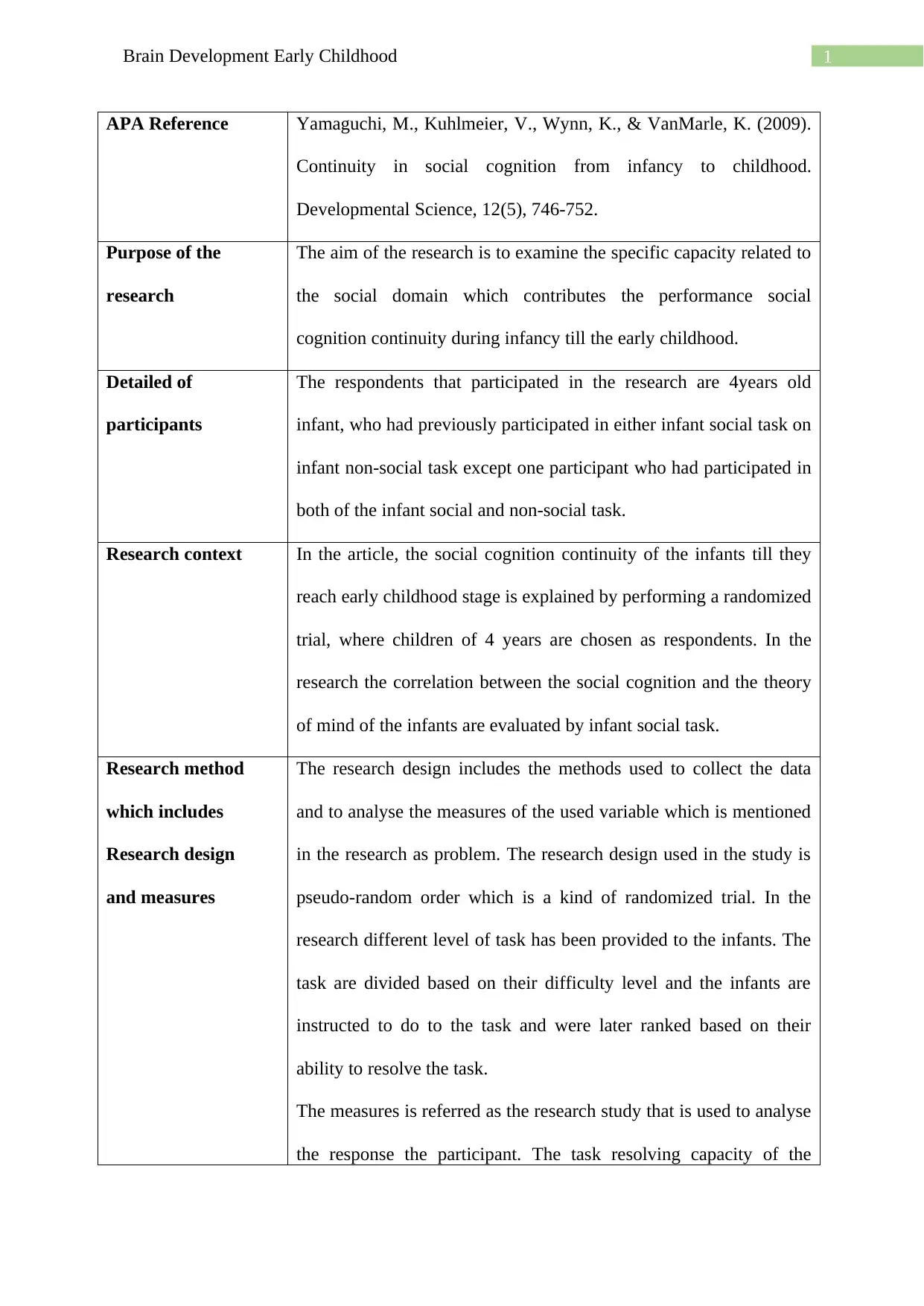
APA Reference Yamaguchi, M., Kuhlmeier, V., Wynn, K., & VanMarle, K. (2009).
Continuity in social cognition from infancy to childhood.
Developmental Science, 12(5), 746-752.
Purpose of the
research
The aim of the research is to examine the specific capacity related to
the social domain which contributes the performance social
cognition continuity during infancy till the early childhood.
Detailed of
participants
The respondents that participated in the research are 4years old
infant, who had previously participated in either infant social task on
infant non-social task except one participant who had participated in
both of the infant social and non-social task.
Research context In the article, the social cognition continuity of the infants till they
reach early childhood stage is explained by performing a randomized
trial, where children of 4 years are chosen as respondents. In the
research the correlation between the social cognition and the theory
of mind of the infants are evaluated by infant social task.
Research method
which includes
Research design
and measures
The research design includes the methods used to collect the data
and to analyse the measures of the used variable which is mentioned
in the research as problem. The research design used in the study is
pseudo-random order which is a kind of randomized trial. In the
research different level of task has been provided to the infants. The
task are divided based on their difficulty level and the infants are
instructed to do to the task and were later ranked based on their
ability to resolve the task.
The measures is referred as the research study that is used to analyse
the response the participant. The task resolving capacity of the
Document Page
2Brain Development Early Childhood
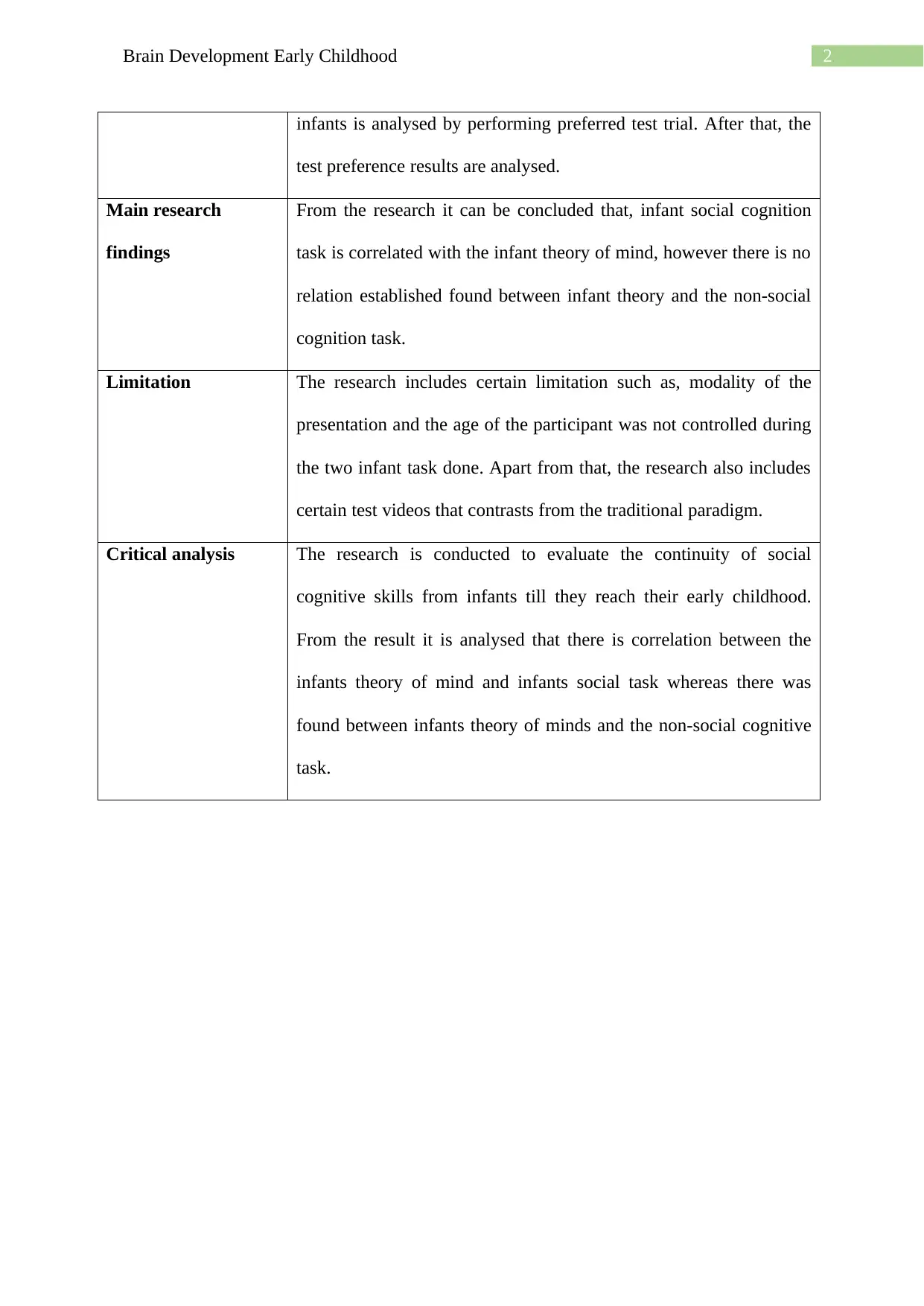
infants is analysed by performing preferred test trial. After that, the
test preference results are analysed.
Main research
findings
From the research it can be concluded that, infant social cognition
task is correlated with the infant theory of mind, however there is no
relation established found between infant theory and the non-social
cognition task.
Limitation The research includes certain limitation such as, modality of the
presentation and the age of the participant was not controlled during
the two infant task done. Apart from that, the research also includes
certain test videos that contrasts from the traditional paradigm.
Critical analysis The research is conducted to evaluate the continuity of social
cognitive skills from infants till they reach their early childhood.
From the result it is analysed that there is correlation between the
infants theory of mind and infants social task whereas there was
found between infants theory of minds and the non-social cognitive
task.
Document Page
3Brain Development Early Childhood
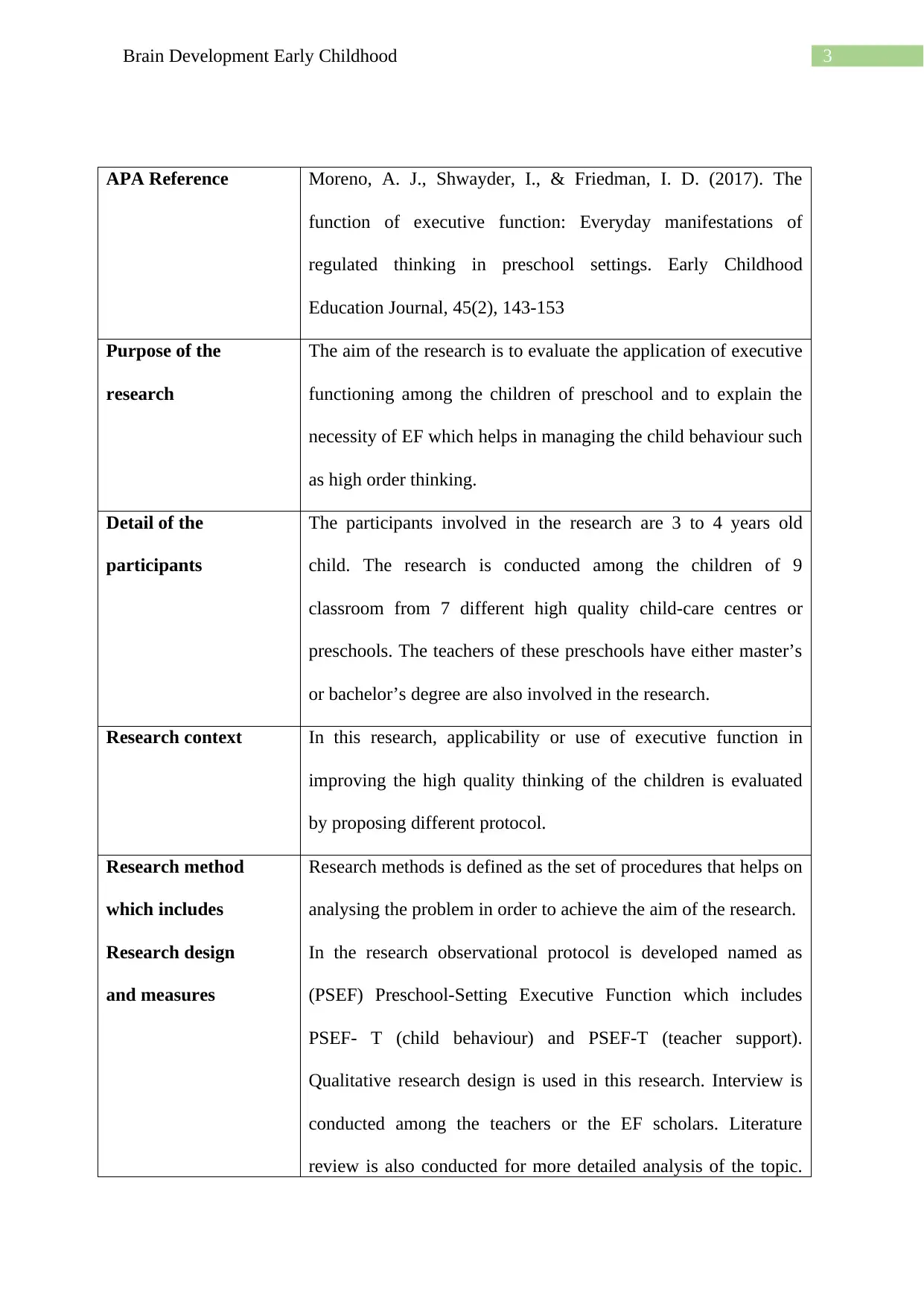
APA Reference Moreno, A. J., Shwayder, I., & Friedman, I. D. (2017). The
function of executive function: Everyday manifestations of
regulated thinking in preschool settings. Early Childhood
Education Journal, 45(2), 143-153
Purpose of the
research
The aim of the research is to evaluate the application of executive
functioning among the children of preschool and to explain the
necessity of EF which helps in managing the child behaviour such
as high order thinking.
Detail of the
participants
The participants involved in the research are 3 to 4 years old
child. The research is conducted among the children of 9
classroom from 7 different high quality child-care centres or
preschools. The teachers of these preschools have either master’s
or bachelor’s degree are also involved in the research.
Research context In this research, applicability or use of executive function in
improving the high quality thinking of the children is evaluated
by proposing different protocol.
Research method
which includes
Research design
and measures
Research methods is defined as the set of procedures that helps on
analysing the problem in order to achieve the aim of the research.
In the research observational protocol is developed named as
(PSEF) Preschool-Setting Executive Function which includes
PSEF- T (child behaviour) and PSEF-T (teacher support).
Qualitative research design is used in this research. Interview is
conducted among the teachers or the EF scholars. Literature
review is also conducted for more detailed analysis of the topic.
tabler-icon-diamond-filled.svg

Paraphrase This Document

Need a fresh take? Get an instant paraphrase of this document with our AI Paraphraser
Document Page
4Brain Development Early Childhood
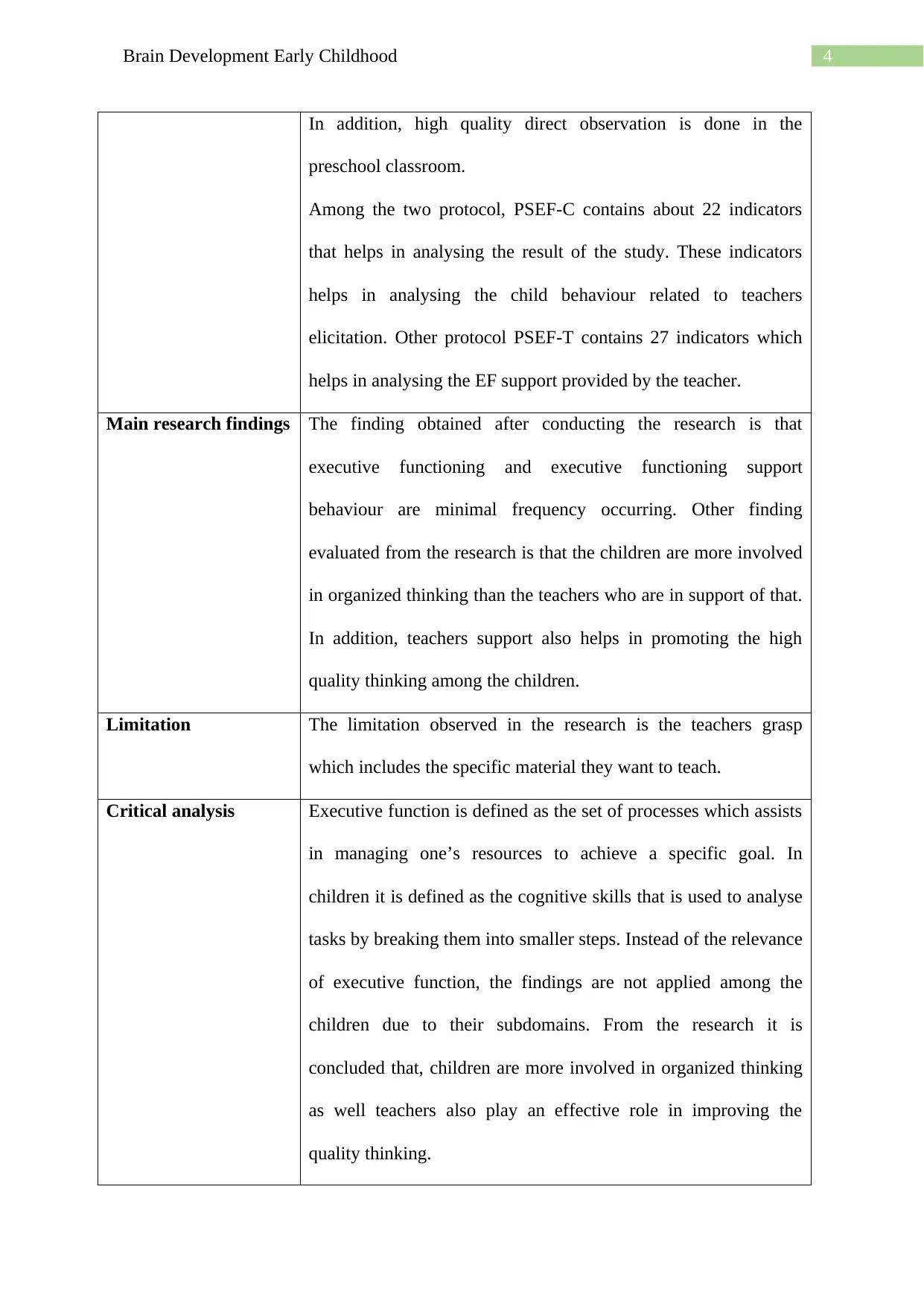
In addition, high quality direct observation is done in the
preschool classroom.
Among the two protocol, PSEF-C contains about 22 indicators
that helps in analysing the result of the study. These indicators
helps in analysing the child behaviour related to teachers
elicitation. Other protocol PSEF-T contains 27 indicators which
helps in analysing the EF support provided by the teacher.
Main research findings The finding obtained after conducting the research is that
executive functioning and executive functioning support
behaviour are minimal frequency occurring. Other finding
evaluated from the research is that the children are more involved
in organized thinking than the teachers who are in support of that.
In addition, teachers support also helps in promoting the high
quality thinking among the children.
Limitation The limitation observed in the research is the teachers grasp
which includes the specific material they want to teach.
Critical analysis Executive function is defined as the set of processes which assists
in managing one’s resources to achieve a specific goal. In
children it is defined as the cognitive skills that is used to analyse
tasks by breaking them into smaller steps. Instead of the relevance
of executive function, the findings are not applied among the
children due to their subdomains. From the research it is
concluded that, children are more involved in organized thinking
as well teachers also play an effective role in improving the
quality thinking.
Document Page
5Brain Development Early Childhood
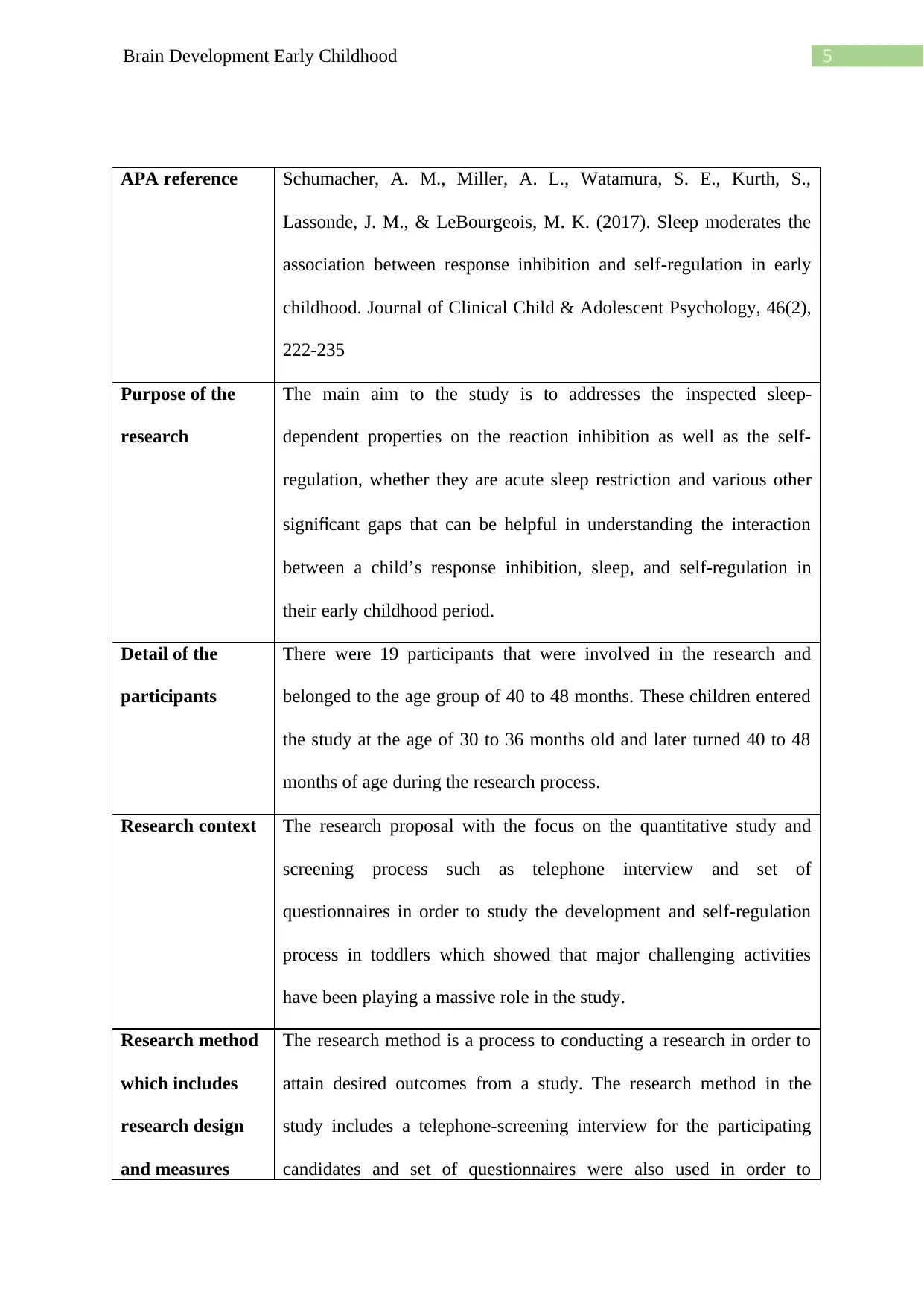
APA reference Schumacher, A. M., Miller, A. L., Watamura, S. E., Kurth, S.,
Lassonde, J. M., & LeBourgeois, M. K. (2017). Sleep moderates the
association between response inhibition and self-regulation in early
childhood. Journal of Clinical Child & Adolescent Psychology, 46(2),
222-235
Purpose of the
research
The main aim to the study is to addresses the inspected sleep-
dependent properties on the reaction inhibition as well as the self-
regulation, whether they are acute sleep restriction and various other
significant gaps that can be helpful in understanding the interaction
between a child’s response inhibition, sleep, and self-regulation in
their early childhood period.
Detail of the
participants
There were 19 participants that were involved in the research and
belonged to the age group of 40 to 48 months. These children entered
the study at the age of 30 to 36 months old and later turned 40 to 48
months of age during the research process.
Research context The research proposal with the focus on the quantitative study and
screening process such as telephone interview and set of
questionnaires in order to study the development and self-regulation
process in toddlers which showed that major challenging activities
have been playing a massive role in the study.
Research method
which includes
research design
and measures
The research method is a process to conducting a research in order to
attain desired outcomes from a study. The research method in the
study includes a telephone-screening interview for the participating
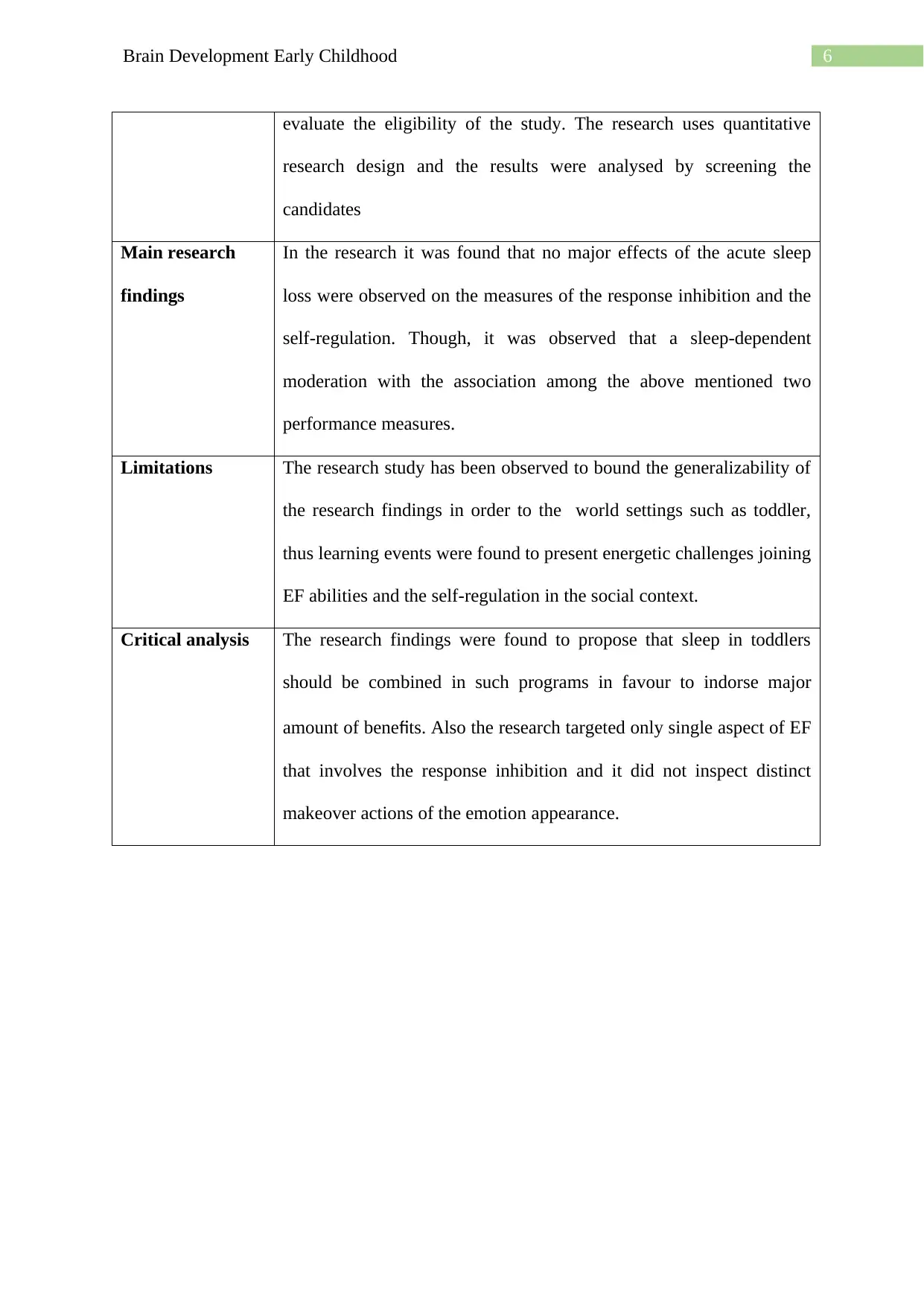
candidates and set of questionnaires were also used in order to
Document Page
6Brain Development Early Childhood
evaluate the eligibility of the study. The research uses quantitative
research design and the results were analysed by screening the
candidates
Main research
findings
In the research it was found that no major effects of the acute sleep
loss were observed on the measures of the response inhibition and the
self-regulation. Though, it was observed that a sleep-dependent
moderation with the association among the above mentioned two
performance measures.
Limitations The research study has been observed to bound the generalizability of
the research findings in order to the world settings such as toddler,
thus learning events were found to present energetic challenges joining
EF abilities and the self-regulation in the social context.
Critical analysis The research findings were found to propose that sleep in toddlers
should be combined in such programs in favour to indorse major
amount of benefits. Also the research targeted only single aspect of EF
that involves the response inhibition and it did not inspect distinct
makeover actions of the emotion appearance.
tabler-icon-diamond-filled.svg

Paraphrase This Document

Need a fresh take? Get an instant paraphrase of this document with our AI Paraphraser
Document Page
7Brain Development Early Childhood
References
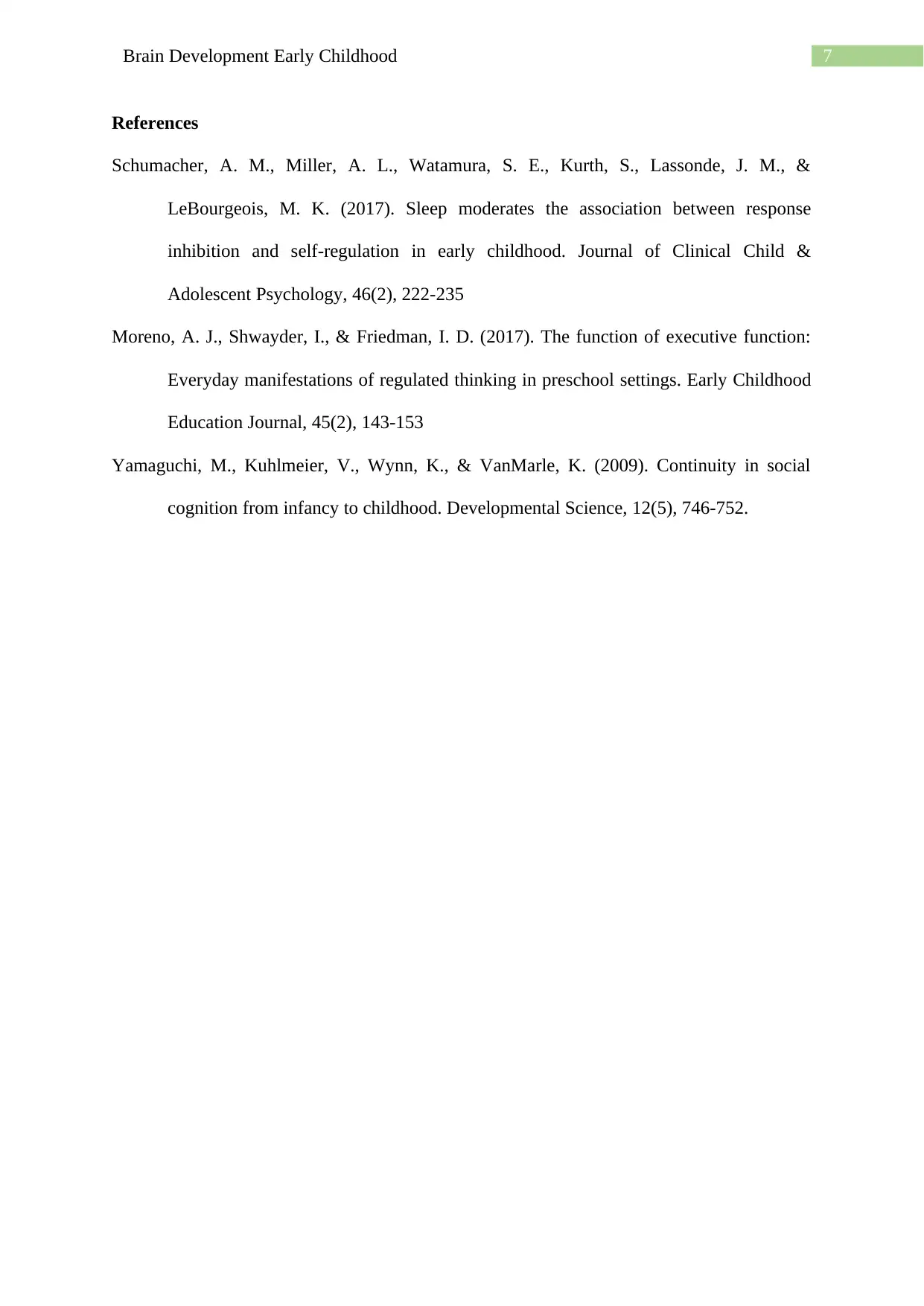
Schumacher, A. M., Miller, A. L., Watamura, S. E., Kurth, S., Lassonde, J. M., &
LeBourgeois, M. K. (2017). Sleep moderates the association between response
inhibition and self-regulation in early childhood. Journal of Clinical Child &
Adolescent Psychology, 46(2), 222-235
Moreno, A. J., Shwayder, I., & Friedman, I. D. (2017). The function of executive function:
Everyday manifestations of regulated thinking in preschool settings. Early Childhood
Education Journal, 45(2), 143-153
Yamaguchi, M., Kuhlmeier, V., Wynn, K., & VanMarle, K. (2009). Continuity in social
cognition from infancy to childhood. Developmental Science, 12(5), 746-752.
chevron_up_icon
1 out of 8
circle_padding
hide_on_mobile
zoom_out_icon
[object Object]