Personalised Care: Components, Models and Inter-Professional Skills
VerifiedAdded on 2022/04/29
|20
|4987
|27
Report
AI Summary
This report provides a detailed overview of personalised care within the context of the NHS Long Term Plan. It explores the six key components of the comprehensive model, including patient choice, shared decision-making, supported self-management, social prescribing, personalised care and support planning, and personal health budgets. The report further examines the personal model for care operating, emphasizing the nurse-patient relationship and the importance of interpersonal skills such as active listening, concise verbal communication, awareness, and patience. Additionally, it highlights the role of inter-professional skills in healthcare, discussing the benefits and barriers of teamwork, along with the principles of beneficence and non-malfeasance. The report also covers the role of the VCSE HW Alliance, effective communication strategies, and the application of co-productive models in healthcare, offering a comprehensive analysis of personalised care approaches.
Running Head: Personalised Care
[Name]
[Institute]
[Date]
[Name]
[Institute]
[Date]

Paraphrase This Document
Need a fresh take? Get an instant paraphrase of this document with our AI Paraphraser
Personalised Care 2
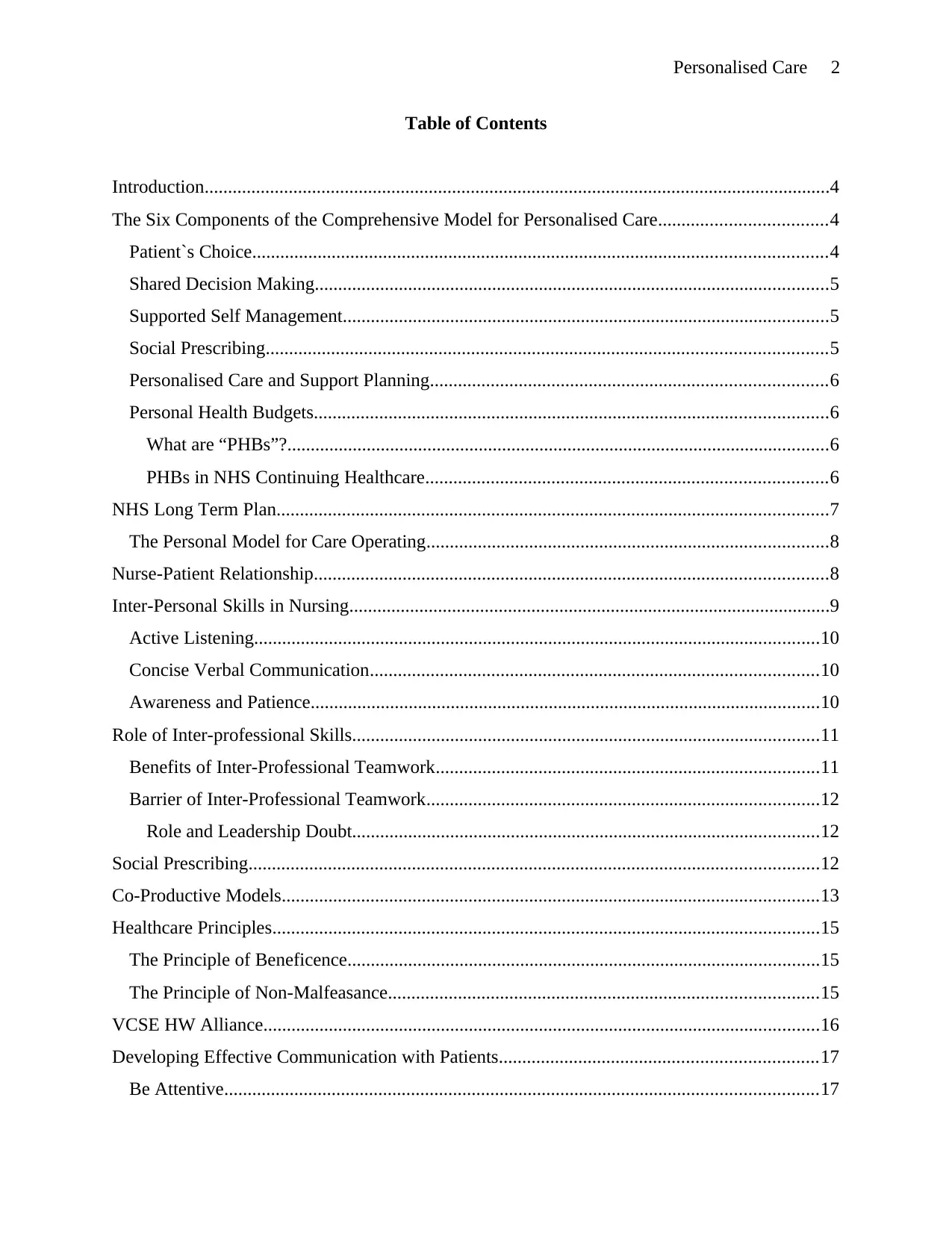
Table of Contents
Introduction......................................................................................................................................4
The Six Components of the Comprehensive Model for Personalised Care....................................4
Patient`s Choice...........................................................................................................................4
Shared Decision Making..............................................................................................................5
Supported Self Management........................................................................................................5
Social Prescribing........................................................................................................................5
Personalised Care and Support Planning.....................................................................................6
Personal Health Budgets..............................................................................................................6
What are “PHBs”?....................................................................................................................6
PHBs in NHS Continuing Healthcare......................................................................................6
NHS Long Term Plan......................................................................................................................7
The Personal Model for Care Operating......................................................................................8
Nurse-Patient Relationship..............................................................................................................8
Inter-Personal Skills in Nursing.......................................................................................................9
Active Listening.........................................................................................................................10
Concise Verbal Communication................................................................................................10
Awareness and Patience.............................................................................................................10
Role of Inter-professional Skills....................................................................................................11
Benefits of Inter-Professional Teamwork..................................................................................11
Barrier of Inter-Professional Teamwork....................................................................................12
Role and Leadership Doubt....................................................................................................12
Social Prescribing..........................................................................................................................12
Co-Productive Models...................................................................................................................13
Healthcare Principles.....................................................................................................................15
The Principle of Beneficence.....................................................................................................15
The Principle of Non-Malfeasance............................................................................................15
VCSE HW Alliance.......................................................................................................................16
Developing Effective Communication with Patients....................................................................17
Be Attentive...............................................................................................................................17
Table of Contents
Introduction......................................................................................................................................4
The Six Components of the Comprehensive Model for Personalised Care....................................4
Patient`s Choice...........................................................................................................................4
Shared Decision Making..............................................................................................................5
Supported Self Management........................................................................................................5
Social Prescribing........................................................................................................................5
Personalised Care and Support Planning.....................................................................................6
Personal Health Budgets..............................................................................................................6
What are “PHBs”?....................................................................................................................6
PHBs in NHS Continuing Healthcare......................................................................................6
NHS Long Term Plan......................................................................................................................7
The Personal Model for Care Operating......................................................................................8
Nurse-Patient Relationship..............................................................................................................8
Inter-Personal Skills in Nursing.......................................................................................................9
Active Listening.........................................................................................................................10
Concise Verbal Communication................................................................................................10
Awareness and Patience.............................................................................................................10
Role of Inter-professional Skills....................................................................................................11
Benefits of Inter-Professional Teamwork..................................................................................11
Barrier of Inter-Professional Teamwork....................................................................................12
Role and Leadership Doubt....................................................................................................12
Social Prescribing..........................................................................................................................12
Co-Productive Models...................................................................................................................13
Healthcare Principles.....................................................................................................................15
The Principle of Beneficence.....................................................................................................15
The Principle of Non-Malfeasance............................................................................................15
VCSE HW Alliance.......................................................................................................................16
Developing Effective Communication with Patients....................................................................17
Be Attentive...............................................................................................................................17
Personalised Care 3
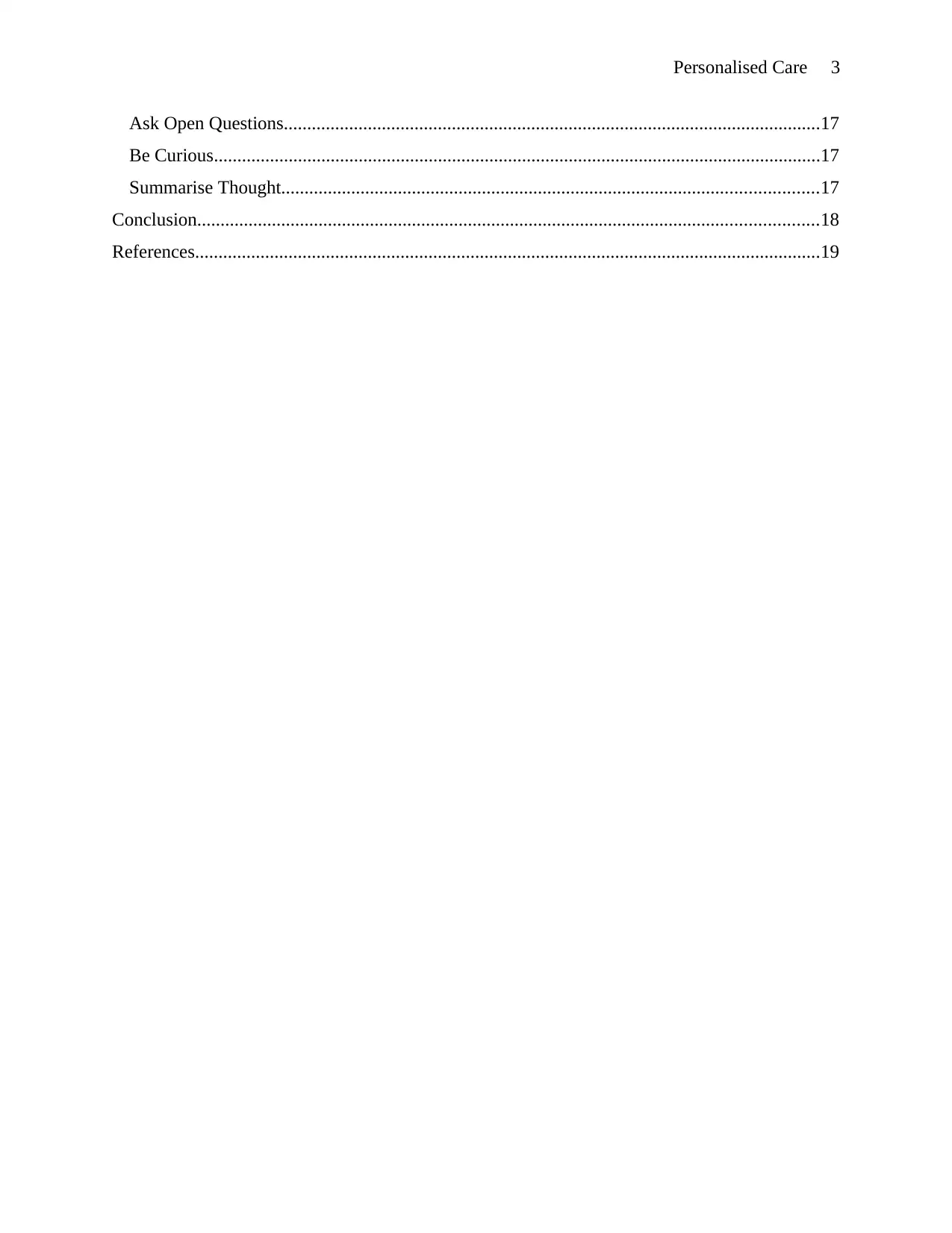
Ask Open Questions...................................................................................................................17
Be Curious..................................................................................................................................17
Summarise Thought...................................................................................................................17
Conclusion.....................................................................................................................................18
References......................................................................................................................................19
Ask Open Questions...................................................................................................................17
Be Curious..................................................................................................................................17
Summarise Thought...................................................................................................................17
Conclusion.....................................................................................................................................18
References......................................................................................................................................19
⊘ This is a preview!⊘
Do you want full access?
Subscribe today to unlock all pages.

Trusted by 1+ million students worldwide
Personalised Care 4
Introduction
Care and health professionals have come together to initiate a “Long Term Plan” to
progress NHS in future, and to get the most value for individuals out of every pound of the
investment of taxpayers. The plan has been basically drawn by those who have known NHS best,
involving the frontline staff of care and health, groups of patients and experts. And they have
given advantages from hearing a broad variety of views, whether via the 250 events that have
occurred, and or the 2,400 submissions that were received from groups and individuals
representing the interests and opinions of 3.45 million people. This particular plan also involves
gauges to:
Enhance care out of care, primary community and medical services of health
Endorse aged people via more personalized care and tough primary and community
services of care
Make services digital a normal NHS part, so that in 6 years, individuals in UK will be
capable to access digitalized GP offer (Thomas, 2019).
The Six Components of the Comprehensive Model for Personalised Care
Patient`s Choice
“NHS England and Monitor” have issued the outcomes of an yearly internet survey about
the experience of patients of the lawful rights around the outpatient appointment`s choice. Te
survey of the current year, executed by Populus, took interview of around 7000 people in UK out
of which 2700 had been told to execute outpatient appointment through their GP within the
preceding year. It demonstrates that around 38% of the patients say that they were provided a
Introduction
Care and health professionals have come together to initiate a “Long Term Plan” to
progress NHS in future, and to get the most value for individuals out of every pound of the
investment of taxpayers. The plan has been basically drawn by those who have known NHS best,
involving the frontline staff of care and health, groups of patients and experts. And they have
given advantages from hearing a broad variety of views, whether via the 250 events that have
occurred, and or the 2,400 submissions that were received from groups and individuals
representing the interests and opinions of 3.45 million people. This particular plan also involves
gauges to:
Enhance care out of care, primary community and medical services of health
Endorse aged people via more personalized care and tough primary and community
services of care
Make services digital a normal NHS part, so that in 6 years, individuals in UK will be
capable to access digitalized GP offer (Thomas, 2019).
The Six Components of the Comprehensive Model for Personalised Care
Patient`s Choice
“NHS England and Monitor” have issued the outcomes of an yearly internet survey about
the experience of patients of the lawful rights around the outpatient appointment`s choice. Te
survey of the current year, executed by Populus, took interview of around 7000 people in UK out
of which 2700 had been told to execute outpatient appointment through their GP within the
preceding year. It demonstrates that around 38% of the patients say that they were provided a
Paraphrase This Document
Need a fresh take? Get an instant paraphrase of this document with our AI Paraphraser
Personalised Care 5
choice of clinic or hospital for their initial outpatient appointment, a progress of 2 percent from
an earlier year.
Shared Decision Making
“Shared Decision Making” (SDM) makes sure that patients are endorsed to make choices
that are appropriate for them. it is a combined procedure via which a professional endorses a
patient to reach to a result related to their treatment.
Supported Self Management
“Supported Self Management” (SSM) is a part of the long term plan of NHS`s devotion
to make the business of personalized care as usual crossways the care and health system. it
actively recognizes the confidence, skills and knowledge people have to handle their own care
and health, exploiting tools for example “Patient Activation Measure” (PAM). Professionals of
care and health modifies the approaches to working with individuals, relied on the individual
preferences, needs and assets of people, and also taking account of any particular barriers of
accessibility and inequalities, and so operating in personalized manner relied on “what matters”
to a patient (Alderwick and Dixon, 2019). Furthermore, it means making sure approaches for
example education of self management, peer support and health coaching are methodically put in
place to assist construct confidence, skills and knowledge.
Social Prescribing
Social prescribing is a means for national agencies to refer patients to a link worker. Link
workers offer patients’ time, concentrating on what actually matters to them and taking a holistic
choice of clinic or hospital for their initial outpatient appointment, a progress of 2 percent from
an earlier year.
Shared Decision Making
“Shared Decision Making” (SDM) makes sure that patients are endorsed to make choices
that are appropriate for them. it is a combined procedure via which a professional endorses a
patient to reach to a result related to their treatment.
Supported Self Management
“Supported Self Management” (SSM) is a part of the long term plan of NHS`s devotion
to make the business of personalized care as usual crossways the care and health system. it
actively recognizes the confidence, skills and knowledge people have to handle their own care
and health, exploiting tools for example “Patient Activation Measure” (PAM). Professionals of
care and health modifies the approaches to working with individuals, relied on the individual
preferences, needs and assets of people, and also taking account of any particular barriers of
accessibility and inequalities, and so operating in personalized manner relied on “what matters”
to a patient (Alderwick and Dixon, 2019). Furthermore, it means making sure approaches for
example education of self management, peer support and health coaching are methodically put in
place to assist construct confidence, skills and knowledge.
Social Prescribing
Social prescribing is a means for national agencies to refer patients to a link worker. Link
workers offer patients’ time, concentrating on what actually matters to them and taking a holistic
Personalised Care 6
doom to well being and health of people. They connect people to statutory services and
community groups for emotional and practical support. Furthermore, link workers endorse
presently groups of community to be sustainable and accessible, and assist people to work jointly
and initiate fresh group with every local associates.
Personalised Care and Support Planning
“Personalised Care and Support Planning” is a sequence of allowed conversions in which
an individual, or people who know individuals closely, will surely take part to explore the
wellbeing and health management within the context of situation of family and complete life.
This particular process acknowledges the strengths and skills of a person, and also their
experiences and the specific thing that matters greatly to an individual. It talks about the specific
things that are not functioning in the life of a person and recognizes results and does things to
resolve them (Alderwick and Dixon, 2019) This procedure us a key for patients getting services
of social and health care. It is a necessary tool to combine the experiences of a person of every
service they access so they will be having a combined plan that covers the needs of wellbeing
and health.
Personal Health Budgets
What are “PHBs”?
It is to find out related to the health budget of an individual which are an quantity of
money to endorse wellbeing and health needs of a person.
doom to well being and health of people. They connect people to statutory services and
community groups for emotional and practical support. Furthermore, link workers endorse
presently groups of community to be sustainable and accessible, and assist people to work jointly
and initiate fresh group with every local associates.
Personalised Care and Support Planning
“Personalised Care and Support Planning” is a sequence of allowed conversions in which
an individual, or people who know individuals closely, will surely take part to explore the
wellbeing and health management within the context of situation of family and complete life.
This particular process acknowledges the strengths and skills of a person, and also their
experiences and the specific thing that matters greatly to an individual. It talks about the specific
things that are not functioning in the life of a person and recognizes results and does things to
resolve them (Alderwick and Dixon, 2019) This procedure us a key for patients getting services
of social and health care. It is a necessary tool to combine the experiences of a person of every
service they access so they will be having a combined plan that covers the needs of wellbeing
and health.
Personal Health Budgets
What are “PHBs”?
It is to find out related to the health budget of an individual which are an quantity of
money to endorse wellbeing and health needs of a person.
⊘ This is a preview!⊘
Do you want full access?
Subscribe today to unlock all pages.
Trusted by 1+ million students worldwide
Personalised Care 7
PHBs in NHS Continuing Healthcare
This is about in what ways PHB is endorsing individuals in acceptance of the funding of
CHC and children care.
There are various kinds of PHBs such as for end of life care, budgets for wheelchair,
mental health, learning disabilities, etc.
NHS Long Term Plan
The bodies of NHS issued their strategy of long term plan for NHS in UK which was a
promise of Prime Minister of £20.2 billion more funds for NHS. This particular plan arrives at an
ominous for NHS. Many people are anticipating longer for their treatment. Targets of
performance are being missed every year round (Miles and Asbridge, 2019) And the system is
very short of too many staff, nurses and doctors. In relation to backdrop, the plan makes a
practical path for NHS over the coming decade, chased that set by the “Five Year Forward
View”.
This plan concentrates on what NHS can offer and in what ways. In terms of what, the
goal is to shift the care model of NHS further upstream: deep services` integration, more cautious
care in the community for individuals with chronic situations, enhanced urgent care`s
coordination to decrease demand on the department of emergency, and visits of outpatients
decreased by a third. Enhancements are pledged in services of priority, involving cancer,
maternity and mental health. The plan further relies on familiar ambitions to collaborate with
services outside hospitals. Universal practitioners are asked to operate with networks of primary
care, social workers and local nurses covering 25,000 to 45,000 patients. Networks are
anticipated to makes “social prescriptions” and offer improved support in homes of care. In
PHBs in NHS Continuing Healthcare
This is about in what ways PHB is endorsing individuals in acceptance of the funding of
CHC and children care.
There are various kinds of PHBs such as for end of life care, budgets for wheelchair,
mental health, learning disabilities, etc.
NHS Long Term Plan
The bodies of NHS issued their strategy of long term plan for NHS in UK which was a
promise of Prime Minister of £20.2 billion more funds for NHS. This particular plan arrives at an
ominous for NHS. Many people are anticipating longer for their treatment. Targets of
performance are being missed every year round (Miles and Asbridge, 2019) And the system is
very short of too many staff, nurses and doctors. In relation to backdrop, the plan makes a
practical path for NHS over the coming decade, chased that set by the “Five Year Forward
View”.
This plan concentrates on what NHS can offer and in what ways. In terms of what, the
goal is to shift the care model of NHS further upstream: deep services` integration, more cautious
care in the community for individuals with chronic situations, enhanced urgent care`s
coordination to decrease demand on the department of emergency, and visits of outpatients
decreased by a third. Enhancements are pledged in services of priority, involving cancer,
maternity and mental health. The plan further relies on familiar ambitions to collaborate with
services outside hospitals. Universal practitioners are asked to operate with networks of primary
care, social workers and local nurses covering 25,000 to 45,000 patients. Networks are
anticipated to makes “social prescriptions” and offer improved support in homes of care. In
Paraphrase This Document
Need a fresh take? Get an instant paraphrase of this document with our AI Paraphraser
Personalised Care 8
switch, the funding share for community and primary services is very much to progress (Miles
and Asbridge, 2019).
The Personal Model for Care Operating
This particular model displays how every of the constituents work collaboratively to
deliver a combined approach around the requirements of every individual. The model aims to
deliver:
Complete-population approaches to endorsing individuals of every age and their
significant carers to handle their mental and physical well-being and health, create
community flexibility and create informed choices and when their health shifts
A universal and a proactive offer of support to people with long term mental and physical
health situations to build confidence, skills and knowledge and to live well with their
conditions of health.
Integrated and intensive approaches to allowing people with more difficult requirements
to have greater control and choice over the care an individual gets.
Nurse-Patient Relationship
A relation of a patient and a nurse is one of the features that impact the autonomy of
patients. Examining the relationship types facilitate us fresh ways of acknowledging the decision
making ability of patients in care setting. The nurse discourses and nursing records` analysis
have displayed that our expert practice is not still completely patient-centered. A good
relationship of a patient and a nurse decreased the hospital stays and enhances the satisfaction
and care of both (Poghosyan et al., 2017). Though, comparatively, even though the participation
switch, the funding share for community and primary services is very much to progress (Miles
and Asbridge, 2019).
The Personal Model for Care Operating
This particular model displays how every of the constituents work collaboratively to
deliver a combined approach around the requirements of every individual. The model aims to
deliver:
Complete-population approaches to endorsing individuals of every age and their
significant carers to handle their mental and physical well-being and health, create
community flexibility and create informed choices and when their health shifts
A universal and a proactive offer of support to people with long term mental and physical
health situations to build confidence, skills and knowledge and to live well with their
conditions of health.
Integrated and intensive approaches to allowing people with more difficult requirements
to have greater control and choice over the care an individual gets.
Nurse-Patient Relationship
A relation of a patient and a nurse is one of the features that impact the autonomy of
patients. Examining the relationship types facilitate us fresh ways of acknowledging the decision
making ability of patients in care setting. The nurse discourses and nursing records` analysis
have displayed that our expert practice is not still completely patient-centered. A good
relationship of a patient and a nurse decreased the hospital stays and enhances the satisfaction
and care of both (Poghosyan et al., 2017). Though, comparatively, even though the participation
Personalised Care 9
of a patient in their decisions is immense, a finest relationship is conditioned by the submissive
role of a patient. A nurse must:
Introduce themselves to the patient and generally use her name while conversing with the
patient. A good handshake at the start of the meeting is frequently best way to rapidly
establish respect and trust.
Ensure that the patient has privacy when you offer care. Ensure that the needs of patients
are met, including easing pain or other different discomfort sources
Keenly listen to the patient. Ensure that a nurse acknowledge the concerns of a patient by
repeating what a patient has said. For instance, "Mrs. Smith, you mentioned that you
were concerned that your bone pain won't be addressed in a timely manner?" though, do
not use repeating often during a conversation as it can be recognised by a patient that a
nurse is not carefully listening. Try to act real, your genuine self when talking with a
patient
Maintain eye contact. Always remember, frequent eye contact can be frightening. Nod
your head and smile and few intervals during the conversation. Speak slowly and calmly
in such a way that a patients understands what you are saying. Your inflection of voice
must say “I care about you”.
Maintain skilled boundaries. Few patients require more healing touch, for example
hugging and hand-holding, then others and few patients desire no touching. Always
endorse differences in culture.
Inter-Personal Skills in Nursing
of a patient in their decisions is immense, a finest relationship is conditioned by the submissive
role of a patient. A nurse must:
Introduce themselves to the patient and generally use her name while conversing with the
patient. A good handshake at the start of the meeting is frequently best way to rapidly
establish respect and trust.
Ensure that the patient has privacy when you offer care. Ensure that the needs of patients
are met, including easing pain or other different discomfort sources
Keenly listen to the patient. Ensure that a nurse acknowledge the concerns of a patient by
repeating what a patient has said. For instance, "Mrs. Smith, you mentioned that you
were concerned that your bone pain won't be addressed in a timely manner?" though, do
not use repeating often during a conversation as it can be recognised by a patient that a
nurse is not carefully listening. Try to act real, your genuine self when talking with a
patient
Maintain eye contact. Always remember, frequent eye contact can be frightening. Nod
your head and smile and few intervals during the conversation. Speak slowly and calmly
in such a way that a patients understands what you are saying. Your inflection of voice
must say “I care about you”.
Maintain skilled boundaries. Few patients require more healing touch, for example
hugging and hand-holding, then others and few patients desire no touching. Always
endorse differences in culture.
Inter-Personal Skills in Nursing
⊘ This is a preview!⊘
Do you want full access?
Subscribe today to unlock all pages.
Trusted by 1+ million students worldwide
Personalised Care 10
A listed nurse cooperate everyday with a display of medical patients, staff, and other
people. These may involve the families of patients, patients, co-workers, care administrators and
doctors. Efficiently achieving everyday tasks needs nurses to have knowledge related to care,
and also such skills to execute that knowledge. Below are some inter personal skills of nursing to
assist nurses to endorse relationship with both co-workers and patients.
Active Listening
Possibly the most significant skill a nurse can own is the capability to listen carefully.
This is specifically important as numerous of patients do not have training in diagnosis of
symptoms and medical terminology. Consequently, nurses should listen thoroughly to decode the
symptomatic signs that an individual communicate, and orally paraphrase those findings to make
sure the precision. Also, nurse require to display active listening when talking with their co-
workers, as this can assist them effectively to finish their tasks
Concise Verbal Communication
Nurses suppose the liability of conveying appropriate information among patient`s
families, patients and physicians to make sure efficient decisions of treatment. Evident
interpersonal communicating is significant in both written and verbal terms. During urgent
situation, appropriate information can make the dissimilarities between death and life. Brief
verbal talks are also necessary among the co-workers. If nurses spread inappropriate information
to each other, an individual might suffer (Li et al., 2018).
A listed nurse cooperate everyday with a display of medical patients, staff, and other
people. These may involve the families of patients, patients, co-workers, care administrators and
doctors. Efficiently achieving everyday tasks needs nurses to have knowledge related to care,
and also such skills to execute that knowledge. Below are some inter personal skills of nursing to
assist nurses to endorse relationship with both co-workers and patients.
Active Listening
Possibly the most significant skill a nurse can own is the capability to listen carefully.
This is specifically important as numerous of patients do not have training in diagnosis of
symptoms and medical terminology. Consequently, nurses should listen thoroughly to decode the
symptomatic signs that an individual communicate, and orally paraphrase those findings to make
sure the precision. Also, nurse require to display active listening when talking with their co-
workers, as this can assist them effectively to finish their tasks
Concise Verbal Communication
Nurses suppose the liability of conveying appropriate information among patient`s
families, patients and physicians to make sure efficient decisions of treatment. Evident
interpersonal communicating is significant in both written and verbal terms. During urgent
situation, appropriate information can make the dissimilarities between death and life. Brief
verbal talks are also necessary among the co-workers. If nurses spread inappropriate information
to each other, an individual might suffer (Li et al., 2018).
Paraphrase This Document
Need a fresh take? Get an instant paraphrase of this document with our AI Paraphraser
Personalised Care 11
Awareness and Patience
Patience plays a very significant part in numerous features of care. Efficient carers offer
information in such a way that eases the members of a family without internalising agitated or
anxious reactions. With a professional and calm demeanor, nurses can surely reassure
demanding, impatient or upset stakeholders that they will get information as soon as it
progresses. This is particularly pertinent when an individual patient cases result in an un-
preferred outcome. Moreover, suitable absurdity can reduce a nervous environment and might
increase depressed spirits. The capability to exploit absurdity therapeutically is a thoroughly
crafted gift, and carers with these particular skills have often been capable to sustain cooperative,
trusted relations with the families as well as the patients.
Role of Inter-professional Skills
Inter-professional teamwork in healthcare is the means by which various professionals of
healthcare with diverse talents, skills and knowledge work together to attain a mutual aim.
Several interventions are accessible to enhance teamwork in care setting. These benefits explore
the role of care trails in enhancing inter-professional teamwork (Jack et al., 2017). A healthcare
pathway improves teamwork by endorsing decision making, communication, collaboration and
coordination to attain optimal outcomes of healthcare. They result in enhanced inter-professional
relations, documentations, communication and personnel knowledge. Pathways of care also
donate to centered care of a patient and enhance the satisfaction of a patient.
Benefits of Inter-Professional Teamwork
Awareness and Patience
Patience plays a very significant part in numerous features of care. Efficient carers offer
information in such a way that eases the members of a family without internalising agitated or
anxious reactions. With a professional and calm demeanor, nurses can surely reassure
demanding, impatient or upset stakeholders that they will get information as soon as it
progresses. This is particularly pertinent when an individual patient cases result in an un-
preferred outcome. Moreover, suitable absurdity can reduce a nervous environment and might
increase depressed spirits. The capability to exploit absurdity therapeutically is a thoroughly
crafted gift, and carers with these particular skills have often been capable to sustain cooperative,
trusted relations with the families as well as the patients.
Role of Inter-professional Skills
Inter-professional teamwork in healthcare is the means by which various professionals of
healthcare with diverse talents, skills and knowledge work together to attain a mutual aim.
Several interventions are accessible to enhance teamwork in care setting. These benefits explore
the role of care trails in enhancing inter-professional teamwork (Jack et al., 2017). A healthcare
pathway improves teamwork by endorsing decision making, communication, collaboration and
coordination to attain optimal outcomes of healthcare. They result in enhanced inter-professional
relations, documentations, communication and personnel knowledge. Pathways of care also
donate to centered care of a patient and enhance the satisfaction of a patient.
Benefits of Inter-Professional Teamwork
Personalised Care 12
In a care setting, gaps in communication can have bad outcomes, from missed diagnosis
to symptoms to errors in medication. Factually, medical errors cause 240,000 deaths every year.
As per to “John Hopkins”, this is the 3rd main death cause in UK. It is simple to see how these
particular accidents can take place, with couple of doctors prescribing couple of medications, and
many nurses delivering those such medications. Notes of HER can assist, but clinical
communication is very important. That means having a team conversation, looping in a
pharmacist for few inter-professional collaboration, and making sure that nurse have every of the
information they require to treat individuals with care. Numerous studies have displayed that in
healthcare; inter-professional collaboration can assist to decrease preventable adverse reactions
of drugs, reduces rates of mortality and optimise diagnosis of medication.
Barrier of Inter-Professional Teamwork
Role and Leadership Doubt
Effective teamwork is only successful when a leader is fair and treats every of the
employees equally. When a leader is biased for example if a leader prefers other employees more
than the employees might get frightened and this might impact a patient who has came for a
treatment. Furious employees might not give medicines to the patient on time due to angriness or
is not treating the patient respectfully or with care due to which patient have to suffer.
Social Prescribing
Social prescribing which is at certain times also called as “community referral”,
necessarily seeks to talk about the requirements of 19% of the patients who confer with their GP
for what significantly a social problem. The practice acknowledges that health of a person is
In a care setting, gaps in communication can have bad outcomes, from missed diagnosis
to symptoms to errors in medication. Factually, medical errors cause 240,000 deaths every year.
As per to “John Hopkins”, this is the 3rd main death cause in UK. It is simple to see how these
particular accidents can take place, with couple of doctors prescribing couple of medications, and
many nurses delivering those such medications. Notes of HER can assist, but clinical
communication is very important. That means having a team conversation, looping in a
pharmacist for few inter-professional collaboration, and making sure that nurse have every of the
information they require to treat individuals with care. Numerous studies have displayed that in
healthcare; inter-professional collaboration can assist to decrease preventable adverse reactions
of drugs, reduces rates of mortality and optimise diagnosis of medication.
Barrier of Inter-Professional Teamwork
Role and Leadership Doubt
Effective teamwork is only successful when a leader is fair and treats every of the
employees equally. When a leader is biased for example if a leader prefers other employees more
than the employees might get frightened and this might impact a patient who has came for a
treatment. Furious employees might not give medicines to the patient on time due to angriness or
is not treating the patient respectfully or with care due to which patient have to suffer.
Social Prescribing
Social prescribing which is at certain times also called as “community referral”,
necessarily seeks to talk about the requirements of 19% of the patients who confer with their GP
for what significantly a social problem. The practice acknowledges that health of a person is
⊘ This is a preview!⊘
Do you want full access?
Subscribe today to unlock all pages.
Trusted by 1+ million students worldwide

1 out of 20


Related Documents


Your All-in-One AI-Powered Toolkit for Academic Success.
+13062052269
info@desklib.com
Available 24*7 on WhatsApp / Email
![[object Object]](/_next/static/media/star-bottom.7253800d.svg)
Unlock your academic potential
Copyright © 2020–2026 A2Z Services. All Rights Reserved. Developed and managed by ZUCOL.