Educational Research Assignment: Research Questions and Methodologies
VerifiedAdded on 2020/11/23
|7
|1510
|227
Homework Assignment
AI Summary
This homework assignment delves into the core concepts of educational research, beginning with the process of formulating suitable research questions. It emphasizes the importance of a well-defined research question as the foundation for any study, highlighting its role in guiding data collection and analysis. The assignment explores the different types of research questions, including comparative, descriptive, and observational-relational, and outlines the stages involved in their development. Furthermore, it differentiates between research methods and methodologies, clarifying that methods are specific tools and techniques used in research, while methodology represents the overarching approach and strategy for conducting the research. The assignment provides examples of various research methods such as interviews, surveys, and experiments, while also explaining the different methodological types like ethnography and phenomenology. The document concludes by reinforcing the interconnectedness of methods and methodologies in achieving research objectives and emphasizes their importance in the educational research field. References to relevant books and journals are included to support the information presented in this assignment.

EDUCATIONAL RESEARCH
Paraphrase This Document
Need a fresh take? Get an instant paraphrase of this document with our AI Paraphraser

TABLE OF CONTENTS
1. What are the processes for arriving at a suitable research question?...........................................1
Answer:........................................................................................................................................1
2. What is the difference between method and methodology?........................................................2
Answer:........................................................................................................................................2
REFERENCES................................................................................................................................5
1. What are the processes for arriving at a suitable research question?...........................................1
Answer:........................................................................................................................................1
2. What is the difference between method and methodology?........................................................2
Answer:........................................................................................................................................2
REFERENCES................................................................................................................................5

1. What are the processes for arriving at a suitable research question?
Answer:
Research question is defined as the initial step for answerable inquiry to a particular topic
or subject. It is the basic of a research project or study and aids in reviewing the collected data
via using the available literature through review processes and techniques (Hartas, 2015). The
prime reason of formulating a suitable research question is the inclusion of an organized
statement to understand the elements for completion of the research project. This statement shed
light on the aim of the study or determination of methodology with the help of elements. The
elements include investigation, analysis and reporting. Commonly, it is of three types and mainly
consists of comparative research questions, descriptive research questions and observational-
relational research questions.
In addition to the above, there are several processes or stages for formulation of research
question. The sequential order is to be implemented to explore the topic or the chosen area
through exploration. This exploration is inter connected with the existing scope of the chosen
area. For instance, if the topic of the research study is 'impact of globalization' then the selected
research question includes about the relevancy in understanding the overall impact by choosing a
specific sector and its related influences. Thus, formulation of question is significant in
understanding the prevalent reason that the entire study is based upon. There are several
parameters including about the recognition of dilemma, clarifying or collecting information to
choose for conducting the research study and later choosing a suitable query through proper
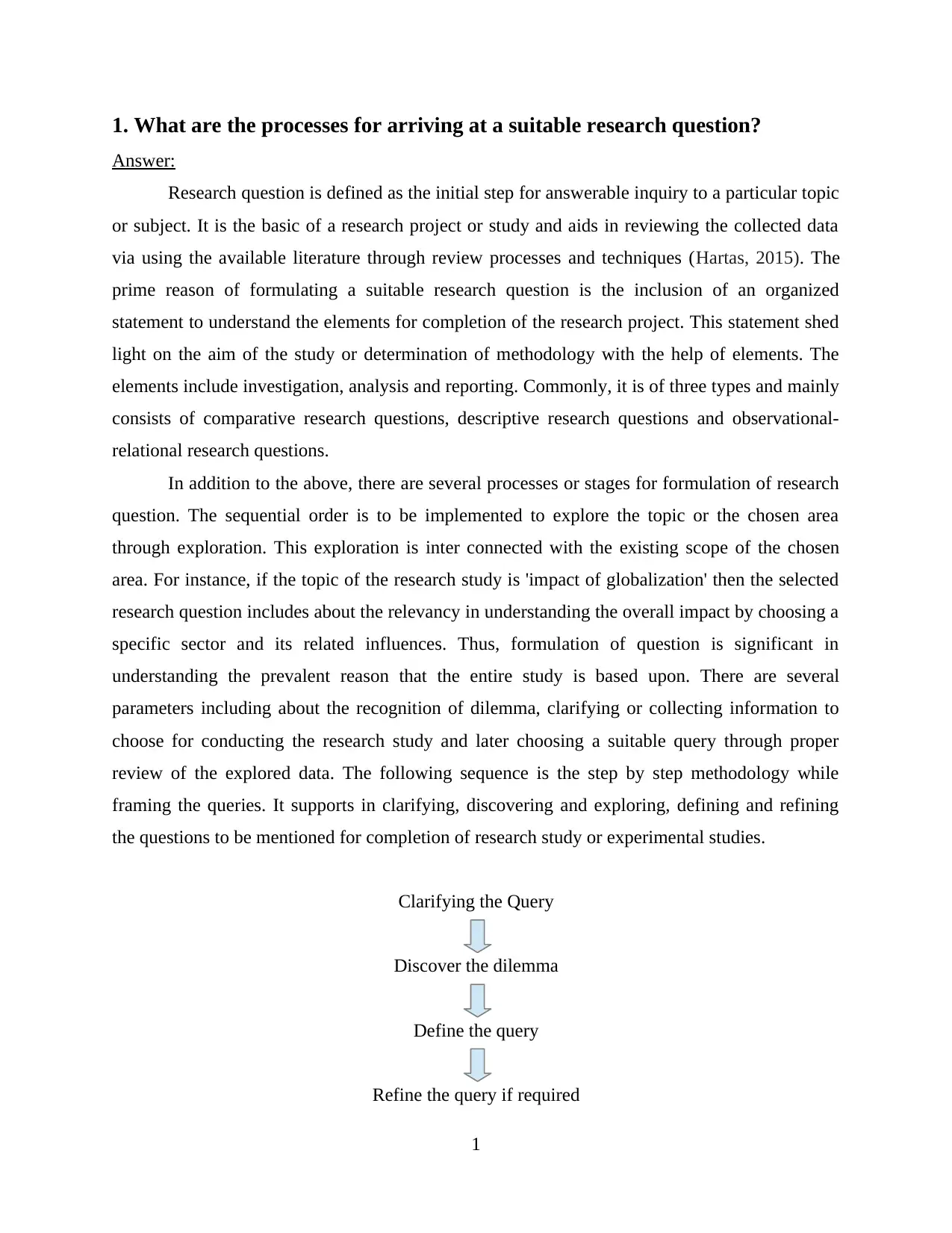
review of the explored data. The following sequence is the step by step methodology while
framing the queries. It supports in clarifying, discovering and exploring, defining and refining
the questions to be mentioned for completion of research study or experimental studies.
Clarifying the Query
Discover the dilemma
Define the query
Refine the query if required
1
Answer:
Research question is defined as the initial step for answerable inquiry to a particular topic
or subject. It is the basic of a research project or study and aids in reviewing the collected data
via using the available literature through review processes and techniques (Hartas, 2015). The
prime reason of formulating a suitable research question is the inclusion of an organized
statement to understand the elements for completion of the research project. This statement shed
light on the aim of the study or determination of methodology with the help of elements. The
elements include investigation, analysis and reporting. Commonly, it is of three types and mainly
consists of comparative research questions, descriptive research questions and observational-
relational research questions.
In addition to the above, there are several processes or stages for formulation of research
question. The sequential order is to be implemented to explore the topic or the chosen area
through exploration. This exploration is inter connected with the existing scope of the chosen
area. For instance, if the topic of the research study is 'impact of globalization' then the selected
research question includes about the relevancy in understanding the overall impact by choosing a
specific sector and its related influences. Thus, formulation of question is significant in
understanding the prevalent reason that the entire study is based upon. There are several
parameters including about the recognition of dilemma, clarifying or collecting information to
choose for conducting the research study and later choosing a suitable query through proper
review of the explored data. The following sequence is the step by step methodology while
framing the queries. It supports in clarifying, discovering and exploring, defining and refining
the questions to be mentioned for completion of research study or experimental studies.
Clarifying the Query
Discover the dilemma
Define the query
Refine the query if required
1
⊘ This is a preview!⊘
Do you want full access?
Subscribe today to unlock all pages.

Trusted by 1+ million students worldwide

Moreover, the types of questions also play crucial role in framing the questions for a
particular topic or study or experiment. If it is descriptive type of query, then it reflects upon the
prescriptive type of framing of a question to give better clarity while adopting the area or subject.
Furthermore, the steps involved in using the process of making questions includes the following
stages. Firstly, selection of the research topic or proposed aim and objectives (Patel, 2015). This
is mainly done through brainstorming process by the scholar. Next the brainstorming process is
categorically sub divided and focus on generation of ideal queries or questions that support in
fulfilling the objectives. The next step is to comprehend the rationale, background information,
ethical considerations to frame questions in accordance to fulfil the data collection. Here the
information collected is to know about the challenges and obstacles that led to narrowing down
the topic.
Furthermore, this framing of questions is integral and takes time to review literature and
complete the tasks to reach the outcomes. Moreover, it provides a broader perspective in
focusing the research objectives to be achieved and recognising the conceptual frameworks for
successful completion of saving time and resources. There is need to know that the discovery of
any new topic is done easily through adopting the route of framing questions. It also offers a
platform to conduct the project planning and data gathering with an overall analysis of
interpretations in managing the reporting (Wellington, 2015). However, type of sources, research
type, scope, formatting etc. are the guidelines that help in framing the questions to complete the
study under ethical framework. It would be beneficial in assigning the remaining parts of the
research study to make the successful completion of the project.
2. What is the difference between method and methodology?
Answer:
There is definitely several basic differences between methodology and method, however,
individuals like scholars, researchers etc. are able to differentiate and put the semantic outline
more clearly. The research is the basic element in the education field which is completely based
on utility of methods and methodologies as well. Thus, the differentiations are based on
parameters such as objective, meaning, purpose etc. Herein, a method is defined as the usage of
several tools, techniques and strategies that is helpful in completion of research study. This is
one of the mediums that is implemented in carrying out the experimental studies to perform the
survey or tests to attain the desired outcomes. It is of several types and has wide range of
2
particular topic or study or experiment. If it is descriptive type of query, then it reflects upon the
prescriptive type of framing of a question to give better clarity while adopting the area or subject.
Furthermore, the steps involved in using the process of making questions includes the following
stages. Firstly, selection of the research topic or proposed aim and objectives (Patel, 2015). This
is mainly done through brainstorming process by the scholar. Next the brainstorming process is
categorically sub divided and focus on generation of ideal queries or questions that support in
fulfilling the objectives. The next step is to comprehend the rationale, background information,
ethical considerations to frame questions in accordance to fulfil the data collection. Here the
information collected is to know about the challenges and obstacles that led to narrowing down
the topic.
Furthermore, this framing of questions is integral and takes time to review literature and
complete the tasks to reach the outcomes. Moreover, it provides a broader perspective in
focusing the research objectives to be achieved and recognising the conceptual frameworks for
successful completion of saving time and resources. There is need to know that the discovery of
any new topic is done easily through adopting the route of framing questions. It also offers a
platform to conduct the project planning and data gathering with an overall analysis of
interpretations in managing the reporting (Wellington, 2015). However, type of sources, research
type, scope, formatting etc. are the guidelines that help in framing the questions to complete the
study under ethical framework. It would be beneficial in assigning the remaining parts of the
research study to make the successful completion of the project.
2. What is the difference between method and methodology?
Answer:
There is definitely several basic differences between methodology and method, however,
individuals like scholars, researchers etc. are able to differentiate and put the semantic outline
more clearly. The research is the basic element in the education field which is completely based
on utility of methods and methodologies as well. Thus, the differentiations are based on
parameters such as objective, meaning, purpose etc. Herein, a method is defined as the usage of
several tools, techniques and strategies that is helpful in completion of research study. This is
one of the mediums that is implemented in carrying out the experimental studies to perform the
survey or tests to attain the desired outcomes. It is of several types and has wide range of
2
Paraphrase This Document
Need a fresh take? Get an instant paraphrase of this document with our AI Paraphraser

application by using interview, survey, card sort, usability study, experiments, mixed methods,
observation, focus groups and secondary data analysis. Primarily the main methods are further
based on research designs and are in relation to the scholar's researcher aim or purpose.
On the other hand, a methodology is refereed as the channel of using combination of
methods to reach the desired results and the entire procedure consists of several techniques,
strategies and tools. This is the science of understanding the research performance to reach
towards the outcomes and use of different methods. It has been incorporated that the entire
strategy must be towards attainment of aim or purpose. Nevertheless, the methodology has been
executed in a research study in order to ensure the application of all the available methods for
utilising the correct processes and procedures. In addition to this, method is a noun with ology as
one of the branches of science. Therefore, it is popularly identified as the knowledge branch that
reflect upon the logical reasoning and the value of the philosophical assumptions. However,
without presence of method, a methodology is incomplete and these two elements must go hand
in hand.
Moreover, methodological types are of different nature and consists of ethnography,
ethnomethodology, phenomenology etc. For instance, the participatory methodological approach
is adopted when the social atmosphere is considered and has been taken into developing the
participant’s viewpoints. It has also assisted in maintaining in qualitative and quantitative
methods while conducting the analysis to fulfil the expectations of the researcher in achieving
the objectives and observations. These types of methodologies are definitely in relation with the
type of method used in this to complete the entire research study (Powney & Watts, 2018).
However, methods help in underpinning the techniques that are used while exploring or
investigating whereas the methodology is based on using all the strategies through
implementation of systems to reach the objectives. Moreover, it also shed upon the method as a
tool or behaviour shown by the scholar and is beneficial in selecting the choice of methods
whereas the methodology is the science of analysing and evaluating about the ways of using
methods to conduct the study in authentic modes.
In addition to these differences, methodology is the complete approach to fulfil the
objectives. The methodology is mainly based on learning techniques to be used while conducting
the experiment or study. On the other side, method is the adoption of using techniques for
complete investigation so that the objectives might get addressed. This also concerns with the
3
observation, focus groups and secondary data analysis. Primarily the main methods are further
based on research designs and are in relation to the scholar's researcher aim or purpose.
On the other hand, a methodology is refereed as the channel of using combination of
methods to reach the desired results and the entire procedure consists of several techniques,
strategies and tools. This is the science of understanding the research performance to reach
towards the outcomes and use of different methods. It has been incorporated that the entire
strategy must be towards attainment of aim or purpose. Nevertheless, the methodology has been
executed in a research study in order to ensure the application of all the available methods for
utilising the correct processes and procedures. In addition to this, method is a noun with ology as
one of the branches of science. Therefore, it is popularly identified as the knowledge branch that
reflect upon the logical reasoning and the value of the philosophical assumptions. However,
without presence of method, a methodology is incomplete and these two elements must go hand
in hand.
Moreover, methodological types are of different nature and consists of ethnography,
ethnomethodology, phenomenology etc. For instance, the participatory methodological approach
is adopted when the social atmosphere is considered and has been taken into developing the
participant’s viewpoints. It has also assisted in maintaining in qualitative and quantitative
methods while conducting the analysis to fulfil the expectations of the researcher in achieving
the objectives and observations. These types of methodologies are definitely in relation with the
type of method used in this to complete the entire research study (Powney & Watts, 2018).
However, methods help in underpinning the techniques that are used while exploring or
investigating whereas the methodology is based on using all the strategies through
implementation of systems to reach the objectives. Moreover, it also shed upon the method as a
tool or behaviour shown by the scholar and is beneficial in selecting the choice of methods
whereas the methodology is the science of analysing and evaluating about the ways of using
methods to conduct the study in authentic modes.
In addition to these differences, methodology is the complete approach to fulfil the
objectives. The methodology is mainly based on learning techniques to be used while conducting
the experiment or study. On the other side, method is the adoption of using techniques for
complete investigation so that the objectives might get addressed. This also concerns with the
3

conducting of study or doing the experiment or testing to know about the methods to be used.
Nonetheless, the methodology helps in using the appropriate processes and techniques with the
focus on implying the research techniques to fulfil the desired outcomes. Whereas, on the other
side the method is the determining factor for getting solutions to the existing problems that are
mostly faced during conducting interviews or any other method to finish the research study in
proper manner.
4
Nonetheless, the methodology helps in using the appropriate processes and techniques with the
focus on implying the research techniques to fulfil the desired outcomes. Whereas, on the other
side the method is the determining factor for getting solutions to the existing problems that are
mostly faced during conducting interviews or any other method to finish the research study in
proper manner.
4
⊘ This is a preview!⊘
Do you want full access?
Subscribe today to unlock all pages.

Trusted by 1+ million students worldwide

REFERENCES
Book and Journals
Ellis, A. K. (2014). Research on educational innovations. Routledge.
Hartas, D. (Ed.). (2015). Educational research and inquiry: Qualitative and quantitative
approaches. Bloomsbury Publishing.
Patel, L. (2015). Decolonizing educational research: From ownership to answerability.
Routledge.
Powney, J., & Watts, M. (2018). Interviewing in educational research. Routledge.
Wellington, J. (2015). Educational research: Contemporary issues and practical approaches.
Bloomsbury Publishing.
5
Book and Journals
Ellis, A. K. (2014). Research on educational innovations. Routledge.
Hartas, D. (Ed.). (2015). Educational research and inquiry: Qualitative and quantitative
approaches. Bloomsbury Publishing.
Patel, L. (2015). Decolonizing educational research: From ownership to answerability.
Routledge.
Powney, J., & Watts, M. (2018). Interviewing in educational research. Routledge.
Wellington, J. (2015). Educational research: Contemporary issues and practical approaches.
Bloomsbury Publishing.
5
1 out of 7
Related Documents
Your All-in-One AI-Powered Toolkit for Academic Success.
+13062052269
info@desklib.com
Available 24*7 on WhatsApp / Email
Unlock your academic potential
Copyright © 2020–2025 A2Z Services. All Rights Reserved. Developed and managed by ZUCOL.