Importance of Financial Risk Management: Royal Bank of Scotland Study
VerifiedAdded on 2022/11/29
|31
|12199
|418
Report
AI Summary
This research report delves into the critical importance of financial risk management within the banking industry, with a specific focus on the Royal Bank of Scotland (RBS). The report provides an in-depth analysis of the financial risks faced by banks, exploring various strategies for risk reduction and mitigation. It examines the impact of financial risks on business stability, evaluating methods to reduce their influence and the significance of risk management for banks. The study utilizes a comprehensive literature review, examining themes such as the impact of financial risk on business stability, ways to reduce financial risk, the significance of risk management for banks, and strategies for reducing finance-related risks. The research employs a detailed methodology, including data collection and analysis, to address key research questions. The findings are presented and discussed, leading to conclusions and recommendations for effective risk management practices. The report offers valuable insights into the challenges and opportunities in financial risk management, emphasizing the need for robust frameworks to safeguard business operations and profitability. The study also examines the impact of various factors, such as market volatility and economic conditions, on the financial health and stability of banks.
Importance of Finance Risk
Management
Management

Paraphrase This Document
Need a fresh take? Get an instant paraphrase of this document with our AI Paraphraser

ABSTRACT
This research report is based on the topic of analyzing the importance of financial
risk within the banking industry pertaining to Royal Bank of Scotland. It involves in-depth
understanding of the financial risk which is being faced by the banks and along with this, it
provides information on the various ways through which the level of risk can be reduced or
mitigated. Based upon the findings, certain point of recommendations is being made which
are useful in exercising control over the varies business risks.
This research report is based on the topic of analyzing the importance of financial
risk within the banking industry pertaining to Royal Bank of Scotland. It involves in-depth
understanding of the financial risk which is being faced by the banks and along with this, it
provides information on the various ways through which the level of risk can be reduced or
mitigated. Based upon the findings, certain point of recommendations is being made which
are useful in exercising control over the varies business risks.
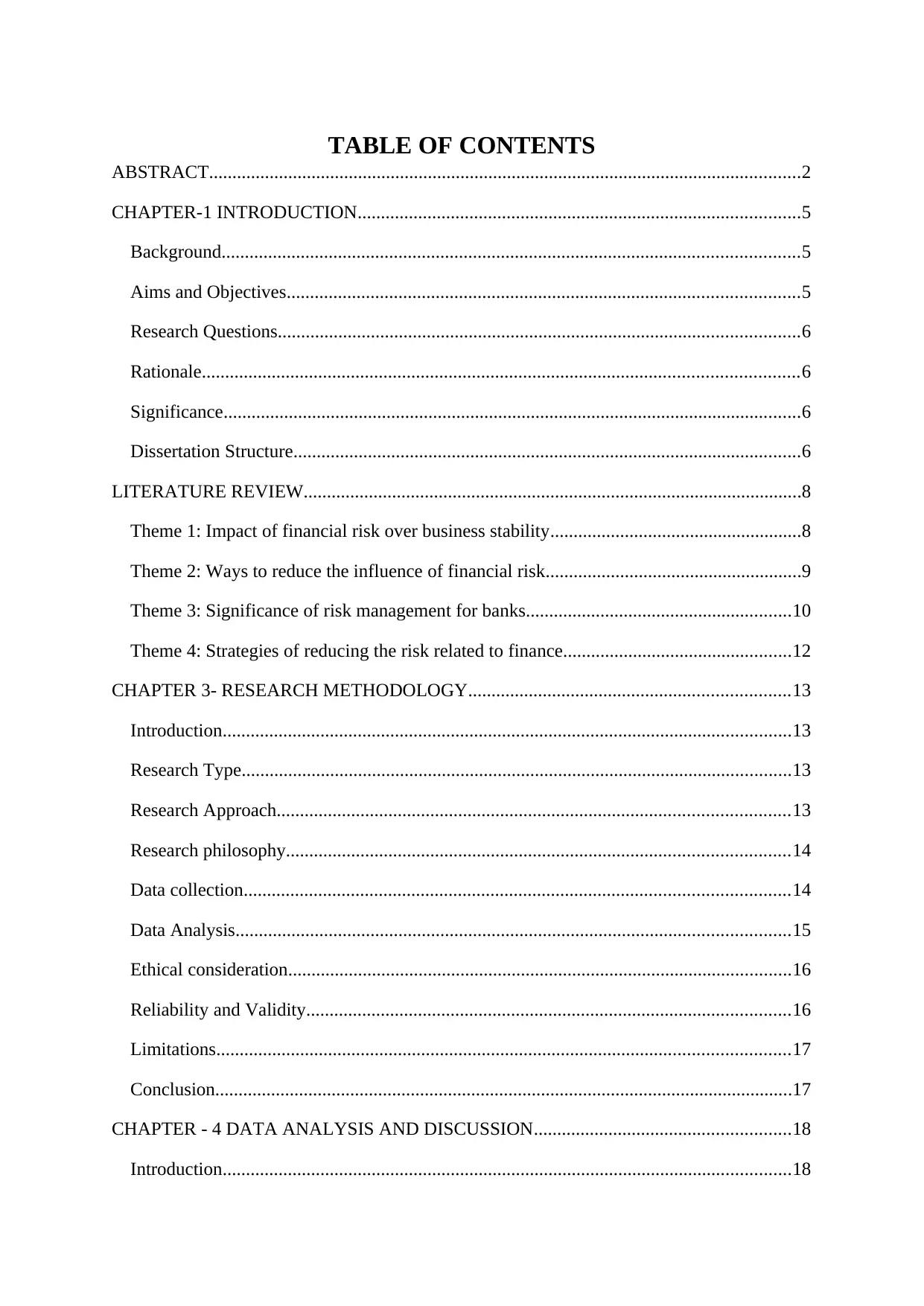
TABLE OF CONTENTS
ABSTRACT...............................................................................................................................2
CHAPTER-1 INTRODUCTION...............................................................................................5
Background............................................................................................................................5
Aims and Objectives..............................................................................................................5
Research Questions................................................................................................................6
Rationale................................................................................................................................6
Significance............................................................................................................................6
Dissertation Structure.............................................................................................................6
LITERATURE REVIEW...........................................................................................................8
Theme 1: Impact of financial risk over business stability......................................................8
Theme 2: Ways to reduce the influence of financial risk.......................................................9
Theme 3: Significance of risk management for banks.........................................................10
Theme 4: Strategies of reducing the risk related to finance.................................................12
CHAPTER 3- RESEARCH METHODOLOGY.....................................................................13
Introduction..........................................................................................................................13
Research Type......................................................................................................................13
Research Approach..............................................................................................................13
Research philosophy............................................................................................................14
Data collection.....................................................................................................................14
Data Analysis.......................................................................................................................15
Ethical consideration............................................................................................................16
Reliability and Validity........................................................................................................16
Limitations...........................................................................................................................17
Conclusion............................................................................................................................17
CHAPTER - 4 DATA ANALYSIS AND DISCUSSION.......................................................18
Introduction..........................................................................................................................18
ABSTRACT...............................................................................................................................2
CHAPTER-1 INTRODUCTION...............................................................................................5
Background............................................................................................................................5
Aims and Objectives..............................................................................................................5
Research Questions................................................................................................................6
Rationale................................................................................................................................6
Significance............................................................................................................................6
Dissertation Structure.............................................................................................................6
LITERATURE REVIEW...........................................................................................................8
Theme 1: Impact of financial risk over business stability......................................................8
Theme 2: Ways to reduce the influence of financial risk.......................................................9
Theme 3: Significance of risk management for banks.........................................................10
Theme 4: Strategies of reducing the risk related to finance.................................................12
CHAPTER 3- RESEARCH METHODOLOGY.....................................................................13
Introduction..........................................................................................................................13
Research Type......................................................................................................................13
Research Approach..............................................................................................................13
Research philosophy............................................................................................................14
Data collection.....................................................................................................................14
Data Analysis.......................................................................................................................15
Ethical consideration............................................................................................................16
Reliability and Validity........................................................................................................16
Limitations...........................................................................................................................17
Conclusion............................................................................................................................17
CHAPTER - 4 DATA ANALYSIS AND DISCUSSION.......................................................18
Introduction..........................................................................................................................18
⊘ This is a preview!⊘
Do you want full access?
Subscribe today to unlock all pages.

Trusted by 1+ million students worldwide

Discussion............................................................................................................................18
Conclusion............................................................................................................................23
CHAPTER 5: CONCLUSION AND RECOMMENDATIONS.............................................24
Conclusion............................................................................................................................24
Recommendations................................................................................................................24
REFERENCES.........................................................................................................................27
Conclusion............................................................................................................................23
CHAPTER 5: CONCLUSION AND RECOMMENDATIONS.............................................24
Conclusion............................................................................................................................24
Recommendations................................................................................................................24
REFERENCES.........................................................................................................................27
Paraphrase This Document
Need a fresh take? Get an instant paraphrase of this document with our AI Paraphraser
CHAPTER-1 INTRODUCTION
Background
Risk management is mainly involved in the areas which experiences the growth and
incorporates the different perspectives and views of aspects in respect to the way in which it
is conducted. The results of the global financial crisis have resulted into making the
regulators and the financial experts to effectively agree on the need of the comprehensive risk
management practices and frameworks in place (Muhammad, Khan and Xu, 2018). The
banks and the other financial institutions encounter with the risk during the time of carrying
out the business in the process of realising the return on the investment. It is important to
understand that the risks have the potential and the ability to eliminate the expected higher
returns and also might result into incurring heavy losses to the business. The banks usually
have the reserves in regard to the expected losses which are unpredictable in nature like the
falling interest rates. This is the area where there is a requirement of effective risk
management framework within banks which supports in their survival.
This research study is based upon the Royal Bank of Scotland, which is a huge retail
and commercial bank in Scotland and the study is focused on grabbing an in-depth
understanding and knowledge in regard to the importance and the relevance of finance risk
management and the how the organization is tackling with the risk it comes across. Along
with that, it helps in drawing better use of theoretical framework in respect to the financial
risk management which assists the businesses in eliminating the negative impact of the risks
over the business functioning and profitability. In the context to the banks and the financial
institutions, the concept of financial risk management is very important as it mostly faces
higher degree of uncertainty pertaining to recovery of the due amount. This leads to making it
essential to make an eye on the potential risks which might be faced by the business
organization.
Aims and Objectives
Aims
The aim of the research study is to determine the importance of financial risk
management in the banking industry, a study on Royal Bank of Scotland.
Objectives
To access the impact of financial risk over business stability.
To determine the ways to reduce the influence of financial risk.
To evaluate the significance of risk management for banks.
Background
Risk management is mainly involved in the areas which experiences the growth and
incorporates the different perspectives and views of aspects in respect to the way in which it
is conducted. The results of the global financial crisis have resulted into making the
regulators and the financial experts to effectively agree on the need of the comprehensive risk
management practices and frameworks in place (Muhammad, Khan and Xu, 2018). The
banks and the other financial institutions encounter with the risk during the time of carrying
out the business in the process of realising the return on the investment. It is important to
understand that the risks have the potential and the ability to eliminate the expected higher
returns and also might result into incurring heavy losses to the business. The banks usually
have the reserves in regard to the expected losses which are unpredictable in nature like the
falling interest rates. This is the area where there is a requirement of effective risk
management framework within banks which supports in their survival.
This research study is based upon the Royal Bank of Scotland, which is a huge retail
and commercial bank in Scotland and the study is focused on grabbing an in-depth
understanding and knowledge in regard to the importance and the relevance of finance risk
management and the how the organization is tackling with the risk it comes across. Along
with that, it helps in drawing better use of theoretical framework in respect to the financial
risk management which assists the businesses in eliminating the negative impact of the risks
over the business functioning and profitability. In the context to the banks and the financial
institutions, the concept of financial risk management is very important as it mostly faces
higher degree of uncertainty pertaining to recovery of the due amount. This leads to making it
essential to make an eye on the potential risks which might be faced by the business
organization.
Aims and Objectives
Aims
The aim of the research study is to determine the importance of financial risk
management in the banking industry, a study on Royal Bank of Scotland.
Objectives
To access the impact of financial risk over business stability.
To determine the ways to reduce the influence of financial risk.
To evaluate the significance of risk management for banks.
To obtain the main strategies of reducing risk related to finance.
Research Questions
Q1. What are financial risks and how the impact business performance?
Q2. How influence of finance risk can be reduced in the context of banking company?
Q3. What is the importance of risk management?
Q4. What the crucial strategies to lower the financial risks?
Rationale
The rationale for choosing this research topic is that in the modern time, as the
business is expanding there is an increase in the risk level which is being faced by the banks
which has led to making the financial risk management topic a very important topic. The
financial risk is having a huge and long-lasting impact over the functioning and the
operations of the financial institutions and the banks. Thus, this results into having a good
understanding about it so that timely actions can be undertaken in order to identify and
implement the risk management practices. Thus, this research study helps in grabbing
knowledge pertaining to the importance of the financial risk management within the banking
industry.
Significance
This study is significant as it supports in identifying the level to which the financial
risk management is helpful for the banking institutions. The data and the information which
is being collected in this study is very valuable to the banks. The major advantage of this
research is for the banks as it helps them in effectively determine the risks which it is exposed
to and thus, based upon which the corrective and remedial steps can be undertaken in order to
improve the performance of the bank. Along with that, it can be further utilized by the other
investigators as a secondary source of information.
Dissertation Structure
Chapter 1 Introduction
This chapter provides brief introduction in respect to the research topic along with
the aims, objectives and the research questions. This provides the reason behind the selection
of this topic and its significance. This section results into drawing attention of the readers
who are having interest into it.
Chapter 2: Literature Review
The literature review chapter involves critical evaluation of the research topic which
involves making use of the books, journals, online sources, authorized published articles etc.
It makes use of the secondary sources for the collection of data which will result into
Research Questions
Q1. What are financial risks and how the impact business performance?
Q2. How influence of finance risk can be reduced in the context of banking company?
Q3. What is the importance of risk management?
Q4. What the crucial strategies to lower the financial risks?
Rationale
The rationale for choosing this research topic is that in the modern time, as the
business is expanding there is an increase in the risk level which is being faced by the banks
which has led to making the financial risk management topic a very important topic. The
financial risk is having a huge and long-lasting impact over the functioning and the
operations of the financial institutions and the banks. Thus, this results into having a good
understanding about it so that timely actions can be undertaken in order to identify and
implement the risk management practices. Thus, this research study helps in grabbing
knowledge pertaining to the importance of the financial risk management within the banking
industry.
Significance
This study is significant as it supports in identifying the level to which the financial
risk management is helpful for the banking institutions. The data and the information which
is being collected in this study is very valuable to the banks. The major advantage of this
research is for the banks as it helps them in effectively determine the risks which it is exposed
to and thus, based upon which the corrective and remedial steps can be undertaken in order to
improve the performance of the bank. Along with that, it can be further utilized by the other
investigators as a secondary source of information.
Dissertation Structure
Chapter 1 Introduction
This chapter provides brief introduction in respect to the research topic along with
the aims, objectives and the research questions. This provides the reason behind the selection
of this topic and its significance. This section results into drawing attention of the readers
who are having interest into it.
Chapter 2: Literature Review
The literature review chapter involves critical evaluation of the research topic which
involves making use of the books, journals, online sources, authorized published articles etc.
It makes use of the secondary sources for the collection of data which will result into
⊘ This is a preview!⊘
Do you want full access?
Subscribe today to unlock all pages.
Trusted by 1+ million students worldwide
effectively answering to the research questions. It makes use of the previous researches in
relation to the topic which has helped in finding better results and information which has
resulted into drawing more accurate inference pertaining to the research problems.
Chapter 3: Research Methodologies
In this chapter, the researcher provides a description about the research methods,
types and approaches which are being used in order to carry out the research effectively. This
led to giving better response to the research questions. In this way, it provides the
mythologies that is being utilized with the aim of analysing the data and drawing result from
it which helps in successfully meeting with the research objectives and questions.
Chapter 4: Data analysis and discussion
In this chapter, the data collected through the various sources is being presented in
such a manner which assists in better and effective analysis of the research data which helps
in deriving the desired outcomes. It might involve, graphical, tabular or them based analysis
and discussion of the gathered data which helps in drawing useful and relevant information.
Along with this, the finding from it is further supported by the literature review.
Chapter 5: Conclusion and Recommendation
This is the last chapter which involves summarizing the entire research and also
providing certain recommendations which will be helpful for the organization. In addition to
this, it provides the evidence whether the stated research aim and objectives is being achieved
or not.
relation to the topic which has helped in finding better results and information which has
resulted into drawing more accurate inference pertaining to the research problems.
Chapter 3: Research Methodologies
In this chapter, the researcher provides a description about the research methods,
types and approaches which are being used in order to carry out the research effectively. This
led to giving better response to the research questions. In this way, it provides the
mythologies that is being utilized with the aim of analysing the data and drawing result from
it which helps in successfully meeting with the research objectives and questions.
Chapter 4: Data analysis and discussion
In this chapter, the data collected through the various sources is being presented in
such a manner which assists in better and effective analysis of the research data which helps
in deriving the desired outcomes. It might involve, graphical, tabular or them based analysis
and discussion of the gathered data which helps in drawing useful and relevant information.
Along with this, the finding from it is further supported by the literature review.
Chapter 5: Conclusion and Recommendation
This is the last chapter which involves summarizing the entire research and also
providing certain recommendations which will be helpful for the organization. In addition to
this, it provides the evidence whether the stated research aim and objectives is being achieved
or not.
Paraphrase This Document
Need a fresh take? Get an instant paraphrase of this document with our AI Paraphraser
LITERATURE REVIEW
Theme 1: Impact of financial risk over business stability
Adeleke and et.al., (2018) states that the financial risk has the major impact on the
businesses further determining the growth and stability of the organization. These risks shall
be pertaining to the mismanagement of the cash flows in the company either through the poor
debt management, receivables management which shall be influencing the credibility of the
company. Also the management of the company shall be facing the tighter liquidity spot in
the market and the payments will not be made timely and efficiently by the business. Štulec
(2017) contradicts that if the management of the company shall take the necessary steps to
manage the cash flows of the business then the liquidity in the business shall be managed and
apart from that all the financial risks of the company shall also be mitigated. For the
receivables management the company shall be appointing proper recovery agents so that the
working capital cycle in the business is run smoothly. According to the Hachem and Sujud
(2018) the other major financial risk that shall be governing the financial health and stability
of the business are the volatility in the market condition of the company. These changes can
be related to the exchange rates risks pertaining to the currency fluctuations, inflation rates,
market interest rates etc. The organization that is having the global footprint shall be facing
the risk of the change in the exchange rates which will accordingly either gain or lose. Apart
from that if the interest rates rise then the borrowings are costlier for the businesses, and so
they are not able to plan for the expansions and growth in the business. Grath (2021) against
the opinion specifies that there are several techniques that the management can apply to avoid
the risks that are pertaining to the foreign currencies. The risk can be hedged using the future
contracts so that the position of the enterprise is hedged and accordingly with the change in
the rates there shall be no loss faced by the company.
As per the views of the Billah, GhlamAllah and Alexakis (2019) financial risks in
the company can also be due to the long term investment decisions that are being finalized by
the management of the organization. Since these decisions are for the long term that is the
reason the risk factor is high because of the large finances that are involved in the
investments. If such capital budgeting decisions fail for the company in that case it shall be
affecting the financial growth and stability of the business by imposing the huge financial
loss. Ozyuksel and Gezgin (2020) interprets that economic factors in the external business
environment of the company shall also pose the financial risks further affecting the stability
of the business position that is maintained by the company. The economic conditions are the
Theme 1: Impact of financial risk over business stability
Adeleke and et.al., (2018) states that the financial risk has the major impact on the
businesses further determining the growth and stability of the organization. These risks shall
be pertaining to the mismanagement of the cash flows in the company either through the poor
debt management, receivables management which shall be influencing the credibility of the
company. Also the management of the company shall be facing the tighter liquidity spot in
the market and the payments will not be made timely and efficiently by the business. Štulec
(2017) contradicts that if the management of the company shall take the necessary steps to
manage the cash flows of the business then the liquidity in the business shall be managed and
apart from that all the financial risks of the company shall also be mitigated. For the
receivables management the company shall be appointing proper recovery agents so that the
working capital cycle in the business is run smoothly. According to the Hachem and Sujud
(2018) the other major financial risk that shall be governing the financial health and stability
of the business are the volatility in the market condition of the company. These changes can
be related to the exchange rates risks pertaining to the currency fluctuations, inflation rates,
market interest rates etc. The organization that is having the global footprint shall be facing
the risk of the change in the exchange rates which will accordingly either gain or lose. Apart
from that if the interest rates rise then the borrowings are costlier for the businesses, and so
they are not able to plan for the expansions and growth in the business. Grath (2021) against
the opinion specifies that there are several techniques that the management can apply to avoid
the risks that are pertaining to the foreign currencies. The risk can be hedged using the future
contracts so that the position of the enterprise is hedged and accordingly with the change in
the rates there shall be no loss faced by the company.
As per the views of the Billah, GhlamAllah and Alexakis (2019) financial risks in
the company can also be due to the long term investment decisions that are being finalized by
the management of the organization. Since these decisions are for the long term that is the
reason the risk factor is high because of the large finances that are involved in the
investments. If such capital budgeting decisions fail for the company in that case it shall be
affecting the financial growth and stability of the business by imposing the huge financial
loss. Ozyuksel and Gezgin (2020) interprets that economic factors in the external business
environment of the company shall also pose the financial risks further affecting the stability
of the business position that is maintained by the company. The economic conditions are the
major determinants of the financial position of the business and the current demand and the
supply forces shall also be accordingly governed for the market. If the economy is in
recession it will be reducing the purchasing power of the individuals and then simultaneously
the demand for the company fall imposing the financial risk and putting threat on the overall
business stability of the company. Saeidi and et.al., (2019) criticizes that if the company
fulfils the function of the financial management in the company and the qualified financial
manager is being employed in the organization to efficiently manage the financial resources
of the business then the financial risk that is faced by the company shall automatically get
reduced and the possible impact that it could have caused to the businesses shall also be
avoided in the company. If the manager determine the proper decisions in respect of the
investing, financing, dividend and the working capital, then the business can prosper with the
achievement of the goals and objectives and also stabilize the operations with the significant
efficiency level in the routine business activities. Diaz-Rainey, Robertson and Wilson (2017)
identifies that the movement of share prices of the company and the increase and decrease in
the market value of the business shall also pose the financial risks of the company. If the
share prices reduce then the overall wealth of the shareholders fall which is the major
objective of the business. This will ultimately affect the growth prospects and the stability of
the business enterprise.
Theme 2: Ways to reduce the influence of financial risk
Torban (2020) believes that it is not always necessary that the company shall be
suffering the financial risks and since they are outside the control of the organization so the
business stability shall also be impacted due to these risks. But rather such financial risks
pertaining to the business can be reduced and their influence on the businesses can be
removed by the company through the application of the several techniques that are available
for the minimization of the risks. The first and the foremost can be that the insurance cover
can be bought for all types of the financial risks that are faced by the company. This will
protect the company covering them from any of the future uncertainties of the business. Belás
and et.al., (2018) contradicts that when the company can already face the tighter liquidity
spot and can fall short of the finances, then it shall be unable to buy the policies of insurance
and make the regular payments of the premium amounts. So it is always not possible for the
management of the company to mitigate the financial risks due to the poor financial position
of the business.
In the opinion of the Chen, Tsai and Liu (2018) the other major way of reducing the
amount of the financial risks and preventing the company from any of the catastrophic losses
supply forces shall also be accordingly governed for the market. If the economy is in
recession it will be reducing the purchasing power of the individuals and then simultaneously
the demand for the company fall imposing the financial risk and putting threat on the overall
business stability of the company. Saeidi and et.al., (2019) criticizes that if the company
fulfils the function of the financial management in the company and the qualified financial
manager is being employed in the organization to efficiently manage the financial resources
of the business then the financial risk that is faced by the company shall automatically get
reduced and the possible impact that it could have caused to the businesses shall also be
avoided in the company. If the manager determine the proper decisions in respect of the
investing, financing, dividend and the working capital, then the business can prosper with the
achievement of the goals and objectives and also stabilize the operations with the significant
efficiency level in the routine business activities. Diaz-Rainey, Robertson and Wilson (2017)
identifies that the movement of share prices of the company and the increase and decrease in
the market value of the business shall also pose the financial risks of the company. If the
share prices reduce then the overall wealth of the shareholders fall which is the major
objective of the business. This will ultimately affect the growth prospects and the stability of
the business enterprise.
Theme 2: Ways to reduce the influence of financial risk
Torban (2020) believes that it is not always necessary that the company shall be
suffering the financial risks and since they are outside the control of the organization so the
business stability shall also be impacted due to these risks. But rather such financial risks
pertaining to the business can be reduced and their influence on the businesses can be
removed by the company through the application of the several techniques that are available
for the minimization of the risks. The first and the foremost can be that the insurance cover
can be bought for all types of the financial risks that are faced by the company. This will
protect the company covering them from any of the future uncertainties of the business. Belás
and et.al., (2018) contradicts that when the company can already face the tighter liquidity
spot and can fall short of the finances, then it shall be unable to buy the policies of insurance
and make the regular payments of the premium amounts. So it is always not possible for the
management of the company to mitigate the financial risks due to the poor financial position
of the business.
In the opinion of the Chen, Tsai and Liu (2018) the other major way of reducing the
amount of the financial risks and preventing the company from any of the catastrophic losses
⊘ This is a preview!⊘
Do you want full access?
Subscribe today to unlock all pages.
Trusted by 1+ million students worldwide
that completely spoils the financial stability of the business is to diversify the investment
portfolio of the business. This can be done through involving both the owned and the
borrowed funds that shall be including the leverage as well as diluting the ownership and
control of the company. The diversification of the portfolio will prevent huge losses as the
decrease in the market value of one fund shall be compensated with that of the other and the
stability of the business shall be prevented. Deevski (2021) determined that another major
strategy to manage the finances of the business is through proper planning of the long term
investments and also maintaining the back up plan in the form of the exit strategy of the
investment plans. It can be through establishing the predefined selling points for the both
profits and losses of the business. Zhu (2020) against the opinion mentioned that for planning
of the diversified investment portfolio or for the exit strategies pertaining to the investments
of the company the business professionals need to be qualified in the same and must have
appropriate knowledge otherwise it can cause blunders for the company further landing them
into trouble. The hiring of the qualified personnels shall again pose the additional costs for
the company.
Another view of the Abdel-Basset and Mohamed (2020) is that the hedging of the
foreign currency and the interest rate risks also plays the major role for the business. This can
be done through purchasing the forwards and the future contracts that shall be hedging the
risks and preventing the company from the financial risks and maintaining the stability of the
business by nullifying the effect of the profits and losses. Zaby and Pohl (2019) assesses that
the one way of reducing the risk is that the companies must identify the proper difference
between the systematic and the non-systematic risks and how do they arise in the business. It
shall also frame the policies for tackling with both the risks that arise in the business. The
systematic risk is affiliated with the whole market rather the unsystematic risk pertains to a
specific segment of the business.
Theme 3: Significance of risk management for banks
Lim and et.al., (2017) determines that risk is inherent in the banks and the financial
institutions and so it becomes very significant for the banking institutions to manage their
risks effectively such the financial impact for the organization can be reduced. Though the
banks function in the highly regulated market where they are secure to the large extent but
with the increasing competition in the market the level of the risks have increased to the
larger extent. The banks and the other financial institutions control the whole financial system
of the economy and the growth and prosperity of the country shall be determined by them,
that is the reason risk management practices in the bank are significantly important. Since the
portfolio of the business. This can be done through involving both the owned and the
borrowed funds that shall be including the leverage as well as diluting the ownership and
control of the company. The diversification of the portfolio will prevent huge losses as the
decrease in the market value of one fund shall be compensated with that of the other and the
stability of the business shall be prevented. Deevski (2021) determined that another major
strategy to manage the finances of the business is through proper planning of the long term
investments and also maintaining the back up plan in the form of the exit strategy of the
investment plans. It can be through establishing the predefined selling points for the both
profits and losses of the business. Zhu (2020) against the opinion mentioned that for planning
of the diversified investment portfolio or for the exit strategies pertaining to the investments
of the company the business professionals need to be qualified in the same and must have
appropriate knowledge otherwise it can cause blunders for the company further landing them
into trouble. The hiring of the qualified personnels shall again pose the additional costs for
the company.
Another view of the Abdel-Basset and Mohamed (2020) is that the hedging of the
foreign currency and the interest rate risks also plays the major role for the business. This can
be done through purchasing the forwards and the future contracts that shall be hedging the
risks and preventing the company from the financial risks and maintaining the stability of the
business by nullifying the effect of the profits and losses. Zaby and Pohl (2019) assesses that
the one way of reducing the risk is that the companies must identify the proper difference
between the systematic and the non-systematic risks and how do they arise in the business. It
shall also frame the policies for tackling with both the risks that arise in the business. The
systematic risk is affiliated with the whole market rather the unsystematic risk pertains to a
specific segment of the business.
Theme 3: Significance of risk management for banks
Lim and et.al., (2017) determines that risk is inherent in the banks and the financial
institutions and so it becomes very significant for the banking institutions to manage their
risks effectively such the financial impact for the organization can be reduced. Though the
banks function in the highly regulated market where they are secure to the large extent but
with the increasing competition in the market the level of the risks have increased to the
larger extent. The banks and the other financial institutions control the whole financial system
of the economy and the growth and prosperity of the country shall be determined by them,
that is the reason risk management practices in the bank are significantly important. Since the
Paraphrase This Document
Need a fresh take? Get an instant paraphrase of this document with our AI Paraphraser
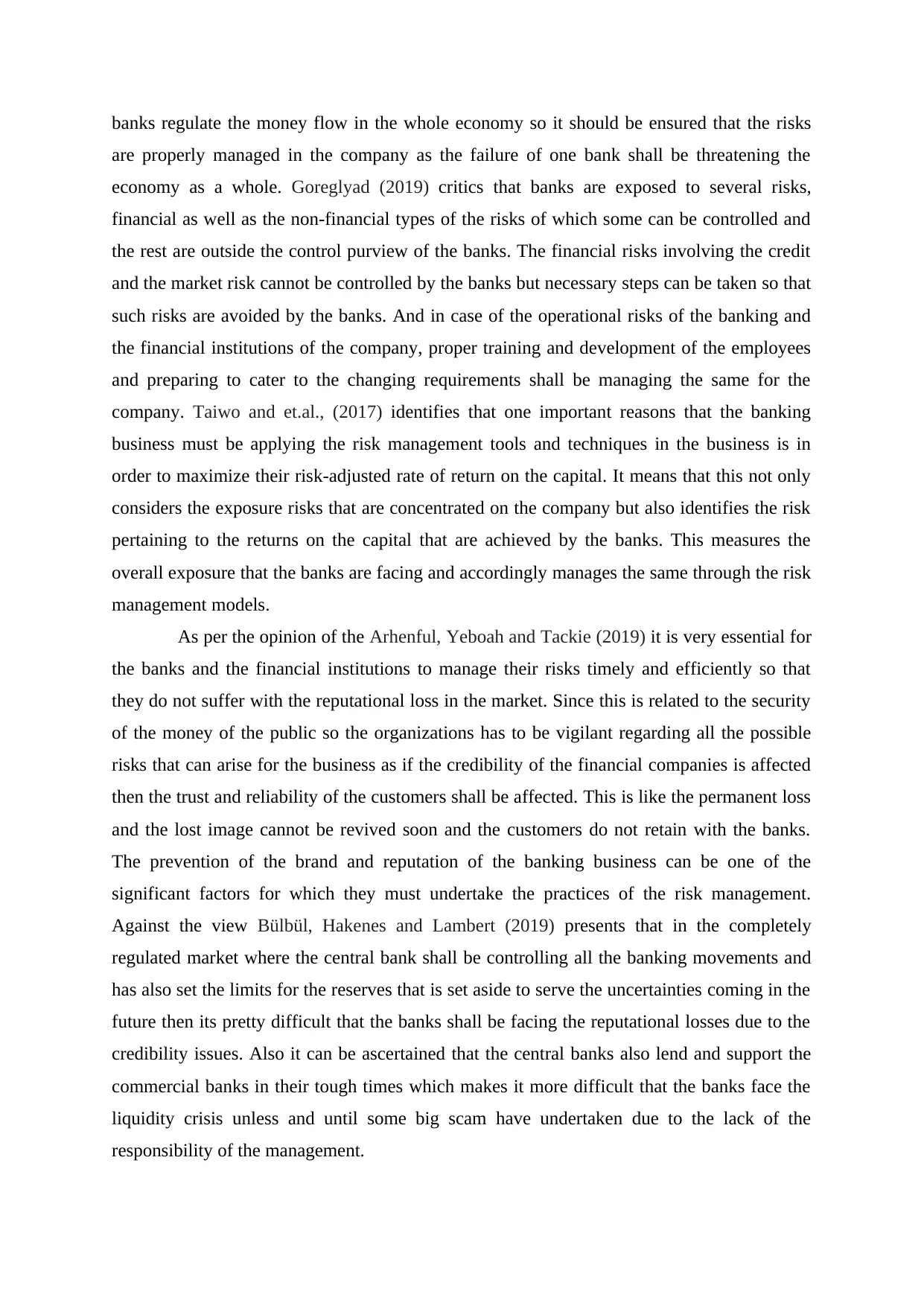
banks regulate the money flow in the whole economy so it should be ensured that the risks
are properly managed in the company as the failure of one bank shall be threatening the
economy as a whole. Goreglyad (2019) critics that banks are exposed to several risks,
financial as well as the non-financial types of the risks of which some can be controlled and
the rest are outside the control purview of the banks. The financial risks involving the credit
and the market risk cannot be controlled by the banks but necessary steps can be taken so that
such risks are avoided by the banks. And in case of the operational risks of the banking and
the financial institutions of the company, proper training and development of the employees
and preparing to cater to the changing requirements shall be managing the same for the
company. Taiwo and et.al., (2017) identifies that one important reasons that the banking
business must be applying the risk management tools and techniques in the business is in
order to maximize their risk-adjusted rate of return on the capital. It means that this not only
considers the exposure risks that are concentrated on the company but also identifies the risk
pertaining to the returns on the capital that are achieved by the banks. This measures the
overall exposure that the banks are facing and accordingly manages the same through the risk
management models.
As per the opinion of the Arhenful, Yeboah and Tackie (2019) it is very essential for
the banks and the financial institutions to manage their risks timely and efficiently so that
they do not suffer with the reputational loss in the market. Since this is related to the security
of the money of the public so the organizations has to be vigilant regarding all the possible
risks that can arise for the business as if the credibility of the financial companies is affected
then the trust and reliability of the customers shall be affected. This is like the permanent loss
and the lost image cannot be revived soon and the customers do not retain with the banks.
The prevention of the brand and reputation of the banking business can be one of the
significant factors for which they must undertake the practices of the risk management.
Against the view Bülbül, Hakenes and Lambert (2019) presents that in the completely
regulated market where the central bank shall be controlling all the banking movements and
has also set the limits for the reserves that is set aside to serve the uncertainties coming in the
future then its pretty difficult that the banks shall be facing the reputational losses due to the
credibility issues. Also it can be ascertained that the central banks also lend and support the
commercial banks in their tough times which makes it more difficult that the banks face the
liquidity crisis unless and until some big scam have undertaken due to the lack of the
responsibility of the management.
are properly managed in the company as the failure of one bank shall be threatening the
economy as a whole. Goreglyad (2019) critics that banks are exposed to several risks,
financial as well as the non-financial types of the risks of which some can be controlled and
the rest are outside the control purview of the banks. The financial risks involving the credit
and the market risk cannot be controlled by the banks but necessary steps can be taken so that
such risks are avoided by the banks. And in case of the operational risks of the banking and
the financial institutions of the company, proper training and development of the employees
and preparing to cater to the changing requirements shall be managing the same for the
company. Taiwo and et.al., (2017) identifies that one important reasons that the banking
business must be applying the risk management tools and techniques in the business is in
order to maximize their risk-adjusted rate of return on the capital. It means that this not only
considers the exposure risks that are concentrated on the company but also identifies the risk
pertaining to the returns on the capital that are achieved by the banks. This measures the
overall exposure that the banks are facing and accordingly manages the same through the risk
management models.
As per the opinion of the Arhenful, Yeboah and Tackie (2019) it is very essential for
the banks and the financial institutions to manage their risks timely and efficiently so that
they do not suffer with the reputational loss in the market. Since this is related to the security
of the money of the public so the organizations has to be vigilant regarding all the possible
risks that can arise for the business as if the credibility of the financial companies is affected
then the trust and reliability of the customers shall be affected. This is like the permanent loss
and the lost image cannot be revived soon and the customers do not retain with the banks.
The prevention of the brand and reputation of the banking business can be one of the
significant factors for which they must undertake the practices of the risk management.
Against the view Bülbül, Hakenes and Lambert (2019) presents that in the completely
regulated market where the central bank shall be controlling all the banking movements and
has also set the limits for the reserves that is set aside to serve the uncertainties coming in the
future then its pretty difficult that the banks shall be facing the reputational losses due to the
credibility issues. Also it can be ascertained that the central banks also lend and support the
commercial banks in their tough times which makes it more difficult that the banks face the
liquidity crisis unless and until some big scam have undertaken due to the lack of the
responsibility of the management.
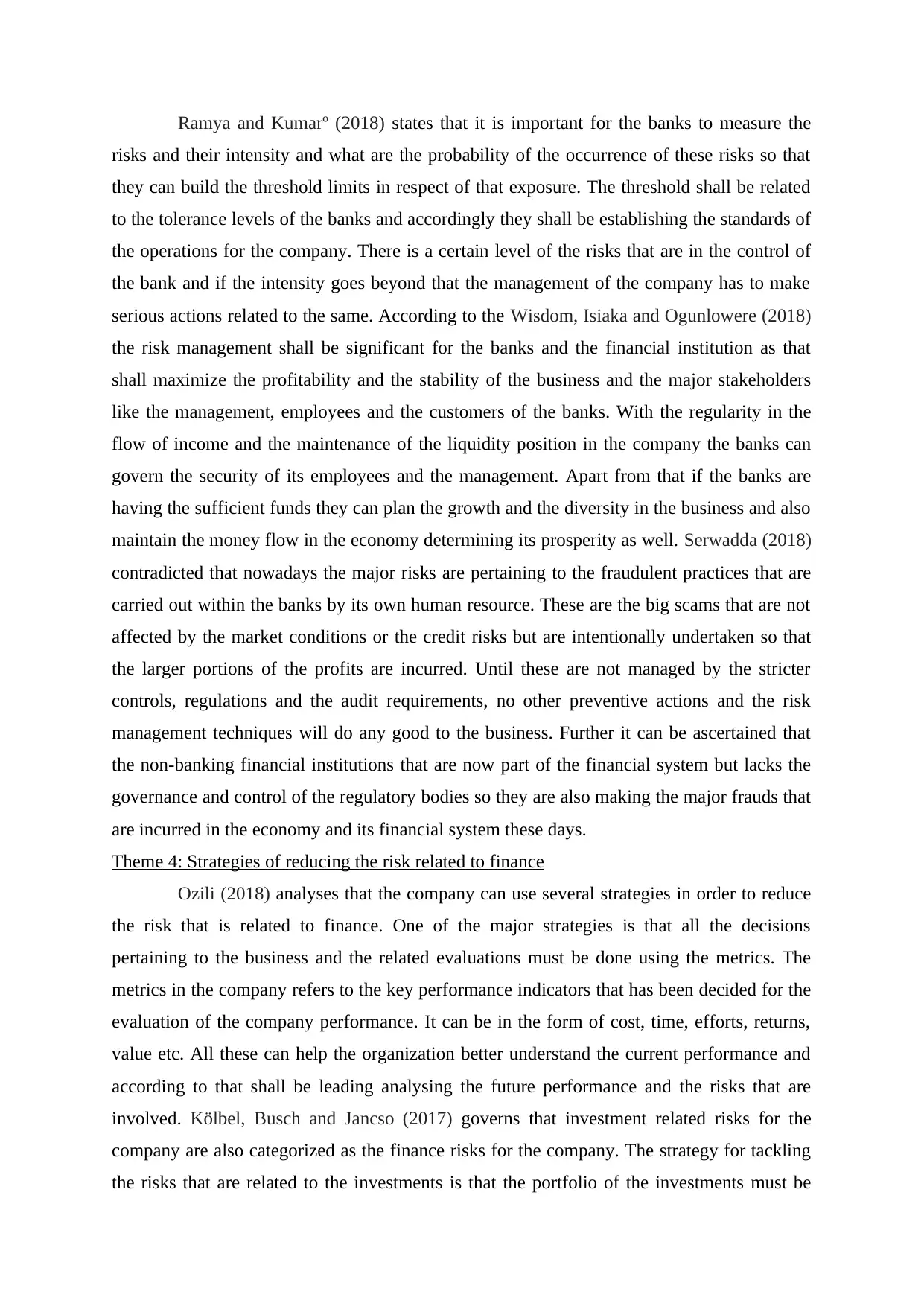
Ramya and Kumarº (2018) states that it is important for the banks to measure the
risks and their intensity and what are the probability of the occurrence of these risks so that
they can build the threshold limits in respect of that exposure. The threshold shall be related
to the tolerance levels of the banks and accordingly they shall be establishing the standards of
the operations for the company. There is a certain level of the risks that are in the control of
the bank and if the intensity goes beyond that the management of the company has to make
serious actions related to the same. According to the Wisdom, Isiaka and Ogunlowere (2018)
the risk management shall be significant for the banks and the financial institution as that
shall maximize the profitability and the stability of the business and the major stakeholders
like the management, employees and the customers of the banks. With the regularity in the
flow of income and the maintenance of the liquidity position in the company the banks can
govern the security of its employees and the management. Apart from that if the banks are
having the sufficient funds they can plan the growth and the diversity in the business and also
maintain the money flow in the economy determining its prosperity as well. Serwadda (2018)
contradicted that nowadays the major risks are pertaining to the fraudulent practices that are
carried out within the banks by its own human resource. These are the big scams that are not
affected by the market conditions or the credit risks but are intentionally undertaken so that
the larger portions of the profits are incurred. Until these are not managed by the stricter
controls, regulations and the audit requirements, no other preventive actions and the risk
management techniques will do any good to the business. Further it can be ascertained that
the non-banking financial institutions that are now part of the financial system but lacks the
governance and control of the regulatory bodies so they are also making the major frauds that
are incurred in the economy and its financial system these days.
Theme 4: Strategies of reducing the risk related to finance
Ozili (2018) analyses that the company can use several strategies in order to reduce
the risk that is related to finance. One of the major strategies is that all the decisions
pertaining to the business and the related evaluations must be done using the metrics. The
metrics in the company refers to the key performance indicators that has been decided for the
evaluation of the company performance. It can be in the form of cost, time, efforts, returns,
value etc. All these can help the organization better understand the current performance and
according to that shall be leading analysing the future performance and the risks that are
involved. Kölbel, Busch and Jancso (2017) governs that investment related risks for the
company are also categorized as the finance risks for the company. The strategy for tackling
the risks that are related to the investments is that the portfolio of the investments must be
risks and their intensity and what are the probability of the occurrence of these risks so that
they can build the threshold limits in respect of that exposure. The threshold shall be related
to the tolerance levels of the banks and accordingly they shall be establishing the standards of
the operations for the company. There is a certain level of the risks that are in the control of
the bank and if the intensity goes beyond that the management of the company has to make
serious actions related to the same. According to the Wisdom, Isiaka and Ogunlowere (2018)
the risk management shall be significant for the banks and the financial institution as that
shall maximize the profitability and the stability of the business and the major stakeholders
like the management, employees and the customers of the banks. With the regularity in the
flow of income and the maintenance of the liquidity position in the company the banks can
govern the security of its employees and the management. Apart from that if the banks are
having the sufficient funds they can plan the growth and the diversity in the business and also
maintain the money flow in the economy determining its prosperity as well. Serwadda (2018)
contradicted that nowadays the major risks are pertaining to the fraudulent practices that are
carried out within the banks by its own human resource. These are the big scams that are not
affected by the market conditions or the credit risks but are intentionally undertaken so that
the larger portions of the profits are incurred. Until these are not managed by the stricter
controls, regulations and the audit requirements, no other preventive actions and the risk
management techniques will do any good to the business. Further it can be ascertained that
the non-banking financial institutions that are now part of the financial system but lacks the
governance and control of the regulatory bodies so they are also making the major frauds that
are incurred in the economy and its financial system these days.
Theme 4: Strategies of reducing the risk related to finance
Ozili (2018) analyses that the company can use several strategies in order to reduce
the risk that is related to finance. One of the major strategies is that all the decisions
pertaining to the business and the related evaluations must be done using the metrics. The
metrics in the company refers to the key performance indicators that has been decided for the
evaluation of the company performance. It can be in the form of cost, time, efforts, returns,
value etc. All these can help the organization better understand the current performance and
according to that shall be leading analysing the future performance and the risks that are
involved. Kölbel, Busch and Jancso (2017) governs that investment related risks for the
company are also categorized as the finance risks for the company. The strategy for tackling
the risks that are related to the investments is that the portfolio of the investments must be
⊘ This is a preview!⊘
Do you want full access?
Subscribe today to unlock all pages.
Trusted by 1+ million students worldwide

1 out of 31


Related Documents


Your All-in-One AI-Powered Toolkit for Academic Success.
+13062052269
info@desklib.com
Available 24*7 on WhatsApp / Email
![[object Object]](/_next/static/media/star-bottom.7253800d.svg)
Unlock your academic potential
Copyright © 2020–2026 A2Z Services. All Rights Reserved. Developed and managed by ZUCOL.