3CO04 Essentials of People Practice: L&D, Benefits, and Evaluation

Verified

Added on  2023/06/06

|9
|2050
|72
Report
AI Summary
This report, prepared for Healthcare on Hand managers, delves into the critical aspects of learning and development (L&D) within people practice. It begins by outlining the benefits of L&D for both individuals and organizations, emphasizing increased skills, enhanced behavior, and improved communication. The report then identifies various types of learning needs, including skills and knowledge gaps, confidence and belief, and the need for perspective and reassurance, along with the reasons for their emergence. It summarizes both face-to-face and blended approaches to L&D, including facilitation, coaching, and mentoring, and discusses how to accommodate individual requirements and preferences in designing and delivering L&D initiatives. Finally, the report explores different methods for evaluating L&D effectiveness, such as the Brinkerhoff success case method and feedback mechanisms, along with their impacts. The report concludes by reiterating the importance of L&D for organizational and individual growth.

Document Page
3CO04 ESSENTIALS OF
PEOPLE PRACTICE
tabler-icon-diamond-filled.svg

Paraphrase This Document

Need a fresh take? Get an instant paraphrase of this document with our AI Paraphraser
Document Page
Table of Contents
INTRODUCTION...........................................................................................................................3
MAIN BODY..................................................................................................................................3
Benefits of learning & development to individuals and organization.........................................3
Different types of learning needs & reasons for which they arise...............................................4
Summary of face to face and blended approaches to L&D.........................................................5
Accommodation of individual requirements & preferences in designing & delivering L&D....6
Methods of evaluating learning & development.........................................................................7
CONCLUSION................................................................................................................................7
REFERENCES................................................................................................................................8
Books and Journals......................................................................................................................8
Document Page
INTRODUCTION
People practice involves number of tasks to be performed by the people manager such as
analysis of learning needs, creation of talent pool, developing policies for people, data analysis
related to people, recruitment of people and management of their grievances, etc. Learning &
developing is among such people practice that are being undertaken within every organization. In
this fact sheet prepared for the managers at Healthcare on hand, the discussion will be done with
regards to the benefits of L&D to both organization as well as individuals, different types of
learning need and the reason for which it arises, summary of blended & face to face L&D
approaches, accommodation of individual requirements while designing & delivering L&D
initiatives and the methods for L&D evaluation with its impact.
MAIN BODY
Benefits of learning & development to individuals and organization
Increased skills: With greater opportunity to learn and develop in the organization, employees
are able to build new and improved their existing skills. This in turn applied by the employees to
their workplace resulting in greater productivity and better of performance of employees.
Therefore, the overall performance of the organization gets improved.
For instance, going digital strategy required a completely new set of skills are needed which may
lead to losing talented & experienced employees, but through effective L&D programs, such new
set of skills can be developed among existing employees and accordingly, the change strategy
can be implemented with greater ease (Atiku and et.al., 2022).
Enhanced behavior: With effective L&D in place, employee’s behavior can also be affected in
a positive manner. Behavior of employees is defined as the reaction of employees towards a
situation taking place in an organization. If appropriate L&D would be in place, then employees
would not resist the change and accordingly, development of positive employee’s attitude would
be possible.
Increase in effective communication: Development of Knowledge centers is possible by
employees which facilitate effective communication among employees and customers of the
Document Page
company regarding its products and services. Accordingly, improved services can be offered to
customers which enhance their satisfaction.
For example, companies by providing their employees with greater learning opportunities can
ensure effective communication with their target audience over communication boards or
discussion tools. For ensuring effective use of such tools, it is necessary for the employees to
have knowledge of the same.
Different types of learning needs & reasons for which they arise
There are four types of needs associated with L&D, such as the following:
Skills & knowledge: For developing skills and knowledge in order to get better job
opportunities, the need for L&D arises among individuals while in case of changing job
requirements at workplace, organizations resort to providing L&D to their employees (Krishnan
and Wesley, 2018).
For instance, L&D is implemented for the development of IT skills among employees to
facilitate ease of communication among management and employees.
Confidence & belief: For performing complex tasks, confidence among employees is must and
in the absence of which the effective outcome can’t be ensured. Therefore, the need of L&D
arises.
Perspective: It refers to the need for changing the attitude of employees towards something such
as change in work culture, technology, etc.
Reassurance: Assuring people in the organization that they are doing a good job along with
communicating the requirement of making difference to be on the right track.
The reason due to which the need for L&D arises are as follows:
Gaps in skillsets with regards to the performance requirements: Such needs arise when an
employee is promoted or transfer to another job position in the organization where different
requirements are there for the performance of job and to ensure the same level of or higher level
of productivity of employees (Iqbal, and Ahmad, 2021).
tabler-icon-diamond-filled.svg

Paraphrase This Document

Need a fresh take? Get an instant paraphrase of this document with our AI Paraphraser
Document Page
For instance, an employee is promoted to the managerial position in the organization and this
would definitely have resulted in new skills set such as critical thinking, relationship
management, decision making skills, interpersonal skills, etc. These must be developed before
promoting to higher position to ensure no gap in their performance.
Gaps in current performance: Employees may not be performing to the standards defined for
them and accordingly, the need to provide learning opportunities arises. This leads to the
development of knowledge among them in how they could perform efficiently and effectively.
Summary of face to face and blended approaches to L&D
There are four methods of providing L&D to the employees in an organization, such as:
Facilitation: It refers to the technique of L&D to facilitate learners in acquiring, retaining and
applying the learned skills & knowledge (Nipasuwan, Thanabordeekij and Ussivakul, 2021).
Approaches to facilitation: There are several approaches of this technique which involves:
Action planning: Through this technique, learners gain commitment for bringing in action what
they have learned.
Brainstorming: It facilitates generation of large quantity of ideas among the group to get the
ideal solution.
Energizers: It facilitates enhancement of personal energy levels by sharing ideas with colleagues,
reviewing training manuals and thinking in oneself.
On & off the job training: On the job training takes place at the workplace or job site itself
while in case of off the job training, employees are taken to another place different from their
workplace. Here both synchronous as well as asynchronous techniques are adopted for providing
L&D to employees (Garratt, 2019). By analyzing skills gap, training programs are designed to
equipped employees with particular skills & knowledge for enhanced performance.
In House L&D programmes External L&D programmes
Job rotation Case studies
Mentoring Management games
Coaching Audi-visual
Document Page
Asynchronous e learning is useful in making it possible to learners to just get log on to the e-
learning environment without any restriction of time. It allows for downloading the learning
materials anytime.
Coaching: It is the method of L&D, where a skilled or experienced individuals are hired for
guiding & advising employees to facilitate the development of career & skills and increased
performance (Sidani and Reese, 2018). Different styles of coaching are:
Executive coaching
Team coaching
Virtual coaching
Mentoring: Here the partnership between the colleagues are established in order to facilitate
growth & learning growth. Mentors are usually seniors and experienced individuals for
supporting younger employees.
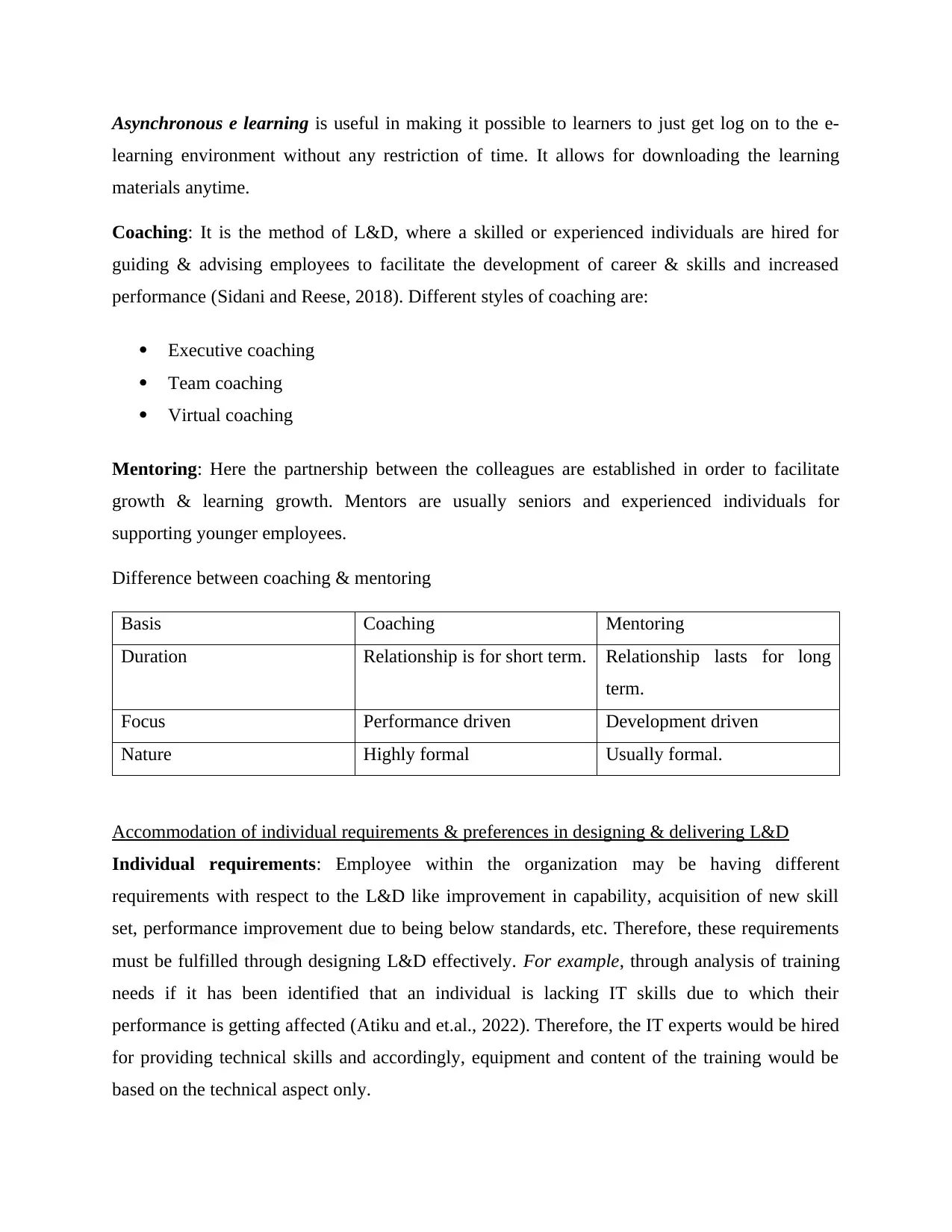
Difference between coaching & mentoring
Basis Coaching Mentoring
Duration Relationship is for short term. Relationship lasts for long
term.
Focus Performance driven Development driven
Nature Highly formal Usually formal.
Accommodation of individual requirements & preferences in designing & delivering L&D
Individual requirements: Employee within the organization may be having different
requirements with respect to the L&D like improvement in capability, acquisition of new skill
set, performance improvement due to being below standards, etc. Therefore, these requirements
must be fulfilled through designing L&D effectively. For example, through analysis of training
needs if it has been identified that an individual is lacking IT skills due to which their
performance is getting affected (Atiku and et.al., 2022). Therefore, the IT experts would be hired
for providing technical skills and accordingly, equipment and content of the training would be
based on the technical aspect only.
Document Page
Individual preferences: It could be related to the delivery mode, need for ethics and equality or
the location where the L&D programs will be initiated. For example, an individual may be
preferring e learning mode because of its ability to provide learning materials anytime they
needed or being able to put greater focus. Therefore, the delivery mode and location must be
decided in adherence to the individual preferences.
Methods of evaluating learning & development
The methods involve the following:
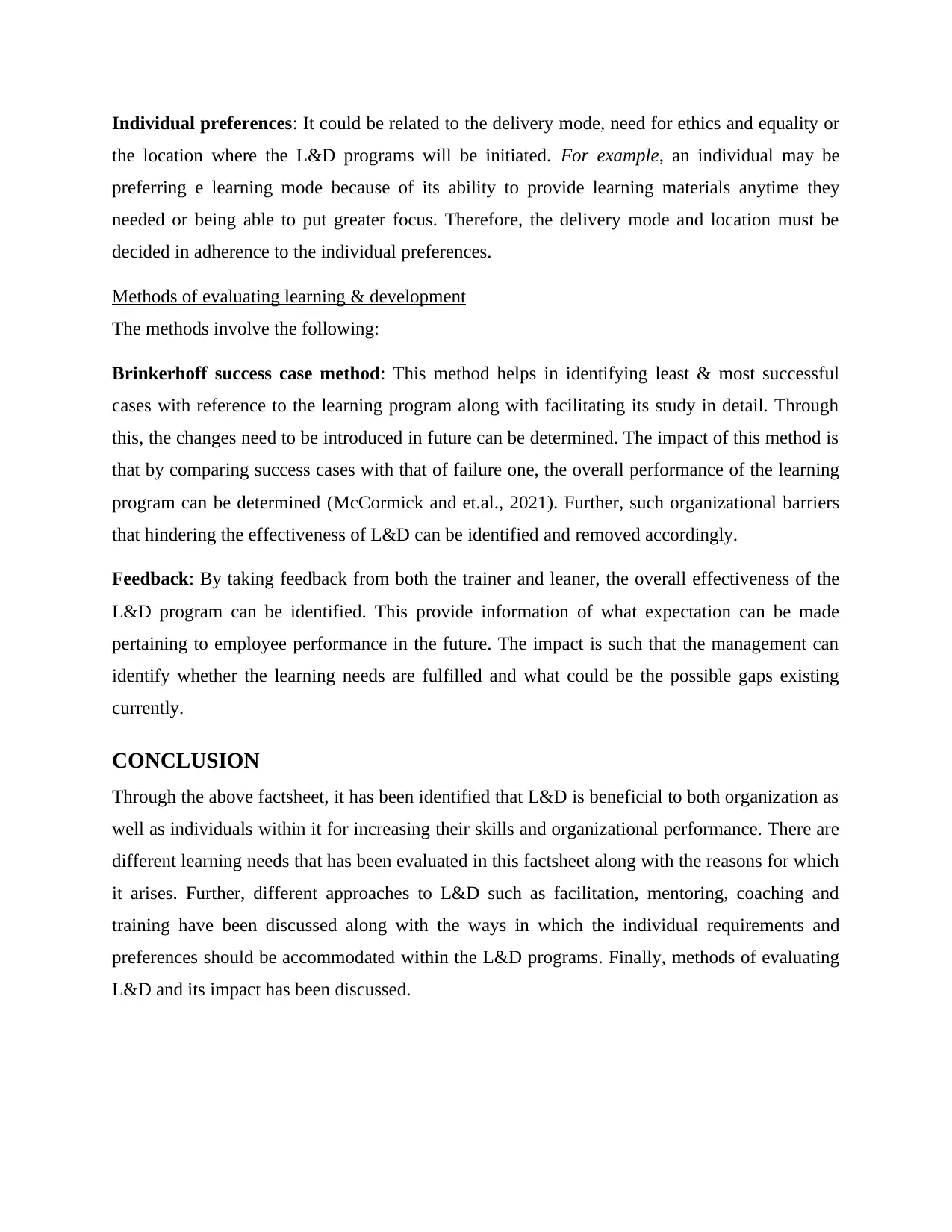
Brinkerhoff success case method: This method helps in identifying least & most successful
cases with reference to the learning program along with facilitating its study in detail. Through
this, the changes need to be introduced in future can be determined. The impact of this method is
that by comparing success cases with that of failure one, the overall performance of the learning
program can be determined (McCormick and et.al., 2021). Further, such organizational barriers
that hindering the effectiveness of L&D can be identified and removed accordingly.
Feedback: By taking feedback from both the trainer and leaner, the overall effectiveness of the
L&D program can be identified. This provide information of what expectation can be made
pertaining to employee performance in the future. The impact is such that the management can
identify whether the learning needs are fulfilled and what could be the possible gaps existing
currently.
CONCLUSION
Through the above factsheet, it has been identified that L&D is beneficial to both organization as
well as individuals within it for increasing their skills and organizational performance. There are
different learning needs that has been evaluated in this factsheet along with the reasons for which
it arises. Further, different approaches to L&D such as facilitation, mentoring, coaching and
training have been discussed along with the ways in which the individual requirements and
preferences should be accommodated within the L&D programs. Finally, methods of evaluating
L&D and its impact has been discussed.
tabler-icon-diamond-filled.svg

Paraphrase This Document

Need a fresh take? Get an instant paraphrase of this document with our AI Paraphraser
Document Page
Document Page
REFERENCES
Books and Journals
Atiku, S., and et.al., 2022. Dimensions of learning organization: Implications for human
resources effectiveness in commercial banks. Management Science Letters, 12(2),
pp.117-124.
Garratt, R., 2019. Personal Paradoxes in Learning to Design “the Learning Organization”.
Iqbal, Q. and Ahmad, N. H., 2021. Sustainable development: The colors of sustainable
leadership in learning organization. Sustainable Development, 29(1), pp.108-119.
Krishnan, D. S. G. and Wesley, D. J., 2018. Perceived Organization Support, Learning &
Development, Job Characteristics and PO Fit: The Contribution of Employee
Communication. Asian Journal of Research in Social Sciences and
Humanities, 8(3), pp.97-109.
McCormick, E. M., and et.al., 2021. Longitudinal network re-organization across
learning and development. NeuroImage, 229, p.117784.
Nipasuwan, N., Thanabordeekij, P. and Ussivakul, A., 2021. Towards a Learning
Organization Learning How to Learn: A Key Competence for Sustainable
Employment. Journal of ASEAN PLUS Studies, 2(2), pp.40-65.
Sidani, Y. and Reese, S., 2018. A journey of collaborative learning organization research:
Interview with Victoria Marsick and Karen Watkins. The Learning Organization.
chevron_up_icon
1 out of 9
circle_padding
hide_on_mobile
zoom_out_icon
[object Object]