Numeracy Assignment: Calculations on Interest, Power, and Roots

Verified

Added on  2020/02/12

|14
|2574
|85
Homework Assignment
AI Summary
This numeracy assignment solution covers a range of mathematical concepts and their applications. Section 1 includes self-analysis of numeracy skills and understanding of powers, roots, interest calculations (simple and compound), linear relationships, net present value, frequency distributions, and probabilities. Task 2 provides examples of how interest rate calculations and future value calculations were applied in real-life scenarios. Section 2 delves into the details of power and root laws, including simplification methods. It also includes detailed calculations of simple and compound interest, and calculations using the rule of 72. Further, it presents the solutions for calculating the amount to invest, interest rate, and the number of years for an investment to reach a certain balance. The assignment also involves constructing and interpreting a scatter plot, deriving a linear equation, and extrapolating/interpolating data. Overall, the assignment demonstrates understanding and application of financial and mathematical concepts.
Document Page
NUMERACY
tabler-icon-diamond-filled.svg

Paraphrase This Document

Need a fresh take? Get an instant paraphrase of this document with our AI Paraphraser
Document Page
TABLE OF CONTENTS
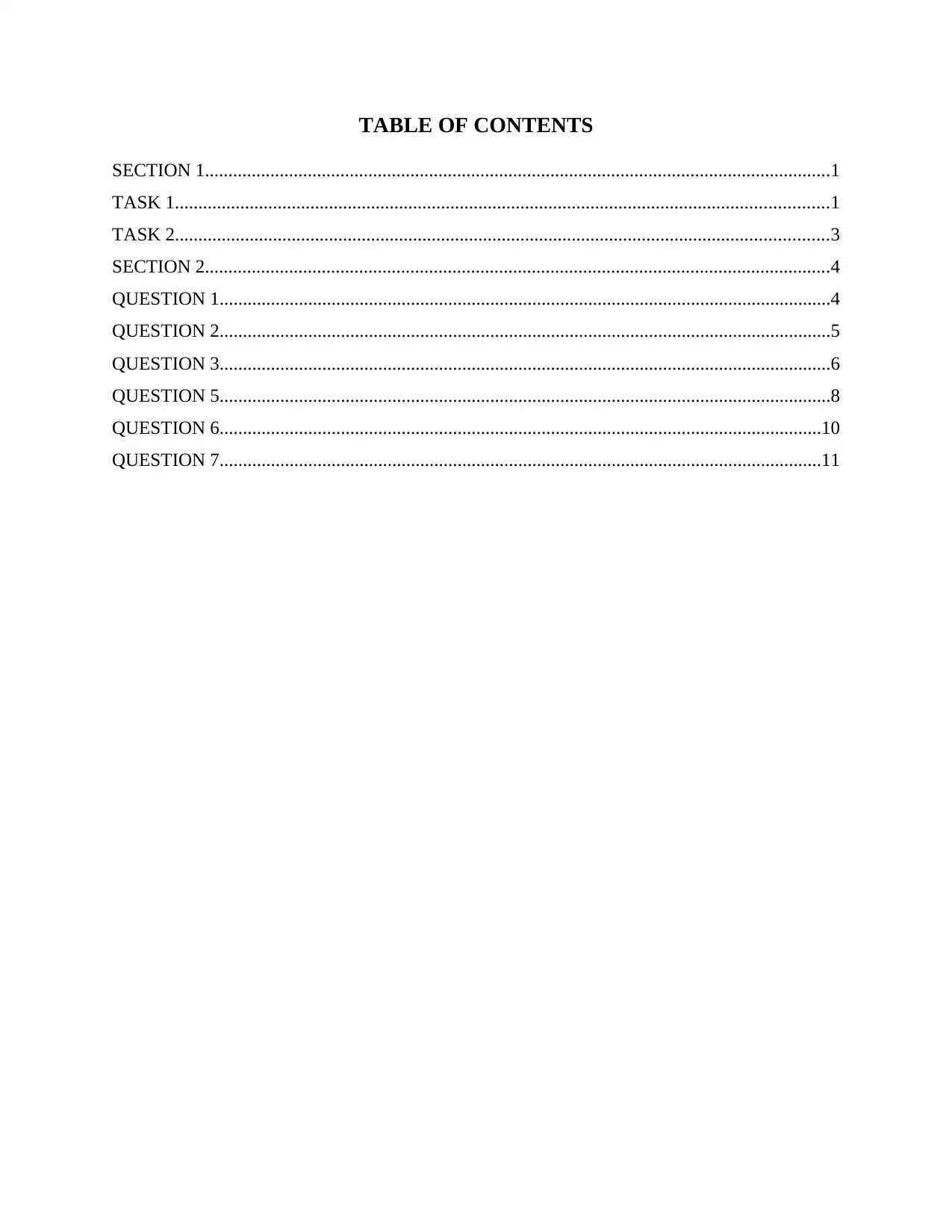
SECTION 1......................................................................................................................................1
TASK 1............................................................................................................................................1
TASK 2............................................................................................................................................3
SECTION 2......................................................................................................................................4
QUESTION 1...................................................................................................................................4
QUESTION 2...................................................................................................................................5
QUESTION 3...................................................................................................................................6
QUESTION 5...................................................................................................................................8
QUESTION 6.................................................................................................................................10
QUESTION 7.................................................................................................................................11
Document Page
SECTION 1
TASK 1
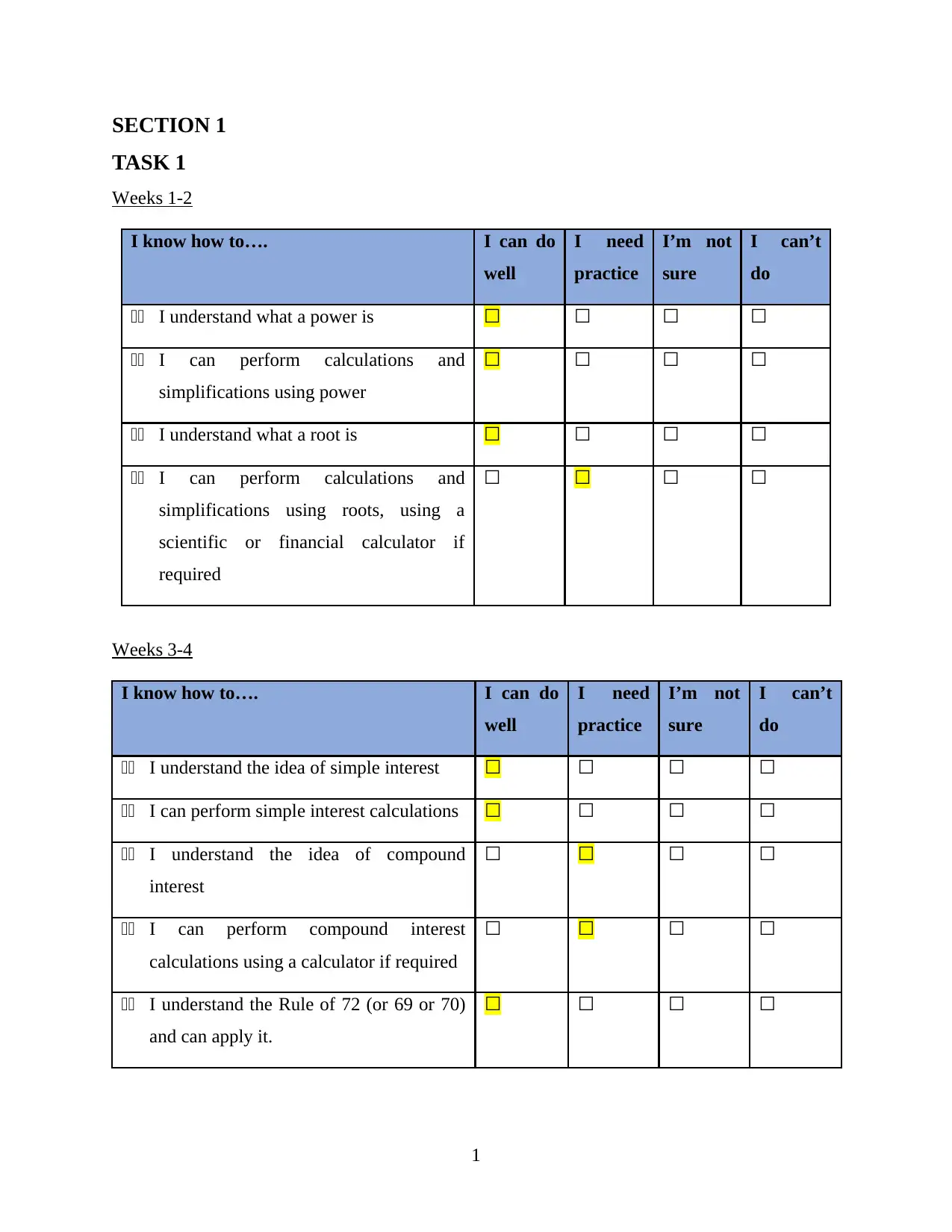
Weeks 1-2
I know how to…. I can do
well
I need
practice
I’m not
sure
I can’t
do
11 I understand what a power is
1
1 I can perform calculations and
simplifications using power

1
1 I understand what a root is
1
1 I can perform calculations and
simplifications using roots, using a
scientific or financial calculator if
required

Weeks 3-4
I know how to…. I can do
well
I need
practice
I’m not
sure
I can’t
do
1
1 I understand the idea of simple interest
1
1 I can perform simple interest calculations
1
1 I understand the idea of compound
interest

1
1 I can perform compound interest
calculations using a calculator if required

1
1 I understand the Rule of 72 (or 69 or 70)
and can apply it.

1
Document Page
Weeks 5-6
I know how to…. I can do
well
I need
practice
I’m not
sure
I can’t
do
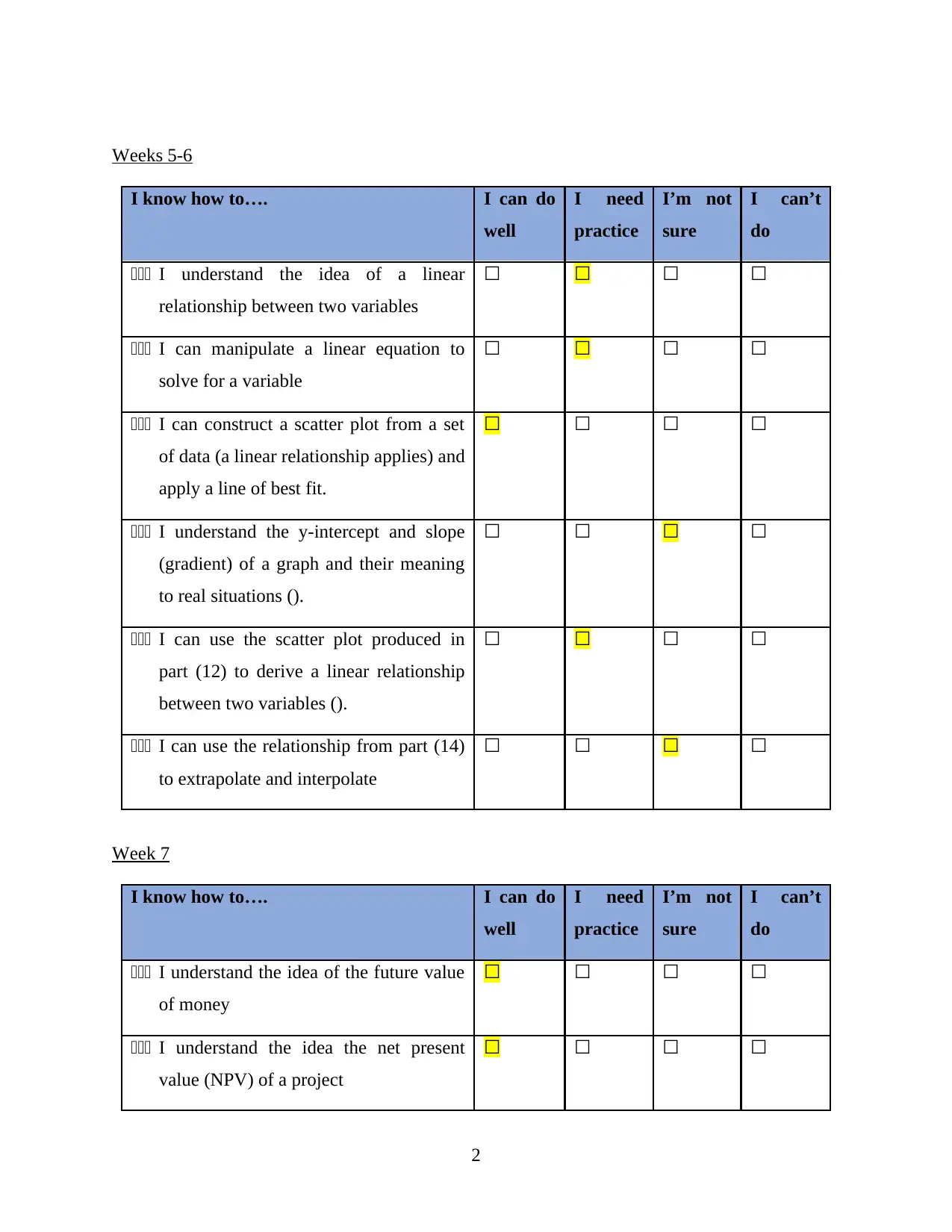
111 I understand the idea of a linear
relationship between two variables

111 I can manipulate a linear equation to
solve for a variable

111 I can construct a scatter plot from a set
of data (a linear relationship applies) and
apply a line of best fit.

111 I understand the y-intercept and slope
(gradient) of a graph and their meaning
to real situations ().

111 I can use the scatter plot produced in
part (12) to derive a linear relationship
between two variables ().

111 I can use the relationship from part (14)
to extrapolate and interpolate

Week 7
I know how to…. I can do
well
I need
practice
I’m not
sure
I can’t
do
111 I understand the idea of the future value
of money

111 I understand the idea the net present
value (NPV) of a project

2
tabler-icon-diamond-filled.svg

Paraphrase This Document

Need a fresh take? Get an instant paraphrase of this document with our AI Paraphraser
Document Page
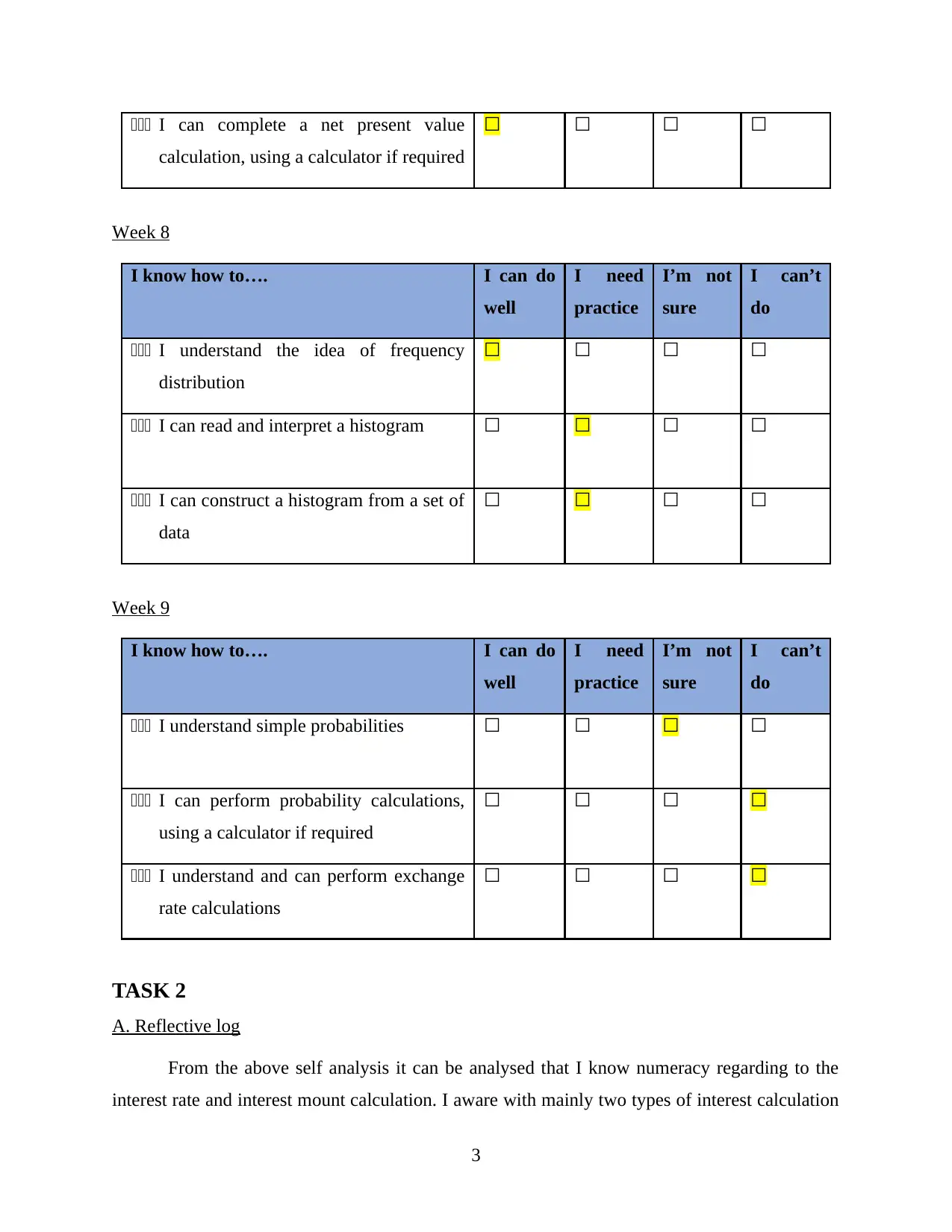
111 I can complete a net present value
calculation, using a calculator if required

Week 8
I know how to…. I can do
well
I need
practice
I’m not
sure
I can’t
do
111 I understand the idea of frequency
distribution

1
11 I can read and interpret a histogram
1
11 I can construct a histogram from a set of
data

Week 9
I know how to…. I can do
well
I need
practice
I’m not
sure
I can’t
do
1
11 I understand simple probabilities
1
11 I can perform probability calculations,
using a calculator if required

1
11 I understand and can perform exchange
rate calculations

TASK 2
A. Reflective log
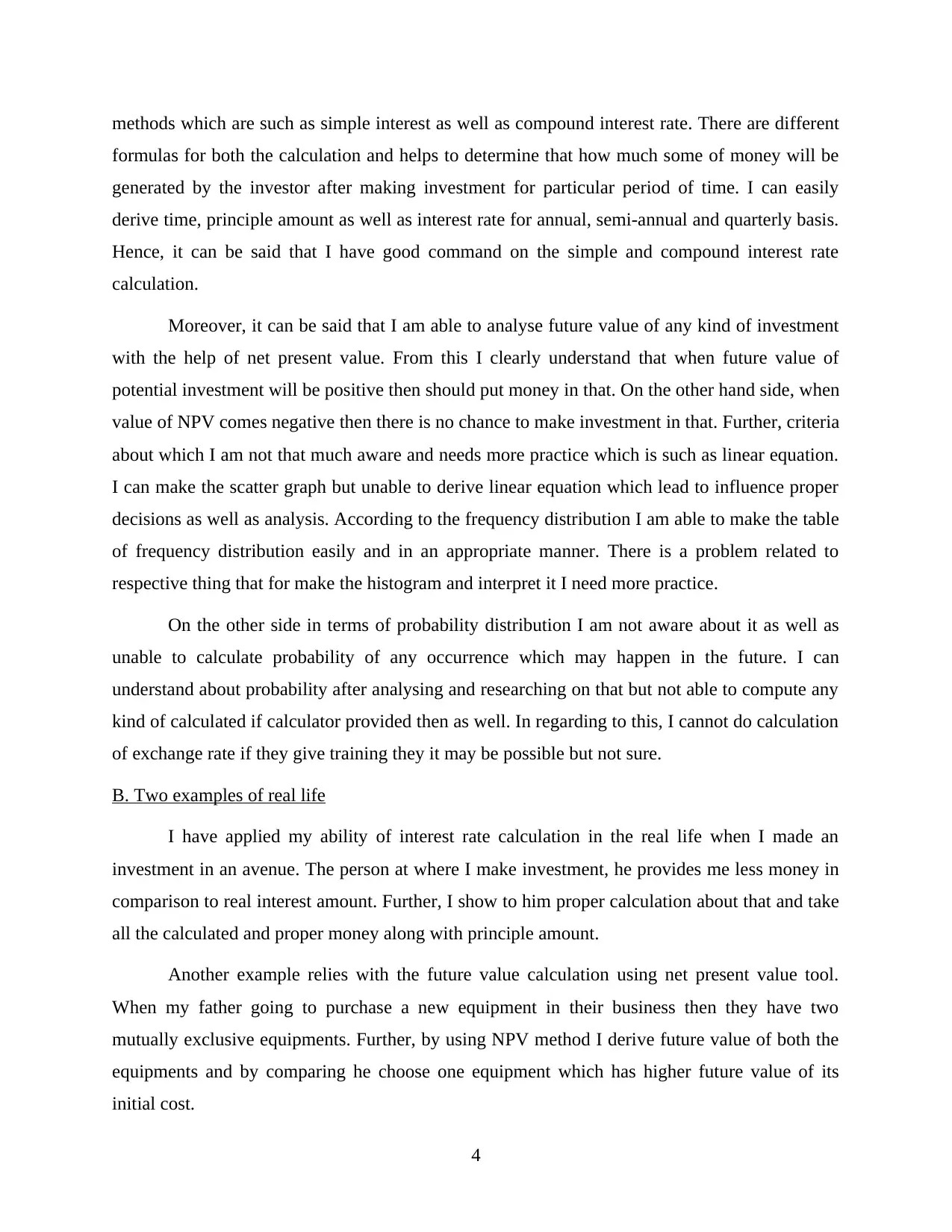
From the above self analysis it can be analysed that I know numeracy regarding to the
interest rate and interest mount calculation. I aware with mainly two types of interest calculation
3
Document Page
methods which are such as simple interest as well as compound interest rate. There are different
formulas for both the calculation and helps to determine that how much some of money will be
generated by the investor after making investment for particular period of time. I can easily
derive time, principle amount as well as interest rate for annual, semi-annual and quarterly basis.
Hence, it can be said that I have good command on the simple and compound interest rate
calculation.
Moreover, it can be said that I am able to analyse future value of any kind of investment
with the help of net present value. From this I clearly understand that when future value of
potential investment will be positive then should put money in that. On the other hand side, when
value of NPV comes negative then there is no chance to make investment in that. Further, criteria
about which I am not that much aware and needs more practice which is such as linear equation.
I can make the scatter graph but unable to derive linear equation which lead to influence proper
decisions as well as analysis. According to the frequency distribution I am able to make the table
of frequency distribution easily and in an appropriate manner. There is a problem related to
respective thing that for make the histogram and interpret it I need more practice.
On the other side in terms of probability distribution I am not aware about it as well as
unable to calculate probability of any occurrence which may happen in the future. I can
understand about probability after analysing and researching on that but not able to compute any
kind of calculated if calculator provided then as well. In regarding to this, I cannot do calculation
of exchange rate if they give training they it may be possible but not sure.
B. Two examples of real life
I have applied my ability of interest rate calculation in the real life when I made an
investment in an avenue. The person at where I make investment, he provides me less money in
comparison to real interest amount. Further, I show to him proper calculation about that and take
all the calculated and proper money along with principle amount.
Another example relies with the future value calculation using net present value tool.
When my father going to purchase a new equipment in their business then they have two
mutually exclusive equipments. Further, by using NPV method I derive future value of both the
equipments and by comparing he choose one equipment which has higher future value of its
initial cost.
4
Document Page
SECTION 2
QUESTION 1
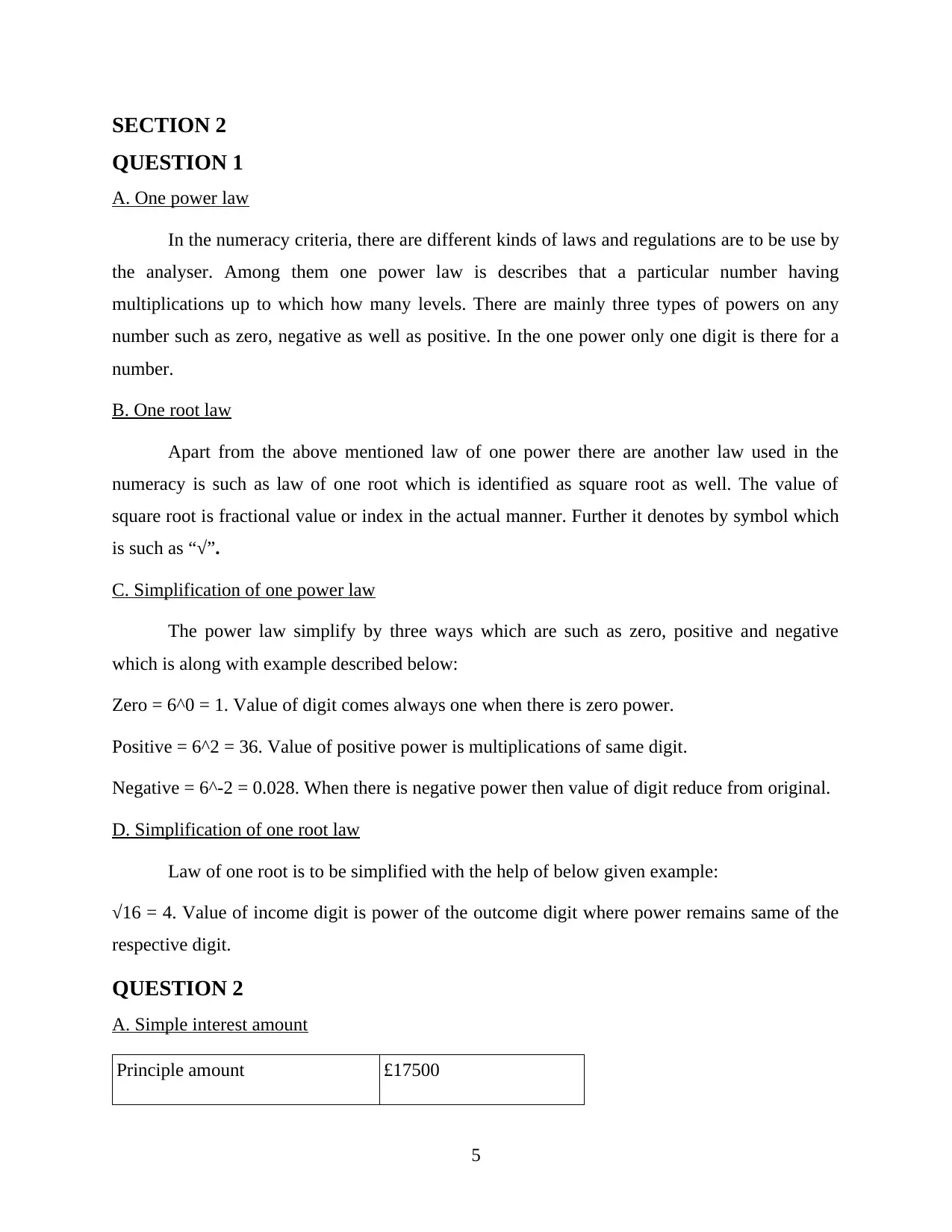
A. One power law
In the numeracy criteria, there are different kinds of laws and regulations are to be use by
the analyser. Among them one power law is describes that a particular number having
multiplications up to which how many levels. There are mainly three types of powers on any
number such as zero, negative as well as positive. In the one power only one digit is there for a
number.
B. One root law
Apart from the above mentioned law of one power there are another law used in the
numeracy is such as law of one root which is identified as square root as well. The value of
square root is fractional value or index in the actual manner. Further it denotes by symbol which
is such as .
C. Simplification of one power law
The power law simplify by three ways which are such as zero, positive and negative
which is along with example described below:
Zero = 6^0 = 1. Value of digit comes always one when there is zero power.
Positive = 6^2 = 36. Value of positive power is multiplications of same digit.
Negative = 6^-2 = 0.028. When there is negative power then value of digit reduce from original.
D. Simplification of one root law
Law of one root is to be simplified with the help of below given example:
16 = 4. Value of income digit is power of the outcome digit where power remains same of the
respective digit.
QUESTION 2
A. Simple interest amount
Principle amount £17500
5
tabler-icon-diamond-filled.svg

Paraphrase This Document

Need a fresh take? Get an instant paraphrase of this document with our AI Paraphraser
Document Page
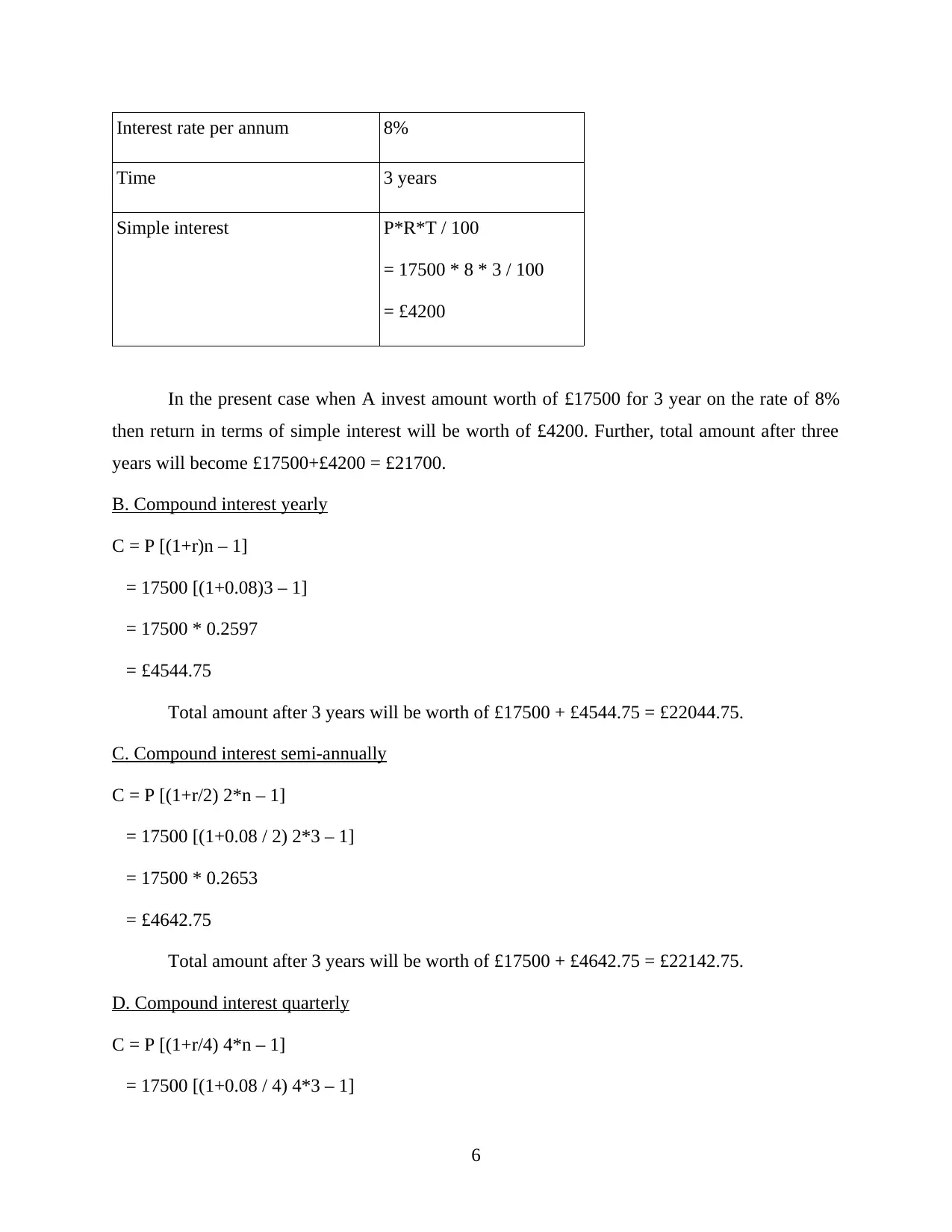
Interest rate per annum 8%
Time 3 years
Simple interest P*R*T / 100
= 17500 * 8 * 3 / 100
= £4200
In the present case when A invest amount worth of £17500 for 3 year on the rate of 8%
then return in terms of simple interest will be worth of £4200. Further, total amount after three
years will become £17500+£4200 = £21700.
B. Compound interest yearly
C = P [(1+r)n – 1]
= 17500 [(1+0.08)3 – 1]
= 17500 * 0.2597
= £4544.75
Total amount after 3 years will be worth of £17500 + £4544.75 = £22044.75.
C. Compound interest semi-annually
C = P [(1+r/2) 2*n – 1]
= 17500 [(1+0.08 / 2) 2*3 – 1]
= 17500 * 0.2653
= £4642.75
Total amount after 3 years will be worth of £17500 + £4642.75 = £22142.75.
D. Compound interest quarterly
C = P [(1+r/4) 4*n – 1]
= 17500 [(1+0.08 / 4) 4*3 – 1]
6
Document Page
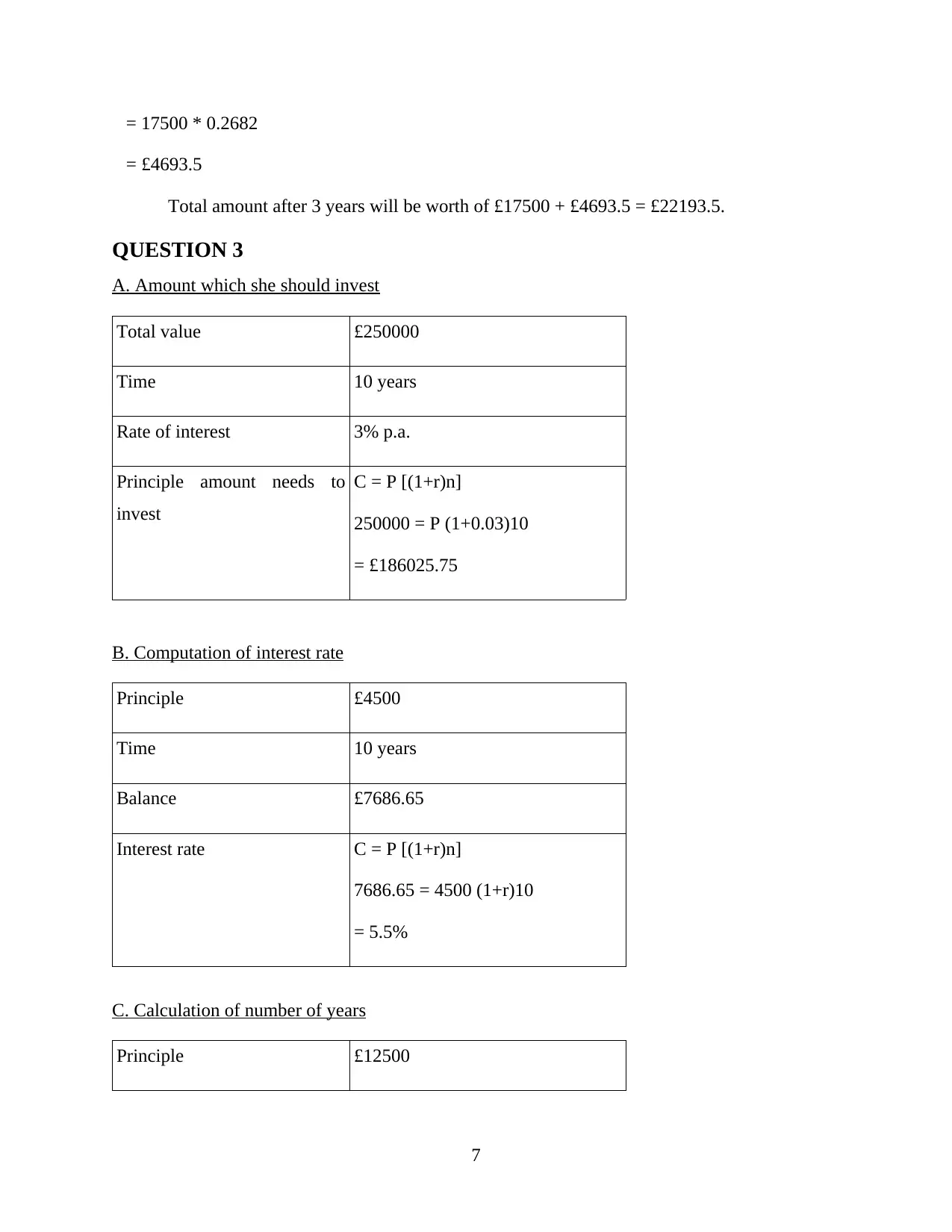
= 17500 * 0.2682
= £4693.5
Total amount after 3 years will be worth of £17500 + £4693.5 = £22193.5.
QUESTION 3
A. Amount which she should invest
Total value £250000
Time 10 years
Rate of interest 3% p.a.
Principle amount needs to
invest
C = P [(1+r)n]
250000 = P (1+0.03)10
= £186025.75
B. Computation of interest rate
Principle £4500
Time 10 years
Balance £7686.65
Interest rate C = P [(1+r)n]
7686.65 = 4500 (1+r)10
= 5.5%
C. Calculation of number of years
Principle £12500
7
Document Page
Interest rate 6% p.a.
Balance £50000
Time C = P [(1+r)n]
50000 = 12500 (1+0.06)n
= 23.8 years
D. Rule of 72
In the numerical world there are various kinds of calculations are needs to calculate to
derive appropriate data or outcomes. In context to this, there is a rule of 72 is used by the firm or
investor when it going to make an investment. As per the rule of 72 it helps to determine time
value that within how many years potential investment amount will become double. For
determine time value interest rate as well as 72 both the values are used. In the present case the
annual interest rate is 6% where number of years will be shown which taken to get double
amount of initial investment with help of respective rule which is calculated as below:
72 / 6% = 12 years. Further, in order to get double sum of money of £12500 i.e. £25000
total 12 years will be taken.
QUESTION 5
A. Scatter Plot
Time (hours) Height (cm)
0 8.8
1 11.4
2 17.6
3 18.4
8
tabler-icon-diamond-filled.svg

Paraphrase This Document

Need a fresh take? Get an instant paraphrase of this document with our AI Paraphraser
Document Page
4 21.3
5 24.2
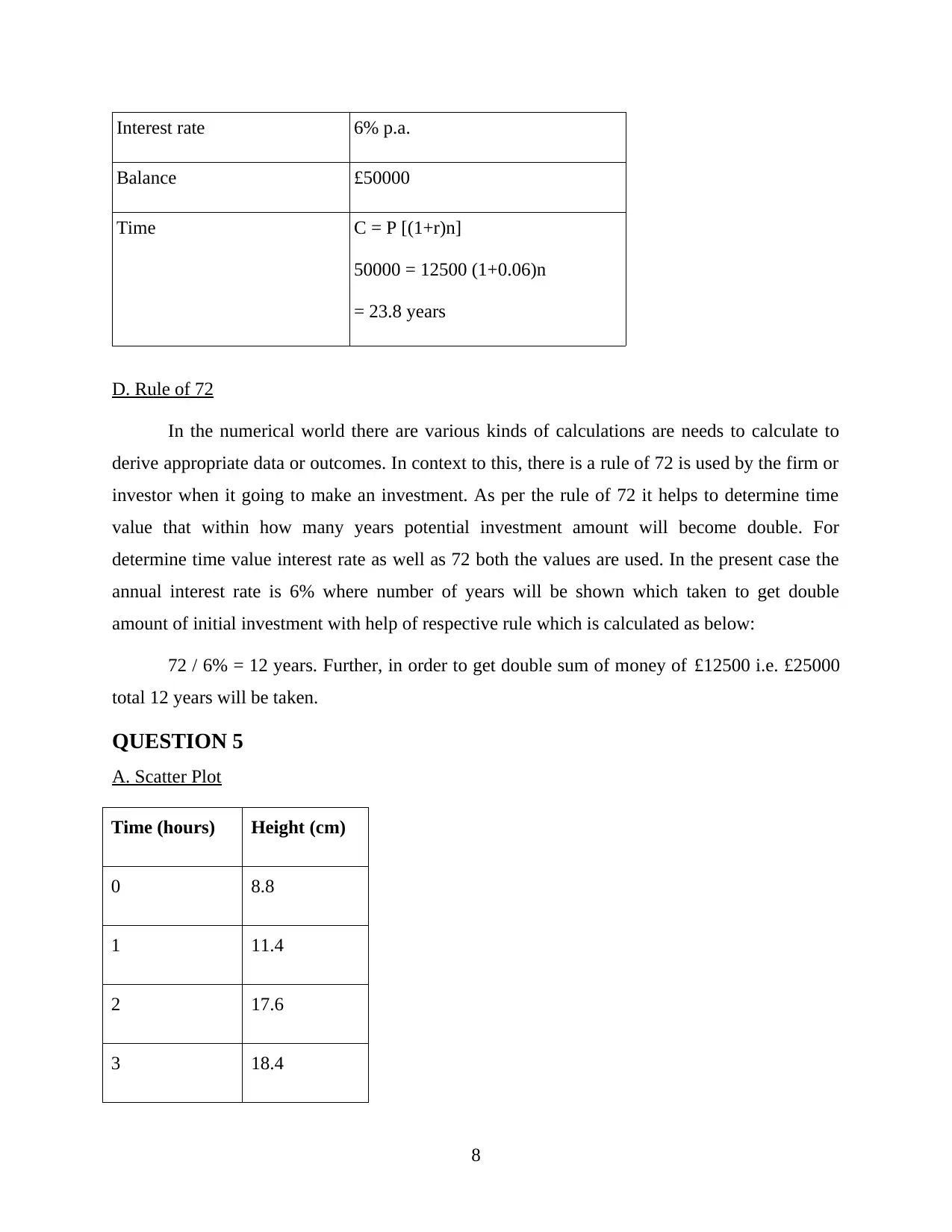
Scatter graph on the basis of above data
0 1 2 3 4 5 6
0
5
10
15
20
25
30
8.8
11.4
17.6 18.4
21.3
24.2
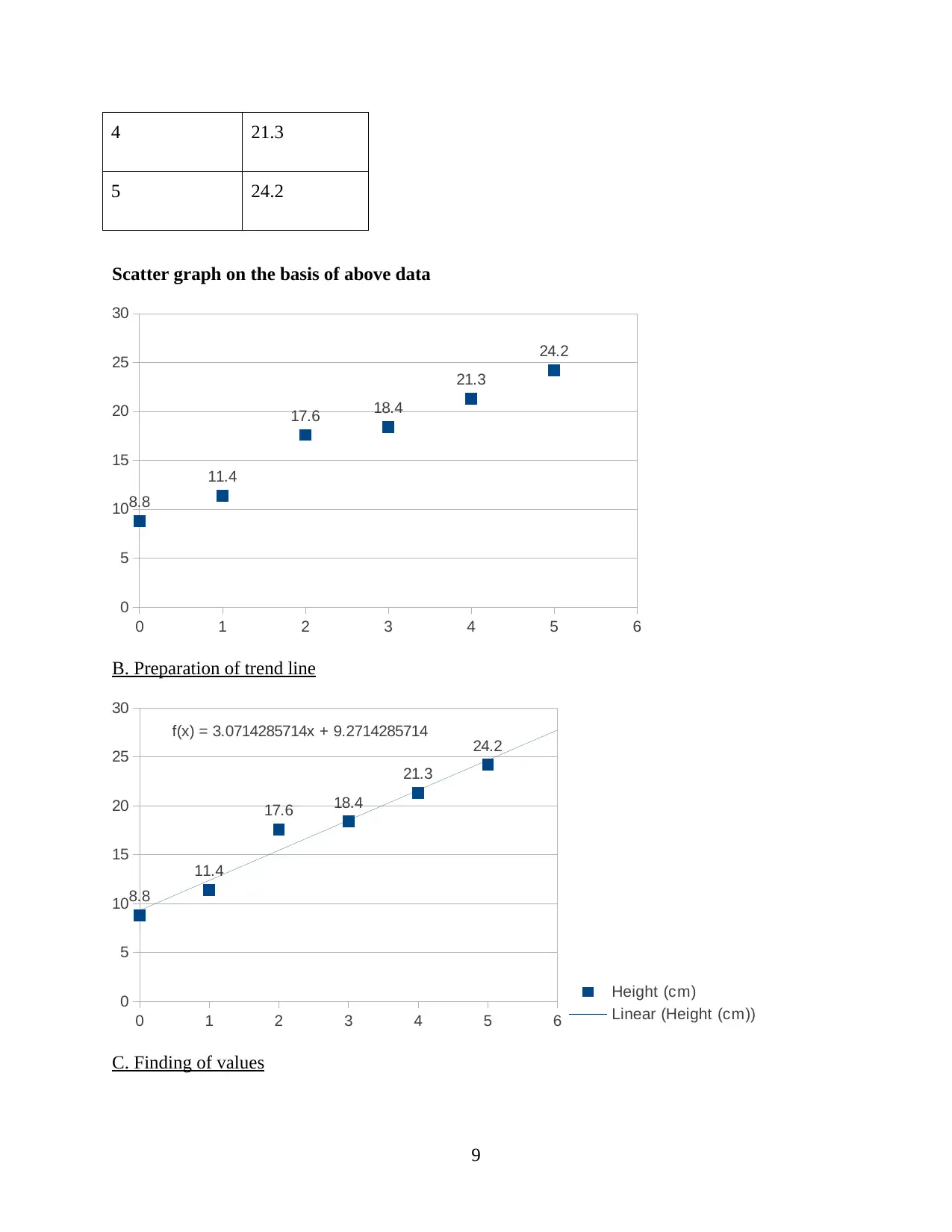
B. Preparation of trend line
0 1 2 3 4 5 6
0
5
10
15
20
25
30
8.8
11.4
17.6 18.4
21.3
24.2
f(x) = 3.0714285714x + 9.2714285714
Height (cm)
Linear (Height (cm))
C. Finding of values
9
Document Page
From the above mentioned analysis it can be determined that as the time in terms of hours
increase then height as well. Value of the the variable is like as below:
f(x) = 3.071x + 9.271
f(2.5) = (3.071 * 2.5) + 9.271
2.5 = 86.046
Value of the x is assumed which is 2.5 and on the basis of these value of the depended
variable will be 86.046. It shows that when on variable fluctuate then another as well from the
86.046.
D. Estimation of age of plant
From the above analysis age of the plan can be estimated as below:
= (86.046 * 5) / 24.2
= 430.23 / 24.2
= 17.78.
QUESTION 6
A. Net present value of the machine
Years
Cash flow of machine
(Amount in £)
Discounting factor @
8%
Present value of
machine
Initial investment 57500
1 10000 0.926 9259
2 12000 0.857 10288
3 20000 0.794 15877
4 20000 0.735 14701
Summation £50125
10
chevron_up_icon
1 out of 14
circle_padding
hide_on_mobile
zoom_out_icon
[object Object]