Organisation Behaviour: Team Dynamics and Philosophies Report
VerifiedAdded on 2020/06/06
|10
|2685
|108
Report
AI Summary
This report provides a comprehensive analysis of organizational behaviour, focusing on the dynamics of effective teams and the underlying philosophies that govern them. It begins with an introduction to organizational behaviour, highlighting its significance in understanding individual and group interactions within a business context. The report then delves into the concept of effective teams versus ineffective teams, exploring the key characteristics that differentiate them. A significant portion of the report is dedicated to Bruce Tuckman's model of group development, outlining the four stages of forming, storming, norming, and performing, and providing insights into the behaviours and leadership styles appropriate for each stage. Furthermore, the report examines various concepts and philosophies of organizational behaviour, such as individual differences, perception, motivated behaviour, organizations as social systems, and the holistic concept, illustrating how these factors influence employee behaviour and organizational effectiveness. The report concludes by summarizing the key findings and emphasizing the importance of organizational behaviour in fostering a productive and harmonious work environment.
ORGANISATION
BEHAVIOUR
BEHAVIOUR

Paraphrase This Document
Need a fresh take? Get an instant paraphrase of this document with our AI Paraphraser
Table of Contents
INTRODUCTION...........................................................................................................................1
P3 Demonstrate an understanding of what makes an effective team as opposed to an
ineffective team......................................................................................................................1
P4: Different concept and philosophies of the organisation behaviour within the organisation
context....................................................................................................................................5
CONCLUSION................................................................................................................................6
REFERENCES................................................................................................................................8
INTRODUCTION...........................................................................................................................1
P3 Demonstrate an understanding of what makes an effective team as opposed to an
ineffective team......................................................................................................................1
P4: Different concept and philosophies of the organisation behaviour within the organisation
context....................................................................................................................................5
CONCLUSION................................................................................................................................6
REFERENCES................................................................................................................................8
INTRODUCTION
Organisation behaviour is the study of people and group in the venture in order to find
their attitude, perception and behaviour while completing the different operations and activities.
It is the study of human behaviour in the venture that how they interact with different people. It
is being classified under the three categories, that are people working in the venture, work
groups and how the venture behave. In simple words, it can be said that it is the study of people
that how they interact in the group. This study is being made so that it can create more effective
business. The report is going to cover the different group development theories and how they are
linked with the group dynamic co-operation. Other than that, it is also going to cover the
different philosophies of the organisation behaviour.
P3 Demonstrate an understanding of what makes an effective team as opposed to an
ineffective team
Co-operation is the way by which people interact with different people in the group and
in the organisation. Group dynamics is the study of behaviour which is taking place in the group.
The study is very useful for the venture because with the help of this study, organisation can
understand the decision-making behaviour, tracking the spread of diseases in society, creating
effective therapy techniques and following the emergence and popularity of new ideas and
technologies (Boddewyn, 2015). Other than that, group development also plays very significant
role in the venture. It is the process by which members of the group create, manage and work
according to the group. It is also known that group changes every time, as the task of the group
accomplished, it changes. The theories for the group development are as follows:
Psychologist Bruce Tuckman model of group development
In the year 1965, Bruce Tuckman have developed the four stages of the group
development. He has stated that there are four stages by which the group can be developed in the
organisation, that are as follows:
Stage 1: Forming: This is the first stage of the group development where organisation decides
that who will be the members of the group and who will guide and lead the group. In this stage,
members are highly dependent on the leader for the different task and activities. Leader first
decides the aim and objectives of the group and how that can be achieved. Other than that, roles
and responsibilities of the group members is not clear in this stage. Moreover, there are several
1
Organisation behaviour is the study of people and group in the venture in order to find
their attitude, perception and behaviour while completing the different operations and activities.
It is the study of human behaviour in the venture that how they interact with different people. It
is being classified under the three categories, that are people working in the venture, work
groups and how the venture behave. In simple words, it can be said that it is the study of people
that how they interact in the group. This study is being made so that it can create more effective
business. The report is going to cover the different group development theories and how they are
linked with the group dynamic co-operation. Other than that, it is also going to cover the
different philosophies of the organisation behaviour.
P3 Demonstrate an understanding of what makes an effective team as opposed to an
ineffective team
Co-operation is the way by which people interact with different people in the group and
in the organisation. Group dynamics is the study of behaviour which is taking place in the group.
The study is very useful for the venture because with the help of this study, organisation can
understand the decision-making behaviour, tracking the spread of diseases in society, creating
effective therapy techniques and following the emergence and popularity of new ideas and
technologies (Boddewyn, 2015). Other than that, group development also plays very significant
role in the venture. It is the process by which members of the group create, manage and work
according to the group. It is also known that group changes every time, as the task of the group
accomplished, it changes. The theories for the group development are as follows:
Psychologist Bruce Tuckman model of group development
In the year 1965, Bruce Tuckman have developed the four stages of the group
development. He has stated that there are four stages by which the group can be developed in the
organisation, that are as follows:
Stage 1: Forming: This is the first stage of the group development where organisation decides
that who will be the members of the group and who will guide and lead the group. In this stage,
members are highly dependent on the leader for the different task and activities. Leader first
decides the aim and objectives of the group and how that can be achieved. Other than that, roles
and responsibilities of the group members is not clear in this stage. Moreover, there are several
1
⊘ This is a preview!⊘
Do you want full access?
Subscribe today to unlock all pages.

Trusted by 1+ million students worldwide
questions that have been asked by the members of the group to the leader. This is because all the
things in the group are not clear in this stage. Leader need to be very much prepared to answer
lots of questions asked by the members. With that, different processes have been ignored by the
leader and members of the group because they are not aware about those processes (Northouse,
2015). Leadership style which is used by the leader in this stage is situational because there are
different situations that can arise in this stage. Sometimes, it can happen that members are able
to understand their roles and responsibilities and working in an effective manner and sometimes,
it might happen that members are not able to fulfil their roles and responsibilities. This is the
reason leader need to adopt the situational leadership style. Members try to build relationship
with each other so that they can work in co-ordinated way and collectively task and activities can
be completed. This helps them to accomplish all the goals and objectives of the group in an
effective and efficient manner.
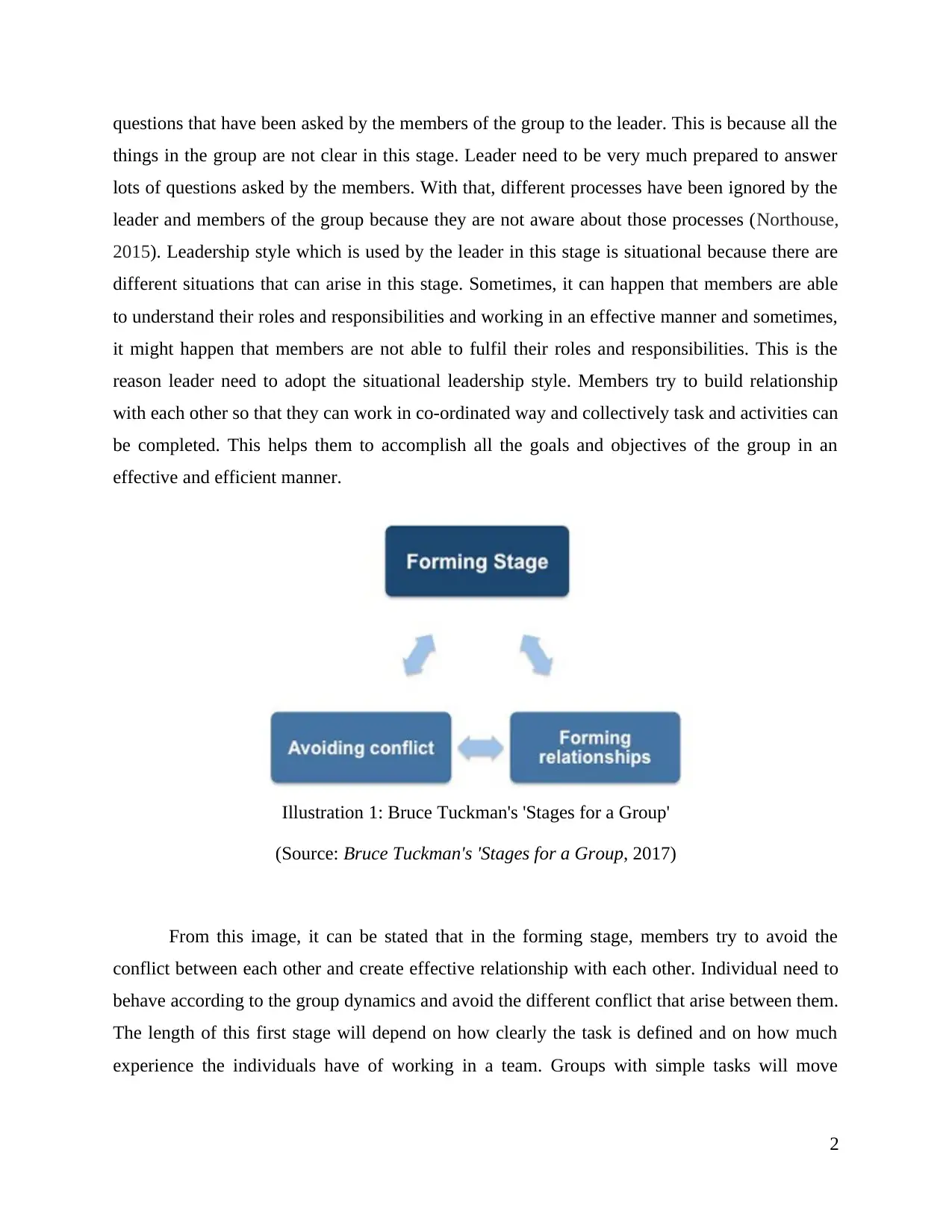
Illustration 1: Bruce Tuckman's 'Stages for a Group'
(Source: Bruce Tuckman's 'Stages for a Group, 2017)
From this image, it can be stated that in the forming stage, members try to avoid the
conflict between each other and create effective relationship with each other. Individual need to
behave according to the group dynamics and avoid the different conflict that arise between them.
The length of this first stage will depend on how clearly the task is defined and on how much
experience the individuals have of working in a team. Groups with simple tasks will move
2
things in the group are not clear in this stage. Leader need to be very much prepared to answer
lots of questions asked by the members. With that, different processes have been ignored by the
leader and members of the group because they are not aware about those processes (Northouse,
2015). Leadership style which is used by the leader in this stage is situational because there are
different situations that can arise in this stage. Sometimes, it can happen that members are able
to understand their roles and responsibilities and working in an effective manner and sometimes,
it might happen that members are not able to fulfil their roles and responsibilities. This is the
reason leader need to adopt the situational leadership style. Members try to build relationship
with each other so that they can work in co-ordinated way and collectively task and activities can
be completed. This helps them to accomplish all the goals and objectives of the group in an
effective and efficient manner.
Illustration 1: Bruce Tuckman's 'Stages for a Group'
(Source: Bruce Tuckman's 'Stages for a Group, 2017)
From this image, it can be stated that in the forming stage, members try to avoid the
conflict between each other and create effective relationship with each other. Individual need to
behave according to the group dynamics and avoid the different conflict that arise between them.
The length of this first stage will depend on how clearly the task is defined and on how much
experience the individuals have of working in a team. Groups with simple tasks will move
2
Paraphrase This Document
Need a fresh take? Get an instant paraphrase of this document with our AI Paraphraser
through orientation quickly but groups with complex goals and tasks may spend much longer in
this stage.
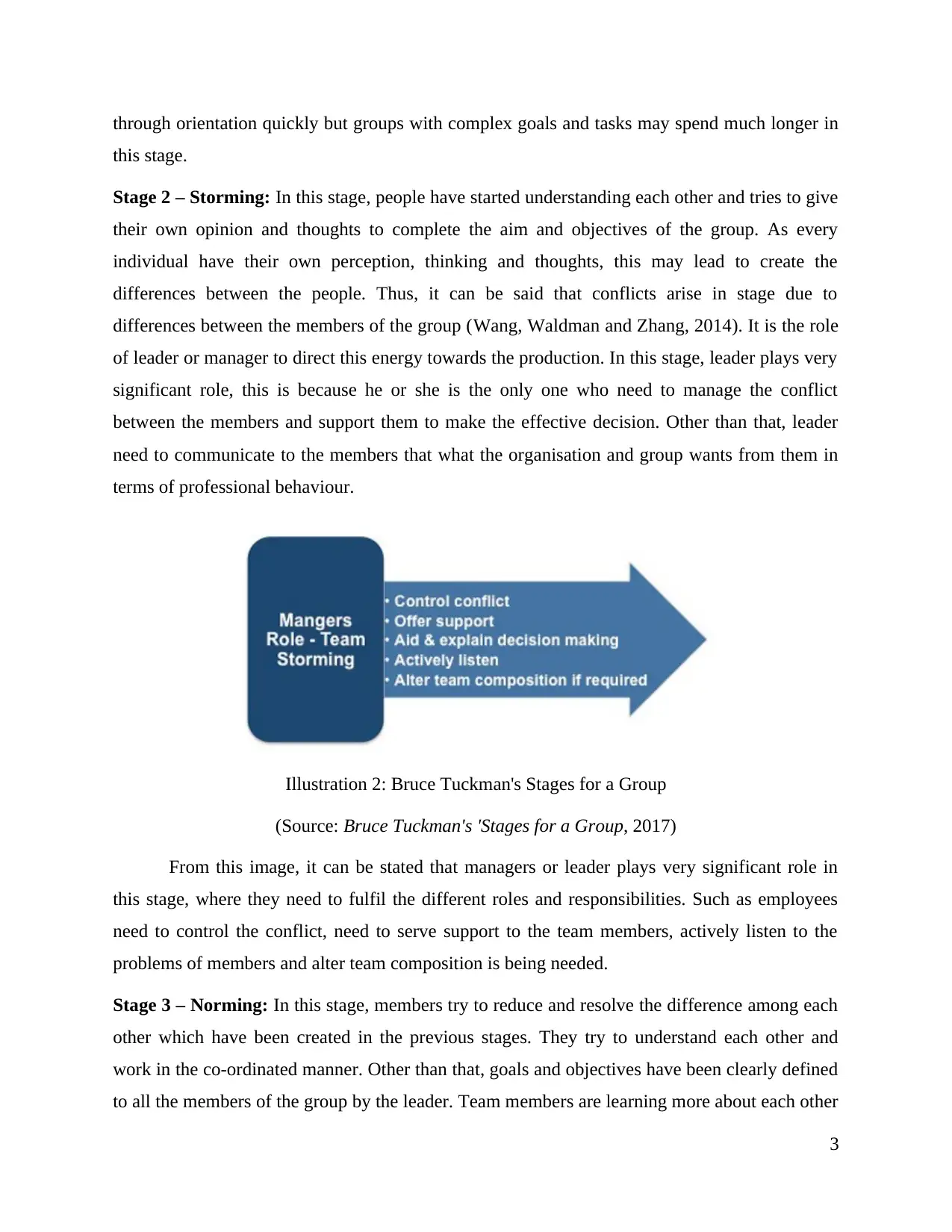
Stage 2 – Storming: In this stage, people have started understanding each other and tries to give
their own opinion and thoughts to complete the aim and objectives of the group. As every
individual have their own perception, thinking and thoughts, this may lead to create the
differences between the people. Thus, it can be said that conflicts arise in stage due to
differences between the members of the group (Wang, Waldman and Zhang, 2014). It is the role
of leader or manager to direct this energy towards the production. In this stage, leader plays very
significant role, this is because he or she is the only one who need to manage the conflict
between the members and support them to make the effective decision. Other than that, leader
need to communicate to the members that what the organisation and group wants from them in
terms of professional behaviour.
Illustration 2: Bruce Tuckman's Stages for a Group
(Source: Bruce Tuckman's 'Stages for a Group, 2017)
From this image, it can be stated that managers or leader plays very significant role in
this stage, where they need to fulfil the different roles and responsibilities. Such as employees
need to control the conflict, need to serve support to the team members, actively listen to the
problems of members and alter team composition is being needed.
Stage 3 – Norming: In this stage, members try to reduce and resolve the difference among each
other which have been created in the previous stages. They try to understand each other and
work in the co-ordinated manner. Other than that, goals and objectives have been clearly defined
to all the members of the group by the leader. Team members are learning more about each other
3
this stage.
Stage 2 – Storming: In this stage, people have started understanding each other and tries to give
their own opinion and thoughts to complete the aim and objectives of the group. As every
individual have their own perception, thinking and thoughts, this may lead to create the
differences between the people. Thus, it can be said that conflicts arise in stage due to
differences between the members of the group (Wang, Waldman and Zhang, 2014). It is the role
of leader or manager to direct this energy towards the production. In this stage, leader plays very
significant role, this is because he or she is the only one who need to manage the conflict
between the members and support them to make the effective decision. Other than that, leader
need to communicate to the members that what the organisation and group wants from them in
terms of professional behaviour.
Illustration 2: Bruce Tuckman's Stages for a Group
(Source: Bruce Tuckman's 'Stages for a Group, 2017)
From this image, it can be stated that managers or leader plays very significant role in
this stage, where they need to fulfil the different roles and responsibilities. Such as employees
need to control the conflict, need to serve support to the team members, actively listen to the
problems of members and alter team composition is being needed.
Stage 3 – Norming: In this stage, members try to reduce and resolve the difference among each
other which have been created in the previous stages. They try to understand each other and
work in the co-ordinated manner. Other than that, goals and objectives have been clearly defined
to all the members of the group by the leader. Team members are learning more about each other
3
and how they will work together and are developing tools such as a problem-solving process, a
code of conduct, a set of team values, and measurement indicators (Arends, 2014). Now, all the
members need to focus on completing the processes of the group rather than wasting the time on
focusing on resolving the dispute between the members.
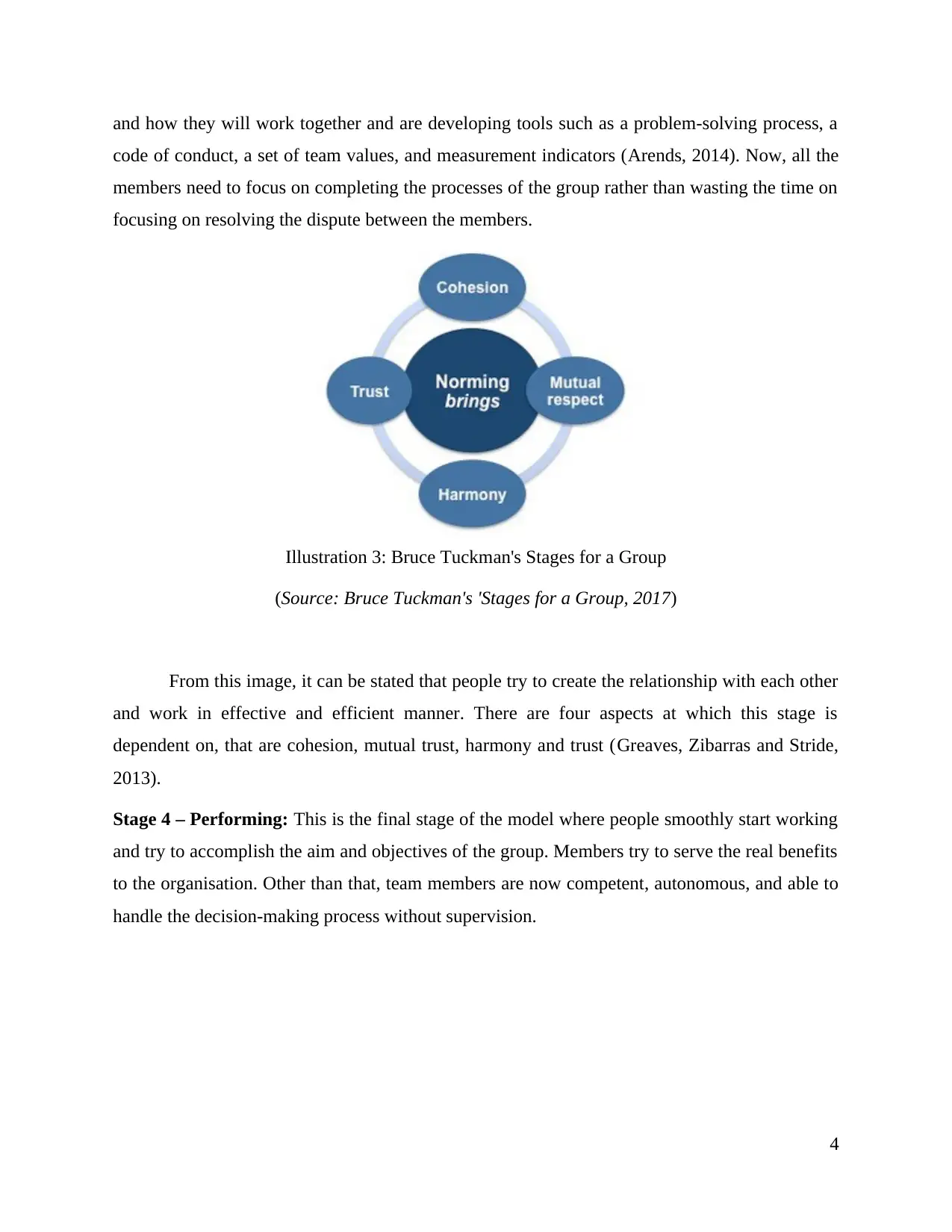
Illustration 3: Bruce Tuckman's Stages for a Group
(Source: Bruce Tuckman's 'Stages for a Group, 2017)
From this image, it can be stated that people try to create the relationship with each other
and work in effective and efficient manner. There are four aspects at which this stage is
dependent on, that are cohesion, mutual trust, harmony and trust (Greaves, Zibarras and Stride,
2013).
Stage 4 – Performing: This is the final stage of the model where people smoothly start working
and try to accomplish the aim and objectives of the group. Members try to serve the real benefits
to the organisation. Other than that, team members are now competent, autonomous, and able to
handle the decision-making process without supervision.
4
code of conduct, a set of team values, and measurement indicators (Arends, 2014). Now, all the
members need to focus on completing the processes of the group rather than wasting the time on
focusing on resolving the dispute between the members.
Illustration 3: Bruce Tuckman's Stages for a Group
(Source: Bruce Tuckman's 'Stages for a Group, 2017)
From this image, it can be stated that people try to create the relationship with each other
and work in effective and efficient manner. There are four aspects at which this stage is
dependent on, that are cohesion, mutual trust, harmony and trust (Greaves, Zibarras and Stride,
2013).
Stage 4 – Performing: This is the final stage of the model where people smoothly start working
and try to accomplish the aim and objectives of the group. Members try to serve the real benefits
to the organisation. Other than that, team members are now competent, autonomous, and able to
handle the decision-making process without supervision.
4
⊘ This is a preview!⊘
Do you want full access?
Subscribe today to unlock all pages.
Trusted by 1+ million students worldwide
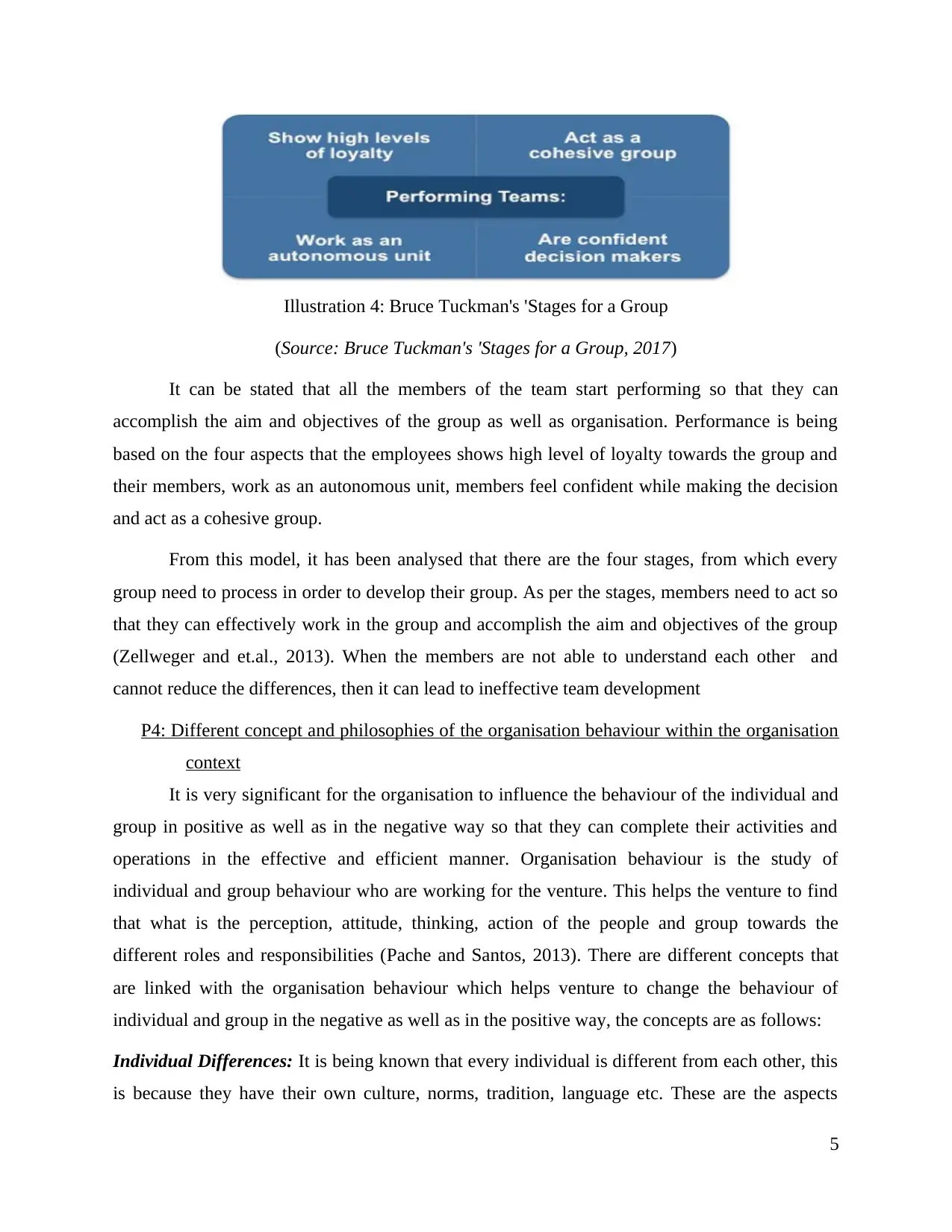
Illustration 4: Bruce Tuckman's 'Stages for a Group
(Source: Bruce Tuckman's 'Stages for a Group, 2017)
It can be stated that all the members of the team start performing so that they can
accomplish the aim and objectives of the group as well as organisation. Performance is being
based on the four aspects that the employees shows high level of loyalty towards the group and
their members, work as an autonomous unit, members feel confident while making the decision
and act as a cohesive group.
From this model, it has been analysed that there are the four stages, from which every
group need to process in order to develop their group. As per the stages, members need to act so
that they can effectively work in the group and accomplish the aim and objectives of the group
(Zellweger and et.al., 2013). When the members are not able to understand each other and
cannot reduce the differences, then it can lead to ineffective team development
P4: Different concept and philosophies of the organisation behaviour within the organisation
context
It is very significant for the organisation to influence the behaviour of the individual and
group in positive as well as in the negative way so that they can complete their activities and
operations in the effective and efficient manner. Organisation behaviour is the study of
individual and group behaviour who are working for the venture. This helps the venture to find
that what is the perception, attitude, thinking, action of the people and group towards the
different roles and responsibilities (Pache and Santos, 2013). There are different concepts that
are linked with the organisation behaviour which helps venture to change the behaviour of
individual and group in the negative as well as in the positive way, the concepts are as follows:
Individual Differences: It is being known that every individual is different from each other, this
is because they have their own culture, norms, tradition, language etc. These are the aspects
5
(Source: Bruce Tuckman's 'Stages for a Group, 2017)
It can be stated that all the members of the team start performing so that they can
accomplish the aim and objectives of the group as well as organisation. Performance is being
based on the four aspects that the employees shows high level of loyalty towards the group and
their members, work as an autonomous unit, members feel confident while making the decision
and act as a cohesive group.
From this model, it has been analysed that there are the four stages, from which every
group need to process in order to develop their group. As per the stages, members need to act so
that they can effectively work in the group and accomplish the aim and objectives of the group
(Zellweger and et.al., 2013). When the members are not able to understand each other and
cannot reduce the differences, then it can lead to ineffective team development
P4: Different concept and philosophies of the organisation behaviour within the organisation
context
It is very significant for the organisation to influence the behaviour of the individual and
group in positive as well as in the negative way so that they can complete their activities and
operations in the effective and efficient manner. Organisation behaviour is the study of
individual and group behaviour who are working for the venture. This helps the venture to find
that what is the perception, attitude, thinking, action of the people and group towards the
different roles and responsibilities (Pache and Santos, 2013). There are different concepts that
are linked with the organisation behaviour which helps venture to change the behaviour of
individual and group in the negative as well as in the positive way, the concepts are as follows:
Individual Differences: It is being known that every individual is different from each other, this
is because they have their own culture, norms, tradition, language etc. These are the aspects
5
Paraphrase This Document
Need a fresh take? Get an instant paraphrase of this document with our AI Paraphraser
which creates the perception, action and behaviour in the individual. This is the reason
differences are created and this is the reason it is significant for the organisation to understand
organisation behaviour with the help of differences.
Perception: It is the way of thinking and perceiving the internal and external stimuli. There are
several things that is observed by the individual and as per that observation, people create the
image of that stimuli. Due to several differences, every individual has their own perception. A
person always organizes and interprets what he sees according to his lifetime of experience and
accumulated value (Majchrzak and et.al., 2014). Employees also see their work in different
manner due to their needs, personality, experience, social surroundings etc.
Motivated Behaviour: It is being known that there are several activities and operations that are
being done by the employees in the organisation. In order to complete those activities in an
effective and efficient manner, employees need proper motivation. It is the factor which is being
derived from the different factors of the organisation such as salary, environment, reward etc.
Thus, venture need to consider all these factors so that they can motivate the employees in order
to influence their behaviour in order to work effectively (Saaty and Kearns, 2014).
Organizations are Social System: It has been known that organisations are the social systems
which is being governed by the social laws as well as psychological laws. This is because people
work for the organisation and they have their own need and desire which helps them to play their
social status and roles. Behaviour of the individual have been influenced by the group as well as
their desires. Thus, it is significant for the organisation to understand the needs and wants of the
employees which helps venture to influence the behaviour of employees.
Holistic Concept: It is fundamental concept of the organisation behaviour which states
relationship between the management and employees. In order to identify the behaviour of
employees in the organisation, it is very significant for management to build relationship with
the employees (Chen and et.al., 2014). Other than that, there are several issues faced by the
employees in the organisation, if the relationship is strong, then employer can understand the
problems faced by the employee.
CONCLUSION
It can be concluded from the project report that organisation behaviour plays very
significant role in the organisation. This is because it helps the venture to identify that how the
6
differences are created and this is the reason it is significant for the organisation to understand
organisation behaviour with the help of differences.
Perception: It is the way of thinking and perceiving the internal and external stimuli. There are
several things that is observed by the individual and as per that observation, people create the
image of that stimuli. Due to several differences, every individual has their own perception. A
person always organizes and interprets what he sees according to his lifetime of experience and
accumulated value (Majchrzak and et.al., 2014). Employees also see their work in different
manner due to their needs, personality, experience, social surroundings etc.
Motivated Behaviour: It is being known that there are several activities and operations that are
being done by the employees in the organisation. In order to complete those activities in an
effective and efficient manner, employees need proper motivation. It is the factor which is being
derived from the different factors of the organisation such as salary, environment, reward etc.
Thus, venture need to consider all these factors so that they can motivate the employees in order
to influence their behaviour in order to work effectively (Saaty and Kearns, 2014).
Organizations are Social System: It has been known that organisations are the social systems
which is being governed by the social laws as well as psychological laws. This is because people
work for the organisation and they have their own need and desire which helps them to play their
social status and roles. Behaviour of the individual have been influenced by the group as well as
their desires. Thus, it is significant for the organisation to understand the needs and wants of the
employees which helps venture to influence the behaviour of employees.
Holistic Concept: It is fundamental concept of the organisation behaviour which states
relationship between the management and employees. In order to identify the behaviour of
employees in the organisation, it is very significant for management to build relationship with
the employees (Chen and et.al., 2014). Other than that, there are several issues faced by the
employees in the organisation, if the relationship is strong, then employer can understand the
problems faced by the employee.
CONCLUSION
It can be concluded from the project report that organisation behaviour plays very
significant role in the organisation. This is because it helps the venture to identify that how the
6
people act individual and in the group in order to complete their roles and responsibilities. There
are several concepts that are linked with the organisation behaviour such as Perception,
Motivated Behaviour, Organisations are Social System, Holistic Concept etc. These concepts
help the organisation to influence the behaviour of employees in an effective and efficient
manner.
7
are several concepts that are linked with the organisation behaviour such as Perception,
Motivated Behaviour, Organisations are Social System, Holistic Concept etc. These concepts
help the organisation to influence the behaviour of employees in an effective and efficient
manner.
7
⊘ This is a preview!⊘
Do you want full access?
Subscribe today to unlock all pages.
Trusted by 1+ million students worldwide
REFERENCES
Books and Journals:
Arends, R., 2014. Learning to teach. McGraw-Hill Higher Education.
Boddewyn, J. J., 2015. Political aspects of MNE theory. In The Eclectic Paradigm (pp. 85-110).
Palgrave Macmillan UK.
Carter, M. Z. and et.al., 2013. Transformational leadership, relationship quality, and employee
performance during continuous incremental organizational change. Journal of
Organizational Behavior. 34(7). pp.942-958.
Chen, X. P. and et.al., 2014. Affective trust in Chinese leaders: Linking paternalistic leadership
to employee performance. Journal of management. 40(3). pp.796-819.
Greaves, M., Zibarras, L. D. and Stride, C., 2013. Using the theory of planned behavior to
explore environmental behavioral intentions in the workplace. Journal of Environmental
Psychology. 34. pp.109-120.
Majchrzak, A. and et.al., 2014. Computer-mediated inter-organizational knowledge-sharing:
Insights from a virtual team innovating using a collaborative tool.
Northouse, P. G., 2015. Leadership: Theory and practice. Sage publications.
Pache, A. C. and Santos, F., 2013. Inside the hybrid organization: Selective coupling as a
response to competing institutional logics. Academy of Management Journal. 56(4).
pp.972-1001.
Parris, D. L. and Peachey, J. W., 2013. A systematic literature review of servant leadership
theory in organizational contexts. Journal of business ethics. 113(3). pp.377-393.
Saaty, T. L. and Kearns, K. P., 2014. Analytical planning: The organization of system (Vol. 7).
Elsevier.
Schwab, D. P., 2013. Research methods for organizational studies. Psychology Press.
Wang, D., Waldman, D. A. and Zhang, Z., 2014. A meta-analysis of shared leadership and team
effectiveness.
Yarbrough, B. V. and Yarbrough, R. M., 2014. Cooperation and governance in international
trade: The strategic organizational approach. Princeton University Press.
Zellweger, T. M. and et.al., 2013. Why do family firms strive for nonfinancial goals? An
organizational identity perspective. Entrepreneurship Theory and Practice. 37(2). pp.229-
248.
8
Books and Journals:
Arends, R., 2014. Learning to teach. McGraw-Hill Higher Education.
Boddewyn, J. J., 2015. Political aspects of MNE theory. In The Eclectic Paradigm (pp. 85-110).
Palgrave Macmillan UK.
Carter, M. Z. and et.al., 2013. Transformational leadership, relationship quality, and employee
performance during continuous incremental organizational change. Journal of
Organizational Behavior. 34(7). pp.942-958.
Chen, X. P. and et.al., 2014. Affective trust in Chinese leaders: Linking paternalistic leadership
to employee performance. Journal of management. 40(3). pp.796-819.
Greaves, M., Zibarras, L. D. and Stride, C., 2013. Using the theory of planned behavior to
explore environmental behavioral intentions in the workplace. Journal of Environmental
Psychology. 34. pp.109-120.
Majchrzak, A. and et.al., 2014. Computer-mediated inter-organizational knowledge-sharing:
Insights from a virtual team innovating using a collaborative tool.
Northouse, P. G., 2015. Leadership: Theory and practice. Sage publications.
Pache, A. C. and Santos, F., 2013. Inside the hybrid organization: Selective coupling as a
response to competing institutional logics. Academy of Management Journal. 56(4).
pp.972-1001.
Parris, D. L. and Peachey, J. W., 2013. A systematic literature review of servant leadership
theory in organizational contexts. Journal of business ethics. 113(3). pp.377-393.
Saaty, T. L. and Kearns, K. P., 2014. Analytical planning: The organization of system (Vol. 7).
Elsevier.
Schwab, D. P., 2013. Research methods for organizational studies. Psychology Press.
Wang, D., Waldman, D. A. and Zhang, Z., 2014. A meta-analysis of shared leadership and team
effectiveness.
Yarbrough, B. V. and Yarbrough, R. M., 2014. Cooperation and governance in international
trade: The strategic organizational approach. Princeton University Press.
Zellweger, T. M. and et.al., 2013. Why do family firms strive for nonfinancial goals? An
organizational identity perspective. Entrepreneurship Theory and Practice. 37(2). pp.229-
248.
8

1 out of 10


Related Documents


Your All-in-One AI-Powered Toolkit for Academic Success.
+13062052269
info@desklib.com
Available 24*7 on WhatsApp / Email
![[object Object]](/_next/static/media/star-bottom.7253800d.svg)
Unlock your academic potential
Copyright © 2020–2026 A2Z Services. All Rights Reserved. Developed and managed by ZUCOL.