GBMT 4004 - Visa Europe's Management and Organisational Behaviour
VerifiedAdded on 2024/07/18
|15
|2686
|352
Report
AI Summary
This report provides an in-depth analysis of Visa Europe's organisational behaviour, focusing on its culture, power dynamics, motivation theories, team arrangements, and leadership styles. It examines Visa Europe's mixed culture, influenced by power distances, individualism, and achievement, using Hofstede's model. The report explores the company's application of Herzberg's Two-Factor Theory and McClelland's Three Needs Theory to motivate employees, along with various motivation techniques. It also discusses the use of cross-functional and virtual teams and suggests improvements through goal-setting, strong leadership, and regular feedback. The leadership at Visa Europe is analyzed using the Competing Values Framework, highlighting its result-oriented and competitive nature. Furthermore, the report proposes integrating Path-Goal Theory and Situational Leadership Theory to enhance organisational behaviour by aligning leadership styles with employees' needs and maturity levels. The report concludes with strategic recommendations for enhancing communication, professional development, and flexible work arrangements to foster a supportive work environment and improve employee productivity.
Assignment Submission Form
Student Name/
Group Members
Student ID
Program Qualification BA(Hons) Business Management
Module Title and Code Management and Organisational Behaviour
GBMT 4004
Component Number and Weighting CW1, 100%
Assignment Title Component 1 Written Assignment-
Individual Report
Assignment Deadline Term 2- Week 9 – 27th July 2024
Partnership University University for Creative Arts
Student Name/
Group Members
Student ID
Program Qualification BA(Hons) Business Management
Module Title and Code Management and Organisational Behaviour
GBMT 4004
Component Number and Weighting CW1, 100%
Assignment Title Component 1 Written Assignment-
Individual Report
Assignment Deadline Term 2- Week 9 – 27th July 2024
Partnership University University for Creative Arts

Paraphrase This Document
Need a fresh take? Get an instant paraphrase of this document with our AI Paraphraser
Executive Summary
This report examines the organisational behaviour of Visa Europe, one of the financial services
leaders in London. The report focuses on the culture, power, motivational theories and models,
team arrangements and leadership styles applied at Visa Europe. Visa Europe has a mixed culture
with power distances, individualism and achievement which are further discussed in the paper. The
company’s use of Herzberg’s Two-Factor Theory and McClallend’s Three Needs Theory to
motivate its employees by different techniques are also explained in detail in the paper with
appropriate models. Visa Europe uses cross-functional or virtual team arrangements and there are
recommendations to make the team more effective by goal-setting, powerful leadership and regular
feedback. The leadership at Visa Europe is elaborated using the Competing Values Framework as
Visa Europe is result-oriented and competitive. The paper also explains how Visa Europe can
integrate Path-Goal Theory and Situational Leadership Theory to bring a positive change to
organisational behaviour by matching leadership styles with followers’ needs and maturity levels.
These approaches create a supportive working environment that sets up workers for success in their
tasks. The report concludes with some strategic recommendations for enhancing communication,
professional development and flexible work arrangements at Visa Europe.
This report examines the organisational behaviour of Visa Europe, one of the financial services
leaders in London. The report focuses on the culture, power, motivational theories and models,
team arrangements and leadership styles applied at Visa Europe. Visa Europe has a mixed culture
with power distances, individualism and achievement which are further discussed in the paper. The
company’s use of Herzberg’s Two-Factor Theory and McClallend’s Three Needs Theory to
motivate its employees by different techniques are also explained in detail in the paper with
appropriate models. Visa Europe uses cross-functional or virtual team arrangements and there are
recommendations to make the team more effective by goal-setting, powerful leadership and regular
feedback. The leadership at Visa Europe is elaborated using the Competing Values Framework as
Visa Europe is result-oriented and competitive. The paper also explains how Visa Europe can
integrate Path-Goal Theory and Situational Leadership Theory to bring a positive change to
organisational behaviour by matching leadership styles with followers’ needs and maturity levels.
These approaches create a supportive working environment that sets up workers for success in their
tasks. The report concludes with some strategic recommendations for enhancing communication,
professional development and flexible work arrangements at Visa Europe.
Table of Contents
Introduction....................................................................................................................................1
Culture and Power Analysis of Visa Europe...............................................................................2
Overview of Culture.....................................................................................................................2
Culture Observed in Visa Europe Using Hofstede’s Model........................................................2
Types and Sources of Power Observed in Visa Europe...............................................................3
Formal Power........................................................................................................................... 3
Personal Power......................................................................................................................... 3
Power Tactics and Their Consequences.......................................................................................3
Examples of Power Tactics......................................................................................................3
Impact on Individual and Team Behaviour.............................................................................. 3
Motivation Theories, Models and Techniques............................................................................4
Application of Motivation Theories and Models in Visa Europe................................................5
Examples of Motivation Techniques........................................................................................... 6
Improving Staff Performance.......................................................................................................6
Teams at Visa Europe................................................................................................................... 6
Effectiveness of Teams................................................................................................................ 7
Leadership at Visa Europe........................................................................................................... 7
Path-Goal and Situational Leadership Approaches.....................................................................8
Path-Goal Theory.....................................................................................................................8
Situational Leadership Theory................................................................................................. 9
Improving Organisation Behaviour with Path-Goal and Situational Leadership Theory at Visa
Europe.......................................................................................................................................... 9
Conclusion With Recommendation............................................................................................10
References.....................................................................................................................................11
Introduction....................................................................................................................................1
Culture and Power Analysis of Visa Europe...............................................................................2
Overview of Culture.....................................................................................................................2
Culture Observed in Visa Europe Using Hofstede’s Model........................................................2
Types and Sources of Power Observed in Visa Europe...............................................................3
Formal Power........................................................................................................................... 3
Personal Power......................................................................................................................... 3
Power Tactics and Their Consequences.......................................................................................3
Examples of Power Tactics......................................................................................................3
Impact on Individual and Team Behaviour.............................................................................. 3
Motivation Theories, Models and Techniques............................................................................4
Application of Motivation Theories and Models in Visa Europe................................................5
Examples of Motivation Techniques........................................................................................... 6
Improving Staff Performance.......................................................................................................6
Teams at Visa Europe................................................................................................................... 6
Effectiveness of Teams................................................................................................................ 7
Leadership at Visa Europe........................................................................................................... 7
Path-Goal and Situational Leadership Approaches.....................................................................8
Path-Goal Theory.....................................................................................................................8
Situational Leadership Theory................................................................................................. 9
Improving Organisation Behaviour with Path-Goal and Situational Leadership Theory at Visa
Europe.......................................................................................................................................... 9
Conclusion With Recommendation............................................................................................10
References.....................................................................................................................................11
⊘ This is a preview!⊘
Do you want full access?
Subscribe today to unlock all pages.

Trusted by 1+ million students worldwide
P a g e | 1
Introduction
Organisation behaviour is the study of human interactions within groups in an organisation to be
effective and efficient in everyday responsibility. It is crucial to understand organisational
behaviour because it can greatly increase employees’ performance, satisfaction and overall success
in the organisation. This report presents an analysis of Visa Europe’s organisational behaviour,
culture and power dynamics, motivational theories, team arrangements and leadership behaviours
that encompass its overall operating environment. Visa Europe, headquartered in London, United
Kingdom, is a leading and innovative financial organisation popularly known for electronic
payments and state-of-the-art financial technology solutions across Europe. Visa Europe has gone
through significant cultural changes over the previous years to remain competitive in the market.
This report will cover the application of different models of culture and power dimensions,
motivation and leadership theory and team arrangement models and how they are contributing to
the organisational behaviour of Visa Europe.
Introduction
Organisation behaviour is the study of human interactions within groups in an organisation to be
effective and efficient in everyday responsibility. It is crucial to understand organisational
behaviour because it can greatly increase employees’ performance, satisfaction and overall success
in the organisation. This report presents an analysis of Visa Europe’s organisational behaviour,
culture and power dynamics, motivational theories, team arrangements and leadership behaviours
that encompass its overall operating environment. Visa Europe, headquartered in London, United
Kingdom, is a leading and innovative financial organisation popularly known for electronic
payments and state-of-the-art financial technology solutions across Europe. Visa Europe has gone
through significant cultural changes over the previous years to remain competitive in the market.
This report will cover the application of different models of culture and power dimensions,
motivation and leadership theory and team arrangement models and how they are contributing to
the organisational behaviour of Visa Europe.
Paraphrase This Document
Need a fresh take? Get an instant paraphrase of this document with our AI Paraphraser
P a g e | 2
Culture and Power Analysis of Visa Europe
Overview of Culture
Organisation culture may be defined as the set of values, beliefs, norms, standards and practices
shared by the people in the organisation. On the other hand, power is the extent of control to
influence the behaviour of the members of the organisation (Robbins and Judge, 2022). In the case
of Visa Europe, there has been a significant shift in the organisational culture due to its
organisational structure and its competitive market environment (Visa Europe Organisation’s
Peak Performance, 2021).
Culture Observed in Visa Europe Using Hofstede’s Model
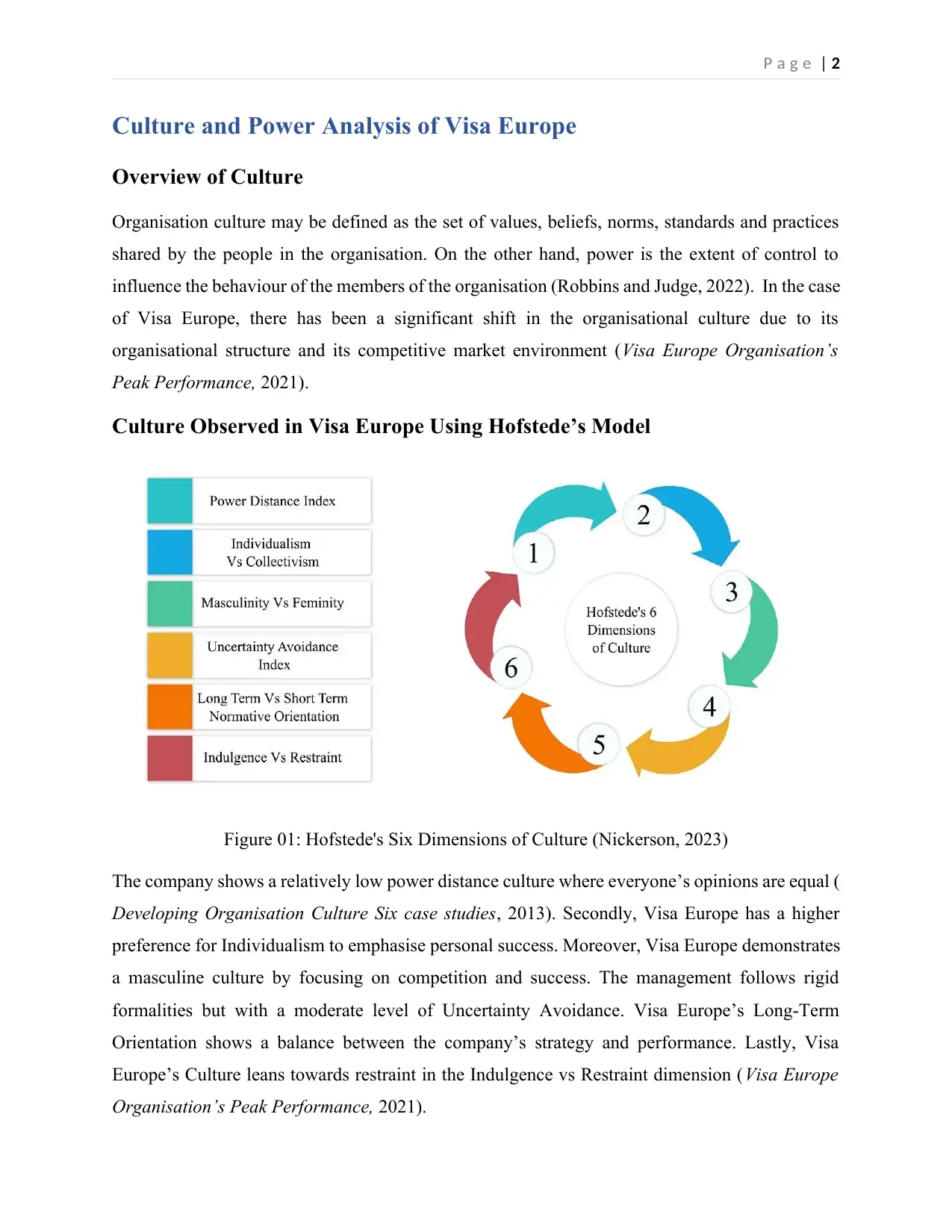
Figure 01: Hofstede's Six Dimensions of Culture (Nickerson, 2023)
The company shows a relatively low power distance culture where everyone’s opinions are equal (
Developing Organisation Culture Six case studies, 2013). Secondly, Visa Europe has a higher
preference for Individualism to emphasise personal success. Moreover, Visa Europe demonstrates
a masculine culture by focusing on competition and success. The management follows rigid
formalities but with a moderate level of Uncertainty Avoidance. Visa Europe’s Long-Term
Orientation shows a balance between the company’s strategy and performance. Lastly, Visa
Europe’s Culture leans towards restraint in the Indulgence vs Restraint dimension (Visa Europe
Organisation’s Peak Performance, 2021).
Culture and Power Analysis of Visa Europe
Overview of Culture
Organisation culture may be defined as the set of values, beliefs, norms, standards and practices
shared by the people in the organisation. On the other hand, power is the extent of control to
influence the behaviour of the members of the organisation (Robbins and Judge, 2022). In the case
of Visa Europe, there has been a significant shift in the organisational culture due to its
organisational structure and its competitive market environment (Visa Europe Organisation’s
Peak Performance, 2021).
Culture Observed in Visa Europe Using Hofstede’s Model
Figure 01: Hofstede's Six Dimensions of Culture (Nickerson, 2023)
The company shows a relatively low power distance culture where everyone’s opinions are equal (
Developing Organisation Culture Six case studies, 2013). Secondly, Visa Europe has a higher
preference for Individualism to emphasise personal success. Moreover, Visa Europe demonstrates
a masculine culture by focusing on competition and success. The management follows rigid
formalities but with a moderate level of Uncertainty Avoidance. Visa Europe’s Long-Term
Orientation shows a balance between the company’s strategy and performance. Lastly, Visa
Europe’s Culture leans towards restraint in the Indulgence vs Restraint dimension (Visa Europe
Organisation’s Peak Performance, 2021).
P a g e | 3
Types and Sources of Power Observed in Visa Europe
Formal Power
Reward power is used by offering incentives to foster performance and Legitimate Power is
considerable, deriving from official roles.
Personal Power
Expert power is prevalent where leaders make decisions through expertise and referent power is
also considerable where leaders inspire employees through interpersonal interaction (Developing
Organisation Culture Six case studies, 2013).
Power Tactics and Their Consequences
Examples of Power Tactics
Structured performance review systems and definitive metrics contribute to increased motivation
among Visa Europe’s employees but they often lead to pressure. On the other hand, rewards like
bonuses and promotions motivate employees but lead to conflict and rivalry.
Impact on Individual and Team Behaviour
While high pressure can increase productivity, not balancing the pressure may result in burnout and
turnover. Reward systems often improve employee retention but focusing on the individual
employees can lead to conflicts. In this case, working in teams can minimise the problem.
(Developing organisation culture Six case studies, 2013).
Types and Sources of Power Observed in Visa Europe
Formal Power
Reward power is used by offering incentives to foster performance and Legitimate Power is
considerable, deriving from official roles.
Personal Power
Expert power is prevalent where leaders make decisions through expertise and referent power is
also considerable where leaders inspire employees through interpersonal interaction (Developing
Organisation Culture Six case studies, 2013).
Power Tactics and Their Consequences
Examples of Power Tactics
Structured performance review systems and definitive metrics contribute to increased motivation
among Visa Europe’s employees but they often lead to pressure. On the other hand, rewards like
bonuses and promotions motivate employees but lead to conflict and rivalry.
Impact on Individual and Team Behaviour
While high pressure can increase productivity, not balancing the pressure may result in burnout and
turnover. Reward systems often improve employee retention but focusing on the individual
employees can lead to conflicts. In this case, working in teams can minimise the problem.
(Developing organisation culture Six case studies, 2013).
⊘ This is a preview!⊘
Do you want full access?
Subscribe today to unlock all pages.
Trusted by 1+ million students worldwide
P a g e | 4
Motivation Theories, Models and Techniques
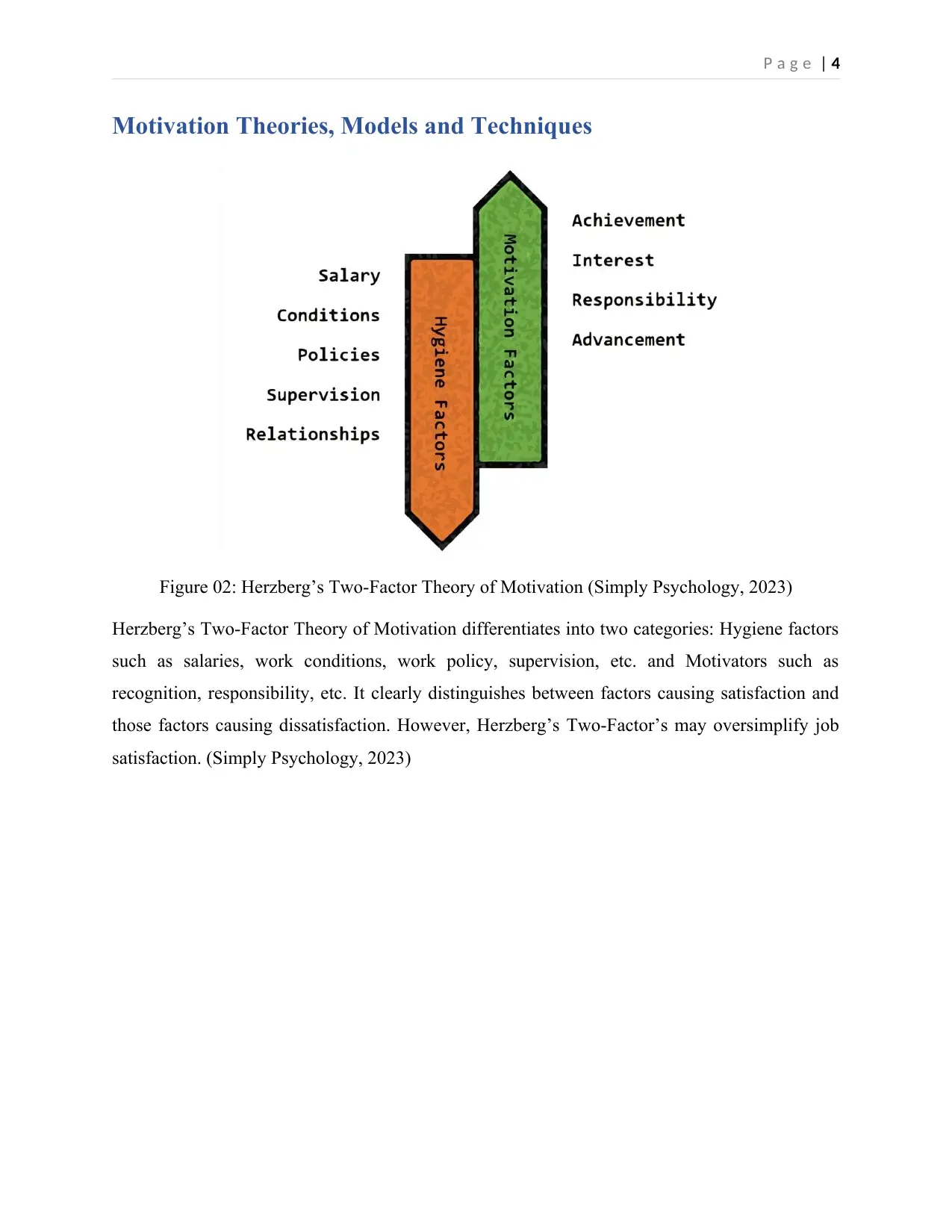
Figure 02: Herzberg’s Two-Factor Theory of Motivation (Simply Psychology, 2023)
Herzberg’s Two-Factor Theory of Motivation differentiates into two categories: Hygiene factors
such as salaries, work conditions, work policy, supervision, etc. and Motivators such as
recognition, responsibility, etc. It clearly distinguishes between factors causing satisfaction and
those factors causing dissatisfaction. However, Herzberg’s Two-Factor’s may oversimplify job
satisfaction. (Simply Psychology, 2023)
Motivation Theories, Models and Techniques
Figure 02: Herzberg’s Two-Factor Theory of Motivation (Simply Psychology, 2023)
Herzberg’s Two-Factor Theory of Motivation differentiates into two categories: Hygiene factors
such as salaries, work conditions, work policy, supervision, etc. and Motivators such as
recognition, responsibility, etc. It clearly distinguishes between factors causing satisfaction and
those factors causing dissatisfaction. However, Herzberg’s Two-Factor’s may oversimplify job
satisfaction. (Simply Psychology, 2023)
Paraphrase This Document
Need a fresh take? Get an instant paraphrase of this document with our AI Paraphraser
P a g e | 5
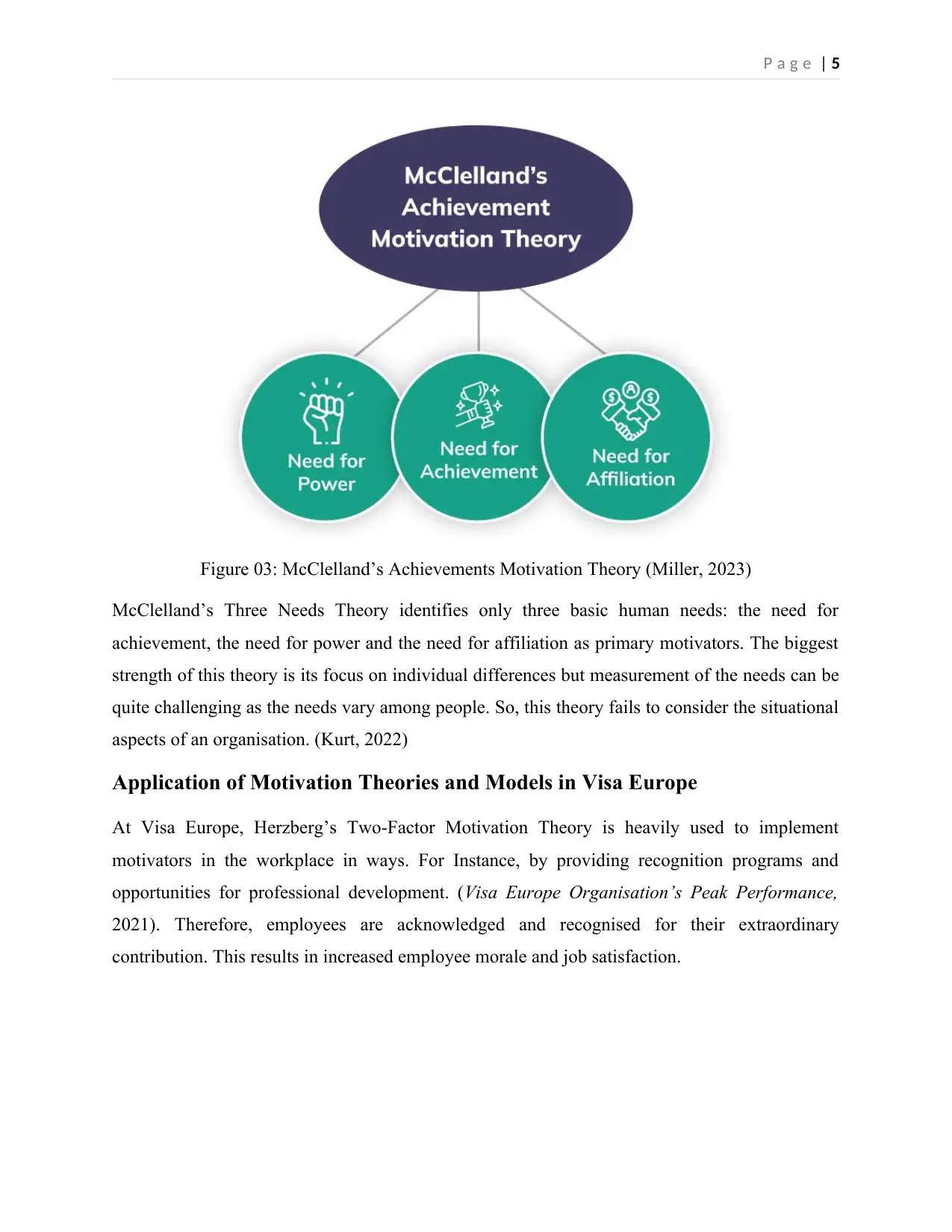
Figure 03: McClelland’s Achievements Motivation Theory (Miller, 2023)
McClelland’s Three Needs Theory identifies only three basic human needs: the need for
achievement, the need for power and the need for affiliation as primary motivators. The biggest
strength of this theory is its focus on individual differences but measurement of the needs can be
quite challenging as the needs vary among people. So, this theory fails to consider the situational
aspects of an organisation. (Kurt, 2022)
Application of Motivation Theories and Models in Visa Europe
At Visa Europe, Herzberg’s Two-Factor Motivation Theory is heavily used to implement
motivators in the workplace in ways. For Instance, by providing recognition programs and
opportunities for professional development. (Visa Europe Organisation’s Peak Performance,
2021). Therefore, employees are acknowledged and recognised for their extraordinary
contribution. This results in increased employee morale and job satisfaction.
Figure 03: McClelland’s Achievements Motivation Theory (Miller, 2023)
McClelland’s Three Needs Theory identifies only three basic human needs: the need for
achievement, the need for power and the need for affiliation as primary motivators. The biggest
strength of this theory is its focus on individual differences but measurement of the needs can be
quite challenging as the needs vary among people. So, this theory fails to consider the situational
aspects of an organisation. (Kurt, 2022)
Application of Motivation Theories and Models in Visa Europe
At Visa Europe, Herzberg’s Two-Factor Motivation Theory is heavily used to implement
motivators in the workplace in ways. For Instance, by providing recognition programs and
opportunities for professional development. (Visa Europe Organisation’s Peak Performance,
2021). Therefore, employees are acknowledged and recognised for their extraordinary
contribution. This results in increased employee morale and job satisfaction.
P a g e | 6
McClelland’s Theory of Needs is applied to align individual motivation with organisational
objectives especially when it comes to the need for achievement, power and affiliation. The
company focuses on understanding the motivating factors of the employees whether it is the need
for power, achievement or affiliation. Visa Europe ensures that everyone’s personal goal is met
while contributing to the success of the organisation. (Developing organisation culture Six case
studies, 2013).
Examples of Motivation Techniques
Some of the ways how Visa Europe has implemented Herzberg’s Two-Factor Motivation
technique are by implementing reward programs, flexible work arrangements, job enrichment,
bonuses and promotions. Some of the ways how Visa Europe has implemented McClelland’s
Theory of Needs are by giving the high performers the chance to work on challenging projects to
excel themselves and giving the power seeker employees leadership roles within the organisation. (
Visa Europe Organisation’s Peak Performance, 2021).
Improving Staff Performance
Visa Europe applies these motivation techniques thus keeping the staff occupied while at work. As
a result, no time is wasted and no work is delayed. Recognition and rewards for good performers to
create a positive organisational workplace and foster a culture of excellence. Job enrichment and
Flexible Working Conditions in Visa Europe contribute to taking more challenging roles and
higher job satisfaction. These techniques also allow Visa Europe to reduce employee turnover rates
by helping employees personally and professionally (Visa Europe Organisation’s Peak
Performance, 2021).
Teams at Visa Europe
At Visa Europe, commonly cross-functional teams and virtual teams are observed since the
organisation aims to integrate groups of workers. Cross-functional teams can be defined as
consisting of individuals coming from different departments working together to solve problems
(Buchanan and Huczynski, 2016). Virtual teams can operate from any geographical location by
using technologies to maintain communication and coordination.
McClelland’s Theory of Needs is applied to align individual motivation with organisational
objectives especially when it comes to the need for achievement, power and affiliation. The
company focuses on understanding the motivating factors of the employees whether it is the need
for power, achievement or affiliation. Visa Europe ensures that everyone’s personal goal is met
while contributing to the success of the organisation. (Developing organisation culture Six case
studies, 2013).
Examples of Motivation Techniques
Some of the ways how Visa Europe has implemented Herzberg’s Two-Factor Motivation
technique are by implementing reward programs, flexible work arrangements, job enrichment,
bonuses and promotions. Some of the ways how Visa Europe has implemented McClelland’s
Theory of Needs are by giving the high performers the chance to work on challenging projects to
excel themselves and giving the power seeker employees leadership roles within the organisation. (
Visa Europe Organisation’s Peak Performance, 2021).
Improving Staff Performance
Visa Europe applies these motivation techniques thus keeping the staff occupied while at work. As
a result, no time is wasted and no work is delayed. Recognition and rewards for good performers to
create a positive organisational workplace and foster a culture of excellence. Job enrichment and
Flexible Working Conditions in Visa Europe contribute to taking more challenging roles and
higher job satisfaction. These techniques also allow Visa Europe to reduce employee turnover rates
by helping employees personally and professionally (Visa Europe Organisation’s Peak
Performance, 2021).
Teams at Visa Europe
At Visa Europe, commonly cross-functional teams and virtual teams are observed since the
organisation aims to integrate groups of workers. Cross-functional teams can be defined as
consisting of individuals coming from different departments working together to solve problems
(Buchanan and Huczynski, 2016). Virtual teams can operate from any geographical location by
using technologies to maintain communication and coordination.
⊘ This is a preview!⊘
Do you want full access?
Subscribe today to unlock all pages.
Trusted by 1+ million students worldwide
P a g e | 7
Effectiveness of Teams
To make the teams at Visa Europe more effective, the purpose of every team should be clear.
Leadership and communication should be effective to optimise all the teams’ performance. Setting
clear goals and objectives (SMART goals), leadership and support, training and development,
regular feedback and evaluation can significantly improve Visa Europe’s team effectiveness by
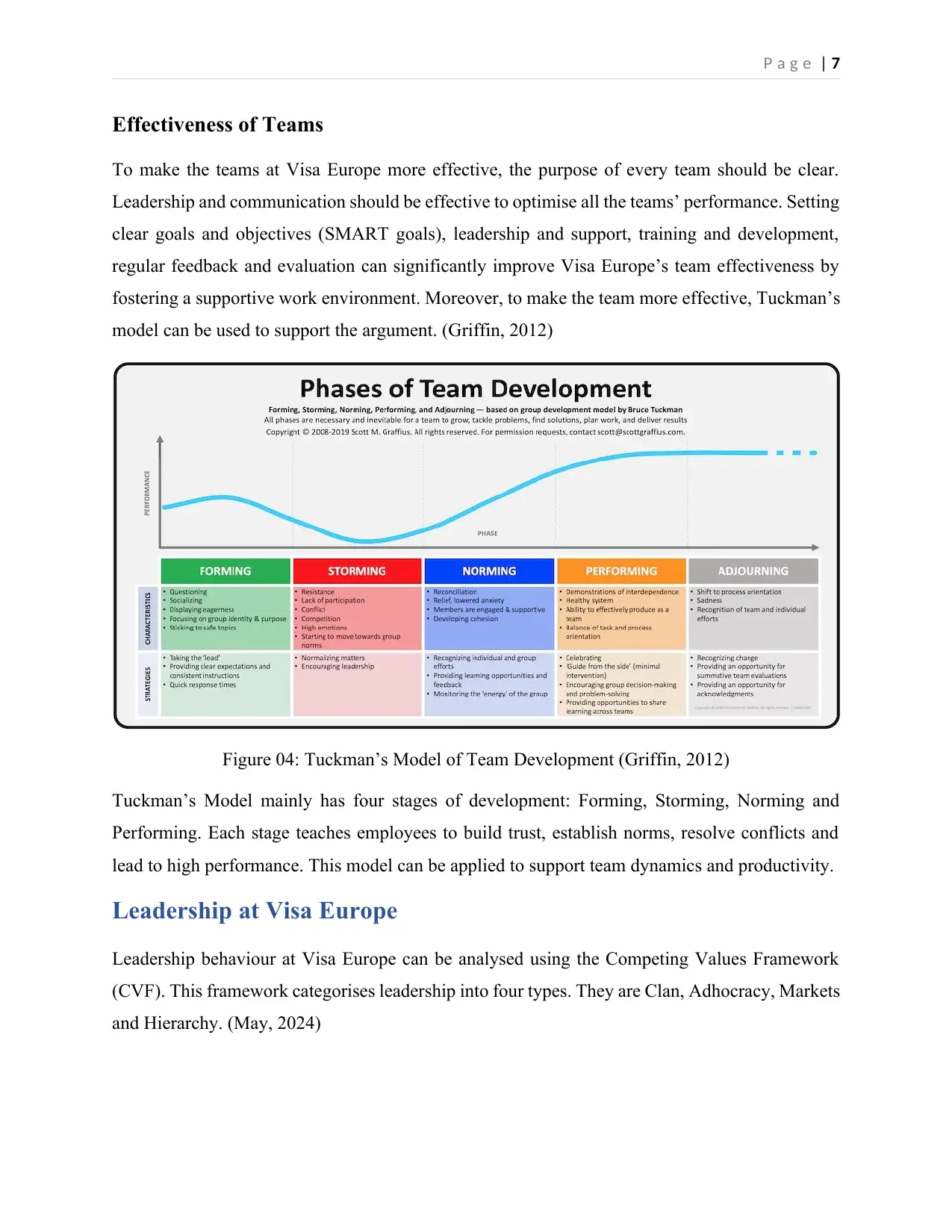
fostering a supportive work environment. Moreover, to make the team more effective, Tuckman’s
model can be used to support the argument. (Griffin, 2012)
Figure 04: Tuckman’s Model of Team Development (Griffin, 2012)
Tuckman’s Model mainly has four stages of development: Forming, Storming, Norming and
Performing. Each stage teaches employees to build trust, establish norms, resolve conflicts and
lead to high performance. This model can be applied to support team dynamics and productivity.
Leadership at Visa Europe
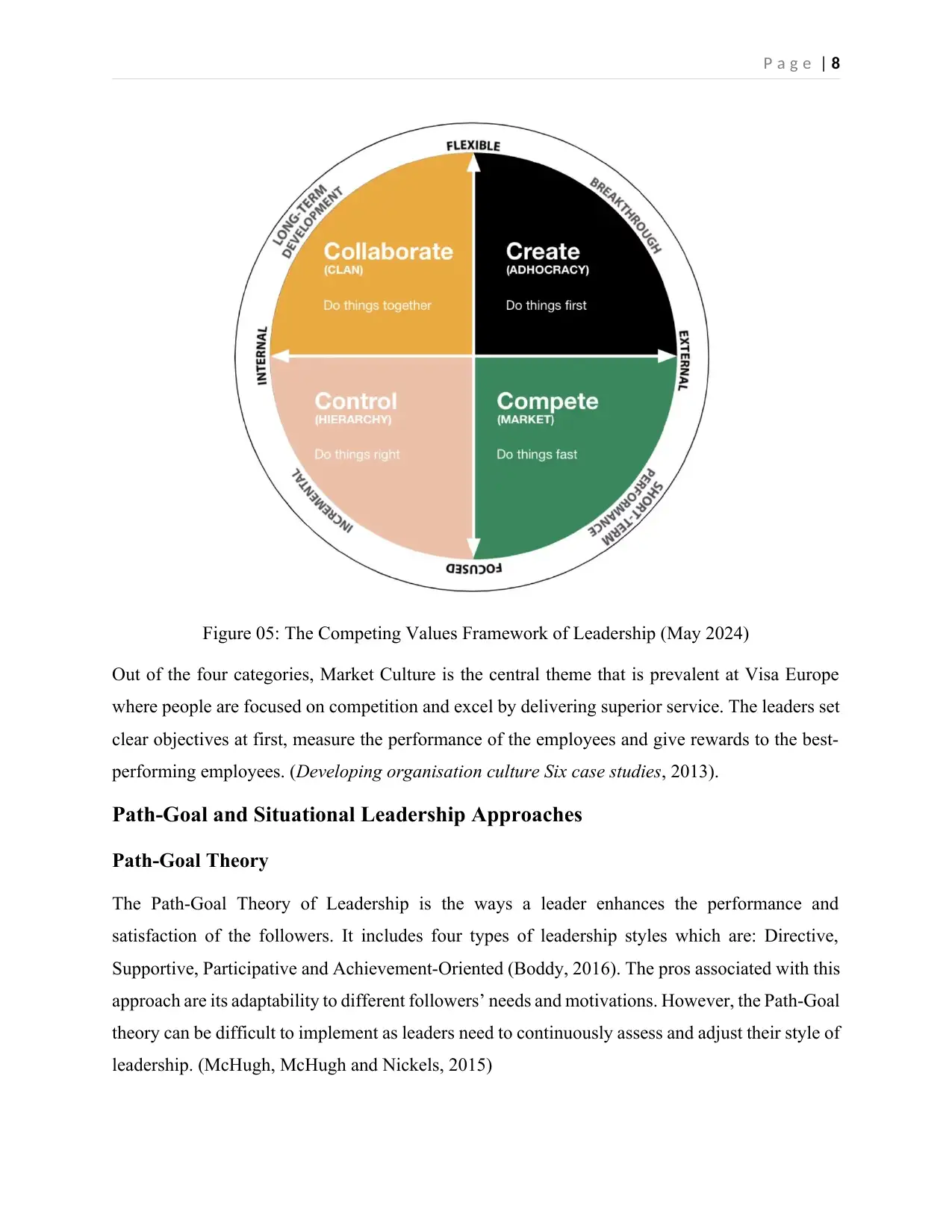
Leadership behaviour at Visa Europe can be analysed using the Competing Values Framework
(CVF). This framework categorises leadership into four types. They are Clan, Adhocracy, Markets
and Hierarchy. (May, 2024)
Effectiveness of Teams
To make the teams at Visa Europe more effective, the purpose of every team should be clear.
Leadership and communication should be effective to optimise all the teams’ performance. Setting
clear goals and objectives (SMART goals), leadership and support, training and development,
regular feedback and evaluation can significantly improve Visa Europe’s team effectiveness by
fostering a supportive work environment. Moreover, to make the team more effective, Tuckman’s
model can be used to support the argument. (Griffin, 2012)
Figure 04: Tuckman’s Model of Team Development (Griffin, 2012)
Tuckman’s Model mainly has four stages of development: Forming, Storming, Norming and
Performing. Each stage teaches employees to build trust, establish norms, resolve conflicts and
lead to high performance. This model can be applied to support team dynamics and productivity.
Leadership at Visa Europe
Leadership behaviour at Visa Europe can be analysed using the Competing Values Framework
(CVF). This framework categorises leadership into four types. They are Clan, Adhocracy, Markets
and Hierarchy. (May, 2024)
Paraphrase This Document
Need a fresh take? Get an instant paraphrase of this document with our AI Paraphraser
P a g e | 8
Figure 05: The Competing Values Framework of Leadership (May 2024)
Out of the four categories, Market Culture is the central theme that is prevalent at Visa Europe
where people are focused on competition and excel by delivering superior service. The leaders set
clear objectives at first, measure the performance of the employees and give rewards to the best-
performing employees. (Developing organisation culture Six case studies, 2013).
Path-Goal and Situational Leadership Approaches
Path-Goal Theory
The Path-Goal Theory of Leadership is the ways a leader enhances the performance and
satisfaction of the followers. It includes four types of leadership styles which are: Directive,
Supportive, Participative and Achievement-Oriented (Boddy, 2016). The pros associated with this
approach are its adaptability to different followers’ needs and motivations. However, the Path-Goal
theory can be difficult to implement as leaders need to continuously assess and adjust their style of
leadership. (McHugh, McHugh and Nickels, 2015)
Figure 05: The Competing Values Framework of Leadership (May 2024)
Out of the four categories, Market Culture is the central theme that is prevalent at Visa Europe
where people are focused on competition and excel by delivering superior service. The leaders set
clear objectives at first, measure the performance of the employees and give rewards to the best-
performing employees. (Developing organisation culture Six case studies, 2013).
Path-Goal and Situational Leadership Approaches
Path-Goal Theory
The Path-Goal Theory of Leadership is the ways a leader enhances the performance and
satisfaction of the followers. It includes four types of leadership styles which are: Directive,
Supportive, Participative and Achievement-Oriented (Boddy, 2016). The pros associated with this
approach are its adaptability to different followers’ needs and motivations. However, the Path-Goal
theory can be difficult to implement as leaders need to continuously assess and adjust their style of
leadership. (McHugh, McHugh and Nickels, 2015)
P a g e | 9
Situational Leadership Theory
Developed by Hersey and Blanchard, Situational leadership theory states that effective leadership
depends on the situation and maturity level of the followers. It also consists of four level leadership
styles: Supporting, Coaching, Delegating and Directing (Robbins and Coulter, 2017). The pros of
this leadership theory are its flexibility and focus on the development of followers. However, it is
challenging for a leader to interpret the maturity levels correctly of the followers and adapt
accordingly.
Improving Organisation Behaviour with Path-Goal and Situational Leadership
Theory at Visa Europe
To improve organisation behaviour at Visa Europe, integrating both Path-Goal and Situational
Leadership approaches can enrich Visa Europe’s leadership behaviour. According to the Path-Goal
theory, ensuring clear goals preventing hindrances to goals and using achievement-oriented
leadership for high performers are tailored by the leaders. Simultaneously, Situational leadership
lets the leaders adapt their styles based on the followers’ maturity. Another advantage is the new
employees benefit from directing and experienced employees benefit from delegating style. This
helps create an engaging yet challenging environment that improves performance and employee
satisfaction (Robbins and Coulter, 2017).
Situational Leadership Theory
Developed by Hersey and Blanchard, Situational leadership theory states that effective leadership
depends on the situation and maturity level of the followers. It also consists of four level leadership
styles: Supporting, Coaching, Delegating and Directing (Robbins and Coulter, 2017). The pros of
this leadership theory are its flexibility and focus on the development of followers. However, it is
challenging for a leader to interpret the maturity levels correctly of the followers and adapt
accordingly.
Improving Organisation Behaviour with Path-Goal and Situational Leadership
Theory at Visa Europe
To improve organisation behaviour at Visa Europe, integrating both Path-Goal and Situational
Leadership approaches can enrich Visa Europe’s leadership behaviour. According to the Path-Goal
theory, ensuring clear goals preventing hindrances to goals and using achievement-oriented
leadership for high performers are tailored by the leaders. Simultaneously, Situational leadership
lets the leaders adapt their styles based on the followers’ maturity. Another advantage is the new
employees benefit from directing and experienced employees benefit from delegating style. This
helps create an engaging yet challenging environment that improves performance and employee
satisfaction (Robbins and Coulter, 2017).
⊘ This is a preview!⊘
Do you want full access?
Subscribe today to unlock all pages.
Trusted by 1+ million students worldwide

1 out of 15


Related Documents


Your All-in-One AI-Powered Toolkit for Academic Success.
+13062052269
info@desklib.com
Available 24*7 on WhatsApp / Email
![[object Object]](/_next/static/media/star-bottom.7253800d.svg)
Unlock your academic potential
Copyright © 2020–2026 A2Z Services. All Rights Reserved. Developed and managed by ZUCOL.