Organizational Behaviour Report: Influences on Workplace Behaviour
VerifiedAdded on 2020/10/22
|17
|4846
|214
Report
AI Summary
This report delves into the multifaceted realm of organizational behaviour, examining its critical components and their impact within a business context. It begins by analyzing the influences of culture, politics, and power on individual and group behaviour within an organization, specifically using A David & Co. as a case study. The report then explores content and process theories of motivation, including Maslow's hierarchy of needs, Hertzberg's two-factor theory, and Vroom's expectancy theory, along with practical techniques for achieving company goals. Furthermore, the report differentiates between effective and ineffective teams, highlighting the key characteristics that contribute to team success. Finally, the report applies organizational behaviour concepts and philosophies to a business situation, providing a comprehensive understanding of how these principles can be leveraged to enhance workplace dynamics and improve overall business performance.
Organizational Behaviour

Paraphrase This Document
Need a fresh take? Get an instant paraphrase of this document with our AI Paraphraser
Table of Contents
Introduction......................................................................................................................................1
TASK 1............................................................................................................................................1
P1 Analyse the influences of culture, politics and power on the behaviour of others in an
organisation context....................................................................................................................1
TASK 2 ...........................................................................................................................................4
P2.How content and process theories of motivation and its techniques to attain goals of a
company......................................................................................................................................4
TASK 3............................................................................................................................................6
P3.Explain what makes an effective team as opposed to an ineffective team............................6
TASK 4............................................................................................................................................9
P4 Apply concept and philosophies of organisational behaviour to a business situation..........9
CONCLUSION..............................................................................................................................10
REFERENCES..............................................................................................................................12
Introduction......................................................................................................................................1
TASK 1............................................................................................................................................1
P1 Analyse the influences of culture, politics and power on the behaviour of others in an
organisation context....................................................................................................................1
TASK 2 ...........................................................................................................................................4
P2.How content and process theories of motivation and its techniques to attain goals of a
company......................................................................................................................................4
TASK 3............................................................................................................................................6
P3.Explain what makes an effective team as opposed to an ineffective team............................6
TASK 4............................................................................................................................................9
P4 Apply concept and philosophies of organisational behaviour to a business situation..........9
CONCLUSION..............................................................................................................................10
REFERENCES..............................................................................................................................12

⊘ This is a preview!⊘
Do you want full access?
Subscribe today to unlock all pages.

Trusted by 1+ million students worldwide
Introduction
Organisation refer as the group of people, who form institution or association to achieve
collective goal .Organisational behaviour is the study of manner individuals interact with other
people in an organisation (Vibert, 2017). This is perform to create business more effective and
efficient. OB theories are used for business groups to maximize output from individual and their
groups. In this report there is a discussion of culture, politics and power as their impact on the
individual and group. Apart from this focus on different motivational theories and techniques
will also be given which will tell how effective team can be developed using same. Lastly
concept and philosophies also briefly discussed under this report .
TASK 1
P1 Analyse the influences of culture, politics and power on the behaviour of others in an
organisation context.
A David and company is a private limited which work in a food and beverage industry.
The company provides a wide range of fresh fruits which delivered at door. It offers complete
range of exotic produce, dairy products, bakery products, ready products ,fresh fruit and
vegetables which are delivered to hotels, restaurants, nursing homes and government
organisations.
Culture
It refers to the customs, social forms beliefs of an individuals which comes from the
earlier generation or from the heredity. Group of people have different culture from another. In a
Organisation, culture refer as the values, norms, believes, social habits ,ethics, religion and
language which employees held with an organisation. The culture guide staff in knowing what to
do and what not to do basically it tells about the rules and behaviour of an individual in the
organisation (Baum, Frese and Baron, 2014).
Types of culture and their influence on the David and company Ltd are below-
Power culture: It refer to the power which some individuals contain within the
organisation. This culture can have positive as well as negative effect on the organisation.
Positive means quick decision,effective utilisation of skills and it result in effective change
whereas negative impact is that staff become dissatisfied, over-dependence on the centralised
1
Organisation refer as the group of people, who form institution or association to achieve
collective goal .Organisational behaviour is the study of manner individuals interact with other
people in an organisation (Vibert, 2017). This is perform to create business more effective and
efficient. OB theories are used for business groups to maximize output from individual and their
groups. In this report there is a discussion of culture, politics and power as their impact on the
individual and group. Apart from this focus on different motivational theories and techniques
will also be given which will tell how effective team can be developed using same. Lastly
concept and philosophies also briefly discussed under this report .
TASK 1
P1 Analyse the influences of culture, politics and power on the behaviour of others in an
organisation context.
A David and company is a private limited which work in a food and beverage industry.
The company provides a wide range of fresh fruits which delivered at door. It offers complete
range of exotic produce, dairy products, bakery products, ready products ,fresh fruit and
vegetables which are delivered to hotels, restaurants, nursing homes and government
organisations.
Culture
It refers to the customs, social forms beliefs of an individuals which comes from the
earlier generation or from the heredity. Group of people have different culture from another. In a
Organisation, culture refer as the values, norms, believes, social habits ,ethics, religion and
language which employees held with an organisation. The culture guide staff in knowing what to
do and what not to do basically it tells about the rules and behaviour of an individual in the
organisation (Baum, Frese and Baron, 2014).
Types of culture and their influence on the David and company Ltd are below-
Power culture: It refer to the power which some individuals contain within the
organisation. This culture can have positive as well as negative effect on the organisation.
Positive means quick decision,effective utilisation of skills and it result in effective change
whereas negative impact is that staff become dissatisfied, over-dependence on the centralised
1
Paraphrase This Document
Need a fresh take? Get an instant paraphrase of this document with our AI Paraphraser
system,conflicts. Power should be equally distributed among different level of organisation so
that no have greater effect on the business system.
Role culture:In organisation, everyone should know about their roles and
responsibilities. The advantage of the role culture is reduction of the number of conflicts and
confusion as there is specified authorities and responsibilities to employees. The disadvantage
employee creativeness hampers,lack of flexibility,difficulty in tackling uncertain and non
standard situations. Roles should be assign on the basis of their capabilities. When the role is
based on their knowledge and skills it will resultant in achieving performance and enhance
satisfaction and motivate them to do better (Coccia and Rolfo, 2013).
Task culture:It a culture when team is an organisation are formed to perform specific
task or projects. The task completion effectively is based on the mix of the team members and
status of the problem or project. The organisation can get creative and more productive with
effectiveness only when they have right mix of skills,personalities and leaders within
organisation.
Person culture: In an organisation human resource is an important asset which can lead
to development and growth of the business. Organisations following this approach can lead a
better business and move towards growth. It a collection of individuals who working for the
organisation. Individual with different skills able to perform every kind of activities. Person
skills are in general which have to be in every person otherwise one will take benefit.
Power
Power is having an authority by an individual to get things in a particular manner. The
person who have power in the organisation have the control on the subordinates behaviour and
their activities. Right use of power can motivate employees by providing guidance for
performance which increase the productivity. Where as wrong use can hampers the work ability
of employees (More, Vito and Walsh, 2012).
Types of power and its impact on the David and company Ltd are given below
Reward power: It a power which give rewards, new projects, training opportunities and
monetary benefits which are used to motivate and improve the performance of
employees.
Coercive power: This a power which gave right for the usage of threat to make people
do what desires. It creates negative image on the employees because of threatening for
2
that no have greater effect on the business system.
Role culture:In organisation, everyone should know about their roles and
responsibilities. The advantage of the role culture is reduction of the number of conflicts and
confusion as there is specified authorities and responsibilities to employees. The disadvantage
employee creativeness hampers,lack of flexibility,difficulty in tackling uncertain and non
standard situations. Roles should be assign on the basis of their capabilities. When the role is
based on their knowledge and skills it will resultant in achieving performance and enhance
satisfaction and motivate them to do better (Coccia and Rolfo, 2013).
Task culture:It a culture when team is an organisation are formed to perform specific
task or projects. The task completion effectively is based on the mix of the team members and
status of the problem or project. The organisation can get creative and more productive with
effectiveness only when they have right mix of skills,personalities and leaders within
organisation.
Person culture: In an organisation human resource is an important asset which can lead
to development and growth of the business. Organisations following this approach can lead a
better business and move towards growth. It a collection of individuals who working for the
organisation. Individual with different skills able to perform every kind of activities. Person
skills are in general which have to be in every person otherwise one will take benefit.
Power
Power is having an authority by an individual to get things in a particular manner. The
person who have power in the organisation have the control on the subordinates behaviour and
their activities. Right use of power can motivate employees by providing guidance for
performance which increase the productivity. Where as wrong use can hampers the work ability
of employees (More, Vito and Walsh, 2012).
Types of power and its impact on the David and company Ltd are given below
Reward power: It a power which give rewards, new projects, training opportunities and
monetary benefits which are used to motivate and improve the performance of
employees.
Coercive power: This a power which gave right for the usage of threat to make people
do what desires. It creates negative image on the employees because of threatening for
2
transfer,firing,demotions etc. It should be used for only those employees who don't take
their job seriously.
Legitimate power: This power is held by the person who hold high post in the
organisation. The duration of this power is short lived because it can be used till the time
he /she holds the position. Power is distributed according to the responsibilities. Such
powers motivate employees for better performance so that they can attain higher position
(Blood, 2013).
Expert power: It a power under which different skills and expertise possessed by an
individual which are not easily available. This power can exercise to influence people
and to attain good position with authority in the organisation. It help in building long
term relation with administration.
Politics
It refer to the activity which is perform to increase status or power within organisation.
Politics in the work place is highly destructive as its focus on the personal gains at the charge of
organisation. It are informal,unofficial and sometimes behind the scenes activity which influence
other targeted objectives. Due to presence of politics in the firm hard working employees not
able to get appraisal which they deserve to get. It a demotivating factor for the employees of
David and company pvt Ltd.
It impact on individual and its members is defined as below-
Decrease productivity: The employees in the organisation who are not able to achieve
higher position in the arrangement due to politics, get demotivated which result in the
reduction of production (Chhokar, Brodbeck and House, 2013).
Wrong decision making: Politics in the organisation make authority to take the decision
according to their interest not for business. This decision can be benefit for a shorter
period of time.
Increase pressure and stress: Politics result in the pressure and stress on the productive
employees as they are not getting rewards what they deserve. It make other individuals to
take up workplace politics if they wish to survive in the organisation for longer.
3
their job seriously.
Legitimate power: This power is held by the person who hold high post in the
organisation. The duration of this power is short lived because it can be used till the time
he /she holds the position. Power is distributed according to the responsibilities. Such
powers motivate employees for better performance so that they can attain higher position
(Blood, 2013).
Expert power: It a power under which different skills and expertise possessed by an
individual which are not easily available. This power can exercise to influence people
and to attain good position with authority in the organisation. It help in building long
term relation with administration.
Politics
It refer to the activity which is perform to increase status or power within organisation.
Politics in the work place is highly destructive as its focus on the personal gains at the charge of
organisation. It are informal,unofficial and sometimes behind the scenes activity which influence
other targeted objectives. Due to presence of politics in the firm hard working employees not
able to get appraisal which they deserve to get. It a demotivating factor for the employees of
David and company pvt Ltd.
It impact on individual and its members is defined as below-
Decrease productivity: The employees in the organisation who are not able to achieve
higher position in the arrangement due to politics, get demotivated which result in the
reduction of production (Chhokar, Brodbeck and House, 2013).
Wrong decision making: Politics in the organisation make authority to take the decision
according to their interest not for business. This decision can be benefit for a shorter
period of time.
Increase pressure and stress: Politics result in the pressure and stress on the productive
employees as they are not getting rewards what they deserve. It make other individuals to
take up workplace politics if they wish to survive in the organisation for longer.
3
⊘ This is a preview!⊘
Do you want full access?
Subscribe today to unlock all pages.
Trusted by 1+ million students worldwide
TASK 2
P2.How content and process theories of motivation and its techniques to attain goals of a
company
Motivation is one of a powerful approach, but yet tricky activity. It assist in internal and
external factor which response according to desire and capabilities of an individual and
committed to work role or to attain goal. In other words, it refers to a general-purpose
willingness to do something. It is a set of psychological needs which can induce to take action on
the basis of motivation (Klotz and Neubaum, 2016). In an organization it is an essential element
to improve the performance of an employees which can lead to increase in a productivity and
enhance a standard of quality. It is necessary to implement motivation procedure in an business
organization on regular basis in order to provide appropriate direction to work force towards
future objects. There are two types of motivation theory, these are describe in below as:
Content theory: It is also known as need theory. It defined as, identifying what are the
needs and associate to motivation for fulfilling these needs. The main content theories which are
expressed in detailed in this project report are as:
Maslow's needs hierarchy theory: This theory contains five basic categories in order to
fulfill the needs of an individual. It was developed by Abraham Maslow. It is assembled
in pyramid form; basic needs at bottom and complex need that is self actualization. These
are stated in below as:
◦ Physiological needs: It includes the most basic needs of human to survive, such as
air, water, shelter and food. Without this an individual will not able to work. It
emphasized on body, mind cannot function well if these requirements are not
fulfilled. Therefore, A David & Co Limited organization should focus on this need.
◦ Social security: When the first need in motivation is fulfilled, second will across as
job security or social security. It refer to a person desire foe security and protection
such as secure source of income, health and place to live (Belschak and et. al., 2015).
◦ Belonging and love: When both basic level are fulfilled, the third step includes the
affection, love and belongingness needs. Employees should work as well as need
some belongingness inside a workplace which is an important part in motivation.
4
P2.How content and process theories of motivation and its techniques to attain goals of a
company
Motivation is one of a powerful approach, but yet tricky activity. It assist in internal and
external factor which response according to desire and capabilities of an individual and
committed to work role or to attain goal. In other words, it refers to a general-purpose
willingness to do something. It is a set of psychological needs which can induce to take action on
the basis of motivation (Klotz and Neubaum, 2016). In an organization it is an essential element
to improve the performance of an employees which can lead to increase in a productivity and
enhance a standard of quality. It is necessary to implement motivation procedure in an business
organization on regular basis in order to provide appropriate direction to work force towards
future objects. There are two types of motivation theory, these are describe in below as:
Content theory: It is also known as need theory. It defined as, identifying what are the
needs and associate to motivation for fulfilling these needs. The main content theories which are
expressed in detailed in this project report are as:
Maslow's needs hierarchy theory: This theory contains five basic categories in order to
fulfill the needs of an individual. It was developed by Abraham Maslow. It is assembled
in pyramid form; basic needs at bottom and complex need that is self actualization. These
are stated in below as:
◦ Physiological needs: It includes the most basic needs of human to survive, such as
air, water, shelter and food. Without this an individual will not able to work. It
emphasized on body, mind cannot function well if these requirements are not
fulfilled. Therefore, A David & Co Limited organization should focus on this need.
◦ Social security: When the first need in motivation is fulfilled, second will across as
job security or social security. It refer to a person desire foe security and protection
such as secure source of income, health and place to live (Belschak and et. al., 2015).
◦ Belonging and love: When both basic level are fulfilled, the third step includes the
affection, love and belongingness needs. Employees should work as well as need
some belongingness inside a workplace which is an important part in motivation.
4
Paraphrase This Document
Need a fresh take? Get an instant paraphrase of this document with our AI Paraphraser
◦ Esteem: It is related to valued, respect and appreciated by others. Employees need to
feel valuable which can be done through their work performance. If workers not able
to focus on their task they will not able to get self esteem.
◦ Self actualization: It is the top most and complex part in Maslow theory. When all
the above needs are fulfilled, it is a last need which reflect an individual desire to
grow and develop to full potential (Effelsberg and Solga, 2015).
Hertzberg two factor theory
In this included two major factor that is related with motivation such as hygiene and
motivating which support in increasing level of motivational for employees and enhance their
productivity as well.
Hygiene factor: It is defined as job factor where employees are to be motivated at the
workplace. It is necessary to satisfy employees so that they can focus towards goals. This
factor considered physiological needs which is required to fulfil employees basic needs or
desires. It included several elements as like pay, status and fringe benefits.
Motivational factors: This factor is very beneficial in providing satisfaction in positive
manner. It support in motivating employees for increasing their work productivity. In this
considered several aspects such as recognition, responsibilities, growth and promotional
opportunities and achievement for motivating employees within firm to get better result
or outcomes as well.
Process theory:
This type of theory is concerned with “how” motivation occurs, what kind of process can
influence motivation towards an employee of an organization. The main process theories which
are explained under as:
Vroom theory: It refers to a specific behaviour of a product of choices which are put into
priority. As per Vroom theory, it implies how hard an employee wants an outcome. This
explains performance, motivation and efforts made by an individuals these are valence,
instrumentality and expectancy (VanStelle and et. al., 2012).
Valence: It helps to know about a person values which results of success. As a HR
manager in A David & Co Limited organization it is necessary to know about the degree
of an employee values which can be reward as a success by improving performance.
5
feel valuable which can be done through their work performance. If workers not able
to focus on their task they will not able to get self esteem.
◦ Self actualization: It is the top most and complex part in Maslow theory. When all
the above needs are fulfilled, it is a last need which reflect an individual desire to
grow and develop to full potential (Effelsberg and Solga, 2015).
Hertzberg two factor theory
In this included two major factor that is related with motivation such as hygiene and
motivating which support in increasing level of motivational for employees and enhance their
productivity as well.
Hygiene factor: It is defined as job factor where employees are to be motivated at the
workplace. It is necessary to satisfy employees so that they can focus towards goals. This
factor considered physiological needs which is required to fulfil employees basic needs or
desires. It included several elements as like pay, status and fringe benefits.
Motivational factors: This factor is very beneficial in providing satisfaction in positive
manner. It support in motivating employees for increasing their work productivity. In this
considered several aspects such as recognition, responsibilities, growth and promotional
opportunities and achievement for motivating employees within firm to get better result
or outcomes as well.
Process theory:
This type of theory is concerned with “how” motivation occurs, what kind of process can
influence motivation towards an employee of an organization. The main process theories which
are explained under as:
Vroom theory: It refers to a specific behaviour of a product of choices which are put into
priority. As per Vroom theory, it implies how hard an employee wants an outcome. This
explains performance, motivation and efforts made by an individuals these are valence,
instrumentality and expectancy (VanStelle and et. al., 2012).
Valence: It helps to know about a person values which results of success. As a HR
manager in A David & Co Limited organization it is necessary to know about the degree
of an employee values which can be reward as a success by improving performance.
5
Instrumentality: In this part of Vroom theory, this explain an employee belief and
connectivity between activity and goal of a business organization.
Expectancy: It describes employees content that more efforts will resultant into success.
As a HR manager, employees will put more efforts hence they will get in better
performance.
TASK 3
P3.Explain what makes an effective team as opposed to an ineffective team
In a business enterprise, a team is made up of two or more people who work together to
attain a common objective (Sliter, Sliter and Jex, 2012). Team work in a company is to improve
standard, accomplished task and change processes. Effective teams can lead to increased
employee motivation and higher productivity. As an HR manager in A David & Co Limited
organization to be an effective team in an business organization it is necessary to work in a
troupe so that they can easily get on their activity and able to perform their task on time. It will
improve a corporation and coordination among employees and their team leader, this leads to
grab an external opportunity from an existing competitive world. There are various factors which
represent difference between effective and ineffective team, these are discussed in detailed as
follows:
Effective team Ineffective team
In an effective team, goals are
processed and can be changeable so
that it can simply match between
individual and teams goals in a
corporative structured.
Whereas, in an ineffective team,
members of a team accepted imposed
goals which are competitively
structured.
This includes an interpersonal
effectiveness, self-actualization and
innovation are encouraged during a
team task (Hoon Song and et. al.,
2012).
This involves organizational persons,
who generally desire order, stability
and structured are encouraged at the of
team task provided.
6
connectivity between activity and goal of a business organization.
Expectancy: It describes employees content that more efforts will resultant into success.
As a HR manager, employees will put more efforts hence they will get in better
performance.
TASK 3
P3.Explain what makes an effective team as opposed to an ineffective team
In a business enterprise, a team is made up of two or more people who work together to
attain a common objective (Sliter, Sliter and Jex, 2012). Team work in a company is to improve
standard, accomplished task and change processes. Effective teams can lead to increased
employee motivation and higher productivity. As an HR manager in A David & Co Limited
organization to be an effective team in an business organization it is necessary to work in a
troupe so that they can easily get on their activity and able to perform their task on time. It will
improve a corporation and coordination among employees and their team leader, this leads to
grab an external opportunity from an existing competitive world. There are various factors which
represent difference between effective and ineffective team, these are discussed in detailed as
follows:
Effective team Ineffective team
In an effective team, goals are
processed and can be changeable so
that it can simply match between
individual and teams goals in a
corporative structured.
Whereas, in an ineffective team,
members of a team accepted imposed
goals which are competitively
structured.
This includes an interpersonal
effectiveness, self-actualization and
innovation are encouraged during a
team task (Hoon Song and et. al.,
2012).
This involves organizational persons,
who generally desire order, stability
and structured are encouraged at the of
team task provided.
6
⊘ This is a preview!⊘
Do you want full access?
Subscribe today to unlock all pages.
Trusted by 1+ million students worldwide
Problem solving adequacy is more than
an ineffective team, through which an
individual can give their opinion and
increase their learning ability to grab an
opportunity in nearby future.
Although, in an ineffective team,
problem solving acceptability is low.
Tuckman’s Team Development model and the impact of development stages on individual
development-
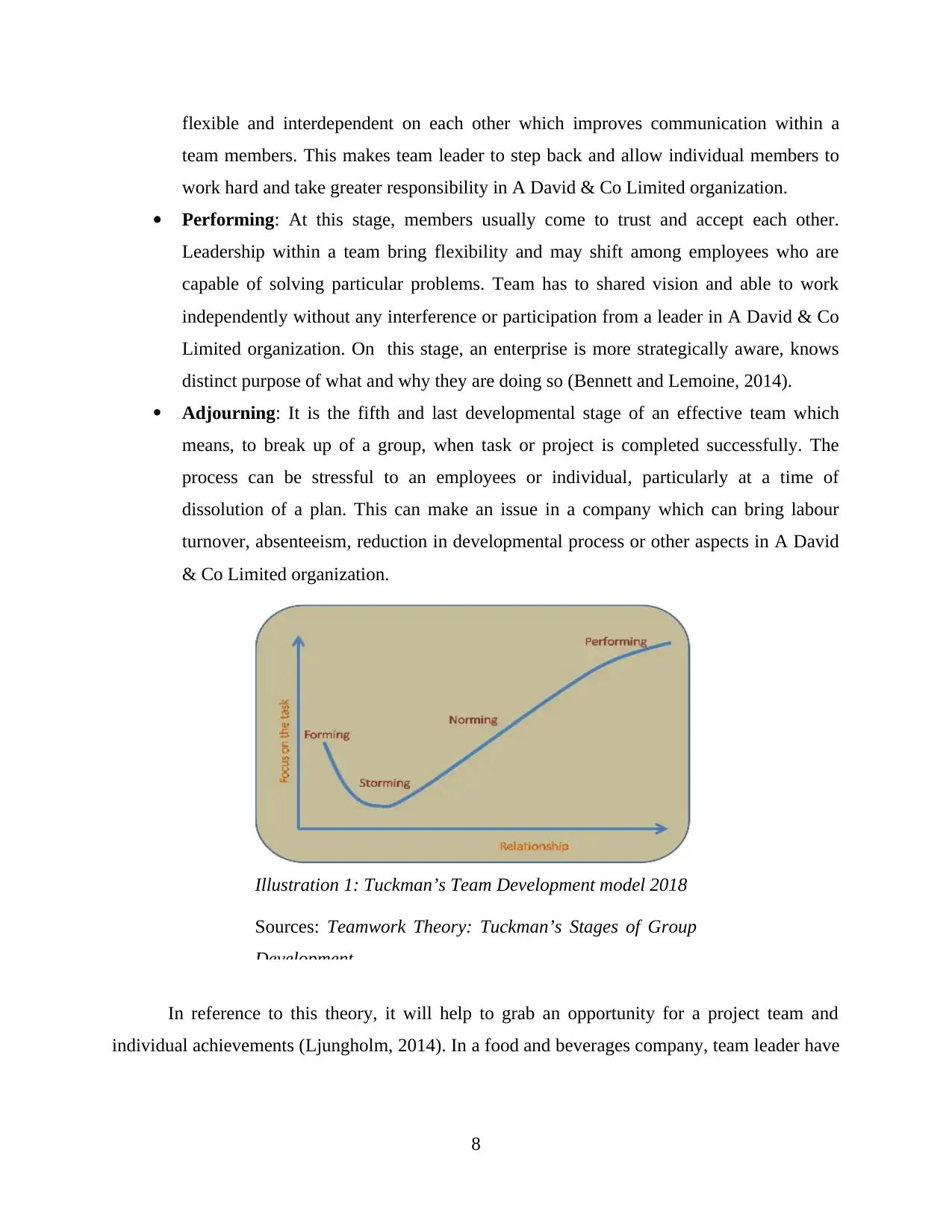
It was given by Bruce Tuckman. This model focuses on a way in which a team tackles a task
from initial formation of a team through the completion of a project goal. When faced with a new
team it is essential to build rapport with one another and generate trust. Tuckman theories has all
necessary and inevitable to grow, face challenges, tackles problems, find there solutions, plan
work and present result. The developmental stages of an effective team are as:
Forming: In this developmental stage of an effective team, it focus during starting
stage to build relationships with a team and clarify mission and their end results. It
signifies a time where a group just formed to come together for a work and features
with anxiety and uncertainty. Forming stage helps in understanding leadership roles and
getting forming with other team members to facilitate development in A David & Co
Limited organization. This includes various outcomes such as delegating responsibility
and accountability, discussion of resources, understanding team purpose and many
more (Brinsfield, 2014).
Storming: It is a second stage of developmental of an effective team, in this, team
members feel comfortable expressing opinions in some internal conflict appear within a
group. Everyone work style is different this can cause personalities to clash which leads
to affect a team work of A David & Co Limited organization. During conflict, team
members will become frustrated which led to lose motivation for a task or project on
which they are currently working. This assist to know their team member nature which
help them in near future to tackle with certain issues (Nagl, 2012).
Norming: This is third stage of developmental of an effective team, it refers to a group
members to become positive about team as a whole. Morale is high as they are actively
working with each other's talent, skills and abilities. In this, members become more
7
an ineffective team, through which an
individual can give their opinion and
increase their learning ability to grab an
opportunity in nearby future.
Although, in an ineffective team,
problem solving acceptability is low.
Tuckman’s Team Development model and the impact of development stages on individual
development-
It was given by Bruce Tuckman. This model focuses on a way in which a team tackles a task
from initial formation of a team through the completion of a project goal. When faced with a new
team it is essential to build rapport with one another and generate trust. Tuckman theories has all
necessary and inevitable to grow, face challenges, tackles problems, find there solutions, plan
work and present result. The developmental stages of an effective team are as:
Forming: In this developmental stage of an effective team, it focus during starting
stage to build relationships with a team and clarify mission and their end results. It
signifies a time where a group just formed to come together for a work and features
with anxiety and uncertainty. Forming stage helps in understanding leadership roles and
getting forming with other team members to facilitate development in A David & Co
Limited organization. This includes various outcomes such as delegating responsibility
and accountability, discussion of resources, understanding team purpose and many
more (Brinsfield, 2014).
Storming: It is a second stage of developmental of an effective team, in this, team
members feel comfortable expressing opinions in some internal conflict appear within a
group. Everyone work style is different this can cause personalities to clash which leads
to affect a team work of A David & Co Limited organization. During conflict, team
members will become frustrated which led to lose motivation for a task or project on
which they are currently working. This assist to know their team member nature which
help them in near future to tackle with certain issues (Nagl, 2012).
Norming: This is third stage of developmental of an effective team, it refers to a group
members to become positive about team as a whole. Morale is high as they are actively
working with each other's talent, skills and abilities. In this, members become more
7
Paraphrase This Document
Need a fresh take? Get an instant paraphrase of this document with our AI Paraphraser
flexible and interdependent on each other which improves communication within a
team members. This makes team leader to step back and allow individual members to
work hard and take greater responsibility in A David & Co Limited organization.
Performing: At this stage, members usually come to trust and accept each other.
Leadership within a team bring flexibility and may shift among employees who are
capable of solving particular problems. Team has to shared vision and able to work
independently without any interference or participation from a leader in A David & Co
Limited organization. On this stage, an enterprise is more strategically aware, knows
distinct purpose of what and why they are doing so (Bennett and Lemoine, 2014).
Adjourning: It is the fifth and last developmental stage of an effective team which
means, to break up of a group, when task or project is completed successfully. The
process can be stressful to an employees or individual, particularly at a time of
dissolution of a plan. This can make an issue in a company which can bring labour
turnover, absenteeism, reduction in developmental process or other aspects in A David
& Co Limited organization.
In reference to this theory, it will help to grab an opportunity for a project team and
individual achievements (Ljungholm, 2014). In a food and beverages company, team leader have
8
Illustration 1: Tuckman’s Team Development model 2018
Sources: Teamwork Theory: Tuckman’s Stages of Group
Development
team members. This makes team leader to step back and allow individual members to
work hard and take greater responsibility in A David & Co Limited organization.
Performing: At this stage, members usually come to trust and accept each other.
Leadership within a team bring flexibility and may shift among employees who are
capable of solving particular problems. Team has to shared vision and able to work
independently without any interference or participation from a leader in A David & Co
Limited organization. On this stage, an enterprise is more strategically aware, knows
distinct purpose of what and why they are doing so (Bennett and Lemoine, 2014).
Adjourning: It is the fifth and last developmental stage of an effective team which
means, to break up of a group, when task or project is completed successfully. The
process can be stressful to an employees or individual, particularly at a time of
dissolution of a plan. This can make an issue in a company which can bring labour
turnover, absenteeism, reduction in developmental process or other aspects in A David
& Co Limited organization.
In reference to this theory, it will help to grab an opportunity for a project team and
individual achievements (Ljungholm, 2014). In a food and beverages company, team leader have
8
Illustration 1: Tuckman’s Team Development model 2018
Sources: Teamwork Theory: Tuckman’s Stages of Group
Development
to work in a group of individuals which simpler people view while working among past
experiences in positive manner.
Different types of organizational team
Mainly there are three types of organizational team. These are describe in detailed as
follows:
Problem-solving team: It is a temporary and cross-functional team which comes from
different departments and possess variety of roles, skills and interest of an employees.
This helps in make-up of team to analysed from different perspectives.
Virtual team: It can be any type of team that communicates digitally rather than in
person. Easier communication tools allow manager to build team on the basis of their
strength and weaknesses instead than geography.
Quality team: It is also known as excellence teams, this is related to identifying and
resolving work issues that have a negative impact on a company efficiency and work
conditions (Colarelli and Arvey, 2015).
TASK 4
P4 Apply concept and philosophies of organisational behaviour to a business situation.
Organisation behaviour- It the study of the behaviour how individuals interact with
other persons in the organisation. This has huge importance in the organisational structure as it
provide information about group and individual performance in business. under this human
behaviour in a work environment is determine and its effect on motivation,leadership and
performance. It helps in understanding relations exist between employees. Organisation
behaviour theories are used for business groups to maximize output from individual and their
groups.
Organisation behaviour have the following features-
It a field of study about human behaviour and a not a discipline
It an humanistic and optimistic approach.
It an applied and normative science (Spector, 2013).
Element are present in concepts of organisational behaviour:
Nature of people: It tells about the features and the qualities which are possessed by the
followers of organisation. It inform about the characteristics which are present in the each
9
experiences in positive manner.
Different types of organizational team
Mainly there are three types of organizational team. These are describe in detailed as
follows:
Problem-solving team: It is a temporary and cross-functional team which comes from
different departments and possess variety of roles, skills and interest of an employees.
This helps in make-up of team to analysed from different perspectives.
Virtual team: It can be any type of team that communicates digitally rather than in
person. Easier communication tools allow manager to build team on the basis of their
strength and weaknesses instead than geography.
Quality team: It is also known as excellence teams, this is related to identifying and
resolving work issues that have a negative impact on a company efficiency and work
conditions (Colarelli and Arvey, 2015).
TASK 4
P4 Apply concept and philosophies of organisational behaviour to a business situation.
Organisation behaviour- It the study of the behaviour how individuals interact with
other persons in the organisation. This has huge importance in the organisational structure as it
provide information about group and individual performance in business. under this human
behaviour in a work environment is determine and its effect on motivation,leadership and
performance. It helps in understanding relations exist between employees. Organisation
behaviour theories are used for business groups to maximize output from individual and their
groups.
Organisation behaviour have the following features-
It a field of study about human behaviour and a not a discipline
It an humanistic and optimistic approach.
It an applied and normative science (Spector, 2013).
Element are present in concepts of organisational behaviour:
Nature of people: It tells about the features and the qualities which are possessed by the
followers of organisation. It inform about the characteristics which are present in the each
9
⊘ This is a preview!⊘
Do you want full access?
Subscribe today to unlock all pages.
Trusted by 1+ million students worldwide

1 out of 17


Related Documents


Your All-in-One AI-Powered Toolkit for Academic Success.
+13062052269
info@desklib.com
Available 24*7 on WhatsApp / Email
![[object Object]](/_next/static/media/star-bottom.7253800d.svg)
Unlock your academic potential
Copyright © 2020–2026 A2Z Services. All Rights Reserved. Developed and managed by ZUCOL.